REVIEW 2 major objections 5 minor 101 references
Inelastic extra $U(1)$ charged scalar dark matter
T0 review · 2 major / 5 minor · reviewed 2026-08-14 · deepseek-v4-flash
Pith's one-line read Thermal-relic scalar dark matter can have present-day annihilation below $10^{-31}\,\mathrm{cm}^3/\mathrm{s}$: an extra $U(1)$ gauge force sets the relic density by coannihilation, while today's signals are suppressed Higgs-exchange…
desk verdict A clean existence proof for inelastic extra U(1) scalar dark matter with suppressed present annihilation, worth refereeing, but the suppression depends on a technically unnatural benchmark that needs a radiative-stability check. read the letter →
The pith
A machine-rendered reading of the paper's core claim, the machinery that carries it, and where it could break.
The reading
What carries the argument
The load-bearing object is the nearly degenerate pair of real scalars $(S,P)$ that form a complex dark matter field charged under an extra $U(1)$, split in mass by the trilinear term $A(\varphi_1\varphi_1\varphi_2^\dagger+\mathrm{h.c.})$ that couples it to the $U(1)$-breaking Higgs. That one term does two jobs: it sets the small splitting $m_P-m_S=0.01\,m_S$, keeping the partner $P$ thermally abundant at freeze-out so that coannihilation (the pair-annihilation of $S$ together with $P$) through $s$-channel $Z'$ exchange sets the relic density, and it makes the gauge coupling off-diagonal, so that $Z'$-mediated dark matter-nucleus scattering is inelastic and kinematically suppressed. The remaining machinery is the effective thermally-averaged cross section that weights $S$ and $P$ annihilation channels by their equilibrium abundances (used to integrate the Boltzmann equation), and the $\lambda_4$, $\sin\alpha$-suppressed Higgs-exchange couplings that set both the present annihilation rate and the elastic scattering cross section.
What would settle it
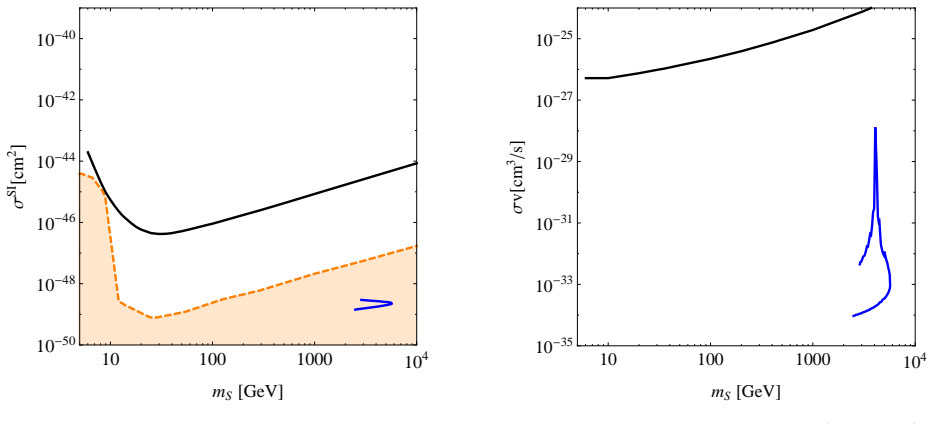
Compute the one-loop quantum corrections to $\lambda_4$ and $\sin\alpha$ in any of the three models: if the corrected effective Higgs-dark matter coupling pushes the spin-independent scattering cross section above the XENON1T limit (about $10^{-47}\,\mathrm{cm}^2$ for the relevant masses) anywhere along the relic-density contours, the claimed suppression is not realized. A cheaper direct check: for the sub-GeV $U(1)_{L_\mu-L_\tau}$ branch at $m_S\simeq0.1\,\mathrm{GeV}$, compare the couplings required to reproduce $\Omega h^2\simeq0.1$ against dark matter-electron scattering and CMB bounds on annihilation into neutrinos, which the paper does not apply.
Extended reading notes
Core claim
The central claim is that freeze-out and the present-day signals of scalar dark matter can be carried by different interactions, decoupling the relic abundance from direct and indirect detection. In the construction, the dark sector is a complex scalar $\varphi_1$ with charge $+1$ under a new $U(1)$, plus a Higgs field $\varphi_2$ with charge $+2$ that breaks the symmetry; after symmetry breaking, dark matter is the lighter real component $S$, with a heavier coannihilating partner $P$ whose mass splitting is generated by the trilinear term $A(\varphi_1\varphi_1\varphi_2^\dagger+\mathrm{h.c.})$. The gauge boson couples only to the off-diagonal current $Z'^\mu((\partial_\mu S)P - S\partial_\mu P)$, so $Z'$-mediated scattering off nucleons is inelastic and inert once the splitting exceeds the recoil energy, and the relic density is fixed by coannihilation $SP\to f\bar f$ for $m_{Z'}>m_S$ or $SS\to Z'Z'$ for $m_{Z'}<m_S$. Present-day annihilation is governed by $s$-channel exchange of the two Higgs bosons, suppressed by taking $\sin\alpha=10^{-3}$ and $\lambda_4=0$, which yields $\langle\sigma v\rangle_0\lesssim O(10^{-31})\,\mathrm{cm}^3/\mathrm{s}$, consistent with both XENON1T and Fermi-LAT. Applying the same machinery to $U(1)_{B-L}$, $U(1)_{(B-L)_3}$ and $U(1)_{L_\mu-L_\tau}$ produces relic-density contours whose predicted elastic cross sections sit at or below the neutrino floor.
Load-bearing premise
The scenario rests on hand-picked small parameters - a dark matter mass splitting of one percent, a Higgs mixing angle of one part in a thousand, and a quartic coupling set exactly to zero - and assumes they stay small, since no symmetry protects them from quantum corrections.
Editorial extensions
If this is right
- Thermal-relic scalar dark matter with present $\langle\sigma v\rangle_0\lesssim10^{-31}\,\mathrm{cm}^3/\mathrm{s}$ is explicitly realizable, so the absence of indirect signals does not by itself refute the thermal WIMP hypothesis when freeze-out runs through a different channel.
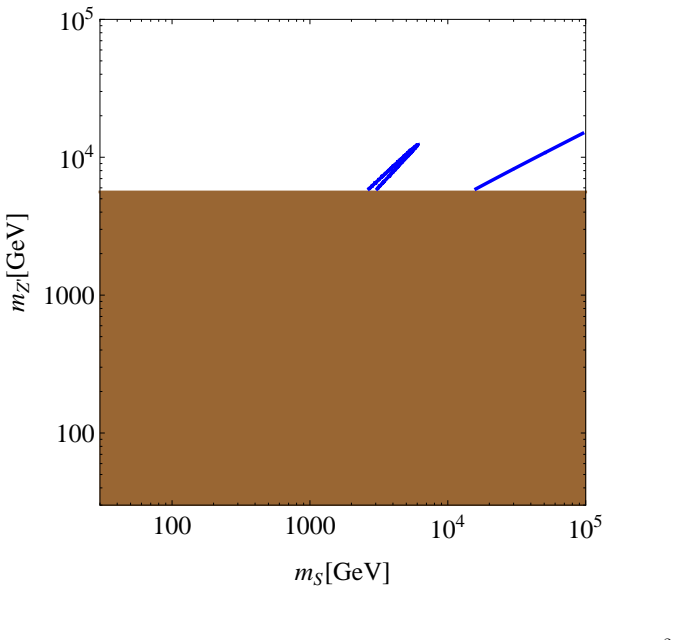
- In the universal $U(1)_{B-L}$ model only heavy dark matter (several TeV and above) survives the LHC bound on $Z'$, while the flavored $U(1)_{(B-L)_3}$ and $U(1)_{L_\mu-L_\tau}$ models admit weak-scale and even sub-GeV thermal dark matter.
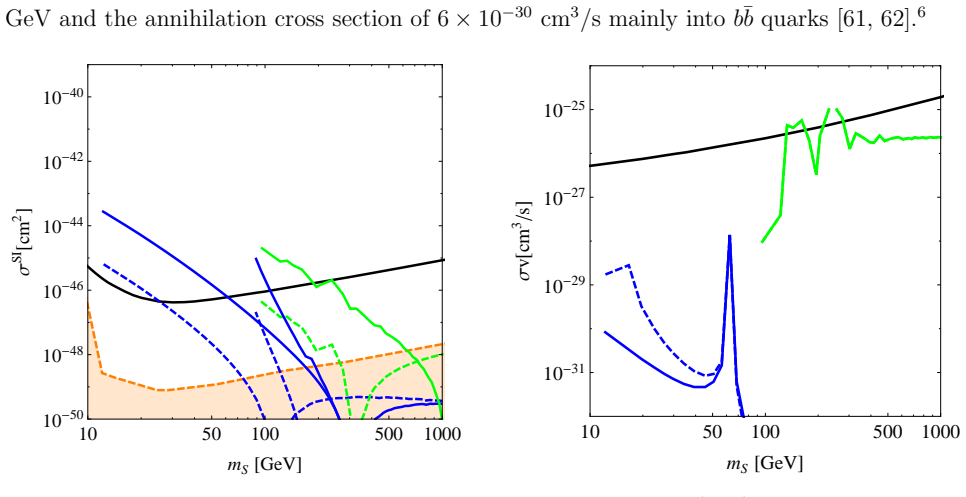
- The $U(1)_{(B-L)_3}$ model can accommodate the 47 Tucanae gamma-ray excess ($m_S\simeq34\,\mathrm{GeV}$, $\langle\sigma v\rangle_0\simeq6\times10^{-30}\,\mathrm{cm}^3/\mathrm{s}$) without violating direct detection limits.
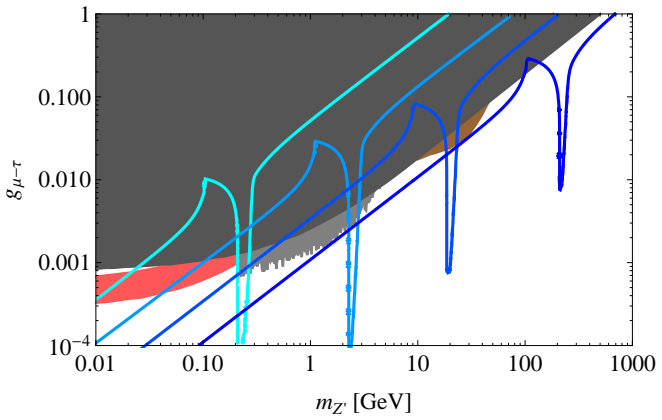
- The light branch of $U(1)_{L_\mu-L_\tau}$ ($m_S\simeq0.1\,\mathrm{GeV}$, $m_{Z'}\simeq0.01$-$0.1\,\mathrm{GeV}$) is compatible with the muon $g-2$ discrepancy, can relax the Hubble tension through $\Delta N_{\rm eff}\simeq0.2$, and its heavier branch connects to the $b\to s\mu^+\mu^-$ anomaly.
- Most of the predicted elastic scattering rates sit at or below the neutrino floor, so next-generation direct detection experiments that reach that background will test the scenario.
Reading between the lines
- Editorial: the pattern - freeze-out by an off-diagonal gauge coupling, today's signals by a weakly-coupled scalar channel - is a template that would transfer to other anomaly-free $U(1)$ groups or gauged flavor symmetries beyond the three worked out here.
- Editorial: the 1% mass splitting and the $10^{-3}$ mixing angle are unprotected, so a one-loop analysis could either find an accidentally natural region or close the scenario; the paper does not perform that calculation.
- Editorial: the heavier state $P$ could be produced at colliders and decay to $S$ plus an (off-shell) $Z'$, giving soft lepton pairs plus missing energy; this signature is a direct probe of the mass splitting the mechanism relies on, though the paper does not estimate it.
- Editorial: the sub-GeV $L_\mu-L_\tau$ contour has not been tested against dark matter-electron scattering or CMB constraints on annihilation into neutrinos, and those bounds are likely to cut into the displayed region; applying them is the cheapest way to check the light-mass claim.
Signed reviews
Editorial analysis
A structured set of objections, weighed in public.
Referee Report
Summary. The manuscript proposes a class of extra-U(1) extensions in which a complex scalar φ1 splits into two real scalars S and P after U(1) breaking. The lighter state S is the dark matter candidate; its thermal relic density is set by Z'-mediated coannihilation with P, while present-day annihilation and direct detection proceed through Higgs-boson exchange because Z'-mediated scattering is kinematically inelastic. The framework is applied to U(1)_{B-L}, U(1)_{(B-L)_3}, and U(1)_{L_μ-L_τ}, with parameter regions reproducing Ωh²≈0.1. The authors also discuss implications for direct detection, Fermi-LAT, the 47 Tucanae gamma-ray excess, the muon g−2 anomaly, IceCube, and the Hubble tension.
Significance. If the construction holds, it provides an existence proof for thermal-relic scalar dark matter whose present annihilation cross section can be as small as O(10^-31) cm^3/s while the freeze-out abundance is set by gauge coannihilation. This would resolve a common tension between thermal WIMPs and null direct-detection results. The manuscript's strengths are its explicit and internally consistent treatment: standard Boltzmann equations with coannihilation, transparent cross-section formulas in Appendices A and B, and concrete scans over three anomaly-free U(1) models with experimental constraints including LHC Z' bounds, BaBar data, neutrino trident bounds, and BBN limits. The main caveat is that the advertised suppression is not a consequence of the gauge structure alone; it is loaded into a benchmark whose radiative stability is not demonstrated.
major comments (2)
- [Sec. III.B, Eq. (17), footnote 3] The central suppression of direct and indirect signals is imposed by the benchmark choice (mP−mS, sinα, λ3, λ4) = (0.01 mS, 1e−3, 1e−3, 0). Footnote 3 states that these values are chosen 'in order to have an efficient coannihilation and to have a tiny effective coupling between h and S,' but no symmetry enforces them. In particular, λ4=0 is not protected: the quartic λ4 φ1†φ1 |Φ|² is allowed by all gauge and global symmetries of the scalar potential (6), and radiative corrections involving λ3, λ5, and the A term generate a nonzero λ4 once φ2 acquires a VEV. Since Eq. (17) shows the effective h−S coupling is λ4 v cosα − (λ3 v2 − √2 A) sinα, a one-loop shift δλ4 can alter σ_SI and (σv)_0 substantially, especially in the light-mass region. The manuscript contains no RGE or effective-potential analysis demonstrating that sinα=1e−3 and λ4=0 are radiatively stable at the scales relevant for freeze-out. Until this is quantified, the claim that the very suppressed present-day signals are a robust property of the models is not established.
- [Sec. VI.C, Figs. 7 and 8, footnote 7] The light-DM region (mS ~ 0.1 GeV, mZ' ~ 0.01–0.1 GeV) is presented as an important consequence because it can simultaneously address the muon g−2 anomaly and relax the Hubble tension while evading Fermi-LAT bounds through annihilation into neutrinos. However, this region is not checked against sub-GeV direct detection via DM–electron scattering (generated by kinetic mixing), CMB bounds on s-wave annihilation into neutrinos or electromagnetic products, or constraints on the Z' decay through kinetic mixing. Footnote 7 explicitly defers the kinetic-mixing constraint to future work. Since the viability of this light region is used to motivate the phenomenology section, these missing constraints should be evaluated before the region is described as viable.
minor comments (5)
- [Sec. II.A, Eq. (2)] The notation f_Tq and f_TG in Eq. (2) is not defined in the text; a brief definition or reference would improve readability.
- [Sec. III.B, footnote 3] Footnote 3 contains ungrammatical phrasing: 'We take as this in order to have...' should read 'We take these values in order to have...'.
- [Sec. VI.B, Fig. 7] The figure caption and text refer to several shaded regions ('light gray,' 'gray,' 'brown,' 'vermilion') that may be difficult to distinguish in grayscale print; explicit labels or line patterns would help.
- [Sec. II.C, Fig. 1] The blue curve in Fig. 1 is called a 'theoretical interpretation' of the XENON1T bound; it should be stated more explicitly that this curve assumes the same Higgs-portal coupling controls both direct detection and present annihilation, an assumption that the model of Sec. III deliberately avoids.
- [Sec. V.A, Eq. (23)] The Yukawa Lagrangian in Eq. (23) uses a notation where the Majorana mass term for N3_R involves φ2; it would be clearer to indicate the charge-conjugation contraction explicitly, as is done for the other N_R terms.
Circularity Check
The suppressed present-day annihilation and direct-detection cross sections are inserted by the Sec. III.B benchmark (λ4=0, sinα=10^-3), not derived from the gauge mechanism; the relic-density contours are genuine outputs, so the circularity is partial.
-
self definitional
[Sec. III.B, parameter choice before Sec. III.C, and footnote 3]
"In the following analysis, we fix (mP −mS, sin α, λ3, λ4) = (0.01mS, 1×10⁻³, 1×10⁻³, 0) 3 and vary ... 3 We take as this in order to have an efficient coannihilation and to have a tiny effective coupling between h and S, which can be seen from Eqs. (3) and (5)."
The central suppression of σ_SI and (σv)_0 is not an output of independent dynamics: it is the square of the h-S effective coupling in Eq. (17), which the benchmark is explicitly chosen to make tiny. With λ4=0 and sinα=10^-3, the h-S coupling is λ4 v cosα − (λ3 v2 − √2 A) sinα ≈ −(λ3 v2 − √2 A)×10^-3, so direct detection (Eq. (1)) and present annihilation (Eq. (5)) are small by construction. Figures 3, 5, 6, and 8 then display these small values as predictions, although the only content added by the U(1) machinery is the coannihilation-based relic abundance. Thus the headline claim of a very suppressed present annihilation cross section reduces to this parameter choice, not to the gauge structure.
full rationale
The thermal-relic part of the derivation is self-contained: the Boltzmann equation (20) with the effective coannihilation cross section (21) is solved with standard formulas, and the relic-density contours in Figs. 2, 4, and 7 are genuine outputs of the gauge coupling, masses, and coannihilation dynamics. The inelastic nature of Z'-mediated scattering follows from the mass splitting generated by the A term in Eqs. (15)-(16), and the SS→Z'Z' s-wave cross section (22) is a real prediction when that channel is kinematically open. The circularity is confined to the headline suppression of present-day signals. Footnote 3 states that the benchmark (mP−mS, sinα, λ3, λ4)=(0.01mS, 10^-3, 10^-3, 0) is chosen 'in order to have an efficient coannihilation and to have a tiny effective coupling between h and S.' From Eq. (17), that same coupling controls both σ_SI (Eq. (1)) and (σv)_0 (Eq. (5)), so the small cross sections displayed in Figs. 3, 5, 6, and 8 are restatements of the parameter choice rather than consequences of the U(1) gauge structure alone. This makes the claimed suppression partially circular: the model is a valid existence proof for such a parameter point, and the abundance calculation is independent, but the central 'very suppressed present annihilation' result is, at the benchmark level, an input. A related but separate concern is that λ4=0 is radiatively unstable because the quartic is allowed by all symmetries and will be generated at one loop; that is a correctness risk rather than an additional circularity.
Assumptions & free parameters
free parameters (6)
- mP - mS =
0.01 mS
- sin alpha =
1e-3
- lambda3 =
1e-3
- lambda4 =
0
- mH =
v2 or v2/4 or v2/10 depending on model
- g' (gauge coupling) =
varied per model, e.g. gB-L=0.5, g(B-L)_3=0.03-1, g_mu-tau ~ 1e-4 to 1
assumptions (6)
- domain assumption Standard thermal freeze-out cosmology: the DM abundance is set by solving the Boltzmann equation for n = n_S + n_P with coannihilation.
- domain assumption The new U(1) gauge boson Z' couples only off-diagonally to S and P, so Z'-mediated DM-nucleus scattering is inelastic and negligible when mP-mS exceeds the recoil energy.
- domain assumption Direct detection and present annihilation are dominated by SM Higgs h and heavy H exchange; no other operators or mediators contribute significantly.
- standard math The hadronic matrix elements (f_Tq, f_TG) and the nonrelativistic spin-independent cross section formula are accurate for the scalar DM.
- domain assumption For U(1)_{(B-L)_3}, a simplified effective Lagrangian with only third-generation charges is sufficient for DM phenomenology; UV completions do not alter the results.
- ad hoc to paper The scalar potential parameters, especially lambda4=0 and sin alpha=1e-3, are radiatively stable at the scales relevant for freeze-out.
invented entities (4)
-
Z' gauge boson
independent evidence
-
Complex scalar DM phi1 splitting into S and P
-
Extra U(1) breaking scalar phi2
-
Right-handed neutrinos N_R
Cite this review
Pith. "Pith review of Inelastic extra $U(1)$ charged scalar dark matter." pith.science (2026). https://pith.science/paper/NKWT5SGF
@misc{pith2026190809277,
  author       = {Pith},
  title        = {Pith review of: Inelastic extra $U(1)$ charged scalar dark matter},
  year         = {2026},
  howpublished = {\url{https://pith.science/paper/NKWT5SGF}},
  note         = {Machine review of arXiv:1908.09277}
}
abstract
The null results in dark matter direct detection experiments imply the present scalar dark matter (DM) annihilation cross section to bottom quark pairs through the Higgs boson exchange is smaller than about $10^{-31}$ cm$^3/$s for a wide DM mass range, which is much smaller than the required annihilation cross section for thermal relic DM. We propose models of a thermal relic DM with the present annihilation cross section being very suppressed. This property can be realized in an extra $U(1)$ gauge interacting complex scalar DM, where the thermal DM abundance is determined by coannihilation through the gauge interaction while the present annihilation is governed by Higgs bosons exchange processes. An interaction between DM and the extra $U(1)$ breaking Higgs field generates a small mass splitting between DM and its coannihilating partner so that coannihilation becomes possible and also the $Z'$-mediated scattering off with a nucleon in direct DM search becomes inelastic. We consider scalar dark matter in $U(1)_{B-L}, U(1)_{(B-L)_3}$ and $U(1)_{L_\mu-L_\tau}$ extended models and identify viable parameter regions. We also discuss various implications to future DM detection experiments, the DM interpretation of the gamma-ray excess in the globular cluster 47 Tucanae, the muon anomalous magnetic moment, the Hubble tension and others.
Figures

Figures from the paper (4 more)


Reference graph
Works this paper leans on
-
[1]
Hubble tension
5, we conclude that the parameter set used in our analysis is consist ent with the current LHC results. For future search reach with a large luminosity, see Ref. [60] and a p art of parameter space of the ( B − L)3 model will be explored. 15 for mS > m Z ′ as well as Z ′ resonant enhanced regions along the line mS ≃ mZ ′/2. 10 20 50 100 200 500 100010 20 ...
-
[2]
Annihilation into charged fermions ⏐ ⏐M(SP → f ¯f ) ⏐ ⏐2 =g′4( qf) 2 Nc 2 m4 Z ′ 1 (s − m2 Z ′)2 + (mZ ′Γ Z ′)2 ( m4 Z ′ [ (2m2 f + m2 S + m2 P ) ( s − 2(m2 P + m2 S) ) + (m2 S − m2 P )2] +(m2 S − m2 P )2[ m2 Z ′ ( 2m2 f + m2 P + m2 S − s ) + (m2 S + m2 P − 2m2 f )s − (m2 S − m2 P )2]) (B1) →g′4( qf) 2 Nc 4(m2 S + m2 f ) (s − m2 Z ′)2 + (mZ ′Γ Z ′)2 (s − ...
-
[3]
Annihilation into neutrinos |M(SP → ν ¯ν)|2 =g′4( qf) 2 Nc 2 m4 Z ′ 1 (s − m2 Z ′)2 + (mZ ′Γ Z ′)2 ( m4 Z ′ [ (−2m2 ν + m2 S + m2 P ) ( s − 2(m2 P + m2 S) ) + (m2 S − m2 P )2] +(m2 S − m2 P )2[ m2 Z ′ ( −2m2 ν + m2 P + m2 S − s ) + (m2 S + m2 P + 2m2 ν)s − (m2 S − m2 P )2]) (B3) →g′4( qf) 2 Nc 4(m2 S − m2 ν) (s − m2 Z ′)2 + (mZ ′Γ Z ′)2 (s − 4m2 S) for mP...
-
[4]
Annihilation into Z ′Z ′ ∫ d cos θ 2 |M(SS → Z ′Z ′)|2 =g′4( qΦ) 4 ( 4(16m4 S + 8m2 S(m2 Z ′ − 2s) − 3m4 Z ′ + 4m2 Z ′s + s2) (s − 2m2 Z ′) √ (s − 4m2 S)(s − 4m2 Z ′) × log ( s − 2m2 Z ′ + √ (s − 4m2 S)(s − 4m2 Z ′) s − 2m2 Z ′ − √ (s − 4m2 S)(s − 4m2 Z ′) ) + 1 m4 Z ′ 32m4 Sm4 Z ′ + m2 S(−32m6 Z ′ + 20m4 Z ′s − 8m4 Z ′s2 + s3) + m4 Z ′(6m4 Z ′ − 4m2 Z ′s...
-
[5]
Ackermann et al
M. Ackermann et al. [Fermi-LAT Collaboration], Phys. Rev. Lett. 115, no. 23, 231301 (2015)
2015
-
[6]
Albert et al
A. Albert et al. [Fermi-LAT and DES Collaborations], Astrophys. J. 834, no. 2, 110 (2017)
2017
-
[7]
D. S. Akerib et al. [LUX Collaboration], Phys. Rev. Lett. 118, no. 25, 251302 (2017)
2017
-
[8]
Cui et al
X. Cui et al. [PandaX-II Collaboration], Phys. Rev. Lett. 119, no. 18, 181302 (2017)
2017
Show all 101 references
-
[9]
Aprile et al
E. Aprile et al. [XENON Collaboration], Phys. Rev. Lett. 121, no. 11, 111302 (2018)
2018
-
[10]
L. M. Krauss, S. Nasri and M. Trodden, Phys. Rev. D 67, 085002 (2003)
2003
-
[11]
Cheung and O
K. Cheung and O. Seto, Phys. Rev. D 69, 113009 (2004)
2004
-
[12]
S. Ipek, D. McKeen and A. E. Nelson, Phys. Rev. D 90, no. 5, 055021 (2014)
2014
-
[13]
Gross, O
C. Gross, O. Lebedev and T. Toma, Phys. Rev. Lett. 119, no. 19, 191801 (2017)
2017
-
[14]
Arcadi, M
G. Arcadi, M. Lindner, F. S. Queiroz, W. Rodejohann and S . Vogl, JCAP 1803, no. 03, 042 (2018)
2018
-
[15]
Pani and G
P. Pani and G. Polesello, Phys. Dark Univ. 21, 8 (2018)
2018
-
[16]
N. F. Bell, G. Busoni and I. W. Sanderson, JCAP 1808, no. 08, 017 (2018) Erratum: [JCAP 1901, no. 01, E01 (2019)]
2018
-
[17]
Li, Phys
T. Li, Phys. Lett. B 782, 497 (2018)
2018
-
[18]
T. Abe, M. Fujiwara and J. Hisano, JHEP 1902, 028 (2019). 23
2019
-
[19]
Azevedo, M
D. Azevedo, M. Duch, B. Grzadkowski, D. Huang, M. Iglick i and R. Santos, JHEP 1901, 138 (2019)
2019
-
[20]
Ishiwata and T
K. Ishiwata and T. Toma, JHEP 1812, 089 (2018)
2018
-
[21]
Huitu, N
K. Huitu, N. Koivunen, O. Lebedev, S. Mondal and T. Toma, Phys. Rev. D 100, no. 1, 015009 (2019)
2019
-
[22]
Alanne, M
T. Alanne, M. Heikinheimo, V. Keus, N. Koivunen and K. Tu ominen, Phys. Rev. D 99, no. 7, 075028 (2019)
2019
-
[23]
Karamitros, Phys
D. Karamitros, Phys. Rev. D 99, no. 9, 095036 (2019)
2019
-
[24]
Okada and O
N. Okada and O. Seto, Phys. Rev. D 89, no. 4, 043525 (2014)
2014
-
[25]
Okada and O
N. Okada and O. Seto, Phys. Rev. D 90, no. 8, 083523 (2014)
2014
-
[26]
A. Das, N. Okada and O. Seto, J. Phys. Conf. Ser. 718, no. 4, 042054 (2016)
2016
- [27]
-
[28]
Hooper and L
D. Hooper and L. Goodenough, Phys. Lett. B 697, 412 (2011)
2011
-
[29]
Hooper and T
D. Hooper and T. Linden, Phys. Rev. D 84, 123005 (2011)
2011
-
[30]
K. Y. Choi and O. Seto, Phys. Rev. D 86, 043515 (2012) Erratum: [Phys. Rev. D 86, 089904 (2012)]
2012
-
[31]
Jungman, M
G. Jungman, M. Kamionkowski and K. Griest, Phys. Rept. 267, 195 (1996)
1996
-
[32]
McDonald and N
J. McDonald and N. Sahu, JCAP 0806, 026 (2008)
2008
-
[33]
Okada and O
N. Okada and O. Seto, Phys. Rev. D 82, 023507 (2010)
2010
-
[34]
Djouadi, O
A. Djouadi, O. Lebedev, Y. Mambrini and J. Quevillon, Ph ys. Lett. B 709, 65 (2012)
2012
-
[35]
W. Chao, W. F. Cui, H. K. Guo and J. Shu, arXiv:1707.09759 [hep-ph]
-
[36]
Okada and O
N. Okada and O. Seto, Phys. Rev. D 98, no. 6, 063532 (2018)
2018
-
[37]
Rodejohann and C
W. Rodejohann and C. E. Yaguna, JCAP 1512, no. 12, 032 (2015)
2015
-
[38]
Biswas, S
A. Biswas, S. Choubey and S. Khan, JHEP 1608, 114 (2016)
2016
-
[39]
Singirala, R
S. Singirala, R. Mohanta and S. Patra, Eur. Phys. J. Plus 133, no. 11, 477 (2018)
2018
-
[40]
Bandyopadhyay, E
P. Bandyopadhyay, E. J. Chun and R. Mandal, Phys. Rev. D 97, no. 1, 015001 (2018)
2018
-
[41]
Biswas, S
A. Biswas, S. Choubey and S. Khan, JHEP 1609, 147 (2016)
2016
-
[42]
Garani and J
R. Garani and J. Heeck, Phys. Rev. D 100, no. 3, 035039 (2019)
2019
-
[43]
L. J. Hall, T. Moroi and H. Murayama, Phys. Lett. B 424, 305 (1998)
1998
-
[44]
Tucker-Smith and N
D. Tucker-Smith and N. Weiner, Phys. Rev. D 64, 043502 (2001)
2001
-
[45]
E. W. Kolb and M. S. Turner, The Early Universe , Addison-Wesley (1990). 24
1990
-
[46]
Griest and D
K. Griest and D. Seckel, Phys. Rev. D 43, 3191 (1991)
1991
-
[47]
Edsjo and P
J. Edsjo and P. Gondolo, Phys. Rev. D 56, 1879 (1997)
1997
-
[48]
R. N. Mohapatra and R. E. Marshak, Phys. Rev. Lett. 44, 1316 (1980) [Erratum-ibid. 44, 1643 (1980)]
1980
-
[49]
R. E. Marshak and R. N. Mohapatra, Phys. Lett. 91B, 222 (1980)
1980
- [50]
-
[51]
Griest and M
K. Griest and M. Kamionkowski, Phys. Rev. Lett. 64, 615 (1990)
1990
-
[52]
Carena, A
M. Carena, A. Daleo, B. A. Dobrescu and T. M. P. Tait, Phys . Rev. D 70, 093009 (2004)
2004
-
[53]
Amrith, J
S. Amrith, J. M. Butterworth, F. F. Deppisch, W. Liu, A. V arma and D. Yallup, JHEP 1905, 154 (2019)
2019
-
[54]
A. Das, P. S. B. Dev and N. Okada, Phys. Lett. B 799, 135052 (2019)
2019
- [55]
-
[56]
K. S. Babu, A. Friedland, P. A. N. Machado and I. Mocioiu, JHEP 1712, 096 (2017)
2017
-
[57]
Alonso, P
R. Alonso, P. Cox, C. Han and T. T. Yanagida, Phys. Lett. B 774, 643 (2017)
2017
-
[58]
L. Bian, S. M. Choi, Y. J. Kang and H. M. Lee, Phys. Rev. D 96, no. 7, 075038 (2017)
2017
-
[59]
P. Cox, C. Han and T. T. Yanagida, JCAP 1801, no. 01, 029 (2018)
2018
-
[60]
E. J. Chun, A. Das, J. Kim and J. Kim, JHEP 1902, 093 (2019)
2019
-
[61]
del Amo Sanchez et al
P. del Amo Sanchez et al. [BaBar Collaboration], Phys. Rev. Lett. 104, 191801 (2010)
2010
-
[62]
Aaboud et al
M. Aaboud et al. [ATLAS Collaboration], JHEP 1801, 055 (2018)
2018
-
[63]
D. A. Faroughy, A. Greljo and J. F. Kamenik, Phys. Lett. B 764, 126 (2017)
2017
-
[64]
Elahi and A
F. Elahi and A. Martin, Phys. Rev. D 100, no. 3, 035016 (2019)
2019
-
[65]
A. M. Brown, T. Lacroix, S. Lloyd, C. Boehm and P. Chadwic k, Phys. Rev. D 98, no. 4, 041301 (2018)
2018
-
[66]
S. J. Lloyd, P. M. Chadwick and A. M. Brown, Mon. Not. Roy. Astron. Soc. 480, 4782 (2018)
2018
-
[67]
Bartels and T
R. Bartels and T. Edwards, Phys. Rev. D 100, no. 6, 068301 (2019)
2019
-
[68]
X. G. He, G. C. Joshi, H. Lew and R. R. Volkas, Phys. Rev. D 43, 22 (1991)
1991
-
[69]
Foot, Mod
R. Foot, Mod. Phys. Lett. A 6, 527 (1991)
1991
-
[70]
E. Ma, D. P. Roy and S. Roy, Phys. Lett. B 525, 101 (2002)
2002
-
[71]
S. Baek, N. G. Deshpande, X. G. He and P. Ko, Phys. Rev. D 64, 055006 (2001)
2001
-
[72]
G. W. Bennett et al. [Muon g-2 Collaboration], Phys. Rev. D 73, 072003 (2006)
2006
-
[73]
Jegerlehner and A
F. Jegerlehner and A. Nyffeler, Phys. Rept. 477, 1 (2009). 25
2009
-
[74]
Davier, A
M. Davier, A. Hoecker, B. Malaescu and Z. Zhang, Eur. Phy s. J. C 71, 1515 (2011) Erratum: [Eur. Phys. J. C 72, 1874 (2012)]
2011
-
[75]
Hagiwara, R
K. Hagiwara, R. Liao, A. D. Martin, D. Nomura and T. Teubn er, J. Phys. G 38, 085003 (2011)
2011
-
[76]
J. P. Lees et al. [BaBar Collaboration], Phys. Rev. D 94, no. 1, 011102 (2016)
2016
-
[77]
Altmannshofer, S
W. Altmannshofer, S. Gori, M. Pospelov and I. Yavin, Phy s. Rev. Lett. 113, 091801 (2014)
2014
-
[78]
S. R. Mishra et al. [CCFR Collaboration], Phys. Rev. Lett. 66, 3117 (1991)
1991
-
[79]
A. M. Sirunyan et al. [CMS Collaboration], Phys. Lett. B 792, 345 (2019)
2019
-
[80]
Drees, M
M. Drees, M. Shi and Z. Zhang, Phys. Lett. B 791, 130 (2019)
2019
-
[81]
Kamada and H
A. Kamada and H. B. Yu, Phys. Rev. D 92, no. 11, 113004 (2015)
2015
-
[82]
Kamada, K
A. Kamada, K. Kaneta, K. Yanagi and H. B. Yu, JHEP 1806, 117 (2018)
2018
-
[83]
A. G. Riess et al. , Astrophys. J. 826, no. 1, 56 (2016)
2016
-
[84]
A. G. Riess et al. , Astrophys. J. 861, no. 2, 126 (2018)
2018
-
[85]
Escudero, D
M. Escudero, D. Hooper, G. Krnjaic and M. Pierre, JHEP 1903, 071 (2019)
2019
-
[86]
Araki, F
T. Araki, F. Kaneko, Y. Konishi, T. Ota, J. Sato and T. Shi momura, Phys. Rev. D 91, no. 3, 037301 (2015)
2015
-
[87]
Araki, F
T. Araki, F. Kaneko, T. Ota, J. Sato and T. Shimomura, Phy s. Rev. D 93, no. 1, 013014 (2016)
2016
-
[88]
M. G. Aartsen et al. [IceCube Collaboration], Phys. Rev. Lett. 113, 101101 (2014)
2014
-
[89]
Altmannshofer, S
W. Altmannshofer, S. Gori, M. Pospelov and I. Yavin, Phy s. Rev. D 89, 095033 (2014)
2014
-
[90]
Altmannshofer, S
W. Altmannshofer, S. Gori, S. Profumo and F. S. Queiroz, JHEP 1612, 106 (2016)
2016
-
[91]
Aaij et al
R. Aaij et al. [LHCb Collaboration], Phys. Rev. Lett. 111, 191801 (2013)
2013
-
[92]
Aaij et al
R. Aaij et al. [LHCb Collaboration], Phys. Rev. Lett. 113, 151601 (2014)
2014
-
[93]
Aaij et al
R. Aaij et al. [LHCb Collaboration], JHEP 1509, 179 (2015)
2015
-
[94]
Aaij et al
R. Aaij et al. [LHCb Collaboration], JHEP 1602, 104 (2016)
2016
- [95]
-
[96]
Cirelli, M
M. Cirelli, M. Kadastik, M. Raidal and A. Strumia, Nucl. Phys. B 813, 1 (2009) Addendum: [Nucl. Phys. B 873, 530 (2013)]
2009
-
[97]
Baek and P
S. Baek and P. Ko, JCAP 0910, 011 (2009)
2009
-
[98]
Foldenauer, Phys
P. Foldenauer, Phys. Rev. D 99, no. 3, 035007 (2019)
2019
-
[99]
Boudaud, J
M. Boudaud, J. Lavalle and P. Salati, Phys. Rev. Lett. 119, no. 2, 021103 (2017). 26
2017
-
[100]
Bartels, D
R. Bartels, D. Gaggero and C. Weniger, JCAP 1705, no. 05, 001 (2017)
2017
-
[101]
Dutra, M
M. Dutra, M. Lindner, S. Profumo, F. S. Queiroz, W. Rodej ohann and C. Siqueira, JCAP 1803, 037 (2018). 27
2018
Reviewed August 14, 2026 · model on record in the stance chip above.
Discussion (0). Continue with ORCID to comment.