REVIEW 4 major objections 5 minor 31 references
Multi-task Learning for Low-resource Second Language Acquisition Modeling
T0 review · 4 major / 5 minor · reviewed 2026-08-14 · deepseek-v4-flash
Pith's one-line read One shared model predicts learner errors from 10x less data
desk verdict A plausible first application of MTL to SLA modeling, but the headline '10x' data-efficiency claim is confounded: at 1K target samples the MTL model trains on ~1.06M total examples and there is no pooled-data control. read the letter →
The pith
A machine-rendered reading of the paper's core claim, the machinery that carries it, and where it could break.
The reading
What carries the argument
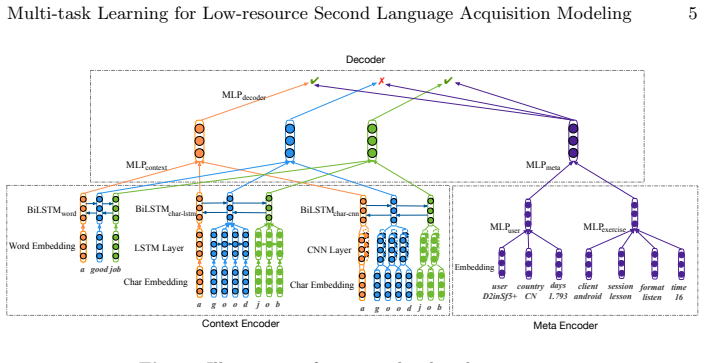
The carrying mechanism is hard parameter sharing in an encoder–decoder architecture. One meta encoder is a multi-layer perceptron that embeds user identity, country, days, client, session, exercise format, and time; a context encoder combines a word-level BiLSTM over pretrained contextual word vectors with character-level LSTM and CNN encoders; and the decoder is a shared MLP with a sigmoid output per word. During multi-task training, the meta encoder, decoder, and user embeddings are shared across all language tasks, while each language keeps its own context encoder, and the per-language cross-entropy losses are summed. This shared meta encoder is the transfer channel: it learns user ability and learning habits from all languages at once, which is why the user-id feature is the single most important input and why the method can predict for a user in a language they have never studied in the training data.
What would settle it
Train the multi-task model on two languages whose user sets are fully disjoint, then cut the target language to 1,000 examples and measure AUC; if the gain over the single-task model shrinks toward zero, the transfer relies on user-identity overlap rather than on general patterns of language learning.
Extended reading notes
Core claim
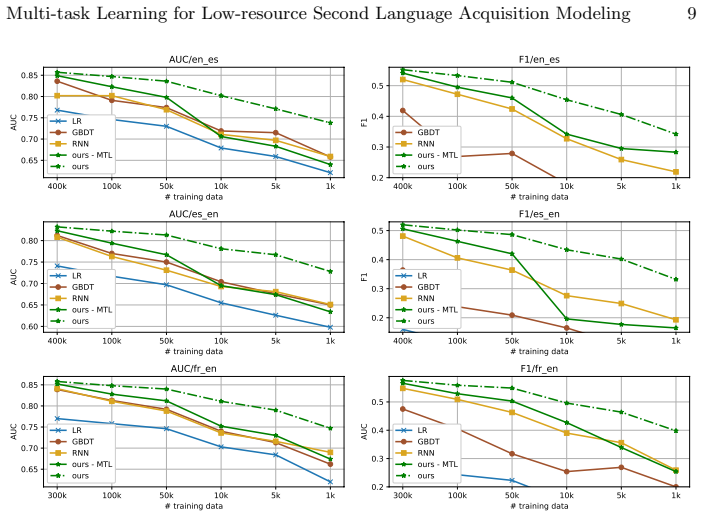
The central claim is that multi-task learning over several language-learning datasets transfers the common structure of language acquisition, and that this transfer is what rescues performance when a single language has very little data. Using the public shared-task data for three language pairs, the authors train one model with a shared meta encoder (which consumes user and exercise metadata) and a shared decoder, plus one context encoder per language. When the target language is reduced to 1K training exercises, the multi-task model scores 0.738 AUC on the en_es test set, versus 0.659 for the best single-task baseline, and the same pattern holds on other language pairs. The model also handles a cold-start setting: for users already seen in one language, it predicts their answers in another language with no training exercises there, improving AUC from 0.771 (best baseline) to 0.881. In the full-data setting, the shared model still edges out all baselines on all three datasets, with the largest gain on the smallest dataset.
Load-bearing premise
The load-bearing premise is that the same students appear across the language datasets, because the shared user ID is the main channel through which learning habits transfer; if auxiliary languages contain entirely different learners, the multi-task advantage may disappear.
Editorial extensions
If this is right
- With only 1K training examples for a target language, the multi-task model reaches 0.738 AUC, while the best single-task baseline reaches 0.659; single-task baselines need more than 10K examples to match that level.
- In the cold-start test, where the target user's exercises are removed from one language but the user remains in another language, the shared model scores 0.881 AUC versus 0.771 for the best baseline, a gain of about 11 points.
- On the full training data, the multi-task model slightly surpasses all baselines on all three language pairs, and the improvement is largest for the smallest dataset.
- Because the shared meta encoder and decoder are trained on all languages simultaneously, adding a new language dataset only requires training a new context encoder while reusing the shared components.
Reading between the lines
- Editorial extension: if the shared user embedding is the real transfer channel, then training the same model on languages with fully disjoint user sets should erase most of the low-resource gain; a direct experiment would settle this.
- Editorial extension: the cold-start evaluation only covers users who already appear in another language dataset; a truly unseen-user test would show whether any benefit remains when the user embedding starts from random initialization.
- Editorial extension: the same shared-meta-encoder design could be carried over to knowledge tracing in other subjects or curricula, as long as a stable learner identifier is shared across tasks.
Signed reviews
Editorial analysis
A structured set of objections, weighed in public.
Referee Report
Summary. The paper proposes a multi-task learning (MTL) approach for second language acquisition (SLA) modeling, where a shared meta encoder and decoder process meta-information (user, country, days, client, session, format, time) and a shared decoder predicts word-level correctness, while each language has its own context encoder. The model is trained jointly on three Duolingo datasets (en_es, es_en, fr_en). The authors claim that in low-resource scenarios (target-language training data reduced to as little as 1K exercises), the MTL model substantially outperforms single-task baselines (e.g., AUC 0.738 vs 0.659 on en_es at 1K), and that it slightly improves over the state of the art in the full-data setting. They also report a cold-start experiment, component ablations, metadata analysis, and a visualization of user embeddings.
Significance. If the low-resource results were properly controlled, the paper would offer a practically useful method for SLA modeling in data-scarce languages and for personalized learning systems. The architecture is sensible, the code is publicly released, and the full-data results (Table 4) modestly improve upon the 2018 Duolingo challenge baseline. However, the central quantitative claim of 'ten times' data efficiency is currently confounded by unequal total training data, and the cold-start experiment does not evaluate truly unseen users. These issues undermine the main contribution as stated, although they are addressable with additional experiments.
major comments (4)
- [Section 4.3, Fig. 3] The data-efficiency comparison is confounded by total training set size. For the 1K en_es condition, the MTL model trains on 1K en_es exercises plus the full es_en (731,896) and fr_en (326,792) training sets, about 1.06M examples in total, whereas the single-task baselines are trained on exactly 1K examples. The statement that baselines need 'more than 10K training data' to match AUC 0.738 thus compares very different total data budgets. Without a control that trains a single-task model on the union of all three datasets (or otherwise equalizes the total amount of data), the gain cannot be attributed to multi-task parameter sharing rather than to the sheer volume of auxiliary data. Please add a pooled-data control or an ablation that limits the MTL model to the same total number of examples as the single-task baselines.
- [Section 4.4, Tables 2 and 3] The cold-start experiment is not a cold start for the two test users. Both users (R WDt7srk and t6nj6nr/) have substantial training data in the fr_en dataset (519 and 998 words, respectively), and because the meta encoder shares user embeddings across all tasks, the model has already seen these users' identifiers and learning histories. The improvement of the MTL model over ours-MTL (AUC 0.881 vs 0.770) therefore reflects cross-language transfer for known users, not prediction for unseen users. The introduction's claim that the unified model works 'even though there is no exercise data for this user' is not tested. Please evaluate users who are absent from all training datasets.
- [Section 3.3, Eq. (7)] The loss definition in Eq. (7) is internally inconsistent. N was previously defined as the number of datasets, yet the sum runs over t = 1 to N with y_t and p_t, which should be over the words/exercises in the batch for a single task. The normalization factor 1/N is also unclear. As written, the loss is not well-defined and cannot be implemented directly. Please rewrite the equation with distinct notation for the number of datasets, the batch size, and the summation index over words.
- [Tables 3–5 (especially Table 4)] The reported differences are often very small (e.g., AUC 0.864 vs 0.861 for en_es in Table 4, a 0.003 difference), and the paper reports no variance, confidence intervals, or significance tests for any comparison. Without multiple random seeds or a paired significance test, it is unclear whether these differences are reliable. Please report standard deviations over multiple runs and, if possible, statistical significance tests on the word-level predictions.
minor comments (5)
- [Abstract] The phrase 'because lacking of training data' should be rephrased, e.g., 'because of the lack of training data'.
- [Figure 3] The last subplot (fr_en F1) has its y-axis labeled 'AUC' instead of 'F1'.
- [Section 2.1] The sentence 'their performances are not very poor' is awkward; consider 'their performance is reasonable'.
- [Section 3.2] The dimensions of r_user and r_exercise after the MLPs are not specified; stating them would improve reproducibility.
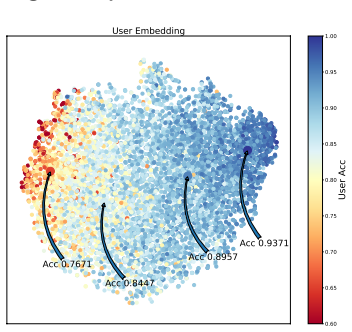
- [Section 5.3] The visualization in Fig. 5 uses the model's own user embeddings to argue that embeddings contain rich information; this is circular and should be described as a qualitative illustration rather than as evidence of predictive power.
Circularity Check
No significant circularity: the central claims are empirical held-out comparisons against external baselines.
full rationale
Central claims are empirical: the paper trains an encoder-decoder multi-task model and evaluates AUC/F1 on held-out test sets against external baselines (LR, GBDT, RNN, GBDT+RNN) from the Duolingo shared task. The multi-task objective (Eq. 8) is a sum of task-specific cross-entropy losses, and the shared-parameter design is an architectural choice, not derived from the target metric; no parameter is fitted to the test set or to the claimed "10x" improvement. The low-resource curves (Fig. 3) compare training-set-size reductions on target languages, and the cold-start experiment uses held-out users' es_en test data. Although the auxiliary-data confound in Fig. 3 (MTL sees roughly 1.06M auxiliary examples at the 1K point) weakens the quantitative data-efficiency interpretation, this is an experimental design concern, not circularity: the comparison is still against held-out data and external baselines. Section 5.3's visualization uses the model's own user embeddings to claim embeddings carry useful signal; this is self-confirming but does not support the central claim and no equation or fitted value is renamed as a prediction. No load-bearing self-citation, uniqueness theorem, or definitional equivalence appears. Hence no significant circularity.
Assumptions & free parameters
free parameters (4)
- alpha (α) in loss function =
not reported
- Embedding/hidden size =
150
- Dropout rate =
0.5
- Learning rate =
0.001
assumptions (4)
- domain assumption Latent common patterns across different language-learning tasks can be learned by sharing a meta encoder and decoder, and these patterns transfer across languages.
- domain assumption User identifiers are consistent across language datasets, allowing the same user to be matched across tasks.
- domain assumption The Duolingo metadata schema (user, country, days, client, session, format, time) is shared across languages and is sufficiently informative for transfer.
- domain assumption ELMo pretrained embeddings provide a useful shared word representation.
Cite this review
Pith. "Pith review of Multi-task Learning for Low-resource Second Language Acquisition Modeling." pith.science (2026). https://pith.science/paper/CUN2YVH5
@misc{pith2026190809283,
  author       = {Pith},
  title        = {Pith review of: Multi-task Learning for Low-resource Second Language Acquisition Modeling},
  year         = {2026},
  howpublished = {\url{https://pith.science/paper/CUN2YVH5}},
  note         = {Machine review of arXiv:1908.09283}
}
read the original abstract
Second language acquisition (SLA) modeling is to predict whether second language learners could correctly answer the questions according to what they have learned. It is a fundamental building block of the personalized learning system and has attracted more and more attention recently. However, as far as we know, almost all existing methods cannot work well in low-resource scenarios due to lacking of training data. Fortunately, there are some latent common patterns among different language-learning tasks, which gives us an opportunity to solve the low-resource SLA modeling problem. Inspired by this idea, in this paper, we propose a novel SLA modeling method, which learns the latent common patterns among different language-learning datasets by multi-task learning and are further applied to improving the prediction performance in low-resource scenarios. Extensive experiments show that the proposed method performs much better than the state-of-the-art baselines in the low-resource scenario. Meanwhile, it also obtains improvement slightly in the non-low-resource scenario.
Figures

Figures from the paper (2 more)

Reference graph
Works this paper leans on
-
[1]
Bauman, K., Tuzhilin, A.: Recommending learning materials to students by iden- tifying their knowledge gaps. In: RecSys Posters (2014)
work page 2014
-
[2]
Information Sciences 432, 559–571 (2018)
Chen, Y., Zhao, D., Lv, L., Zhang, Q.: Multi-task learning for dangerous object detection in autonomous driving. Information Sciences 432, 559–571 (2018)
work page 2018
-
[3]
In: Proceedings of the 25th inter- national conference on Machine learning
Collobert, R., Weston, J.: A unified architecture for natural language processing: Deep neural networks with multitask learning. In: Proceedings of the 25th inter- national conference on Machine learning. pp. 160–167. ACM (2008)
work page 2008
-
[4]
In: 2013 IEEE Inter- national Conference on Acoustics, Speech and Signal Processing
Deng, L., Hinton, G., Kingsbury, B.: New types of deep neural network learning for speech recognition and related applications: An overview. In: 2013 IEEE Inter- national Conference on Acoustics, Speech and Signal Processing. pp. 8599–8603. IEEE (2013)
work page 2013
-
[5]
Dong, D., Wu, H., He, W., Yu, D., Wang, H.: Multi-task learning for multiple language translation. In: Proceedings of the 53rd Annual Meeting of the Associ- ation for Computational Linguistics and the 7th International Joint Conference on Natural Language Processing (Volume 1: Long Papers). vol. 1, pp. 1723–1732 (2015)
work page 2015
-
[6]
In: European Conference on Information Retrieval
Goutte, C., Gaussier, E.: A probabilistic interpretation of precision, recall and f- score, with implication for evaluation. In: European Conference on Information Retrieval. pp. 345–359. Springer (2005)
work page 2005
-
[7]
Information Sciences 320, 418–428 (2015)
Guo, W., Chen, G.: Human action recognition via multi-task learning base on spatial–temporal feature. Information Sciences 320, 418–428 (2015)
work page 2015
-
[8]
Radiology 143(1), 29–36 (1982)
Hanley, J.A., McNeil, B.J.: The meaning and use of the area under a receiver operating characteristic (roc) curve. Radiology 143(1), 29–36 (1982)
1982
Show all 31 references
-
[9]
Information Sciences 436, 388–402 (2018)
He, H., Du, L., Liu, Y., Ding, J.: Similarity preserving multi-task learning for radar target recognition. Information Sciences 436, 388–402 (2018)
2018
-
[10]
Information Sciences 357, 39–60 (2016) Multi-task Learning for Low-resource Second Language Acquisition Modeling 15
Jiang, Y., Deng, Z., Choi, K.S., Chung, F.L., Wang, S.: A novel multi-task tsk fuzzy classifier and its enhanced version for labeling-risk-aware multi-task classification. Information Sciences 357, 39–60 (2016) Multi-task Learning for Low-resource Second Language Acquisition Modeling 15
2016
-
[11]
In: 2017 IEEE international conference on acous- tics, speech and signal processing (ICASSP)
Kim, S., Hori, T., Watanabe, S.: Joint ctc-attention based end-to-end speech recog- nition using multi-task learning. In: 2017 IEEE international conference on acous- tics, speech and signal processing (ICASSP). pp. 4835–4839. IEEE (2017)
2017
-
[12]
arXiv preprint arXiv:1412.6980 (2014)
Kingma, D.P., Ba, J.: Adam: A method for stochastic optimization. arXiv preprint arXiv:1412.6980 (2014)
2014 arXiv
-
[13]
In: Proceedings of the Thirteenth Workshop on Innovative Use of NLP for Building Educational Ap- plications
Klerke, S., Alonso, H.M., Plank, B.: Grotoco@ slam: Second language acquisition modeling with simple features, learners and task-wise models. In: Proceedings of the Thirteenth Workshop on Innovative Use of NLP for Building Educational Ap- plications. pp. 206–211 (2018)
2018
-
[14]
Routledge (2014)
Larsen-Freeman, D., Long, M.H.: An introduction to second language acquisition research. Routledge (2014)
2014
-
[15]
arXiv preprint arXiv:1605.05101 (2016)
Liu, P., Qiu, X., Huang, X.: Recurrent neural network for text classification with multi-task learning. arXiv preprint arXiv:1605.05101 (2016)
2016 arXiv
-
[16]
Information Sciences 496, 180–197 (2019)
Liu, Y., Song, R., Bucknall, R., Zhang, X.: Intelligent multi-task allocation and planning for multiple unmanned surface vehicles (usvs) using self-organising maps and fast marching method. Information Sciences 496, 180–197 (2019)
2019
-
[17]
arXiv preprint arXiv:1410.8206 (2014)
Luong, M.T., Sutskever, I., Le, Q.V., Vinyals, O., Zaremba, W.: Addressing the rare word problem in neural machine translation. arXiv preprint arXiv:1410.8206 (2014)
2014 arXiv
-
[18]
Journal of machine learn- ing research 9(Nov), 2579–2605 (2008)
Maaten, L.v.d., Hinton, G.: Visualizing data using t-sne. Journal of machine learn- ing research 9(Nov), 2579–2605 (2008)
2008
-
[19]
In: Proceedings of the Thirteenth Workshop on Innovative Use of NLP for Building Educational Applications
Nayak, N.V., Rao, A.R.: Context based approach for second language acquisition. In: Proceedings of the Thirteenth Workshop on Innovative Use of NLP for Building Educational Applications. pp. 212–216 (2018)
2018
-
[20]
arXiv preprint arXiv:1806.04525 (2018)
Osika, A., Nilsson, S., Sydorchuk, A., Sahin, F., Huss, A.: Second language acqui- sition modeling: An ensemble approach. arXiv preprint arXiv:1806.04525 (2018)
2018 arXiv
-
[21]
User Modeling and User-Adapted Interaction27(3- 5), 313–350 (2017)
Pel´ anek, R.: Bayesian knowledge tracing, logistic models, and beyond: an overview of learner modeling techniques. User Modeling and User-Adapted Interaction27(3- 5), 313–350 (2017)
2017
-
[22]
In: Proc
Peters, M.E., Neumann, M., Iyyer, M., Gardner, M., Clark, C., Lee, K., Zettle- moyer, L.: Deep contextualized word representations. In: Proc. of NAACL (2018)
2018
-
[23]
In: Proceedings of the Thir- teenth Workshop on Innovative Use of NLP for Building Educational Applications
Rich, A., Popp, P.O., Halpern, D., Rothe, A., Gureckis, T.: Modeling second- language learning from a psychological perspective. In: Proceedings of the Thir- teenth Workshop on Innovative Use of NLP for Building Educational Applications. pp. 223–230 (2018)
2018
-
[24]
CoRR abs/1706.05098 (2017), http://arxiv.org/abs/1706.05098
Ruder, S.: An overview of multi-task learning in deep neural networks. CoRR abs/1706.05098 (2017), http://arxiv.org/abs/1706.05098
2017 arXiv
-
[25]
In: Proceedings of the Thirteenth Workshop on Innovative Use of NLP for Building Educational Applications
Settles, B., Brust, C., Gustafson, E., Hagiwara, M., Madnani, N.: Second language acquisition modeling. In: Proceedings of the Thirteenth Workshop on Innovative Use of NLP for Building Educational Applications. pp. 56–65 (2018)
2018
-
[26]
The Journal of Machine Learning Research 15(1), 1929–1958 (2014)
Srivastava, N., Hinton, G., Krizhevsky, A., Sutskever, I., Salakhutdinov, R.: Dropout: a simple way to prevent neural networks from overfitting. The Journal of Machine Learning Research 15(1), 1929–1958 (2014)
2014
-
[27]
In: Proceedings of the Thirteenth Workshop on Innovative Use of NLP for Building Educational Applications
Tomoschuk, B., Lovelett, J.: A memory-sensitive classification model of errors in early second language learning. In: Proceedings of the Thirteenth Workshop on Innovative Use of NLP for Building Educational Applications. pp. 231–239 (2018)
2018
-
[28]
In: 2015 IEEE international conference on acoustics, speech and signal processing (ICASSP)
Wu, Z., Valentini-Botinhao, C., Watts, O., King, S.: Deep neural networks em- ploying multi-task learning and stacked bottleneck features for speech synthesis. In: 2015 IEEE international conference on acoustics, speech and signal processing (ICASSP). pp. 4460–4464. IEEE (2015...
2015
-
[29]
In: Proceedings of the Thirteenth Workshop on Innovative Use of NLP for Building Educational Applications
Xu, S., Chen, J., Qin, L.: Cluf: a neural model for second language acquisition modeling. In: Proceedings of the Thirteenth Workshop on Innovative Use of NLP for Building Educational Applications. pp. 374–380 (2018)
2018
-
[30]
In: Proceedings of the Thirteenth Workshop on Innovative Use of NLP for Building Educational Applications
Yuan, Z.: Neural sequence modelling for learner error prediction. In: Proceedings of the Thirteenth Workshop on Innovative Use of NLP for Building Educational Applications. pp. 381–388 (2018)
2018
-
[31]
In: European conference on computer vision
Zhang, Z., Luo, P., Loy, C.C., Tang, X.: Facial landmark detection by deep multi- task learning. In: European conference on computer vision. pp. 94–108. Springer (2014)
2014
Reviewed August 14, 2026 · model on record in the stance chip above.
Discussion (0). Continue with ORCID to comment.