REVIEW 3 major objections 4 minor 43 references
Probing Graphene's Nonlocality with Singular Metasurfaces
T0 review · 3 major / 4 minor · reviewed 2026-08-14 · deepseek-v4-flash
Pith's one-line read The paper claims that a singular graphene metasurface—a conductivity grating whose local doping is almost completely suppressed—couples THz light to plasmon momenta near the Fermi wavevector, where graphene's nonlocal electron response…
desk verdict Plausible and practically useful extension of singular graphene metasurface theory into the nonlocal regime, but the central nonlocal spectra rest on an adiabatic factorization that breaks down exactly at the singularity. read the letter →
The pith
A machine-rendered reading of the paper's core claim, the machinery that carries it, and where it could break.
The reading
What carries the argument
The central object is the nonlocal surface conductivity folded into a plane-wave coupling equation. Under the adiabatic approximation, the current Fourier amplitude reads $J_{n,x} = \sigma(k+ng)[E_{n,x} + \frac{\zeta_1}{2}(E_{n+1,x}+E_{n-1,x})]$, valid when the grating wavenumber $g$ is much smaller than the Fermi wavevector $k_F$; this equation determines which Fourier harmonics of the plasmon field enter the lossy, Landau-damped regions of graphene's phase space. The nonlocal $\sigma(k,\omega)$ comes from the two-dimensional density-density response function in the relaxation-time approximation, which encodes Pauli-blocked interband transitions at low momentum and intraband Landau damping at high momentum. The second piece of machinery is the local analogue offset of Eq. (6), a positive conductivity shift $\Delta\sigma(\omega)$ that saturates the local conductivity at $\sigma_s = 2i\epsilon_0 v_F/\beta$, so that an ordinary local simulation mimics the nonlocal saturation of the plasmon wavevector.
What would settle it
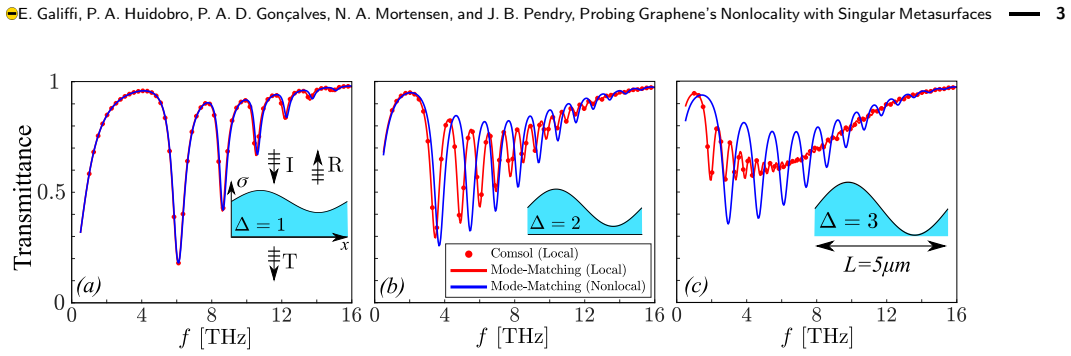
A far-field THz transmission measurement on a graphene grating with period $L = 5\,\mu\mathrm{m}$, Fermi level $E_F = 0.4\,\mathrm{eV}$, and modulation strength $\Delta = 3$ would settle the claim: if the spectrum matches the local-response prediction and the two plasmon resonances continue to merge as the grating deepens, nonlocality is not playing the dominant role claimed here; if the spectrum shows the predicted blueshift, extra broadening, and saturation of the resonance positions, the nonlocal mechanism is confirmed.
Extended reading notes
Core claim
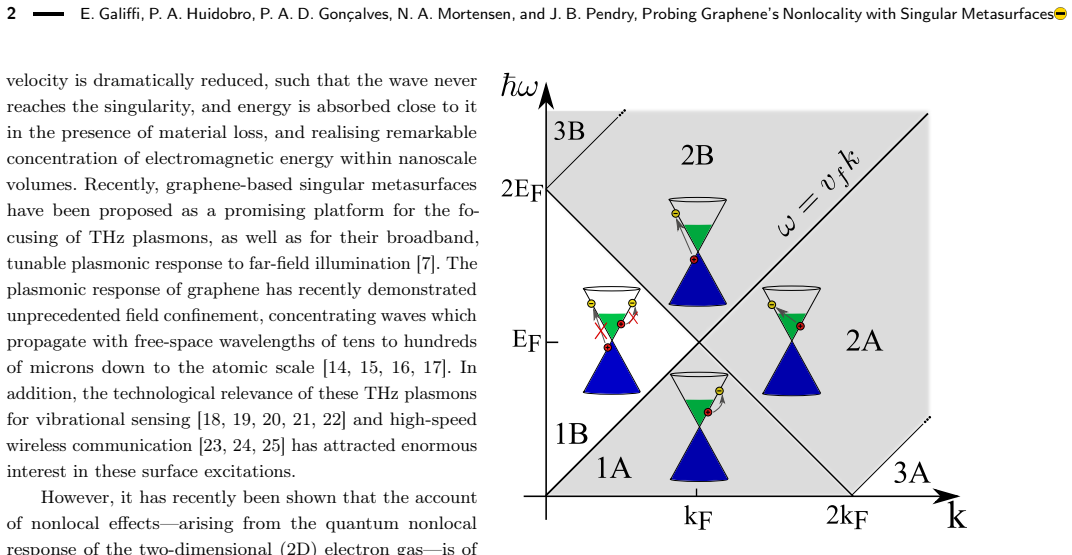
On its own terms, the paper's central discovery is that the singular limit of a graphene conductivity grating is the natural far-field probe of graphene's nonlocal response. Using a Fourier-mode expansion with the full momentum-dependent conductivity $\sigma(k,\omega)$, the authors find that for weak gratings the local and nonlocal transmission spectra coincide, but as the modulation strength $\Delta = -\log_{10}(1-\zeta_1)$ grows to 3, nonlocality becomes dominant: the Fourier components with large momenta see an enhanced conductivity, the resonances blueshift, and the merging of modes predicted by local-response theory is prevented. The mechanism is that the high-momentum components enter the region of phase space where Landau damping from intraband transitions is active, effectively saturating the plasmon wavevector near the electronic one. The paper further claims that a constant surface-conductivity offset, Eq. (6), with $\beta \simeq 1.29$, reproduces the nonlocal spectrum in a local calculation, providing a practical route to including nonlocal effects in more complex setups.
Load-bearing premise
The load-bearing premise is that the periodic doping modulation can be factored outside graphene's nonlocal response kernel, an adiabatic approximation whose validity requires the grating wavenumber $g$ to be far below the Fermi wavevector $k_F$, even though the singular regime drives the dominant plasmon momenta up to $k_F$, where that separation of scales is strained.
Editorial extensions
If this is right
- Far-field THz transmission through a deep graphene conductivity grating becomes a direct probe of graphene's nonlocal conductivity at momenta up to the Fermi wavevector.
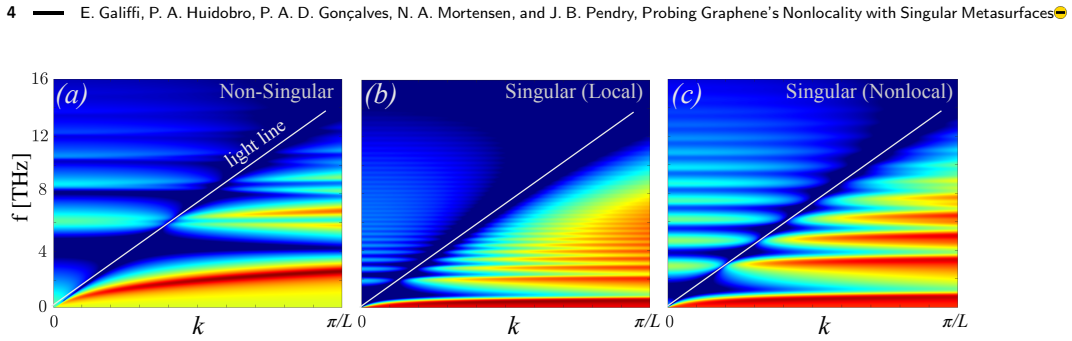
- Nonlocality sets a floor on the effective conductivity at the singular point, so the predicted ultra-flat degenerate bands and the associated field enhancement are partially washed out by intraband Landau damping.
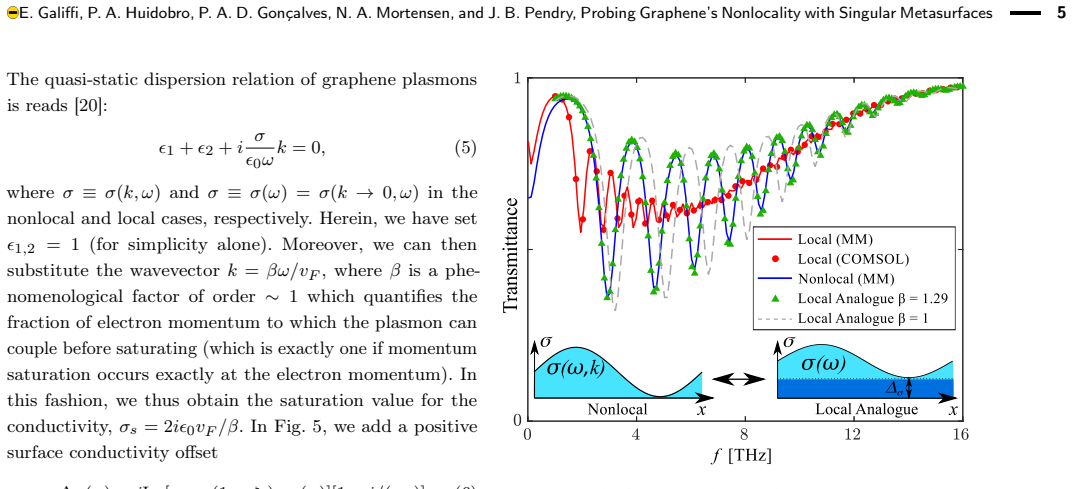
- The single-offset local analogue with $\beta \simeq 1.29$ reproduces the nonlocal spectrum, allowing local-response simulations of more complex graphene metasurfaces without solving the full nonlocal problem.
- The difference between local and nonlocal behaviour is negligible for weak gratings and becomes decisive only as the singular limit is approached, so nonlocal corrections are needed precisely in the regime designed for maximum absorption and field concentration.
Reading between the lines
- Beyond the paper, the same saturation mechanism should operate in any two-dimensional conductor whose doping can be periodically suppressed, so singular gratings could serve as a general spectroscopy of nonlocal response in 2D materials.
- Beyond the paper, the fitted coefficient $\beta \simeq 1.29$ is an experimentally accessible parameter: measuring how it varies with Fermi level, grating period, and temperature would test the simple offset model and yield quantitative information about the momentum at which Landau damping saturates.
- Beyond the paper, the smearing of the singularity implies a practical upper bound on the achievable field enhancement and absorption bandwidth of singular graphene metasurfaces, because the conductivity cannot be driven below the nonlocal saturation value; the paper does not spell out this bound.
Signed reviews
Editorial analysis
A structured set of objections, weighed in public.
Referee Report
Summary. The paper studies the optical response of a graphene metasurface whose local conductivity is periodically suppressed, forming what the authors call a singular conductivity grating. It extends an earlier local-response treatment of such gratings by incorporating the nonlocal (momentum-dependent) conductivity of graphene. The central claims are: (i) in the singular limit the nonlocal response becomes the dominant effect, opposing the merging of surface-plasmon modes and effectively smearing the singularity; (ii) a simple local-analogue model, obtained by adding a constant conductivity offset with a phenomenological factor β ≈ 1.29, reproduces the fully nonlocal transmission spectrum. The nonlocal calculation is performed with a mode-matching method based on Eq. (4), which factorizes the spatially varying doping profile outside a nonlocal conductivity kernel, under an adiabatic approximation stated to require g ≪ k_F. The local limit of the method is benchmarked against COMSOL.
Significance. If the claims hold, the paper would establish a practically relevant platform for probing graphene's nonlocal response with far-field THz spectroscopy, and the proposed local-analogue model would be a useful tool for simulating complex graphene-based structures without a full nonlocal solver. The paper makes productive use of a standard nonlocal conductivity model (Appendix A, based on the Mermin/RPA polarizability), and the local-limit FEM benchmark is a genuine strength. However, the central nonlocal spectra rest on an uncontrolled adiabatic factorization near the singular point, and the key validation of the local analogue model is a fit rather than a prediction. These issues currently leave the quantitative predictions—the shape of the nonlocal spectra and the value β ≈ 1.29—unestablished.
major comments (3)
- [§2, Eq. (4)] The adiabatic factorization that produces Eq. (4) is stated to be accurate as long as g ≪ k_F. This condition fails exactly in the singular region that the paper studies. For the parameters of Fig. 3 (E_F = 0.4 eV, v_F = 9.5 × 10^5 m/s, L = 5 μm), the average Fermi wavevector is k_F,0 ≈ 640 μm^-1 and g = 2π/L ≈ 1.26 μm^-1, so g/k_F,0 ≈ 2 × 10^-3. However, the local doping profile is ζ(x) = 1 + ζ_1 cos(gx), so the local Fermi wavevector scales as k_F(x) = k_F,0 ζ(x). At the singular point for Δ = 3, ζ_min = 10^-3, giving k_F,min ≈ 0.64 μm^-1 and g/k_F,min ≈ 2. The stated validity condition is therefore violated by three orders of magnitude in the very region where the conductivity is suppressed and the field is expected to be most singular. Since Eq. (4) evaluates the nonlocal kernel at the average Fermi level and lets the modulation appear only as a scalar prefactor, the nonlocal spectra in Fig. 3(c) and the claimed smearing of the singularity are not established as consequences of the model.
- [§3, Fig. 5 and Eq. (6)] The local-analogue model is validated against the nonlocal spectrum by choosing β ≃ 1.29, as stated in the text: 'by choosing β≃1.29 this simple model is able to reproduce the entire transmission spectrum with remarkable accuracy, hereby validating the physical assumptions behind our local analogue model'. This is a fitting exercise, not an independent validation. The parameter β is free, and the agreement is therefore a measure of flexibility rather than physical content. To validate the model, the authors would need to determine β from a separate observable or regime (e.g., a different modulation strength, a different frequency range, or reflection data) and then show that the same value predicts the transmission spectrum without further adjustment.
- [§2–§3, method validation] The nonlocal mode-matching method is benchmarked against FEM only in the local-response limit; no comparison with a nonlocal numerical solution is provided. The local benchmark validates the Bloch-mode implementation for a local conductivity, but it cannot validate the nonlocal factorization in Eq. (4), which is the only nonlocal ingredient in the calculation. Given the failure of the stated validity condition at the singular point (see first major comment), the authors should provide a direct numerical solution of the nonlocal integral equation (Eq. 2) for the grating, or an independent nonlocal solver (e.g., a full RPA-based electromagnetic simulation) for at least one of the singular cases, to establish that the predicted spectra are not an artifact of the factorization.
minor comments (4)
- [§3, Eq. (6)] The definition of Δσ(ω) is notationally confusing: the right-hand side contains 'i Im[σ_s − (1−ζ_1)σ_D(ω)]' multiplied by a complex factor, but the text refers to a 'positive surface conductivity offset' and to 'smearing of the imaginary part of the surface conductivity'. Please clarify whether the offset is purely imaginary, purely real, or complex, and show explicitly how the loss tangent is preserved by the second factor.
- [§3, text before Eq. (5)] The sentence 'The quasi-static dispersion relation of graphene plasmons is reads [20]:' contains a typo ('is reads' should be 'reads').
- [Fig. 4 caption] The caption states that 'modes above each band gap become extremely broad, due to their stronger radiative coupling', but the plotted quantity is described only as the logarithm of the absolute value of the reflection coefficient. Please specify the axes and color scale more precisely, and indicate whether the broadening is attributed to radiative coupling or to material loss.
- [Abstract and §2] The abstract and introduction refer to the 'full nonlocal optical response' of graphene, but the calculation uses an adiabatic factorization that assumes a separation of length scales and evaluates the nonlocal kernel at the average Fermi level. This wording overstates the generality of the treatment; a more cautious phrasing, such as 'a nonlocal response model based on the adiabatic approximation', would be more accurate.
Circularity Check
Local-analogue validation is circular: β=1.29 is fitted to the very nonlocal spectrum it is then said to reproduce; the nonlocal core calculation is otherwise a forward application of a published conductivity model.
-
fitted input called prediction
[Section 3 (Results), Eq. (6) and Fig. 5 (local analogue model paragraph)]
"For β = 1, the agreement between the previous nonlocal result (Fig. 3c) and the spectrum obtained using the local analogue model is only qualitative. However, as the figure plainly shows, by choosing β≃ 1.29 this simple model is able to reproduce the entire transmission spectrum with remarkable accuracy, hereby validating the physical assumptions behind our local analogue model, and providing us with a useful and intuitive method for the incorporation of nonlocal effects in the future modelling of complex metasurfaces based on 2D materials."
Eq. (6) introduces a conductivity offset Δσ(ω) = i Im[σ_s − (1−ζ1)σ_D(ω)][1 − i/(ωτ)], where σ_s = 2iε0v_F/β. The parameter β is the only new free parameter in the local analogue model, and it is explicitly chosen in the quoted sentences so that the local FEM spectrum matches the nonlocal transmission spectrum already computed from Eq. (4). The 'entire transmission spectrum' is therefore the fitting target, not an independent output. Calling this agreement a 'validation' of the physical assumptions is circular: the model is constructed with a parameter tuned to the very spectrum it is then said to reproduce. The nonlocal calculation itself is not circular, but this local-analogue claim is a consistency/fitting statement rather than an independent prediction.
full rationale
The main nonlocal calculation in the paper is a forward application of the published nonlocal graphene conductivity model described in Appendix A (quoted from Ref. [20]) to the mode-matching relation Eq. (4). No uniqueness theorem or prior nonlocal result is invoked to forbid alternatives, and the authors explicitly state the validity condition g ≪ k_F for the adiabatic factorization in Eq. (4); whether that condition actually holds at the singular point is a correctness concern about uncontrolled approximation, not circularity. The nonlocal spectra in Figs. 3 and 4 therefore have independent content. The circular step is localized to the local analogue model: β ≈ 1.29 is chosen after seeing the nonlocal spectrum, so the excellent agreement in Fig. 5 is a fit, not a validation. Since the local analogue model is one of the paper's stated contributions, this is partial circularity, but the central nonlocal result does not reduce to that fit.
Assumptions & free parameters
free parameters (1)
- beta =
~1.29
assumptions (5)
- domain assumption The RPA nonlocal conductivity model of Ref. [20] in Appendix A correctly describes graphene's nonlocal optical response.
- domain assumption Adiabatic factorization of the modulated conductivity outside the nonlocal kernel, Eq. (2), valid when the modulation scale is much larger than the Fermi wavelength.
- domain assumption The quasi-static dispersion relation Eq. (5) applies to the graphene plasmon modes considered.
- domain assumption The zero-temperature density-density response function describes the graphene response, with the relaxation-time approximation accounting for loss.
- standard math Mermin's relaxation-time approximation preserves electron number density while introducing finite lifetime.
Cite this review
Pith. "Pith review of Probing Graphene's Nonlocality with Singular Metasurfaces." pith.science (2026). https://pith.science/paper/ZP47W3UJ
@misc{pith2026190809320,
  author       = {Pith},
  title        = {Pith review of: Probing Graphene's Nonlocality with Singular Metasurfaces},
  year         = {2026},
  howpublished = {\url{https://pith.science/paper/ZP47W3UJ}},
  note         = {Machine review of arXiv:1908.09320}
}
read the original abstract
Singular graphene metasurfaces, conductivity gratings realized by periodically suppressing the local doping level of a graphene sheet, have recently been proposed to efficiently harvest THz light and couple it to surface plasmons over broad absorption bands, achieving remarkably high field enhancement. However, the large momentum wavevectors thus attained are sensitive to the nonlocal behaviour of the underlying electron liquid. Here, we extend the theory of singular graphene metasurfaces to account for the full nonlocal optical response of graphene and discuss the resulting impact on the plasmon resonance spectrum. Finally, we propose a simple local analogue model that is able to reproduce the effect of nonlocality in local-response calculations by introducing a constant conductivity offset, which could prove a valuable tool in the modelling of more complex experimental graphene-based platforms.
Figures

Figures from the paper (2 more)
Reference graph
Works this paper leans on
-
[1]
Y. Luo, J. B. Pendry, and A. Aubry. Surface plasmons and singularities. Nano Lett., 10(10):4186–4191, 2010
work page 2010
- [2]
-
[3]
N. M. Estakhri and A. Alù. Physics of unbounded, broadband absorption/gain efficiency in plasmonic nanoparticles. Phys. Rev. B, 87(20):205418, 2013
work page 2013
-
[4]
R.Chikkaraddy,B.DeNijs,F.Benz,S.J.Barrow,O.A. Scherman, E. Rosta, A. Demetriadou, P. Fox, O. Hess, and J. J. Baumberg. Single-molecule strong coupling at room temperature in plasmonic nanocavities.Nature, 535(7610):127, 2016
work page 2016
-
[5]
W. Zhu, R. Esteban, A. G. Borisov, J. J. Baumberg, P. Nordlander, H. J. Lezec, J. Aizpurua, and K. B. Crozier. Quantum mechanical effects in plasmonic structures with subnanometre gaps.Nat. Commun., 7:11495, 2016
work page 2016
-
[6]
A. I. Fernández-Domínguez, S. I. Bozhevolnyi, and N. A. Mortensen. Plasmon-enhanced generation of nonclassical light. ACS Photonics, 5(9):3447–3451, 2018
work page 2018
-
[7]
E. Galiffi, J. B. Pendry, and P. A. Huidobro. Broad- band tunable thz absorption with singular graphene metasurfaces. ACS Nano, 12(2):1006–1013, 2018
work page 2018
-
[8]
F. Yang, P. A. Huidobro, and J. B. Pendry. Transfor- mation optics approach to singular metasurfaces.Phys. Rev. B, 98(12):125409, 2018
work page 2018
Show all 43 references
-
[9]
A. V. Kildishev, A. Boltasseva, and V. M. Sha- laev. Planar photonics with metasurfaces. Science, 339(6125):1232009, 2013
2013
-
[10]
Yu and F
N. Yu and F. Capasso. Flat optics with designer meta- surfaces. Nat. Mater., 13(2):139, 2014
2014
-
[11]
A. M. Shaltout, V. M. Shalaev, and M. L. Brongersma. Spatiotemporal light control with active metasurfaces. Science, 364(6441):eaat3100, 2019
2019
-
[12]
J. B. Pendry, P. A. Huidobro, Y. Luo, and E. Galiffi. Compacteddimensionsandsingularplasmonicsurfaces. Science, 358(6365):915–917, 2017
2017
-
[13]
Galiffi, J
E. Galiffi, J. B. Pendry, and P. A. Huidobro. Singu- lar graphene metasurfaces.EPJ Appl. Metamaterials, 6:10, 2019
2019
-
[14]
D. A. Iranzo, S. Nanot, E. J. C. Dias, I. Epstein, C. Peng, D. K. Efetov, M. B. Lundeberg, R. Par- ret, J. Osmond, J.-Y. Hong, K. Kong, D. R. Englund, N. M. R. Peres, and F. H. L. Koppens. Probing the ultimate plasmon confinement limits with a van der Waals heterostructure. Sc...
2018
-
[15]
M. B. Lundeberg, Y. Gao, R. Asgari, C. Tan, B. Van Duppen, M. Autore, P. Alonso-González, A. Woessner, K. Watanabe, T. Taniguchi, R. Hillen- REFERENCES 7 brand, J. Hone, M. Polini, and F. H. L. Koppens. Tun- ing quantum nonlocal effects in graphene plasmonics. Science, 357(634...
2017
-
[16]
E. J. C. Dias, D. A. Iranzo, P. A. D. Gonçalves, Y. Ha- jati, Y. V. Bludov, A.-P. Jauho, N. A. Mortensen, F. H. L. Koppens, and N. M. R. Peres. Probing non- local effects in metals with graphene plasmons.Phys. Rev. B, 97:245405, 2018
2018
-
[17]
G. X. Ni, A. S. McLeod, Z. Sun, L. Wang, L. Xiong, K. W. Post, S. S. Sunku, B.-Y. Jiang, J. Hone, C. R. Dean, M. M. Fogler, and D. N. Basov. Fundamental limits to graphene plasmonics.Nature, 557(7706):530– 533, 2018
2018
-
[18]
Rodrigo, O
D. Rodrigo, O. Limaj, D. Janner, D. Etezadi, F. J. García de Abajo, V. Pruneri, and H. Altug. Mid- infrared plasmonic biosensing with graphene.Science, 349(6244):165–168, 2015
2015
-
[19]
Y. Li, H. Yan, D. B. Farmer, X. Meng, W. Zhu, R. M. Osgood, T. F. Heinz, and P. Avouris. Graphene plas- mon enhanced vibrational sensing of surface-adsorbed layers. Nano Lett., 14(3):1573–1577, 2014
2014
-
[20]
P. A. D. Gonçalves and N. M. R. Peres.An Introduc- tion to Graphene Plasmonics. World Scientific, Singa- pore, 1st edition, 2016
2016
-
[21]
A. N. Grigorenko, M. Polini, and K. S. Novoselov. Graphene plasmonics.Nat. Photonics, 6(11):749, 2012
2012
-
[22]
Low and P
T. Low and P. Avouris. Graphene plasmonics for terahertz to mid-infrared applications. ACS Nano, 8(2):1086–1101, 2014
2014
-
[23]
Vicarelli, M
L. Vicarelli, M. S. Vitiello, D. Coquillat, A. Lombardo, A. C. Ferrari, W. Knap, M. Polini, V. Pellegrini, and A. Tredicucci. Graphene field-effect transistors as room-temperature terahertz detectors. Nat. Mater., 11(10):865–871, 2012
2012
-
[24]
Poumirol, P
J.-M. Poumirol, P. Q. Liu, T. M. Slipchenko, A. Y. Nikitin, L. Martín-Moreno, J. Faist, and A. B. Kuz- menko. Electrically controlled terahertz magneto- optical phenomena in continuous and patterned graphene. Nat. Commun., 8:14626, 2017
2017
-
[25]
X. Yang, A. Vorobiev, A. Generalov, M. A. Andersson, and J. Stake. A flexible graphene terahertz detector. Appl. Phys. Lett., 111(2):021102, 2017
2017
-
[26]
S. Raza, S. I. Bozhevolnyi, M. Wubs, and N. A. Mortensen. Nonlocal optical response in metallic nanos- tructures. J. Phys. Cond. Mater., 27(18):183204, 2015
2015
-
[27]
A. D. Boardman.Electromagnetic surface modes. John Wiley & Sons, 1982
1982
-
[28]
Schwartz and W
C. Schwartz and W. L. Schaich. Hydrodynamic models of surface plasmons.Phys. Rev. B, 26:7008–7011, 1982
1982
-
[29]
F. J. García de Abajo. Nonlocal effects in the plas- mons of strongly interacting nanoparticles, dimers, and waveguides. J. Phys. Chem. C, 112(46):17983–17987, 2008
2008
-
[30]
Toscano, S
G. Toscano, S. Raza, W. Yan, C. Jeppesen, S. Xiao, M. Wubs, A.-P. Jauho, S. I. Bozhevolnyi, and N. A. Mortensen. Nonlocal response in plasmonic waveguid- ing with extreme light confinement.Nanophotonics, 2(3):161–166, 2013
2013
-
[31]
Yang, Y.-T
F. Yang, Y.-T. Wang, P. A. Huidobro, and J. B. Pendry. Nonlocal effects in singular plasmonic metasurfaces. Phys. Rev. B, 99:165423, 2019
2019
-
[32]
Y. Luo, A. I. Fernández-Domínguez, A. Wiener, S. A. Maier, and J. B. Pendry. Surface plasmons and nonlo- cality: a simple model.Phys. Rev. Lett., 111(9):093901, 2013
2013
-
[33]
N. A. Mortensen, S. Raza, M. Wubs, T. Søndergaard, and S. I. Bozhevolnyi. A generalized nonlocal optical response theory for plasmonic nanostructures. Nat. Commun., 5:3809, 2014
2014
-
[34]
W. Yan, M. Wubs, and N. A. Mortensen. Projected dipole model for quantum plasmonics.Phys. Rev. Lett., 115:137403, 2015
2015
-
[35]
Christensen, W
T. Christensen, W. Yan, A.-P. Jauho, M. Soljačić, and N. A. Mortensen. Quantum corrections in nanoplas- monics: Shape, scale, and material.Phys. Rev. Lett., 118:157402, 2017
2017
-
[36]
P. A. D. Gonçalves, T. Christensen, N. Rivera, A.-P. Jauho, N. A. Mortensen, and M. Sol- jačić. Plasmon-emitter interactions at the nanoscale. arXiv:1904.09279, 2019
1904 arXiv
-
[37]
H. Kwon, D. Sounas, A. Cordaro, A. Polman, and A. Alù. Nonlocal metasurfaces for optical signal pro- cessing. Phys. Rev. Lett., 121(17):173004, 2018
2018
-
[38]
H. Yan, T. Low, W. Zhu, Y. Wu, M. Freitag, X. Li, F. Guinea, P. Avouris, and F. Xia. Damping pathways of mid-infrared plasmons in graphene nanostructures. Nat. Photonics, 7(5):394–399, 2013
2013
-
[39]
T. M. Slipchenko, M. L. Nesterov, L. Martín-Moreno, and A. Y. Nikitin. Analytical solution for the diffrac- tion of an electromagnetic wave by a graphene grating. J. Opt., 15(11):114008, 2013
2013
-
[40]
P. A. Huidobro, M. Kraft, R. Kun, S. A. Maier, and J. B. Pendry. Graphene, plasmons and transformation optics. J. Opt., 18(4):044024, 2016
2016
-
[41]
Fan, N.-H
Y. Fan, N.-H. Shen, T. Koschny, and C. M. Souk- oulis. Tunable terahertz meta-surface with graphene cut-wires. ACS Photonics, 2(1):151–156, 2015
2015
-
[42]
Kraft, Y
M. Kraft, Y. Luo, S. A. Maier, and J. B. Pendry. De- signing plasmonic gratings with transformation optics. Phys. Rev. X, 5:031029, 2015
2015
-
[43]
N. D. Mermin. Lindhard dielectric function in the 8 REFERENCES relaxation-time approximation. Phys. Rev. B, 1:2362– 2363, Mar 1970
1970
Reviewed August 14, 2026 · model on record in the stance chip above.
Discussion (0). Continue with ORCID to comment.