REVIEW 4 major objections 7 minor 38 references
advPattern: Physical-World Attacks on Deep Person Re-Identification via Adversarially Transformable Patterns
T0 review · 4 major / 7 minor · reviewed 2026-08-14 · deepseek-v4-flash
Pith's one-line read Adversarial clothing patterns can hide or impersonate a person across surveillance cameras.
desk verdict First physical-world re-ID attack with a genuinely new cross-camera pattern idea, but the headline physical-world numbers rest on a baseline inconsistency and tiny effective samples. read the letter →
The pith
A machine-rendered reading of the paper's core claim, the machinery that carries it, and where it could break.
The reading
What carries the argument
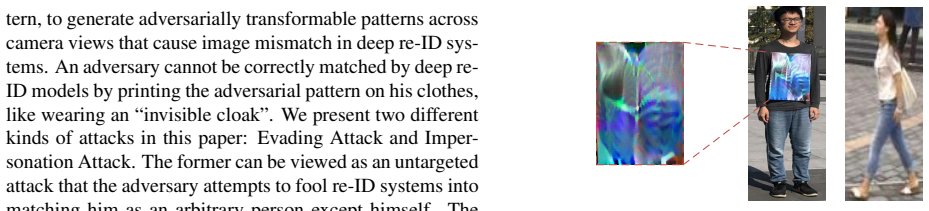
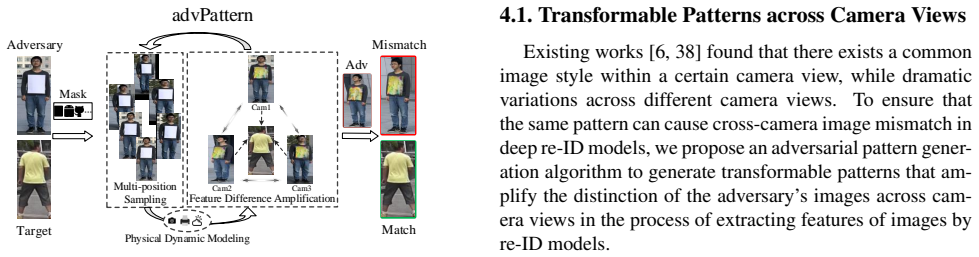
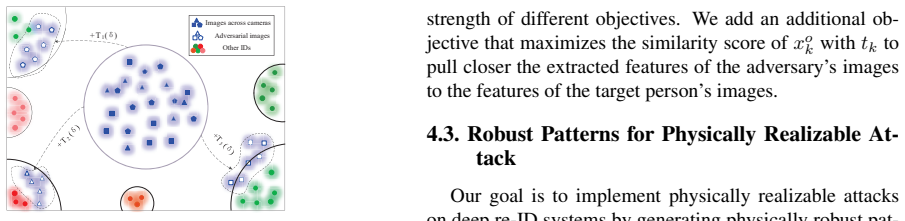
The key machinery is advPattern, an iterative optimization that adjusts a clothing pattern by minimizing or maximizing similarity scores over image pairs. For each image the pattern is perspectively transformed with $T_i(\delta)$ and overlaid via $o(x_i, T_i(\delta))$; a multi-position sampling strategy augments the generating set with varied distances and angles, and a degradation function $\phi(\cdot)$ randomly changes brightness or blurs images to simulate physical dynamics. A total-variation term smooths the pattern, a mask $M_x$ shapes it like a decorative logo, and the search space is constrained to a printable color interval $P$. This machinery converts an appearance change into a controlled shift of the person's location in the re-ID feature space, which is what makes evasion and impersonation possible.
What would settle it
A controlled experiment in which the same pattern is printed by two different printers and photographed under controlled lighting at the same 14 positions: if the attack success rate changes materially between printers or lighting conditions, the degradation function $\phi(\cdot)$ does not capture the physical factors the paper claims it models.
Extended reading notes
Core claim
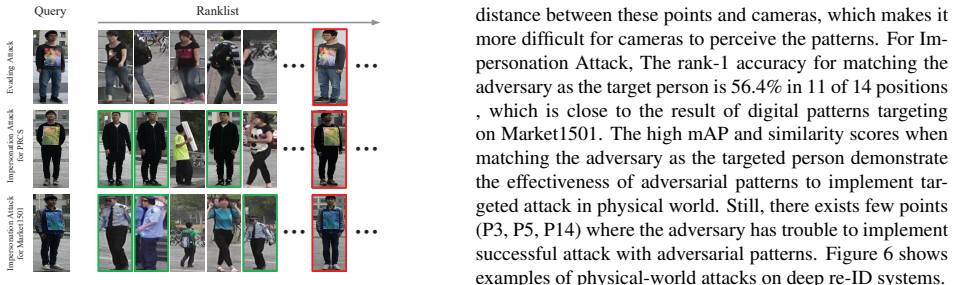
The central discovery is that adversarial patterns printed on clothing can transfer across camera views and fool deep re-ID models in the physical world. Concretely, the paper claims that a wearer's rank-1 matching accuracy drops from 87.9% to 27.1% under an Evading Attack, and that under an Impersonation Attack the wearer is matched to a chosen target person with 47.1% rank-1 accuracy and 67.9% mAP. The attack is achieved without modifying any stored image: the adversary only wears the pattern, and the optimization makes the re-ID feature extractor pull same-camera images together while pushing cross-camera images apart (evasion), or pull the wearer's features toward the target's features (impersonation). The paper further claims that both a siamese network and a classification-based embedding network are vulnerable.
Load-bearing premise
The attack works only if overlaying the digitally generated pattern and applying the brightness/blur degradation function faithfully reproduces how the printed fabric appears in real camera views across distances and angles.
Editorial extensions
If this is right
- If the central claim holds, a person wearing the generated pattern can expect to evade cross-camera matching in roughly three of every four physical-world queries (average rank-1 down to 27.1%).
- The same pattern can make a re-ID system name a chosen target for the wearer almost half the time (47.1% rank-1) under impersonation, meaning targeted misidentification is physically realizable.
- Attack effectiveness varies with position: at some camera distances and angles the pattern gives 0% matching success, while at others it leaves evasion rank-1 at 60-80%, so the attack is position-dependent.
- Both siamese-style and classification-style deep re-ID models are vulnerable, which suggests the vulnerability is not an artifact of one architecture.
Reading between the lines
- If the pattern's effectiveness transfers to unseen re-ID architectures, a practical countermeasure would be to train re-ID models with adversarial-pattern augmentation so identity features ignore clothing texture; this is a testable extension the paper does not explore.
- Because four of the fourteen physical test positions showed 0% Evading Attack success, one extension is to sample more positions and lighting conditions during optimization; the paper's own data implies the current degradation model under-covers some real-world conditions.
- Cross-dataset impersonation (target from Market1501) succeeded less than same-dataset impersonation, suggesting that domain gap, not just pattern optimization, limits physical impersonation; measuring how much of the gap is due to image style could guide improved transfer.
- The white-box assumption is strong; a natural next test is whether patterns optimized on one model transfer to a black-box re-ID system, since adversarial transferability has been shown in classification.
Signed reviews
Editorial analysis
A structured set of objections, weighed in public.
Referee Report
Summary. The paper proposes advPattern, an optimization-based method to generate printable clothing patterns that cause deep person re-identification (re-ID) models to fail to match the wearer (Evading Attack) or to match the wearer as a chosen target person (Impersonation Attack). The pattern is optimized over a multi-position sampling set with perspective transforms, a mask to keep it decorative-looking, total variation smoothing, and a degradation model for physical-world robustness. Experiments are reported in the digital domain on two re-ID models using Market1501 and a new PRCS dataset, and in the physical world with a printed pattern worn by five adversaries at 14 positions under three cameras. The headline claims are that the rank-1 accuracy of the re-ID model for matching the adversary drops from 87.9% to 27.1% under Evading Attack, and that Impersonation Attack reaches 47.1% rank-1 and 67.9% mAP in the physical world.
Significance. If the physical-world claims are established, this would be an important contribution: it is, to the authors' knowledge, the first demonstration of physical-world adversarial clothing against deep re-ID, and it extends prior physical adversarial examples from classifiers to an image retrieval task. The optimization framework is clearly specified, the digital experiments are run on two different model architectures, the PRCS dataset is a useful resource, and the authors release code. The core idea of learning transformable patterns via multi-position sampling with a degradation function is sensible. However, the paper's central quantitative claims rest on the physical-world evaluation, and that evaluation currently has methodological gaps—missing no-pattern controls, an apparent mismatch between the stated and effective sample size, and internal numeric inconsistencies—that prevent the reader from verifying the headline numbers. The contribution is therefore promising but not yet rigorously supported.
major comments (4)
- [Table 4, Section 5.3, Abstract] The physical-world Evading Attack drop is computed against an implicit 100% no-pattern baseline: in every row of Table 4, Δrank-1 = 100% − rank-1. The paper states that images were taken 'with/without the adversarial pattern', but no per-point no-pattern rank-1 or mAP values are reported, so the reader cannot tell how much of the drop is due to the pattern and how much is due to the re-ID model's baseline error at that distance/angle. The abstract's 'decreases from 87.9% to 27.1%' compares the physical-world attacked rank-1 against the digital PRCS rank-1 of model A from Table 1, not against a paired physical-world no-pattern measurement. This apples-to-oranges comparison is load-bearing for the central claim and must be replaced with a proper paired control.
- [Section 5.3, Table 4] The granularity of the physical-world results is inconsistent with the stated protocol. The text says '100 queries for each testing point are performed', yet all reported rank-1 values are multiples of 20% (0%, 20%, 40%, 60%, 80%), which implies only 5 binary subject-level outcomes per point. With 5 adversaries, the per-point estimates have very wide confidence intervals (e.g., a reported 0% has an upper 95% bound around 52%), and the averaged 27.1% is based on at most 70 independent identity-level outcomes. The paper must report the actual number of queries and per-identity/per-query counts, or explicitly state that the statistics are subject-level, and should provide error bars or a significance test.
- [Section 4.3, Eqs. (8) and (9)] The optimization formulations are internally inconsistent. In Eq. (8), the Evading Attack minimizes a loss plus the total variation penalty κ·TV(δ), which correctly encourages smoothness. In Eq. (9), the Impersonation Attack is written as an arg max with a positive term +κ·TV(δ); maximizing total variation is the opposite of smoothing and contradicts the stated goal of producing 'smooth and consistent patches'. In addition, the text following Eq. (8) says 'where λ and κ are hyperparameters', but λ does not appear in Eq. (8). These inaccuracies make it impossible to reproduce the exact objective used for the physical impersonation pattern.
- [Section 5.3, experiment setup] The physical-world evaluation lacks the baselines and ablations needed to attribute the results to the proposed algorithm. No comparison is made to a random pattern, a plain/texture pattern, an unoptimized mask, or a pattern optimized without the multi-position/degradation components. Furthermore, physical Evading Attack is tested only with model A and physical Impersonation Attack only with model B, so there is no evidence of cross-model generalization of the physically printed pattern. Adding at least a random-pattern control and reporting both attack types on both models would substantially strengthen the claims.
minor comments (7)
- [Section 5.3, text vs. Table 4] The text states 'The average Δrank-1 and ΔmAP are 62.2% and 61.1%', but Table 4 shows the average Δrank-1 as 74.3%; only ΔmAP (61.1%) matches. Please correct the inconsistency.
- [Section 5.3, text] The sentences 'For Evading Attack, the average rank-1 accuracy drops to 11.1% in 9 of 14 positions' and 'The rank-1 accuracy for matching the adversary as the target person is 56.4% in 11 of 14 positions' are unclear: are these averages over the selected subsets, and how do they relate to the overall averages of 27.1% and 47.1%? Please clarify and report the per-subset values directly.
- [Section 4.1, Eq. (1)] The symbol D(δ) in the threat-model objective is introduced as a measure of the 'reality' of the pattern, but its definition is never given and it does not appear in the implemented optimization objectives (Eqs. (3)–(9)). Either define D(δ) and show how it is incorporated, or remove it from the formal problem statement to avoid a dangling term.
- [Section 4.3] The text mentions that NPS was introduced but 'hard to balance' and then replaced by a color-interval constraint P; this is fine, but the sentence structure reads as if NPS were still part of the final objective. Please rephrase to state clearly that NPS is not used in the final formulation.
- [Section 5.1, Table 1] The similarity-score column (ss) is not defined; the reader must infer that it is an average pairwise similarity. Please provide the exact formula or definition, as it is later used to interpret the impact of attacks.
- [Figure 5 and Section 5.3] There is a typo in 'the filed of cameras views'; and the left-top point is said to be omitted but its position is not indicated in the figure. Also, the distance range in the text (5m–10m) does not match the example coordinates in Figure 5 (e.g., P1 at 4.39m). Please align these details.
- [Section 4.3, Eq. (7)] The total variation term appears to be an L2 TV; if the intent is to encourage piecewise-smooth patches, an L1 TV is often used. The choice is not motivated. This is a minor presentation issue but should be clarified.
Circularity Check
No circular derivation: pattern-generation objectives are standard attack objectives, and the paper's independent content lies in generalization and physical transfer; the baseline-reporting concern is a correctness issue, not circularity.
full rationale
The paper's pattern-generation objectives (Eqs. 3, 5, 8 for Evading Attack; Eqs. 4, 6, 9 for Impersonation Attack) optimize the same similarity function f_theta that is later used to measure rank-1 accuracy. This is the standard definition of an adversarial attack, not a circular derivation: the paper does not claim to predict a score from first principles; it reports the measured success of an optimized pattern. The independent content lies in generalization to unseen testing images (Tables 2-3 TS results) and to physical-world positions not used during optimization (Table 4), which are not forced by the training objective. Market1501 also provides an external benchmark for digital impersonation. The paper uses a self-built PRCS dataset, but evaluation against a self-built dataset is not circular. There are no load-bearing self-citations: references [36,37] are by different authors, and [25] is cited only for the TV/NPS technique, not as a central premise. The main methodological concern is that Table 4's Delta rank-1 appears to be computed against a 100% no-pattern baseline, while the abstract compares against the 87.9% PRCS rank-1; this is a measurement/reporting issue and a correctness risk, not an equivalence of input and output by construction. Therefore the circularity score is 0.
Assumptions & free parameters
free parameters (6)
- alpha
- beta
- lambda1, lambda2
- kappa
- mask Mx
- color interval P
assumptions (5)
- domain assumption White-box access to the target re-ID model f_theta
- domain assumption The overlay operation o(x, T(delta)) and perspective transformation T_i accurately simulate how a printed pattern appears on a person in camera views
- domain assumption The augmented generating set X_C approximates the distribution of viewing transformations
- domain assumption The degradation function phi (random brightness and blur) models physical conditions well enough
- domain assumption Constraining delta to color interval P and minimizing TV is sufficient for printability and unobtrusiveness
Cite this review
Pith. "Pith review of advPattern: Physical-World Attacks on Deep Person Re-Identification via Adversarially Transformable Patterns." pith.science (2026). https://pith.science/paper/6QK7JF3S
@misc{pith2026190809327,
  author       = {Pith},
  title        = {Pith review of: advPattern: Physical-World Attacks on Deep Person Re-Identification via Adversarially Transformable Patterns},
  year         = {2026},
  howpublished = {\url{https://pith.science/paper/6QK7JF3S}},
  note         = {Machine review of arXiv:1908.09327}
}
read the original abstract
Person re-identification (re-ID) is the task of matching person images across camera views, which plays an important role in surveillance and security applications. Inspired by great progress of deep learning, deep re-ID models began to be popular and gained state-of-the-art performance. However, recent works found that deep neural networks (DNNs) are vulnerable to adversarial examples, posing potential threats to DNNs based applications. This phenomenon throws a serious question about whether deep re-ID based systems are vulnerable to adversarial attacks. In this paper, we take the first attempt to implement robust physical-world attacks against deep re-ID. We propose a novel attack algorithm, called advPattern, for generating adversarial patterns on clothes, which learns the variations of image pairs across cameras to pull closer the image features from the same camera, while pushing features from different cameras farther. By wearing our crafted "invisible cloak", an adversary can evade person search, or impersonate a target person to fool deep re-ID models in physical world. We evaluate the effectiveness of our transformable patterns on adversaries'clothes with Market1501 and our established PRCS dataset. The experimental results show that the rank-1 accuracy of re-ID models for matching the adversary decreases from 87.9% to 27.1% under Evading Attack. Furthermore, the adversary can impersonate a target person with 47.1% rank-1 accuracy and 67.9% mAP under Impersonation Attack. The results demonstrate that deep re-ID systems are vulnerable to our physical attacks.
Figures

Figures from the paper (3 more)

Reference graph
Works this paper leans on
-
[1]
An improved deep learning architecture for person re-identification
Ejaz Ahmed, Michael Jones, and Tim K Marks. An improved deep learning architecture for person re-identification. In Proc. of IEEE CVPR, pages 3908–3916, 2015
work page 2015
-
[2]
Synthesizing robust ad- versarial examples
Anish Athalye and Ilya Sutskever. Synthesizing robust ad- versarial examples. arXiv:1707.07397, 2017
arXiv 2017
-
[3]
Towards evaluating the robustness of neural networks
Nicholas Carlini and David Wagner. Towards evaluating the robustness of neural networks. In Proc. of IEEE S&P, pages 39–57, 2017
work page 2017
-
[4]
Deep ranking for person re-identification via joint representa- tion learning
Shi-Zhe Chen, Chun-Chao Guo, and Jian-Huang Lai. Deep ranking for person re-identification via joint representa- tion learning. IEEE Transactions on Image Processing , 25(5):2353–2367, 2016
work page 2016
-
[5]
A multi-task deep network for person re- identification
Weihua Chen, Xiaotang Chen, Jianguo Zhang, and Kaiqi Huang. A multi-task deep network for person re- identification. In Proc. of AAAI, pages 3988–3994, 2017
work page 2017
-
[6]
Person re-identification by multi-channel parts-based cnn with improved triplet loss function
De Cheng, Yihong Gong, Sanping Zhou, Jinjun Wang, and Nanning Zheng. Person re-identification by multi-channel parts-based cnn with improved triplet loss function. In Proc. of IEEE CVPR, pages 1335–1344, 2016
work page 2016
-
[7]
Shengyong Ding, Liang Lin, Guangrun Wang, and Hongyang Chao. Deep feature learning with relative distance comparison for person re-identification.Pattern Recognition, 48(10):2993–3003, 2015
work page 2015
-
[8]
Robust physical-world attacks on deep learning visual classification
Kevin Eykholt, Ivan Evtimov, Earlence Fernandes, Bo Li, Amir Rahmati, Chaowei Xiao, Atul Prakash, Tadayoshi Kohno, and Dawn Song. Robust physical-world attacks on deep learning visual classification. In Proc. of IEEE CVPR, pages 1625–1634, 2018
work page 2018
Show all 38 references
-
[9]
The re-identification challenge
Shaogang Gong, Marco Cristani, Chen Change Loy, and Timothy M Hospedales. The re-identification challenge. In Person re-identification, pages 1–20. 2014
2014
-
[10]
Explaining and harnessing adversarial exam- ples
Ian J Goodfellow, Jonathon Shlens, and Christian Szegedy. Explaining and harnessing adversarial exam- ples. arXiv:1412.6572
-
[11]
Adversarial pertur- bations against deep neural networks for malware classifica- tion
Kathrin Grosse, Nicolas Papernot, Praveen Manoharan, Michael Backes, and Patrick McDaniel. Adversarial pertur- bations against deep neural networks for malware classifica- tion. arXiv:1606.04435, 2016
2016 arXiv
-
[12]
Deep residual learning for image recognition
Kaiming He, Xiangyu Zhang, Shaoqing Ren, and Jian Sun. Deep residual learning for image recognition. In Proc. of IEEE CVPR, pages 770–778, 2016
2016
-
[13]
Adversarial exam- ples for generative models
Jernej Kos, Ian Fischer, and Dawn Song. Adversarial exam- ples for generative models. In Proc. of IEEE SPW , pages 36–42, 2018
2018
-
[14]
Imagenet classification with deep convolutional neural net- works
Alex Krizhevsky, Ilya Sutskever, and Geoffrey E Hinton. Imagenet classification with deep convolutional neural net- works. In Proc. of NIPS, pages 1097–1105, 2012
2012
-
[15]
Ad- versarial examples in the physical world
Alexey Kurakin, Ian Goodfellow, and Samy Bengio. Ad- versarial examples in the physical world. arXiv:1607.02533, 2016
2016 arXiv
-
[16]
Feature cross-substitution in adversarial classification
Bo Li and Yevgeniy V orobeychik. Feature cross-substitution in adversarial classification. In Proc. of NIPS, pages 2087– 2095, 2014
2014
-
[17]
Scalable optimization of randomized operational decisions in adversarial classifica- tion settings
Bo Li and Yevgeniy V orobeychik. Scalable optimization of randomized operational decisions in adversarial classifica- tion settings. In Proc. of AISTATS, pages 599–607, 2015
2015
-
[18]
Deep- reid: Deep filter pairing neural network for person re- identification
Wei Li, Rui Zhao, Tong Xiao, and Xiaogang Wang. Deep- reid: Deep filter pairing neural network for person re- identification. In Proc. of IEEE CVPR, pages 152–159, 2014
2014
-
[19]
Delving into transferable adversarial examples and black- box attacks
Yanpei Liu, Xinyun Chen, Chang Liu, and Dawn Song. Delving into transferable adversarial examples and black- box attacks. arXiv:1611.02770, 2016
2016 arXiv
-
[20]
Multi- camera activity correlation analysis
Chen Change Loy, Tao Xiang, and Shaogang Gong. Multi- camera activity correlation analysis. InProc. of IEEE CVPR, pages 1988–1995, 2009
1988
-
[21]
Understanding deep image representations by inverting them
Aravindh Mahendran and Andrea Vedaldi. Understanding deep image representations by inverting them. In Proc. of IEEE CVPR, pages 5188–5196, 2015
2015
-
[22]
Deepfool: a simple and accurate method to fool deep neural networks
Seyed-Mohsen Moosavi-Dezfooli, Alhussein Fawzi, and Pascal Frossard. Deepfool: a simple and accurate method to fool deep neural networks. In Proc. of IEEE CVPR, pages 2574–2582, 2016
2016
-
[23]
Transferability in machine learning: from phe- nomena to black-box attacks using adversarial samples
Nicolas Papernot, Patrick McDaniel, and Ian Goodfel- low. Transferability in machine learning: from phe- nomena to black-box attacks using adversarial samples. arXiv:1605.07277, 2016
2016 arXiv
-
[24]
The limitations of deep learning in adversarial settings
Nicolas Papernot, Patrick McDaniel, Somesh Jha, Matt Fredrikson, Z Berkay Celik, and Ananthram Swami. The limitations of deep learning in adversarial settings. In Proc. of IEEE EuroS&P, pages 372–387, 2016
2016
-
[25]
Accessorize to a crime: Real and stealthy attacks on state-of-the-art face recognition
Mahmood Sharif, Sruti Bhagavatula, Lujo Bauer, and Michael K Reiter. Accessorize to a crime: Real and stealthy attacks on state-of-the-art face recognition. In Proc. of ACM CCS, pages 1528–1540, 2016
2016
-
[26]
Very deep convolutional networks for large-scale image recognition
Karen Simonyan and Andrew Zisserman. Very deep convolutional networks for large-scale image recognition. arXiv:1409.1556, 2014
2014 arXiv
-
[27]
Going deeper with convolutions
Christian Szegedy, Wei Liu, Yangqing Jia, Pierre Sermanet, Scott Reed, Dragomir Anguelov, Dumitru Erhan, Vincent Vanhoucke, and Andrew Rabinovich. Going deeper with convolutions. In Proc. of IEEE CVPR, pages 1–9, 2015
2015
-
[28]
Intriguing properties of neural networks
Christian Szegedy, Wojciech Zaremba, Ilya Sutskever, Joan Bruna, Dumitru Erhan, Ian Goodfellow, and Rob Fergus. Intriguing properties of neural networks. arXiv:1312.6199, 2013
2013 arXiv
-
[29]
Joint learning of single-image and cross- image representations for person re-identification
Faqiang Wang, Wangmeng Zuo, Liang Lin, David Zhang, and Lei Zhang. Joint learning of single-image and cross- image representations for person re-identification. In Proc. of IEEE CVPR, pages 1288–1296, 2016
2016
-
[30]
Intelligent multi-camera video surveil- lance: A review
Xiaogang Wang. Intelligent multi-camera video surveil- lance: A review. Pattern recognition letters , 34(1):3–19, 2013
2013
-
[31]
Learning deep feature representations with domain guided dropout for person re-identification
Tong Xiao, Hongsheng Li, Wanli Ouyang, and Xiaogang Wang. Learning deep feature representations with domain guided dropout for person re-identification. In Proc. of IEEE CVPR, pages 1249–1258, 2016
2016
-
[32]
Deep metric learning for person re-identification
Dong Yi, Zhen Lei, Shengcai Liao, and Stan Z Li. Deep metric learning for person re-identification. In Proc. of IEEE ICPR, pages 34–39, 2014
2014
-
[33]
Harry potter’s marauder’s map: Localizing and tracking multiple persons-of-interest by nonnegative discretization
Shoou-I Yu, Yi Yang, and Alexander Hauptmann. Harry potter’s marauder’s map: Localizing and tracking multiple persons-of-interest by nonnegative discretization. InProc. of IEEE CVPR, pages 3714–3720, 2013
2013
-
[34]
Age progres- sion/regression by conditional adversarial autoencoder
Zhifei Zhang, Yang Song, and Hairong Qi. Age progres- sion/regression by conditional adversarial autoencoder. In Proc. of IEEE CVPR, pages 5810–5818, 2017
2017
-
[35]
Im- age super-resolution by neural texture transfer
Zhifei Zhang, Zhaowen Wang, Zhe Lin, and Hairong Qi. Im- age super-resolution by neural texture transfer. In Proc. of IEEE CVPR, pages 7982–7991, 2019
2019
-
[36]
Person re-identification: Past, present and future
Liang Zheng, Yi Yang, and Alexander G Haupt- mann. Person re-identification: Past, present and future. arXiv:1610.02984, 2016
2016 arXiv
-
[37]
A discrimi- natively learned cnn embedding for person reidentification
Zhedong Zheng, Liang Zheng, and Yi Yang. A discrimi- natively learned cnn embedding for person reidentification. ACM Transactions on Multimedia Computing, Communica- tions, and Applications (TOMM), 14(1):13, 2017
2017
-
[38]
Camera style adaptation for person re- identification
Zhun Zhong, Liang Zheng, Zhedong Zheng, Shaozi Li, and Yi Yang. Camera style adaptation for person re- identification. In Proc. of IEEE CVPR , pages 5157–5166, 2018
2018
Reviewed August 14, 2026 · model on record in the stance chip above.
Discussion (0). Continue with ORCID to comment.