REVIEW 3 major objections 6 minor 17 references
Resource Allocation for Non-Orthogonal Multiple Access (NOMA) Enabled LPWA Networks
T0 review · 3 major / 6 minor · reviewed 2026-08-14 · deepseek-v4-flash
Pith's one-line read NOMA scheduling and power allocation can raise a 4,000-node LPWA network's minimum rate by about 100 dB in simulation.
desk verdict Competent NOMA-LPWA resource allocation paper whose 100 dB headline gain is a Shannon-capacity artifact, not a LoRa result; worth peer review but the authors should be pushed to fix the rate model. read the letter →
The pith
A machine-rendered reading of the paper's core claim, the machinery that carries it, and where it could break.
The reading
What carries the argument
The carrying mechanism is power-domain NOMA with successive interference cancellation (SIC): multiple nodes occupy the same channel and transmission-time resource block, separated only by power. The gateway orders the nodes by normalized channel gain $\gamma_{w,n}=g_{w,n}/\sigma_w^2$, decodes the strongest first, subtracts it, and moves down the list, so later nodes see only weaker interferers. The algorithmic machinery is the decomposition of the NP-hard max-min problem: a low-complexity channel clustering that sorts all nodes by $\gamma$ and deals them across channels to maximize gain separation; two transmission-time/spreading-factor allocation schemes (unfair, which minimizes collision time for interferers, and fair, which equalizes $N_k^f T_f$); and an optimal power allocation run as a one-dimensional search over the auxiliary rate target $\tau$, solving a convex feasibility problem for each value. Algorithm 1 ties the three pieces together.
What would settle it
Build or simulate a LoRa NOMA link with two nodes on the same channel and spreading factor, apply the paper's power allocation, and measure the weaker node's decoded rate against $B \log_2(1+\mathrm{SINR})$ after SIC; if the measured rate falls consistently below the Shannon value or outages occur at the predicted operating points, the central claim is falsified. Scaling the same measurement to 4,000 nodes in the paper's deployment model would test whether the 100 dB minimum-rate gain survives non-ideal cancellation.
Extended reading notes
Core claim
The paper's central claim is that uplink power-domain NOMA, applied to LPWA networks with a single gateway, converts the interference that limits today's LoRa-class networks into a manageable decoding order, and that the corresponding resource allocation problem is tractable when split into channel, transmission-time, and power sub-problems. For a cluster of nodes sharing one channel and one transmission time, the gateway decodes in decreasing order of normalized channel gain $\gamma_{w,n}=g_{w,n}/\sigma_w^2$, subtracting each stronger signal before decoding the next; weaker nodes therefore see less interference. The achievable rate of node $n$ is Shannon's $R_n^{\mathrm{NOMA}} = \sum_w B_w \xi_{w,n} \log_2(1+\phi_{w,n}^{\mathrm{NOMA}})$ after cancellation, and the paper maximizes the minimum such rate subject to power limits, receiver-sensitivity thresholds, and the NOMA decoding order. The simulation result is that the proposed channel clustering, spreading-factor allocation, and power optimization improve the minimum uplink transmission rate by about 100 dB compared with a non-NOMA LPWA baseline at 4,000 active nodes.
Load-bearing premise
The rate gains assume the gateway cancels interference perfectly and that nodes use capacity-achieving codes; if real SIC has error propagation or LoRa's chirp codes fall short of Shannon's formula, the 100 dB improvement would shrink.
Editorial extensions
If this is right
- A single gateway can scale to thousands of active nodes with bounded minimum rate, where current LoRa-style networks would enter a collision avalanche.
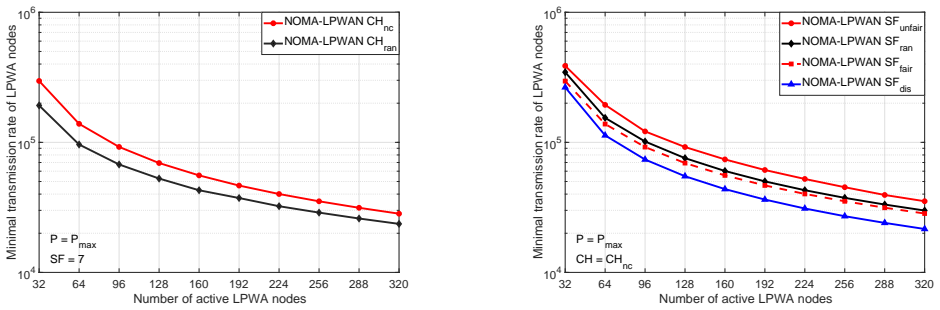
- Ranking nodes by normalized channel gain and distributing them across channels before assigning spreading factors is enough to beat random allocation by over 50% in minimum rate.
- The 'unfair' spreading-factor allocation, which puts fewer nodes on longer transmission times, outperforms equal, random, and distance-based assignments because it shortens interferers' collision windows.
- Optimizing power after the channel and spreading-factor assignments improves the worst node's rate and can reduce transmit power, extending node battery life.
- The max-min objective gives throughput fairness by construction, so the gains do not come at the cost of starving the weakest node.
Reading between the lines
- A testable extension is to run the same allocation on a small NOMA-LoRa testbed with two or three colliding nodes and measure post-SIC SINR; if real receivers cannot approach the Shannon rate after cancellation, the 100 dB gain is an upper bound rather than an operating point.
- The max-min metric likely understates the compromise with total throughput; a follow-on could optimize a weighted combination of minimum rate and sum rate, where NOMA's benefits may look different.
- The same clustering logic could be applied to other LPWA technologies with repeated preambles, such as NB-IoT, since they also map to channel and transmission-time resource blocks.
- Because the scheme only changes gateway receive processing and node transmit power, it suggests a migration path for existing LoRa hardware, provided spreading-factor orthogonality imperfections are handled as modeled.
Signed reviews
Editorial analysis
A structured set of objections, weighed in public.
Referee Report
Summary. The paper studies uplink non-orthogonal multiple access (NOMA) for low-power wide-area (LPWA) networks. It formulates a max-min uplink transmission-rate optimization problem (P1), decomposes it into three sub-problems — channel allocation, transmission-time/spreading-factor allocation, and power allocation — and proposes low-complexity heuristics plus an optimal power-allocation feasibility search. Simulations with a LoRa-like single-gateway deployment of up to 4000 active nodes report roughly a 100 dB improvement in the minimum transmission rate compared with non-NOMA baselines.
Significance. If the results hold, the paper would show that power-domain NOMA with SIC can dramatically improve fairness-limited LPWA capacity, and it offers a tractable decomposition of a hard mixed-integer nonconvex problem. The power-allocation step is a genuine feasibility optimization with no tuned constants, and the comparison is tied to an explicit, falsifiable rate expression in Eq. (5). The main limitation is that the rate expression is Shannon capacity rather than a LoRa-CSS achievable rate; this does not break the internal logic, but it substantially changes the interpretation of the headline '100 dB' numerical claim.
major comments (3)
- [§III, Eq. (5); §IV, Fig. 3] The transmission rate in Eq. (5) is the Shannon capacity B log2(1+SINR), which assumes capacity-achieving channel codes and perfect SIC. For the LoRa CSS physical layer used as the example in Section IV, the maximum uncoded data rate is roughly alpha_f*B/2^alpha_f — about 6.8 kbps for SF7 and 0.37 kbps for SF12 at B=125 kHz — while Fig. 3 reports minimum rates spanning several orders of magnitude, including values above this ceiling. The approximately 100 dB minimum-rate gain is therefore not a LoRa/LPWA result but an information-theoretic upper bound. Please either replace Eq. (5) with a LoRa-specific achievable rate that accounts for CSS modulation, code rate, and imperfect SIC, or explicitly present the results as an idealized upper bound and remove the LoRa/LPWA physical-layer claims from the title, Section IV, and Conclusion.
- [§III, constraint (6h)] Constraint C7 is written as sum_n xi_{w,n} <= 1 for all w, which means that every cluster contains at most one node. This contradicts the entire NOMA setup, where multiple nodes share a cluster, and it is also inconsistent with the accompanying text, which states that C7 means a node cannot be allocated to more than one cluster. The correct constraint is sum_w xi_{w,n} <= 1. This must be fixed because P1 is the formal statement of the paper's central optimization claim.
- [§IV, Fig. 3 and Section V] The comparison against 'OMA-LPWAN' uses a baseline in which each node transmits in its own dedicated slot among N slots, which is an intentionally weak orthogonal scheme. To support the claim that NOMA-enabled LPWA is superior to current LPWA practice, the authors should also compare against a standard LoRaWAN-style baseline with ALOHA-style channel access, no SIC, and no power optimization, and report the ratio of NOMA-Popt to that baseline at the same number of nodes.
minor comments (6)
- [§II.A] In the cluster-set notation, the disjointness statement uses 'Q_f ∩ Q_f′ = ∅' where it should refer to S_f; this typo makes the definition of transmission-time subsets hard to follow.
- [§III.C, Algorithm 1] The sentence 'we amplify both sides by 10^11 to get an accurate optimization result' is unexplained; if this is a numerical-scaling trick, please justify it or remove it.
- [§III, Eq. (6c) and §IV] Constraint C2 compares pw,n*gw,n with theta_f, but Section IV defines theta_f in dB-like terms (sigma_w^2 + SNR_req); please state explicitly whether all quantities are in linear scale and what units theta_f takes.
- [§IV, Figs. 1–3] No confidence intervals, random-seed information, or number of Monte Carlo realizations are reported; please add these details so that the simulations are reproducible and the comparisons are statistically meaningful.
- [§V, Conclusion] The statement that a testbed 'would be able to validate NOMA-LoRa' overstates the contribution, because no testbed measurements are presented in this paper; please either report such measurements or soften the claim.
- [Abstract and §IV] The phrase 'approximately 100 dB improvement' should be made precise by specifying the exact baseline, the number of nodes, and the metric ratio; as written, the reader cannot verify the value directly from Fig. 3.
Circularity Check
No significant circularity; the max-min rate analysis is self-contained, with the LoRa PHY mismatch being a modeling assumption rather than a circular step.
full rationale
The paper's derivation chain does not reduce to its own inputs. The max-min rate objective (P1) and Eq. (5) define the evaluated metric, and the proposed algorithms are evaluated on that same metric, which is a standard optimization loop rather than a fitted prediction. The power allocation subproblem transforms the constraint R >= tau into the linear inequality Eq. (7) and solves feasibility by one-dimensional search; no parameter is fitted to a subset of data and then renamed as a prediction. The approximately 100 dB improvement in Fig. 3 is a simulation-output comparison against OMA and no-NOMA baselines under the same channel model, so it is generated by the model rather than imported from a self-citation. The paper's few overlapping-author references (e.g., [14] on LoRa throughput maximization) are background citations and are not load-bearing for the channel, transmission-time, or power-allocation derivations. No uniqueness theorem is invoked, no ansatz is smuggled in via citation, and no known empirical pattern is merely renamed. The main caveat is that Eq. (5) assumes capacity-achieving codes and perfect SIC, which may not match LoRa's CSS physical-layer rate ceiling; this is a modeling assumption and a correctness risk, not circularity. Absence of external benchmarks is an evaluation limitation, not a circular step.
Assumptions & free parameters
assumptions (7)
- domain assumption Rayleigh fading with unit-mean exponential small-scale fading and log-distance path loss
- domain assumption Perfect channel state information at the gateway
- domain assumption Perfect SIC without error propagation and capacity-achieving channel codes
- domain assumption All nodes start transmitting at the same time
- domain assumption Nodes on different channels do not interfere
- ad hoc to paper Collision factor model coli,n = min(T_f,T_i)/T_f for inter-cluster interference
- domain assumption NP-hardness of P1
Cite this review
Pith. "Pith review of Resource Allocation for Non-Orthogonal Multiple Access (NOMA) Enabled LPWA Networks." pith.science (2026). https://pith.science/paper/IATBCHGE
@misc{pith2026190809336,
  author       = {Pith},
  title        = {Pith review of: Resource Allocation for Non-Orthogonal Multiple Access (NOMA) Enabled LPWA Networks},
  year         = {2026},
  howpublished = {\url{https://pith.science/paper/IATBCHGE}},
  note         = {Machine review of arXiv:1908.09336}
}
read the original abstract
In this paper, we investigate the resource allocation for uplink non-orthogonal multiple access (NOMA) enabled low-power wide-area (LPWA) networks to support the massive connectivity of users/nodes. Here, LPWA nodes communicate with a central gateway through resource blocks like channels, transmission times, bandwidths, etc. The nodes sharing the same resource blocks suffer from intra-cluster interference and possibly inter-cluster interference, which makes current LPWA networks unable to support the massive connectivity. Using the minimum transmission rate metric to highlight the interference reduction that results from the addition of NOMA, and while assuring user throughput fairness, we decompose the minimum rate maximization optimization problem into three sub-problems. First, a low-complexity sub-optimal nodes clustering scheme is proposed assigning nodes to channels based on their normalized channel gains. Then, two types of transmission time allocation algorithms are proposed that either assure fair or unfair transmission time allocation between LPWA nodes sharing the same channel. For a given channel and transmission time allocation, we further propose an optimal power allocation scheme. Simulation evaluations demonstrate approximately 100dB improvement of the selected metric for a single network with 4000 active nodes.
Figures

Reference graph
Works this paper leans on
-
[1]
Internet of Things: A survey on enabling technol ogies, protocols, and applications,
A. Al-Fuqaha, M. Guizani, M. Mohammadi, M. Aledhari, and M. Ayyash, “Internet of Things: A survey on enabling technol ogies, protocols, and applications,” IEEE Communications Surveys and Tuto- rials, vol. 17, no. 4, pp. 2347–2376, Jun. 2015
work page 2015
-
[2]
Low power w ide area networks: An overview,
U. Raza, P . Kulkarni, and M. Sooriyabandara, “Low power w ide area networks: An overview,” IEEE Communications Surveys and Tutorials , vol. 19, no. 2, pp. 855–873, Jan. 2017
work page 2017
-
[3]
Resource e fficiency in low-power wide- area networks for IoT applications,
Z. Qin and J. A. McCann, “Resource e fficiency in low-power wide- area networks for IoT applications,” in IEEE Global Communications Conference (Globecom’2017) , Dec. 2017, pp. 1–7
work page 2017
-
[4]
A primer on 3GPP narrowband In ternet of Things,
Y . P . E. Wang, X. Lin, A. Adhikary, A. Grovlen, Y . Sui, Y . Blankenship, J. Bergman, and H. S. Razaghi, “A primer on 3GPP narrowband In ternet of Things,” IEEE Communications Magazine , vol. 55, no. 3, pp. 117– 123, Mar. 2017
work page 2017
-
[5]
Understanding the limits of LoRaW A N,
F. Adelantado, X. Vilajosana, P . Tuset-Peiro, B. Martin ez, J. Melia- Segui, and T. Watteyne, “Understanding the limits of LoRaW A N,” IEEE Communications Magazine, vol. 55, no. 9, pp. 34–40, Sep. 2017
work page 2017
-
[6]
E. D. Poorter, J. Hoebeke, M. Strobbe, I. Moerman, S. Latr , M. Weyn, B. Lannoo, and J. Famaey, “Sub-GHz LPW AN network coexistenc e, management and virtualization: An overview and open resear ch chal- lenges,” Wireless Personal Communications, vol. 95, no. 1, pp. 187–213, Jul. 2017
work page 2017
-
[7]
On the limits of LoR aW AN channel access,
D. Bankov, E. Khorov, and A. Lyakhov, “On the limits of LoR aW AN channel access,” in International Conference on Engineering and Telecommunication (EnT’2016) , Nov. 2016, pp. 10–14
work page 2016
-
[8]
Low power wide area network anal ysis: Can LoRa scale?
O. Georgiou and U. Raza, “Low power wide area network anal ysis: Can LoRa scale?” IEEE Wireless Communications Letters , vol. 6, no. 2, pp. 162–165, Jan. 2017
work page 2017
Show all 17 references
-
[9]
Do LoRa lo w- power wide-area networks scale?
M. C. Bor, U. Roedig, T. V oigt, and J. M. Alonso, “Do LoRa lo w- power wide-area networks scale?” in Proceedings of the 19th ACM International Conference on Modeling, Analysis and Simula tion of Wireless and Mobile Systems (MSWiM ’2016) , Nov. 2016, pp. 59–67
2016
-
[10]
Non-orthogonal multiple access (NOMA) for cel lular future radio access,
Y . Saito, Y . Kishiyama, A. Benjebbour, T. Nakamura, A. L i, and K. Higuchi, “Non-orthogonal multiple access (NOMA) for cel lular future radio access,” in IEEE 77th V ehicular Technology Conference (VTC Spring’2013) , Jun. 2013, pp. 1–5
2013
-
[11]
Non- orthogonal multiple access in large-scale heterogeneous n etworks,
Y . Liu, Z. Qin, M. Elkashlan, A. Nallanathan, and J. A. Mc Cann, “Non- orthogonal multiple access in large-scale heterogeneous n etworks,” IEEE Journal on Selected Areas in Communications , vol. 35, no. 12, pp. 2667– 2680, Jul. 2017
2017
-
[12]
Uplink nonorthog onal multiple access in 5G systems,
N. Zhang, J. Wang, G. Kang, and Y . Liu, “Uplink nonorthog onal multiple access in 5G systems,” IEEE Communications Letters , vol. 20, no. 3, pp. 458–461, Mar. 2016
2016
-
[13]
Dynamic user clu stering and power allocation for uplink and downlink non-orthogona l multiple access (NOMA) systems,
M. S. Ali, H. Tabassum, and E. Hossain, “Dynamic user clu stering and power allocation for uplink and downlink non-orthogona l multiple access (NOMA) systems,” IEEE Access , vol. 4, pp. 6325–6343, Aug. 2016
2016
-
[14]
Minimum throug hput maximization in LoRa networks powered by ambient energy har vesting,
F. Benkhelifa, Z. Qin, and J. A. McCann, “Minimum throug hput maximization in LoRa networks powered by ambient energy har vesting,” in IEEE International Conference on Communications (ICC’201 9), Shanghai, China, May 2019
2019
-
[15]
Ma ssive non- orthogonal multiple access for cellular IoT: Potentials an d limitations,
M. Shirvanimoghaddam, M. Dohler, and S. J. Johnson, “Ma ssive non- orthogonal multiple access for cellular IoT: Potentials an d limitations,” IEEE Communications Magazine , vol. 55, no. 9, pp. 55–61, Sep. 2017
2017
-
[16]
RACH preamble repetition in NB-IoT network,
N. Jiang, Y . Deng, M. Condoluci, W. Guo, A. Nallanathan, and M. Dohler, “RACH preamble repetition in NB-IoT network,” IEEE Communications Letters , vol. 22, no. 6, pp. 1244–1247, Jun. 2018
2018
-
[17]
Impact of LoRa imperfect orthogonality: Analysis of link- level perfor- mance,
D. Croce, M. Gucciardo, S. Mangione, G. Santaromita, an d I. Tinnirello, “Impact of LoRa imperfect orthogonality: Analysis of link- level perfor- mance,” IEEE Communications Letters, vol. 22, no. 4, pp. 796–799, Jan. 2018
2018
Reviewed August 14, 2026 · model on record in the stance chip above.
Discussion (0). Continue with ORCID to comment.