REVIEW 5 major objections 6 minor 18 references
Learning adaptively from the unknown for few-example video person re-ID
T0 review · 5 major / 6 minor · reviewed 2026-08-14 · deepseek-v4-flash
Pith's one-line read This paper claims that video person re-identification can be learned from only one labeled tracklet per identity by iteratively estimating labels for unlabeled tracklets and retraining on those whose nearest labeled sample is closer than…
desk verdict Modest but real idea in relative-distance pseudo-label sampling; unreproducible as written due to broken Algorithm 1, missing ablations, and unvalidated label-noise. read the letter →
The pith
A machine-rendered reading of the paper's core claim, the machinery that carries it, and where it could break.
The reading
What carries the argument
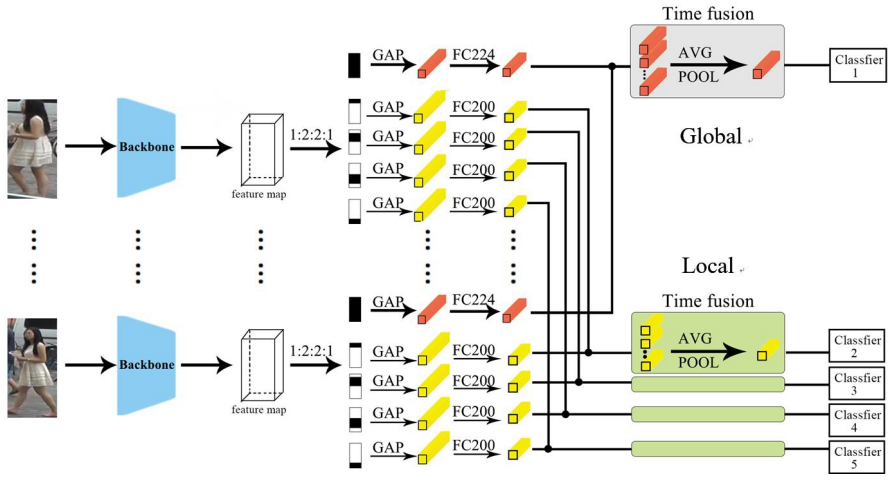
The load-bearing object is the adaptive relative distance sampling (ARD) rule together with the Part Attention Model (PAM). ARD compares each unlabeled sample's distance to its nearest labeled sample (an intra-class distance under the estimated label) with its distance to the nearest differently labeled sample (the minimum inter-class distance), and admits samples only when the former is below k times the latter, with k started by a probe and increased adaptively when sample growth stalls. The Part Attention Model is a ResNet50 backbone with a global branch and four vertically sliced local branches, each with its own classifier, that produces an efficient feature for tracklets. Together they carry the argument because the sampling rule decides which pseudo-labels enter the training set, and the network must be accurate enough with few parameters for the iterative retraining loop to converge quickly.
What would settle it
Take one of the reported one-example setups (e.g., DukeMTMC-VID), record which pseudo-labeled samples ARD selects at each iteration, and compare their estimated labels against ground truth: if a nontrivial fraction of admitted samples have wrong labels while the reported accuracy still holds, the selection rule is not the cause of the gain, and if that fraction is high the stated assumption is false.
Extended reading notes
Core claim
The central claim is that combining a deliberately simple part-attention network with a sampling rule based on relative, not absolute, distances lets one-example video re-ID reach or beat fully supervised performance on several benchmarks. The PAM network slices the feature map into four vertical parts, learns a classifier for the global feature and for each part, and concatenates them into the tracklet representation. The ARD strategy first estimates a label for each unlabeled tracklet by nearest labeled sample, then accepts it only while its intra-class distance stays below a scaled version of the minimum inter-class distance; when accepted-sample growth slows, it raises the scale k and repeats until k exceeds 1 and all unlabeled samples are used. The paper claims this relative-distance criterion fixes a failure of absolute-distance sampling, where shallow appearance similarity (same T-shirt color) pulls in wrong identities.
Load-bearing premise
The whole pseudo-labeling loop rests on assuming that an unlabeled tracklet whose nearest labeled tracklet is closer than any labeled tracklet of a different identity has indeed been assigned the correct identity; if the feature embedding misorders these distances, the wrong labels are fed back into training.
Editorial extensions
If this is right
- A one-example video re-ID system can beat existing one-example and unsupervised methods on PRID2011, iLIDS-VID and DukeMTMC-VID, and match or approach them on MARS.
- The ARD strategy uses all unlabeled samples by the time it finishes, unlike the static SRD variant, and needs fewer iterations than linear-increase sampling.
- With only 20% labeled data on MARS, the method reaches 68.38% rank-1 and 52.61% mAP, which the paper compares favorably to some fully-supervised methods in its table.
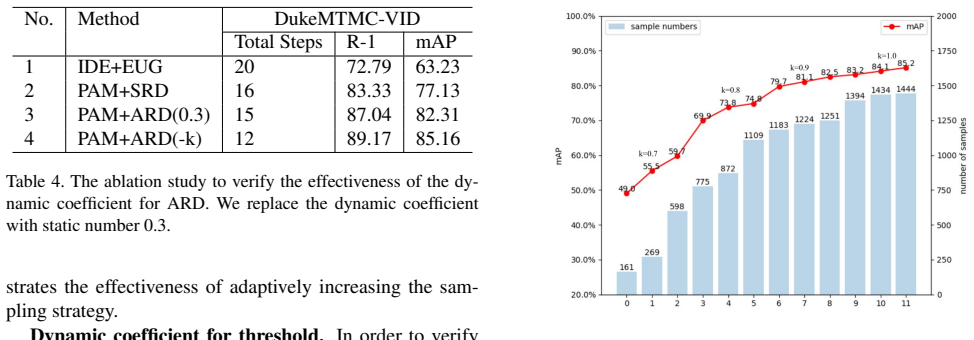
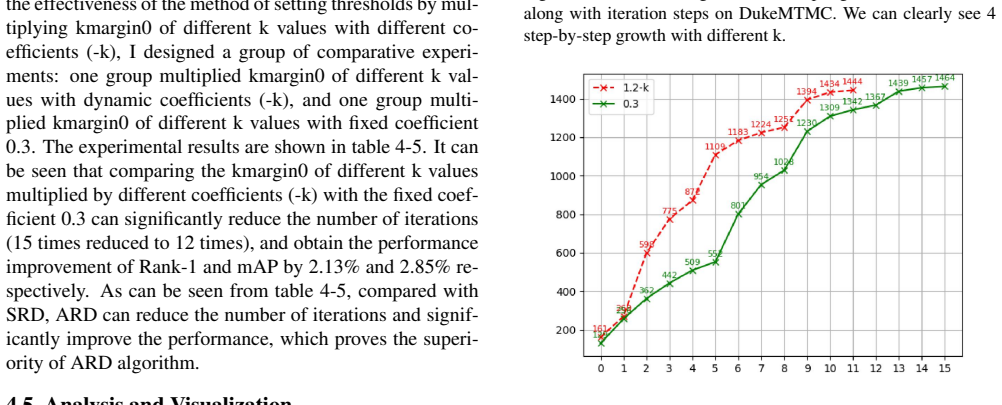
- The dynamic threshold $(-k)$ times the previous sample-growth margin cuts iterations from 15 to 12 and raises rank-1 by 2.13 points on DukeMTMC-VID.
- If the method is correct, deploying person re-ID to a new camera network could require annotating only one tracklet per person rather than thousands.
Reading between the lines
- The relative-distance admission rule is not specific to video re-ID: any few-shot classification task with a feature embedding could adopt the same intra-class < k * inter-class test for pseudo-label trust, though the paper does not claim this.
- The paper's reported gains would be on firmer ground if the authors had measured label-estimation accuracy of ARD against ground truth per iteration; that measurement is absent but is a natural, cheap extension.
- Because the threshold comparison happens in the feature space of a network trained on one sample per class, the method's ceiling likely depends on whether that initial embedding orders identities correctly; a reasonable test is varying the backbone or adding self-supervised pretraining to see if gains scale.
- If the assumption holds, the same iterative pseudo-labeling loop might extend to domains where a single labeled exemplar per category is available, such as object re-ID across camera networks.
Signed reviews
Editorial analysis
A structured set of objections, weighed in public.
Referee Report
Summary. The paper addresses one-example and few-example video person re-identification. It proposes PAM, a multi-branch network with a global branch and four local branches built on a ResNet-50 backbone, and two pseudo-label sampling strategies: static relative distance sampling (SRD) and adaptive relative distance sampling (ARD). The method initializes with one labeled tracklet per identity, estimates labels for all unlabeled tracklets by nearest labeled sample in feature space, selects a subset using a threshold on the ratio of estimated intra-class to inter-class distances, retrains the network, and repeats this process while adaptively increasing the threshold parameter k until all unlabeled samples are used. On PRID2011, iLIDS-VID, DukeMTMC-VID, and MARS, the paper reports one-example rank-1/mAP figures of 89.78/-, 56.13/-, 89.17/85.16, and 61.57/45.36, respectively, claiming large improvements over prior methods. The paper also reports semi-supervised results on MARS and ablation studies on DukeMTMC-VID.
Significance. If the reported numbers are reproducible, this would be a substantial empirical advance for one-example and few-example video person re-identification, especially the large gains on PRID2011 and iLIDS-VID. The PAM architecture is simple, parameter-efficient, and the relative-distance pseudo-label selection idea is interesting and worth pursuing. However, the paper's strengths are mainly architectural and empirical; the central selection mechanism is not validated, the procedural description is incomplete and internally inconsistent, and the numerical claims are single-run with no variance or label-noise measurements. The paper would be much more credible if pseudo-label precision, sensitivity to hyperparameters, and run-to-run variability were reported. As it stands, the significance of the empirical claims cannot be fully assessed.
major comments (5)
- [Section 3.3.1] The correctness argument for SRD/ARD is circular in the one-example setting. The text states: 'When the intra-class distance is less than the minimum inter-class distance, we have reason to believe that the estimated tag is correct.' But the 'intra-class distance' for an unlabeled sample x is computed as the distance from x to its nearest labeled sample. This is an intra-class distance only if that nearest labeled sample has the same identity as x, which is exactly the label being estimated. Meanwhile, the 'minimum inter-class distance' is computed among the labeled samples only and never involves any distance from x to a labeled sample of a different identity. Therefore the inequality D_intra < k * D_inter does not control the probability that the pseudo-label is wrong. The paper reports no pseudo-label precision versus k or iteration, no sensitivity analysis for k0 or the 0.15 probe threshold, and no noise-level measurement of the final training set. Since ARD's claimed gains rest on this selection criterion, this missing validation is load-bearing.
- [Algorithm 1] Algorithm 1 cannot be executed as printed. Lines 4-7 set k = k0 + 0.1 inside a do-while loop whose exit condition depends only on |P-data| < 0.15 * |L-data|, so k does not progress through the probe values 0.6, 0.7, ..., 1.0 described in the text. The subscripted quantities in line 10, |P_datakt|, |P_datak-1|, |P_datak1|, and |P_datak0|, are undefined. In addition, the threshold (-k) * |P_datak1| - |P_datak0| is negative for k > 0, while the sample-count difference between consecutive iterations is usually non-negative, making the condition 'difference < (-k) * ...' unsatisfiable in normal operation. The text in Section 3.3.1 and Section 4.5 also refers to different coefficients, first (-k) and later (1.2-k). As printed, the algorithm cannot produce the adaptive k schedule that the paper credits for the reported improvements.
- [Table 3, Section 4.4] The ablation table contains 'x x x x x' placeholders for the two control rows IDE+ARD and PAM+EUG(k=0.05), yet Section 4.4 draws quantitative conclusions from these rows, claiming a 2.7% improvement for PAM over IDE and a 2.7% improvement for ARD over EUG. Without the actual numbers, neither the 'Part Attention Model' ablation nor the 'Sampling strategy' ablation is supported. Because the paper presents both components as contributions, these missing entries are not a minor cosmetic issue.
- [Sections 4.1 and 4.2] The experimental claims are reported as single-run point estimates with no standard deviations, number of repeats, or seeds. The one-example protocol randomly selects which tracklet per identity is labeled, so the reported rank-1/mAP values can be expected to vary substantially across draws, especially on the smaller datasets. Additionally, the paper never measures the label noise of the enlarged training set, even though the method's core mechanism is pseudo-label selection. Without variance estimates and pseudo-label precision, the 'large margin' superiority of PAM+ARD over EUG and DGM cannot be considered statistically established.
- [Section 4.1] Several key hyperparameters are not given values: k0, the 0.15 probe ratio, the SRD convergence threshold b, and the loss weight. The paragraph on implementation details says 'the value of the loss function is set to 0.1' without specifying which loss coefficient this refers to (global classification loss, local branch losses, or a combined objective), and uses K ambiguously as both the number of classes and a symbol related to the sampling threshold. Without these values, the reported results are not reproducible even if Algorithm 1 were fully specified.
minor comments (6)
- [Abstract and Section 1] The manuscript has pervasive grammatical errors, e.g., 'We iteratively estimates labels' and 'which exceeds the previous methods by large margin.' A thorough language edit is needed before publication.
- [Section 3.3.1] Several sentences in the SRD description are garbled, e.g., 'The distance between the unlabeled sample in the feature space and the nearest labeled sample is the label sample and the rest of the label' and 'when the a equation is satisfied.' These passages need to be rewritten so that the definitions of D_intra and D_inter are unambiguous.
- [Table 1 and References] The caption says all methods are one-example except BUC, but BUC is an unsupervised clustering method operating under a different labeling protocol; including it in the same comparison table without a separate analysis is misleading. In addition, the reference for TAUDL appears to be incorrect: [12] is cited in the table as TAUDL but the reference list entry [12] is Sun et al., 'Beyond Part Models,' not the TAUDL paper.
- [Section 4.2] The text states that on MARS the result is 'slightly inferior to the PAM+GPS algorithm proposed in Chapter 3,' but no PAM+GPS result is shown in Table 1, and the contribution list in Section 1 reports different PAM+GPS numbers (86.9% rank-1 on DukeMTMC-VID and 47.26% mAP on MARS). This inconsistency should be corrected.
- [Table 2] Row 3 of Table 2 labels PAM+ARD as 'Super.' with 61.57 rank-1 and 45.36 mAP, but these are the one-example results from Table 1, not a supervised result. The Type column entries need to distinguish one-example, semi-supervised, and supervised settings clearly.
- [Figures and References] Figure references are inconsistent: the text refers to 'Figure 4-6' and 'Figure 4-1,' while the figures themselves are numbered 4 and 5. Also, references [19] and [20] are cited in the MARS dataset description but do not appear in the reference list, and reference [1] is an incomplete URL-like entry.
Circularity Check
No significant circularity: the reported rank-1/mAP numbers are measured on held-out benchmark test sets, and no prediction reduces to a fitted input or self-citation.
full rationale
The paper's central claims are empirical comparisons on PRID2011, iLIDS-VID, DukeMTMC-VID, and MARS. The test protocols are external to the method's training loop, so the final evaluation is not a hidden derivation from the method's own assumptions. The pseudo-label selection in Sec. 3.3.1 uses the model's own distance estimates to choose samples for retraining; this is a self-training heuristic, not a circular proof step. The statement 'When the intra-class distance is less than the minimum inter-class distance, we have reason to believe that the estimated tag is correct' is an unvalidated assumption about nearest-neighbor label confidence, and the distance to the nearest labeled sample is only intra-class if the nearest sample shares the identity, which is exactly what is being estimated. This is a correctness and robustness concern, not circularity of the kind where the claimed result is equivalent by construction to its input. The paper compares against external baselines (EUG, DGM, Stepwise, BUC, TAUDL) and reports ablations; there is no self-citation chain invoked as a uniqueness theorem, and no fitted parameter is renamed as a prediction. Accordingly, no specific circular step can be exhibited, and the score is 0.
Assumptions & free parameters
free parameters (6)
- k (relative distance threshold multiplier) =
0.6 to 1.0, step 0.1
- k0 (initial probe value) =
not stated explicitly; probe tries 0.6, 0.7, 0.8, 0.9, 1.0
- b (SRD convergence threshold) =
e.g., 0.01, 0.03
- min_ratio (0.15 x labeled set) =
0.15
- number of local parts (p) =
4
- loss weight =
0.1
assumptions (4)
- domain assumption ResNet50 pretrained on ImageNet provides useful features for the person re-ID domain.
- domain assumption The nearest labeled sample in feature space is a reliable label estimate for the unlabeled sample.
- ad hoc to paper If d_intra < k times d_inter, the pseudo-label is correct.
- ad hoc to paper Adding selected pseudo-label samples and retraining monotonically improves the model.
Cite this review
Pith. "Pith review of Learning adaptively from the unknown for few-example video person re-ID." pith.science (2026). https://pith.science/paper/3CP2NE3L
@misc{pith2026190809340,
  author       = {Pith},
  title        = {Pith review of: Learning adaptively from the unknown for few-example video person re-ID},
  year         = {2026},
  howpublished = {\url{https://pith.science/paper/3CP2NE3L}},
  note         = {Machine review of arXiv:1908.09340}
}
read the original abstract
This paper mainly studies one-example and few-example video person re-identification. A multi-branch network PAM that jointly learns local and global features is proposed. PAM has high accuracy, few parameters and converges fast, which is suitable for few-example person re-identification. We iteratively estimates labels for unlabeled samples, incorporates them into training sets, and trains a more robust network. We propose the static relative distance sampling(SRD) strategy based on the relative distance between classes. For the problem that SRD can not use all unlabeled samples, we propose adaptive relative distance sampling (ARD) strategy. For one-example setting, We get 89.78\%, 56.13\% rank-1 accuracy on PRID2011 and iLIDS-VID respectively, and 85.16\%, 45.36\% mAP on DukeMTMC and MARS respectively, which exceeds the previous methods by large margin.
Figures

Figures from the paper (2 more)
Reference graph
Works this paper leans on
-
[1]
MARS: A Video Benchmark for Large-Scale Person Re- Identification | SpringerLink
-
[2]
Shengyong Ding, Liang Lin, Guangrun Wang, and Hongyang Chao. Deep feature learning with relative distance comparison for person re-identification.Pattern Recognition, 48(10):2993–3003, Oct. 2015
work page 2015
-
[3]
Martin Hirzer, Csaba Beleznai, Peter M. Roth, and Horst Bischof. Person Re-identification by Descriptive and Dis- criminative Classification. In Anders Heyden and Fredrik Kahl, editors, Image Analysis, volume 6688, pages 91–102. Springer Berlin Heidelberg, Berlin, Heidelberg, 2011
work page 2011
-
[4]
Siamese Neural Networks for One-shot Image Recognition
Gregory Koch, Richard Zemel, and Ruslan Salakhutdinov. Siamese Neural Networks for One-shot Image Recognition. page 8
-
[5]
Im- ageNet Classification with Deep Convolutional Neural Net- works
Alex Krizhevsky, Ilya Sutskever, and Geoffrey E Hinton. Im- ageNet Classification with Deep Convolutional Neural Net- works. In F. Pereira, C. J. C. Burges, L. Bottou, and K. Q. Weinberger, editors, Advances in Neural Information Pro- cessing Systems 25 , pages 1097–1105. Curran Associates, Inc., 2012
work page 2012
-
[6]
Harmonious Attention Network for Person Re-Identification
Wei Li, Xiatian Zhu, and Shaogang Gong. Harmo- nious Attention Network for Person Re-Identification. arXiv:1802.08122 [cs], Feb. 2018. arXiv: 1802.08122
work page Pith review arXiv 2018
-
[7]
A bottom-up clustering approach to unsupervised per- son re-identification
Yutian Lin, Xuanyi Dong, Liang Zheng, Yan Yan, and Yi Yang. A bottom-up clustering approach to unsupervised per- son re-identification. In AAAI, 2019
work page 2019
-
[8]
Video-based Person Re-identification with Accumulative Motion Context
Hao Liu, Zequn Jie, Karlekar Jayashree, Meibin Qi, Jian- guo Jiang, Shuicheng Yan, and Jiashi Feng. Video-based Person Re-identification with Accumulative Motion Context. arXiv:1701.00193 [cs], Dec. 2016. arXiv: 1701.00193
work page Pith review arXiv 2016
Show all 18 references
-
[9]
Quality Aware Net- work for Set to Set Recognition
Yu Liu, Junjie Yan, and Wanli Ouyang. Quality Aware Net- work for Set to Set Recognition. arXiv:1704.03373 [cs] , Apr. 2017. arXiv: 1704.03373
2017 arXiv
-
[10]
Stepwise Metric Promotion for Unsupervised Video Person Re-identification
Zimo Liu, Dong Wang, and Huchuan Lu. Stepwise Metric Promotion for Unsupervised Video Person Re-identification. In 2017 IEEE International Conference on Computer Vision (ICCV), pages 2448–2457, Venice, Oct. 2017. IEEE
2017
-
[11]
Attention-based Few-Shot Person Re-identification Using Meta Learning
Alireza Rahimpour and Hairong Qi. Attention-based Few-Shot Person Re-identification Using Meta Learning. arXiv:1806.09613 [cs], June 2018. arXiv: 1806.09613
2018 arXiv
-
[12]
Beyond Part Models: Person Retrieval with Re- fined Part Pooling (and A Strong Convolutional Baseline)
Yifan Sun, Liang Zheng, Yi Yang, Qi Tian, and Shengjin Wang. Beyond Part Models: Person Retrieval with Re- fined Part Pooling (and A Strong Convolutional Baseline). In Vittorio Ferrari, Martial Hebert, Cristian Sminchisescu, and Yair Weiss, editors, Computer Vision ECCV 2018 , ...
2018
-
[13]
Matching Networks for One Shot Learning
Oriol Vinyals, Charles Blundell, Timothy Lillicrap, Koray Kavukcuoglu, and Daan Wierstra. Matching Networks for One Shot Learning. arXiv:1606.04080 [cs, stat], June 2016. arXiv: 1606.04080
2016 arXiv
-
[14]
Person Re-identification by Video Ranking
Taiqing Wang, Shaogang Gong, Xiatian Zhu, and Shengjin Wang. Person Re-identification by Video Ranking. In David Fleet, Tomas Pajdla, Bernt Schiele, and Tinne Tuytelaars, editors, Computer Vision ECCV 2014 , volume 8692, pages 688–703. Springer International Publishing, Cham, 2014
2014
-
[15]
Exploit the Unknown Gradually: One-Shot Video-Based Person Re-identification by Stepwise Learning
Yu Wu, Yutian Lin, Xuanyi Dong, Yan Yan, Wanli Ouyang, and Yi Yang. Exploit the Unknown Gradually: One-Shot Video-Based Person Re-identification by Stepwise Learning. In 2018 IEEE/CVF Conference on Computer Vision and Pat- tern Recognition, pages 5177–5186, Salt Lake City, UT, June
2018
-
[16]
Ma, Liang Zheng, Jiawei Li, and Pong C
Mang Ye, Andy J. Ma, Liang Zheng, Jiawei Li, and Pong C. Yuen. Dynamic Label Graph Matching for Unsupervised Video Re-identification. In 2017 IEEE International Confer- ence on Computer Vision (ICCV), pages 5152–5160, Venice, Oct. 2017. IEEE
2017
-
[17]
Dong Yi, Zhen Lei, and Stan Z. Li. Deep Metric Learning for Practical Person Re-Identification. arXiv:1407.4979 [cs], July 2014. arXiv: 1407.4979
2014 arXiv
-
[18]
R. Zhao, W. Oyang, and X. Wang. Person Re-Identification by Saliency Learning. IEEE Transactions on Pattern Analy- sis and Machine Intelligence, 39(2):356–370, Feb. 2017
2017
Reviewed August 14, 2026 · model on record in the stance chip above.
Discussion (0). Continue with ORCID to comment.