REVIEW 4 major objections 5 minor 63 references
HyperService: Interoperability and Programmability Across Heterogeneous Blockchains
T0 review · 4 major / 5 minor · reviewed 2026-08-14 · deepseek-v4-flash
Pith's one-line read HyperService claims to be the first platform that both lets developers write cross-chain dApps in one language and provably secures their execution across heterogeneous blockchains.
desk verdict A genuine systems contribution for cross-chain programmability with a real prototype, but the UC security proof in Section 8 is a sketch that omits the passive-corruption case, and the ideal functionality is cut to fit the protocol. read the letter →
The pith
A machine-rendered reading of the paper's core claim, the machinery that carries it, and where it could break.
The reading
What carries the argument
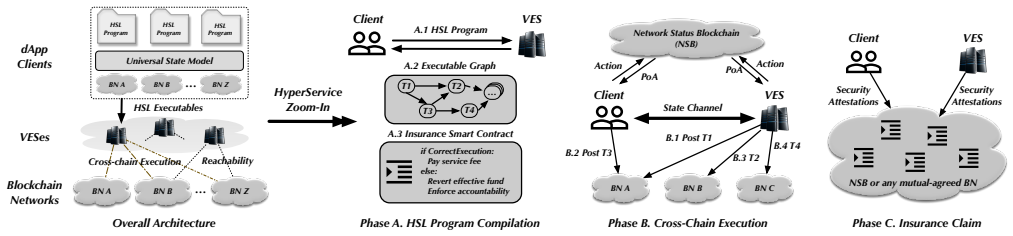
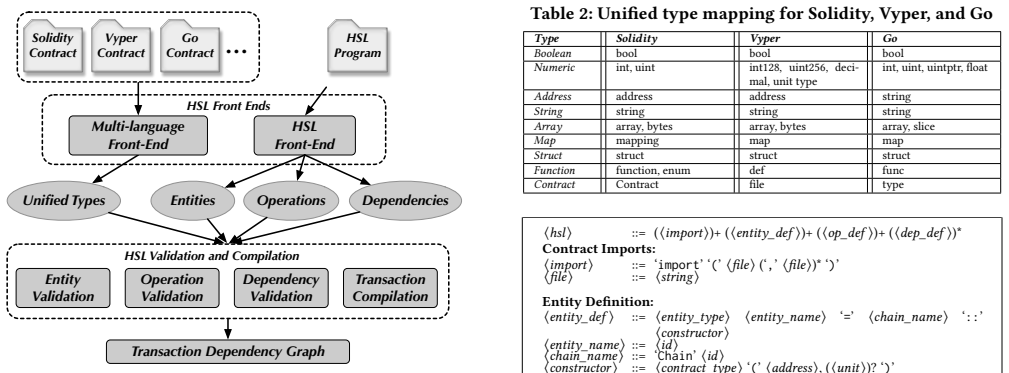
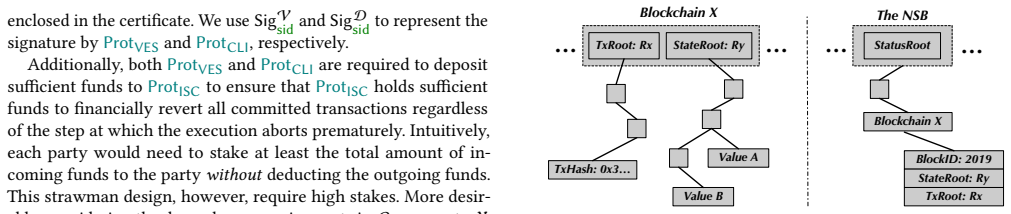
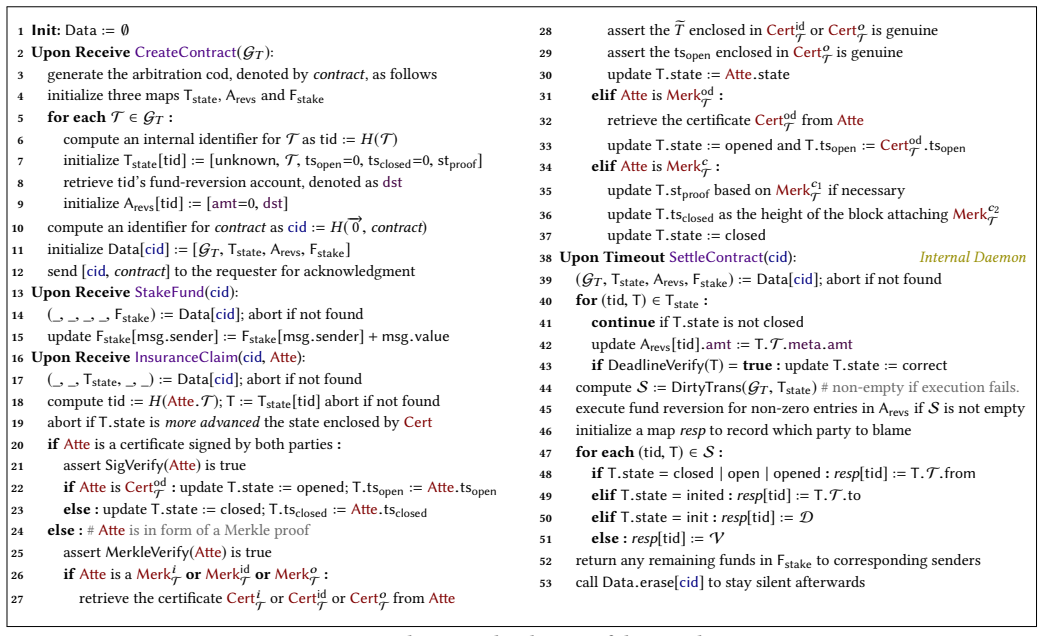
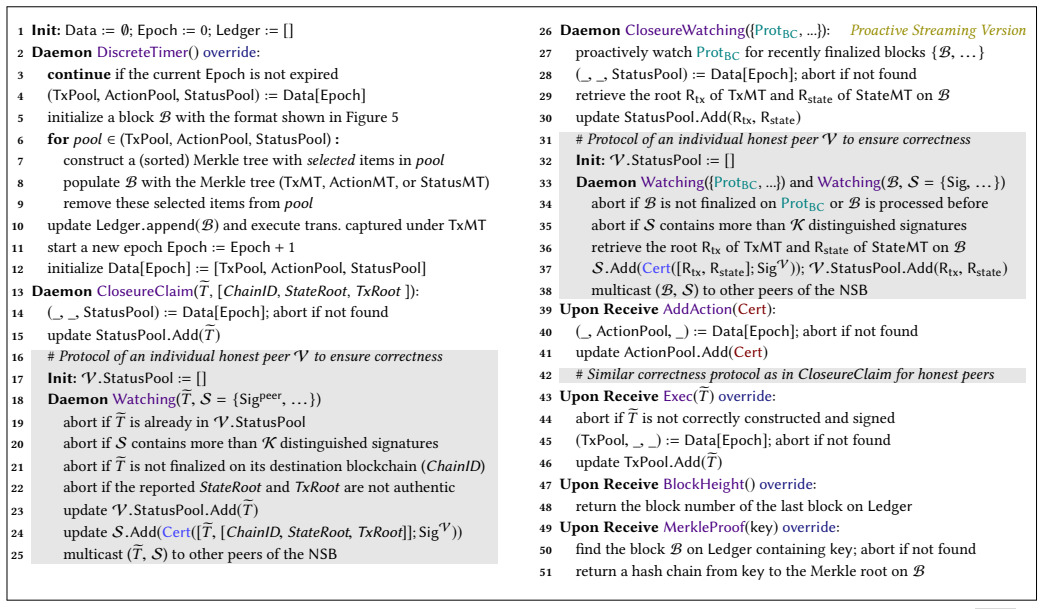
The load-bearing machinery is the pair (NSB, ISC) under UIP: the Network Status Blockchain is a "blockchain of blockchains" that packs StatusRoot (finalized transaction state from underlying chains) and ActionRoot (certificates of actions by VESes and clients) into its blocks, giving an objective unified clock and proof medium; the Insurance Smart Contract is a code-arbitrator that, given proofs from the NSB, checks preconditions and deadlines, marks dirty transactions, and executes a decision tree to blame the right party and revert funds. Supporting this, the HSL compiler produces the Transaction Dependency Graph $G_T$ whose transaction wrappers carry fund-reversion tuples, state proofs, and deadlines, so the ISC can arbitrate mechanically. The ideal functionality $F_{\mathrm{UIP}}$ and its UC proof tie the real protocol's guarantees to a trusted abstraction.
What would settle it
Run a test on the prototype in which an adversary delays finality of one underlying transaction while the NSB advances, then call ProtISC and check whether a transaction whose precondition has not actually finalized can be marked correct and a payment settled; if the ISC ever pays out on a non-finalized precondition, the real protocol is distinguishable from $F_{\mathrm{UIP}}$ and Theorem 8.1 is false.
Extended reading notes
Core claim
On the paper's own terms, the discovery is that cross-chain dApps over heterogeneous blockchains can be made simultaneously programmable and secure: the UIP protocol provably UC-realizes the ideal functionality $F_{\mathrm{UIP}}$ (Theorem 8.1), meaning a dApp either completes with publicly verifiable correctness or aborts with misbehaving parties held accountable and committed funds reverted. Programmability comes from HSL, whose compiler validates the dApp and emits a transaction dependency graph; security comes from the NSB, which records finalized state and signed actions in Merkle trees, and the ISC, which arbitrates the graph's preconditions and deadlines and executes the decision tree for accountability. The paper further claims this is the first generic interoperability protocol whose scope goes beyond token exchange to arbitrary smart-contract invocations across chains.
Load-bearing premise
The whole guarantee leans on the Network Status Blockchain being correct: if fewer than K of its consensus nodes are honest, or if it finalizes a wrong StatusRoot, the insurance contract can misarbitrate and the promised financial atomicity breaks.
Editorial extensions
If this is right
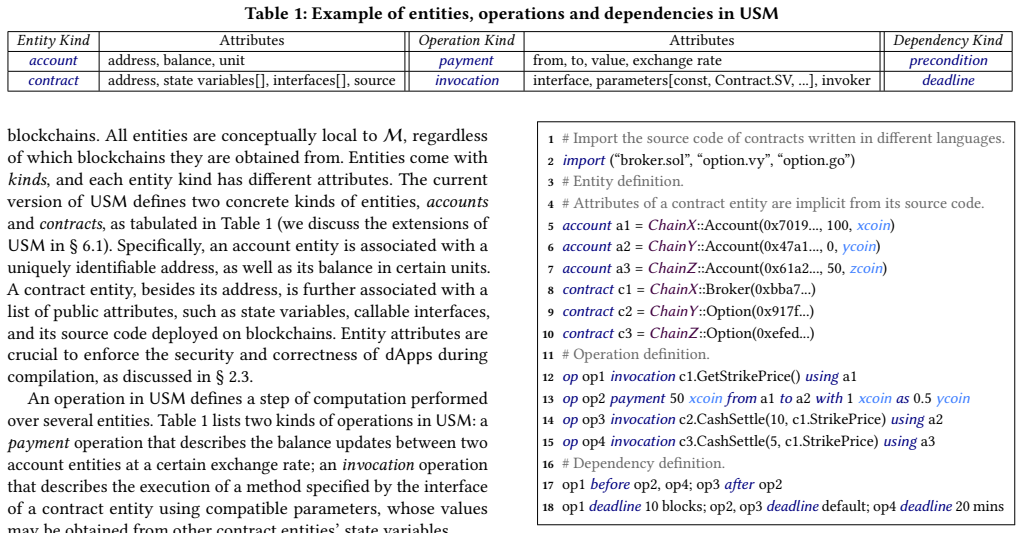
- Developers can write cross-chain dApps in HSL against a unified state model and have them compiled into executable transaction graphs for any set of public-ledger blockchains, without protocol changes to those chains.
- A dApp either completes with publicly verifiable correctness or aborts with financial reversion and an identified accountable party, so VESes can operate as trust-free cross-chain service providers that misbehave at their own risk.
- Any blockchain can serve as an oracle for other blockchains, so financial derivatives can obtain strike prices from a chain rather than from a trusted data-feed provider.
- The same machinery generalizes to sharded blockchains, where an existing beacon or identity chain can play the NSB role and cross-shard contracts are simpler to write than cross-chain ones.
- The measured NSB throughput of about 1000 KB/s of committed certificates bounds aggregate dApp capacity; with at most six NSB transactions per dApp transaction, capacity is about 170,000 divided by the certificate size in bytes transactions per second when off-chain channels are fully unavailable.
Reading between the lines
- If Theorem 8.1 is sound, the practical trust bottleneck of a HyperService deployment is not the cryptography but the NSB: an adversary who controls the NSB quorum can corrupt the arbitration itself, so the "zero trust" framing in the introduction should be read as "trust the NSB quorum plus one honest participant."
- The contrast between Theorem 8.1 (passive corruption) and Theorem 8.2 (Byzantine, but only with all communication through the NSB) implies a design trade-off: off-chain state channels buy latency at the cost of a weaker adversarial model, so production systems must pick a point on that curve.
- The latency breakdown in Table 3 suggests that session creation (roughly 60% of end-to-end time) is the highest-leverage target for optimization, since ISC deployment and handshake dominate what HyperService itself controls.
- A direct experimental check of the arbitration logic: deliberately stall a transaction at each of the six protocol states, invoke the ISC, and verify that the blamed party matches the decision tree in Figure 9; any mismatch would indicate the real protocol and $F_{\mathrm{UIP}}$ diverge.
Signed reviews
Editorial analysis
A structured set of objections, weighed in public.
Referee Report
Summary. The paper presents HyperService, a platform that aims to provide both interoperability and programmability across heterogeneous blockchains. The system has two main components: a developer-facing programming framework built around a Unified State Model (USM) and a high-level language HSL, which compiles cross-chain dApps into a transaction dependency graph; and a blockchain-facing cryptographic protocol UIP, which coordinates execution across blockchains using a Network Status Blockchain (NSB) and Insurance Smart Contracts (ISCs) to enforce correctness, accountability, and financial atomicity. The authors claim that UIP provably realizes an ideal functionality F_UIP in the Universal Composability framework, and they implement a prototype of roughly 35,000 lines of code, reporting end-to-end dApp latency on the order of seconds and an NSB throughput measurement. The paper also claims to be the first platform to simultaneously provide interoperability and programmability across heterogeneous blockchains.
Significance. If the security claims were fully established, this would be a substantial contribution to blockchain interoperability: it goes beyond atomic token swaps by offering a general programming model for cross-chain dApps and a protocol designed to execute them over heterogeneous ledgers. The paper is also strong on the systems side: it provides a detailed protocol specification, a working prototype, and experimental results on three categories of dApps, and it explicitly discusses extensions and limitations. The claimed UC-security theorem is the central load-bearing assertion, and as written the proof has significant gaps: it does not handle passively corrupted parties in the simulator construction, and the Byzantine result is proven only for a variant that removes the off-chain channels. The 'zero trust' language in the introduction is not supported by the paper's own trust assumptions on the NSB. For these reasons, the current version does not justify the security claims as stated, though the underlying design and prototype are valuable.
major comments (4)
- [§8.4–§8.5, Theorem 8.1] The proof of Theorem 8.1 does not address the simulation of passively corrupted parties, which is a required part of a UC security proof. The simulator S in §8.4 is constructed only for the dummy adversary that relays messages, and the hybrid argument in §8.5 replaces parties with dummy parties without giving any procedure for S to output the internal state (secret keys, random coins, session bookkeeping, received messages) of a party that the environment chooses to corrupt. Without such a procedure, the environment can distinguish a real execution from an ideal one by examining a corrupted party's state. The sentence in Fact 1 that this is 'immediately clear' is not a substitute for the missing simulator construction. Therefore Theorem 8.1 is not established as written.
- [§8.6, Theorem 8.2] The Byzantine security result is proven only for H-ProtUIP, which requires all communication through the NSB. The actual ProtUIP protocol uses off-chain state channels for agility, and §8.6 explicitly explains why the dual-medium design prevents the simulator from accurately emulating a Byzantine-corrupted party (conflicting messages can be sent to the channel and the NSB). Consequently, the paper's deployed protocol has no proof of security against a fully malicious (Byzantine) adversary; Theorem 8.1 covers only passive corruption, and Theorem 8.2 applies to a variant that is not the system described in §4 and evaluated in §5. The unqualified statements in the abstract and §1 that UIP 'provably realizes' applications and is 'fully trust-free' therefore outrun what the proofs actually demonstrate.
- [§2.5 vs. §1] The introduction claims that UIP is 'fully trust-free' and that HyperService coordinates execution 'in a fully decentralized manner with zero trust assumptions', but §2.5 states that 'The correctness of UIP relies on the correctness of the NSB' and assumes that at least K consensus nodes of the NSB are honest. This is a genuine trust assumption on a permissioned subsystem introduced by the paper. The security theorem also inherits any failure modes of the NSB, including delayed or incorrect finality. The claim of zero trust should be qualified or removed, and the concrete trust model for the NSB should be stated in the introduction where the strong claims are made.
- [§8.1, Figure 11] There is a circularity concern about the ideal functionality: the text states 'We intentionally define F_UIP verbosely ... to accurately match F_UIP to the real world protocol ProtUIP', and Figure 11 embeds the same arbitration decision tree and the same certificate and attestation steps used by ProtUIP. As a result, the UC-realization proof largely shows that ProtUIP implements an idealization of its own concrete logic. This does not invalidate the protocol design, but it substantially weakens the force of the 'provably realizes' claim, because the ideal functionality does not abstract away the protocol's implementation choices. To make the security claim meaningful, the authors should either present a more abstract F_UIP that captures only the desired correctness and financial-atomicity properties, or explicitly discuss why the verbosity is needed and what security properties are being guaranteed beyond the protocol's own definition.
minor comments (5)
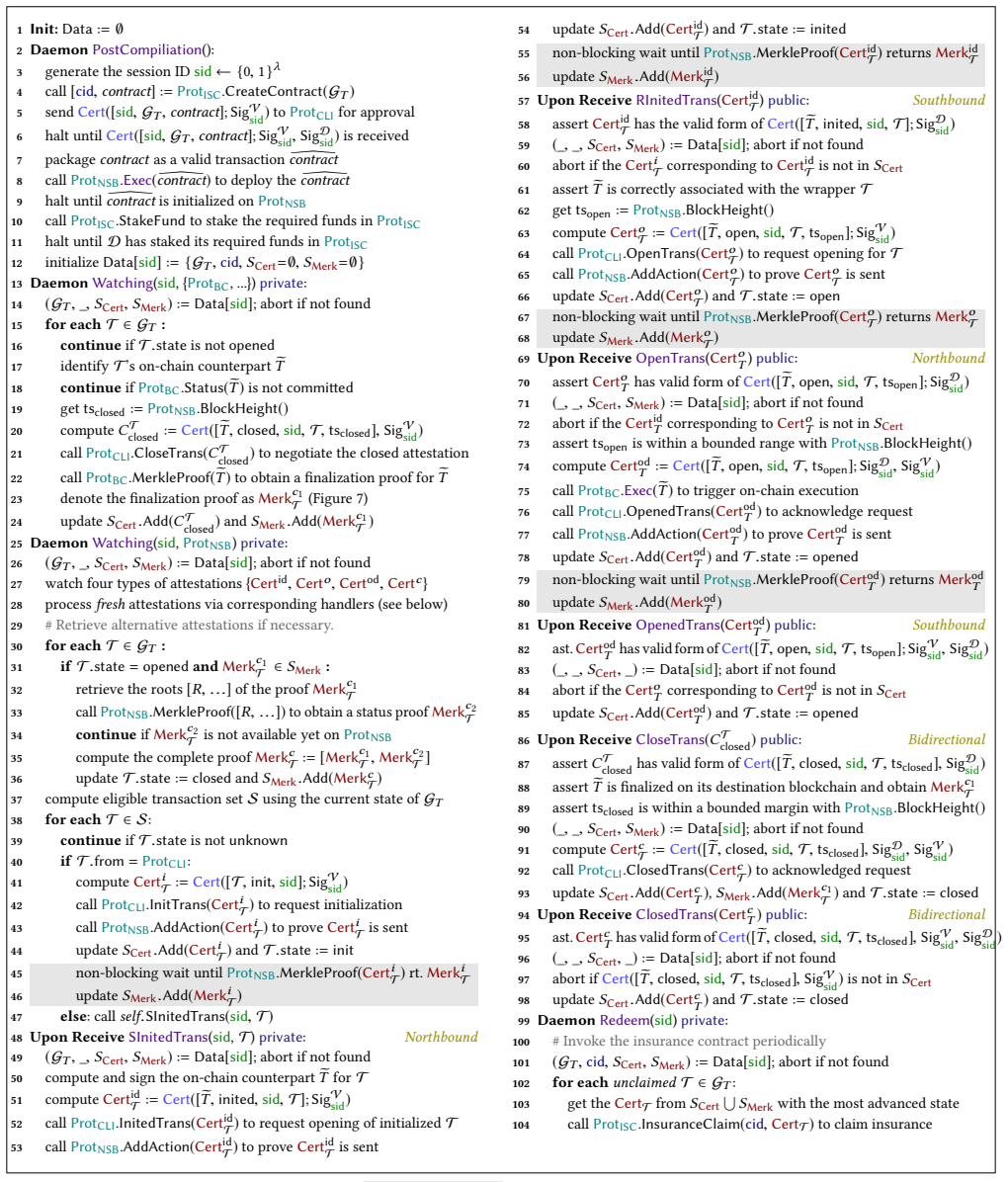
- [Figure 6, lines 82 and 95] The protocol pseudocode uses 'ast.' where it should say 'assert', which is confusing in a formal protocol description.
- [§8.3] There is a grammatical error: 'We now the prove our main theorems' should be 'We now prove our main theorems'.
- [§4.6] The sentence 'Then we prove that ProtUIP, our the decentralized real-world protocol' contains a typo: 'our the' should be 'our'.
- [§8.5, Hybrid A1] The description of where the contract is deployed says 'on PNSB or PBC', but in the real protocol the insurance contract is deployed on the NSB; the reason for allowing either in the hybrid should be clarified.
- [Figure 4] Transaction T5 on ChainZ is listed without its detail fields, and the figure caption does not explain whether the omission is for space or because T5 has the same structure as T4. A brief note would improve readability.
Circularity Check
FUIP is deliberately defined to match ProtUIP, so Theorem 8.1 largely proves that the real protocol realizes a trusted copy of its own state machine and arbitration tree.
-
self definitional
[Section 8.1, 'Verbose Definition of FUIP' (Figure 11)]
"We intentionally define FUIP verbosely (that is, sending many signed messages) in order to accurately match FUIP to the real world protocol ProtUIP."
The ideal functionality is explicitly constructed from the real protocol rather than from an independent statement of desired security, so Theorem 8.1's conclusion that ProtUIP UC-realizes FUIP is close to 'ProtUIP realizes a trusted copy of ProtUIP.' The state-transition interfaces of FUIP (ReqTransInit/Inited/Open/Opened/Close and TermExecution) mirror the handlers of ProtVES/ProtCLI and ProtISC; hence the proof's hybrid arguments mostly show that the real-world attestations line up with the pre-transcribed ideal transcript. This does not add an external security derivation: the target specification was reverse-engineered from the implementation.
-
self definitional
[Section 8.1 TermExecution vs Section 4.4.2 / Figure 9]
"The arbitration logic is also derived from decision tree mentioned in Figure 9."
The real-world ISC's accountability logic is first defined in Section 4.4.2 by deriving the decision tree 'from the execution steps taken by ProtVES and ProtCLI' (Figure 9); FUIP then adopts the same decision tree in its TermExecution interface. When Theorem 8.1 concludes that ProtUIP holds misbehaving parties accountable, it is comparing the protocol's accountability rule to an ideal functionality that contains that very rule by construction. The accountability/financial-atomicity guarantee is therefore assumed in the ideal specification, not independently derived.
full rationale
The paper's central security theorem is not fully circular, but it is substantially weakened by construction. The authors explicitly state in Section 8.1 that FUIP is defined verbosely 'in order to accurately match FUIP to the real world protocol ProtUIP,' and the ideal functionality's TermExecution interface copies the same accountability decision tree (Figure 9) that ProtISC already implements (Section 4.4.2). Consequently, Theorem 8.1's conclusion that ProtUIP UC-realizes FUIP largely verifies that the real protocol is internally consistent with a trusted transcription of itself; the 'provably realizes' claim does not validate the arbitration/accountability semantics against an independent specification. There remains non-circular content: the proof connects the real cryptographic attestations (signatures, Merkle proofs, NSB quorum) to the ideal interface under the stated assumptions, and the implementation/evaluation, NSB honest-majority assumption, and external factors are independent of the theorem. The passive-corruption gap in Sections 8.4-8.5 is a proof-completeness issue rather than circularity, so it is not scored here.
Assumptions & free parameters
assumptions (5)
- domain assumption Underlying blockchains have secure consensus and transaction finality.
- domain assumption At least K consensus nodes of the NSB are honest.
- domain assumption Imported contract source code matches the bytecode actually deployed on chain.
- standard math Hash functions are preimage resistant and signatures are EU-CMA secure.
- standard math The UC framework soundly captures protocol security.
invented entities (3)
-
Network Status Blockchain (NSB)
independent evidence
-
Insurance Smart Contract (ISC)
independent evidence
-
Verifiable Execution System (VES)
independent evidence
Cite this review
Pith. "Pith review of HyperService: Interoperability and Programmability Across Heterogeneous Blockchains." pith.science (2026). https://pith.science/paper/HZIOZBLR
@misc{pith2026190809343,
  author       = {Pith},
  title        = {Pith review of: HyperService: Interoperability and Programmability Across Heterogeneous Blockchains},
  year         = {2026},
  howpublished = {\url{https://pith.science/paper/HZIOZBLR}},
  note         = {Machine review of arXiv:1908.09343}
}
read the original abstract
Blockchain interoperability, which allows state transitions across different blockchain networks, is critical functionality to facilitate major blockchain adoption. Existing interoperability protocols mostly focus on atomic token exchange between blockchains. However, as blockchains have been upgraded from passive distributed ledgers into programmable state machines (thanks to smart contracts), the scope of blockchain interoperability goes beyond just token exchange. In this paper, we present HyperService, the first platform that delivers interoperability and programmability across heterogeneous blockchains. HyperService is powered by two innovative designs: (i) a developer-facing programming framework that allows developers to build cross-chain applications in a unified programming model; and (ii) a secure blockchain-facing cryptography protocol that provably realizes those applications on blockchains. We implement a prototype of HyperService in about 35,000 lines of code to demonstrate its practicality. Our experiment results show that HyperService imposes reasonable latency, in order of seconds, on the end-to-end execution of cross-chain applications
Figures
Figures from the paper (9 more)





Reference graph
Works this paper leans on
-
[1]
https://cosmos.network/resources/whitepaper, 2019
Cosmos WhitePaper. https://cosmos.network/resources/whitepaper, 2019
work page 2019
-
[2]
https://harmony.one/whitepaper.pdf, 2019
Harmony: Technical Whitepaper. https://harmony.one/whitepaper.pdf, 2019
work page 2019
-
[3]
Monoxide: Scale Out Blockchain with Asynchronized Consensus Zones. In USENIX NSDI (2019)
work page 2019
-
[4]
Open Source Code for HyperService by HyperService-Consortium. https://github. com/HyperService-Consortium, 2019
work page 2019
-
[5]
https://en.bitcoin.it/wiki/Atomic_ swap, Accessed on 2019
Bitcoin Wiki: Atomic Cross-Chain Trading. https://en.bitcoin.it/wiki/Atomic_ swap, Accessed on 2019
work page 2019
-
[6]
https://coinmarketcap.com, Accessed on 2019
CoinMarketCap. https://coinmarketcap.com, Accessed on 2019
work page 2019
-
[7]
https://cosmos.network, Accessed on 2019
Cosmos. https://cosmos.network, Accessed on 2019
work page 2019
-
[8]
DPOS Consensus Algorithm. https://steemit.com/dpos/@dantheman/dpos- consensus-algorithm-this-missing-white-paper, Accessed on 2019
work page 2019
Show all 63 references
-
[9]
Morgan: Blockchain and Distributed Ledger
J.P. Morgan: Blockchain and Distributed Ledger. https://www.jpmorgan.com/ global/blockchain, Accessed on 2019
2019
-
[10]
https://github.com/nebulasio, Accessed on 2019
Nebulas. https://github.com/nebulasio, Accessed on 2019
2019
-
[11]
http://www.oraclize.it, Accessed on 2019
Oraclize. http://www.oraclize.it, Accessed on 2019
2019
-
[12]
https://polkadot.network, Accessed on 2019
Polkadot. https://polkadot.network, Accessed on 2019
2019
-
[13]
https://rhombus.network, Accessed on 2019
rhombus. https://rhombus.network, Accessed on 2019
2019
-
[14]
https://solidity.readthedocs.io/en/v0.5.6/, Accessed on 2019
Solidity. https://solidity.readthedocs.io/en/v0.5.6/, Accessed on 2019
2019
-
[15]
https://github.com/ cosmos/ics, Accessed on 2019
Standards for the Cosmos network & Interchain Ecosystem. https://github.com/ cosmos/ics, Accessed on 2019
2019
-
[16]
https://github.com/paritytech/substrate, Accessed on 2019
Substrate. https://github.com/paritytech/substrate, Accessed on 2019
2019
-
[17]
https://tendermint.com, Accessed on 2019
Tendermint Core. https://tendermint.com, Accessed on 2019
2019
-
[18]
https://metrics.torproject.org/rs.html#search/flag: authority, Accessed on 2019
Tor Directory Authorities. https://metrics.torproject.org/rs.html#search/flag: authority, Accessed on 2019
2019
-
[19]
https://github.com/ethereum/vyper, Accessed on 2019
Vyper. https://github.com/ethereum/vyper, Accessed on 2019
2019
-
[20]
Chainspace: A Sharded Smart Contracts Platform
Al-Bassam, M., Sonnino, A., Bano, S., Hrycyszyn, D., and Danezis, G. Chainspace: A Sharded Smart Contracts Platform. NDSS (2017)
2017
-
[21]
Enabling Blockchain Innovations with Pegged Sidechains
Back, A., Corallo, M., Dashjr, L., Friedenbach, M., Maxwell, G., Miller, A., Poelstra, A., Timón, J., and Wuille, P. Enabling Blockchain Innovations with Pegged Sidechains. URL: tinyurl. com/mj656p7 (2014)
2014
-
[22]
L., Gao, V., Maurer, B., Nowacki, T., Pott, A., Qadeer, S., Rain, Russi, D., Sezer, S., Zakian, T., and Zhou, R
Blackshear, S., Cheng, E., Dill, D. L., Gao, V., Maurer, B., Nowacki, T., Pott, A., Qadeer, S., Rain, Russi, D., Sezer, S., Zakian, T., and Zhou, R. Move: A language with programmable resources. Tech. rep., The Libra Association, 2019
2019
-
[23]
Chimera: A Declarative Language for Streaming Network Traffic Analysis
Borders, K., Springer, J., and Burnside, M. Chimera: A Declarative Language for Streaming Network Traffic Analysis. In USENIX Security Symposium (2012)
2012
-
[24]
In 27th USENIX Security Symposium (2018)
Breidenbach, L., Cornell Tech, I., Daian, P., Tramer, F., and Juels, A.Enter the Hydra: Towards Principled Bug Bounties and Exploit-Resistant Smart Contracts. In 27th USENIX Security Symposium (2018)
2018
-
[25]
Bulletproofs: Short proofs for Confidential Transactions and More
Bünz, B., Bootle, J., Boneh, D., Poelstra, A., Wuille, P., and Maxwell, G. Bulletproofs: Short proofs for Confidential Transactions and More. In 2018 IEEE Symposium on Security and Privacy (SP) (2018), IEEE, pp. 315–334
2018
-
[26]
Chain Interoperability
Buterin, V. Chain Interoperability. R3 Reports (2016)
2016
-
[27]
A Next-Generation Smart Contract and Decentralized Appli- cation Platform
Buterin, V., et al. A Next-Generation Smart Contract and Decentralized Appli- cation Platform. white paper (2014)
2014
-
[28]
Universally Composable Security: A New Paradigm for Crypto- graphic Protocols
Canetti, R. Universally Composable Security: A New Paradigm for Crypto- graphic Protocols. In IEEE Symposium on Foundations of Computer Science (2001)
2001
-
[29]
M., Juels, A., Miller, A., and Song, D
Cheng, R., Zhang, F., Kos, J., He, W., Hynes, N., Johnson, N. M., Juels, A., Miller, A., and Song, D. Ekiden: A Platform for Confidentiality-Preserving, Trustworthy, and Performant Smart Contract Execution. In IEEE EuroS&P (2019)
2019
-
[30]
Intel SGX explained, Accessed on 2019
Costan, V., and Devadas, S. Intel SGX explained, Accessed on 2019. https: //eprint.iacr.org/2016/086.pdf
2019
-
[31]
Tor: The Second-Generation Onion Router
Dingledine, R., Mathewson, N., and Syverson, P. Tor: The Second-Generation Onion Router. In USENIX Security Symposium (2004)
2004
-
[32]
E., Sirer, E
Eyal, I., Gencer, A. E., Sirer, E. G., and V an Renesse, R. Bitcoin-NG: A Scalable Blockchain Protocol. In USENIX NSDI (2016)
2016
-
[33]
H., Kulkarni, S
Gao, P., Xiao, X., Li, D., Li, Z., Jee, K., Wu, Z., Kim, C. H., Kulkarni, S. R., and Mittal, P. SAQL: A Stream-based Query System for Real-time Abnormal System Behavior Detection. In USENIX Security Symposium (2018)
2018
-
[34]
R., and Mittal, P
Gao, P., Xiao, X., Li, Z., Jee, K., Xu, F., Kulkarni, S. R., and Mittal, P. AIQL: Enabling Efficient Attack Investigation from System Monitoring Data. InUSENIX ATC (2018)
2018
-
[35]
The Bitcoin Backbone Protocol with Chains of Variable Difficulty
Garay, J., Kiayias, A., and Leonardos, N. The Bitcoin Backbone Protocol with Chains of Variable Difficulty. In Annual International Cryptology Conference (2017)
2017
-
[36]
Proof-of-stake Sidechains
Gazi, P., Kiayias, A., and Zindros, D. Proof-of-stake Sidechains. In IEEE Symposium on Security & Privacy (2019)
2019
-
[37]
Bolt: Anonymous Payment Channels for Decentralized Currencies
Green, M., and Miers, I. Bolt: Anonymous Payment Channels for Decentralized Currencies. In ACM CCS (2017)
2017
-
[38]
Atomic Cross-Chain Swaps
Herlihy, M. Atomic Cross-Chain Swaps. In ACM PODC (2018)
2018
-
[39]
M., and Felten, E
Kalodner, H., Goldfeder, S., Chen, X., Weinberg, S. M., and Felten, E. W. Arbitrum: Scalable, Private Smart Contracts. In USENIX Security Symposium (2018)
2018
-
[40]
Revive: Rebalancing Off-blockchain Payment Net- works
Khalil, R., and Gervais, A. Revive: Rebalancing Off-blockchain Payment Net- works. In ACM CCS (2017)
2017
-
[41]
Proof-of-work Sidechains
Kiayias, A., and Zindros, D. Proof-of-work Sidechains. Tech. rep., Cryptology ePrint Archive, Report 2018/1048, 2018
2018
-
[42]
E., Anderson, J
Killian, C. E., Anderson, J. W., Braud, R., Jhala, R., and V ahdat, A. M. Mace: Language support for building distributed systems. In ACM PLDI (2007)
2007
-
[43]
K., Jovanovic, P., Gailly, N., Khoffi, I., Gasser, L., and Ford, B
Kogias, E. K., Jovanovic, P., Gailly, N., Khoffi, I., Gasser, L., and Ford, B. En- hancing Bitcoin Security and Performance with Strong Consistency via Collective Signing. In USENIX Security Symposium (2016)
2016
-
[44]
OmniLedger: A Secure, Scale-out, Decentralized Ledger via Sharding
Kokoris-Kogias, E., Jovanovic, P., Gasser, L., Gailly, N., Syta, E., and Ford, B. OmniLedger: A Secure, Scale-out, Decentralized Ledger via Sharding. In IEEE Symposium on Security and Privacy (2018)
2018
-
[45]
Hawk: The Blockchain Model of Cryptography and Privacy-preserving Smart Contracts
Kosba, A., Miller, A., Shi, E., Wen, Z., and Papamanthou, C. Hawk: The Blockchain Model of Cryptography and Privacy-preserving Smart Contracts. In IEEE Symposium on Security and Privacy (2016)
2016
-
[46]
teEther: Gnawing at Ethereum to Automatically Exploit Smart Contracts
Krupp, J., and Rossow, C. teEther: Gnawing at Ethereum to Automatically Exploit Smart Contracts. In USENIX Security Symposium (2018)
2018
-
[47]
Time, Clocks, and the Ordering of Events in a Distributed System
Lamport, L. Time, Clocks, and the Ordering of Events in a Distributed System. Communications of the ACM (1978)
1978
-
[48]
The Byzantine Generals Problem
Lamport, L., Shostak, R., and Pease, M. The Byzantine Generals Problem. ACM Transactions on Programming Languages and Systems (TOPLAS) (1982)
1982
-
[49]
Keystone: A Framework for Architecting TEEs
Lee, D., Kohlbrenner, D., Shinde, S., Song, D., and Asanović, K. Keystone: A Framework for Architecting TEEs. arXiv preprint arXiv:1907.10119 (2019)
2019 arXiv
-
[50]
T., Condie, T., Garofalakis, M., Gay, D
Loo, B. T., Condie, T., Garofalakis, M., Gay, D. E., Hellerstein, J. M., Maniatis, P., Ramakrishnan, R., Roscoe, T., and Stoica, I. Declarative networking: Language, execution and optimization. In SIGMOD (2006)
2006
-
[51]
Making Smart Contracts Smarter
Luu, L., Chu, D.-H., Olickel, H., Saxena, P., and Hobor, A. Making Smart Contracts Smarter. In ACM CCS (2016)
2016
-
[52]
A Secure Sharding Protocol for Open Blockchains
Luu, L., Narayanan, V., Zheng, C., Baweja, K., Gilbert, S., and Saxena, P. A Secure Sharding Protocol for Open Blockchains. In ACM CCS (2016)
2016
-
[53]
Con- currency and Privacy with Payment-channel Networks
Malavolta, G., Moreno-Sanchez, P., Kate, A., Maffei, M., and Ravi, S. Con- currency and Privacy with Payment-channel Networks. In ACM CCS (2017)
2017
-
[54]
Bitcoin: A Peer-to-Peer Electronic Cash System
Nakamoto, S. Bitcoin: A Peer-to-Peer Electronic Cash System. https://bitcoin. org/bitcoin.pdf, 2008
2008
-
[55]
Parr, T. Antlr. https://www.antlr.org/, 2014
2014
-
[56]
A Concurrent Perspective on Smart Contracts
Sergey, I., and Hobor, A. A Concurrent Perspective on Smart Contracts. In Financial Cryptography and Data Security (2017)
2017
-
[57]
Hilti: An abstract execution environment for deep, stateful network traffic analysis
Sommer, R., V allentin, M., De Carli, L., and Paxson, V. Hilti: An abstract execution environment for deep, stateful network traffic analysis. In IMC (2014)
2014
-
[58]
VAST: A Unified Platform for Interactive Network Forensics
V allentin, M., Paxson, V., and Sommer, R. VAST: A Unified Platform for Interactive Network Forensics. In USENIX NSDI (2016)
2016
-
[59]
CryptoNote v 2.0
V an Saberhagen, N. CryptoNote v 2.0. https://cryptonote.org/whitepaper.pdf, 2013
2013
-
[60]
Ethereum: A secure decentralised generalised transaction ledger
Wood, G. Ethereum: A secure decentralised generalised transaction ledger. Ethereum Project Yellow Paper (2014)
2014
-
[61]
RapidChain: Scaling Blockchain via Full Sharding
Zamani, M., Movahedi, M., and Raykova, M. RapidChain: Scaling Blockchain via Full Sharding. In ACM CCS (2018)
2018
-
[62]
XCLAIM: Trustless, Interoperable, Cryptocurrency-Backed Assets
Zamyatin, A., Harz, D., Lind, J., Panayiotou, P., Gervais, A., and Knottenbelt, W. XCLAIM: Trustless, Interoperable, Cryptocurrency-Backed Assets. In IEEE Symposium on Security and Privacy (2019)
2019
-
[63]
Town Crier: An Authenticated Data Feed for Smart Contracts
Zhang, F., Cecchetti, E., Croman, K., Juels, A., and Shi, E. Town Crier: An Authenticated Data Feed for Smart Contracts. In ACM CCS (2016). A APPENDIX A.1 Specification of ProtNSB and ProtBC The detailed protocol description of ProtNSB and ProtBC is given in Figure 12. We mode...
2016
Reviewed August 14, 2026 · model on record in the stance chip above.
Discussion (0). Continue with ORCID to comment.