REVIEW 3 major objections 4 minor 110 references
Towards high-precision nuclear forces from chiral effective field theory
T0 review · 3 major / 4 minor · reviewed 2026-08-14 · deepseek-v4-flash
Pith's one-line read This review argues that chiral effective field theory has reached the point where its fifth-order two-nucleon potentials reproduce scattering data as well as phenomenological high-precision potentials while using about 40% fewer…
desk verdict Credible review of chiral EFT nuclear forces with one unproven new claim: the N3LO consistency problem for 3NFs is asserted on an in-preparation calculation, so read it as a status report, not a new result. read the letter →
The pith
A machine-rendered reading of the paper's core claim, the machinery that carries it, and where it could break.
The reading
What carries the argument
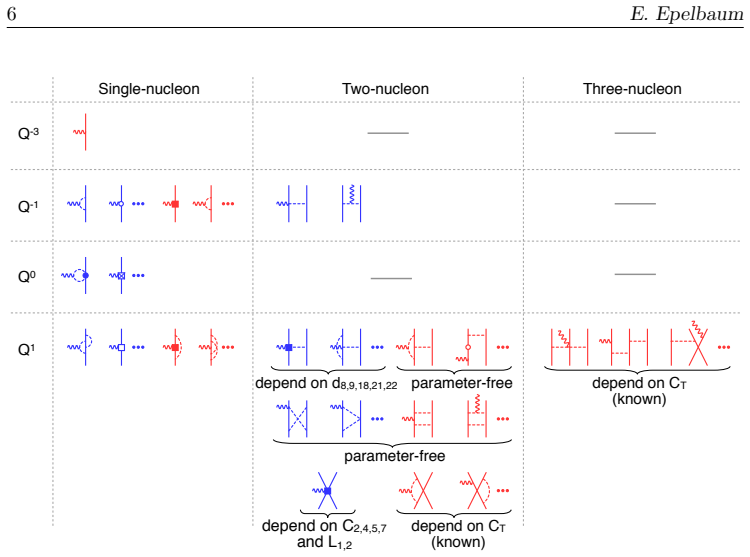
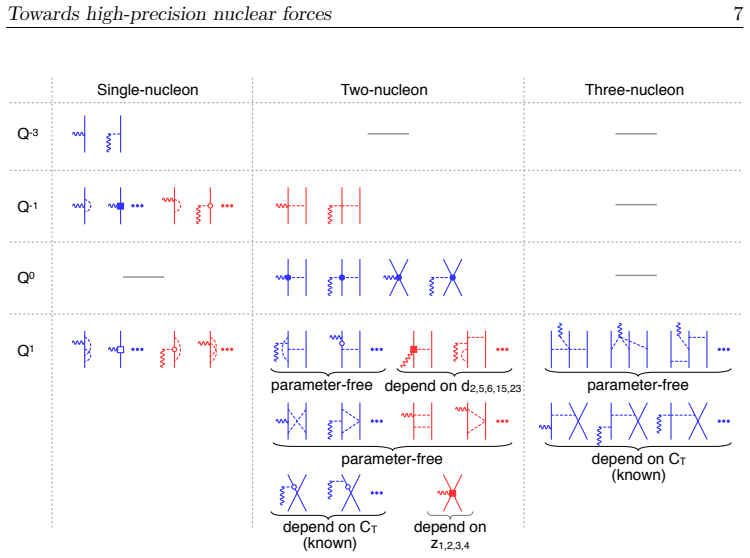
The central object is the chiral expansion of nuclear forces, organized by the power-counting formula $\nu = -4 - B + 2(A + L) + \sum_i V_i \Delta_i$, which orders two-, three- and four-nucleon forces in powers of $Q = p/\Lambda_b$ or $M_\pi/\Lambda_b$. The two-pion-exchange two-nucleon potential is the workhorse: its spectral-function representation allows regularization by multiplying the pion propagator with $\exp[-(q^2 + M_\pi^2)/\Lambda^2]$ without spoiling analyticity, and its strength is parameter-free once the pion-nucleon low-energy constants are fixed. For the three-nucleon force, the load-bearing check is the Faddeev-equation identity shown in Fig. 7: iterating a regularized one-pion-exchange 2NF with the dimensionally regulated two-pion-one-pion-exchange 3NF produces a linear divergence proportional to $\Lambda\, q_1^i q_3^j/(q_3^2 + M_\pi^2)$ that cannot be absorbed into the low-energy constant $c_D$ without violating chiral symmetry, demonstrating the need to recalculate irreducible 3NF pieces with the same cutoff.
What would settle it
Complete the cutoff-regulated calculation of the Faddeev iteration in Fig. 7: if the linear divergence proportional to $\Lambda\, q_1^i q_3^j/(q_3^2 + M_\pi^2)$ cancels against the cutoff-regulated irreducible two-pion-one-pion 3NF or can be absorbed into the low-energy constant $c_D$ together with an allowed derivative coupling, then the claimed N3LO consistency problem for the 3NF disappears.
Extended reading notes
Core claim
The paper's central claim is that chiral EFT has entered a precision era in the two-nucleon sector. At N4LO+ the potentials of Ref. [58] achieve chi-squared per datum of 1.06 for neutron-proton and 1.00 for proton-proton scattering against the 2013 scattering database below 300 MeV laboratory energy, matching or surpassing phenomenological high-precision potentials while using about 40% fewer adjustable parameters. This matters because the long-range part of the NN force is not fitted: it is determined by the spontaneously broken chiral symmetry of QCD together with pion-nucleon low-energy constants taken from a dispersion-relation analysis of pion-nucleon scattering. The review also claims that moving to the three-nucleon sector requires solving a consistency problem: nuclear potentials and currents are derived using dimensional regularization, but the Schrodinger and Faddeev equations are solved with a finite cutoff, and starting at N3LO a naive cutoff regularization of the dimensionally regulated 3NF generates a chiral-symmetry-breaking linear divergence that must cancel against a cutoff-regularized recalculation of the irreducible contribution. This is why higher-order 3NF contributions are not yet available in consistent form.
Load-bearing premise
The conclusion that consistent 3NF regularization at N3LO is an open problem rests on the specific Faddeev-iteration calculation of the two-pion-one-pion-exchange 3NF, which the review cites as in preparation and does not show.
Editorial extensions
If this is right
- N4LO+ chiral potentials can serve as partial-wave analyses of NN scattering below the pion-production threshold, giving a systematically improvable baseline for few- and many-body calculations.
- The parameter-free long-range two-pion exchange means a large part of the intermediate-range attraction of the nuclear force is a direct consequence of QCD's chiral symmetry rather than a phenomenological fit.
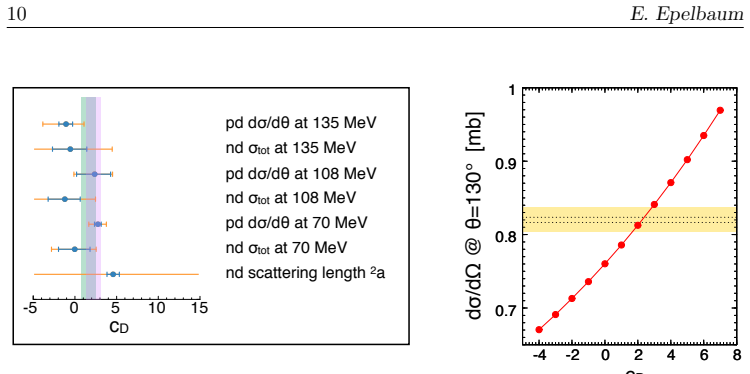
- At N2LO, including the three-nucleon force with $c_D$ fixed from nucleon-deuteron cross-section data and $c_E$ from the triton binding energy improves agreement for light nuclei up to $A=16$, but the estimated truncation errors remain large.
- Until the N3LO regularization problem is solved, consistent higher-order 3NF contributions and exchange currents cannot be included in few-nucleon calculations.
- The observed discrepancies in nucleon-deuteron spin observables, which are insensitive to the off-shell behavior of the NN potential, are likely to require 3NF contributions beyond N2LO, plausibly up to N4LO.
Reading between the lines
- Beyond the paper: if the N3LO consistency problem is resolved along the lines of the Faddeev example, the same cutoff-consistency requirement should be applied to N3LO electroweak currents, or exchange-current observables may carry uncancelled regulator artifacts even when the 3NF sector looks consistent.
- Beyond the paper: the spectral-function regularization used for the NN potential could be extended to three-nucleon forces, preserving analyticity and likely reducing finite-cutoff artifacts; a testable consequence is that cutoff dependence of nucleon-deuteron scattering observables would shrink faster than with naive local regulators.
- Beyond the paper: the roughly 40% reduction in fitted parameters implies that truncation error, rather than parameter estimation, dominates the uncertainty budget, so Bayesian truncation-error estimates for $A \geq 3$ observables should become the main comparison target for future experiments.
Signed reviews
Editorial analysis
A structured set of objections, weighed in public.
Referee Report
Summary. This proceedings article reviews the current status of chiral effective field theory for nuclear forces. The author summarizes the derivation of nuclear forces and currents via the method of unitary transformation, the chiral power counting, and the state of the art in the two-nucleon sector, emphasizing the semi-local chiral potentials of Refs. [56–58] up to N4LO+. The paper reports that the N4LO+ potentials of Ref. [58] achieve χ2/datum close to 1 for NN scattering below the pion-production threshold with fewer adjustable parameters than phenomenological potentials. In Section 5, the paper makes a new technical claim: naive cutoff regularization of dimensional-regularization-derived three-nucleon forces (3NFs) is inconsistent starting at N3LO, because an iterated Faddeev contribution produces a linear divergence of the form shown in Eq. (4), one piece of which allegedly violates chiral symmetry. The abstract and summary frame the paper as a review with a discussion of open challenges, and Section 5 identifies consistent 3NF regularization as the main bottleneck for precision beyond the NN sector.
Significance. If the status report is accurate, the paper is a useful and timely snapshot: the NN potentials of Ref. [58] with near-unity χ2/datum and reduced parameter counts are genuinely important, and the discussion of truncation-error estimation and parameter-free long-range parts is valuable. The review is also up-front about the unresolved 3NF discrepancies, which is a recognized open problem. However, the paper's own new technical claim—the alleged chiral-symmetry-breaking divergence in Eq. (4)—is not supported by a derivation in the manuscript and is referenced to an unpublished calculation ('Hermann Krebs, EE, in preparation' in Fig. 7). Since this claim is the basis for the paper's central message that consistent 3NF regularization at N3LO is a major unsolved problem, the significance of the paper as a research contribution is currently limited by this missing support. The NN-sector summaries in Section 3 are independent of Eq. (4) and appear defensible as literature statements.
major comments (3)
- [Section 5, Eq. (4)] The central technical claim that cutoff regularization of DR-derived 3NFs at N3LO produces a chiral-symmetry-breaking linear divergence is asserted, not derived. The text states the structure of the divergent terms and claims that the first term 'violates the chiral symmetry', but it provides no coefficient computation, no regulator scheme, and no demonstration that the divergence cannot be absorbed into a chiral-invariant counterterm. Because this claim is load-bearing for the paper's message that consistent 3NF regularization at N3LO is a major unsolved problem, it must be supported by an explicit calculation (or by a published reference containing that calculation) before the claim can be accepted as established.
- [Fig. 7 and surrounding text] The key step in the argument—that recalculating V_3N^{2π–1π} with cutoff regularization 'cancels exactly' the problematic divergence—is attributed to an unpublished work, as indicated by the label 'Hermann Krebs, EE, in preparation' in Fig. 7. This makes the central consistency claim uncheckable by the reader. The manuscript should either include the calculation in an appendix, cite a published paper, or explicitly mark the claim as provisional and state what would follow if the cancellation is only approximate or scheme-dependent.
- [Section 5, sentence following Eq. (4)] The statement that the first divergent term 'violates the chiral symmetry, since it corresponds to a derivative-less coupling of the exchanged pion' requires substantiation. One must show that no chiral-invariant local counterterm at the relevant order can absorb a term of that form, and that the divergence is not an artifact of a particular regulator choice. Without such a demonstration, the conclusion that 'a naive cutoff regularization of the 3NFs, derived using DR, is, in fact, inconsistent starting from N3LO' is not established. This point is distinct from the missing derivation: even if the quoted divergent terms are correct, the symmetry argument needs to be made explicit.
minor comments (4)
- [Fig. 2] Figure 2 appears to be reproduced from a presentation slide and contains duplicated text and unreadable labels, which is not appropriate for a journal article and should be redrawn.
- [Eq. (3)] The notation in Eq. (3) uses Λ in the regularization exponent; please clarify whether this is the same cutoff used in the momentum-space regulator defined elsewhere in the text, and define the range of the spectral integral consistently.
- [References [9, 10, 14, 15]] Some references are cited as 'these proceedings' without full bibliographic information; for the final version, please provide complete citations so that the reader can locate them.
- [Throughout] The text refers to 'N 4LO' with inconsistent spacing and occasionally as 'N4LO+'; please standardize the notation (e.g., N4LO and N4LO+) throughout.
Circularity Check
No construction-level circularity in the main NN-precision claim; Section 5's N3LO-regularization gap is an in-preparation self-citation that is a verification concern, not a circular reduction.
full rationale
The paper's principal quantitative claim is that the N4LO+ potentials of Ref. [58] reproduce the Granada NN database essentially at PWA quality with about forty percent fewer adjustable parameters than phenomenological potentials. This is benchmarked against external data (Granada database, Nijmegen PWA), and the long-range two-pion-exchange contribution is parameter-free up to pion-nucleon LECs taken from Roy-Steiner analyses, so it does not reduce by construction to the paper's inputs. The c_D and c_E determinations in Section 4 are explicit fits to triton binding and selected Nd data, then used for independent observables, not relabeled as predictions. The one load-bearing new element is Section 5: the assertion that cutoff-regularizing DR-derived 3NFs is inconsistent at N3LO because of the Eq. (4) divergence and the claim that a cutoff recalculation of V_3N^{2π-1π} cancels exactly that divergence. That cancellation is attributed in Fig. 7 to 'Hermann Krebs, EE, in preparation' and no calculation is shown; this is a real verification gap, since the challenge would not hold if the cancellation were inexact or scheme-dependent. However, this is not circularity in the required sense: it is not an equation equivalent by construction to an input, nor a fitted parameter renamed as a prediction, nor an imported uniqueness theorem. The review's other self-citations are to published, externally benchmarked calculations, so the overall circularity burden is low.
Assumptions & free parameters
free parameters (3)
- c_D (3NF LEC) =
1.7±0.8 (R=0.9 fm), 7.2±0.7 (R=1.0 fm)
- c_E (3NF LEC) =
-0.329 (+0.103/-0.106) for R=0.9 fm; -0.652±0.067 for R=1.0 fm
- Cutoff Lambda =
350, 400, 450, 500, 550 MeV
assumptions (4)
- domain assumption Spontaneous chiral symmetry breaking of QCD and its approximate SU(2)xSU(2) pattern justify the chiral Lagrangian.
- domain assumption Weinberg's power counting with resummation of infrared-enhanced ladder diagrams via the Schrodinger or Lippmann-Schwinger equation is a valid organizing principle.
- domain assumption The cutoff Lambda can be kept finite and of order the breakdown scale without invalidating the chiral expansion.
- domain assumption The breakdown scale Lambda_b is approximately 600 MeV, as estimated in Ref. [56].
Cite this review
Pith. "Pith review of Towards high-precision nuclear forces from chiral effective field theory." pith.science (2026). https://pith.science/paper/4I36W6D5
@misc{pith2026190809349,
  author       = {Pith},
  title        = {Pith review of: Towards high-precision nuclear forces from chiral effective field theory},
  year         = {2026},
  howpublished = {\url{https://pith.science/paper/4I36W6D5}},
  note         = {Machine review of arXiv:1908.09349}
}
read the original abstract
Chiral effective field theory is being developed into a precision tool for low-energy nuclear physics. I review the state of the art in the two-nucleon sector, discuss applications to few-nucleon systems and address challenges that will have to be faced over the coming years.
Figures


Figures from the paper (3 more)

Reference graph
Works this paper leans on
-
[58]
P. Reinert, H. Krebs and E. Epelbaum, Eur. Phys. J. A 54, no. 5, 86 (2018)
work page 2018
-
[1]
Bernard, N
V. Bernard, N. Kaiser and U.-G. Meißner, Int. J. Mod. Phys. E 4, 193 (1995)
1995
-
[2]
Weinberg, Phys
S. Weinberg, Phys. Lett. B 251, 288 (1990)
1990
-
[3]
Gl¨ ockleet al., Phys
W. Gl¨ ockleet al., Phys. Rept. 274, 107 (1996)
1996
-
[4]
B. R. Barrett, P. Navratil and J. P. Vary, Prog. Part. Nucl. Phys. 69, 131 (2013)
2013
-
[5]
Hagen et al., Phys
G. Hagen et al., Phys. Rev. Lett. 109, 032502 (2012)
2012
-
[6]
Hergert et al., Phys
H. Hergert et al., Phys. Rev. C 87, no. 3, 034307 (2013)
2013
-
[7]
V. Soma, C. Barbieri and T. Duguet, Phys. Rev. C 87, no. 1, 011303 (2013)
2013
Show all 110 references
-
[8]
Lovato et al., Phys
A. Lovato et al., Phys. Rev. Lett. 111, no. 9, 092501 (2013)
2013
-
[9]
Nuclear structure and dynamics from chiral forces, talk given at the Int
Petr Navratil, these proceedings. Nuclear structure and dynamics from chiral forces, talk given at the Int. Conf. Nuclear Theory in the Supercomputing Era – 2018 (NTSE-2018, October 29 November 2, 2018, Daejeon, South Korea)
2018
-
[10]
James Vary, these proceedings
-
[11]
Lee, Prog
D. Lee, Prog. Part. Nucl. Phys. 63, 117 (2009)
2009
-
[12]
Lee, Lect
D. Lee, Lect. Notes Phys. 936, 237 (2017)
2017
-
[13]
L¨ ahde, Ulf-G
T.A. L¨ ahde, Ulf-G. Meißner, Lect. Notes Phys. 957, 1 (2019)
2019
-
[14]
Meißner, these proceedings
Ulf-G. Meißner, these proceedings
-
[15]
Dean Lee, these proceedings
-
[16]
Epelbaum, H
E. Epelbaum, H. W. Hammer and U.-G. Meißner, Rev. Mod. Phys. 81, 1773 (2009)
2009
-
[17]
Epelbaum and U.-G
E. Epelbaum and U.-G. Meißner, Ann. Rev. Nucl. Part. Sci. 62, 159 (2012)
2012
-
[18]
Machleidt and D
R. Machleidt and D. R. Entem, Phys. Rept. 503, 1 (2011)
2011
-
[19]
G. P. Lepage, nucl-th/9706029
-
[20]
Epelbaum and J
E. Epelbaum and J. Gegelia, Eur. Phys. J. A 41, 341 (2009). Towards high-precision nuclear forces 15
2009
-
[21]
Epelbaum, A
E. Epelbaum, A. M. Gasparyan, J. Gegelia and U.-G. Meißner, Eur. Phys. J. A 54, no. 11, 186 (2018)
2018
-
[22]
Fukuda, K
N. Fukuda, K. Sawada, M. Taketani, Prog. Theor. Phys. 12, 156 (1954)
1954
-
[23]
Okubo, Prog
S. Okubo, Prog. Theor. Phys. 12, 603 (1954)
1954
-
[24]
Epelbaum, W
E. Epelbaum, W. Gl¨ ockle and U.-G. Meißner, Nucl. Phys. A 637, 107 (1998)
1998
-
[25]
Epelbaum, W
E. Epelbaum, W. Gl¨ ockle and U.-G. Meißner, Nucl. Phys. A 671, 295 (2000)
2000
-
[26]
Epelbaum, Phys
E. Epelbaum, Phys. Lett. B 639, 456 (2006)
2006
-
[27]
Epelbaum, Eur
E. Epelbaum, Eur. Phys. J. A 34, 197 (2007)
2007
-
[28]
K¨ olling, E
S. K¨ olling, E. Epelbaum, H. Krebs and U.-G. Meißner, Phys. Rev. C 84, 054008 (2011)
2011
-
[29]
Krebs, A
H. Krebs, A. Gasparyan and E. Epelbaum, Phys. Rev. C 85, 054006 (2012)
2012
-
[30]
Krebs, E
H. Krebs, E. Epelbaum and U.-G. Meißner, Annals Phys. 378, 317 (2017)
2017
-
[31]
Nogga, R
A. Nogga, R. G. E. Timmermans and U. van Kolck, Phys. Rev. C 72, 054006 (2005)
2005
-
[32]
M. C. Birse, Phys. Rev. C 74, 014003 (2006)
2006
-
[33]
M. P. Valderrama, Int. J. Mod. Phys. E 25, no. 05, 1641007 (2016)
2016
-
[34]
Ordonez and U
C. Ordonez and U. van Kolck, Phys. Lett. B 291, 459 (1992)
1992
-
[35]
J. L. Friar and S. A. Coon, Phys. Rev. C 49, 1272 (1994)
1994
-
[36]
Kaiser, R
N. Kaiser, R. Brockmann and W. Weise, Nucl. Phys. A 625, 758 (1997)
1997
-
[37]
Kaiser, Phys
N. Kaiser, Phys. Rev. C 61, 014003 (2000)
2000
-
[38]
Kaiser, Phys
N. Kaiser, Phys. Rev. C 62, 024001 (2000)
2000
-
[39]
Kaiser, Phys
N. Kaiser, Phys. Rev. C 64, 057001 (2001)
2001
-
[40]
Kaiser, Phys
N. Kaiser, Phys. Rev. C 65, 017001 (2002)
2002
-
[41]
D. R. Entem, N. Kaiser, R. Machleidt and Y. Nosyk, Phys. Rev. C 91, no. 1, 014002 (2015)
2015
-
[42]
van Kolck, Phys
U. van Kolck, Phys. Rev. C 49, 2932 (1994)
1994
-
[43]
Epelbaum et al., Phys
E. Epelbaum et al., Phys. Rev. C 66, 064001 (2002)
2002
-
[44]
Ishikawa and M
S. Ishikawa and M. R. Robilotta, Phys. Rev. C 76, 014006 (2007)
2007
-
[45]
Bernard, E
V. Bernard, E. Epelbaum, H. Krebs and U.-G. Meißner, Phys. Rev. C 77, 064004 (2008)
2008
-
[46]
Bernard, E
V. Bernard, E. Epelbaum, H. Krebs and U.-G. Meißner, Phys. Rev. C 84, 054001 (2011). 16 E. Epelbaum
2011
-
[47]
Krebs, A
H. Krebs, A. Gasparyan and E. Epelbaum, Phys. Rev. C 87, no. 5, 054007 (2013)
2013
-
[48]
Girlanda, A
L. Girlanda, A. Kievsky and M. Viviani, Phys. Rev. C 84, 014001 (2011)
2011
-
[49]
Ordonez, L
C. Ordonez, L. Ray and U. van Kolck, Phys. Rev. C 53, 2086 (1996)
1996
-
[50]
Kaiser, S
N. Kaiser, S. Gerstendorfer and W. Weise, Nucl. Phys. A 637, 395 (1998)
1998
-
[51]
Krebs, E
H. Krebs, E. Epelbaum and U.-G. Meißner, Eur. Phys. J. A 32, 127 (2007)
2007
-
[52]
Epelbaum, H
E. Epelbaum, H. Krebs and U.-G. Meißner, Nucl. Phys. A 806, 65 (2008)
2008
-
[53]
Krebs, A
H. Krebs, A. M. Gasparyan and E. Epelbaum, Phys. Rev. C 98, no. 1, 014003 (2018)
2018
-
[54]
Piarulli et al., Phys
M. Piarulli et al., Phys. Rev. C 91, no. 2, 024003 (2015)
2015
-
[55]
Ekstr¨ om, G
A. Ekstr¨ om, G. Hagen, T. D. Morris, T. Papenbrock and P. D. Schwartz, Phys. Rev. C 97, no. 2, 024332 (2018)
2018
-
[56]
Epelbaum, H
E. Epelbaum, H. Krebs and U.-G. Meißner, Eur. Phys. J. A 51, no. 5, 53 (2015)
2015
-
[57]
Epelbaum, H
E. Epelbaum, H. Krebs and U.-G. Meißner, Phys. Rev. Lett. 115, no. 12, 122301 (2015)
2015
-
[59]
R. B. Wiringa, V. G. J. Stoks and R. Schiavilla, Phys. Rev. C 51, 38 (1995)
1995
-
[60]
Binder et al
S. Binder et al. [LENPIC Collaboration], Phys. Rev. C 93, no. 4, 044002 (2016)
2016
-
[61]
Binder et al
S. Binder et al. [LENPIC Collaboration], Phys. Rev. C 98, no. 1, 014002 (2018)
2018
-
[62]
K¨ olling, E
S. K¨ olling, E. Epelbaum, H. Krebs and U.-G. Meißner, Phys. Rev. C 80, 045502 (2009)
2009
-
[63]
Krebs, E
H. Krebs, E. Epelbaum and U.-G. Meißner, Few-Body Syst. 60, 31 (2019)
2019
-
[64]
Arenhovel and M
H. Arenhovel and M. Sanzone, Few Body Syst. Suppl. 3, 1 (1991)
1991
-
[65]
Golak et al., Phys
J. Golak et al., Phys. Rept. 415, 89 (2005)
2005
-
[66]
Kubis and U.-G
B. Kubis and U.-G. Meißner, Nucl. Phys. A 679, 698 (2001)
2001
-
[67]
M. R. Schindler, J. Gegelia and S. Scherer, Eur. Phys. J. A 26, 1 (2005)
2005
-
[68]
H. W. Fearing, T. R. Hemmert, R. Lewis and C. Unkmeir, Phys. Rev. C 62, 054006 (2000)
2000
-
[69]
Gasparyan and M
A. Gasparyan and M. F. M. Lutz, Nucl. Phys. A 848, 126 (2010)
2010
-
[70]
Fettes, U.-G
N. Fettes, U.-G. Meißner, M. Mojzis and S. Steininger, Annals Phys. 283, 273 (2000) Erratum: [Annals Phys. 288, 249 (2001)]
2000
-
[71]
J. W. Chen, G. Rupak and M. J. Savage, Nucl. Phys. A 653, 386 (1999)
1999
-
[72]
Pastore, R
S. Pastore, R. Schiavilla and J. L. Goity, Phys. Rev. C 78, 064002 (2008). Towards high-precision nuclear forces 17
2008
-
[73]
Pastore et al., Phys
S. Pastore et al., Phys. Rev. C 80, 034004 (2009)
2009
-
[74]
Pastore, L
S. Pastore, L. Girlanda, R. Schiavilla and M. Viviani, Phys. Rev. C 84, 024001 (2011)
2011
-
[75]
Hermann Krebs, Nuclear Currents in Chiral Effective Field Theory , to appear in Eur. Phys. J. A
-
[76]
Baroni et al., Phys
A. Baroni et al., Phys. Rev. C 93, no. 1, 015501 (2016) Erratum: [Phys. Rev. C 93, no. 4, 049902 (2016)] Erratum: [Phys. Rev. C 95, no. 5, 059901 (2017)]
2016
-
[77]
R. J. Furnstahl, N. Klco, D. R. Phillips and S. Wesolowski, Phys. Rev. C 92, no. 2, 024005 (2015)
2015
-
[78]
J. A. Melendez, S. Wesolowski and R. J. Furnstahl, Phys. Rev. C 96, no. 2, 024003 (2017)
2017
-
[79]
Wesolowski, R
S. Wesolowski, R. J. Furnstahl, J. A. Melendez and D. R. Phillips, J. Phys. G 46, no. 4, 045102 (2019)
2019
-
[80]
Epelbaum, W
E. Epelbaum, W. Gl¨ ockle and U.-G. Meißner, Nucl. Phys. A 747, 362 (2005)
2005
-
[81]
D. R. Entem and R. Machleidt, Phys. Rev. C 68, 041001 (2003)
2003
-
[82]
Gezerlis et al., Phys
A. Gezerlis et al., Phys. Rev. C 90, no. 5, 054323 (2014)
2014
-
[83]
T. A. Rijken, Annals Phys. 208, 253 (1991)
1991
-
[84]
Hoferichter, J
M. Hoferichter, J. Ruiz de Elvira, B. Kubis and U.-G. Meißner, Phys. Rev. Lett. 115, no. 19, 192301 (2015)
2015
-
[85]
Hoferichter, J
M. Hoferichter, J. Ruiz de Elvira, B. Kubis and U.-G. Meißner, Phys. Rept. 625, 1 (2016)
2016
-
[86]
D. R. Entem, R. Machleidt and Y. Nosyk, Phys. Rev. C 96, no. 2, 024004 (2017)
2017
-
[87]
Navarro Perez, J
R. Navarro Perez, J. E. Amaro and E. Ruiz Arriola, Phys. Rev. C 88, no. 6, 064002 (2013) Erratum: [Phys. Rev. C 91, no. 2, 029901 (2015)]
2013
-
[88]
Epelbaum, High-precision nuclear forces: Where do we stand? , to appear in proceedings of the 9th International workshop on Chiral Dynamics, 17-21 Septem- ber 2018, Durham, NC, USA
E. Epelbaum, High-precision nuclear forces: Where do we stand? , to appear in proceedings of the 9th International workshop on Chiral Dynamics, 17-21 Septem- ber 2018, Durham, NC, USA
2018
-
[89]
Bersbach et al., Phys
A.J. Bersbach et al., Phys. Rev. D 13 (1976) 535
1976
-
[90]
Kuckes et al., Phys
A.F. Kuckes et al., Phys. Rev. 121 (1961) 1226
1961
-
[91]
V. G. J. Stoks, R. A. M. Klomp, M. C. M. Rentmeester and J. J. de Swart, Phys. Rev. C 48, 792 (1993)
1993
-
[92]
Skibi´ nskiet al., Phys
R. Skibi´ nskiet al., Phys. Rev. C 93, no. 6, 064002 (2016)
2016
-
[93]
Wita la et al., Few Body Syst
H. Wita la et al., Few Body Syst. 57, no. 12, 1213 (2016)
2016
-
[94]
Wita la et al., Few Body Syst
H. Wita la et al., Few Body Syst. 60, no. 1, 19 (2019). 18 E. Epelbaum
2019
-
[95]
Epelbaum et al
E. Epelbaum et al. [LENPIC Collaboration], Phys. Rev. C 99, no. 2, 024313 (2019)
2019
-
[96]
Golak et al., Eur
J. Golak et al., Eur. Phys. J. A 43, 241 (2010)
2010
-
[97]
Hebeler, H
K. Hebeler, H. Krebs, E. Epelbaum, J. Golak and R. Skibi´ nski, Phys. Rev. C 91, no. 4, 044001 (2015)
2015
-
[98]
H. W. Hammer, A. Nogga and A. Schwenk, Rev. Mod. Phys. 85, 197 (2013)
2013
-
[99]
Sekiguchi et al., Phys
K. Sekiguchi et al., Phys. Rev. C 65, 034003 (2002)
2002
-
[100]
Kalantar-Nayestanaki, E
N. Kalantar-Nayestanaki, E. Epelbaum, J. G. Messchendorp and A. Nogga, Rept. Prog. Phys. 75, 016301 (2012)
2012
-
[101]
S. A. Coon and H. K. Han, Few Body Syst. 30, 131 (2001)
2001
-
[102]
B. S. Pudliner et al., Phys. Rev. C 56, 1720 (1997)
1997
-
[103]
Krebs, Electroweak current in chiral effective field theory , to appear in pro- ceedings of the 9th International workshop on Chiral Dynamics, 17-21 September 2018, Durham, NC, USA
H. Krebs, Electroweak current in chiral effective field theory , to appear in pro- ceedings of the 9th International workshop on Chiral Dynamics, 17-21 September 2018, Durham, NC, USA
2018
-
[104]
A. A. Slavnov, Nucl. Phys. B 31, 301 (1971)
1971
-
[105]
Djukanovic, M
D. Djukanovic, M. R. Schindler, J. Gegelia and S. Scherer, Phys. Rev. D 72, 045002 (2005)
2005
-
[106]
Djukanovic, J
D. Djukanovic, J. Gegelia, S. Scherer and M. R. Schindler, Few Body Syst. 41, 141 (2007)
2007
-
[107]
Behrendt et al., Eur
J. Behrendt et al., Eur. Phys. J. A 52, no. 9, 296 (2016)
2016
-
[108]
Ekstr¨ omet al., J
A. Ekstr¨ omet al., J. Phys. G 42, no. 3, 034003 (2015)
2015
-
[109]
Skibi´ nskiet al., Phys
R. Skibi´ nskiet al., Phys. Rev. C 98, 014001 (2018)
2018
-
[110]
Girlanda, A
L. Girlanda, A. Kievsky, M. Viviani and L. E. Marcucci, Phys. Rev. C 99, no. 5, 054003 (2019)
2019
Reviewed August 14, 2026 · model on record in the stance chip above.
Discussion (0). Continue with ORCID to comment.