REVIEW 4 major objections 4 minor 92 references
Accurate simulation for finite projected entangled pair states in two dimensions
T0 review · 4 major / 4 minor · reviewed 2026-08-14 · deepseek-v4-flash
Pith's one-line read Variational Monte Carlo sampling of finite PEPS reproduces quantum Monte Carlo and DMRG results on 32x32 and 24x24 lattices.
desk verdict A genuinely useful finite-PEPS method with real benchmark validation at 32x32; the 24x24 frustrated numbers are encouraging but the optimization and FSS error bars need tightening. read the letter →
The pith
A machine-rendered reading of the paper's core claim, the machinery that carries it, and where it could break.
The reading
What carries the argument
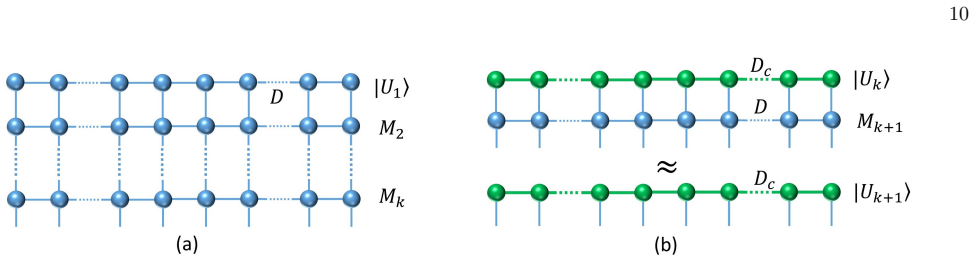
The engine is single-layer Monte Carlo sampling of the PEPS amplitude, with bond dimension D (the size of the virtual index connecting neighboring tensors). For a spin configuration $|S\rangle$ the amplitude $\Psi(S)$ is a tensor trace over the bond indices; energy and gradients are written as Monte Carlo averages of the local energy $E_{\text{loc}}(S)$ and of logarithmic derivatives of $\Psi(S)$. A Metropolis sweep visits every lattice bond sequentially and tries to flip each antiparallel nearest-neighbor spin pair, accepting with probability $\min(1, |\Psi(S_b)|^2/|\Psi(S_a)|^2)$; because only ratios are needed, proposals can be computed with a smaller cutoff $D_{c1}=2D$ while observables use $D_{c2}=3D$, and a boundary-MPS contraction makes the sweep cost $O(ND^4D_c^2)$. The optimization begins from a simple-update imaginary-time-evolved state and proceeds by stochastic gradient descent with random per-element steps and decreasing step lengths. Afterward, observables are reweighted by the spin-inversion-symmetrized amplitude $\Phi(S)=\Psi(S)+\Psi(\bar S)$, and long-distance correlations are extracted from many Monte Carlo sweeps.
What would settle it
Repeat the D=8 optimization for the 32x32 Heisenberg model from several random seeds and step-length schedules while keeping the same boundary conditions; if the lowest energies found differ by more than about 1e-4 per site or systematically miss the quantum Monte Carlo value -0.65633(1), the claim that the method reliably reaches near-exact ground states for large systems is not supported.
Extended reading notes
Core claim
The paper's central claim is that a variational Monte Carlo treatment of finite projected entangled pair states removes the practical bottlenecks that have kept PEPS simulations to small or infinite-unit-cell settings, making large finite systems both affordable and accurate. Concretely, with bond dimension D=8, a sequentially visited spin-pair Metropolis sweep at reduced contraction cutoff for proposal generation, and a final spin-inversion symmetrization of the wave function, the algorithm reproduces quantum Monte Carlo ground-state energies for the square-lattice Heisenberg model on lattices from 8x8 to 32x32 with energy errors at or below about 8e-5 per site and staggered-magnetization errors about 1e-3. For the frustrated J1-J2 model, where QMC has a sign problem, the D=8 energies on 8x28 stripes agree with DMRG to about 1e-4, and 24x24 simulations at J2/J1=0.5 extrapolate to -0.49635(5), consistent with DMRG, variational QMC, and iPEPS estimates. The authors take the convergence of spin orders with increasing D, including recovery of SU(2) symmetry and x/y isotropy, as evidence that the optimization reaches the correct ground-state subspace, and they argue the approach extends to fermionic systems and to time evolution.
Load-bearing premise
The accuracy claim depends on the assumption that the gradient-based optimization, beginning from the simple-update state, gets near the best variational answer for every lattice size; if optimization stalls in a local minimum for some sizes, the close agreement with reference methods would be partly a coincidence.
Editorial extensions
If this is right
- Finite PEPS simulations can now reach 32x32 (unfrustrated) and 24x24 (frustrated) with D=8, and because Monte Carlo convergence is nearly size-independent, larger lattices are mainly a matter of computing resources.
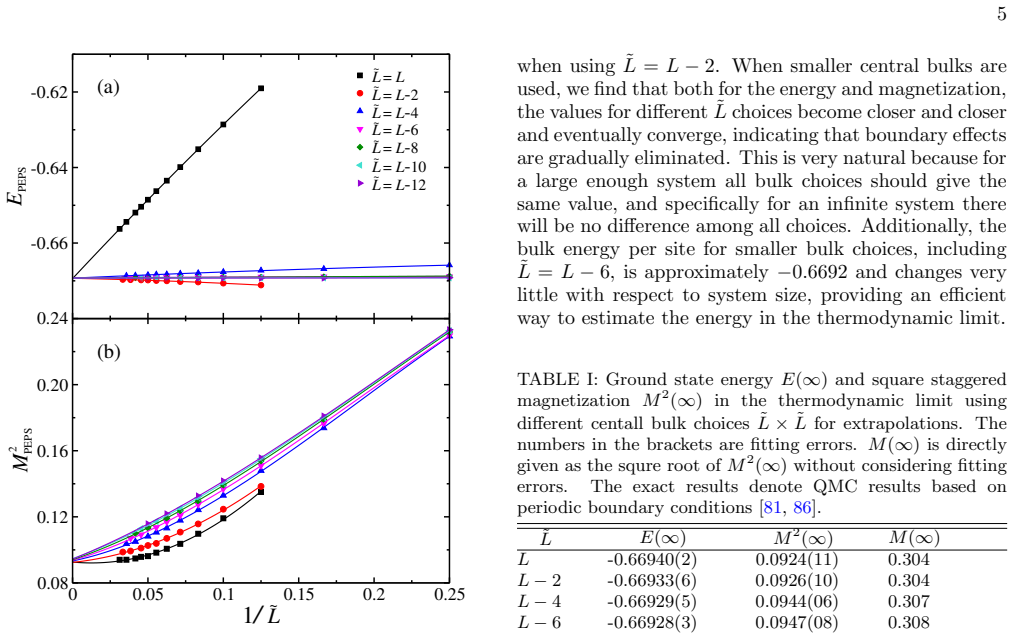
- For the J1-J2 model at J2/J1=0.5, bulk energies from open-boundary systems show much smaller finite-size effects than DMRG or vQMC, giving an efficient way to estimate thermodynamic-limit energies.
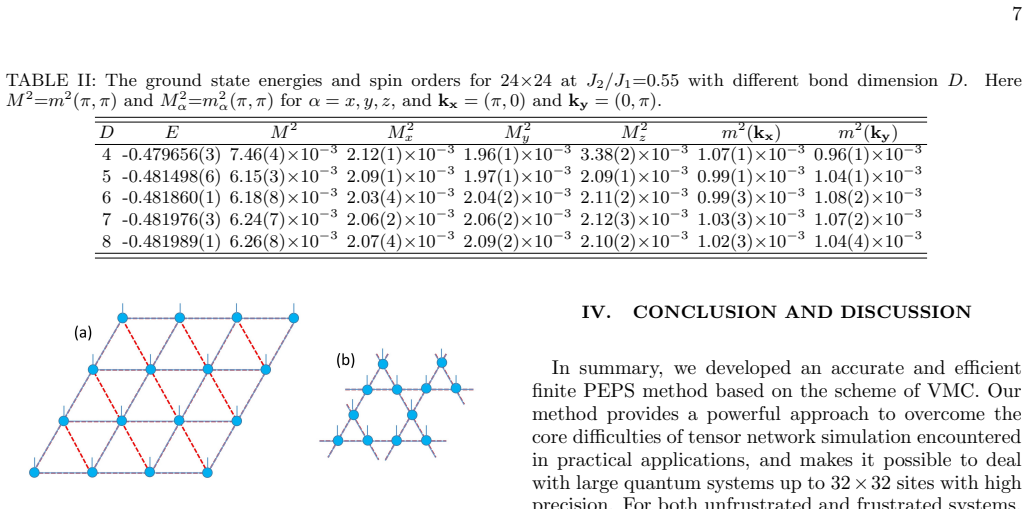
- The systematic study from D=4 to D=8 at J2/J1=0.55 shows energy and spin orders converging while SU(2) symmetry and x/y axis isotropy are gradually recovered, which the paper reads as evidence the optimization lands in the correct ground-state subspace.
- The method extends directly to fermionic systems (Hubbard/t-J models) via Grassmann-number tensor networks and to time evolution in the t-VMC scheme, both stated as immediate generalizations.
- Finite PEPS without a predefined unit cell can describe translation-symmetry-broken phases, incommensurate orders, and trapped cold atoms, and can be compared directly with DMRG on the same finite geometry.
Reading between the lines
- Because the acceptance ratio during sampling is only compared with a random number, the cutoff used to generate configurations can be much smaller than the one used for observables; a natural extension the paper does not explore is to push this asymmetry further and correct any residual bias by reweighting, which would cut the dominant sampling cost.
- Spin-inversion symmetrization is applied only after optimization; applying the same idea to lattice symmetries (translations, rotations, reflections) during or after optimization could further reduce variance and improve long-distance correlations, at the price of more sampling.
- The near-size-independent Monte Carlo convergence suggests the algorithm's scaling is dominated by per-sweep cost and number of gradient steps, so the practical path to, say, 40x40 or D=10 is parallel hardware rather than algorithmic innovation; this is a prediction, not a claim of the paper.
- The consistency among several central-bulk choices in the finite-size-scaling analysis implies that open-boundary finite PEPS can serve as a controlled estimator of bulk properties; testing this on the Heisenberg point at even larger system sizes would isolate how much of the residual error comes from incomplete optimization versus the D=8 truncation.
Signed reviews
Editorial analysis
A structured set of objections, weighed in public.
Referee Report
Summary. This paper presents a variational Monte Carlo (VMC) scheme for finite projected entangled pair states (PEPS) and applies it to the square-lattice spin-1/2 Heisenberg model up to 32x32 and the frustrated J1-J2 model up to 24x24, together with small triangular- and kagome-lattice benchmarks. The central methodological innovations are a sequential spin-pair update that reduces the cost of an MC sweep to O(ND^4Dc^2), a spin-inversion-symmetrized sampling weight, and a stochastic-gradient optimization initialized from simple-update states. The authors report ground-state energies and spin correlations that agree with QMC, DMRG, vQMC, and exact-diagonalization results to within roughly 1e-4 in energy for the unfrustrated case and claim excellent agreement for the frustrated case as well. The paper concludes that the method substantially advances finite-PEPS simulations and can address systems beyond the reach of QMC and DMRG.
Significance. If the central claim holds, this is a significant methodological advance: it substantially enlarges the system sizes accessible to finite-PEPS simulations while retaining benchmark-quality accuracy. The strengths of the paper are its validation against independent QMC (Sandvik), DMRG (Gong et al.), vQMC (Hu et al.), and exact-diagonalization results, with no parameters fitted to reproduce those benchmarks; the documented convergence of the cutoffs Dc1 and Dc2 in the appendices; and the honest admission in Sec. II C that the errors vary randomly with L, possibly because of incomplete optimization. However, the accuracy claims for the largest and frustrated systems rest on optimization and finite-size-scaling assumptions that are not fully supported: the SIS estimator is not specified precisely, no convergence diagnostic (gradient norm, energy variance, or restart tests) is provided, and the spread among central-bulk extrapolations is not folded into the quoted errors.
major comments (4)
- [Sec. II C, Fig. 3, Table IV] The authors state that the errors of energy and magnetization 'vary randomly with respect to L, possibly because of incomplete optimization' (Sec. II C), yet no optimization-convergence diagnostic is reported. The stopping criterion is only that the energy decreases very slowly (Sec. II B); no gradient norm, energy variance, or restart-from-different-initialization test is provided for the large systems. This matters because the central claim that D=8 PEPS is accurate up to 32x32 requires that the reported energies are representative of the variational optimum. Concretely, Table IV shows energy errors of 4.3e-5 (L=14), 7.6e-5 (L=20), 8.5e-5 (L=24), and 7.9e-5 (L=32), which fluctuate rather than decreasing smoothly with L. Please add a quantitative convergence diagnostic and at least one independent initialization test for a representative large system, and discuss how the random L-dependent error affects the FSS extrapolations.
- [Sec. II B, Eq. (3)] The spin-inversion-symmetrized state Φ(S)=Ψ(S)+Ψ(S_bar) is introduced in Sec. II B, and the text says that all observables are evaluated with the new weight |Φ(S)|^2. However, Eq. (3) defines the local energy as Σ_{S'} [Ψ(S')/Ψ(S)] <S'|H|S>, not with Φ ratios. If the Monte Carlo average uses weights |Φ(S)|^2 while Eloc(S) is still computed with Ψ(S')/Ψ(S), the resulting estimator is not an unbiased estimate of <Φ|H|Φ>/<Φ|Φ>. The manuscript does not state which ratio is used in the SIS runs. Since all final tables (e.g., Table IV) use SIS, this ambiguity affects every reported number and must be clarified.
- [Table I, Fig. 4] In the thermodynamic-limit extrapolation for the Heisenberg model, Table I gives E(∞) values from -0.66940(2) for L~=L to -0.66926(6) for L~=L-8. The spread of 1.4e-4 is about seven times the quoted fitting error of 2e-5, and the L~=L-8, L-10, and L-12 values lie about 1.6e-4 to 1.8e-4 below the QMC value -0.669437. Quoting -0.66940(2) as the extrapolated energy while reporting the other bulk choices as 'all in excellent agreement' does not account for the systematic dependence on the central-bulk choice. The FSS uncertainty should include this spread.
- [Sec. III A, Fig. 6] For the frustrated 24x24 system at J2/J1=0.5, the extrapolated PEPS energy -0.49635(5) (or the window [-0.4964,-0.4962]) is compared with DMRG energy -0.4968 and vQMC energy -0.4961. The difference between the PEPS value and the DMRG value is about 4.5e-4, almost an order of magnitude larger than the reported PEPS fitting error of 5e-5, and the mutual spread of the comparison references is about 7e-4. Treating the two references as lower bounds does not remove this discrepancy. The claim of 'excellent agreement' for the frustrated 24x24 case needs a combined uncertainty estimate that includes the spread of the reference methods, or an explicit statement that the agreement is only at the 5e-4 level.
minor comments (4)
- [General] There are numerous typographical errors, including 'sequetially' (Sec. II), 'furstrated' and 'kgaome' (Sec. III), 'persit' (Sec. III A), 'cofigurations' (Sec. II A), 'centall' (Table I caption), and 'Intutively' and 'geomertric' (Sec. IV). A careful proofread is needed.
- [Sec. II A, Eq. (9)] For the sequential visiting scheme, the acceptance probability in Eq. (9) contains no K-factor analogous to Eq. (8), and the text does not explicitly prove detailed balance for the deterministic bond-by-bond sweep. A brief explanation of why the proposal probabilities cancel (or why detailed balance still holds) would remove ambiguity.
- [Sec. II B, Eq. (10)] The optimization update in Eq. (10) uses the sign of the gradient with a random magnitude r·δ(i), but no information is given about the variance of the stochastic gradient estimator or the number of sweeps M used per gradient step beyond the specific value 45000 for 32x32. A short discussion of estimator noise and its effect on the convergence criterion would strengthen the optimization section.
- [Sec. III A, Table II] In Table II the text says 'the energy persit E and spin order converge gradually'; presumably 'persist' is intended. Also, the reported MC sampling errors for spin orders are all of similar size; it would be helpful to state how these errors were estimated (e.g., binning or blocking).
Circularity Check
No significant circularity: all key accuracy claims are checked against independent QMC, DMRG, vQMC, and ED benchmarks, with no fitted parameter renamed as a prediction.
full rationale
The paper's derivation chain is not circular. The PEPS energy estimator (Eqs. 2-6) is the standard variational Monte Carlo estimator, so agreement with benchmark data is an external falsification rather than a tautology. Heisenberg energies and magnetizations are compared with QMC (Sandvik 1997; Syljuasen-Sandvik 2002); frustrated 8x28 energies and correlations are compared with DMRG (Gong et al. 2014); 24x24 extrapolations are compared with independent vQMC (Hu et al. 2013) and iPEPS (Haghshenas-Sheng 2018); triangular and kagome results are compared with exact diagonalization. No PEPS tensor or hyperparameter is fitted to reproduce these benchmark values; D, Dc1, Dc2, and step lengths are fixed by convergence tests (Appendices D-E). Self-citations to Refs. [75, 78, 79] are methodological lineage for VMC-PEPS, and Ref. [89] is a pointer to a follow-up application; none of these carries the accuracy claims. The statement in Sec. II C that energy and magnetization errors 'vary randomly with respect to L, possibly because of incomplete optimization' is an honest convergence caveat, not evidence that a result reduces to its input; it concerns whether the stochastic gradient descent reached a global optimum, not whether the benchmark comparison is definitionally forced. Therefore no step in the paper satisfies the circularity criteria: no self-definitional quantity, no fitted input called a prediction, and no load-bearing self-citation chain.
Assumptions & free parameters
free parameters (2)
- Optimization step-length schedule delta(i) =
0.005, 0.002, 0.001, 0.0005
- Bond dimension D and contraction cutoffs Dc1, Dc2 =
D=8, Dc1=16, Dc2=24
assumptions (4)
- domain assumption The PEPS with D=8 and real tensors can accurately represent the ground states of the Heisenberg and J1-J2 models at the claimed precision.
- domain assumption The spin-inversion symmetrized wavefunction Phi yields unbiased energy estimates via the same local-energy formula derived for Psi.
- domain assumption Sequential visiting of bonds produces an ergodic, detailed-balance-preserving Markov chain over the Sz=0 sector.
- domain assumption Finite-size scaling using central bulk sizes and low-order polynomials gives thermodynamic limit values with the quoted errors.
Cite this review
Pith. "Pith review of Accurate simulation for finite projected entangled pair states in two dimensions." pith.science (2026). https://pith.science/paper/XB4QN7EZ
@misc{pith2026190809359,
  author       = {Pith},
  title        = {Pith review of: Accurate simulation for finite projected entangled pair states in two dimensions},
  year         = {2026},
  howpublished = {\url{https://pith.science/paper/XB4QN7EZ}},
  note         = {Machine review of arXiv:1908.09359}
}
abstract
Based on the scheme of variational Monte Carlo sampling, we develop an accurate and efficient two-dimensional tensor-network algorithm to simulate quantum lattice models. We find that Monte Carlo sampling shows huge advantages in dealing with finite projected entangled pair states, which allows significantly enlarged system size and improves the accuracy of tensor network simulation. We demonstrate our method on the square-lattice antiferromagnetic Heisenberg model up to $32 \times 32$ sites, as well as a highly frustrated $J_1-J_2$ model up to $24\times 24$ sites. The results, including ground state energy and spin correlations, are in excellent agreement with those of the available quantum Monte Carlo or density matrix renormalization group methods. Therefore, our method substantially advances the calculation of 2D tensor networks for finite systems, and potentially opens a new door towards resolving many challenging strongly correlated quantum many-body problems.
Figures


Figures from the paper (8 more)




Reference graph
Works this paper leans on
-
[1]
S. R. White, Phys. Rev. Lett. 69, 2863 (1992). [2] G. Vidal, Phys. Rev. Lett. 93, 040502 (2004). 13
1992
-
[3]
Verstraete, D
F. Verstraete, D. Porras, and J. I. Cirac, Phys. Rev. Lett. 93, 227205 (2004)
2004
-
[4]
Verstraete, M
F. Verstraete, M. M. Wolf, D. Perez-Garcia, and J. I. Cirac, Phys. Rev. Lett. 96, 220601 (2006)
2006
-
[5]
Verstraete and J
F. Verstraete and J. I. Cirac, arXiv:0407066 (2004)
2004
-
[6]
Vidal, Phys
G. Vidal, Phys. Rev. Lett. 99, 220405 (2007)
2007
-
[7]
Z. Y. Xie, J. Chen, J. F. Yu, X. Kong, B. Normand, and T. Xiang, Phys. Rev. X 4, 011025 (2014)
2014
-
[8]
S. Yang, L. Lehman, D. Poilblanc, K. Van Acoleyen, F. Verstraete, J. Cirac, and N. Schuch, Physical Review Letters 112 (2014)
2014
-
[9]
C. V. Kraus, N. Schuch, F. Verstraete, and J. I. Cirac, Phys. Rev. A 81, 052338 (2010)
2010
Show all 92 references
-
[10]
Or´ us, Nat
R. Or´ us, Nat. Rev. Phys.1, 538 (2019)
2019
-
[11]
Schollw¨ ock, Annals of Physics326, 96 (2011)
U. Schollw¨ ock, Annals of Physics326, 96 (2011)
2011
-
[12]
Or´ us, Annals of Physics349, 117 (2014)
R. Or´ us, Annals of Physics349, 117 (2014)
2014
-
[13]
Haegeman and F
J. Haegeman and F. Verstraete, Annual Review of Condensed Matter Physics 8, 355–406 (2017)
2017
-
[14]
S. R. White and I. Affleck, Phys. Rev. B 54, 9862 (1996)
1996
-
[15]
S. R. White and D. J. Scalapino, Phys. Rev. Lett. 91, 136403 (2003)
2003
-
[16]
Levin and C
M. Levin and C. P. Nave, Phys. Rev. Lett. 99, 120601 (2007)
2007
-
[17]
H. J. Liao, Z. Y. Xie, J. Chen, Z. Y. Liu, H. D. Xie, R. Z. Huang, B. Normand, and T. Xiang, Phys. Rev. Lett. 118, 137202 (2017)
2017
-
[18]
Z.-C. Gu, M. Levin, and X.-G. Wen, Phys. Rev. B 78, 205116 (2008)
2008
-
[19]
Gu and X.-G
Z.-C. Gu and X.-G. Wen, Phys. Rev. B 80, 155131 (2009)
2009
-
[20]
Chen, Z.-C
X. Chen, Z.-C. Gu, and X.-G. Wen, Phys. Rev. B 83, 035107 (2011)
2011
-
[21]
Schuch, I
N. Schuch, I. Cirac, and D. P´ erez-Garc´ ıa, Annals of Physics 325, 2153–2192 (2010)
2010
-
[22]
Schuch, D
N. Schuch, D. P´ erez-Garc´ ıa, and J. I. Cirac, Phys. Rev. B 84, 165139 (2011)
2011
-
[23]
Verstraete and J
F. Verstraete and J. I. Cirac, Phys. Rev. Lett. 104, 190405 (2010)
2010
-
[24]
Haegeman, T
J. Haegeman, T. J. Osborne, H. Verschelde, and F. Verstraete, Phys. Rev. Lett. 110, 100402 (2013)
2013
-
[25]
Tagliacozzo, A
L. Tagliacozzo, A. Celi, and M. Lewenstein, Phys. Rev. X 4, 041024 (2014)
2014
-
[26]
Q. Hu, A. Franco-Rubio, and G. Vidal, arxiv:1809.05176 (2018)
2018 arXiv
-
[27]
I. L. Markov and Y. Shi, SIAM Journal on Computing 38, 963 (2008)
2008
-
[28]
Arad and Z
I. Arad and Z. Landau, SIAM Journal on Computing 39, 3089 (2010)
2010
-
[29]
I. H. Kim and B. Swingle, arXiv:1711.07500 (2017)
2017 arXiv
-
[30]
Huggins, P
W. Huggins, P. Patil, B. Mitchell, K. B. Whaley, and E. M. Stoudenmire, Quantum Science and Technology 4, 024001 (2019)
2019
-
[31]
F. Pan, P. Zhou, S. Li, and P. Zhang, arxiv:1912.03014 (2019)
2019 arXiv
-
[32]
A. J. Ferris and D. Poulin, Phys. Rev. Lett. 113, 030501 (2014)
2014
-
[33]
Bravyi, M
S. Bravyi, M. Suchara, and A. Vargo, Phys. Rev. A 90, 032326 (2014)
2014
-
[34]
Swingle, Phys
B. Swingle, Phys. Rev. D 86, 065007 (2012)
2012
-
[35]
Hayden, S
P. Hayden, S. Nezami, X.-L. Qi, N. Thomas, M. Walter, and Z. Yang, Journal of High Energy Physics 2016, 9 (2016)
2016
-
[36]
Boguslawski, K
K. Boguslawski, K. H. Marti, O. Legeza, and M. Reiher, Journal of Chemical Theory and Computation 8, 1970 (2012)
2012
-
[37]
Nakatani and G
N. Nakatani and G. K.-L. Chan, The Journal of Chemical Physics 138, 134113 (2013)
2013
-
[38]
Szalay, M
S. Szalay, M. Pfeffer, V. Murg, G. Barcza, F. Verstraete, R. Schneider, and O. Legeza, International Journal of Quantum Chemistry 115, 1342–1391 (2015)
2015
-
[39]
Stoudenmire and D
E. Stoudenmire and D. J. Schwab, in Advances in Neural Information Processing Systems 29, edited by D. D. Lee, M. Sugiyama, U. V. Luxburg, I. Guyon, and R. Garnett (Curran Associates, Inc., 2016), pp. 4799–4807
2016
-
[40]
E. M. Stoudenmire, Quantum Science and Technology 3, 034003 (2018)
2018
-
[41]
Z.-Y. Han, J. Wang, H. Fan, L. Wang, and P. Zhang, Phys. Rev. X 8, 031012 (2018)
2018
-
[42]
Y. Liu, X. Zhang, M. Lewenstein, and S.-J. Ran, arxiv:1803.09111 (2018)
2018 arXiv
-
[43]
Cheng, L
S. Cheng, L. Wang, T. Xiang, and P. Zhang, Phys. Rev. B 99, 155131 (2019)
2019
-
[44]
Z.-F. Gao, S. Cheng, R.-Q. He, Z. Y. Xie, H.-H. Zhao, Z.-Y. Lu, and T. Xiang, arxiv:1904.06194 (2019)
2019 arXiv
- [45]
-
[46]
A. J. Gallego and R. Or´ us, arxiv:1708.01525 (2017)
2017 arXiv
- [47]
-
[48]
S. R. White, Phys. Rev. B 48, 10345 (1993)
1993
-
[49]
Verstraete, V
F. Verstraete, V. Murg, and J. Cirac, Advances in Physics 57, 143 (2008)
2008
-
[50]
Jordan, R
J. Jordan, R. Or´ us, G. Vidal, F. Verstraete, and J. I. Cirac, Phys. Rev. Lett. 101, 250602 (2008)
2008
-
[51]
Or´ us and G
R. Or´ us and G. Vidal, Phys. Rev. B80, 094403 (2009)
2009
-
[52]
Z. Y. Xie, H. C. Jiang, Q. N. Chen, Z. Y. Weng, and T. Xiang, Phys. Rev. Lett. 103, 160601 (2009)
2009
-
[53]
Z. Y. Xie, J. Chen, M. P. Qin, J. W. Zhu, L. P. Yang, and T. Xiang, Phys. Rev. B 86, 045139 (2012)
2012
-
[54]
Lubasch, J
M. Lubasch, J. I. Cirac, and M.-C. Ba˜ nuls, Phys. Rev. B 90, 064425 (2014)
2014
-
[55]
Lubasch, J
M. Lubasch, J. I. Cirac, and M.-C. Ba˜ nuls, New Journal of Physics 16, 033014 (2014)
2014
-
[56]
Vanderstraeten, M
L. Vanderstraeten, M. Mari¨ en, F. Verstraete, and J. Haegeman, Phys. Rev. B 92, 201111 (2015)
2015
-
[57]
Yang, Z.-C
S. Yang, Z.-C. Gu, and X.-G. Wen, Phys. Rev. Lett.118, 110504 (2017)
2017
-
[58]
H. C. Jiang, Z. Y. Weng, and T. Xiang, Phys. Rev. Lett. 101, 090603 (2008)
2008
-
[59]
Corboz, R
P. Corboz, R. Or´ us, B. Bauer, and G. Vidal, Phys. Rev. B 81, 165104 (2010)
2010
-
[60]
Wang and F
L. Wang and F. Verstraete, arxiv:11104362 (2011)
2011
-
[61]
Piˇ zorn, L
I. Piˇ zorn, L. Wang, and F. Verstraete, Phys. Rev. A83, 052321 (2011)
2011
-
[62]
Corboz, A
P. Corboz, A. M. L¨ auchli, K. Penc, M. Troyer, and F. Mila, Phys. Rev. Lett. 107, 215301 (2011)
2011
-
[63]
H. N. Phien, J. A. Bengua, H. D. Tuan, P. Corboz, and R. Or´ us, Phys. Rev. B92, 035142 (2015)
2015
-
[64]
Huang, H.-J
R.-Z. Huang, H.-J. Liao, Z.-Y. Liu, H.-D. Xie, Z.-Y. Xie, H.-H. Zhao, J. Chen, and T. Xiang, arXiv:1611.09574 (2016)
2016 arXiv
-
[65]
Zhao, Z.-Y
H.-H. Zhao, Z.-Y. Xie, T. Xiang, and M. Imada, Phys. Rev. B 93, 125115 (2016)
2016
-
[66]
Corboz, Phys
P. Corboz, Phys. Rev. B 94, 035133 (2016)
2016
-
[67]
Vanderstraeten, J
L. Vanderstraeten, J. Haegeman, P. Corboz, and F. Verstraete, Phys. Rev. B 94, 155123 (2016)
2016
-
[68]
Z. Y. Xie, H. J. Liao, R. Z. Huang, H. D. Xie, J. Chen, Z. Y. Liu, and T. Xiang, Phy. Rev. B 96, 045128 (2017)
2017
-
[69]
M. T. Fishman, L. Vanderstraeten, V. Zauner-Stauber, J. Haegeman, and F. Verstraete, Phys. Rev. B98, 235148 14 (2018)
2018
-
[70]
Corboz, P
P. Corboz, P. Czarnik, G. Kapteijns, and L. Tagliacozzo, Phys. Rev. X 8, 031031 (2018)
2018
-
[71]
Rader and A
M. Rader and A. M. L¨ auchli, Phys. Rev. X 8, 031030 (2018)
2018
-
[72]
Vanderstraeten, J
L. Vanderstraeten, J. Haegeman, and F. Verstraete, Phys. Rev. B 99, 165121 (2019)
2019
-
[73]
Liao, J.-G
H.-J. Liao, J.-G. Liu, L. Wang, and T. Xiang, Physical Review X 9 (2019)
2019
- [74]
-
[75]
A. W. Sandvik and G. Vidal, Phys. Rev. Lett. 99, 220602 (2007)
2007
-
[76]
Schuch, M
N. Schuch, M. M. Wolf, F. Verstraete, and J. I. Cirac, Phys. Rev. Lett. 100, 040501 (2008)
2008
-
[77]
L. Wang, I. Piˇ zorn, and F. Verstraete, Phys. Rev. B83, 134421 (2011)
2011
-
[78]
Liu, S.-J
W.-Y. Liu, S.-J. Dong, Y.-J. Han, G.-C. Guo, and L. He, Physical Review B 95, 195154 (2017)
2017
-
[79]
Liu, S.-J
W.-Y. Liu, S.-J. Dong, C. Wang, Y.-J. Han, H. An, G.-C. Guo, and L. He, Phys. Rev. B 98, 241109 (2018)
2018
-
[80]
S.-J. Dong, C. Wang, Y. Han, G.-C. Guo, and L. He, Phys. Rev. B 99, 195153 (2019)
2019
-
[81]
A. W. Sandvik, Phys. Rev. B 56, 11678 (1997)
1997
-
[82]
O. F. Sylju˚ asen and A. W. Sandvik, Phys. Rev. E 66, 046701 (2002)
2002
-
[83]
S. R. White and A. L. Chernyshev, Phys. Rev. Lett. 99, 127004 (2007)
2007
-
[84]
A. W. Sandvik, AIP Conference Proceedings 1297, 135 (2010)
2010
-
[85]
A. W. Sandvik, Phys. Rev. Lett. 101, 140603 (2008)
2008
-
[86]
A. W. Sandvik and H. G. Evertz, Phys. Rev. B 82, 024407 (2010)
2010
-
[87]
S.-S. Gong, W. Zhu, D. N. Sheng, O. I. Motrunich, and M. P. A. Fisher, Phys. Rev. Lett. 113, 027201 (2014)
2014
-
[88]
W.-J. Hu, F. Becca, A. Parola, and S. Sorella, Phys. Rev. B 88, 060402 (2013)
2013
-
[89]
Liu, S.-S
W.-Y. Liu, S.-S. Gong, Y.-B. Li, D. Poilblanc, W.-Q. Chen, and Z.-C. Gu, Gapless quantum spin liquid and global phase diagram of the spin-1/2 j1- j2 square antiferromagnetic heisenberg model (2020), arXiv:2009.01821
2020 arXiv
-
[90]
Haghshenas and D
R. Haghshenas and D. N. Sheng, Phys. Rev. B97, 174408 (2018)
2018
-
[91]
Carleo, F
G. Carleo, F. Becca, M. Schir´ o, and M. Fabrizio, Sci. Rep. 2, 243 (2012)
2012
-
[92]
Cheng, L
S. Cheng, L. Wang, and P. Zhang, Phys. Rev. B 103, 125117 (2021)
2021
-
[93]
Dong, W.-Y
S.-J. Dong, W.-Y. Liu, C. Wang, Y. Han, G.-C. Guo, and L. He, Computer Physics Communications 228, 163 (2018)
2018
Reviewed August 14, 2026 · model on record in the stance chip above.
Discussion (0). Continue with ORCID to comment.