REVIEW 4 major objections 5 minor 36 references
Competition between entropy and energy in network glass: the hidden connection between intermediate phase and liquid-liquid transition
T0 review · 4 major / 5 minor · reviewed 2026-08-14 · deepseek-v4-flash
Pith's one-line read A network model of glass undergoes a first-order transition between two liquid phases, and the model identifies the intermediate phase as the homogeneous liquid frozen in above the glass transition.
desk verdict A physically appealing entropy/energy competition mechanism with a non-monotonic TLLT(n), but the first-order transition claim is not established by the data. read the letter →
The pith
A machine-rendered reading of the paper's core claim, the machinery that carries it, and where it could break.
The reading
What carries the argument
The central object is the single-configuration free energy $F(\Gamma)=H(\Gamma)-TS_{vib}(\Gamma)$, where $\Gamma$ is the occupation pattern of strong springs, $H$ is the elastic energy of the inherent structure, and $S_{vib}=-\sum_\omega \ln\omega+c$ counts the vibrational entropy through the eigenvalues of the Hessian matrix. Low-frequency floppy modes make $S_{vib}$ large, so entropy is maximized by phase separation into rigid and floppy clusters; the stress energy $H$ is minimized by homogeneous spring distributions. The paper writes analytic free energies for these two limiting ansatze, shows that Monte Carlo data follow the lower branch at each temperature, and identifies $T_{LLT}$ as their crossing. The non-monotonic $T_{LLT}(n)$ curve follows from comparing the entropy gain of separation with the energy cost, peaking at the rigidity threshold where floppy modes are most abundant.
What would settle it
Measure the specific heat of the $n=2.06$ network at increasing system sizes while scanning temperature through $T_{LLT}\approx 0.2$: the claim requires the jump to converge to a finite discontinuity exactly at the free-energy crossing in the $N\to\infty$ limit. Alternatively, in a strong liquid near the rigidity threshold such as silica, look for a $\lambda$-like peak in $C_p$ above $T_g$; its absence would contradict the connection.
Extended reading notes
Core claim
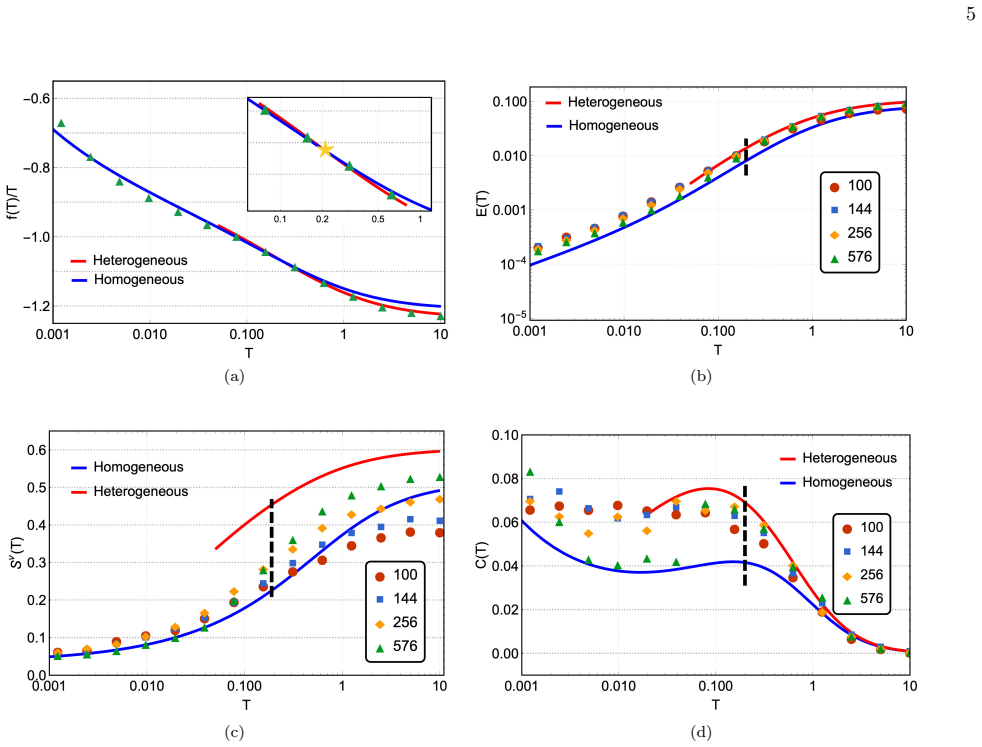
The central discovery is that an elastic network model of glass, with harmonic springs representing covalent constraints and weak springs representing van der Waals forces, has two competing liquid-like states. At high temperature the vibrational entropy of floppy modes, modes with near-zero frequency, favors configurations in which stiff springs cluster into rigid islands surrounded by floppy regions. At low temperature the elastic stress energy stored in the springs favors homogeneous configurations. Sampling the Boltzmann weight $e^{-F(\Gamma)/T}$ with $F=H-TS_{vib}$ reveals a free-energy crossover at $T_{LLT}\approx 0.2$ for $n=2.06$, and this crossover converges to a first-order transition as $N\to\infty$: energy, vibrational entropy, and specific heat each jump from the high-temperature phase value to a lower value in the homogeneous phase, while the relaxation plateau and static structure factor of the heterogeneous phase disappear. The model predicts that $T_{LLT}(n)$ is maximal at the rigidity threshold $n_c$, so when the liquid-liquid transition occurs before the glass transition, the liquid freezes into a homogeneous glass, which the paper identifies with the intermediate phase.
Load-bearing premise
The analytical free energy of the heterogeneous phase, taken from the authors' earlier work, is assumed to capture the configurational-entropy and surface-energy costs of rigid-floppy phase separation; if that free energy is inaccurate, the free-energy crossing and the predicted transition temperature are not reliable.
Editorial extensions
If this is right
- Compositions with $T_{LLT}>T_g$ freeze into a homogeneous network glass, which should show the intermediate-phase fingerprints: low fragility, no non-reversible heat, and homogeneous stress distribution.
- The intermediate-phase boundaries are set by the two intersections of $T_{LLT}(n)$ with $T_g(n)$, so their location and width depend on the strength of van der Waals forces.
- A liquid crossing $T_{LLT}$ on cooling should undergo a fragile-to-strong dynamic crossover as its structure becomes homogeneous.
- Scattering and correlation measurements on the high-temperature side of $T_{LLT}$ should see a static structure factor plateau and two relaxation times, both disappearing at the transition.
Reading between the lines
- This reading implies that the intermediate-phase boundaries should shift in a predictable way with pressure, since pressure changes the frustration energy scale and therefore moves $T_{LLT}$ relative to $T_g$; the paper mentions pressure as a perturbation but does not compute this shift.
- Because $T_{LLT}$ is scaled by the frustration energy $k\epsilon^2$, the dimensionless ratio $T_{LLT}/k\epsilon^2$ should be roughly transferable across network glasses with similar constraint counts, so silica, germania, and chalcogenides might collapse onto one curve.
- A dynamical test not proposed in the paper is to measure the intermediate scattering function above and below $T_{LLT}$: the heterogeneous phase's plateau should vanish discontinuously at the transition, giving a clear experimental marker distinct from the usual glassy relaxation.
Signed reviews
Editorial analysis
A structured set of objections, weighed in public.
Referee Report
Summary. The paper studies a two-dimensional triangular-lattice elastic network model with random bond-length mismatches and weak next-nearest-neighbor springs, using Metropolis Monte Carlo to sample network topologies under a free energy F = H - T S_vib. The authors report that the system switches from a high-temperature heterogeneous phase with rigid-floppy phase separation to a low-temperature homogeneous phase, and they claim that this is a first-order liquid-liquid transition at TLLT ≈ 0.2 for n = 2.06, with jumps in stress energy, vibrational entropy, and specific heat in the thermodynamic limit. They also compute TLLT as a function of the constraint number n from analytic branches and find a non-monotonic curve peaked at the rigidity threshold nc, which they connect to the intermediate phase and to its relation with the glass transition temperature Tg. The paper concludes that inside the intermediate phase the liquid undergoes the LLT before being trapped at Tg, yielding homogeneous glass, while outside it the glass is frozen in heterogeneous structures.
Significance. If the first-order transition claim is confirmed, the paper offers a simple mechanistic link between the intermediate phase and the liquid-liquid transition in network glasses, and it gives concrete experimental signatures: a specific-heat peak or lambda anomaly above Tg, loss of structural correlations, and a predictable dependence of the IP width on Van der Waals strength. The analytic two-branch description is a strength, as is the direct comparison between Monte Carlo data and the analytic free-energy curves, and the non-monotonic TLLT(n) prediction is falsifiable. However, the central transition temperature is obtained from fitted branches, the entropy reconstruction relies on an unspecified integration constant, and the finite-size evidence stops at N = 576 without error bars, coexistence checks, or hysteresis tests. The significance is therefore conditional: the paper is likely to be influential if these gaps are closed, but as it stands the central first-order claim is not yet established.
major comments (4)
- [Thermodynamics, Eq. (5)] The total entropy is computed as S(T) = S(∞) - ∫_T^∞ C(T')/T' dT', but the integration constant S(∞) is never specified in the main text or referenced to a derivation. Since the free energy is F = E - TS and the transition temperature is identified with the crossing of the two free-energy branches, the absolute offset of each branch is a load-bearing quantity: different choices of S(∞) for the heterogeneous and homogeneous branches can move or eliminate the crossing. The authors should state exactly how S(∞) is determined and demonstrate that the inferred TLLT is insensitive to that choice.
- [Thermodynamics, Fig. 3] The analytical free-energy curves for the heterogeneous and homogeneous phases are taken from Refs. [28,30] and are fitted to the simulation data, with the text stating that the numerics can be "perfectly fitted" but without reporting the number of fitted parameters, their best-fit values, or their uncertainties. Because TLLT ≈ 0.2 is defined as the crossing of these fitted branches, the central numerical result is not a parameter-free prediction. The authors should either constrain the parameters from independent measurements or quantify how the fitted parameters affect the location of the crossing.
- [Thermodynamics, Fig. 3 and central claim] The claim that the Monte Carlo data "converge to discontinuous jumps in the thermodynamic limit N → ∞" is not supported by a quantitative finite-size analysis. The largest system simulated has N = 576, no error bars are shown, and no evidence of two-state coexistence (bimodal energy or order-parameter distribution), hysteresis between heating and cooling, or a free-energy barrier is presented. Without such evidence, the data are equally consistent with a gradual crossover between the two structure families, and the central assertion of a first-order transition remains unverified. I ask the authors to supply finite-size scaling of the apparent jumps, or to demonstrate coexistence/hysteresis directly.
- [Spatial and temporal correlations, Fig. 4] The correlation functions show a plateau at high temperature and fast decay at low temperature, but the plateau is not shown to be a thermodynamic order parameter, and the two relaxation times are not connected to a free-energy barrier. Given that the Monte Carlo weight contains the vibrational entropy explicitly, slow relaxation or trapping in the low-temperature homogeneous state is a real concern; without equilibration checks (e.g., comparing cooling and heating protocols, or reporting autocorrelation times), the identification of the low-temperature branch as an equilibrium phase is not fully established.
minor comments (5)
- [Figure 3] The figure legend does not identify which marker style corresponds to which system size (N = 64, 128, 256, 576); please clarify the symbol mapping in the caption.
- [Eq. (3)] The notation n_c N ln T uses n_c for the constraint-count parameter, which is the same symbol used in the text for the rigidity threshold n_c = d; please disambiguate these two uses.
- [Figure 4 caption] The caption states that blue open symbols correspond to temperatures T ≲ α, but α is a dimensionless ratio of spring constants while T has units of energy; please clarify what energy scale is being compared with T.
- [Introduction, Ref. [28]] The sentence "As proven in Ref. [28]" relies entirely on a self-cited prior proof; since the heterogeneous-phase free energy is central to the present argument, the relevant derivation should be summarized in the main text or in the supplement.
- [Supplementary Material] The submitted version does not include the Supplementary Material that is referenced for the theory derivations, fitting procedures, and the numerical extraction of TLLT in Fig. 5; the revision should ensure the supplement is available so that the described fits can be checked.
Circularity Check
The reported TLLT is the crossing of self-cited, parameter-fitted free-energy branches; Eq. (5)'s unspecified entropy constant turns the 'prediction' into a fit.
-
fitted input called prediction
[RESULTS — Thermodynamics, Eq. (5) and Fig. 3(a)]
"The main numerical result of free energy F in the upper left panel of Fig. 3 combines both direct measurement of energy E and the inferred total entropy S = Sv + Sc by integrating over the specific heat C, S(T) = S(∞) − ∫ ∞T C(T)/T dT, (5), as F = E − TS. The theory derivations and the way we consistently fit parameters are fully documented in the Supplementary Material Notes 3-5 or see Ref. [30] for homogeneous networks and Ref. [28] for heterogeneous networks."
The transition temperature TLLT≈0.2 is identified from a free-energy crossover, but the numerical free energy F=E−TS contains an arbitrary integration constant S(∞). Changing S(∞) by ΔS shifts F by −T ΔS and moves the temperature at which the heterogeneous and homogeneous branches cross. The analytic branches themselves are taken from the authors' earlier papers with parameters that are explicitly 'consistently fit'. Thus TLLT is not a derived prediction: it is the output of a fitting procedure in which the integration constant and branch parameters set the crossing.
-
self citation load bearing
[RESULTS — Network structures; Refs. [17,28,30]]
"As proven in Ref. [28] and directly inferred by Eq. 3, vibrational entropy is large for floppy modes with a vanishing ω. ... On the contrary, networks with constraints homogeneously distributed store lower elastic energy than other configurations given the number of springs, as shown in Ref. [17]."
The two-phase picture that the paper claims to demonstrate is imported from the authors' own prior publications [17,28,30]: the heterogeneous phase's entropy mechanism and free energy are taken from [28], the homogeneous phase's energy mechanism from [17], and the analytic branches fitted in Fig. 3 from [28,30]. The central claim that these structures are distinct thermodynamic phases separated by a first-order transition therefore depends on a self-citation chain, while the present simulation data are 'perfectly fitted' to those same imported branches rather than providing an independent derivation of the free-energy functions.
1 more flagged steps
-
self definitional
[RESULTS — Thermodynamics, Fig. 3(a)-(d) and Fig. 5(a)]
"At the free energy crossover TLLT, marked in Fig. 3(b)(c)(d), we are also observing the convergence to discontinuous jumps at the transition in the thermodynamic limit N → ∞ from a higher value in high temperature heterogeneous phase to a lower value in the low temperature homogeneous phase in stress energy, vibrational entropy, and the specific heat."
The 'discontinuous jumps' are the vertical separations between the two fitted analytic branches evaluated at their imposed crossing. Because the branches have been fitted to the same simulation data and the free energy includes an undetermined constant, the first-order signature is inherited from the ansatz's branch structure rather than measured independently. No coexistence, hysteresis, or quantitative finite-size extrapolation is shown, so the statement that the system converges to a first-order transition restates the crossing of the fitted branches rather than testing it.
full rationale
The paper's central quantitative claim is that TLLT≈0.2 separates an entropy-dominated heterogeneous phase from an energy-dominated homogeneous phase. That number is read off from the crossing of two analytic free-energy branches. The paper explicitly says the numerical free energy is built from Eq. (5) with an unspecified S(∞), and that the analytic branches come from Refs. [28,30] with parameters that are 'consistently fit'. Because the integration constant shifts F by a linear term in T, the crossing temperature can be moved by choosing S(∞); the 'prediction' of TLLT is therefore not parameter-free. The non-monotonic TLLT(n) curve in Fig. 5(a) is likewise the locus of crossings of the same fitted branches, so the agreement with simulation data points is not an independent confirmation. There is partial independent content: the snapshots and correlation functions do distinguish heterogeneous high-temperature from homogeneous low-temperature structures, and the silica estimate in footnote [32] is an external order-of-magnitude anchor. But the thermodynamic transition—its first-order character, the jumps, and the n-dependence—reduces by construction to the fitted branch crossing plus the arbitrary entropy constant. This warrants a partial-circularity score of 6 rather than a higher one.
Assumptions & free parameters
free parameters (3)
- weak spring ratio α = 3k_w/k
- parameters in theoretical free energy fits
- integration constant S(∞) in entropy
assumptions (5)
- domain assumption Boltzmann weight with free energy F(Γ)=H(Γ)-T S_vib(Γ) using harmonic vibrational entropy Eq. (3)
- ad hoc to paper Hessian depends only on occupation {σ}, independent of rest-length mismatches
- ad hoc to paper Rigid-floppy phase separation is the correct description of the heterogeneous phase at high temperature, as 'proven' in Ref. [28]
- domain assumption The two ansatze (homogeneous and heterogeneous) exhaust the relevant thermodynamic states
- domain assumption Thermodynamic limit behavior inferred from N up to 576 in 2D
Cite this review
Pith. "Pith review of Competition between entropy and energy in network glass: the hidden connection between intermediate phase and liquid-liquid transition." pith.science (2026). https://pith.science/paper/6H7MIJYH
@misc{pith2026190809383,
  author       = {Pith},
  title        = {Pith review of: Competition between entropy and energy in network glass: the hidden connection between intermediate phase and liquid-liquid transition},
  year         = {2026},
  howpublished = {\url{https://pith.science/paper/6H7MIJYH}},
  note         = {Machine review of arXiv:1908.09383}
}
read the original abstract
In network glass including chalcogenides, the network topology of microscopic structures can be tuned by changing the chemical compositions. As the composition is varied, an intermediate phase (IP) singularly different from the adjacent floppy or rigid phases on sides has been revealed in the vicinity of the rigidity onset of the network. Glass formers in the IP appear to be reversible at glass transition and strong in dynamical fragility. Meanwhile, the calorimetry experiments indicate the existence of a first-order liquid-liquid transition (LLT) at a temperature above the glass transition in some strong glass-forming liquids. How are the intermediate phase and the liquid-liquid transition related? Recent molecular dynamics simulations hint that the intermediate phase is thermodynamically distinct that the transitions to IP as varying the chemical composition in fact reflect the LLT: out of IP, the glass is frozen in vibrational entropy-dominated heterogeneous structures with voids; while inside IP, energy dominates and the microscopic structures of liquids become homogeneous. Here we demonstrate such first-order thermodynamic liquid-liquid transition numerically and analytically in an elastic network model of network glass and discuss possible experimental approaches to testify the connection.
Figures


Figures from the paper (1 more)

Reference graph
Works this paper leans on
- [1]
-
[2]
J. C. Phillips, Journal of Non-Crystalline Solids 34, 153 (1979)
work page 1979
-
[3]
Thorpe, Journal of Non-Crystalline Solids 76, 109 (1985)
M. Thorpe, Journal of Non-Crystalline Solids 76, 109 (1985)
work page 1985
-
[4]
R. W. Hall and P. G. Wolynes, Phys. Rev. Lett. 90, 085505 (2003)
work page 2003
- [5]
-
[6]
J. C. Mauro, D. C. Allan, and M. Potuzak, Physical Review B 80, 094204 (2009)
work page 2009
-
[7]
L. Yan, G. D¨ uring, and M. Wyart, Proceedings of the National Academy of Sciences 110, 6307 (2013)
work page 2013
-
[8]
P. Boolchand, D. Georgiev, and B. Goodman, Journal of Optoelectronics and Advanced Materials 3, 703 (2001)
work page 2001
Show all 36 references
-
[9]
F. Wang, S. Mamedov, P. Boolchand, B. Goodman, and M. Chandrasekhar, Phys. Rev. B 71, 174201 (2005)
2005
-
[10]
Rompicharla, D
K. Rompicharla, D. I. Novita, P. Chen, P. Boolchand, M. Micoulaut, and W. Huff, Journal of Physics: Con- densed Matter 20, 202101 (2008)
2008
-
[11]
Bhosle, K
S. Bhosle, K. Gunasekera, P. Boolchand, and M. Mi- coulaut, International Journal of Applied Glass Science 3, 205 (2012)
2012
-
[12]
D. J. Jacobs and M. F. Thorpe, Phys. Rev. Lett. 75, 4051 (1995)
1995
-
[13]
D. J. Jacobs and M. F. Thorpe, Phys. Rev. E 53, 3682 (1996)
1996
-
[14]
Barr´ e, A
J. Barr´ e, A. R. Bishop, T. Lookman, and A. Saxena, Phys. Rev. Lett. 94, 208701 (2005)
2005
-
[15]
Thorpe, D
M. Thorpe, D. Jacobs, M. Chubynsky, and J. Phillips, Journal of Non-Crystalline Solids 266-269, Part 2 , 859 (2000)
2000
-
[16]
M. V. Chubynsky, M.-A. Bri` ere, and N. Mousseau, Phys. Rev. E 74, 016116 (2006)
2006
-
[17]
Yan and M
L. Yan and M. Wyart, Phys. Rev. Lett. 113, 215504 (2014)
2014
-
[18]
K. A. Kirchner and J. C. Mauro, Frontiers in Materials 6, 11 (2019)
2019
-
[19]
Bri` ere, M
M.-A. Bri` ere, M. V. Chubynsky, and N. Mousseau, Phys. Rev. E 75, 056108 (2007)
2007
-
[20]
Micoulaut and M
M. Micoulaut and M. Bauchy, physica status solidi (b) 250, 976 (2013)
2013
-
[21]
Bauchy, A
M. Bauchy, A. Kachmar, and M. Micoulaut, The Journal of chemical physics 141, 194506 (2014)
2014
-
[22]
Bauchy and M
M. Bauchy and M. Micoulaut, Nature communications 6 (2015)
2015
-
[23]
Yildirim, J.-Y
C. Yildirim, J.-Y. Raty, and M. Micoulaut, The Journal of chemical physics 148, 244505 (2018)
2018
-
[24]
C. A. Angell, Science 319, 582 (2008)
2008
-
[25]
S. Wei, I. Gallino, R. Busch, and C. A. Angell, Nature Physics 7, 178 (2011)
2011
-
[26]
C. A. Angell, in Glassy, amorphous and nano-crystalline materials (Springer, 2011) pp. 21–40
2011
-
[27]
S. Wei, F. Yang, J. Bednarcik, I. Kaban, O. Shuleshova, A. Meyer, and R. Busch, Nature communications 4, 2083 (2013)
2013
-
[28]
Yan, Nature communications 9, 1359 (2018)
L. Yan, Nature communications 9, 1359 (2018)
2018
-
[29]
G. G. Naumis, Physical Review E 71, 026114 (2005)
2005
-
[30]
Yan and M
L. Yan and M. Wyart, Physical Review E 92, 022310 (2015)
2015
-
[31]
Newman and G
M. Newman and G. Barkema, Monte carlo methods in statistical physics chapter 1-4 (Oxford University Press: New York, USA, 1999)
1999
-
[32]
Notice that the temperature predicted here is in the unit of covalent bond bending and stretching energy. For in- stance, in the case of silica with an average constraint number nSiO2 = 3.67, the liquid-liquid phase transition temperature has been experimentally reported atTLL...
-
[33]
Horbach and W
J. Horbach and W. Kob, Physical Review B 60, 3169 (1999)
1999
-
[34]
Sastry and C
S. Sastry and C. A. Angell, Nature materials 2, 739 (2003)
2003
-
[35]
Brueckner, Journal of non-crystalline solids 5, 123 (1970)
R. Brueckner, Journal of non-crystalline solids 5, 123 (1970)
1970
-
[36]
Jutzi and U
P. Jutzi and U. Schubert, Silicon chemistry: from the atom to extended systems (John Wiley & Sons, 2007)
2007
Reviewed August 14, 2026 · model on record in the stance chip above.
Discussion (0). Continue with ORCID to comment.