REVIEW 3 major objections 2 minor 20 references
Normal Crossings Singularities for Symplectic Topology, II
T0 review · 3 major / 2 minor · reviewed 2026-08-14 · deepseek-v4-flash
Pith's one-line read For any normal crossings symplectic variety, the paper claims regularizations exist virtually: the space of regularizations is weakly homotopy equivalent to the space of symplectic structures.
desk verdict Extends their SC symplectic divisor/variety program to arbitrary normal crossings with real new equivalences, but the central homotopy theorem still rests on an unproved transfer from their earlier paper. read the letter →
The pith
A machine-rendered reading of the paper's core claim, the machinery that carries it, and where it could break.
The reading
What carries the argument
The load-bearing object is a regularization: a compatible system of tubular-neighborhood diffeomorphisms, one for each stratum of the divisor or variety, equipped with Hermitian line-bundle data that turns the model normal-bundle symplectic form into the ambient symplectic form. For NC objects the regularization is assembled from local SC regularizations via chart compatibility, or globally from reified regularizations of the transverse immersion. A deliberately weaker version, weak regularizations, is the proof device: Section 5 argues that the SC proof of the weak homotopy equivalence goes through for weak regularizations in the NC setting, then cites the SC lemmas saying weak regularizations can be strengthened to genuine ones.
What would settle it
Take the 3-fold folding example of Section 4.5 and explicitly compute the normal-bundle isomorphisms that the overlap of two NC charts induces; if a positive-area triple point forces the product Hermitian structure on one chart to differ from the pulled-back structure on the other by a nonzero multiple of the symplectic class, then the weak regularizations cannot be strengthened and Theorem 4.5 would fail for that family.
Extended reading notes
Core claim
The paper's central claim is that the topological SC symplectic divisor and variety notions, and their regularization machinery, survive passage to arbitrary normal crossings. An NC symplectic divisor is defined locally as an SC symplectic divisor, and equivalently as the image of a closed transverse immersion of codimension two whose multiple-point strata inherit symplectic forms with matching intersection orientations. An NC symplectic variety is defined by an NC atlas whose local models are SC symplectic configurations, and equivalently as a quotient of a symplectic manifold by a compatible involution on its normalization. The main theorem, Theorem 4.5, asserts that the projection from the space of regularizations for an NC symplectic variety to the space of its symplectic structures is a weak homotopy equivalence; the proof is sketched in Section 5 by reducing to weak regularizations and transferring the SC proof, rather than carried out in full here.
Load-bearing premise
The result rests on the assertion that weak regularizations, which are easier to glue in the general normal-crossings setting, can be cut down to genuine regularizations exactly as in the simple-crossings case; the paper sketches this transfer rather than proving it in the NC context.
Editorial extensions
If this is right
- If Theorem 4.5 holds, the projection from regularizations to symplectic structures is a weak homotopy equivalence, giving a virtual existence of regularized almost complex structures for every NC symplectic variety.
- The local and global perspectives on NC symplectic divisors and varieties are interchangeable, so a construction can be checked either chart-by-chart or via transverse immersions.
- The divisor-level analogue, Theorem 3.4, follows from the variety-level theorem, matching the situation for SC singularities.
- The regularization framework extends symplectic sum and degeneration techniques from SC to arbitrary NC symplectic divisors and varieties.
- The examples show that genuinely non-SC NC configurations, including folded varieties and 3-fold identifications, are admitted by the new definitions.
Reading between the lines
- If the weak homotopy equivalence is established, Gromov-Witten invariants for NC symplectic varieties can likely be constructed by the same regularization route used for SC varieties, without adding smoothness assumptions on the singularities.
- The global immersion viewpoint suggests a computational extension: many NC varieties can be encoded by finitely many local charts and an involution, reducing regularization questions to patching Hermitian bundles over the multiple-point strata.
- The weak-regularization strategy, if it succeeds, may also apply to log or exploded variants of Gromov-Witten theory, where only local compatibility of almost complex structures is required.
- A natural test beyond the paper is whether the weak homotopy equivalence remains true for families of NC varieties with varying symplectic structures; the paper's local inductive proof structure indicates this should be checked stratum by stratum.
Signed reviews
Editorial analysis
A structured set of objections, weighed in public.
Referee Report
Summary. The paper extends the authors' previous work on simple crossings (SC) symplectic divisors and varieties to arbitrary normal crossings (NC) symplectic divisors and varieties. It gives local and global definitions of NC divisors and NC varieties, proves that these perspectives are equivalent (Propositions 3.6 and 4.12, and the correspondence in Section 4.3), and states Theorem 4.5 as the NC analogue of [5, Theorem 2.17], asserting that the projection from the space of regularizations to the space of symplectic structures is a weak homotopy equivalence. Section 5 sketches the proof of Theorem 4.5 by reducing to a weaker notion of regularization and asserting that the cut-down lemmas of [5] transfer to the NC setting.
Significance. If Theorem 4.5 is established, the paper provides a foundational framework for regularized almost complex structures on normal crossings symplectic varieties, with direct applications to Gromov-Witten theory and symplectic sum constructions. The manuscript is careful and detailed in its definitions, and it contains substantial new material: the local-global equivalence for NC varieties, the resolution uniqueness result (Proposition 3.14), the alternative global characterization of regularizations (Proposition 4.12), and a range of clarifying examples, including non-SC NC varieties. However, the load-bearing existence theorem is not proved in the manuscript: the proof in Section 5 depends on an unproven transfer of cut-down lemmas from the SC setting, and the required equivariance is precisely the new difficulty in the NC case. The central claim is therefore currently conditional on a nontrivial missing argument.
major comments (3)
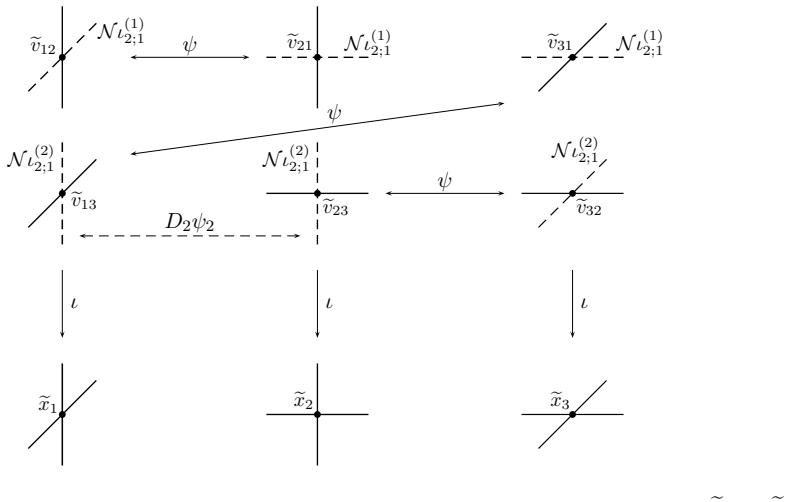
- [Section 5, final two paragraphs] The reduction of Theorem 4.5 to weak regularizations is not complete without a proof of the cut-down step in the NC setting. The manuscript states: 'By Lemma 5.8 and Corollary 5.9 in [5], weak regularizations and equivalences between them in the simple NC setting can be cut down to regularizations and equivalences between regularizations. The same reasoning applies in the arbitrary NC setting viewed from the global perspective of either Section 4.2 or 4.4.' This is the only justification for passing from weak to strong regularizations. In the SC setting of [5], the normalization is a disjoint union of smooth components and the involution ψ only interchanges branches along double loci; in the NC setting, ψ acts on higher strata and on normal bundles, as illustrated by Example 4.17 and Figure 4. The compatibility conditions (4.17)–(4.18), or equivalently (4.30)–(4.31) via Proposition 4.12, require the cut-down construction to be ψ-equivariant. The manuscript does not prove that [5, Lemma 5.8] and [5, Corollary 5.9] admit such an equivariant extension. Since the weak-homotopy-equivalence conclusion of Theorem 4.5 depends exactly on this step, the central claim is currently unsupported.
- [Section 5, weak regularization in the global perspective] The global notion of a weak ω-regularization for the pair (ι,ψ) is introduced only informally. The paragraph beginning 'Suppose (~X,~ω) and (ι,ψ) are as in Definition 4.8' describes a tuple satisfying (4.21) and a list of conditions, with the first condition in (3.23) 'may not hold' and the second holding only over an intersection of domains. No explicit space of weak regularizations, no topology, and no equivalence relation for weak regularizations in the global perspective is defined. The inductive proof later uses equivalences of weak regularizations over open sets, so these missing definitions are not merely cosmetic. Theorem 4.5 is a statement about families and homotopy equivalences; without a precise global notion of weak regularization, the argument in Section 5 cannot be verified.
- [Theorem 3.4 and its relation to Theorem 4.5] Theorem 3.4, the NC divisor analogue of [5, Theorem 2.13], is stated without a direct proof; the text says it 'is implied by Theorem 4.5' and refers to Example 4.15. Since the proof of Theorem 4.5 contains the gap described above, the status of Theorem 3.4 is also unresolved. The authors should either give a direct proof of Theorem 3.4 or complete the proof of Theorem 4.5 so that the implication is valid.
minor comments (2)
- [Section 5, first paragraph after Definition 5.2] The sentence 'The last task is readily accomplished by combining the proof of [5, Theorem 2.7] with the local perspective of Section 4.1' appears to contain a typo: the reference is likely to [5, Theorem 2.17] or [5, Theorem 2.13]. Please check the intended theorem.
- [Title page] The title reads 'Normal Crossings Singularities for Symplectic Topology, I I' with an extra space; this is a formatting typo.
Circularity Check
Theorem 4.5 rests on an unproved self-cited transfer of the weak-to-strong regularization cut-down; the core geometric equivalences remain independent content.
-
self citation load bearing
[Section 5 (proof of Theorem 4.5), paragraph following Definition 5.2]
"By Lemma 5.8 and Corollary 5.9 in [5], weak regularizations and equivalences between them in the simple NC setting can be cut down to regularizations and equivalences between regularizations. The same reasoning applies in the arbitrary NC setting viewed from the global perspective of either Section 4.2 or 4.4. Thus, it is sufficient to establish Theorem 4.5 with regularizations replaced by weak regularizations everywhere."
The proof of the paper's central claim, Theorem 4.5, is reduced to two tasks: constructing weak regularizations and cutting them down to genuine regularizations. The second task is the load-bearing step that actually yields the theorem's conclusion, but it is not proved for arbitrary NC varieties. The paper asserts it follows from the authors' own prior [5, Lemma 5.8, Corollary 5.9] by 'the same reasoning applies,' without proving the needed ψ-equivariant transfer to higher strata or normal-bundle actions (cf. Examples 4.16-4.17).
full rationale
The paper is not circular in the definitional sense: the local and global notions of NC divisors and varieties (Definitions 3.2, 4.3, Lemma 3.5, Proposition 3.6, Corollary 4.10) are genuine mathematical definitions and equivalences, not fitted to the desired conclusions. The new definitions are benchmarked against classical geometric notions, and Examples 4.13-4.17 provide independent content. However, the proof of Theorem 4.5 is not carried out here. Section 5 reduces the theorem to a 'weak regularization' version and then asserts, by appeal to the authors' own [5], that weak regularizations can be cut down to strong regularizations in the arbitrary-NC setting. The quoted passage does not prove this transfer; it declares that the same reasoning applies. This is a load-bearing self-citation gap: if the transfer fails, the weak-homotopy-equivalence conclusion is unsupported. That is a correctness/proof-completeness concern rather than a constructed equivalence or fitted parameter, so the score is moderate rather than high. The independent geometric equivalences and examples prevent the paper from being wholly circular, but the central theorem's proof is not self-contained.
Assumptions & free parameters
assumptions (3)
- standard math Standard results in differential topology (tubular neighborhood theorem, Inverse Function Theorem, submanifold transversality) are assumed.
- domain assumption The prior theorems and lemmas of the authors' paper [5] (Theorems 2.13, 2.17, Lemmas 5.8, 5.9, Proposition 5.3) are established and valid.
- domain assumption An NC variety is required to be Hausdorff, paracompact, and second-countable, with overlap maps that are diffeomorphisms in the sense of Definition 4.1.
Cite this review
Pith. "Pith review of Normal Crossings Singularities for Symplectic Topology, II." pith.science (2026). https://pith.science/paper/U7FHZWOU
@misc{pith2026190809390,
  author       = {Pith},
  title        = {Pith review of: Normal Crossings Singularities for Symplectic Topology, II},
  year         = {2026},
  howpublished = {\url{https://pith.science/paper/U7FHZWOU}},
  note         = {Machine review of arXiv:1908.09390}
}
read the original abstract
In recent work, we introduced topological notions of simple normal crossings symplectic divisor and variety, showed that they are equivalent, in a suitable sense, to the corresponding geometric notions, and established a topological smoothability criterion for them. The present paper extends these notions to arbitrary normal crossings singularities, from both local and global perspectives, and shows that they are also equivalent to the corresponding geometric notions. In subsequent papers, we extend our smoothability criterion to arbitrary normal crossings symplectic varieties and construct a variety of geometric structures associated with normal crossings singularities in algebraic geometry.
Figures


Figures from the paper (1 more)

Reference graph
Works this paper leans on
-
[5]
M. Farajzadeh Tehrani, M. McLean, and A. Zinger, Normal crossings singularities for sym- plectic topology, Adv. Math. 339 (2018), 672-748
work page 2018
-
[1]
D. Abramovich and Q. Chen, Stable logarithmic maps to Deligne-Faltings pairs II , Asian J. Math. 18 (2014), no. 3, 465–488 39
work page 2014
-
[2]
L. Caporaso and J. Harris, Counting plane curves in any genus , Invent. Math. 131 (1998), no. 2, 345–392
work page 1998
-
[3]
Atiyah-Floer Conjecture: a Formulation, a Strategy to Prove and Generalizations
A. Daemi and K. Fukaya, Atiyah-Floer Conjecture: a formulation, a strategy to prove , and generalizations, math/1707.03924
-
[4]
M. Farajzadeh Tehrani, M. McLean, and A. Zinger, Singularities and semistable degenerations for symplectic topology , C. R. Math. Acad. Sci. Paris 356 (2018), no. 4, 420-432
work page 2018
-
[6]
The Smoothability of Normal Crossings Symplectic Varieties
M. Farajzadeh Tehrani, M. McLean, and A. Zinger, The smoothability of normal crossings symplectic varieties , math/1410.2573v2
-
[7]
M. Farajzadeh Tehrani and A. Zinger, Normal crossings singularities for symplectic topology: structures, in preparation
-
[8]
Gompf, A new construction of symplectic manifolds , Ann
R. Gompf, A new construction of symplectic manifolds , Ann. of Math. 142 (1995), no. 3, 527–595
work page 1995
Show all 20 references
-
[9]
Gromov, Pseudoholomorphic curves in symplectic manifolds , Invent
M. Gromov, Pseudoholomorphic curves in symplectic manifolds , Invent. Math. 82 (1985), no 2, 307–347
1985
-
[10]
Gromov, Partial Differential Relations , Results in Mathematics and Related Areas (3), Springer-Verlag, 1986
M. Gromov, Partial Differential Relations , Results in Mathematics and Related Areas (3), Springer-Verlag, 1986
1986
-
[11]
Gross and B
M. Gross and B. Siebert, Logarithmic Gromov-Witten invariants , J. Amer. Math. Soc. 26 (2013), no. 2, 451–510
2013
-
[12]
Li and Y
A.-M. Li and Y. Ruan, Symplectic surgery and Gromov-Witten invariants of Calabi- Yau 3- folds, Invent. Math. 145 (2001), no. 1, 151–218
2001
-
[13]
Li, A degeneration formula for GW-invariants , J
J. Li, A degeneration formula for GW-invariants , J. Diff. Geom. 60 (2002), no. 1, 199–293
2002
-
[14]
McCarthy and J
J. McCarthy and J. Wolfson, Symplectic normal connect sum , Topology 33 (1994), no. 4, 729–764
1994
-
[15]
McLean, The growth rate of symplectic homology and affine varieties , Geom
M. McLean, The growth rate of symplectic homology and affine varieties , Geom. Funct. Anal. 22 (2012), no. 2, 369–442
2012
-
[16]
McLean, Reeb orbits and the minimal discrepancy of an isolated singu larity, In- vent
M. McLean, Reeb orbits and the minimal discrepancy of an isolated singu larity, In- vent. Math. 204 (2016), no. 2, 505-594
2016
-
[17]
Parker, Gromov-Witten invariants of exploded manifolds , math/1102.0158
B. Parker, Gromov-Witten invariants of exploded manifolds , math/1102.0158
-
[18]
Sheridan, Homological mirror symmetry for Calabi-Yau hypersurfaces i n projective space , Invent
N. Sheridan, Homological mirror symmetry for Calabi-Yau hypersurfaces i n projective space , Invent. Math. 199 (2015), no. 1, 1-186
2015
-
[19]
Tian, The quantum cohomology and its associativity , Current Developments in Mathemat- ics 1995, 361–401, Inter
G. Tian, The quantum cohomology and its associativity , Current Developments in Mathemat- ics 1995, 361–401, Inter. Press
1995
-
[20]
Warner, Foundations of Differentiable Manifolds and Lie Groups , GTM 94, Springer- Verlag, 1983 40
F. Warner, Foundations of Differentiable Manifolds and Lie Groups , GTM 94, Springer- Verlag, 1983 40
1983
Reviewed August 14, 2026 · model on record in the stance chip above.
Discussion (0). Continue with ORCID to comment.