REVIEW 5 major objections 3 minor 49 references
Percolation on branching simplicial and cell complexes and its relation to interdependent percolation
T0 review · 5 major / 3 minor · reviewed 2026-08-14 · deepseek-v4-flash
Pith's one-line read Branching cell complexes can have more than two percolation transitions.
desk verdict Solid exact mapping and intermediate-transition results, but the anomalous scaling claim rests on critical-point formulas that are internally inconsistent as printed. read the letter →
The pith
A machine-rendered reading of the paper's core claim, the machinery that carries it, and where it could break.
The reading
What carries the argument
The central object is the recursive percolation map $T_{n+1}=1-(1-p)\sum_{k\ge 1}r_k(1-T_n^{m-1})^k$, encoding the probability that the two initial nodes stay connected after $n$ rounds of gluing and link removal. Its fixed-point equation $f(T)=0$ is studied with bifurcation theory; the type of bifurcation (transcritical, saddle-node, or pitchfork of order $s$) sets the upper-transition universality class, while multi-modal $r_k$ creates additional saddle-node bifurcations that give intermediate transitions. The fractal exponent is obtained from the largest eigenvalue $\lambda_n$ of the Jacobian of the generating-function recursion via $\psi_n=\ln\lambda_n/\ln[\langle k\rangle(m-1)]$, and the RG flow of the map near $(p_c,T_c)$ yields the order-parameter scaling. The exact mapping identifies $T$ with $1-S'$ (one minus the MCGC reach probability), $p$ with $1-\tilde p$, polygon side count $m$ with $\kappa+1$, and $r_k$ with the multiplex activity distribution $P(B)$, transferring known results from correlated multiplex networks.
What would settle it
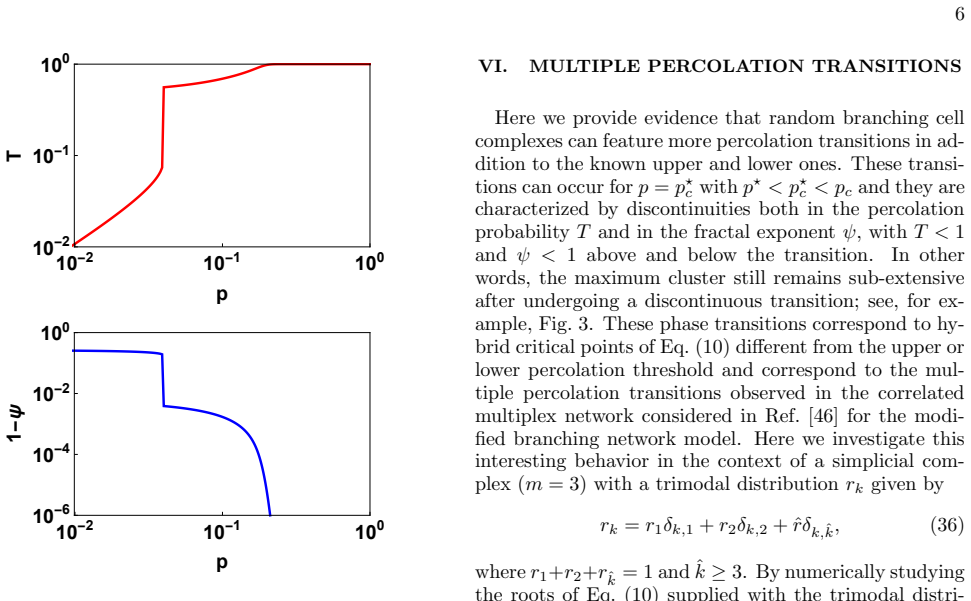
Iterate the exact generating-function recursions (Eq. (38)) for a branching simplicial complex with $r_k=0.62\delta_{k,1}+0.07\delta_{k,2}+0.31\delta_{k,20}$ to very large $n$ (e.g., $n=10^4$) and compute $T$ and $\psi_n$ from Eq. (47). If no discontinuity appears near $p\approx 0.0395$ with $T<1$ and $\psi<1$ on both sides, the intermediate-transition claim fails. Separately, at a critical point of order $s=5$, plot $-\ln P_\infty$ versus $\ln(p-p_c)$ over several decades; the predicted slope is $\sigma=1/2$, so a cleanly different slope would falsify the anomalous scaling.
Extended reading notes
Core claim
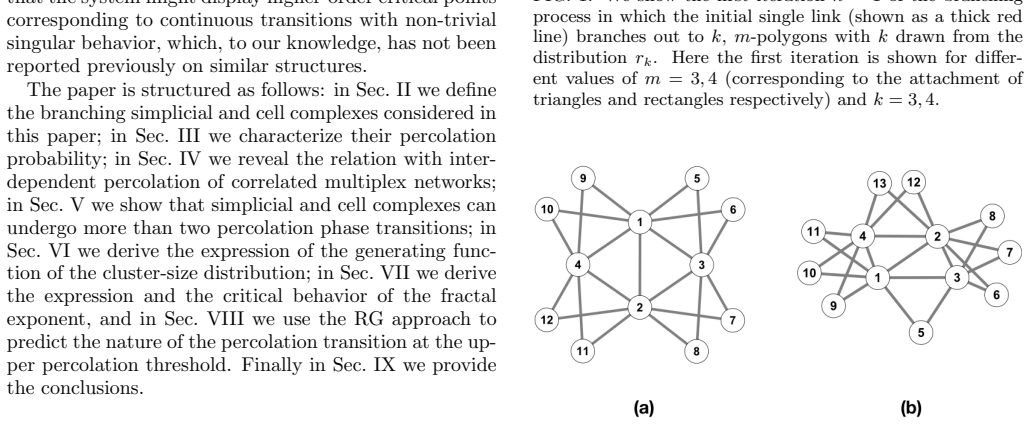
The central claim is that branching cell complexes are not limited to the two percolation transitions previously known for non-amenable graphs. When the branching distribution $r_k$ has more than one mode, the fixed-point equation for the percolation probability develops additional hybrid (saddle-node) bifurcations below the upper threshold; at these, $T$ and the fractal exponent $\psi$ both jump while remaining below one, so the giant component stays sub-extensive. At the upper threshold the transition can take several universality classes depending on the bifurcation: transcritical bifurcations give a discontinuous transition, saddle-node bifurcations give a BKT singularity $P_\infty\sim\exp[-\alpha/(\Delta p)^{1/2}]$, and pitchfork critical points of order $s$ give continuous transitions with $P_\infty\sim\exp[-A/(\Delta p)^\sigma]$, $\sigma=(s-3)/(s-1)$, generalizing BKT to arbitrary $\sigma$. These results follow from analyzing the recursive map $T_{n+1}=1-(1-p)\sum_k r_k(1-T_n^{m-1})^k$ and from an exact mapping, for a modified construction, to the mutually connected giant component equation of multiplex networks with maximally correlated degrees.
Load-bearing premise
The load-bearing assumption is that, in the recursion for the component size $M_n$, the term that does not depend on earlier component sizes is exponentially smaller than the term that does; if both grew at the same exponential rate, the formula for the fractal exponent and the predicted universality classes would need revision.
Editorial extensions
If this is right
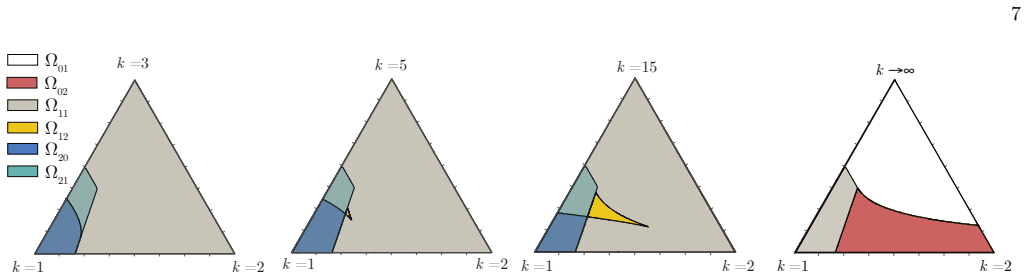
- A multimodal branching distribution $r_k$ produces one or more intermediate discontinuous transitions at which $T$ and $\psi$ jump but remain below 1; the paper gives explicit phase diagrams for trimodal distributions on triangles.
- The universality class of the upper percolation transition is controlled by the topology of the branching complex: discontinuous, BKT, and anomalous continuous transitions can all occur as $r_k$ varies.
- At a critical point of order $s$, the percolation probability approaches its critical value as $|\Delta T|\sim|\Delta p|^{1/(s-1)}$, so the effective critical exponent can be tuned by the branching distribution.
- Because of the exact mapping, any transition found for these branching cell complexes has a counterpart in correlated multiplex networks with perfect inter-layer degree correlation, and vice versa.
- The lower percolation threshold is always $p^*=0$ in these complexes, so every intermediate transition occurs while the largest component is still sub-extensive.
Reading between the lines
- The mapping suggests that the intermediate transitions in branching complexes are the geometric analogue of cascading-failure events in interdependent networks; if so, intuitions about fragility from multiplex percolation could transfer to designing or avoiding multi-stage failure in hierarchical materials.
- The anomalous scaling family $P_\infty\sim\exp[-A/(\Delta p)^\sigma]$ with $\sigma=(s-3)/(s-1)$ interpolates between BKT and exponential singularities; this family may appear in other hierarchical or non-amenable geometries where an order-$s$ pitchfork bifurcation controls percolation.
- These complexes are two-dimensional; the same recursive-equation approach might extend to higher-dimensional branching simplicial complexes, where new intermediate transitions or modified anomalous scaling could appear.
- The paper's phase diagrams come from fixed-point analysis; a finite-size scaling theory for the intermediate jumps (how $M_n$ grows with $n$ exactly at $p_c^*$) is not developed and would be a natural next test of whether the discontinuities survive finite-size corrections.
Signed reviews
Editorial analysis
A structured set of objections, weighed in public.
Referee Report
Summary. The paper studies link percolation on random branching simplicial and cell complexes, where each link is incident to k m-polygons drawn from a distribution r_k. The authors derive a one-dimensional recursion for the percolation probability T, show that its fixed-point equation is formally analogous to that of interdependent percolation in a correlated multiplex network, and use this mapping plus a renormalization-group treatment to characterize the possible phase transitions. The main claims are: (i) such complexes can display one or more intermediate hybrid transitions in addition to the lower and upper percolation thresholds, at which T and the fractal exponent ψ jump while remaining below one; and (ii) the upper transition can be discontinuous, BKT-like, or continuous with an anomalous singular dependence P∞ ∼ exp[−A/(Δp)^σ] with σ = (s−3)/(s−1) at a critical point of order s. The central recursive equations and the RG framework are clearly presented, and the numerical phase diagrams are self-consistent. However, the paper contains inconsistencies in the stated conditions for the higher-order critical points on which claim (ii) is built.
Significance. If the claims are correct, the paper identifies new universality classes in a solvable hierarchical network model and establishes a conceptually interesting bridge between percolation on branching cell complexes and interdependent percolation in multiplex networks. The derivation is self-contained: Eq. (10) follows from the model, no parameters are fitted to data, and the RG scaling calculation is explicit. The prediction of anomalous continuous transitions with exponent σ = (s−3)/(s−1) is a falsifiable statement and is a genuinely new result for this class of models, if it survives the corrections to the critical-point conditions. The numerical confirmation for s = 4 in Fig. 10 is encouraging, but the deviations reported for s = 5, 6 cannot be interpreted until the critical-manifold conditions are fixed and the numerical parameters are verified to lie on the true manifold.
major comments (5)
- [Sec. IV, Eq. (19)] The condition for a second-order (transcritical) critical point at T_c = 1 is misstated. Differentiating f(T) = T − 1 + (1−p)R(1−T^{m−1}) at p_c = 1 − 1/[(m−1)r1] gives f''(1) = [2(m−1)r2 − (m−2)r1]/r1, so the condition f''(1) < 0 is r1 > 2(m−1)/(m−2) r2, not r1 > (2m−1)/(m−2) r2 as printed. For m = 3 the printed inequality requires r1 > 5r2, which would exclude the s = 4 example (r1,r2,r3) = (8/11,2/11,1/11) used in Figs. 7 and 10, since that example satisfies r1 = 4r2.
- [Sec. IV, Eq. (25)] The tricritical condition is printed as r1 = (2m−1)/(m−2) r2, but the correct condition f''(1) = 0 gives r1 = 2(m−1)/(m−2) r2, i.e., r1 = 4r2 for m = 3. The paper itself later uses the correct form in Sec. IX D (the line 'when r1 = 2r2(m−1)/(m−2), pc = ...'), so the two parts of the manuscript contradict each other. This inconsistency must be resolved because the tricritical manifold determines where the universality class of the upper transition changes.
- [Sec. IV, Eq. (33)] The stated formula for r_k at a critical point of order s is not compatible with the example used in the paper. For m = 3 and k = 2, Eq. (33) gives r2 = Γ(1/2)Γ(1/2)/Γ(3) r1 = (π/2)r1, whereas vanishing of f''(1) requires r2 = r1/4. The coefficients (0.727273, 0.181818, 0.0909091) shown for the s = 4 case in Figs. 7 and 10 satisfy the algebraic relations r1 = 4r2 and r2 = 2r3, not Eq. (33). Consequently, the s = 5 and s = 6 parameter sets used in Fig. 10 may not lie on the true critical manifold, and the reported deviations from the theoretical σ could be an artifact of off-manifold parameters. The authors should either correct Eq. (33) to the actual solution of Eqs. (31)–(32) or provide the explicit parameter values used and verify them against the corrected conditions.
- [Sec. IX D and Fig. 10] The numerical evidence for the anomalous exponent σ = (s−3)/(s−1) is incomplete. The s = 4 data agree with σ = 1/3, but the s = 5 and s = 6 exponents are reported to deviate from the prediction, and the paper attributes this to finite sizes or the continuous approximation. Given that the critical-point conditions in Sec. IV are misstated, the s = 5 and s = 6 runs may have been performed at parameters that are not critical points of order s. The authors should recompute these cases using the corrected conditions and then reassess whether the deviations persist; without this, the claim that the anomalous scaling generalizes beyond s = 4 is not supported.
- [Sec. VIII A, Eq. (42)] The derivation of the fractal exponent assumes that the non-homogeneous term ∂F_n/∂x in Eq. (42) is subleading compared with the homogeneous term, so that M_n is proportional to ∏ λ_n for large n. This is stated without proof. The conclusion is plausible—a bounded forcing term cannot change the exponential growth rate—but the manuscript should justify the claim, for example by bounding ∂F_n/∂x uniformly in n and noting that the contribution from the first source term already grows at the rate ∏ λ_n. Since Eq. (47) and the subsequent RG expression for P∞ rest on this step, a short argument or a reference to a derivation is needed.
minor comments (3)
- [Sec. III] The phase enumeration is numbered (1), (3), (3); the second item should read (2).
- [Eq. (3)] The formula M_n = (\bar N_n)^{\psi_n} is typeset in a way that could be misread as (\bar N_n)\psi_n; please clarify with an explicit exponent.
- [Fig. 10] The figure shows the theoretical prediction as a thin dotted line, but it is unclear whether this line corresponds to s = 4 only or is meant for all s. For a useful comparison, the predicted slopes for s = 5 and s = 6 should be included or clearly described in the caption.
Circularity Check
Minor non-load-bearing self-citation; the derivation itself is self-contained and not circular.
full rationale
The derivation is self-contained. The percolation probability T is defined by the recursive branching equation (6), whose fixed point is Eq. (7)/(10); no parameter is fitted to output data. The intermediate transitions in Sec VI are found by direct numerical solution of this fixed-point equation (Figs. 3-6), not inherited from Ref. [46]. The fractal exponent in Eq. (47) follows from the Jacobian of the generating-function recursion (49), and the RG scaling P_infty ~ exp[-A/(Delta p)^sigma] in Sec IX is obtained by expanding the same exact RG map (60); the higher-order conditions (31)-(34) are derivative conditions on f, so the exponents are mathematical consequences rather than inputs. The only self-citation is Ref. [46] (Kryven and Bianconi), used to motivate the mapping in Sec V: 'Since the considered multiplex networks have been shown to display multiple percolation phase transitions, it follows that the mapping described above suggests that also in the modified random branching network one may expect multiple critical points in the equation determining the linking probability.' The paper then explicitly states that the original model 'needs to be explored in detail and will be addressed in the following section,' and Sec VI verifies the multiple-transition claim by direct solution of Eq. (10). The explicit caveats, namely the unproved subleading assumption on partial F_n/partial x in Sec VIII and the reported s=5,6 deviations in Fig. 10, are accuracy limitations rather than circular steps. The score reflects only the minor, non-load-bearing self-citation; the central derivation is independent.
Assumptions & free parameters
assumptions (4)
- domain assumption The random branching cell complex is statistically self-similar: each link independently branches into k polygons drawn from r_k, so the connection probability T_n obeys the recursion Eq (6) in the infinite-size limit.
- domain assumption The physical percolation probability is the smallest solution of Eq (10) in [0,1].
- domain assumption The non-homogeneous term ∂F_n/∂x in Eq (42) is subleading for n≫1, so M_n is governed by the product of largest eigenvalues.
- domain assumption Taylor expansions of Eq (60) truncated at leading order are valid close to the critical points, including the continuous approximation dx/dn = -C x(x^{s-1} + B Δp).
Cite this review
Pith. "Pith review of Percolation on branching simplicial and cell complexes and its relation to interdependent percolation." pith.science (2026). https://pith.science/paper/F6DKKC4I
@misc{pith2026190809392,
  author       = {Pith},
  title        = {Pith review of: Percolation on branching simplicial and cell complexes and its relation to interdependent percolation},
  year         = {2026},
  howpublished = {\url{https://pith.science/paper/F6DKKC4I}},
  note         = {Machine review of arXiv:1908.09392}
}
read the original abstract
Network geometry has strong effects on network dynamics. In particular, the underlying hyperbolic geometry of discrete manifolds has recently been shown to affect their critical percolation properties. Here we investigate the properties of link percolation in non-amenable two-dimensional branching simplicial and cell complexes, i.e., simplicial and cell complexes in which the boundary scales like the volume. We establish the relation between the equations determining the percolation probability in random branching cell complexes and the equation for interdependent percolation in multiplex networks with inter-layer degree correlation equal to one. By using this relation we show that branching cell complexes can display more than two percolation phase transitions: the upper percolation transition, the lower percolation transition, and one or more intermediate phase transitions. At these additional transitions the percolation probability and the fractal exponent both feature a discontinuity. Furthermore, by using the renormalization group theory we show that the upper percolation transition can belong to various universality classes including the Berezinskii-Kosterlitz-Thouless (BKT) transition, the discontinuous percolation transition, and continuous transitions with anomalous singular behavior that generalize the BKT transition.
Figures

Figures from the paper (7 more)


Reference graph
Works this paper leans on
- [46]
-
[1]
S. N. Dorogovtsev, A. V. Goltsev, and J. F. Mendes, Rev. Mod. Phys. 80, 1275 (2008)
work page 2008
-
[2]
A.-L. Barab´ asiet al. , Network science (Cambridge uni- versity press, 2016)
work page 2016
-
[3]
S. N. Dorogovtsev and J. F. Mendes, Evolution of net- works: From biological nets to the Internet and WWW (OUP Oxford, 2013)
work page 2013
-
[4]
Bianconi, Multilayer Networks: Structure and Func- tion (Oxford University Press, Oxford, 2018)
G. Bianconi, Multilayer Networks: Structure and Func- tion (Oxford University Press, Oxford, 2018). 16
work page 2018
-
[5]
S. Boccaletti, G. Bianconi, R. Criado, C. I. Del Ge- nio, J. G´ omez-Gardenes, M. Romance, I. Sendina-Nadal, Z. Wang, and M. Zanin, Phys. Rep. 544, 1 (2014)
work page 2014
-
[6]
M. Kivel¨ a, A. Arenas, M. Barthelemy, J. P. Gleeson, Y. Moreno, and M. A. Porter, Jour. Com. Net. 2, 203 (2014)
work page 2014
- [7]
Show all 49 references
-
[8]
Salnikov, D
V. Salnikov, D. Cassese, and R. Lambiotte, Euro. J. Phys. 40, 014001 (2018)
2018
-
[9]
Bianconi and C
G. Bianconi and C. Rahmede, Sci. Rep. 7, 41974 (2017)
2017
-
[10]
Bianconi and C
G. Bianconi and C. Rahmede, Phys. Rev. E 93, 032315 (2016)
2016
-
[11]
Mulder and G
D. Mulder and G. Bianconi, J. Stat. Phys. 173, 783 (2018)
2018
-
[12]
Bianconi and R
G. Bianconi and R. M. Ziff, Phys. Rev. E 98, 052308 (2018)
2018
-
[13]
Kryven, R
I. Kryven, R. M. Ziff, and G. Bianconi, Phys. Rev. E 100, 022306 (2019)
2019
-
[14]
A. P. Mill´ an, J. J. Torres, and G. Bianconi, Sci. Rep. 8, 9910 (2018)
2018
-
[15]
A. P. Mill´ an, J. J. Torres, and G. Bianconi, Phys. Rev. E 99, 022307 (2019)
2019
-
[16]
ˇSuvakov, M
M. ˇSuvakov, M. Andjelkovi´ c, and B. Tadi´ c, Sci. Rep.8, 1987 (2018)
2018
-
[17]
Iacopini, G
I. Iacopini, G. Petri, A. Barrat, and V. Latora, Nat. Comm. 10, 2485 (2019)
2019
-
[18]
P. S. Skardal and A. Arenas, Phys. Rev. Lett. 122, 248301 (2019)
2019
-
[19]
Ara´ ujo, P
N. Ara´ ujo, P. Grassberger, B. Kahng, K. Schrenk, and R. Ziff, Euro. Phys. J, Special Topics 223, 2307 (2014)
2014
-
[20]
D. Lee, B. Kahng, Y. Cho, K.-I. Goh, and D.-S. Lee, J. Korean Phys. Soc. 73, 152 (2018)
2018
-
[21]
R. M. D’Souza, J. G´ omez-Garde˜ nes, J. Nagler, and A. Arenas, arXiv preprint arXiv:1907.09957 (2019)
2019 arXiv
-
[22]
Achlioptas, R
D. Achlioptas, R. M. D’Souza, and J. Spencer, Science 323, 1453 (2009)
2009
-
[23]
Riordan and L
O. Riordan and L. Warnke, Science 333, 322 (2011)
2011
-
[24]
R. A. da Costa, S. N. Dorogovtsev, A. V. Goltsev, and J. F. F. Mendes, Phys. Rev. Lett. 105, 255701 (2010)
2010
-
[25]
R. M. Ziff, Phys. Rev. Lett. 103, 045701 (2009)
2009
-
[26]
Bianconi, Phys
G. Bianconi, Phys. Rev. E 97, 022314 (2018)
2018
-
[27]
S. V. Buldyrev, R. Parshani, G. Paul, H. E. Stanley, and S. Havlin, Nature 464, 1025 (2010)
2010
-
[28]
Parshani, S
R. Parshani, S. V. Buldyrev, and S. Havlin, Phys. Rev. Lett. 105, 048701 (2010)
2010
-
[29]
Baxter, S
G. Baxter, S. Dorogovtsev, A. Goltsev, and J. Mendes, Phys. Rev. Lett. 109, 248701 (2012)
2012
-
[30]
Kryven, Nat
I. Kryven, Nat. Comm. 10, 404 (2019)
2019
-
[31]
Bianconi and S
G. Bianconi and S. N. Dorogovtsev, Phys. Rev. E 89, 062814 (2014)
2014
-
[32]
Boettcher, V
S. Boettcher, V. Singh, and R. M. Ziff, Nat. Comm. 3, 787 (2012)
2012
-
[33]
Gu and R
H. Gu and R. M. Ziff, Phys. Rev. E 85, 051141 (2012)
2012
-
[34]
Mertens and C
S. Mertens and C. Moore, Phys. Rev. E 96, 042116 (2017)
2017
-
[35]
D. M. Auto, A. A. Moreira, H. J. Herrmann, and J. S. Andrade Jr., Phys. Rev. E 78, 066112 (2008)
2008
-
[36]
Boettcher, J
S. Boettcher, J. L. Cook, and R. M. Ziff, Phys. Rev. E 80, 041115 (2009)
2009
-
[37]
Hasegawa, M
T. Hasegawa, M. Sato, and K. Nemoto, Phys. Rev. E 82, 046101 (2010)
2010
-
[38]
Nogawa and T
T. Nogawa and T. Hasegawa, Phys. Rev. E 89, 042803 (2014)
2014
-
[39]
Singh and S
V. Singh and S. Boettcher, Phys. Rev. E 90, 012117 (2014)
2014
-
[40]
Nogawa, J
T. Nogawa, J. Phys. A: Math. Gen. 51, 505003 (2018)
2018
-
[41]
Boettcher and C
S. Boettcher and C. Brunson, EPL (Europhysics Lett.) 110, 26005 (2015)
2015
-
[42]
Singh, C
V. Singh, C. T. Brunson, and S. Boettcher, Phys. Rev. E 90, 052119 (2014)
2014
-
[43]
Hinczewski and A
M. Hinczewski and A. N. Berker, Phys. Rev. E73, 066126 (2006)
2006
-
[44]
S. N. Dorogovtsev, A. V. Goltsev, and J. F. F. Mendes, Phys. Rev. E 65, 066122 (2002)
2002
-
[45]
S. N. Dorogovtsev, Phys. Rev. E 67, 045102 (2003)
2003
-
[47]
Lyons, Jour
R. Lyons, Jour. Math. Phys. 41, 1099 (2000)
2000
-
[48]
A. A. Migdal, Soviet Journal of Experimental and The- oretical Physics 42, 743 (1976)
1976
-
[49]
L. P. Kadanoff, Ann. Phys. 100, 359 (1976)
1976
Reviewed August 14, 2026 · model on record in the stance chip above.
Discussion (0). Continue with ORCID to comment.