REVIEW 3 major objections 5 minor 57 references
Scalable Probabilistic Matrix Factorization with Graph-Based Priors
T0 review · 3 major / 5 minor · reviewed 2026-08-14 · deepseek-v4-flash
Pith's one-line read Prune bad graph edges to make matrix factorization better and faster
desk verdict A practical graph-pruning step for matrix factorization that works in experiments, but the contested-edge story is better supported empirically than theoretically. read the letter →
The pith
A machine-rendered reading of the paper's core claim, the machinery that carries it, and where it could break.
The reading
What carries the argument
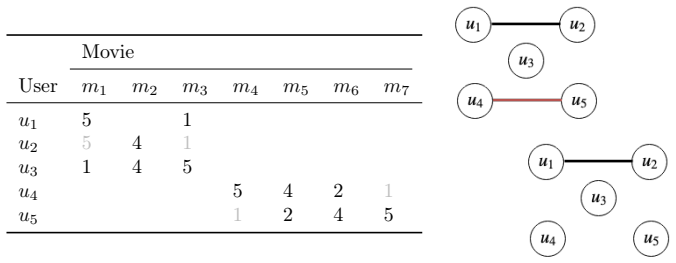
The load-bearing object is the adjacency update rule: an edge survives only if the expected sample covariance $E[S_D]$ of the latent features is at least the threshold $\tau$ (set to zero), otherwise it is removed as contested. The paper computes this expectation by decomposing each outer product into posterior covariance plus outer product of posterior means, then approximates the posterior covariance with an unbiased Monte Carlo estimate from K samples drawn via sparse Cholesky factorization of a block-diagonal approximation to the posterior precision; this column-wise independence assumption makes the Cholesky step linear in the graph size. The step is justified as a constrained graphical-lasso approximation by sign-consistency results saying that, for sparse and large problems, thresholding the sample covariance marks the same non-zeros as the graphical lasso would.
What would settle it
Take a synthetic 400 by 400 setup with a known true graph and a known fraction of planted contested edges, run GRAEM's zero-threshold M-step, and also run an explicit constrained graphical-lasso solve on the same expected sample covariance, then compare the two edge sets and the RMSE of each; if the sets diverge substantially under the paper's reported settings (7% observed entries, $\sigma^2 = 0.01$), the claimed equivalence is not what drives the accuracy gain.
Extended reading notes
Core claim
The central discovery is that a graph edge is worth keeping only if the latent features of its endpoints are positively correlated given the observed ratings; edges with negative estimated covariance actively mislead the factorization, and removing them helps. GPMF formalizes this by replacing the spherical priors of probabilistic matrix factorization with full-covariance Gaussian priors whose precision matrices are regularized Laplacians built from the graph, so the prior becomes a Gaussian Markov random field. Using EM, the M-step estimates the expected sample covariance of the latent feature columns and removes entries whose covariance is below $\tau=0$, which the authors identify as contested edges via sign-consistency results for the graphical lasso. The paper shows the E-step MAP objective equals the GRALS objective, giving convergence guarantees, and that the extra M-step is linear-cost; on real benchmarks the pruned graphs improve RMSE while using fewer edges, and on a densified 40-nearest-neighbour MovieLens20M graph GPMF improves while the fixed-graph baseline worsens.
Load-bearing premise
The rule that decides which edges are contested relies on the theorem that thresholding the sample covariance at zero marks exactly the edges the graphical lasso would set to zero; the paper sets the threshold to zero on real datasets without verifying the theorem's conditions, so if those conditions fail the deleted edges need not be the contested ones.
Editorial extensions
If this is right
- On the reported benchmarks GPMF/GRAEM achieves RMSE 0.8857 on Flixster versus 0.9152 for GRALS, and 0.7887 on MovieLens20M (40NN) versus 0.7922, so pruning edges improves accuracy over keeping the full graph.
- The method's complexity remains linear in the number of non-zeros; each removed edge shrinks the adjacency matrix, making the regularized least-squares iterations cheaper, and the paper demonstrates a 300k by 300k graph with 3 million edges updating in under ten minutes on a laptop.
- The generated graph is reusable: feeding the pruned graph to KPMF preserves or improves accuracy (77% of Douban user edges, 65% of MovieLens 100k edges), suggesting contested-edge removal is a general preprocessing step for graph-regularized matrix completion.
- Increasing graph density from 10 to 40 nearest neighbours degrades GRALS but lets GPMF keep improving, so noisy graphs can be rendered useful instead of discarded.
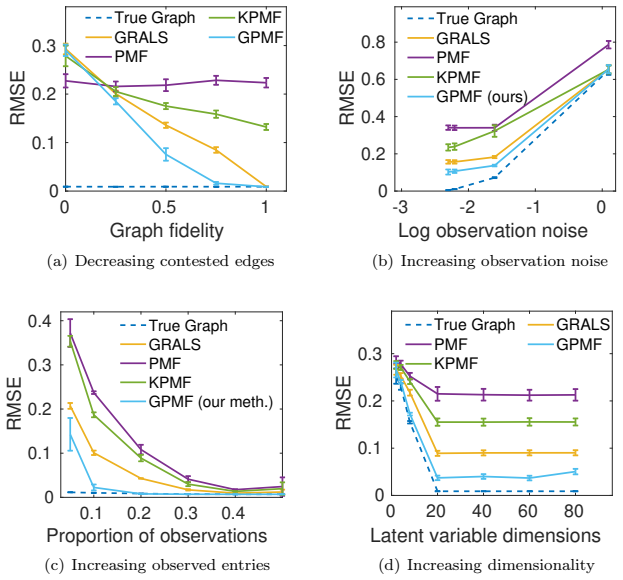
- On synthetic data with 10% observed entries, GPMF nearly matches the accuracy of the true graph, while GRALS needs about 30% observations for comparable accuracy; when observation noise grows, GPMF degrades to at worst the corrupted-graph baseline.
Reading between the lines
- Not stated in the paper: the zero threshold is a heuristic rather than a verified regime of the underlying equivalence theorem. One could stress-test it by replacing Equation (8) with an explicit constrained graphical-lasso solve on the same covariance and comparing both the edge sets and final RMSE; the paper's own synthetic numbers (only 31.7% to 44.3% of planted contested edges recovered) sugge
- Not stated in the paper: the column-wise independence assumption that makes the posterior covariance tractable is also a modelling restriction, because a full inverse-Kronecker-sum covariance would couple the latent-feature columns. Extending the M-step to a low-rank plus diagonal correction could capture more signal without breaking linear complexity.
- Not stated in the paper: because the M-step is written as an adjacency update, it is a model-selection rule for the Gaussian Markov random field graph itself, which connects the method to graph-learning problems and suggests an iterative or annealed version could trade graph sparsity against accuracy in a principled way.
- A testable extension, absent from the paper, is to apply the pruned graph to graph-convolutional matrix-completion models, which the paper benchmarks but does not train on the updated graph; if the gain transfers, contested-edge removal is a model-agnostic graph-denoising step.
Signed reviews
Editorial analysis
A structured set of objections, weighed in public.
Referee Report
Summary. The manuscript introduces GPMF, a probabilistic formulation of graph-regularised matrix factorization in which the precision matrices of the latent-feature priors are graph Laplacians, and GRAEM, an alternating algorithm that—after a PMF initialization—uses a thresholded posterior sample-covariance matrix to delete graph edges whose latent-feature correlation is negative (the 'contested edges'). The authors show in Lemma 1 that, conditional on a fixed graph, the MAP objective coincides with the GRALS objective. The central empirical claims are that pruning contested edges improves RMSE relative to GRALS on Flixster, MovieLens100k, Epinions, and MovieLens20M, and that the pruning step has linear cost, allowing a 300k-node/3M-edge graph to be processed in under ten minutes on a laptop.
Significance. If the identification step works as claimed, the contribution is practically valuable: a linear-time graph-pruning heuristic that improves accuracy and can be appended to GRALS, with a principled probabilistic derivation and experiments on standard benchmarks. The paper is also honest in reporting mixed results (Yahoo Music, KPMF with pruned graphs) and in acknowledging that the GLASSO approximation is only moderately successful in simulation. The main significance is limited, however, by the fact that the contested-edge identification—the mechanism behind the claimed accuracy gains—is not convincingly validated, and the claimed convergence guarantee does not follow from the cited tools.
major comments (3)
- [§3.3.3, Eq. (8)] The pruning rule in Eq. (8) thresholds E[S_D] at τ=0 and is justified by the sign-consistency and sparsity-equivalence results of Fattahi and Sojoudi. Those results are stated for a sufficiently large penalty τ with a highly sparse GLASSO solution (roughly 10N non-zeros). At τ=0 the GLASSO penalty vanishes, the solution is the dense inverse sample covariance, and the support-equivalence argument does not apply. The paper's own synthetic evaluation (Section 4.1) reports that only 31.7% of true contested edges are removed and 19% of true edges are wrongly removed at 7% observations, and the conclusion states that the GLASSO approximation is 'only moderately successful.' Because Eq. (8) is the entire M-step, the central claim that accuracy gains come from removing contested edges rests on an unvalidated approximation. I ask the authors to verify sign-consistency at the operating point, to compare against thresholding at positive τ where the cited equivalence has support, and to include a control such as random edge removal at the same rate to show the gains are not generic sparsification.
- [§3.3.1–3.3.4] The quantity thresholded in Eq. (8) is E[S_D] = (1/D) Σ_d (Σ_post_{U:d} + μ_post_{U:d} μ_post_{U:d}^T), a posterior second moment computed under a column-wise-independence approximation and MAP substitution. This is not an empirical sample covariance of i.i.d. draws from the model, so the cited GLASSO/thresholding equivalence—which is a statement about sample covariance matrices—does not directly apply to the object being thresholded. The authors should either derive the thresholding rule for posterior second moments under their approximate posterior, or explicitly treat Eq. (8) as a heuristic and validate it empirically; the current text moves between 'MLE' and 'highly-efficient approximation' without establishing which claim is being made.
- [Section 3, Algorithm 1] The abstract and Section 3 state that the EM formulation 'guarantees convergence' and that the method inherits the global convergence guarantees of GRALS via Xu and Yin. Those guarantees apply to block-coordinate minimization of a fixed biconvex objective. Here the M-step does not maximize Q (it heuristically changes the graph), and the graph change alters the regularizer in the subsequent E-step, so the objective is not fixed across iterations. The convergence claim is therefore unsupported as stated. Please state the precise convergence property that is guaranteed, or weaken the claim to empirical convergence.
minor comments (5)
- [Section 4.2, Table 1] The sentence 'we get the same accuracy for Flixster with almost halved edges' is accurate from the table, but the accompanying claim that the pruned graph improves 'arbitrary algorithms' is contradicted by the MovieLens100k KPMF result (0.9336 vs 0.9374).
- [Section 2, Eq. (4)] The notation switches between Λ_U and L_U^+ without consistently naming the regularization strength; in Eq. (4) the factor σ^2/2 appears without explaining that the posterior has been multiplied by σ^2.
- [Section 4.1, Figure 2] The text says 'at worst GPMF is only as bad as using the original corrupted graph,' but at high noise PMF appears competitive, and the comparison point is not clearly defined; please clarify.
- [Section 4.2, Figure 3] The proportion of remaining edges is reported in figure titles, but for MovieLens20M the caption says '40NN graph' while the text reports 10/20/40-NN results; it would help to state all edge-retention rates in one table.
- [Throughout] Several typos should be corrected: 'effect' for 'affect' (Section 1), 'helf' for 'half' (Section 4.2), 'samge' for 'same' (Appendix B.2), and inconsistent verb tense in Section 4.
Circularity Check
No significant circularity: GPMF's graph update is an empirical mechanism evaluated on held-out entries, not a renamed input or self-citation-driven prediction.
full rationale
The derivation chain is not circular. GPMF defines a generative model whose MAP objective, under a regularized-Laplacian precision matrix, is shown in Lemma 1 to coincide with GRALS; this is an independent algebraic reduction. The M-step derives the precision MLE as the inverse of an expected sample covariance matrix (Eq. 6), and the contested-edge removal rule (Eq. 8) thresholds that expected covariance at tau=0. The GLASSO equivalence used to justify the thresholding is imported from external results (Fattahi and Sojoudi, Zhang et al., Mazumder and Hastie), not from the authors' own prior work, and it is not used as an unexamined premise of the paper's own method. The claimed accuracy gains are evaluated on held-out entries against external baselines on Flixster, Douban, MovieLens, Epinions, Yahoo Music, and MovieLens20M, so the result is falsifiable rather than forced by construction. The self-citations present (KBMF, Nguyen and Mamitsuka, Zheng et al.) are literature or baseline references and do not carry the contested-edge argument. The paper itself concedes that the GLASSO approximation is only moderately successful in simulated data, which is a robustness limitation rather than circularity. No fitted parameter is relabeled as a prediction, and no equation reduces to its own input; hence the appropriate circularity score is 0.
Assumptions & free parameters
free parameters (5)
- threshold tau =
0
- latent dimension D =
10 (20 for Yahoo Music)
- observation noise sigma^2 =
0.05 to 10 depending on dataset
- regularization strengths lambda_L, lambda_U, lambda_V =
Various values in Table 2
- posterior sample count K =
not reported
assumptions (5)
- standard math Precision matrix zero pattern equals graph conditional independence (GMRF property).
- standard math Regularized Laplacian L+ = L + gamma I is a valid precision matrix with the same zero pattern as the graph.
- domain assumption Sign-consistency: non-zero entries of the GLASSO solution have signs opposite to the corresponding sample covariance entries, so negative sample covariances identify removable edges.
- ad hoc to paper Column-wise independence of the posterior covariance: off-diagonal blocks of C in the Kronecker sum are set to zero, making the posterior precision block-diagonal.
- ad hoc to paper Sparsity-structure equivalence between the thresholded sample covariance matrix and the GLASSO solution holds at the operating point tau=0.
Cite this review
Pith. "Pith review of Scalable Probabilistic Matrix Factorization with Graph-Based Priors." pith.science (2026). https://pith.science/paper/D4RCRGUS
@misc{pith2026190809393,
  author       = {Pith},
  title        = {Pith review of: Scalable Probabilistic Matrix Factorization with Graph-Based Priors},
  year         = {2026},
  howpublished = {\url{https://pith.science/paper/D4RCRGUS}},
  note         = {Machine review of arXiv:1908.09393}
}
abstract
In matrix factorization, available graph side-information may not be well suited for the matrix completion problem, having edges that disagree with the latent-feature relations learnt from the incomplete data matrix. We show that removing these $\textit{contested}$ edges improves prediction accuracy and scalability. We identify the contested edges through a highly-efficient graphical lasso approximation. The identification and removal of contested edges adds no computational complexity to state-of-the-art graph-regularized matrix factorization, remaining linear with respect to the number of non-zeros. Computational load even decreases proportional to the number of edges removed. Formulating a probabilistic generative model and using expectation maximization to extend graph-regularised alternating least squares (GRALS) guarantees convergence. Rich simulated experiments illustrate the desired properties of the resulting algorithm. On real data experiments we demonstrate improved prediction accuracy with fewer graph edges (empirical evidence that graph side-information is often inaccurate). A 300 thousand dimensional graph with three million edges (Yahoo music side-information) can be analyzed in under ten minutes on a standard laptop computer demonstrating the efficiency of our graph update.
Figures

Figures from the paper (1 more)

Reference graph
Works this paper leans on
-
[1]
Managing uncertainty in social networks
Eytan Adar and Christopher Re. Managing uncertainty in social networks. IEEE Data Eng. Bull., 30 0 (2): 0 15--22, 2007
work page 2007
-
[2]
Binary rating estimation with graph side information
Kwangjun Ahn, Kangwook Lee, Hyunseung Cha, and Changho Suh. Binary rating estimation with graph side information. In Advances in Neural Information Processing Systems, pages 4272--4283, 2018
work page 2018
-
[3]
Predicting protein complex membership using probabilistic network reliability
Saurabh Asthana, Oliver D King, Francis D Gibbons, and Frederick P Roth. Predicting protein complex membership using probabilistic network reliability. Genome research, 14 0 (6): 0 1170--1175, 2004
work page 2004
-
[4]
Graph convolutional matrix completion
Rianne van den Berg, Thomas N Kipf, and Max Welling. Graph convolutional matrix completion. arXiv preprint arXiv:1706.02263, 2017
arXiv 2017
-
[5]
Christopher M. Bishop. Pattern Recognition and Machine Learning. Springer, 2006
2006
-
[6]
Metagenes and molecular pattern discovery using matrix factorization
Jean-Philippe Brunet, Pablo Tamayo, Todd R Golub, and Jill P Mesirov. Metagenes and molecular pattern discovery using matrix factorization. Proceedings of the national academy of sciences, 101 0 (12): 0 4164--4169, 2004
work page 2004
-
[7]
Graph regularized nonnegative matrix factorization for data representation
Deng Cai, Xiaofei He, Jiawei Han, and Thomas S Huang. Graph regularized nonnegative matrix factorization for data representation. IEEE Transactions on Pattern Analysis and Machine Intelligence, 33 0 (8): 0 1548--1560, 2011
work page 2011
-
[8]
Emmanuel J Candes and Yaniv Plan. Matrix completion with noise. Proceedings of the IEEE, 98 0 (6): 0 925--936, 2010
work page 2010
Show all 57 references
-
[9]
Exact matrix completion via convex optimization
Emmanuel J Cand \`e s and Benjamin Recht. Exact matrix completion via convex optimization. Foundations of Computational mathematics, 9 0 (6): 0 717, 2009
2009
-
[10]
Matrix completion with noisy side information
Kai-Yang Chiang, Cho-Jui Hsieh, and Inderjit S Dhillon. Matrix completion with noisy side information. In C. Cortes, N. D. Lawrence, D. D. Lee, M. Sugiyama, and R. Garnett, editors, Advances in Neural Information Processing Systems 28, pages 3447--3455. Curran Associates, Inc....
2015
-
[11]
Dhillon, and Cho-Jui Hsieh
Kai-Yang Chiang, Inderjit S. Dhillon, and Cho-Jui Hsieh. Using side information to reliably learn low-rank matrices from missing and corrupted observations. Journal of Machine Learning Research, 19 0 (76): 0 1--35, 2018. URL http://jmlr.org/papers/v19/17-112.html
2018
-
[12]
An overview of low-rank matrix recovery from incomplete observations
Mark A Davenport and Justin Romberg. An overview of low-rank matrix recovery from incomplete observations. IEEE Journal of Selected Topics in Signal Processing, 10 0 (4): 0 608--622, 2016
2016
-
[13]
A column approximate minimum degree ordering algorithm
Timothy A Davis, John R Gilbert, Stefan I Larimore, and Esmond G Ng. A column approximate minimum degree ordering algorithm. ACM Transactions on Mathematical Software (TOMS), 30 0 (3): 0 353--376, 2004
2004
-
[14]
Learning laplacian matrix in smooth graph signal representations
Xiaowen Dong, Dorina Thanou, Pascal Frossard, and Pierre Vandergheynst. Learning laplacian matrix in smooth graph signal representations. IEEE Transactions on Signal Processing, 64 0 (23): 0 6160--6173, 2016
2016
-
[15]
The yahoo! music dataset and kdd-cup'11
Gideon Dror, Noam Koenigstein, Yehuda Koren, and Markus Weimer. The yahoo! music dataset and kdd-cup'11. In Proceedings of the 2011 International Conference on KDD Cup 2011-Volume 18, pages 3--18. JMLR. org, 2011
2011
-
[16]
Graph learning with laplacian constraints: Modeling attractive gaussian markov random fields
Hilmi E Egilmez, Eduardo Pavez, and Antonio Ortega. Graph learning with laplacian constraints: Modeling attractive gaussian markov random fields. In Signals, Systems and Computers, 2016 50th Asilomar Conference on, pages 1470--1474. IEEE, 2016
2016
-
[17]
Graph learning from data under laplacian and structural constraints
Hilmi E Egilmez, Eduardo Pavez, and Antonio Ortega. Graph learning from data under laplacian and structural constraints. IEEE Journal of Selected Topics in Signal Processing, 11 0 (6): 0 825--841, 2017
2017
-
[18]
Graphical lasso and thresholding: Equivalence and closed-form solutions
Salar Fattahi and Somayeh Sojoudi. Graphical lasso and thresholding: Equivalence and closed-form solutions. arXiv preprint arXiv:1708.09479, 2017
2017 arXiv
-
[19]
Graphical lasso and thresholding: equivalence and closed-form solutions
Salar Fattahi and Somayeh Sojoudi. Graphical lasso and thresholding: equivalence and closed-form solutions. The Journal of Machine Learning Research, 20 0 (1): 0 364--407, 2019
2019
-
[20]
Kernelized bayesian matrix factorization
Mehmet G \"o nen, Suleiman Khan, and Samuel Kaski. Kernelized bayesian matrix factorization. In International Conference on Machine Learning, pages 864--872, 2013
2013
-
[21]
Pathway graphical lasso
Maxim Grechkin, Maryam Fazel, Daniela Witten, and Su-In Lee. Pathway graphical lasso. In Twenty-Ninth AAAI Conference on Artificial Intelligence, 2015
2015
-
[22]
A systemic analysis of link prediction in social network
Sogol Haghani and Mohammad Reza Keyvanpour. A systemic analysis of link prediction in social network. Artificial Intelligence Review, pages 1--35, 2017
2017
-
[23]
The movielens datasets: History and context
F Maxwell Harper and Joseph A Konstan. The movielens datasets: History and context. Transactions on Interactive Intelligent Systems, 5 0 (4), 2015
2015
-
[24]
Deep models of interactions across sets
Jason Hartford, Devon R Graham, Kevin Leyton-Brown, and Siamak Ravanbakhsh. Deep models of interactions across sets. arXiv preprint arXiv:1803.02879, 2018
2018 arXiv
-
[25]
Hastie, R
T. Hastie, R. Tibshirani, and J. Friedman. The Elements of Statistical Learning: Data Mining, Inference, and Prediction, Second Edition. Springer Series in Statistics. Springer New York, 2009
2009
-
[26]
The future of computational chemogenomics
Edgar Jacoby and JB Brown. The future of computational chemogenomics. In Computational Chemogenomics, pages 425--450. Springer, 2018
2018
-
[27]
The bigraphical lasso
Alfredo Kalaitzis, John Lafferty, Neil Lawrence, and Shuheng Zhou. The bigraphical lasso. In International Conference on Machine Learning, pages 1229--1237, 2013
2013
-
[28]
Matrix factorization techniques for recommender systems
Yehuda Koren, Robert Bell, and Chris Volinsky. Matrix factorization techniques for recommender systems. Computer, 2009
2009
-
[29]
Lauritzen
S.L. Lauritzen. Graphical Models. Oxford science publications. Clarendon Press, 1996
1996
-
[30]
Lrbm: A restricted boltzmann machine based approach for representation learning on linked data
Kang Li, Jing Gao, Suxin Guo, Nan Du, Xiaoyi Li, and Aidong Zhang. Lrbm: A restricted boltzmann machine based approach for representation learning on linked data. In 2014 IEEE International Conference on Data Mining, pages 300--309. IEEE, 2014
2014
-
[31]
Bayesian regularization via graph laplacian
Fei Liu, Sounak Chakraborty, Fan Li, Yan Liu, Aurelie C Lozano, et al. Bayesian regularization via graph laplacian. Bayesian Analysis, 9 0 (2): 0 449--474, 2014
2014
-
[32]
Graph summarization methods and applications: A survey
Yike Liu, Tara Safavi, Abhilash Dighe, and Danai Koutra. Graph summarization methods and applications: A survey. ACM Computing Surveys (CSUR), 51 0 (3): 0 62, 2018
2018
-
[33]
Recommender systems with social regularization
Hao Ma, Dengyong Zhou, Chao Liu, Michael R Lyu, and Irwin King. Recommender systems with social regularization. In Proceedings of the fourth ACM international conference on Web search and data mining, pages 287--296. ACM, 2011
2011
-
[34]
The graphical lasso: New insights and alternatives
Rahul Mazumder and Trevor Hastie. The graphical lasso: New insights and alternatives. Electronic journal of statistics, 6: 0 2125, 2012
2012
-
[35]
Birds of a feather: Homophily in social networks
Miller McPherson, Lynn Smith-Lovin, and James M Cook. Birds of a feather: Homophily in social networks. Annual review of sociology, 27 0 (1): 0 415--444, 2001
2001
-
[36]
A review on matrix factorization techniques in recommender systems
Rachana Mehta and Keyur Rana. A review on matrix factorization techniques in recommender systems. In 2017 2nd International Conference on Communication Systems, Computing and IT Applications (CSCITA), pages 269--274. IEEE, 2017
2017
-
[37]
Probabilistic matrix factorization
Andriy Mnih and Ruslan R Salakhutdinov. Probabilistic matrix factorization. In Advances in neural information processing systems, pages 1257--1264, 2008
2008
-
[38]
Geometric matrix completion with recurrent multi-graph neural networks
Federico Monti, Michael Bronstein, and Xavier Bresson. Geometric matrix completion with recurrent multi-graph neural networks. In Advances in Neural Information Processing Systems, pages 3697--3707, 2017
2017
-
[39]
Latent feature kernels for link prediction on sparse graphs
Canh Hao Nguyen and Hiroshi Mamitsuka. Latent feature kernels for link prediction on sparse graphs. IEEE transactions on neural networks and learning systems, 23 0 (11): 0 1793--1804, 2012
2012
-
[40]
Collaborative filtering with graph information: Consistency and scalable methods
Nikhil Rao, Hsiang-Fu Yu, Pradeep K Ravikumar, and Inderjit S Dhillon. Collaborative filtering with graph information: Consistency and scalable methods. In Advances in neural information processing systems, pages 2107--2115, 2015
2015
-
[41]
Rue and L
H. Rue and L. Held. Gaussian Markov Random Fields: Theory and Applications. CRC Press, 2005
2005
-
[42]
Optimizing parallel collaborative filtering approaches for improving recommendation systems performance
Christos Sardianos, Grigorios Ballas Papadatos, and Iraklis Varlamis. Optimizing parallel collaborative filtering approaches for improving recommendation systems performance. Information, 10 0 (5): 0 155, 2019
2019
-
[43]
On the kronecker product
Kathrin Schacke. On the kronecker product. Master's thesis, University of Waterloo, 2004
2004
-
[44]
Yes, there is a correlation:-from social networks to personal behavior on the web
Parag Singla and Matthew Richardson. Yes, there is a correlation:-from social networks to personal behavior on the web. In Proceedings of the 17th international conference on World Wide Web, pages 655--664. ACM, 2008
2008
-
[45]
Equivalence of graphical lasso and thresholding for sparse graphs
Somayeh Sojoudi. Equivalence of graphical lasso and thresholding for sparse graphs. The Journal of Machine Learning Research, 17 0 (1): 0 3943--3963, 2016 a
2016
-
[46]
Graphical lasso and thresholding: Conditions for equivalence
Somayeh Sojoudi. Graphical lasso and thresholding: Conditions for equivalence. In Decision and Control (CDC), pages 7042--7048. IEEE, 2016 b
2016
-
[47]
Enter the matrix: factorization uncovers knowledge from omics
Genevieve L Stein-O’Brien, Raman Arora, Aedin C Culhane, Alexander V Favorov, Lana X Garmire, Casey S Greene, Loyal A Goff, Yifeng Li, Aloune Ngom, Michael F Ochs, et al. Enter the matrix: factorization uncovers knowledge from omics. Trends in Genetics, 2018
2018
-
[48]
mtrust: discerning multi-faceted trust in a connected world
Jiliang Tang, Huiji Gao, and Huan Liu. mtrust: discerning multi-faceted trust in a connected world. In Proceedings of the fifth ACM international conference on Web search and data mining, pages 93--102. ACM, 2012
2012
-
[49]
A block coordinate descent method for regularized multiconvex optimization with applications to nonnegative tensor factorization and completion
Yangyang Xu and Wotao Yin. A block coordinate descent method for regularized multiconvex optimization with applications to nonnegative tensor factorization and completion. SIAM Journal on imaging sciences, 6 0 (3): 0 1758--1789, 2013
2013
-
[50]
Depth image inpainting: Improving low rank matrix completion with low gradient regularization
Hongyang Xue, Shengming Zhang, and Deng Cai. Depth image inpainting: Improving low rank matrix completion with low gradient regularization. IEEE Transactions on Image Processing, 26 0 (9): 0 4311--4320, 2017
2017
-
[51]
Convolutional geometric matrix completion
Kai-Lang Yao and Wu-Jun Li. Convolutional geometric matrix completion. arXiv preprint arXiv:1803.00754, 2018
2018 arXiv
-
[52]
Gene prioritization using bayesian matrix factorization with genomic and phenotypic side information
Pooya Zakeri, Jaak Simm, Adam Arany, Sarah ElShal, and Yves Moreau. Gene prioritization using bayesian matrix factorization with genomic and phenotypic side information. Bioinformatics, 34 0 (13): 0 i447--i456, 2018
2018
-
[53]
Large-scale sparse inverse covariance estimation via thresholding and max-det matrix completion
Richard Zhang, Salar Fattahi, and Somayeh Sojoudi. Large-scale sparse inverse covariance estimation via thresholding and max-det matrix completion. In Proceedings of the 35th International Conference on Machine Learning, pages 5766--5775. PMLR, 2018
2018
-
[54]
Leveraging node attributes for incomplete relational data
He Zhao, Lan Du, and Wray Buntine. Leveraging node attributes for incomplete relational data. In Proceedings of the 34th International Conference on Machine Learning-Volume 70, pages 4072--4081. JMLR. org, 2017
2017
-
[55]
Zhao , L
Z. Zhao , L. Zhang , X. He , and W. Ng . Expert finding for question answering via graph regularized matrix completion. IEEE Transactions on Knowledge and Data Engineering, 27 0 (4): 0 993--1004, April 2015. ISSN 1041-4347. doi:10.1109/TKDE.2014.2356461
2015
-
[56]
Collaborative matrix factorization with multiple similarities for predicting drug-target interactions
Xiaodong Zheng, Hao Ding, Hiroshi Mamitsuka, and Shanfeng Zhu. Collaborative matrix factorization with multiple similarities for predicting drug-target interactions. In Proceedings of the 19th ACM SIGKDD international conference on Knowledge discovery and data mining, pages 10...
2013
-
[57]
Kernelized probabilistic matrix factorization: Exploiting graphs and side information
Tinghui Zhou, Hanhuai Shan, Arindam Banerjee, and Guillermo Sapiro. Kernelized probabilistic matrix factorization: Exploiting graphs and side information. In Proceedings of the 2012 SIAM International Conference on Data Mining, pages 403--414. SIAM, 2012
2012
Reviewed August 14, 2026 · model on record in the stance chip above.
Discussion (0). Continue with ORCID to comment.