REVIEW 3 major objections 4 minor 29 references
Pressure-dependent shear response of jammed packings of spherical particles
T0 review · 3 major / 4 minor · reviewed 2026-08-14 · deepseek-v4-flash
Pith's one-line read The ensemble shear modulus of jammed packings is the sum of per-family linear softening and upward jumps at contact-network rearrangements.
desk verdict A concrete mechanistic explanation for the ensemble shear-modulus scaling in jammed packings, provided the measurement protocol is clarified. read the letter →
The pith
A machine-rendered reading of the paper's core claim, the machinery that carries it, and where it could break.
The reading
What carries the argument
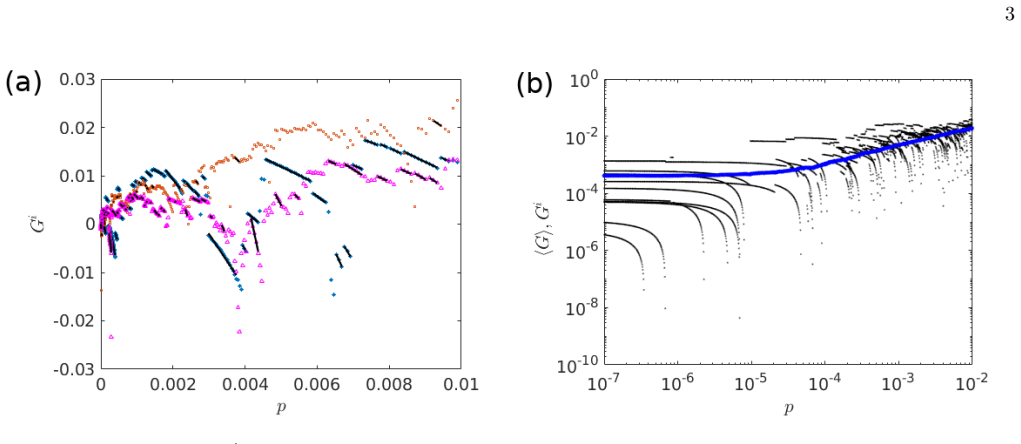
The central object is the linear relation $G^i(p)=G^i_0-\lambda^i p$ within a geometrical family, derived from energy conservation $-p\,dL^d-\Sigma_{xy}L^d\,d\gamma=dU$ at fixed contact network, with $G^i_0=L^{-d}\,d^2U/d\gamma^2$ and $\lambda^i=\phi^{-1}\,d^2\phi/d\gamma^2$. The paper establishes that $\lambda^i>0$ almost always, so within-family stiffness decreases linearly with pressure. The second mechanism is the discontinuous rearrangement jump, isolated by the decomposition $G^i=G^{if}+G^{is}+G^{ir}$ into first-family, change-in-family, and rearrangement parts. The compact formula that organizes the data is $\langle G\rangle=(\langle G_0\rangle+a p^\alpha)/(1+c p^{\alpha-\beta})$, which smoothly interpolates between the two power laws, and the matching crossover behavior of $\langle G^f+G^s\rangle$ and $\langle G^r\rangle$ is what ties the exponent switch to the geometry of rearrangements.
What would settle it
Measure the ensemble-averaged rearrangement contribution $\langle G^r\rangle$ for the same packings while (i) including contacts that newly form during the applied shear strain and (ii) applying negative shear of the same magnitude; if the mean jump is no longer upward or no longer comparable to $\langle G^f+G^s\rangle$ for $p>p^{**}$, the proposed balance fails.
Extended reading notes
Core claim
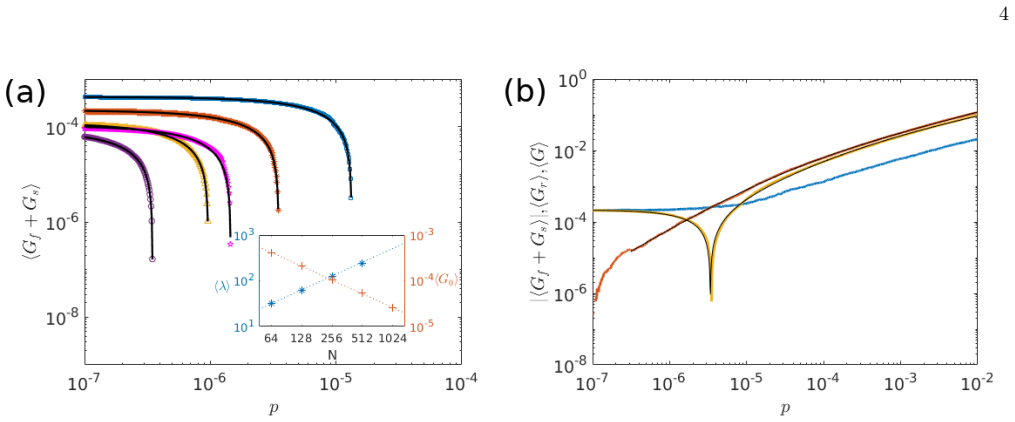
The central claim is that the known power-law scaling of the ensemble-averaged shear modulus near jamming onset is an emergent balance, not a bulk property of individual packings. Each packing $i$ obeys $G^i = G^i_0 - \lambda^i p$ along a geometrical family, with $\lambda^i>0$ in nearly all cases, so its stiffness falls linearly as pressure rises. When pressure increases enough to change the force-bearing contact network—through a particle rearrangement or through an added contact—$G^i$ changes discontinuously, and these jumps are on average upward. The ensemble average $\langle G\rangle$ therefore separates into a first-geometrical-family plus family-change contribution $\langle G^f+G^s\rangle$, which decreases linearly with $p$, and a rearrangement contribution $\langle G^r\rangle$, which is positive and grows with $p$. The paper shows that each contribution, and their sum $\langle G\rangle$, is described by a function that transitions between two power laws over the same pressure interval, with crossover $p^{**}\sim N^{-1}$, and that the two opposing contributions remain comparable in the large-$N$ limit. It also demonstrates compression unjamming: because compression shifts bond angles and can induce a mechanical instability, a jammed packing can move to a configuration whose jamming onset lies above the current packing fraction.
Load-bearing premise
Everything about the sign and size of the rearrangement jumps rests on measuring $G^i$ with the double-sided linear spring while ignoring contacts that would newly form during the applied positive shear strain; using negative shear or including new contacts could change the jumps and destroy the compensation.
Editorial extensions
If this is right
- For $p>p^{**}$, the geometrical-family contribution remains comparable to the rearrangement contribution at every system size, so the linear within-family softening cannot be ignored in the thermodynamic limit.
- The low-pressure exponent $\alpha\approx 1$ is controlled by the first-family term $\langle G_0\rangle-\langle\lambda\rangle p$, while the high-pressure exponent $\beta\approx 0.5$ is controlled by the upward rearrangement jumps; the crossover $p^{**}\sim N^{-1}$ is where the two contributions balance.
- Since $\langle G^r\rangle$ is zero below the pressure of the first rearrangement, the $p^\beta$ regime requires ensembles with enough pressure range to sample many rearrangements.
- Compression unjamming occurs with a probability that is independent of system size for sheared packings and nonzero in the large-$N$ limit for packings compressed at fixed $\gamma=0$, so cyclic compression protocols near jamming can encounter irreversibility.
Reading between the lines
- If upward jumps are the generic cause of the rising ensemble average, then the high-pressure exponent $\beta$ should be directly related to the density of rearrangement events per pressure interval; a test would compare $d\langle G^r\rangle/dp$ with the measured rate of contact-network changes.
- The same decomposition could be applied to pressure ramps at fixed shear strain and to strain ramps at fixed pressure, predicting that the observed power-law response in each protocol is the sum of within-family softening and jumps, rather than a single intrinsic exponent.
- For non-spherical particles, where the high-pressure exponent differs ($\beta\approx 1$ for ellipses in earlier studies), applying this decomposition would reveal whether the change comes from weaker within-family softening or from rearrangement jumps that no longer compensate it.
- Compression unjamming may imply that compression history and shear history are not interchangeable near jamming, with consequences for protocols that attempt to prepare jammed states by isotropic compression alone.
Signed reviews
Editorial analysis
A structured set of objections, weighed in public.
Referee Report
Summary. This Letter studies the pressure dependence of the static shear modulus of jammed packings of frictionless, purely repulsive disks and spheres under athermal quasistatic shear. The authors report that for an individual packing, the shear modulus decreases linearly with pressure along a geometrical family of fixed contact network, following G^i = G^i_0 - lambda_i p, while discontinuous upward jumps in G^i occur at rearrangements between families. They partition the ensemble-averaged modulus into first-family, change-in-family, and rearrangement contributions, and show that the sum is described by a scaling function that crosses over from a low-pressure power law with exponent alpha ~ 1 to a high-pressure power law with exponent beta ~ 0.5, matching earlier results. They also report the phenomenon of compression unjamming, in which a jammed packing becomes unjammed upon isotropic compression.
Significance. If the central mechanism is correct, the paper provides a microscopic explanation of the well-known alpha-to-beta exponent crossover in the shear modulus of jammed packings, connecting within-family mechanical softening to rearrangement statistics. The compression-unjamming observation is also surprising and potentially important for understanding reversibility and cyclic compaction. The authors are explicit that the scaling functions in Eqs. (8) and (9) are empirical interpolations, and the strength of the paper lies in the direct observation of a linear within-family decrease and upward jumps, rather than in a parameter-free prediction. The manuscript is clearly written and the figures support the reported trends. However, as detailed below, the derivation of Eq. (5) and the nonstandard protocol used to measure G^i are load-bearing and need to be addressed before the central conclusion can be accepted.
major comments (3)
- [Derivation of Eq. (5), Eqs. (3)-(4)] The energy balance dU = -p dL^d - Sigma_xy L^d dgamma describes a path in which volume and shear strain both change. The shear modulus is then defined as the derivative of -Sigma_xy with respect to gamma at constant volume, which requires dL^d = 0 and therefore dphi = 0 during the differentiation. Under that condition the second term in Eq. (4) vanishes and Eq. (5) does not follow; the linear decrease -lambda_i p is not a consequence of energy conservation as stated. The authors should either supply a correct derivation starting from the virial expression and the force balance of the frozen-contact system, or present the linear decrease as an empirical observation rather than a derived prediction.
- [Page 3, 'To determine the shear modulus G^i'] The measurement uses a double-sided linear spring for all existing contacts and excludes new contacts that form during the applied shear. This is not the quasistatic shear modulus of the one-sided repulsive system whose scaling is quoted in Eq. (2). The appearance of G^i < 0 in Fig. 2(a) indicates that the probe can disagree qualitatively with the physical modulus of a stable jammed packing. Since the central mechanism -- within-family softening plus upward rearrangement jumps -- is inferred entirely from this G^i, the paper needs to demonstrate that the same family slopes, jump signs, and the compensation between the two contributions are obtained with the physical one-sided potential, including contact breaking and formation. Without such a check, the claim that jumps are on average upward and cancel the linear decrease could be an artifact of the contact-treatment protocol.
- [Fig. 3 and Eqs. (8)-(9)] The decomposition G^i = G_f^i + G_s^i + G_r^i is presented as the sum of a first-family term, a change-in-family term, and a rearrangement term, but the operational rule for assigning every discontinuity to G_r versus updating G_f and G_s is not described in the text. Moreover, Eqs. (8) and (9) contain six or more adjustable parameters and are fitted to the same data whose scaling they are used to explain; the agreement in Fig. 3(b) therefore does not by itself confirm that the two contributions are comparable. The authors should state the assignment algorithm precisely and report the fit parameters and uncertainties.
minor comments (4)
- [Summary paragraph, page 2] The word 'decribes' should be 'describes' in the sentence 'a physically motivated scaling function that accurately decribes <G>'.
- [Page 3, after Eq. (5)] The sentence 'find again that lambda_i < 0 is extremely rare' is confusing given the sign convention in Eq. (5), where the natural claim is that lambda_i > 0 almost always; please rephrase for clarity.
- [Inset to Fig. 3(a)] The text states that <G_0> and <lambda> are plotted versus N but does not give the functional forms used for the fits or the error bars; please specify these details.
- [Page 5, scaling function for <G>] The statement that <G> can be approximated by a single scaling function because both contributions transition over the same pressure interval is plausible but not quantitatively justified; a direct comparison of the sum of the two fitted functions (Eqs. (8) and (9)) with the single-function fit would strengthen this step.
Circularity Check
No significant circularity: the linear decrease and upward-jump compensation are empirically tested, not imposed by construction.
full rationale
The central relation G_i=G_i0−λ_i p is derived from energy conservation along a fixed-contact family (Eqs. 3–5) with G_i0 and λ_i defined as second derivatives, and then independently verified against simulated packings via a stress-strain measurement; the sign of λ_i and the upward trend of rearrangement jumps are data outcomes, not fit outputs. The decomposition G_i=G_f+G_s+G_r is bookkeeping, but the claims that ⟨G_s⟩≈0 and that jumps compensate softening are supported by the identified rearrangement events and by comparing ⟨G_f+G_s⟩ with ⟨G⟩, rather than being tautological. Equations (8)–(9) and the α/β fit to ⟨G⟩ are descriptive scaling forms fitted to the same data; they are not presented as predictions derived from the mechanism, so they do not constitute fitted-input-called-prediction circularity. Self-citations to ref. [18] motivate and provide the virial method for the λ_i>0 and individual-family results, but the present paper re-derives and re-tests those claims, so the citations are not load-bearing. The frozen-contact, double-sided-spring protocol and negative-G_i events raise physical-validity concerns, but those are correctness issues, not circularity.
Assumptions & free parameters
free parameters (4)
- alpha (low-pressure power-law exponent) =
approximately 1
- beta (high-pressure power-law exponent) =
approximately 0.5
- Scaling coefficients and exponents a, c, d, e in Eq. (8) for <Gf+Gs> =
not reported
- Scaling coefficients a', c', b, d', e' in Eq. (9) for <Gr> =
not reported
assumptions (5)
- domain assumption Athermal quasistatic energy conservation and the relation dL^d/L^d = -d(phi)/phi hold along a geometrical family.
- domain assumption A geometrical family is defined by an unchanged force-bearing contact network; changes in the network coincide with the discontinuities.
- domain assumption The linear-response shear modulus can be obtained by applying small positive shear with a double-sided linear spring and excluding contacts that form during the test strain.
- ad hoc to paper The interpolating forms in Eqs. (8) and (9) are appropriate descriptors of the pressure dependence.
- domain assumption Bidisperse frictionless linear-spring disks and spheres are representative of the jamming universality class.
Cite this review
Pith. "Pith review of Pressure-dependent shear response of jammed packings of spherical particles." pith.science (2026). https://pith.science/paper/NM7VFIOH
@misc{pith2026190809435,
  author       = {Pith},
  title        = {Pith review of: Pressure-dependent shear response of jammed packings of spherical particles},
  year         = {2026},
  howpublished = {\url{https://pith.science/paper/NM7VFIOH}},
  note         = {Machine review of arXiv:1908.09435}
}
abstract
The mechanical response of packings of purely repulsive, spherical particles to athermal, quasistatic simple shear near jamming onset is highly nonlinear. Previous studies have shown that, at small pressure $p$, the ensemble-averaged static shear modulus $\langle G-G_0 \rangle$ scales with $p^\alpha$, where $\alpha \approx 1$, but above a characteristic pressure $p^{**}$, $\langle G-G_0 \rangle \sim p^\beta$, where $\beta \approx 0.5$. However, we find that the shear modulus $G^i$ for an individual packing typically decreases linearly with $p$ along a geometrical family where the contact network does not change. We resolve this discrepancy by showing that, while the shear modulus does decrease linearly within geometrical families, $\langle G \rangle$ also depends on a contribution from discontinuous jumps in $\langle G \rangle$ that occur at the transitions between geometrical families. For $p > p^{**}$, geometrical-family and rearrangement contributions to $\langle G \rangle$ are of opposite signs and remain comparable for all system sizes. $\langle G \rangle$ can be described by a scaling function that smoothly transitions between the two power-law exponents $\alpha$ and $\beta$. We also demonstrate the phenomenon of {\it compression unjamming}, where a jammed packing can unjam via isotropic compression.
Figures

Figures from the paper (1 more)

Reference graph
Works this paper leans on
-
[1]
T. S. Majmudar, M. Sperl, S. Luding, and R. P. Behringer, Phys. Rev. Lett. 98, 058001 (2007)
work page 2007
-
[2]
R. P. Behringer and B. Chakraborty, Reports on Progress in Physics 82, 012601 (2019)
work page 2019
-
[3]
D. J. Durian, Phys. Rev. Lett. 75, 4780 (1995)
work page 1995
-
[4]
H. P. Zhang and H. A. Makse, Phys. Rev. E 72, 011301 (2005)
work page 2005
-
[5]
K. W. Desmond, P. J. Young, D. Chen, and E. R. Weeks, Soft Matter 9, 3424 (2013)
work page 2013
- [6]
-
[7]
A. V. Tkachenko and T. A. Witten, Phys. Rev. E 60, 687 (1999)
work page 1999
-
[8]
Q. Wu, T. Bertrand, M. D. Shattuck, and C. S. O’Hern, Phys. Rev. E 96, 062902 (2017)
work page 2017
Show all 29 references
-
[9]
Atkinson, F
S. Atkinson, F. H. Stillinger, and S. Torquato, Phys. Rev. E 88, 062208 (2013)
2013
-
[10]
H. A. Makse, D. L. Johnson, and L. M. Scwartz, Phys. Rev. Lett. 84, 4160 (2000)
2000
-
[11]
C. S. O’Hern, L. E. Silbert, A. J. Liu, and S. R. Nagel, Phys. Rev. E 68, 011306 (2003)
2003
-
[12]
C. P. Goodrich, A. J. Liu, and S. R. Nagel, Phys. Rev. Lett. 109, 095704 (2012)
2012
-
[13]
L. E. Silbert, Soft Matter 6, 2918 (2010)
2010
-
[14]
Henkes, M
S. Henkes, M. van Hecke, and W. van Saarloos, Euro- 6 phys. Lett. 90, 14003 (2010)
2010
-
[15]
Boromand, A
A. Boromand, A. Signoriello, J. Lowensohn, C. S. Orel- lana, E. R. Weeks, F. Ye, M. D. Shattuck, and C. S. O’Hern, Soft Matter 15, 5854 (2019)
2019
-
[16]
A. J. Liu and S. R. Nagel, Ann. Rev. Condens. Matter Phys. 1, 347 (2010)
2010
-
[17]
L. E. Silbert, A. J. Liu, and S. R. Nagel, Phys. Rev. E 73, 041304 (2006)
2006
-
[18]
S. Chen, T. Bertrand, W. Jin, M. D. Shattuck, and C. S. O’Hern, Phys. Rev. E 98, 042906 (2018)
2018
-
[19]
Bertrand, R
T. Bertrand, R. P. Behringer, B. Chakraborty, C. S. O’Hern, and M. D. Shattuck, Phys. Rev. E 93, 012901 (2016)
2016
-
[20]
Bitzek, P
E. Bitzek, P. Koskinen, F. G¨ ahler, M. Moseler, and P. Gumbsch, Phys. Rev. Lett. 97, 170201 (2006)
2006
-
[21]
N. Xu, J. Blawzdziewicz, and C. S. O’Hern, Phys. Rev. E 71, 061306 (2005)
2005
-
[22]
C. P. Goodrich, A. J. Liu, and J. P. Sethna, Proc. Natl. Acad. Sci. USA 113, 9745 (2016)
2016
-
[23]
Kumar and S
N. Kumar and S. Luding, Granular Matter 18, 58 (2016)
2016
-
[24]
J. R. Royer and P. M. Chaikin, PNAS 112, 49 (2015)
2015
-
[25]
Y. Jin, P. Urbani, F. Zamponi, and H. Yoshino, Science Advances 4, eaat6387 (2018)
2018
-
[26]
C. F. Schreck, N. Xu, and C. S. O’Hern, Soft Matter 6, 2960 (2010)
2010
-
[27]
VanderWerf, W
K. VanderWerf, W. Jin, M. D. Shattuck, and C. S. O’Hern, Phys. Rev. E 97, 012909 (2018)
2018
-
[28]
Jaeger, Soft Matter 11, 12 (2015)
H. Jaeger, Soft Matter 11, 12 (2015)
2015
-
[29]
Brito, H
C. Brito, H. Ikeda, P. Urbani, M. Wyart, and F. Zam- poni, PNAS 115, 11736 (2018)
2018
Reviewed August 14, 2026 · model on record in the stance chip above.
Discussion (0). Continue with ORCID to comment.