REVIEW 3 major objections 3 minor 65 references
Generalized bulk-edge correspondence for non-hermitian topological systems
T0 review · 3 major / 3 minor · reviewed 2026-08-14 · deepseek-v4-flash
Pith's one-line read This paper restores bulk-edge correspondence in non-Hermitian chains by replacing the ordinary periodic boundary condition with a modified one parameterized by a skin-effect scale $b$, and proves the correspondence in the enlarged…
desk verdict A fresh boundary-condition trick that makes non-Hermitian bulk-edge correspondence intuitive for a chiral SSH model, but the general proof is explicitly restricted to the perturbative regime and the role of the free parameter b remains under-examined. read the letter →
The pith
A machine-rendered reading of the paper's core claim, the machinery that carries it, and where it could break.
The reading
What carries the argument
The load-bearing object is the modified periodic boundary condition (mpbc), defined by boundary hopping terms $\Delta H = b^{-L} t |1\rangle\langle L| + b^L t |L\rangle\langle 1|$ for the single-band chain and by the analogous terms for the SSH-type chain; it imposes $\psi(j+L)=b^L\psi(j)$. A similarity transformation $S=\mathrm{diag}[1,1,b,b,b^2,b^2,\dots]$ turns the mpbc Hamiltonian into an ordinary periodic Hamiltonian with rescaled hoppings, leaving the spectrum unchanged. This machinery replaces the ordinary Brillouin zone by the circle $\beta=b e^{ik}$, on which the chiral winding numbers $w_\pm = (1/2\pi)[\arg R_\pm(\beta)]_{k=0}^{2\pi}$ are evaluated. Its essential work is to make the bulk reference geometry compatible with exponential localization of skin modes, so that the deformation argument of the Hermitian proof can be carried over to the enlarged parameter space $\tilde{\tau}=\{\tau,b\}$.
What would settle it
Numerically diagonalize the open-boundary SSH chain at a point where the mpbc phase diagram gives $(w_+,w_-)=(1,-1)$ but which is not smoothly connected to the Hermitian line; if no zero-energy edge state appears, the deformation argument is insufficient. Alternatively, compute the actual generalized Brillouin zone by the method of Ref. 12 and compare its winding number with the mpbc winding number at $b=|\beta(E_{\mathrm{bot}})|$; a disagreement marks the boundary of the proof's validity.
Extended reading notes
Core claim
The central claim is that the modified periodic boundary condition (mpbc), in which the wave function is multiplied by $b^L$ across the boundary, is the correct reference bulk geometry for non-Hermitian systems with skin effect. Under mpbc the eigenstates take the generalized Bloch form with $\beta=b e^{ik}$, and the bulk Hamiltonian $H_{\mathrm{mpbc}}(\beta)$ is explicitly chiral. The winding numbers $w_\pm$ of the off-diagonal entries $R_\pm(\beta)$ around the origin are well defined, and the paper proves a bulk-edge correspondence in $\tilde{\tau}=\{\tau,b\}$: the region with $(w_+,w_-)=(1,-1)$ signals a zero-energy edge state under open boundary, and this region is smoothly connected to the Hermitian topological-insulator region. The proof adapts the chiral-symmetry bulk-edge proof of Ref. 61, with the additional parameter $b$ absorbing the skin effect. The paper also exhibits an optimal path $b=|\beta(E_{\mathrm{bot}})|$ along which the mpbc spectrum reproduces the bottom of the open-boundary bulk spectrum, and shows that switching the mpbc off continuously evolves a detached spectral branch into the zero-energy edge state.
Load-bearing premise
The proof assumes that a single number $b$ captures the whole non-Hermitian skin effect, i.e. that the generalized Brillouin zone is the circle $|\beta|=b$; in general it is not.
Editorial extensions
If this is right
- On any path in the $(t_1,b)$ phase diagram that is smoothly connected to the Hermitian line $b=1$, the $w=1$ region guarantees a zero-energy edge state under open boundary, whereas the ordinary periodic-boundary spectrum misplaces the gap closings.
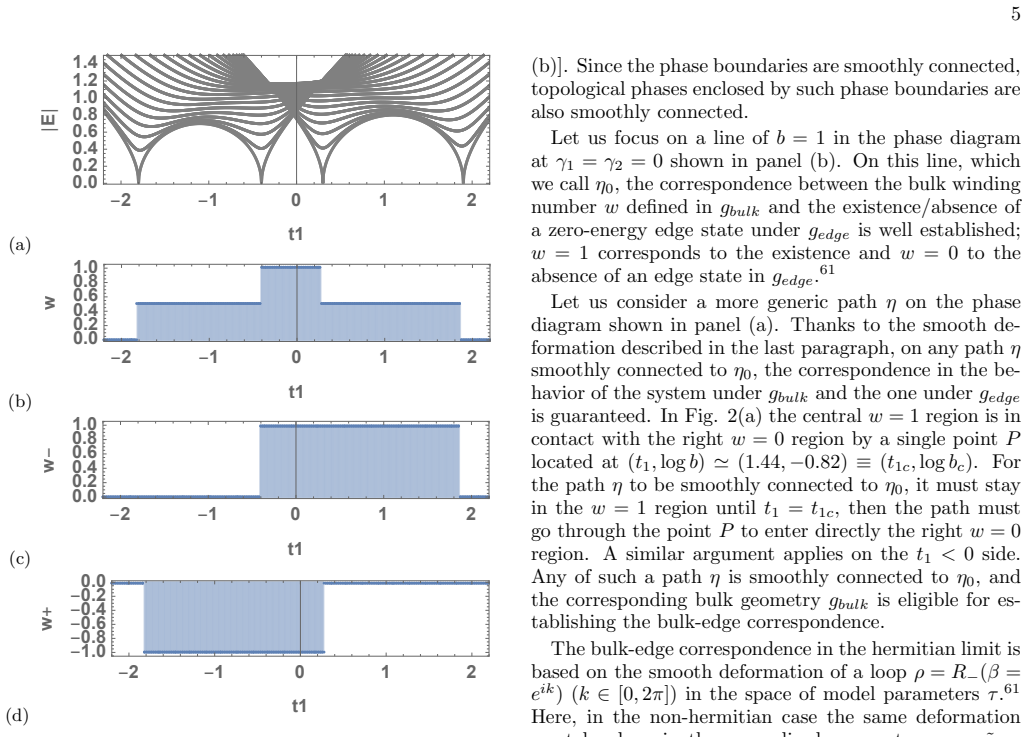
- The central $w=1$ region is smoothly connected to the Hermitian topological-insulator phase, while the $w=1/2$ regions with $(w_+,w_-)=(1,0)$ or $(0,-1)$ are new topological phases with no Hermitian analogue.
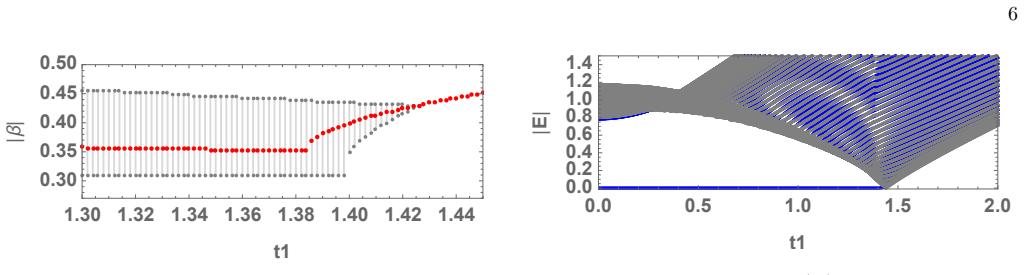
- Along the optimal path $b=|\beta(E_{\mathrm{bot}})|$, the mpbc spectrum reproduces the bottom of the open-boundary bulk spectrum, and gradually switching off the mpbc turns a detached spectral branch into the zero-energy edge state.
- The generalized bulk-edge correspondence is at present proven only in the perturbative non-Hermitian regime, namely for phases smoothly connected to a Hermitian topological phase; the authors state that a more general proof is left to future work.
Reading between the lines
- Read $b$ as the radial scale of the generalized Brillouin zone; where that zone is genuinely non-circular, the natural extension is to let $b$ depend on $k$, making the present construction the constant-$b$ slice of a more general contour formulation.
- The same strategy should transfer to other symmetry classes and higher dimensions, replacing the scalar $b$ by a boundary-condition object matched to the anisotropic skin effect; a testable consequence is that topological edge-state existence is governed by winding numbers computed on such skin-effect-matched bulk geometries.
- In engineered directional-gain or lossy lattices, the claim predicts that closing the ring with an amplitude-amplifying link $b^L$ should make the measured bulk spectrum follow the open-boundary gap closings, and the $w=1/2$ windows should appear as parameter ranges with mid-gap states and anomalous winding.
Signed reviews
Editorial analysis
A structured set of objections, weighed in public.
Referee Report
Summary. The paper proposes a modified periodic boundary condition (mpbc) parameterized by b for non-Hermitian one-dimensional tight-binding models with skin effect. For a non-Hermitian SSH model with third-nearest-neighbor hopping and chiral symmetry, the authors define chiral winding numbers w± on the circular contour β = b e^{ik} (Eq. (19)), compute an analytic phase diagram in the enlarged parameter space (t1, b), and claim a generalized bulk-edge correspondence: points with (w+, w−) = (1, −1) in the region smoothly connected to the Hermitian topological phase host zero-energy edge states under open boundary conditions. The paper also introduces an optimal path b = |β(Ebot)|, chosen so that the mpbc spectrum reproduces the bottom of the OBC band, and numerically follows the evolution from mpbc to OBC.
Significance. If fully established, the mpbc construction would be a useful and practical way to restore the bulk-edge correspondence for non-Hermitian systems with skin effect, and the explicit analytic phase diagram for a concrete model is a valuable pedagogical and methodological contribution. The winding-number definitions, the similarity transformation in Sec. III, and the phase-boundary equations in Sec. IV are explicit and correct as far as they go, and the numerical spectra along the optimal path support the existence of protected zero modes in that specific setting. However, the central proof is only a deformation sketch, the authors explicitly restrict it to the perturbative regime, and they defer the general proof to Ref. 64, so the abstract's finite-region claim is considerably stronger than what is demonstrated.
major comments (3)
- [Sec. IV, Eq. (19) and the paragraph after Eq. (23)] The proof of the generalized bulk-edge correspondence is not completed for arbitrary points in the w = 1 region. The winding numbers are evaluated on the circular contour β = b e^{ik}, but the authors themselves note in the discussion of Refs. 11 and 12 that the OBC generalized Brillouin zone is generically non-circular, and they restrict the proof to the perturbative regime, deferring a more general proof to Ref. 64. The smooth deformation of the circular-contour phase diagram as γ1, γ2 → 0 only shows that these circular-contour winding numbers vary continuously; it does not identify the OBC gap-closing condition with the zero set of R±(β) on that circle for every b. Thus the abstract's claim that a finite region in (t1, b) indicates a topologically protected OBC edge state is not established for all points in the region.
- [Sec. V, Eq. (24) and Fig. 6] The optimal path ηbar is defined by b = |β(Ebot)|, which is extracted from the OBC generalized Brillouin zone and hence from OBC spectral data. The subsequent numerical evolution from mpbc to OBC along this path therefore partially builds in the presence of the edge state. Because the OBC spectrum is independent of the auxiliary parameter b, the observation of zero modes on ηbar does not prove that every other red-region point with a different value of b hosts an OBC zero mode. A concrete test would be to compute the OBC spectrum for a point in the w = 1 region with b far from |β(Ebot)|; the stated correspondence requires such a point to display the zero mode.
- [Sec. IV, paragraph following Eq. (23)] The assertion that 'on any path η smoothly connected to η0, the correspondence ... is guaranteed' is asserted rather than proved. The smooth connection between phase boundaries in the (τ, b) space does not by itself transfer the usual PBC/OBC bulk-edge correspondence to the non-Hermitian setting, because the applicability of Ref. 61 to the mpbc reference geometry is precisely the point at issue. This is a load-bearing gap: the central result of the paper depends on this transfer, and the manuscript's own sentence restricting the proof to the perturbative regime and citing an in-preparation general proof makes the gap explicit.
minor comments (3)
- [Eq. (21)] Equation (21) is ambiguous as printed: the text requires w = (w+ − w−)/2, since w = 1 for (w+, w−) = (1, −1) and w = 1/2 for (1, 0) or (0, −1), but the displayed expression appears to be a half-sum with an overall sign. Please correct or clarify.
- [Fig. 4 caption] The caption should state explicitly that the plotted |β| is |β(Ebot)| and that the gray bars outline the w = 1 region in the (t1, log b) plane, so that the reader can connect the figure to Eq. (24) without inferring it from the main text.
- [Sec. I, paragraph 2] There is a typo in the phrase 'edge geometrygedge'; it should read 'edge geometry g_edge'. Similar spacing artifacts appear elsewhere in the typeset text and should be corrected.
Circularity Check
One fitted-input step in the optimal-path demonstration; the central phase diagram remains independently computed.
-
fitted input called prediction
[Section V, Eq. (24), Figs. 4–6]
"To reproduce the spectrum at the band bottom Ebot under obc, we need to tune the parameter b to be consistent with the value of β corresponding to Ebot at each t1. Thus, b should be determined as b =|β(Ebot)|. (24) ... Since the gap closing is a property of the band bottom, this ensures that the positions of the gap closing are also reproduced. ... This is the simplest and most direct way to establish the bulk-edge correspondence."
The mpbc parameter b is an auxiliary degree of freedom not fixed by the Hamiltonian. In the optimal-path construction it is fitted to the OBC spectrum via β(Ebot), and the matching of gap-closing positions between the mpbc bulk and OBC is then guaranteed by construction ('this ensures that the positions ... are reproduced'). The interpolation Hδ (Eq. (25)) returns to the same OBC Hamiltonian, so the zero-energy edge state in Fig. 6 is already an OBC input rather than an independent prediction. This makes the optimal-path demonstration circular in itself. It is not load-bearing for the analytically computed phase diagram of Sec. IV, so the circularity is partial and non-central.
full rationale
The central phase diagram (Fig. 2(a)) and winding numbers w± are computed analytically from H_mpbc(β) alone, with no OBC data entering the calculation; they are not fitted. The generalized BEC is argued in Sec. IV by deforming across γ1,γ2 to the Hermitian limit and invoking Ryu–Hatsugai's proof (Ref. 61), an external result, not a self-citation. The paper explicitly restricts this proof to the perturbative regime and defers a general proof to footnote 64 ('in preparation'); that is a rigor/scope limitation, not circularity. The one genuinely constructed step is the optimal path η̄ in Sec. V, where b is chosen from the OBC spectrum (Eq. (24)); the resulting agreement of gap closings and the edge-state evolution are therefore partly built in. Since this path is presented as an illustrative 'intuitive form' rather than the basis of the central classification, the derivation's main content remains independent. Overall: one non-central fitted-input step, partial circularity, score 3.
Assumptions & free parameters
free parameters (1)
- b =
b = |β(E_bot)| for the optimal path
assumptions (4)
- domain assumption Chiral (sublattice) symmetry of the non-Hermitian SSH model
- ad hoc to paper The modified periodic boundary condition provides a valid reference bulk geometry for non-Hermitian systems with skin effect
- domain assumption The generalized Brillouin zone under open boundary is a circle of radius b
- ad hoc to paper Smooth deformation in the enlarged parameter space (τ,b) preserves zero-energy edge states under open boundary
Cite this review
Pith. "Pith review of Generalized bulk-edge correspondence for non-hermitian topological systems." pith.science (2026). https://pith.science/paper/VZLZZEFL
@misc{pith2026190809438,
  author       = {Pith},
  title        = {Pith review of: Generalized bulk-edge correspondence for non-hermitian topological systems},
  year         = {2026},
  howpublished = {\url{https://pith.science/paper/VZLZZEFL}},
  note         = {Machine review of arXiv:1908.09438}
}
read the original abstract
A modified periodic boundary condition adequate for non-hermitian topological systems is proposed. Under this boundary condition a topological number characterizing the system is defined in the same way as in the corresponding hermitian system and hence, at the cost of introducing an additional parameter that characterizes the non-hermitian skin effect, the idea of bulk-edge correspondence in the hermitian limit can be applied almost as it is. We develop this framework through the analysis of a non-hermitian SSH model with chiral symmetry, and prove the bulk-edge correspondence in a generalized parameter space. A finite region in this parameter space with a nontrivial pair of chiral winding numbers is identified as topologically nontrivial, indicating the existence of a topologically protected edge state under open boundary.
Figures


Figures from the paper (2 more)

Reference graph
Works this paper leans on
-
[1]
author author H. Feshbach ,\ https://doi.org/10.1016/0003-4916(58)90007-1 journal journal Annals of Physics \ volume 5 ,\ pages 357 ( year 1958 ) NoStop
-
[2]
author author N. Hatano \ and\ author D. R. \ Nelson ,\ 10.1103/PhysRevLett.77.570 journal journal Phys. Rev. Lett. \ volume 77 ,\ pages 570 ( year 1996 ) NoStop
-
[3]
author author N. Hatano \ and\ author D. R. \ Nelson ,\ 10.1103/PhysRevB.56.8651 journal journal Phys. Rev. B \ volume 56 ,\ pages 8651 ( year 1997 ) NoStop
-
[4]
author author C. M. \ Bender \ and\ author S. Boettcher ,\ 10.1103/PhysRevLett.80.5243 journal journal Phys. Rev. Lett. \ volume 80 ,\ pages 5243 ( year 1998 ) NoStop
-
[5]
author author A. Ghatak \ and\ author T. Das ,\ 10.1088/1361-648x/ab11b3 journal journal Journal of Physics: Condensed Matter \ volume 31 ,\ pages 263001 ( year 2019 ) NoStop
-
[6]
author author T. Ozawa , author H. M. \ Price , author A. Amo , author N. Goldman , author M. Hafezi , author L. Lu , author M. C. \ Rechtsman , author D. Schuster , author J. Simon , author O. Zilberberg , \ and\ author I. Carusotto ,\ 10.1103/RevModPhys.91.015006 journal journal Rev. Mod. Phys. \ volume 91 ,\ pages 015006 ( year 2019 ) NoStop
-
[7]
author author Z. Gong , author Y. Ashida , author K. Kawabata , author K. Takasan , author S. Higashikawa , \ and\ author M. Ueda ,\ 10.1103/PhysRevX.8.031079 journal journal Phys. Rev. X \ volume 8 ,\ pages 031079 ( year 2018 ) NoStop
-
[8]
author author K. Esaki , author M. Sato , author K. Hasebe , \ and\ author M. Kohmoto ,\ 10.1103/PhysRevB.84.205128 journal journal Phys. Rev. B \ volume 84 ,\ pages 205128 ( year 2011 ) NoStop
Show all 65 references
-
[9]
author author Y. C. \ Hu \ and\ author T. L. \ Hughes ,\ 10.1103/PhysRevB.84.153101 journal journal Phys. Rev. B \ volume 84 ,\ pages 153101 ( year 2011 ) NoStop
2011 doi
-
[10]
author author T. E. \ Lee ,\ 10.1103/PhysRevLett.116.133903 journal journal Phys. Rev. Lett. \ volume 116 ,\ pages 133903 ( year 2016 ) NoStop
2016 doi
-
[11]
Yao \ and\ author Z
author author S. Yao \ and\ author Z. Wang ,\ 10.1103/PhysRevLett.121.086803 journal journal Phys. Rev. Lett. \ volume 121 ,\ pages 086803 ( year 2018 ) NoStop
2018 doi
-
[12]
Yokomizo \ and\ author S
author author K. Yokomizo \ and\ author S. Murakami ,\ 10.1103/PhysRevLett.123.066404 journal journal Phys. Rev. Lett. \ volume 123 ,\ pages 066404 ( year 2019 ) NoStop
2019 doi
-
[13]
author author V. M. \ Martinez Alvarez , author J. E. \ Barrios Vargas , \ and\ author L. E. F. \ Foa Torres ,\ 10.1103/PhysRevB.97.121401 journal journal Phys. Rev. B \ volume 97 ,\ pages 121401 ( year 2018 ) NoStop
2018 doi
-
[14]
author author F. K. \ Kunst , author E. Edvardsson , author J. C. \ Budich , \ and\ author E. J. \ Bergholtz ,\ 10.1103/PhysRevLett.121.026808 journal journal Phys. Rev. Lett. \ volume 121 ,\ pages 026808 ( year 2018 ) NoStop
2018 doi
-
[15]
author author Y. Xiong ,\ 10.1088/2399-6528/aab64a journal journal Journal of Physics Communications \ volume 2 ,\ eid 035043 ( year 2018 ) ,\ http://arxiv.org/abs/1705.06039 arXiv:1705.06039 [cond-mat.mes-hall] NoStop
2018 arXiv
-
[16]
Herviou , author J
author author L. Herviou , author J. H. \ Bardarson , \ and\ author N. Regnault ,\ 10.1103/PhysRevA.99.052118 journal journal Phys. Rev. A \ volume 99 ,\ pages 052118 ( year 2019 ) NoStop
2019 doi
-
[17]
author author F. K. \ Kunst \ and\ author V. Dwivedi ,\ 10.1103/PhysRevB.99.245116 journal journal Phys. Rev. B \ volume 99 ,\ pages 245116 ( year 2019 ) NoStop
2019 doi
-
[18]
Okuma \ and\ author M
author author N. Okuma \ and\ author M. Sato ,\ 10.1103/PhysRevLett.123.097701 journal journal \ volume 123 ,\ eid 097701 ( year 2019 ) ,\ http://arxiv.org/abs/1904.06355 arXiv:1904.06355 [cond-mat.mes-hall] NoStop
2019 arXiv
-
[19]
Mochizuki , author D
author author K. Mochizuki , author D. Kim , \ and\ author H. Obuse ,\ 10.1103/PhysRevA.93.062116 journal journal Phys. Rev. A \ volume 93 ,\ pages 062116 ( year 2016 ) NoStop
2016 doi
-
[20]
Lieu ,\ 10.1103/PhysRevB.97.045106 journal journal Phys
author author S. Lieu ,\ 10.1103/PhysRevB.97.045106 journal journal Phys. Rev. B \ volume 97 ,\ pages 045106 ( year 2018 ) NoStop
2018 doi
-
[21]
Kawabata , author K
author author K. Kawabata , author K. Shiozaki , \ and\ author M. Ueda ,\ 10.1103/PhysRevB.98.165148 journal journal Phys. Rev. B \ volume 98 ,\ pages 165148 ( year 2018 ) NoStop
2018 doi
-
[22]
Shen , author B
author author H. Shen , author B. Zhen , \ and\ author L. Fu ,\ 10.1103/PhysRevLett.120.146402 journal journal Phys. Rev. Lett. \ volume 120 ,\ pages 146402 ( year 2018 ) NoStop
2018 doi
-
[23]
Leykam , author K
author author D. Leykam , author K. Y. \ Bliokh , author C. Huang , author Y. D. \ Chong , \ and\ author F. Nori ,\ 10.1103/PhysRevLett.118.040401 journal journal Phys. Rev. Lett. \ volume 118 ,\ pages 040401 ( year 2017 ) NoStop
2017 doi
-
[24]
Yuce ,\ 10.1103/PhysRevA.97.042118 journal journal Phys
author author C. Yuce ,\ 10.1103/PhysRevA.97.042118 journal journal Phys. Rev. A \ volume 97 ,\ pages 042118 ( year 2018 ) NoStop
2018 doi
-
[25]
Jin \ and\ author Z
author author L. Jin \ and\ author Z. Song ,\ 10.1103/PhysRevB.99.081103 journal journal Phys. Rev. B \ volume 99 ,\ pages 081103 ( year 2019 ) NoStop
2019 doi
-
[26]
Song , author S
author author F. Song , author S. Yao , \ and\ author Z. Wang ,\ @noop journal journal arXiv e-prints \ ,\ eid arXiv:1905.02211 ( year 2019 ) ,\ http://arxiv.org/abs/1905.02211 arXiv:1905.02211 [cond-mat.mes-hall] NoStop
1905 arXiv
-
[27]
\ Zirnstein , author G
author author H.-G. \ Zirnstein , author G. Refael , \ and\ author B. Rosenow ,\ @noop journal journal arXiv e-prints \ ,\ eid arXiv:1901.11241 ( year 2019 ) ,\ http://arxiv.org/abs/1901.11241 arXiv:1901.11241 [cond-mat.mes-hall] NoStop
1901 arXiv
-
[28]
author author C. H. \ Lee \ and\ author R. Thomale ,\ 10.1103/PhysRevB.99.201103 journal journal \ volume 99 ,\ eid 201103 ( year 2019 ) ,\ http://arxiv.org/abs/1809.02125 arXiv:1809.02125 [cond-mat.other] NoStop
2019 arXiv
-
[29]
author author D. S. \ Borgnia , author A. Jura Kruchkov , \ and\ author R.-J. \ Slager ,\ @noop journal journal arXiv e-prints \ ,\ eid arXiv:1902.07217 ( year 2019 ) ,\ http://arxiv.org/abs/1902.07217 arXiv:1902.07217 [cond-mat.mes-hall] NoStop
1902 arXiv
-
[30]
author author C. H. \ Lee , author L. Li , \ and\ author J. Gong ,\ 10.1103/PhysRevLett.123.016805 journal journal Phys. Rev. Lett. \ volume 123 ,\ pages 016805 ( year 2019 ) NoStop
2019 doi
-
[31]
Li , author C
author author L. Li , author C. H. \ Lee , \ and\ author J. Gong ,\ 10.1103/PhysRevB.100.075403 journal journal Phys. Rev. B \ volume 100 ,\ pages 075403 ( year 2019 ) NoStop
2019 doi
-
[32]
\ Zeng , author Y.-B
author author Q.-B. \ Zeng , author Y.-B. \ Yang , \ and\ author Y. Xu ,\ @noop journal journal arXiv e-prints \ ,\ eid arXiv:1901.08060 ( year 2019 ) ,\ http://arxiv.org/abs/1901.08060 arXiv:1901.08060 [cond-mat.mes-hall] NoStop
1901 arXiv
-
[33]
Kawabata , author K
author author K. Kawabata , author K. Shiozaki , author M. Ueda , \ and\ author M. Sato ,\ @noop journal journal arXiv e-prints \ ,\ eid arXiv:1812.09133 ( year 2018 ) ,\ http://arxiv.org/abs/1812.09133 arXiv:1812.09133 [cond-mat.mes-hall] NoStop
2018 arXiv
-
[34]
Kawabata , author S
author author K. Kawabata , author S. Higashikawa , author Z. Gong , author Y. Ashida , \ and\ author M. Ueda ,\ 10.1038/s41467-018-08254-y journal journal Nature Communications \ volume 10 ,\ pages 297 ( year 2019 a ) NoStop
2019 doi
-
[35]
Xiao , author X
author author L. Xiao , author X. Zhan , author Z. H. \ Bian , author K. K. \ Wang , author X. Zhang , author X. P. \ Wang , author J. Li , author K. Mochizuki , author D. Kim , author N. Kawakami , author W. Yi , author H. Obuse , author B. C. \ Sanders , \ and\ author P. Xue...
-
[36]
Parto , author S
author author M. Parto , author S. Wittek , author H. Hodaei , author G. Harari , author M. A. \ Bandres , author J. Ren , author M. C. \ Rechtsman , author M. Segev , author D. N. \ Christodoulides , \ and\ author M. Khajavikhan ,\ 10.1103/PhysRevLett.120.113901 journal journ...
-
[37]
Weimann , author M
author author S. Weimann , author M. Kremer , author Y. Plotnik , author Y. Lumer , author S. Nolte , author K. G. \ Makris , author M. Segev , author M. . C. \ Rechtsman , \ and\ author A. Szameit ,\ https://doi.org/10.1038/nmat4811 journal journal Nature Materials \ volume 1...
-
[38]
author author M. A. \ Bandres , author S. Wittek , author G. Harari , author M. Parto , author J. Ren , author M. Segev , author D. N. \ Christodoulides , \ and\ author M. Khajavikhan ,\ 10.1126/science.aar4005 journal journal Science \ volume 359 ( year 2018 ),\ 10.1126/scien...
-
[39]
Harari , author M
author author G. Harari , author M. A. \ Bandres , author Y. Lumer , author M. C. \ Rechtsman , author Y. D. \ Chong , author M. Khajavikhan , author D. N. \ Christodoulides , \ and\ author M. Segev ,\ 10.1126/science.aar4003 journal journal Science \ volume 359 ( year 2018 ),...
-
[40]
Zhao , author P
author author H. Zhao , author P. Miao , author M. H. \ Teimourpour , author S. Malzard , author R. El-Ganainy , author H. Schomerus , \ and\ author L. Feng ,\ 10.1038/s41467-018-03434-2 journal journal Nature Communications \ volume 9 ,\ pages 981 ( year 2018 ) NoStop
-
[41]
Diehl , author E
author author S. Diehl , author E. Rico , author M. A. \ Baranov , \ and\ author P. Zoller ,\ 10.1038/nphys2106 journal journal Nature Physics \ volume 7 ,\ pages 971 ( year 2011 ) ,\ http://arxiv.org/abs/1105.5947 arXiv:1105.5947 [quant-ph] NoStop
2011 arXiv
-
[42]
Feng , author R
author author L. Feng , author R. El-Ganainy , \ and\ author L. Ge ,\ 10.1038/s41566-017-0031-1 journal journal Nature Photonics \ volume 11 ,\ pages 752 ( year 2017 ) NoStop
2017 doi
-
[43]
Zhen , author C
author author B. Zhen , author C. W. \ Hsu , author Y. Igarashi , author L. Lu , author I. Kaminer , author A. Pick , author S.-L. \ Chua , author J. D. \ Joannopoulos , \ and\ author M. Soljacic ,\ https://doi.org/10.1038/nature14889 journal journal Nature \ volume 525 ,\ pag...
-
[44]
Zhou , author C
author author H. Zhou , author C. Peng , author Y. Yoon , author C. W. \ Hsu , author K. A. \ Nelson , author L. Fu , author J. D. \ Joannopoulos , author M. Solja c i \'c , \ and\ author B. Zhen ,\ 10.1126/science.aap9859 journal journal Science \ volume 359 ,\ pages 1009 ( y...
-
[45]
Helbig , author T
author author T. Helbig , author T. Hofmann , author S. Imhof , author M. Abdelghany , author T. Kiessling , author L. W. \ Molenkamp , author C. H. \ Lee , author A. Szameit , author M. Greiter , \ and\ author R. Thomale ,\ @noop journal journal arXiv e-prints \ ,\ eid arXiv:...
1907 arXiv
-
[46]
Hofmann , author T
author author T. Hofmann , author T. Helbig , author F. Schindler , author N. Salgo , author M. Brzezi \'n ska , author M. Greiter , author T. Kiessling , author D. Wolf , author A. Vollhardt , author A. Kaba s i , author C. H. \ Lee , author A. Bilu s i \'c , author R. Thomal...
1908 arXiv
-
[47]
author author D. C. \ Brody ,\ 10.1088/1751-8113/47/3/035305 journal journal Journal of Physics A Mathematical General \ volume 47 ,\ eid 035305 ( year 2014 ) ,\ http://arxiv.org/abs/1308.2609 arXiv:1308.2609 [quant-ph] NoStop
2014 arXiv
-
[48]
Hatano \ and\ author G
author author N. Hatano \ and\ author G. Ordonez ,\ 10.1063/1.4904200 journal journal Journal of Mathematical Physics \ volume 55 ,\ pages 122106 ( year 2014 ) ,\ http://arxiv.org/abs/https://doi.org/10.1063/1.4904200 https://doi.org/10.1063/1.4904200 NoStop
2014 doi
-
[49]
Amir , author N
author author A. Amir , author N. Hatano , \ and\ author D. R. \ Nelson ,\ 10.1103/PhysRevE.93.042310 journal journal Phys. Rev. E \ volume 93 ,\ pages 042310 ( year 2016 ) NoStop
2016 doi
-
[50]
author author W. D. \ Heiss ,\ 10.1088/1751-8113/45/44/444016 journal journal Journal of Physics A Mathematical General \ volume 45 ,\ eid 444016 ( year 2012 ) ,\ http://arxiv.org/abs/1210.7536 arXiv:1210.7536 [quant-ph] NoStop
2012 arXiv
-
[51]
Kanki , author S
author author K. Kanki , author S. Garmon , author S. Tanaka , \ and\ author T. Petrosky ,\ 10.1063/1.5002689 journal journal Journal of Mathematical Physics \ volume 58 ,\ pages 092101 ( year 2017 ) ,\ http://arxiv.org/abs/https://doi.org/10.1063/1.5002689 https://doi.org/10....
2017 doi
-
[52]
Kawabata , author T
author author K. Kawabata , author T. Bessho , \ and\ author M. Sato ,\ 10.1103/PhysRevLett.123.066405 journal journal Phys. Rev. Lett. \ volume 123 ,\ pages 066405 ( year 2019 b ) NoStop
2019 doi
-
[53]
Fukuta , author S
author author T. Fukuta , author S. Garmon , author K. Kanki , author K.-i. \ Noba , \ and\ author S. Tanaka ,\ 10.1103/PhysRevA.96.052511 journal journal Phys. Rev. A \ volume 96 ,\ pages 052511 ( year 2017 ) NoStop
2017 doi
-
[54]
Shen \ and\ author L
author author H. Shen \ and\ author L. Fu ,\ 10.1103/PhysRevLett.121.026403 journal journal Phys. Rev. Lett. \ volume 121 ,\ pages 026403 ( year 2018 ) NoStop
2018 doi
-
[55]
Papaj , author H
author author M. Papaj , author H. Isobe , \ and\ author L. Fu ,\ 10.1103/PhysRevB.99.201107 journal journal \ volume 99 ,\ eid 201107 ( year 2019 ) ,\ http://arxiv.org/abs/1802.00443 arXiv:1802.00443 [cond-mat.dis-nn] NoStop
2019 arXiv
-
[56]
Kozii \ and\ author L
author author V. Kozii \ and\ author L. Fu ,\ @noop journal journal arXiv e-prints \ ,\ eid arXiv:1708.05841 ( year 2017 ) ,\ http://arxiv.org/abs/1708.05841 arXiv:1708.05841 [cond-mat.mes-hall] NoStop
2017 arXiv
-
[57]
Yoshida , author R
author author T. Yoshida , author R. Peters , \ and\ author N. Kawakami ,\ 10.1103/PhysRevB.98.035141 journal journal Phys. Rev. B \ volume 98 ,\ pages 035141 ( year 2018 ) NoStop
2018 doi
-
[58]
Yoshida , author R
author author T. Yoshida , author R. Peters , author N. Kawakami , \ and\ author Y. Hatsugai ,\ 10.1103/PhysRevB.99.121101 journal journal Phys. Rev. B \ volume 99 ,\ pages 121101 ( year 2019 ) NoStop
2019 doi
-
[59]
author author P. A. \ McClarty \ and\ author J. G. \ Rau ,\ @noop journal journal arXiv e-prints \ ,\ eid arXiv:1904.02160 ( year 2019 ) ,\ http://arxiv.org/abs/1904.02160 arXiv:1904.02160 [cond-mat.str-el] NoStop
1904 arXiv
-
[60]
Hatsugai ,\ 10.1103/PhysRevLett.71.3697 journal journal Phys
author author Y. Hatsugai ,\ 10.1103/PhysRevLett.71.3697 journal journal Phys. Rev. Lett. \ volume 71 ,\ pages 3697 ( year 1993 ) NoStop
1993 doi
-
[61]
Ryu \ and\ author Y
author author S. Ryu \ and\ author Y. Hatsugai ,\ 10.1103/PhysRevLett.89.077002 journal journal Phys. Rev. Lett. \ volume 89 ,\ pages 077002 ( year 2002 ) NoStop
2002 doi
-
[62]
@citealpnum YaoWang and denote the hopping amplitude in the forward direction as t_1^- and t_2^-
note Here, we inherit the convention of Ref. @citealpnum YaoWang and denote the hopping amplitude in the forward direction as t_1^- and t_2^- . Stop
-
[63]
author author J. K. \ Asb \'o th , author L. Oroszl \'a ny , \ and\ author A. P \'a lyi ,\ @noop journal journal arXiv e-prints \ ,\ eid arXiv:1509.02295 ( year 2015 ) ,\ http://arxiv.org/abs/1509.02295 arXiv:1509.02295 [cond-mat.mes-hall] NoStop
2015 arXiv
-
[64]
Imura, Y
note K.-I. Imura, Y. Takane, in preparation. Stop
-
[65]
note A wrinkle-like feature around t_1 1.38 is due to the disappearance of cusps in the generalized Brillouin zone non-Bloch NoStop
Reviewed August 14, 2026 · model on record in the stance chip above.
Discussion (0). Continue with ORCID to comment.