REVIEW 3 major objections 4 minor 73 references
Information geometry, trade-off relations, and generalized Glansdorff-Prigogine criterion for stability
T0 review · 3 major / 4 minor · reviewed 2026-08-14 · deepseek-v4-flash
Pith's one-line read The excess entropy production of a linear master equation equals the time derivative of a Fisher-metric line element, making the Glansdorff-Prigogine stability criterion a Lyapunov condition.
desk verdict The linear-master-equation identity is correct and elegant, but the autocatalytic example's sign error invalidates the central claim about nonlinear stability. read the letter →
The pith
A machine-rendered reading of the paper's core claim, the machinery that carries it, and where it could break.
The reading
What carries the argument
The carrying object is the Fisher metric on the probability simplex, whose line element is $ds^2 = \sum_i (dp_i)^2/p_i$, together with the Lyapunov function $\delta^2 L = \frac{1}{2}\sum_i (\delta p_i)^2/\bar p_i$, which around a steady state is half that line element. The mechanism that carries the argument is the identity $d\delta^2 L/dt = -\delta^2\sigma$, converting the classical thermodynamic stability criterion into decay of an information-geometric distance. The generalisation replaces the excess entropy production by the time derivative of the Fisher-information speed $(ds/dt)^2$ and reads stability from the sign of $d[(ds/dt)^2]/dt$, with the Cramér-Rao inequality supplying the physical bound in terms of fluctuations and responses of observables.
What would settle it
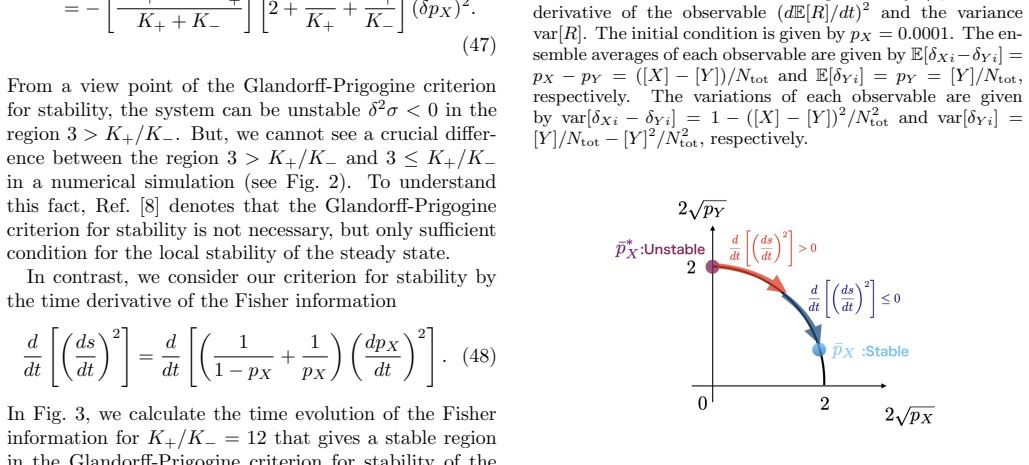
Direct numerical integration of a nonlinear master equation with a known unstable steady state, such as the autocatalytic reaction near $K_+/K_-$ values where the classical criterion is ambiguous, should show $d[(ds/dt)^2]/dt>0$ while the system is near the unstable state and $\le 0$ as it settles into the stable one; a violation of this sign pattern would falsify the generalised criterion.
Extended reading notes
Core claim
The central discovery is that the excess entropy production of a linear master equation is minus the time derivative of half the Fisher line element: $\delta^2\sigma = -\frac{1}{2}\frac{d}{dt}\sum_i (\delta p_i)^2/\bar p_i = -\frac{d}{dt}\delta^2 L$. Therefore the Glansdorff-Prigogine condition $\delta^2\sigma\ge 0$ is equivalent to the Lyapunov condition $d\delta^2 L/dt\le 0$, with the Lyapunov function itself an information-geometric quantity. Around a steady state the paper identifies this with monotone decrease of the Fisher information $(ds/dt)^2$. For nonlinear master equations, where the classical argument breaks down, the paper proposes the generalised criterion $d[(ds/dt)^2]/dt\le 0$ for stability and $>0$ for instability, interprets it through the Cramér-Rao bound on fluctuation-response ratios, and demonstrates it on an autocatalytic reaction for which the classical criterion is inconclusive.
Load-bearing premise
The argument assumes that the time derivative of the Fisher-information speed is a general stability indicator: that $d[(ds/dt)^2]/dt\le 0$ marks approach to a stable steady state and $>0$ marks departure from it, in nonlinear as well as linear master equations.
Editorial extensions
If this is right
- For linear master equations, the Glansdorff-Prigogine criterion is a theorem about monotone decay of a Fisher-metric distance, not just a heuristic stability test.
- Near equilibrium, the Onsager coefficients can be expressed through the Fisher metric in flux coordinates, so transport coefficients acquire an information-geometric reading.
- The generalised criterion $d[(ds/dt)^2]/dt\le 0$ extends stability analysis to nonlinear master equations, where the classical excess-entropy condition is not reliable.
- The Cramér-Rao inequality gives a fluctuation-response ratio whose time dependence signals stabilisation or destabilisation, connecting thermodynamic uncertainty relations to stability.
- In the autocatalytic reaction, the criterion assigns instability to the zero-concentration steady state and stability to the nonzero steady state, resolving the ambiguous classical prediction.
Reading between the lines
- Editorial inference: the Fisher-information speed is defined for any differentiable probability path, so the same sign test could be applied to non-Markovian or explicitly time-dependent processes, a regime the paper does not treat.
- Editorial inference: the identity between excess entropy production and the Fisher-metric derivative suggests that, in the linear regime, the Onsager matrix and the Fisher metric may be the same geometric object; if so, transport coefficients could be estimated directly from trajectory-level probability fluctuations.
- Editorial inference: the criterion may certify stability of individual steady states rather than global contraction of the whole probability simplex, so a natural extension is to check whether $d[(ds/dt)^2]/dt\le 0$ holds on entire basins of attraction.
- Editorial inference: the paper's framing suggests reading thermodynamic uncertainty relations as stability certificates, where growth of the fluctuation-to-response ratio marks approach to a steady state; this goes beyond the paper's own narrower connection.
Editorial analysis
A structured set of objections, weighed in public.
Referee Report
Summary. The paper claims three main results: (i) for linear master equations, the excess entropy production is exactly the negative time derivative of the Fisher-information line element, giving a Lyapunov interpretation of the Glansdorff-Prigogine criterion; (ii) a generalized stability criterion based on the monotonicity of the Fisher information speed, d/dt[(ds/dt)^2] ≤ 0, which is claimed to work for nonlinear master equations where the classical criterion allegedly fails; and (iii) trade-off relations, including a Cramér-Rao-type bound and an Onsager-coefficient interpretation of the Fisher metric. The advertised nonlinear illustration is an autocatalytic reaction X+Y ⇋ 2X, for which the paper claims the Glansdorff-Prigogine criterion predicts instability for K_+/K_- < 3 while numerical simulations show no such transition.
Significance. The linear-master-equation identity in Eqs. (15)-(17), relating the excess entropy production to -d/dt of the weighted squared deviation, is a clean and potentially useful result, and the connection drawn between the Fisher metric and the Onsager coefficient in the near-equilibrium regime is suggestive. If the generalized criterion were rigorously established, it would provide an information-geometric Lyapunov condition for a broader class of stochastic dynamics. However, the central nonlinear claim is not proven and the sole nonlinear example contains an algebraic error that generates the claimed instability region. As a result, the paper's main advertised contribution, the generalization of the Glansdorff-Prigogine criterion to nonlinear master equations, is unsupported.
major comments (3)
- [A generalization of the Glansdorff-Prigogine criterion for stability, Eq. (28)] The proposed criterion d/dt[(ds/dt)^2] ≤ 0 for stability and d/dt[(ds/dt)^2] > 0 for instability is asserted rather than derived. A valid Lyapunov condition requires not only that the candidate function is nonnegative and vanishes at the steady state, but that it decreases along trajectories and that its decrease implies convergence. The Fisher information speed (ds/dt)^2 is a nonnegative quantity that vanishes at the steady state, but no theorem is given showing that its time derivative controls approach to the steady state for nonlinear master equations. The paper's own monotonicity result, Eq. (25), is quoted for time-independent transition rates, which does not cover the nonlinear case in which the transition rates depend on the probabilities themselves. This is the load-bearing step for the claimed generalization.
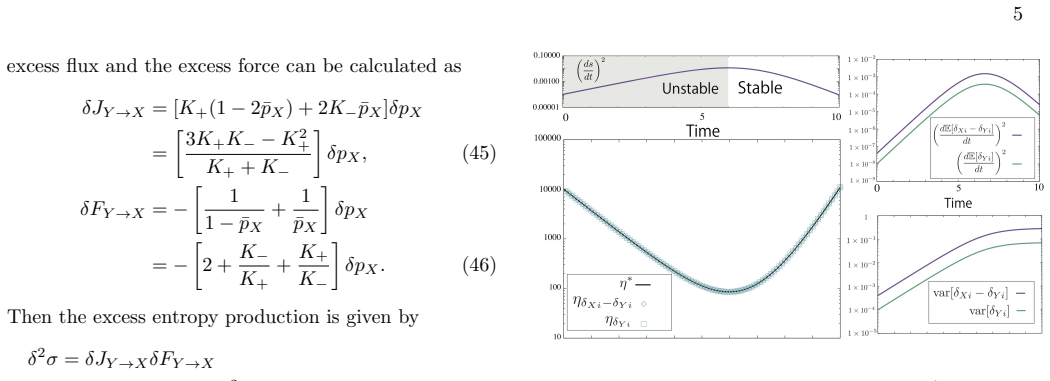
- [Example: Autocatalytic reaction, Eq. (45)] The calculation of the excess flux contains a sign error. From Eqs. (42)-(43), J_{Y→X} = K_+ p_X(1-p_X) - K_- p_X^2, and linearizing about p̄_X = K_+/(K_+ + K_-) gives δJ_{Y→X} = [K_+(1-2p̄_X) - 2K_- p̄_X] δp_X = -K_+ δp_X. The published expression [K_+(1-2p̄_X) + 2K_- p̄_X] is the derivative of K_+ p(1-p) + K_- p^2, with the wrong sign for the reverse reaction term. Since δF_{Y→X} is negative, the corrected δ²σ is K_+ [1/(1-p̄_X) + 1/p̄_X] (δp_X)^2 > 0 for all K_± > 0. Thus the predicted instability region K_+/K_- < 3 is an artifact of the sign error, and the claim that the Glansdorff-Prigogine criterion fails for this model is unsupported. This removes the only nonlinear demonstration of the generalized criterion.
- [The linear master equation and the Lyapunov stability, Eqs. (15)-(17)] The linear derivation is internally consistent, but the claimed equivalence between the generalized criterion and the Glansdorff-Prigogine criterion around steady states is not established for the nonlinear case. The text states that Eq. (25) 'can be regarded as' the Lyapunov stability condition and that for the linear master equation the generalized criterion is equivalent to the Glansdorff-Prigogine criterion; however, the monotonicity of (ds/dt)^2 for linear master equations is a known result, while the same monotonicity does not follow for the nonlinear master equation. Without a proof that d/dt[(ds/dt)^2] is a Lyapunov function for the nonlinear dynamics, Eq. (28) remains a plausible but unproven ansatz.
minor comments (4)
- [The Lyapunov function and information geometry, Eq. (24)] The identification δ²L = (1/2)ds² relies on treating δp_i as an infinitesimal dp_i; the notation 'around the steady state p ≃ p̄ and δp_i = dp' is ambiguous and should be stated as a first-order identification with a controlled remainder.
- [Throughout] There are several typographical issues, including 'Glandorff' for 'Glansdorff', 'Form the expression' for 'From the expression', and 'relasionship' in the Supplementary Information.
- [A generalization of the Glansdorff-Prigogine criterion for stability, Eq. (27)] In Eq. (27), η_R = var[R] / (dE[R]/dt)^2 is bounded below by η* = 1/(ds/dt)^2; the notation η_R ≥ η* is dimensionally and logically consistent only if the observables are dimensionless, which is not stated.
- [Example: Autocatalytic reaction, Fig. 3] The numerical simulations displayed in Fig. 3 are described qualitatively but no parameters, integration method, or error estimates are given; this makes it difficult to verify the claimed absence of a transition at K_+/K_- = 3.
Circularity Check
No circular reduction; the excess-entropy/Fisher-information identity is derived self-containedly, and the key self-citations are to parameter-free theorems rather than fitted inputs. The nonlinear instability claim fails on an algebraic sign error and a sufficiency caveat, which are correctness risks, not circularity.
full rationale
The central identity for the linear master equation is obtained by direct algebra: with δF_{j→i} = δp_j/p̄_j − δp_i/p̄_i + O(δp²), Eqs. (13)–(15) give δ²σ = −Σ δJ_{j→i} δp_i/p̄_i = −(1/2) d/dt Σ (δp_i)²/p̄_i. This derivation does not assume the conclusion and involves no fitted parameter. The identification δ²L = (1/2)ds² (Eq. 24) is the standard definition of the Fisher line element, not a circular redeclaration of a target result. The proposed information-geometric criterion (Eqs. 28–29) is a reformulation of the Cramér-Rao bound and of Fisher-information monotonicity; the paper cites its own prior work [48,49] for the latter, but that theorem is parameter-free with stated Markov-process assumptions and is not calibrated to the present example. Thus the self-citation is at most a minor, non-load-bearing support for the linear statement, where Eq. (17) already provides the Lyapunov bound, and an interpretive source for the generalized criterion. The nonlinear autocatalytic demonstration contains a sign error in the linearized excess flux (Eq. 45): expanding J_{Y→X} = K_+ p_X(1−p_X) − K_− p_X² about p̄_X gives δJ_{Y→X} = −K_+ δp_X, not [K_+(1−2p̄_X) + 2K_− p̄_X]δp_X. With the correct sign, δ²σ is positive for all K_±, so the claimed Glansdorff-Prigogine instability region is an artifact. The paper itself also notes that the Glansdorff-Prigogine criterion is only sufficient, not necessary (Ref. [8]), which further undermines the inference from δ²σ < 0 to instability. These are algebraic and logical correctness defects, not circular reductions. No fitted parameter is relabeled as a prediction, no uniqueness theorem is imported from the authors, and no ansatz is smuggled in via citation.
Assumptions & free parameters
assumptions (5)
- domain assumption Master equation dynamics with a stationary distribution (Eq. 1-2).
- standard math Monotonic decrease of the Fisher information (Eq. 25) for time-independent transition rates.
- domain assumption Near-equilibrium linear relation between excess force and excess flux, δF = α δJ with α = 1/(W p̄) (Eqs. 30-32).
- domain assumption Existence of a flux and force mode decomposition (Eqs. 33-34).
- ad hoc to paper The identification of dη*/dt ≥ 0 with stability (Eq. 28).
Cite this review
Pith. "Pith review of Information geometry, trade-off relations, and generalized Glansdorff-Prigogine criterion for stability." pith.science (2026). https://pith.science/paper/BXCLZEIT
@misc{pith2026190809446,
  author       = {Pith},
  title        = {Pith review of: Information geometry, trade-off relations, and generalized Glansdorff-Prigogine criterion for stability},
  year         = {2026},
  howpublished = {\url{https://pith.science/paper/BXCLZEIT}},
  note         = {Machine review of arXiv:1908.09446}
}
read the original abstract
We discuss a relationship between information geometry and the Glansdorff-Prigogine criterion for stability. For the linear master equation, we found a relation between the line element and the excess entropy production rate. This relation leads to a new perspective of stability in a nonequilibrium steady-state. We also generalize the Glansdorff-Prigogine criterion for stability based on information geometry. Our information-geometric criterion for stability works well for the nonlinear master equation, where the Glansdorff-Prigogine criterion for stability does not work well. We derive a trade-off relation among the fluctuation of the observable, the mean change of the observable, and the intrinsic speed. We also derive a novel thermodynamic trade-off relation between the excess entropy production rate and the intrinsic speed. These trade-off relations provide a physical interpretation of our information-geometric criterion for stability. We illustrate our information-geometric criterion for stability by an autocatalytic reaction model, where dynamics are driven by a nonlinear master equation.
Figures


Figures from the paper (2 more)

Reference graph
Works this paper leans on
-
[8]
The Glansdorff-Prigogine thermodynamic stability criterion in the light of Lyapunovs theory
de Sobrino, L. The Glansdorff-Prigogine thermodynamic stability criterion in the light of Lyapunovs theory. J. Theor. Biol. 54, 323 (1975)
work page 1975
-
[1]
The equation (15) denotes that its time derivative is equal to the excess entropy production, d dtδ2L =−δ2σ. (17) Then, the Glansdorff-Prigogine criterion for stability in the relaxation process can be considered as the Lyapunov stability criterion [7] d dtδ2L≤ 0 (stable) , (18) d dtδ2L> 0 (unstable) . (19) The particular casedδ2L/dt = 0 is called as the n...
-
[2]
Glansdorff, P. & Prigogine, I. On a general evolution crite- rion in macroscopic physics. Physica, 30, 351-374 (1964)
work page 1964
-
[3]
Non-equilibrium stability theory
Glansdorff, P., & Prigogine, I. Non-equilibrium stability theory. Physica, 46, 344-366 (1970)
work page 1970
-
[4]
Thermodynamic theory of structure, stability and fluctuations
Glansdorff, P., & Prigogine, I. Thermodynamic theory of structure, stability and fluctuations. (Wiley, 1971)
work page 1971
-
[5]
Remarks on Glansdorff and Prigogine’s Theory of Stability
Tomita, H. Remarks on Glansdorff and Prigogine’s Theory of Stability. Prog. Theor. Phys., 47, 1052 (1972)
work page 1972
-
[6]
Keizer, J., & Fox, R. F. Qualms regarding the range of validity of the Glansdorff-Prigogine criterion for stability of non-equilibrium states. Proc. Natl. Acad. Sci., 71, 192- 196 (1974)
work page 1974
-
[7]
The thermo- dynamic stability theory of non-equilibrium states
Glansdorff, P., Nicolis, G., & Prigogine, I. The thermo- dynamic stability theory of non-equilibrium states. Proc. Natl. Acad. Sci. 71, 197-199 (1974)
work page 1974
Show all 73 references
-
[9]
What can be stated by the Glansdorff-Prigogine criterion concerning the stability of mass-action kinetic systems?
Wilhelm, T., & H¨ anggi, P. What can be stated by the Glansdorff-Prigogine criterion concerning the stability of mass-action kinetic systems?. J. Chem. Phys. 110, 6128- 6134 (1999)
1999
-
[10]
Schl¨ ogl, F.On stability of steady states. Z. Phys. 243, 303- 310 (1971)
1971
-
[12]
Hatano, T., & Sasa, S. I. Steady-state thermodynamics of Langevin systems. Phys. Rev. Lett., 86, 3463 (2001)
2001
-
[13]
S., Nakagawa, N
Komatsu, T. S., Nakagawa, N. An expression for sta- tionary distribution in nonequilibrium steady states. Phys. Rev. Lett., 100, 030601 (2008)
2008
-
[14]
S., Nakagawa, N., Sasa, S
Komatsu, T. S., Nakagawa, N., Sasa, S. I., & Tasaki, H. Steady-state thermodynamics for heat conduction: micro- scopic derivation. Phys. Rev. Lett., 100, 230602 (2008)
2008
-
[15]
Stochastic thermodynamics, fluctuation the- orems and molecular machines
Seifert, U. Stochastic thermodynamics, fluctuation the- orems and molecular machines . Reports on Progress in Physics, 75(12), 126001 (2012)
2012
-
[16]
Revisiting the Glansdorff- Prigogine Criterion for Stability Within Irreversible Ther- modynamics
Maes, C., & Netoˇ cn´ y, K. Revisiting the Glansdorff- Prigogine Criterion for Stability Within Irreversible Ther- modynamics. J. Stat. Phys. 159, 1286-1299 (2015)
2015
-
[17]
M., Horowitz, J
Parrondo, J. M., Horowitz, J. M., & Sagawa, T. Thermo- dynamics of information. Nat. Phys., 11, 131-139 (2015)
2015
-
[18]
Kawai, R., J. M. R. Parrondo, & Christian Van den Broeck. Dissipation: The phase-space perspective. Phys. Rev. Lett., 98, 080602 (2007)
2007
-
[19]
E., Janzing, D., & Mahler, G
Allahverdyan, A. E., Janzing, D., & Mahler, G. Thermo- dynamic efficiency of information and heat flow. J. Stat. Mech., (2009) P09011
2009
-
[20]
Generalized Jarzynski equality under nonequilibrium feedback control
Sagawa, T., & Ueda, M. Generalized Jarzynski equality under nonequilibrium feedback control . Phys. Rev. Lett., 104(9), 090602 (2010)
2010
-
[21]
A., Bell, A
Still, S., Sivak, D. A., Bell, A. J., & Crooks, G. E. Thermodynamics of prediction. Phys. Rev. Lett., 109(12), 120604 (2012)
2012
-
[22]
Fluctuation theorem with infor- mation exchange: role of correlations in stochastic ther- modynamics
Sagawa, T., & Ueda, M. Fluctuation theorem with infor- mation exchange: role of correlations in stochastic ther- modynamics. Phys. Rev. Lett., 109(18), 180602 (2012)
2012
-
[23]
Information thermodynamics on causal networks
Ito, S., & Sagawa, T. Information thermodynamics on causal networks. Phys. Rev. Lett.,111(18), 180603 (2013)
2013
-
[24]
C., & Seifert, U
Hartich, D., Barato, A. C., & Seifert, U. Stochastic ther- modynamics of bipartite systems: transfer entropy inequal- ities and a Maxwells demon interpretation . J. Stat. Mech. (2014). P02016
2014
-
[26]
Maxwell’s demon in biochemical signal transduction with feedback loop
Ito, S., & Sagawa, T. Maxwell’s demon in biochemical signal transduction with feedback loop. Nat. Commun., 6, 7498 (2015)
2015
-
[27]
C., & Seifert, U
Hartich, D., Barato, A. C., & Seifert, U. Sensory ca- pacity: An information theoretical measure of the perfor- mance of a sensor. Phys. Rev. E, 93, 022116 (2016)
2016
-
[28]
E., Lizier, J
Spinney, R. E., Lizier, J. T., & Prokopenko, M. Transfer entropy in physical systems and the arrow of time . Phys. Rev. E, 94(2), 022135 (2016)
2016
-
[29]
Backward transfer entropy: Informational measure for detecting hidden Markov models and its interpretations in thermodynamics, gambling and causality
Ito, S. Backward transfer entropy: Informational measure for detecting hidden Markov models and its interpretations in thermodynamics, gambling and causality . Sci. Rep., 6, 36831 (2016)
2016
-
[30]
E., & Still, S
Crooks, G. E., & Still, S. Marginal and conditional sec- ond laws of thermodynamics. Europhys. Lett., 125, 40005 (2019)
2019
-
[31]
Lin- ear irreversible thermodynamics and Onsager reciprocity for information-driven engines
Yamamoto, S., Ito, S., Shiraishi, N., & Sagawa, T. Lin- ear irreversible thermodynamics and Onsager reciprocity for information-driven engines. Phys. Rev. E, 94, 052121 (2016)
2016
-
[32]
E., Govern, C
Ouldridge, T. E., Govern, C. C., & ten Wolde, P. R. Thermodynamics of computational copying in biochemical systems. Phys. Rev. X, 7, 021004 (2017)
2017
-
[33]
Information Ther- modynamics for Time Series of Signal-Response Models
Auconi, A., Giansanti, A., & Klipp, E. Information Ther- modynamics for Time Series of Signal-Response Models. Entropy, 21, 177 (2019)
2019
-
[34]
Unified framework for the second law of thermody- namics and information thermodynamics based on infor- mation geometry
Ito, S. Unified framework for the second law of thermody- namics and information thermodynamics based on infor- mation geometry. arXiv:1810.09545 (2018)
2018 arXiv
-
[35]
Rao, C. R. Information and the accuracy attainable in the estimation of statistical parameters. In Breakthroughs in statistics. (pp. 235-247) (Springer New York, 1992)
1992
-
[36]
I., & Nagaoka, H
Amari, S. I., & Nagaoka, H. Methods of information ge- ometry. (American Mathematical Soc., 2007)
2007
-
[37]
E., & Vos, P
Kass, R. E., & Vos, P. W. Geometrical foundations of asymptotic inference (Vol. 908) (John Wiley & Sons. 2011)
2011
-
[39]
Ay, N., Jost, J., Vˆ an Lˆ e, H., & Schwachh¨ ofer, L.Infor- mation geometry (Vol. 64). (Berlin: Springer 2017)
2017
-
[40]
Metric geometry of equilibrium thermody- namics
Weinhold, F. Metric geometry of equilibrium thermody- namics. J. Chem. Phys., 63, 2479 (1975)
1975
-
[41]
Thermodynamics: A Riemannian geomet- ric model
Ruppeiner, G. Thermodynamics: A Riemannian geomet- ric model. Phys. Rev. A, 20, 1608 (1979). 7
1979
-
[42]
Salamon, P., & Berry, R. S. Thermodynamic length and dissipated availability. Phys. Rev. Lett., 51, 1127 (1983)
1983
-
[43]
Crooks, G. E. Measuring thermodynamic length. Phys. Rev. Lett., 99, 100602 (2007)
2007
-
[44]
Nonconvexity of the rela- tive entropy for Markov dynamics: A Fisher information approach
Polettini, M., & Esposito, M. Nonconvexity of the rela- tive entropy for Markov dynamics: A Fisher information approach. Phys. Rev. E, 88, 012112 (2013)
2013
-
[45]
A., & Crooks, G
Sivak, D. A., & Crooks, G. E. Thermodynamic metrics and optimal paths. Phys. Rev. Lett., 108, 190602 (2012)
2012
-
[46]
M., & Crooks, G
Rotskoff, G. M., & Crooks, G. E. Optimal control in nonequilibrium systems: Dynamic Riemannian geometry of the Ising model. Phys. Rev. E, 92, 060102 (2015)
2015
-
[47]
A univer- sal tradeoff between power, precision and speed in physical communication
Lahiri, S., Sohl-Dickstein, J., & Ganguli, S. A univer- sal tradeoff between power, precision and speed in physical communication. arXiv preprint arXiv:1603.07758 (2016)
2016 arXiv
-
[48]
M., Crooks, G
Rotskoff, G. M., Crooks, G. E., & Vanden-Eijnden, E. Geometric approach to optimal nonequilibrium con- trol: Minimizing dissipation in nanomagnetic spin sys- tems. Phys. Rev. E, 95, 012148 (2017)
2017
-
[49]
Stochastic thermodynamic interpretation of infor- mation geometry
Ito, S. Stochastic thermodynamic interpretation of infor- mation geometry. Phys. Rev. Lett., 121, 030605 (2018)
2018
-
[50]
Ito, S., & Dechant, A Stochastic time-evolution, informa- tion geometry and the Cram´ er-Rao Bound.arXiv preprint arXiv:1810.06832 (2018)
2018 arXiv
-
[51]
Multidimensional thermodynamic uncer- tainty relations
Dechant, A. Multidimensional thermodynamic uncer- tainty relations. J. Phys. A: Mathematical and Theoreti- cal, 52, 035001 (2018)
2018
-
[52]
C., & Seifert, U
Barato, A. C., & Seifert, U. Thermodynamic uncertainty relation for biomolecular processes. Phys. Rev. Lett., 114, 158101 (2015)
2015
-
[53]
C., & Seifert, U
Pietzonka, P., Barato, A. C., & Seifert, U. Universal bounds on current fluctuations. Phys. Rev. E, 93, 052145 (2016)
2016
-
[54]
C., & Seifert, U
Pietzonka, P., Barato, A. C., & Seifert, U. Universal bound on the efficiency of molecular motors. J. Stat. Mech. (2016). P124004
2016
-
[55]
Tighten- ing the uncertainty principle for stochastic currents
Polettini, M., Lazarescu, A., & Esposito, M. Tighten- ing the uncertainty principle for stochastic currents. Phys. Rev. E, 94, 052104 (2016)
2016
-
[56]
R., Horowitz, J
Gingrich, T. R., Horowitz, J. M., Perunov, N., & Eng- land, J. L. Dissipation bounds all steady-state current fluc- tuations. Phys. Rev. Lett., 116, 120601 (2016)
2016
-
[57]
Universal trade- off relation between power and efficiency for heat engines
Shiraishi, N., Saito, K., & Tasaki, H. Universal trade- off relation between power and efficiency for heat engines. Phys. Rev. Lett., 117, 190601 (2016)
2016
-
[58]
Garrahan, J. P. Simple bounds on fluctuations and un- certainty relations for first-passage times of counting ob- servables. Phys. Rev. E, 95, 032134 (2017)
2017
-
[59]
Discrete-time ther- modynamic uncertainty relation
Proesmans, K., & Van den Broeck, C. Discrete-time ther- modynamic uncertainty relation. Europhys. Lett., 119, 20001 (2017)
2017
-
[60]
Frenetic bounds on the entropy production
Maes, C. Frenetic bounds on the entropy production. Phys. Rev. Lett., 119, 160601 (2017)
2017
-
[61]
Process interpretation of current entropic bounds
Nardini, C., & Touchette, H. Process interpretation of current entropic bounds. Euro. Phys. J. B, 91, 16 (2018)
2018
-
[62]
Dechant, A., & Sasa, S. I. Current fluctuations and trans- port efficiency for general Langevin systems.J. Stat. Mech. (2018). P063209
2018
-
[63]
Dechant, A., & Sasa, S. I. Entropic bounds on currents in Langevin systems. Phys. Rev. E, 97, 062101 (2018)
2018
-
[64]
Speed limit for clas- sical stochastic processes
Shiraishi, N., Funo, K., & Saito, K. Speed limit for clas- sical stochastic processes. Phys. Rev. Lett., 121, 070601 (2018)
2018
-
[65]
Proesmans, K., & Horowitz, J. M. Hysteretic thermody- namic uncertainty relation for systems with broken time- reversal symmetry. J. Stat. Mech. (2019) P054005
2019
-
[66]
M., Gingrich T
Li J., Horowitz J. M., Gingrich T. R. and Fakhri N. Quantifying dissipation using fluctuating currents. Nature communications, 10, 1666 (2019)
2019
-
[67]
M., Guarnieri, G., Goold, J
Timpanaro, A. M., Guarnieri, G., Goold, J. & Landi, G. T. Thermodynamic uncertainty relations from exchange fluctuation theorems, arXiv:1904.07574 (2019)
2019 arXiv
-
[68]
Falasco, G., Esposito, M., & Delvenne, J. C. Unify- ing Thermodynamic Uncertainty Relations. arXiv preprint arXiv:1906.11360 (2019)
2019 arXiv
-
[69]
Uncertainty relations in stochastic processes: An information inequality approach
Hasegawa, Y., & Van Vu, T. Uncertainty relations in stochastic processes: An information inequality approach. Phys. Rev. E, 99, 062126 (2019)
2019
-
[70]
P., Cianciaruso, M., C´ eleri, L
Pires, D. P., Cianciaruso, M., C´ eleri, L. C., Adesso, G., & Soares-Pinto, D. O. Generalized geometric quantum speed limits. Phys. Rev. X, 6, 021031 (2016)
2016
-
[71]
& Ohzeki M., Quantum speed limit is not quantum, Phys
Okuyama M. & Ohzeki M., Quantum speed limit is not quantum, Phys. Rev. Lett. 120, 070402 (2018). SUPPLEMENT AR Y INFORMA TION I. Partial entropy production and information geometrical coordinate If we consider the bipartite Markov network, we can discuss the information flux an...
2018
-
[72]
M., & Esposito, M
Horowitz, J. M., & Esposito, M.. Thermodynamics with continuous information flow . Phys. Rev. X, 4(3), 031015 (2014)
2014
-
[73]
Linear irreversible thermodynamics and Onsager reciprocity for information-driven engines
Yamamoto, S., Ito, S., Shiraishi, N., & Sagawa, T. Linear irreversible thermodynamics and Onsager reciprocity for information-driven engines. Phys. Rev. E, 94, 052121 (2016)
2016
-
[74]
Network theory of microscopic and macroscopic behavior of master equation systems
Schnakenberg, J. Network theory of microscopic and macroscopic behavior of master equation systems. Rev. Mod. Phys. 48, 571 (1976)
1976
-
[75]
Amari, S. I. Information geometry on hierarchy of probability distributions. IEEE transactions on information theory, 47, 1701-1711 (2001)
2001
-
[76]
Amari, S. I. Information geometry and its applications. (Springer Japan, 2016)
2016
Reviewed August 14, 2026 · model on record in the stance chip above.
Discussion (0). Continue with ORCID to comment.