REVIEW 3 major objections 4 minor 51 references
Object-Driven Multi-Layer Scene Decomposition From a Single Image
T0 review · 3 major / 4 minor · reviewed 2026-08-14 · deepseek-v4-flash
Pith's one-line read A single RGB image can be decomposed into layered color and depth that complete occluded objects, and the paper shows this beats prior LDI and view-synthesis baselines on indoor scenes.
desk verdict A useful, well-ablated extension of single-image LDI prediction, but the re-composition loss in Eq. (8) is printed wrong and must be fixed before the paper is reproducible. read the letter →
The pith
A machine-rendered reading of the paper's core claim, the machinery that carries it, and where it could break.
The reading
What carries the argument
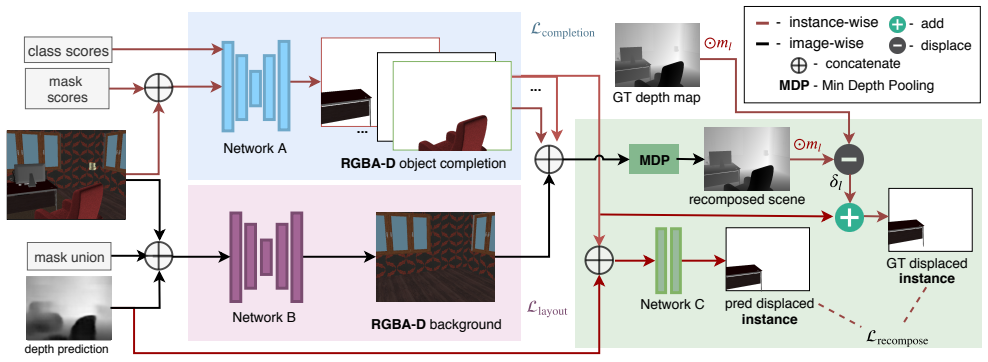
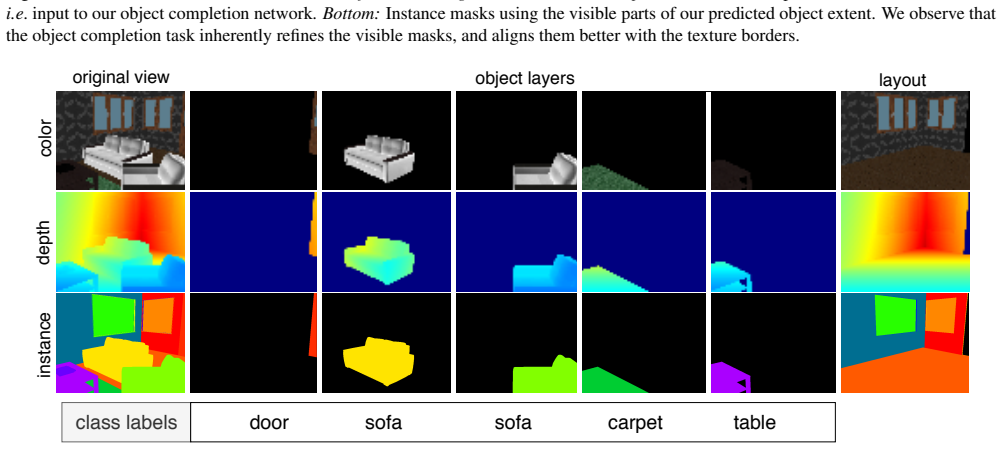
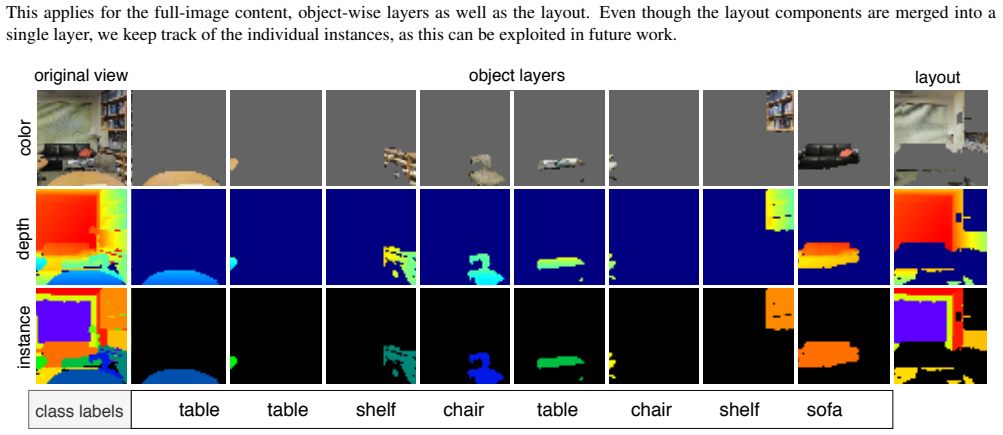
The load-bearing mechanism is a three-network pipeline: an object completion encoder-decoder that takes the RGB image, predicted mask, and class scores and outputs a completed RGBA-D representation of each object; a U-Net layout generator that predicts a background scene layout with adversarial, perceptual, and reconstruction losses; and a minimum depth pooling (MDP) re-composition block that concatenates predicted layers, selects per-pixel the layer with smallest depth, and learns depth displacements to align visible regions with the input depth. The MDP re-composition loss is what ties the independently predicted object and layout layers into a coherent depth-ordered scene.
What would settle it
Run the full pipeline on a real indoor dataset with complete, hole-free meshes and compare second-layer depth and color errors against the paper's reported numbers; if the gains over prior baselines shrink substantially, the reported advantage is partly an artifact of incomplete rendering targets. A simpler check is to replace Mask R-CNN predictions with ground-truth instance masks at test time and measure whether the second-layer accuracy changes.
Extended reading notes
Core claim
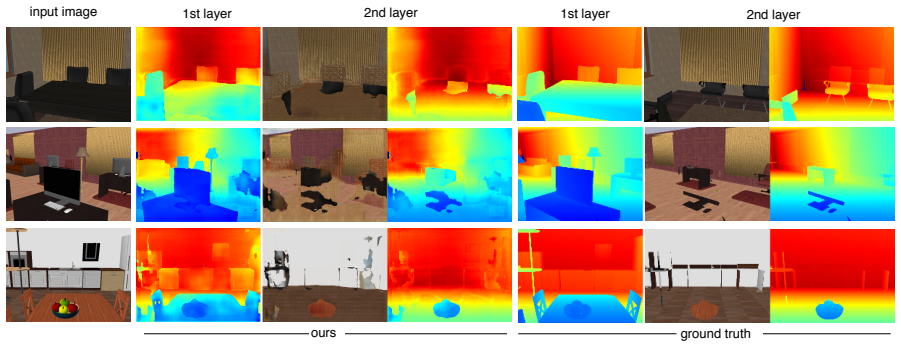
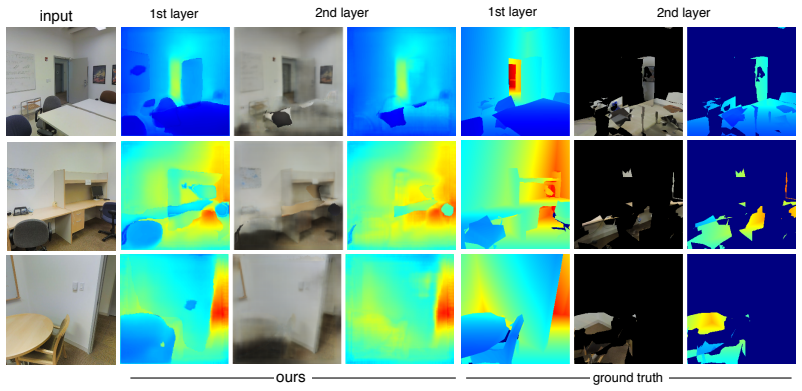
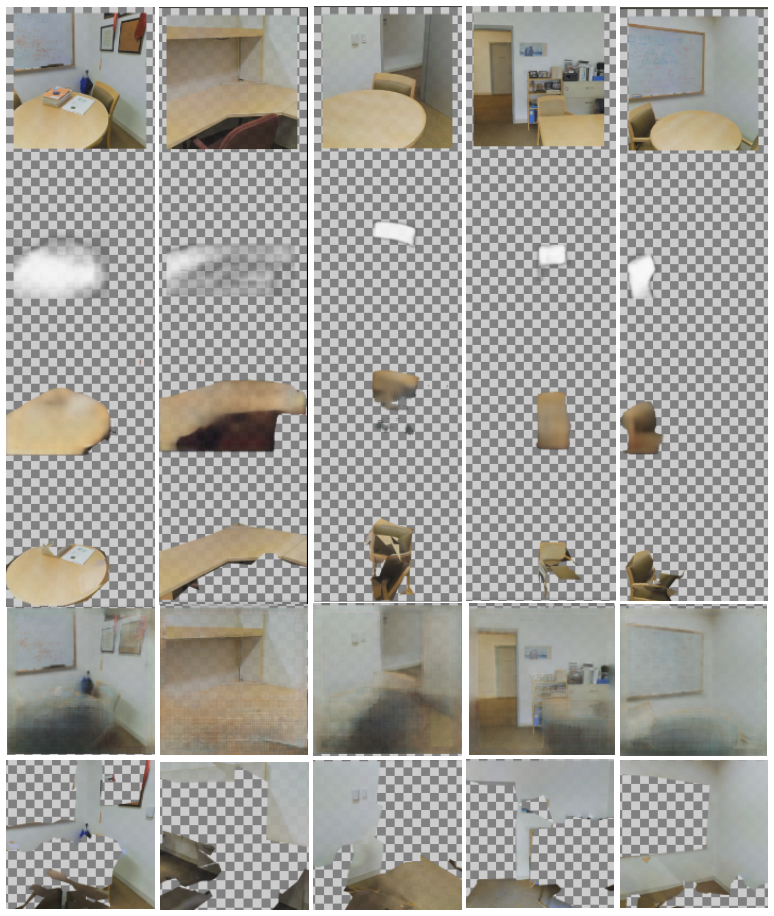
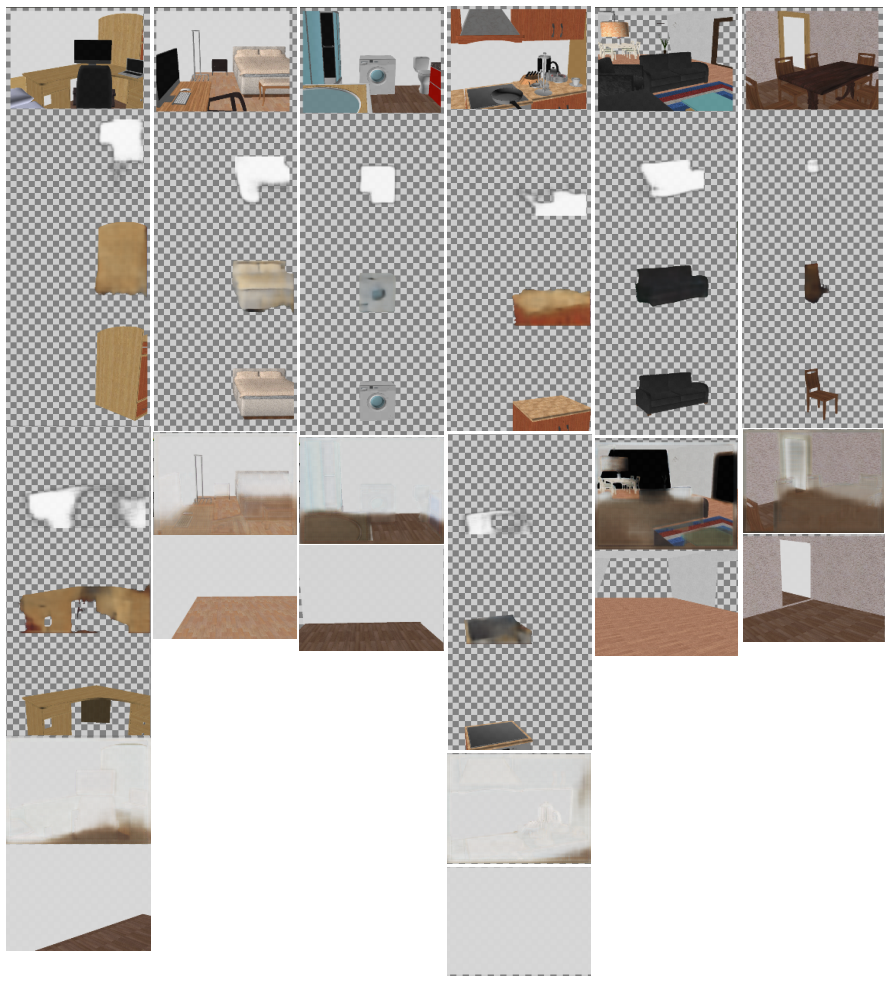
The paper claims that an object-driven decomposition with adaptive layer count outperforms prior methods for LDI prediction from a single image, and that the resulting layered representation yields better view synthesis. The method detects objects with Mask R-CNN, completes each object's color, transparency, and depth into an RGBA-D map, predicts an object-free scene layout, and then recomposes all layers using a minimum depth pooling step that enforces global depth consistency. On SunCG, the reported second-layer depth error is lower than both prior baselines, and view synthesis SSIM is higher; results on Stanford 2D-3D confirm the second-layer gains in a real-world setting.
Load-bearing premise
The method's training targets are generated by rendering scene meshes, and the authors note that real datasets like Stanford 2D-3D contain holes and missing surfaces, so the ground-truth occluded layers may themselves be incomplete or biased.
Editorial extensions
If this is right
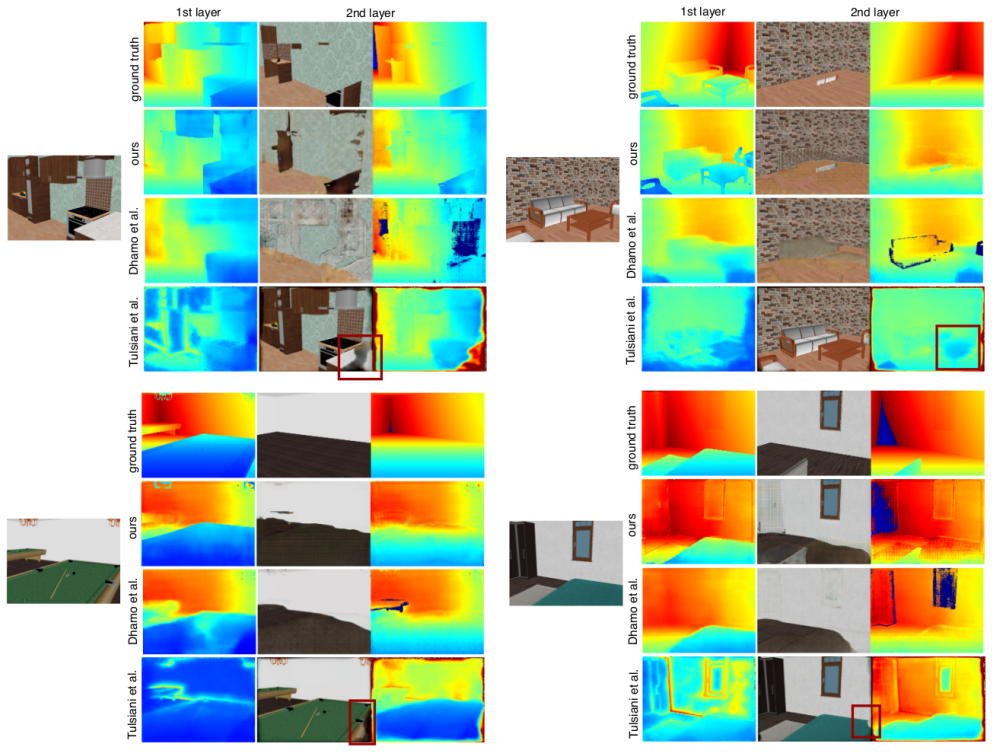
- A single RGB image can produce more than two depth layers, so occluded intermediate objects appear in the layered output rather than being merged into background.
- Adding semantic class scores to object completion improves occluded-region depth and color accuracy compared to class-agnostic completion.
- Enforcing recomposed-image consistency through minimum depth pooling improves depth accuracy not only for visible object regions but also for occluded parts.
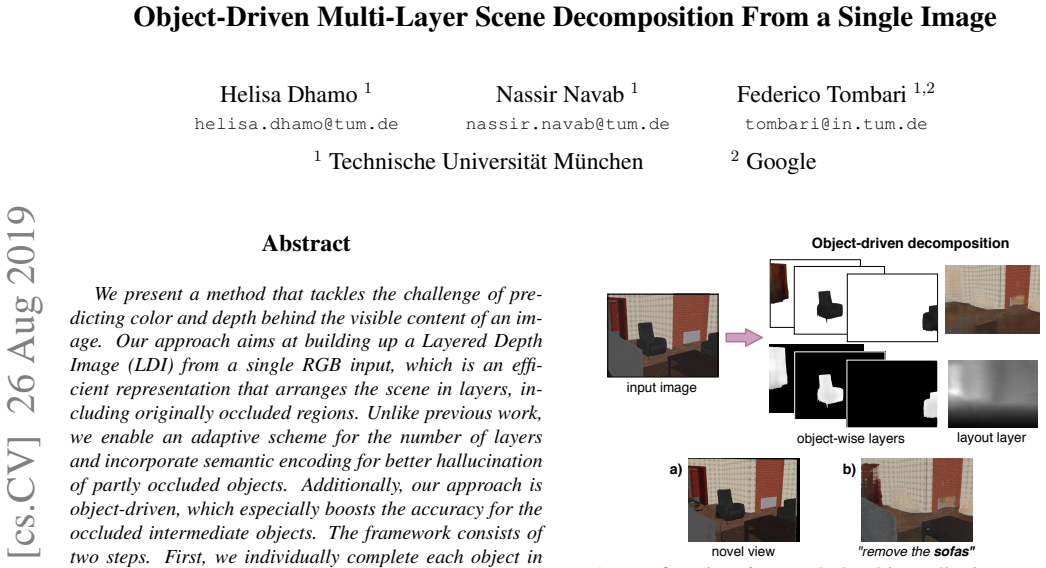
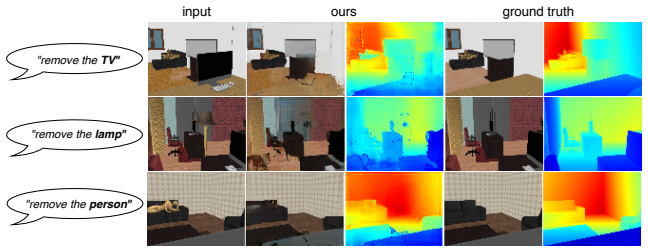
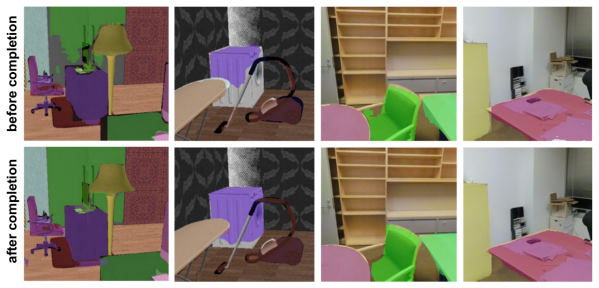
- The object-wise representation directly supports object removal and diminished reality, since a requested category can be dropped from the layers and the remaining layers re-render the scene.
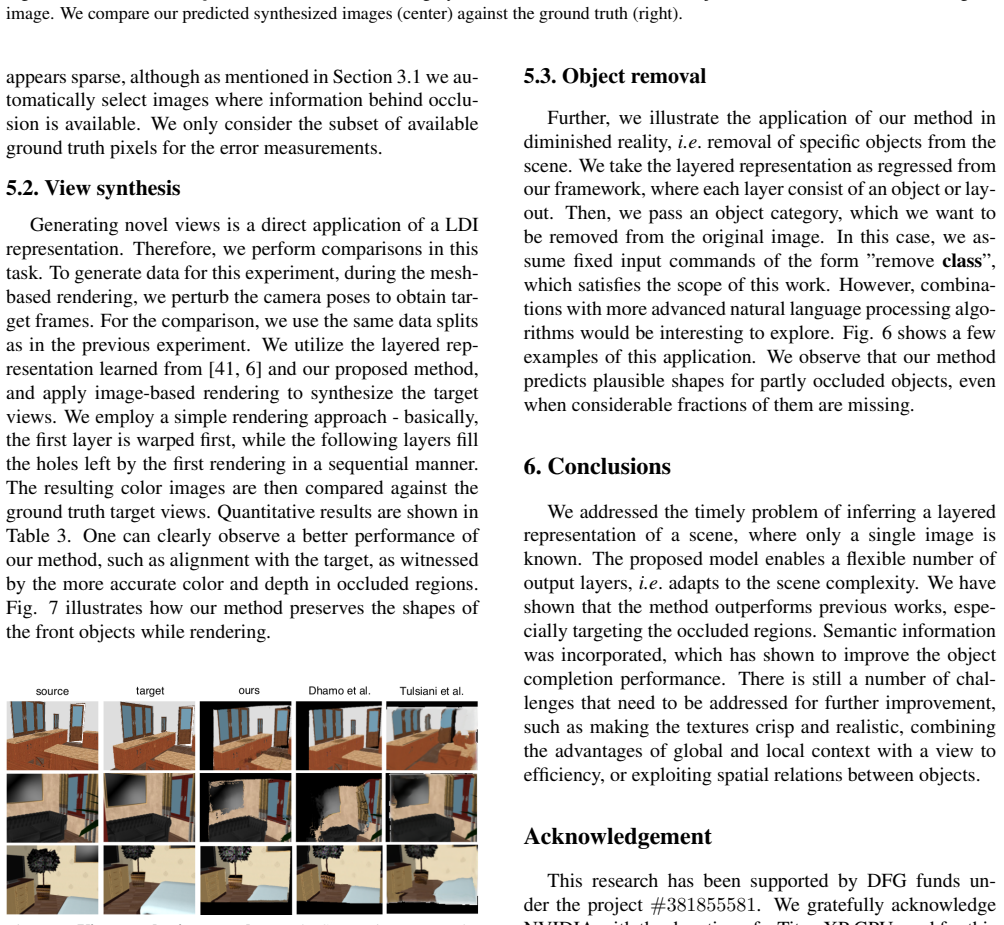
- Better LDI prediction translates to higher view-synthesis quality under simple image-based rendering, measured by SSIM, MPE, and RMSE.
Reading between the lines
- If the reported gains hold, the same object-driven decomposition could be applied to outdoor scenes by swapping the object detector and layout prior, since the method itself is not indoor-specific.
- The reliance on Mask R-CNN suggests a testable extension: replacing predicted masks with ground-truth masks should isolate how much of the second-layer accuracy depends on detector quality versus the completion networks.
- A future dataset with hole-free real-scene meshes could resolve whether the Stanford 2D-3D results understate the method's true capability or are partly inflated by the renderer's missing surfaces.
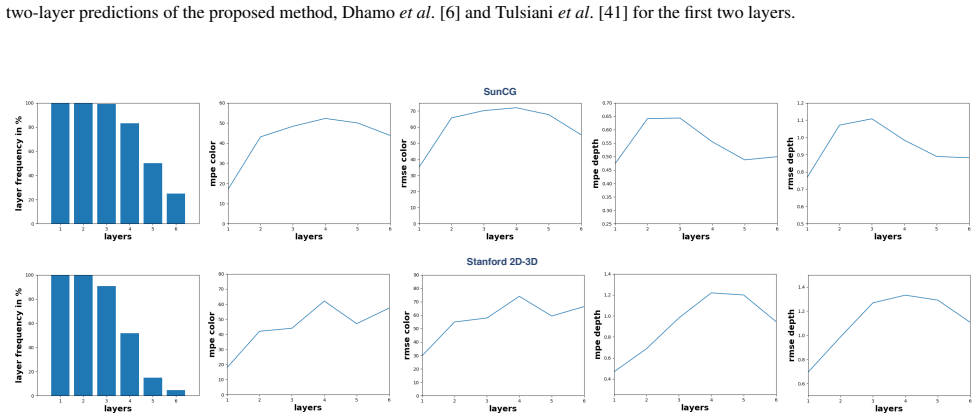
- The adaptive layer count implies the method's error should be reported per-layer frequency, which the paper does in the supplement; a natural extension is a practical heuristic for choosing the number of layers at inference time based on detection confidence.
Signed reviews
Editorial analysis
A structured set of objections, weighed in public.
Referee Report
Summary. The paper proposes an object-driven approach to single-image Layered Depth Image (LDI) prediction. It uses Mask R-CNN to obtain instance masks and class scores, completes each partially occluded object's RGBA-D with Network A, predicts a scene layout with Network B, and assembles the layers through a minimum-depth-pooling (MDP) re-composition step supervised by Network C. Supervision is generated by mesh-based rendering from SunCG and Stanford 2D-3D. The method is evaluated against Dhamo et al. [6] and Tulsiani et al. [41] on LDI prediction, view synthesis, and object removal, reporting improvements on SunCG and on occluded-layer structure on Stanford 2D-3D. The paper also introduces two rendered datasets for the task.
Significance. If the technical issues are resolved, the paper would be a solid contribution: it extends LDI prediction from fixed two-layer models to an object-adaptive number of layers, demonstrates that semantic and instance cues help complete occluded object regions, and provides a mesh-rendered supervision pipeline with two datasets for future work. The reported gains over [6] and [41] are large in the SunCG comparisons, e.g., Table 1 second-layer depth MPE of 0.641 versus 1.139 and 1.582, and Table 3 SSIM of 0.65 versus 0.56 and 0.33. The paper is generally well organized, with additional ablations, qualitative results, and failure cases in the supplement. Its main weakness is that the central re-composition loss is not defined reproducibly, and a few component-ablation claims are not fully supported by the reported numbers.
major comments (3)
- [Sec. 3.4, Eqs. (7)-(8)] The re-composition loss as printed is not the loss the text and Fig. 2 describe. Eq. (7) defines delta_l as a scalar per layer (the difference between mean ground-truth depth and mean predicted depth over the binary mask m_l), and Eq. (8) computes || y_{delta,l} - hat_y_{d,l} ||_1 with y_{delta,l} = hat_y_{d,l} + delta_l, which reduces to || delta_l ||_1. This is a per-layer mean-shift regularizer; it neither compares the displaced depth to the ground-truth depth y_{d,l} nor enforces that the recomposed layers encode the structure of the original input, contrary to the claim in Sec. 3.4 and the Fig. 2 caption. Consequently, the '+Lrecompose' row in Table 1 is not reproducible from the paper. Please correct Eq. (8), most plausibly to L_recompose = || y_{d,l} - (hat_y_{d,l} + delta_l) ||_1, and clarify whether delta_l is a learned per-pixel displacement map or a deterministic scalar. The corrected definition should also be reflected in Fig. 2 and in the ablation description.
- [Sec. 3.4, MDP layer] The minimum-depth-pooling operation selects, for each pixel, the layer with the lowest predicted depth, producing an index map via an argmin. This selection is non-differentiable, and the paper does not describe how gradients from L_recompose propagate through the layer-order selection to the depth values that determine the ordering. As a result, the claim that the network 'implicitly and globally enforce[s] the depth consistency' of layer sorting is not established. Please provide a detailed treatment of the MDP layer's gradient flow (e.g., a straight-through estimator or a detached mask) and state explicitly whether the layer ordering is supervised during training.
- [Sec. 5.1, Table 1] The ablation claims in the text are not fully supported by the reported numbers. From the 'Ours, baseline (w/o class scores)' row to the '+ class scores' row, the second-layer depth MPE increases from 0.687 to 0.700, while the first-layer MPE improves from 0.551 to 0.508. The sentence stating 'one can observe an improvement from adding the class category component ... especially for depth' is therefore inaccurate for the second layer. In addition, no error bars or significance tests are provided, so the small differences between ablation rows (e.g., second-layer depth MPE 0.657 versus 0.641 for +Lp versus +Lrecompose) cannot be distinguished from noise. Please report per-component results accurately, include uncertainty estimates or significance testing, and temper the component-wise improvement claims accordingly.
minor comments (4)
- [Sec. 3.4] There is a typo in the sentence beginning 'Foe each layer l' near Eq. (7); it should read 'For each layer l'.
- [Sec. 4, zero-padding paragraph] The sentence 'the the original view is spanned' contains a duplicated article; it should be 'the original view'.
- [Sec. 3.3, Eq. (6)] The notation for y_c and y_d is inconsistent: Eq. (4) treats them as ground-truth layouts, but the sentence following Eq. (6) says 'where y_c, y_d denote output color and depth respectively.' Please unify the notation to distinguish ground truth from predictions.
- [General] The paper states that the two datasets will be publicly released, but code availability is not mentioned. Given the ambiguity in the re-composition loss definition, releasing code (or at least pseudocode for the MDP and L_recompose computation) would materially aid reproducibility.
Circularity Check
No circular derivation: predictions are supervised from rendered ground truth and benchmarked against external baselines; the only self-citation is a non-load-bearing baseline.
full rationale
The paper's load-bearing claim is that a single RGB image can be decomposed into an object-driven Layered Depth Image with completed occluded layers, outperforming prior work. This is established by supervised training on automatically rendered ground-truth RGBA-D layers (Section 3.1, Eqs. (1)-(6)) and by comparison with Tulsiani et al. [41] and Dhamo et al. [6] on SunCG and Stanford 2D-3D (Tables 1-3). The network outputs are not defined in terms of the evaluation metrics or the test inputs: the targets are obtained from explicit mesh rendering of the scene, while the inputs are RGB, Mask R-CNN mask/class predictions, and a monocular depth prior. No fitted parameter is renamed as a prediction, and no uniqueness theorem or ansatz is imported from the authors' prior work. The only overlapping-author reference is [6], which appears as an independently published baseline and as a data-generation contrast ('Unlike Dhamo et al. [6], we employ a mesh-based rendering approach'); this citation is not load-bearing for the claimed derivation. One internal inconsistency is noted for completeness but is not circularity: substituting Eq. (7) into Eq. (8) gives L_recompose = ||δ_l||_1, so the printed loss only aligns the per-layer mean depth with the ground-truth mean rather than enforcing the 'image re-composition' described in the text and Fig. 2; this is a reproducibility/correctness concern. The acknowledged limitations (mesh holes in Stanford 2D-3D, undetected objects) are data-quality issues scoped to the real-data experiment and do not make the evaluation circular. The derivation chain is therefore self-contained, with at most a minor, non-load-bearing self-citation.
Assumptions & free parameters
free parameters (4)
- Relevance map weights gamma in L_completion =
0.7 in visible region, 1.5 in occluded region, 0.2 otherwise
- Layout loss weights lambda_r and lambda_p =
lambda_r = 100, lambda_p = 25
- Mask matching IoU threshold =
0.3
- Zero-padding band sizes =
16 pixels top/bottom, 12 pixels left/right
assumptions (4)
- domain assumption Mesh-rendered ground truth layers are faithful to real occlusion and disocclusion.
- domain assumption Mask R-CNN detections and class scores are good enough at test time.
- domain assumption The external monocular depth prior (Laina et al. [23]) provides a reliable global depth reference.
- standard math Conventional backpropagation with Adam optimizes the stated losses.
Cite this review
Pith. "Pith review of Object-Driven Multi-Layer Scene Decomposition From a Single Image." pith.science (2026). https://pith.science/paper/X37ZL4UH
@misc{pith2026190809521,
  author       = {Pith},
  title        = {Pith review of: Object-Driven Multi-Layer Scene Decomposition From a Single Image},
  year         = {2026},
  howpublished = {\url{https://pith.science/paper/X37ZL4UH}},
  note         = {Machine review of arXiv:1908.09521}
}
read the original abstract
We present a method that tackles the challenge of predicting color and depth behind the visible content of an image. Our approach aims at building up a Layered Depth Image (LDI) from a single RGB input, which is an efficient representation that arranges the scene in layers, including originally occluded regions. Unlike previous work, we enable an adaptive scheme for the number of layers and incorporate semantic encoding for better hallucination of partly occluded objects. Additionally, our approach is object-driven, which especially boosts the accuracy for the occluded intermediate objects. The framework consists of two steps. First, we individually complete each object in terms of color and depth, while estimating the scene layout. Second, we rebuild the scene based on the regressed layers and enforce the recomposed image to resemble the structure of the original input. The learned representation enables various applications, such as 3D photography and diminished reality, all from a single RGB image.
Figures

Figures from the paper (11 more)
Reference graph
Works this paper leans on
-
[6]
Peeking behind objects: Layered depth prediction from a single image
Helisa Dhamo, Keisuke Tateno, Iro Laina, Nassir Navab, and Federico Tombari. Peeking behind objects: Layered depth prediction from a single image. Pattern Recognition Letters, 2019
work page 2019
-
[41]
Layer-structured 3d scene inference via view synthesis
Shubham Tulsiani, Richard Tucker, and Noah Snavely. Layer-structured 3d scene inference via view synthesis. In ECCV, 2018
work page 2018
-
[1]
Joint 2d-3d-semantic data for indoor scene under- standing
Iro Armeni, Sasha Sax, Amir Roshan Zamir, and Silvio Savarese. Joint 2d-3d-semantic data for indoor scene under- standing. arXiv:1702.01105, 2017
arXiv 2017
-
[2]
Jimmy Ba, Jamie Ryan Kiros, and Geoffrey E. Hinton. Layer normalization. arXiv:1607.06450, 2016
arXiv 2016
-
[3]
Simon Baker, Richard Szeliski, and P. Anandan. A layered approach to stereo reconstruction. CVPR, 1998
work page 1998
-
[4]
3d-r2n2: A unified approach for single and multi-view 3d object reconstruction
Christopher B Choy, Danfei Xu, JunYoung Gwak, Kevin Chen, and Silvio Savarese. 3d-r2n2: A unified approach for single and multi-view 3d object reconstruction. In ECCV, 2016
work page 2016
-
[5]
Imagenet: A large-scale hierarchical image database
Jia Deng, Wei Dong, Richard Socher, Li-Jia Li, Kehui Li, and Li Fei-Fei. Imagenet: A large-scale hierarchical image database. CVPR, 2009
work page 2009
-
[7]
Segan: Segmenting and generating the invisible
Kiana Ehsani, Roozbeh Mottaghi, and Ali Farhadi. Segan: Segmenting and generating the invisible. In CVPR, 2018
work page 2018
Show all 51 references
-
[8]
Depth map prediction from a single image using a multi-scale deep net- work
David Eigen, Christian Puhrsch, and Rob Fergus. Depth map prediction from a single image using a multi-scale deep net- work. In NIPS, 2014
2014
-
[9]
Haoqiang Fan, Hao Su, and Leonidas J. Guibas. A point set generation network for 3d object reconstruction from a single image. In CVPR, 2017
2017
-
[10]
Goodfellow, Jean Pouget-Abadie, Mehdi Mirza, Bing Xu, David Warde-Farley, Sherjil Ozair, Aaron Courville, and Yoshua Bengio
Ian J. Goodfellow, Jean Pouget-Abadie, Mehdi Mirza, Bing Xu, David Warde-Farley, Sherjil Ozair, Aaron Courville, and Yoshua Bengio. Generative adversarial nets. In NIPS, 2014
2014
-
[11]
Predicting complete 3d models of indoor scenes
Ruiqi Guo, Chuhang Zou, and Derek Hoiem. Predicting complete 3d models of indoor scenes. arXiv:1504.02437, 2015
2015 arXiv
-
[12]
Girshick
Kaiming He, Georgia Gkioxari, Piotr Doll ´ar, and Ross B. Girshick. Mask r-cnn. ICCV, 2017
2017
-
[13]
Deep residual learning for image recognition
Kaiming He, Xiangyu Zhang, Shaoqing Ren, and Jian Sun. Deep residual learning for image recognition. CVPR, 2016
2016
-
[14]
Casual 3d photography
Peter Hedman, Suhib Alsisan, Richard Szeliski, and Jo- hannes Kopf. Casual 3d photography. ACM Trans. Graph., 2017
2017
-
[15]
Densely connected convolutional net- works
Gao Huang, Zhuang Liu, Laurens van der Maaten, and Kil- ian Q Weinberger. Densely connected convolutional net- works. In CVPR, 2017
2017
-
[16]
Scene collaging: Analysis and syn- thesis of natural images with semantic layers
Phillip Isola and Ce Liu. Scene collaging: Analysis and syn- thesis of natural images with semantic layers. ICCV, 2013
2013
-
[17]
Image-to-image translation with conditional adver- sarial networks
Phillip Isola, Jun-Yan Zhu, Tinghui Zhou, and Alexei A Efros. Image-to-image translation with conditional adver- sarial networks. ICCV, 2017
2017
-
[18]
Jianbo Jiao, Ying Cao, Yibing Song, and Rynson W. H. Lau. Look deeper into depth: Monocular depth estimation with semantic booster and attention-driven loss. In ECCV, 2018
2018
-
[19]
Perceptual losses for real-time style transfer and super-resolution
Justin Johnson, Alexandre Alahi, and Li Fei-Fei. Perceptual losses for real-time style transfer and super-resolution. In ECCV, 2016
2016
-
[20]
Depth trans- fer: Depth extraction from videos using nonparametric sam- pling
Kevin Karsch, Ce Liu, and Sing Bing Kang. Depth trans- fer: Depth extraction from videos using nonparametric sam- pling. In Dense Image Correspondences for Computer Vi- sion. 2016
2016
-
[21]
What uncertainties do we need in bayesian deep learning for computer vision? In NIPS, 2017
Alex Kendall and Yarin Gal. What uncertainties do we need in bayesian deep learning for computer vision? In NIPS, 2017
2017
-
[22]
2d-to-3d image conversion by learning depth from examples
Janusz Konrad, Meng Wang, and Prakash Ishwar. 2d-to-3d image conversion by learning depth from examples. InCVPR Workshops, 2012
2012
-
[23]
Deeper depth prediction with fully convolutional residual networks
Iro Laina, Christian Rupprecht, Vasileios Belagiannis, Fed- erico Tombari, and Nassir Navab. Deeper depth prediction with fully convolutional residual networks. In 3DV, 2016
2016
-
[24]
van den Hengel, and Mingyi He
Bo Li, Chunhua Shen, Yuchao Dai, A. van den Hengel, and Mingyi He. Depth and surface normal estimation from monocular images using regression on deep features and hi- erarchical crfs. In CVPR, 2015
2015
-
[25]
Microsoft coco: Common objects in context
Tsung-Yi Lin, Michael Maire, Serge Belongie, James Hays, Pietro Perona, Deva Ramanan, Piotr Doll´ar, and C Lawrence Zitnick. Microsoft coco: Common objects in context. In ECCV, 2014
2014
-
[26]
Single im- age depth estimation from predicted semantic labels
Beyang Liu, Stephen Gould, and Daphne Koller. Single im- age depth estimation from predicted semantic labels. CVPR, 2010
2010
-
[27]
Planercnn: 3d plane detection and reconstruction from a single image
Chen Liu, Kihwan Kim, Jinwei Gu, Yasutaka Furukawa, and Jan Kautz. Planercnn: 3d plane detection and reconstruction from a single image. In CVPR, 2019
2019
-
[28]
Layered scene decomposition via the occlusion-crf
Chen Liu, Pushmeet Kohli, and Yasutaka Fukurawa. Layered scene decomposition via the occlusion-crf. In CVPR, 2016
2016
-
[29]
Deep con- volutional neural fields for depth estimation from a single image
Fayao Liu, Chunhua Shen, and Guosheng Lin. Deep con- volutional neural fields for depth estimation from a single image. CVPR, 2015
2015
-
[30]
Discrete-continuous depth estimation from a single image
Miaomiao Liu, Mathieu Salzmann, and Xuming He. Discrete-continuous depth estimation from a single image. In CVPR, 2014
2014
-
[31]
U-net: Convolutional networks for biomedical image segmentation
Olaf Ronneberger, Philipp Fischer, and Thomas Brox. U-net: Convolutional networks for biomedical image segmentation. MICCAI, 2015
2015
-
[32]
Monocular depth esti- mation using neural regression forest
Anirban Roy and Sinisa Todorovic. Monocular depth esti- mation using neural regression forest. CVPR, 2016
2016
-
[33]
Learn- ing depth from single monocular images
Ashutosh Saxena, Sung H Chung, and Andrew Y Ng. Learn- ing depth from single monocular images. In NIPS, 2006
2006
-
[34]
Make3d: Learning 3d scene structure from a single still image
Ashutosh Saxena, Min Sun, and Andrew Y Ng. Make3d: Learning 3d scene structure from a single still image. PAMI, 2009
2009
-
[35]
Layered depth images
Jonathan Shade, Steven Gortler, Li-wei He, and Richard Szeliski. Layered depth images. SIGGRAPH ’98, 1998
1998
-
[36]
Very deep convolutional networks for large-scale image recognition
Karen Simonyan and Andrew Zisserman. Very deep convolutional networks for large-scale image recognition. arXiv:1409.1556, 2014
2014 arXiv
-
[37]
Chang, Manolis Savva, and Thomas Funkhouser
Shuran Song, Fisher Yu, Andy Zeng, Angel X. Chang, Manolis Savva, and Thomas Funkhouser. Semantic scene completion from a single depth image. CVPR, 2017
2017
-
[38]
Sudderth, and Michael J
Deqing Sun, Erik B. Sudderth, and Michael J. Black. Lay- ered segmentation and optical flow estimation over time. CVPR, 2012
2012
-
[39]
Scene parsing with object instances and occlusion ordering
Joseph Tighe, Marc Niethammer, and Svetlana Lazebnik. Scene parsing with object instances and occlusion ordering. CVPR, 2014. 9
2014
-
[40]
Efros, and Jitendra Malik
Shubham Tulsiani, Saurabh Gupta, David Fouhey, Alexei A. Efros, and Jitendra Malik. Factoring shape, pose, and layout from the 2d image of a 3d scene. In CVPR, 2018
2018
-
[42]
John Y . A. Wang and Edward H. Adelson. Representing moving images with layers.IEEE transactions on image pro- cessing, 1994
1994
-
[43]
Peng Wang, Xiaohui Shen, Zhe Lin, Scott Cohen, Brian Price, and Alan L. Yuille. Towards unified depth and se- mantic prediction from a single image. CVPR, 2015
2015
-
[44]
Adversarial semantic scene completion from a sin- gle depth image
Yida Wang, David Joseph Tan, Nassir Navab, and Federico Tombari. Adversarial semantic scene completion from a sin- gle depth image. 3DV, 2018
2018
-
[45]
MarrNet: 3D Shape Reconstruction via 2.5D Sketches
Jiajun Wu, Yifan Wang, Tianfan Xue, Xingyuan Sun, William T Freeman, and Joshua B Tenenbaum. MarrNet: 3D Shape Reconstruction via 2.5D Sketches. In NIPS, 2017
2017
-
[46]
Learning a Probabilistic La- tent Space of Object Shapes via 3D Generative-Adversarial Modeling
Jiajun Wu, Chengkai Zhang, Tianfan Xue, William T Free- man, and Joshua B Tenenbaum. Learning a Probabilistic La- tent Space of Object Shapes via 3D Generative-Adversarial Modeling. In NIPS, 2016
2016
-
[47]
Multi-scale continuous crfs as sequential deep networks for monocular depth estimation
Dan Xu, Elisa Ricci, Wanli Ouyang, Xiaogang Wang, and Nicu Sebe. Multi-scale continuous crfs as sequential deep networks for monocular depth estimation. CVPR, 2017
2017
-
[48]
Yi Yang, Sam Hallman, Deva Ramanan, and Charless C. Fowlkes. Layered object models for image segmentation. PAMI, 2012
2012
-
[49]
Deep depth comple- tion of a single rgb-d image
Yinda Zhang and Thomas Funkhouser. Deep depth comple- tion of a single rgb-d image. CVPR, 2018
2018
-
[50]
Stereo magnification: Learning view syn- thesis using multiplane images
Tinghui Zhou, Richard Tucker, John Flynn, Graham Fyffe, and Noah Snavely. Stereo magnification: Learning view syn- thesis using multiplane images. ACM Trans. Graph., 2018
2018
-
[51]
Layoutnet: Reconstructing the 3d room layout from a single rgb image
Chuhang Zou, Alex Colburn, Qi Shan, and Derek Hoiem. Layoutnet: Reconstructing the 3d room layout from a single rgb image. arXiv:1803.08999, 2018. 10 Supplementary Material We present additional evaluation results of our method, such as a visual comparison with [6, 41] on LDI ...
2018 arXiv
Reviewed August 14, 2026 · model on record in the stance chip above.
Discussion (0). Continue with ORCID to comment.