REVIEW 3 major objections 4 minor 19 references
Seeds for collisionless reconnection
T0 review · 3 major / 4 minor · reviewed 2026-08-14 · deepseek-v4-flash
Pith's one-line read A local surplus or deficit of elementary magnetic flux quanta can form the magnetic islands and X points that ignite collisionless reconnection, without any plasma instability.
desk verdict A self-consistent Josephson-junction calculation of flux-quantum seeds for reconnection whose plasma relevance rests entirely on an unvalidated constitutive law. read the letter →
The pith
A machine-rendered reading of the paper's core claim, the machinery that carries it, and where it could break.
The reading
What carries the argument
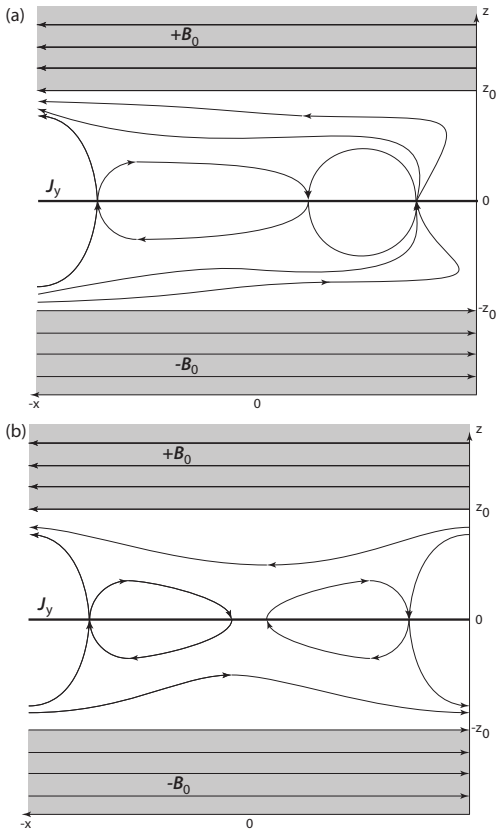
The load-bearing object is the Josephson-junction analogy for the reconnection layer, expressed through the London-type current relation $\mathbf{j}=-(1/\mu_0\lambda^2)(\mathbf{A}-(\Phi_0/2\pi)\nabla S)$, with phase $S=N_\phi\theta$ counting the accumulated flux elements. Height-integrated over the film thickness $d$, this becomes a sheet current $J$ with screening length $\Lambda=\lambda^2/d$, and the requirement that the tangential field vanish at $z=\pm z_0$ fixes the Bessel expansion coefficients of the vector potential. The resulting cylindrically symmetric vortex solution is written as Bessel integrals, and its key output is the vertical field component $B_z\propto N_\phi$, which remains nonzero at the layer boundary and deforms the external antiparallel field into islands and X points.
What would settle it
Run a fully kinetic particle-in-cell simulation of an antiparallel electron-inertial current sheet with no imposed seed, resolving the electron skin depth, and search for spontaneous emergence of a vertical field component $B_z$ whose amplitude tracks the local surplus or deficit of elementary flux quanta and whose field-line topology contains islands and X points of vertical scale about $z_0$; if no such deformation appears, the claimed flux-quantum seeding does not occur.
Extended reading notes
Core claim
The central claim is that a stationary, two-dimensional, non-driven configuration of antiparallel magnetic fields—separated by a field-free current film of electron inertial scale—needs no plasma instability to begin reconnecting. A local accumulation of $N_\phi$ elementary flux quanta $\Phi_0=\pi\hbar/2e$ in the film creates a current vortex described by the London-Josephson relation $\mathbf{j}=-(1/\mu_0\lambda^2)(\mathbf{A}-(\Phi_0/2\pi)\nabla S)$ with $S=N_\phi\theta$. Solving Laplace's equation outside the film with ideal-conductor boundary conditions and vanishing tangential field at $z=\pm z_0$ gives a vector potential and field components (Eqs. 21–23) that include a vertical component $B_z$; this component is finite and continuous at the boundary, has the same sign above and below the sheet, and its central value is proportional to $N_\phi$. Superposing this field on the exponentially screened external antiparallel field produces magnetic islands, X points, and field-free magnetic holes of vertical size of order $z_0$. The paper therefore claims that quantised flux exchange on the microscopic level can classically generate the seeds that ignite large-scale collisionless reconnection.
Load-bearing premise
The entire construction rests on the assumption that the central current film responds like a superconducting Josephson junction—with a phase tied to the number of flux quanta and ideal-conductor screening over a penetration depth $\Lambda=\lambda^2/d$—an assumption imported from superconductivity without a plasma derivation.
Editorial extensions
If this is right
- Reconnection onset would not require an externally imposed seed: statistical fluctuations in the number of flux quanta in the current film naturally produce the initial islands and X points.
- The seed structure is intrinsically electron-scale, with vertical size of order the half-thickness $z_0$ of the field-free layer, so it should appear before any macroscopic tearing signature.
- The strength of the vertical field at the origin, $B_z(0,z_0)\propto N_\phi$, gives a direct observable measure of how many elementary flux quanta are involved in seeding.
- Because instabilities are purely electrostatic on these scales, the flux-quantum mechanism fills the gap left by tearing-type modes, which cannot operate in the non-magnetic central region.
Reading between the lines
- If the mechanism holds, the same seed physics should appear wherever antiparallel fields are separated by a field-free electron-inertial layer, making electron-scale magnetic holes and X-point chains a generic precursor signature in solar-wind and magnetosheath current sheets.
- A natural next step is to derive or falsify the London-Josephson relation (5) from a kinetic plasma closure; that would fix the screening scale $\Lambda$ from plasma parameters instead of leaving it free.
- Convolving the single-accumulation solution over many local surplus or deficit flux elements would generate multi-X-line configurations, linking this static seed picture to spontaneous reconnection along an extended sheet.
- The paper itself notes that the distributed weak electron current in $|z|<z_0$ is omitted; including it in the same boundary-value problem would test whether the seed islands survive a more realistic current profile.
Signed reviews
Editorial analysis
A structured set of objections, weighed in public.
Referee Report
Summary. The paper proposes a microscopic seed mechanism for the onset of collisionless magnetic reconnection. It models a two-dimensional, antiparallel field configuration with a central current film of thickness d, flanked by field-free domains of half-width z0, using a London–Josephson constitutive relation (Eq. 5) with phase S=Nφθ. A local accumulation of Nφ elementary flux quanta produces a vector potential Aθ whose integrals are solved in cylindrical symmetry (Eqs. 21–24). Superposition of the resulting field on the external antiparallel field is claimed to create magnetic islands and X points of vertical size of order z0, which can serve as seeds for large-scale reconnection without invoking plasma instabilities.
Significance. If the mechanism holds, it offers a genuinely new microphysical route to reconnection onset, connecting flux quantization to seed X-point formation in collisionless current sheets. The paper is a forward boundary-value problem with no data fitting; the algebra leading to Eqs. (21)–(24) is internally consistent under the stated constitutive and boundary assumptions, and the limit |z0|→∞ recovers a known Pearl-type vortex solution (Eq. 26). However, the central physical input—the London–Josephson relation (Eq. 5)—is imported from superconductivity without a plasma derivation, and the screening length Λ is left as a free scale. In addition, Eq. (23) for Bz omits a term required by the curl operation, so the field topology asserted in the abstract is not, as written, a consequence of the preceding equations.
major comments (3)
- [§2.4, Eq. (23)] Equation (23) is not the correct curl of the vector potential (21). With A=Aθ θ̂, one has Bz=(1/ρ)∂ρ(ρAθ)=Aθ/ρ+∂ρAθ. Substitution of Eq. (21) yields an integrand proportional to κJ0(κξ)cosh(κ|ζ−ζ0|)/[κsinh(κ|ζ0|)+cosh(κ|ζ0|)], not κJ1′(κξ)cosh(...) as written. The term J1(κξ)/ξ is missing from the published expression. This error propagates into the flux integral (28) and the field-line equation (30), and it directly affects the claimed island/X-point topology, because that topology is inferred from Bz(ρ,z). The integrals should be corrected and the conclusions re-evaluated with the correct Bz.
- [§2.1, Eq. (5)] The London–Josephson relation j=−(1/µ0λ²)(A−Φ0∇S/2π) with S=Nφθ is the load-bearing constitutive input, but no plasma derivation is supplied. In a collisionless plasma of unpaired electrons there is no Cooper-pair condensate and no macroscopic quantum phase; ∇S is pure gauge in a classical gauge theory and can be absorbed into A, leaving only a local London-type response. Electron inertia alone yields a nonlocal, frequency-dependent current response, not Eq. (5). Since every field component in Eqs. (21)–(24) follows mechanically from this relation and the screening boundary condition, the central claim remains conditional on an unvalidated analogy. The authors should either derive the relation from a kinetic or two-fluid model, identify the regime where it holds, or explicitly reframe the conclusion as a model-dependent prediction and state what observable would distinguish it.
- [§2.3, Eq. (19)] The boundary condition Bρ(±z0)=0 is imposed as a 'Landau–Ginzburg condition', but this is not the standard boundary condition at an ideal-conductor or superconductor surface; for a perfect conductor the normal component of the perturbation field is controlled, while the tangential component can be nonzero and is related to surface currents. The manuscript should justify why the tangential perturbation field vanishes at z=±z0. In addition, the effective screening length Λ=λ²/d (Eq. 7) is a free parameter, entering directly into Eqs. (21)–(24) and hence into the claimed vertical scale z0 of the islands and X points. Without a quantitative estimate of Λ or α in Eq. (6), the prediction is not falsifiable at the level claimed in the abstract.
minor comments (4)
- [§2.5, Eq. (29)] Equation (29) contains the typographical artifact 'B0xx'; it should read B0x x̂, with the unit vector defined consistently.
- [§2.6, Eqs. (31)–(32)] The field-line asymptotes ζ(ξ)∼f(ζ0)ξ² and ζ(ξ)∼g(ζ0)√ξ are asserted from qualitative Bessel-function expansions, but the κ-integrals defining f and g are not evaluated; a numerical evaluation of Eqs. (21)–(23) would substantially strengthen the paper.
- [§1.1, Eq. (3)] The notation Nφ is used both for the integer number of excess flux elements and for the left-hand side of Eq. (3), which is defined as a difference; this is confusing and should be clarified.
- [References] The reference for Syrovatskii is given with a DOI corresponding to a 2004 Nonlinear Processes in Geophysics article, which appears to be a different work from the 1971 Soviet Physics JETP paper cited in the text.
Circularity Check
No significant circularity: the field solutions are a forward solve of an assumed constitutive model, not a fit or a renamed input.
full rationale
The paper's derivation is self-contained as a forward boundary-value calculation. It assumes a current film obeying the London-Josephson relation, Eq. (5), with S = N_phi theta, then solves Laplace's equation in the field-free flanking regions with screening boundary conditions, Eqs. (13)-(20), to obtain the vector potential and field components, Eqs. (21)-(24). The localized accumulation of N_phi flux elements is an assumed initial fluctuation, not a quantity fitted to any data, and the resulting B_z component, islands, and X points are mathematical consequences of that source and of the imposed boundary conditions. Equation (27) merely states that B_z is proportional to N_phi by construction; this is an algebraic consequence, not a circular prediction. The superconductivity analogy underlying Eq. (5) is imported from external standard references (Josephson; Ginzburg-Landau; Pearl; Clem), not from the present authors' prior work, and its physical validity in a collisionless plasma is an assumption to be judged on plasma physics grounds, not a circularity. The self-citations (Baumjohann & Treumann, 2012; Treumann & Baumjohann, 2015) are contextual review references and do not carry the derivation. The paper also explicitly acknowledges limitations, such as neglecting the distributed weak electron current and calling the model primitive, but these are completeness caveats, not evidence that an output has been smuggled into an input. No fitted parameter is relabeled as a prediction, and no known result is merely renamed: the Josephson-vortex mathematics is applied to a new plasma configuration and a reconnection-seeding interpretation is drawn from the solved fields. Hence the correct circularity finding is no significant circularity.
Assumptions & free parameters
free parameters (2)
- Nφ
- Λ (effective screening length)
assumptions (5)
- ad hoc to paper The current film obeys the London-Josephson relation j = -(1/µ0λ²)(A - Φ0/2π∇S) with phase S=Nφθ.
- domain assumption Magnetic flux is quantized in units of Φ0=πℏ/2e and remains an integer in the plasma.
- domain assumption The field-free region screens like an ideal conductor over skin depth λ, with vanishing tangential B at |z|=z0.
- domain assumption Plasma instabilities at electron inertial scales are purely electrostatic, so magnetic tearing-type modes do not operate.
- ad hoc to paper Thermal fluctuations produce a local excess or lack of Nφ flux elements at one point of the current sheet.
Cite this review
Pith. "Pith review of Seeds for collisionless reconnection." pith.science (2026). https://pith.science/paper/D7OA7L6G
@misc{pith2026190809524,
  author       = {Pith},
  title        = {Pith review of: Seeds for collisionless reconnection},
  year         = {2026},
  howpublished = {\url{https://pith.science/paper/D7OA7L6G}},
  note         = {Machine review of arXiv:1908.09524}
}
read the original abstract
A stationary, two-dimensional, and non-driven antiparallel magnetic field configuration consisting of a central current film, flanked by two non-magnetic domains of electron inertial scale, resembling the Josephson model. Landau-Ginsburg conditions apply at the boundaries to the oppositely directed external magnetic fields, whose sources are located at infinity. On the microscopic level sufficiently large magnetic islands and X points form from exchange of small numbers of elementary magnetic fluxes without reference to any plasma instabilities which on these scales are purely electrostatic. These may serve as seeds to ignite large-scale collisionless reconnection.
Figures

Reference graph
Works this paper leans on
-
[1]
Bardeen J, Cooper LN, and Schrieffer JR: Theory of superconductivity, Phys. Rev. 108, 1175-1204, https://doi.org/10.1103/PhysRev.108.1175,
-
[1941]
Pearl J: Structure of superconductive vortices near a metal-air interface. J. Appl. Phys. 37, 4139-4141, https://doi.org/10.1063/1.1707989,
-
[1950]
2, 1234-1250, https://doi.org/10.1007/BF02731579,
Ginzburg VL: On the theory of superconductivity, Nuovo Cim. 2, 1234-1250, https://doi.org/10.1007/BF02731579,
-
[1955]
Gradshteyn IS and Ryzhik IM: Tables of integrals, series, and products, New York 1965, Academic Press. Harris EG: On a plasma sheath separating regions of oppositely directed magnetic fields, Nuovo Cimento 23, 115-121, https://doi.org/10.1007/BF02733547,
-
[1956]
Einstein A: Über die von der molekularkinetischen Theorie der Wärme geforderte Bewegung von in ruhenden Flüssigkeiten suspendierten Teilchen, Ann. Phys. 322, 549-560, https://doi.org/10.1002/andp.19053220806,
-
[1957]
Baumjohann W and Treumann RA: Basic Space Plasma Physics, London 1996, Revised and enlarged edition, Imperial College Press, London, https://doi.org/10.1142/P850,
-
[1962]
Josephson B: Coupled superconductors. Rev. Mod. Phys. 36, 216-220, https://doi.org/10.1103/RevModPhys.36.216,
-
[1964]
Josephson B: The discovery of tunnelling supercurrents. Rev. Mod. Phys. 46, 251-254, https://doi.org/10.1103/RevModPhys.46.251,
Show all 19 references
-
[1966]
Syrovatskii SI: Formation of current sheets in a plasma with a frozen-in strong magnetic field, Sov. J. Exp. Theoret. Phys. 33, 933-940, https://doi.org/10.5194/npg-11-647-2004,
2004 doi
-
[1973]
Landau L: Theory of the superfluidity on Helium II, Phys. Rev. 60, 356-358, https://doi.org/10.1103/PhysRev.60.356,
-
[1974]
Clem JR: Two-dimensional vortices in a stack of thin superconducting films: A model for high-temperature superconducting multilayers, Phys. Rev. B 43, 7837-7846, https://doi.org/10.1103/PhysRevB.43.7837,
-
[1975]
Yamada M, Kulsrud R, and Ji H: Magnetic reconnection, Rev. Mod. Phys. 82, 603-664, https://doi.org/10.1103/RevModPhys.82.603,
-
[1987]
Josephson B: Possible new effects in superconductive tunnelling. Phys. Lett. 1, 251-253, https://doi.org/10.1016/0031-9163(62)91369-0,
-
[1990]
Vasyliunas VM: Theoretical models of magnetic field line merging. I., Rev. Geophys. Space Phys. 13, 303-336, https://doi.org/10.1029/RG013i001p00303,
-
[1991]
Cooper LN: Bound electron pairs in a degenerate Fermi gas, Phys. Rev. 104, 1189-1190, https://doi.org/10.1103/PhysRev.104.1189,
-
[2004]
Astrophys
Treumann RA and Baumjohann W: Spontaneous magnetic reconnection, Astron. Astrophys. Rev. 23, ID 4, https://doi.org/10.1007/s00159- 015-0087-1,
-
[2005]
Clem JR: Theory of magnetically coupled type-II superconducting films, Phys. Rev. B 9, 898-911, https://doi.org/10.1103/PhysRevB.9.898,
-
[2010]
12 Zweibel E and Yamada M: Magnetic reconnection in astrophysical and laboratory plasmas, Ann. Rev. Astron. Astrophys. 47, 291-332, https://doi.org/10.1146/annurev-astro-082708-101726,
-
[2015]
Treumann RA, Brostrom L, LaBelle J, and Sckopke N: The plasma wave signature of a ‘magnetic hole’ in the vicinity of the magnetopause, J. Geophys. Res. 95, 19099-19114, https://doi.org/10.1029/JA095iA11p19099,
Reviewed August 14, 2026 · model on record in the stance chip above.
Discussion (0). Continue with ORCID to comment.