REVIEW 2 major objections 4 minor 48 references
Impact of the Nuclear Equation of State on the Stability of Hybrid Neutron Stars
T0 review · 2 major / 4 minor · reviewed 2026-08-14 · deepseek-v4-flash
Pith's one-line read The paper claims that, with all quark-model parameters held fixed, the choice of hadronic equation of state changes the quark phase inside hybrid neutron stars through the deconfinement bag constant, so the maximum mass of a hybrid star…
desk verdict Honest vBag model study where the hadronic-EoS dependence of the quark phase is real but built into the construction; worth reading and citing, with the 'unexpected' framing and simultaneous-restoration assumption as the soft spots. read the letter →
The pith
A machine-rendered reading of the paper's core claim, the machinery that carries it, and where it could break.
The reading
What carries the argument
The load-bearing object is the vBag equation of state, a bag-type quark matter model with vector interactions and a simultaneous onset of chiral symmetry restoration and deconfinement. The mechanism that carries the argument is the identification of the deconfinement bag constant with the hadron pressure at the chiral restoration point, $B_\mathrm{dc}=P_H(T,\mu_{B\chi},\mu_C)$, together with the thermodynamic consistency pieces $s_\mathrm{dc}$ and $n_{C,\mathrm{dc}}$ that enter the quark-phase entropy and charge density when $B_\mathrm{dc}$ depends on temperature and charge chemical potential. These terms turn the hadronic model into an active ingredient of the quark phase: they modify the quark equation of state and, through the $\beta$-equilibrium conditions, the mass-radius curves of hybrid stars.
What would settle it
A first-principles determination of the cold dense QCD phase diagram that finds the chiral restoration and deconfinement chemical potentials at different values would invalidate the identification $B_\mathrm{dc}=P_H(T,\mu_{B\chi},\mu_C)$; alternatively, a precise measurement of a hybrid star's maximum mass and radius that matches the uncorrected $B_\mathrm{dc}=0$ branch would contradict the correction mechanism.
Extended reading notes
Core claim
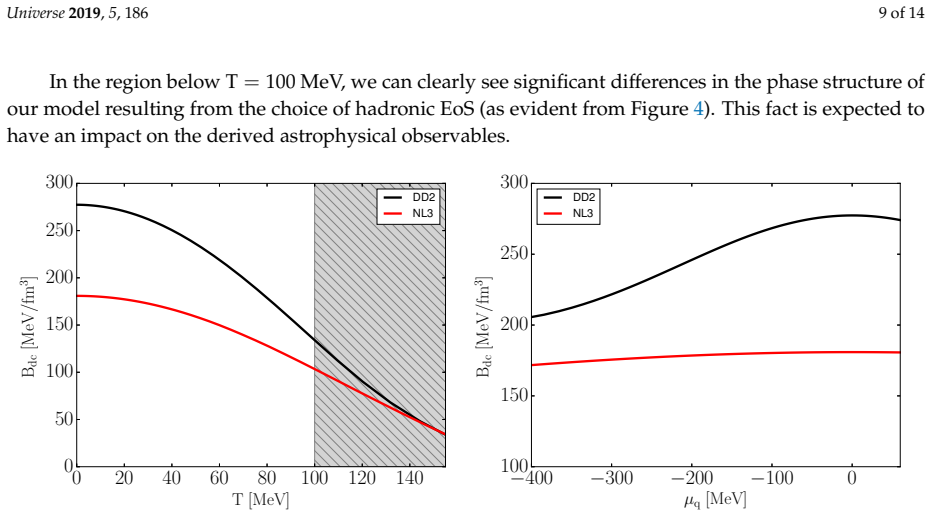
With the vBag free parameters fixed at $B_\chi^{1/4}=152.7\ \mathrm{MeV}$ and $K_v=6\times 10^{-6}\ \mathrm{MeV}^{-2}$, the paper's central result is that the deconfinement bag constant $B_\mathrm{dc}$ is not a free parameter but a hadronic quantity: it is set equal to the hadronic pressure at the chiral restoration point, $B_\mathrm{dc}=P_H(T,\mu_{B\chi},\mu_C)$. Because DD2 and NL3 have different pressures at that point, the quark phase in $\beta$-equilibrium acquires different corrections, including the charge-density correction $n_{C,\mathrm{dc}}$. The resulting hybrid neutron stars have different maximum masses: the DD2+vBag branch reaches about $2.1\,M_\odot$ thanks to these corrections, while NJL-like branches computed with $B_\mathrm{dc}=0$ do not. The paper presents this as unexpected, since all quark-model parameters are kept constant; the quark phase of DD2+vBag would not support the heavier star without the hadronic modification.
Load-bearing premise
The load-bearing premise is that deconfinement and chiral symmetry restoration happen at the same baryon chemical potential, which is what allows $B_\mathrm{dc}$ to be read off from the hadronic pressure; if the two transitions split, the hadronic correction to the quark phase disappears and the predicted difference between DD2 and NL3 hybrid stars goes with it.
Editorial extensions
If this is right
- Hybrid star maximum mass is not determined by the quark model's parameters alone; a softer or stiffer hadronic equation of state shifts the quark phase and the mass limit.
- The finite-temperature and charge-asymmetry behavior of the quark phase is also model-dependent through $s_\mathrm{dc}$ and $n_{C,\mathrm{dc}}$, so merger and supernova applications inherit the hadronic-model dependence, not just static cold stars.
- A relatively soft hadronic equation of state can still reach pulsar masses around $2.1\,M_\odot$ once the quark phase is stiffened by the hadronic correction, without increasing the vector repulsion strength $K_v$.
- Within this vBag setting, no twin-star solutions appear, so the coupling constrains which hybrid equation-of-state families can produce separate stable branches.
Reading between the lines
- If the simultaneous-onset assumption is right, then hybrid star observables such as radius at a given mass and tidal deformability carry information about the hadronic pressure at the deconfinement density; fitting one without the other would mis-estimate the quark model parameters.
- The mechanism suggests a transferable rule: the hybrid maximum mass should track the hadronic pressure at the chiral restoration point, so a scan over hadronic models with identical vBag parameters would produce a monotonic relation between that pressure and the mass limit. Constructing such a scan would be a direct numerical test of the paper's mechanism.
- In merger or supernova modeling, the $s_\mathrm{dc}$ correction means the entropy of the quark phase depends on the hadronic temperature behavior, so thermal effects during a post-merger remnant could distinguish simultaneous-onset models from ordinary bag models in gravitational wave signals. This is a consequence the paper does not develop.
Signed reviews
Editorial analysis
A structured set of objections, weighed in public.
Referee Report
Summary. The paper constructs two-phase equations of state for hybrid neutron stars by combining the relativistic mean-field hadronic models DD2 and NL3 with the vBag quark model. The key feature of vBag is the assumption that chiral symmetry restoration and deconfinement occur simultaneously, implemented by defining the deconfinement bag constant Bdc as the hadron pressure at the quark-determined chiral restoration point (Eq. 31) and by adding thermodynamic correction terms sdc and nC,dc (Eqs. 35-36). Using these EoS, the authors compute temperature-baryon chemical potential phase diagrams and, for cold beta-equilibrated matter, neutron star mass-radius relations. They find that the choice of hadronic EoS changes the quark phase and leads to different maximum hybrid neutron star masses, even though the vBag free parameters Bχ and Kv are kept fixed.
Significance. The paper is a clearly written, internally consistent model study. It makes explicit the thermodynamic bookkeeping required when a bag constant depends on temperature and chemical potentials, and it includes a valuable control calculation with Bdc = 0 (dash-dotted curves in Fig. 6) that isolates the effect of the hadron-dependent correction terms. The central demonstration, that within vBag the hadronic EoS influences the quark phase and the hybrid maximum mass, is of interest for hybrid star phenomenology. However, because the hadronic dependence of the quark phase is introduced by construction through Eq. (31), the main result is best understood as a property of the vBag model rather than as an emergent or model-independent prediction about dense QCD. The authors are transparent about the underlying assumption, but the abstract and conclusions present the result more strongly than the model setup warrants.
major comments (2)
- [§2, Eq. (31)] The connection between the hadronic EoS and the quark phase is introduced by definition rather than derived: Bdc is set equal to the hadron pressure at the quark-determined chiral restoration point, so the quark EoS depends on the hadronic model by construction. The qualitative statement that the hadronic EoS 'modifies' the quark phase is therefore not an emergent finding. Section 4 calls the maximum-mass difference 'unexpected,' but it is a direct consequence of Eqs. (17)-(18) and (31); the authors should reframe the result as a quantitative consequence of the simultaneous-restoration Ansatz and use the Bdc = 0 control (Fig. 6) as the baseline for that statement.
- [§1 and §5] The central quantitative result is conditional on the simultaneous onset of chiral symmetry restoration and deconfinement, an assumption the authors themselves flag as 'far from certain in the desired high density domain' (Section 1). If the two transitions occur at different chemical potentials, Eq. (31) no longer holds, the correction terms in Eqs. (35)-(36) vanish, and the DD2/NL3 difference in hybrid maximum masses disappears, as the Bdc = 0 curves in Fig. 6 indicate. The abstract and conclusions should state this conditionality explicitly, and ideally the paper should quantify the sensitivity by varying the offset between the chiral-restoration and deconfinement chemical potentials.
minor comments (4)
- [§2, Eqs. (5)-(6)] The cutoff in Eq. (5) is written with Θ(Λ² - p_vec²), while the text and Eq. (6) define ∫_Λ using Θ(p_vec² - Λ²); this sign mismatch should be corrected and the intended domain of the three-momentum cutoff stated consistently.
- [§3, Figs. 2-4] The grey region labeled as lying outside the model's expected applicability domain is used repeatedly but never defined; the authors should state the criterion (for example T < 100 MeV or a bound on µB) in the text or in the figure captions.
- [§4, Fig. 6] The purely hadronic maximum masses of DD2 and NL3 are described as 'rather similar though not identical,' but the numerical values are not given; providing these values and the hybrid onset masses would let the reader separate the hadronic contribution from the effect of Bdc and nC,dc.
- [§5] The statement that 'within vBag' a hadron-quark transition density above about 1.5 M⊙ is a direct consequence of obtaining hybrid stars with a maximum mass of about 2.1 M⊙ is drawn from a single parameter set (Bχ^{1/4} = 152.7 MeV, Kv = 6×10^{-6} MeV^{-2}); this should be qualified as parameter-dependent unless a scan over the vBag parameters is provided.
Circularity Check
The 'impact' of the hadronic EoS on hybrid stars is built into vBag's definition of Bdc, but the quantitative M-R results are computed and the assumption is acknowledged.
-
self definitional
[Section 2, Eqs. (17)-(18), (23), (30)-(31); Abstract; Section 4, Fig. 6 caption.]
"By defining Bdc as the hadron pressure at the point of quark chiral symmetry restoration, one easily sees that both transitions would coincide. ... Bdc = PH(T, µBχ, µC). ... This feature results in a non–trivial connection between the hadron and quark EoS, modifying the quark phase beyond its onset density. We find that this unique property has an impact on the predicted hybrid (quark core) neutron star mass–radius relations."
Equation (18)/(23) inserts Bdc into the quark pressure, P_Q = sum_f P_f + Bdc, and Eq. (31) defines Bdc as the hadron pressure PH at µBχ. Hence the quark-phase EoS depends on the hadronic EoS by construction; the qualitative claim that the hadronic EoS modifies the quark phase and affects hybrid M-R relations is a restatement of the definition rather than an emergent result. The TOV sequences and maximum-mass differences are computed, not fitted, but Fig. 6's Bdc=0 dash-dotted curves confirm that the DD2/NL3 difference is carried by Bdc and nC,dc, so the central 'unexpected' effect is a consequence of the model assumption, not an independent prediction.
full rationale
The paper's thermodynamic relations are internally consistent, and the mass-radius curves are genuine numerical solutions of the TOV equations rather than fits to the observational data shown for comparison. However, the headline qualitative result—that the hadronic EoS affects the quark phase and hybrid neutron star stability—is built into vBag through Eq. (31), where Bdc is defined as the hadron pressure at the chiral-restoration chemical potential, and Eq. (23), where Bdc is added to the quark pressure. Thus the 'impact' is definitional: it is true by construction that the quark phase depends on the hadronic model. The authors acknowledge this in Section 1, calling simultaneous chiral restoration and deconfinement 'far from certain' and 'a model assumption of vBag', and in Section 3 they note 'Obviously, the impact on the deconfined quark matter is largely dependent on the choice of hadronic EoS'. This candor lowers the severity. The self-citations to prior vBag papers (refs. [19]-[22]) establish the model but do not smuggle in an unstated ansatz; the assumptions are explicitly written out. No fitted parameter is renamed as a prediction, and no uniqueness theorem is imported to forbid alternatives. The central claim is therefore partially circular at the qualitative level but retains independent quantitative content in the computed phase boundaries and M-R curves. Score 4 captures one central definitional step with an acknowledged model assumption.
Assumptions & free parameters
free parameters (2)
- Bχ^{1/4} =
152.7 MeV
- Kv =
6x10^-6 MeV^-2
assumptions (4)
- domain assumption Rainbow truncation and a constant effective gluon propagator with hard cutoff are valid approximations for the quark DSE.
- ad hoc to paper Chiral symmetry restoration and deconfinement occur simultaneously at all densities considered.
- domain assumption A two-phase approach with a first-order transition is an adequate description of the hadron-quark interface.
- domain assumption Static, spherically symmetric neutron stars in beta equilibrium and charge neutrality follow the TOV equations.
Cite this review
Pith. "Pith review of Impact of the Nuclear Equation of State on the Stability of Hybrid Neutron Stars." pith.science (2026). https://pith.science/paper/SURDUAAF
@misc{pith2026190809534,
  author       = {Pith},
  title        = {Pith review of: Impact of the Nuclear Equation of State on the Stability of Hybrid Neutron Stars},
  year         = {2026},
  howpublished = {\url{https://pith.science/paper/SURDUAAF}},
  note         = {Machine review of arXiv:1908.09534}
}
read the original abstract
We construct a set of equations of state (EoS) of dense and hot matter with a 1st order phase transition from a hadronic system to a deconfined quark matter state. In this two-phase approach, hadrons are described using the relativistic mean field theory with different parametrisations and the deconfined quark phase is modeled using vBag, a bag-type model extended to include vector interactions as well as a simultaneous onset of chiral symmetry restoration and deconfinement. This feature results in a non-trivial connection between the hadron and quark EoS, modifying the quark phase beyond its onset density. We find that this unique property has an impact on the predicted hybrid (quark core) neutron star mass--radius relations.
Figures


Figures from the paper (3 more)


Reference graph
Works this paper leans on
-
[1]
Three Lectures on Hadron Physics
Roberts, C.D. Three Lectures on Hadron Physics. J. Phys. Conf. Ser. 2016, 706, 022003
work page 2016
-
[2]
Critical point of QCD at finite T and mu, lattice results for physical quark masses
Fodor, Z.; Katz, S.D. Critical point of QCD at finite T and mu, lattice results for physical quark masses. JHEP 2004, 2004, 050
work page 2004
-
[3]
Aoki, Y.; Endrodi, G.; Fodor, Z.; Katz, S.D.; Szabo, K.K. The Order of the quantum chromodynamics transition predicted by the standard model of particle physics. Nature 2006, 443, 675–678
work page 2006
-
[4]
The QCD Equation of State toO(µ6 B) from Lattice QCD
Bazavov, A.; Ding, H.-T.; Hegde, P .; Kaczmarek, O.; Karsch, F.; Laermann, E.; Maezawa, Y.; Mukherjee, S.; Ohno H.; Petreczky, P .; et al. The QCD Equation of State toO(µ6 B) from Lattice QCD. Phys. Rev. D 2017, 95, 054504
work page 2017
-
[5]
The QCD equation of state at finite density from analytical continuation
Guenther, J.N.; Bellwied, R.; Borsanyi, S.; Fodor, Z.; Katz, S.D.; Pasztor, A.; Ratti, C.; Szabó, K.K. The QCD equation of state at finite density from analytical continuation. Nucl. Phys. A 2017, 967, 720–723
work page 2017
-
[6]
Chiral crossover in QCD at zero and non-zero chemical potentials
Bazavov, A.; Ding, H.-T.; Hegde, P .; Kaczmarek, O.; Karsch, F.; Karthik, N.; Laermann, E.; Lahiri, A.; Larsen, R.; Li, S.-T.; et al. Chiral crossover in QCD at zero and non-zero chemical potentials. arXiv 2018, arXiv:1812.08235
arXiv 2018
-
[7]
Bastian, N.U.F.; Blaschke, D.; Fischer, T.; Röpke, G. Towards a Unified Quark-Hadron Matter Equation of State for Applications in Astrophysics and Heavy-Ion Collisions. Universe 2018, 4, 67
work page 2018
-
[8]
A Novel Approach to Model Hybrid Stars
Dexheimer, V .A.; Schramm, S. A Novel Approach to Model Hybrid Stars. Phys. Rev. C 2010, 81, 045201
work page 2010
Show all 48 references
-
[9]
An Effective chiral Hadron-Quark Equation of State
Steinheimer, J.; Schramm, S.; Stocker, H. An Effective chiral Hadron-Quark Equation of State. J. Phys. G 2011, 38, 035001
2011
-
[10]
Net-baryon number fluctuations in the Hybrid Quark-Meson-Nucleon model at finite density
Marczenko, M.; Sasaki, C. Net-baryon number fluctuations in the Hybrid Quark-Meson-Nucleon model at finite density. Phys. Rev. D 2018, 97, 036011
2018
-
[11]
Chiral symmetry restoration by parity doubling and the structure of neutron stars
Marczenko, M.; Blaschke, D.; Redlich, K.; Sasaki, C. Chiral symmetry restoration by parity doubling and the structure of neutron stars. Phys. Rev. D 2018, 98, 103021. Universe 2019, 5, 186 13 of 14
2018
-
[12]
Quarks and Gluons at High Temperatures and Densities
Cleymans, J.; Gavai, R.V .; Suhonen, E. Quarks and Gluons at High Temperatures and Densities. Phys. Rept. 1986, 130, 217
1986
-
[13]
Equations of state for supernovae and compact stars
Oertel, M.; Hempel, M.; Klähn, T.; Typel, S. Equations of state for supernovae and compact stars. Rev. Mod. Phys. 2017, 89, 015007
2017
-
[14]
The state of matter in simulations of core-collapse supernovae—Reflections and recent developments
Fischer, T.; Bastian, N.U.; Blaschke, D.; Cierniak, M.; Hempel, M.; Klähn, T.; Martínez-Pinedo, G.; Newton, W.G.; Röpke, G.; Typel, S. The state of matter in simulations of core-collapse supernovae—Reflections and recent developments. Publ. Astron. Soc. Aust. 2017, 34, 67
2017
-
[15]
Strange Matter
Farhi, E.; Jaffe, R.L. Strange Matter. Phys. Rev. D 1984, 30, 2379
1984
-
[16]
Shapiro Delay Measurement of A Two Solar Mass Neutron Star
Demorest, P .; Pennucci, T.; Ransom, S.; Roberts, M.; Hessels, J. Shapiro Delay Measurement of A Two Solar Mass Neutron Star. Nature 2010, 467, 1081–1083
2010
-
[17]
The NANOGrav Nine-year Data Set: Mass and Geometric Measurements of Binary Millisecond Pulsars
Fonseca, E.; Pennucci, T.T.; Ellis, J.A.; Stairs, I.H.; Nice, D.J.; Ransom, S.M.; Demorest, P .B.; Arzoumanian, Z.; Crowter, K.; Dolch, T.; et al. The NANOGrav Nine-year Data Set: Mass and Geometric Measurements of Binary Millisecond Pulsars. Astrophys. J. 2016, 832, 167
2016
-
[18]
A Massive Pulsar in a Compact Relativistic Binary
Antoniadis, J.; Freire, P .C.; Wex, N.; Tauris, T.M.; Lynch, R.S.; van Kerkwijk, M.H.; Kramer, M.; Bassa, C.; Dhillon, V .S.; Driebe, T.; et al. A Massive Pulsar in a Compact Relativistic Binary. Science 2013, 340, 6131
2013
-
[19]
Vector interaction enhanced bag model for astrophysical applications
Klähn, T.; Fischer, T. Vector interaction enhanced bag model for astrophysical applications. Astrophys. J. 2015, 810, 134
2015
-
[20]
Simultaneous chiral symmetry restoration and deconfinement— Consequences for the QCD phase diagram
Klähn, T.; Fischer, T.; Hempel, M. Simultaneous chiral symmetry restoration and deconfinement— Consequences for the QCD phase diagram. Astrophys. J. 2017, 836, 89
2017
-
[21]
Consequences of simultaneous chiral symmetry breaking and deconfinement for the isospin symmetric phase diagram
Fischer, T.; Klähn, T.; Hempel, M. Consequences of simultaneous chiral symmetry breaking and deconfinement for the isospin symmetric phase diagram. Eur. Phys. J. A 2016, 52, 225
2016
-
[22]
Vector-Interaction-Enhanced Bag Model
Cierniak, M.; Klähn, T.; Fischer, T.; Bastian, N.U. Vector-Interaction-Enhanced Bag Model. Universe 2018, 4, 30
2018
-
[23]
Phase diagram and critical endpoint for strongly-interacting quarks
Qin, S.x.; Chang, L.; Chen, H.; Liu, Y.x.; Roberts, C.D. Phase diagram and critical endpoint for strongly-interacting quarks. Phys. Rev. Lett. 2011, 106, 172301
2011
-
[24]
Phase structure of three and four flavor QCD
Fischer, C.S.; Luecker, J.; Welzbacher, C.A. Phase structure of three and four flavor QCD. Phys. Rev. D 2014, 90, 034022
2014
-
[25]
Two point fermion correlation functions at finite density
Rusnak, J.J.; Furnstahl, R.J. Two point fermion correlation functions at finite density. Z. Phys. A Hadrons Nucl. 1995, 352, 345–350
1995
-
[26]
Dyson-Schwinger equations: Density, temperature and continuum strong QCD
Roberts, C.D.; Schmidt, S.M. Dyson-Schwinger equations: Density, temperature and continuum strong QCD. Prog. Part. Nucl. Phys. 2000, 45, S1–S103
2000
-
[27]
Pion form factor from a contact interaction
Gutierrez-Guerrero, L.X.; Bashir, A.; Cloet, I.C.; Roberts, C.D. Pion form factor from a contact interaction. Phys. Rev. C 2010, 81, 065202
2010
-
[28]
Dynamical chiral symmetry breaking, Goldstone’s theorem and the consistency of the Schwinger-Dyson and Bethe-Salpeter Equations
Munczek, H.J. Dynamical chiral symmetry breaking, Goldstone’s theorem and the consistency of the Schwinger-Dyson and Bethe-Salpeter Equations. Phys. Rev. D 1995, 52, 4736–4740
1995
-
[29]
Goldstone theorem and diquark confinement beyond rainbow ladder approximation
Bender, A.; Roberts, C.D.; Von Smekal, L. Goldstone theorem and diquark confinement beyond rainbow ladder approximation. Phys. Lett. B 1996, 380, 7–12
1996
-
[30]
NJL model analysis of quark matter at large density
Buballa, M. NJL model analysis of quark matter at large density. Phys. Rept. 2005, 407, 205–376
2005
-
[31]
Extended NJL model for light and heavy mesons without q- anti-q thresholds
Ebert, D.; Feldmann, T.; Reinhardt, H. Extended NJL model for light and heavy mesons without q- anti-q thresholds. Phys. Lett. B 1996, 388, 154–160
1996
-
[32]
Composition and thermodynamics of nuclear matter with light clusters
Typel, S.; Röpke, G.; Klähn, T.; Blaschke, D.; Wolter, H.H. Composition and thermodynamics of nuclear matter with light clusters. Phys. Rev. C 2010, 81, 015803
2010
-
[33]
A New parametrization for the Lagrangian density of relativistic mean field theory
Lalazissis, G.A.; Konig, J.; Ring, P . A New parametrization for the Lagrangian density of relativistic mean field theory. Phys. Rev. C 1997, 55, 540–543
1997
-
[34]
Asymmetric nuclear matter in a parity doublet model with hidden local symmetry
Motohiro, Y.; Kim, Y.; Harada, M. Asymmetric nuclear matter in a parity doublet model with hidden local symmetry. Phys. Rev. C 2015, 92, 025201
2015
-
[35]
Constraining the Symmetry Parameters of the Nuclear Interaction
Lattimer, J.M.; Lim, Y. Constraining the Symmetry Parameters of the Nuclear Interaction. Astrophys. J. 2013, 771, 51
2013
-
[36]
Nuclear energy density optimization: Large deformations
Kortelainen, M.; McDonnell, J.; Nazarewicz, W.; Reinhard, P .G.; Sarich, J.; Schunck, N.; Stoitsov, M.V .; Wild, S.M. Nuclear energy density optimization: Large deformations. Phys. Rev. 2012, C85, 024304. Universe 2019, 5, 186 14 of 14
2012
-
[37]
Abbott, B.P . et al. [The LIGO Scientific Collaboration and the Virgo Collaboration] GW170817: Measurements of neutron star radii and equation of state. Phys. Rev. Lett. 2018, 121, 161101
2018
-
[38]
Tidal Deformabilities and Radii of Neutron Stars from the Observation of GW170817
De, S.; Finstad, D.; Lattimer, J.M.; Brown, D.A.; Berger, E.; Biwer, C.M. Tidal Deformabilities and Radii of Neutron Stars from the Observation of GW170817. Phys. Rev. Lett. 2018, 121, 091102
2018
-
[39]
First results on the equation of state constraints from NICER
Guillot, S. First results on the equation of state constraints from NICER. In Proceedings of the Neutron Stars and Their Environments Workshop MODE-SNR-PWN, Orléans, France, 8–10 April 2019
2019
-
[40]
The NANOGrav 11-year Data Set: High-precision timing of 45 Millisecond Pulsars
Arzoumanian, Z.; Adam, B.; Burke-Spolaor, S.; Chamberlin, S.; Chatterjee, S.; Christy, B.; Cordes, J.M.; Cornish, N.J.; Crawford, F.; Cromartie, H.T.; et al. The NANOGrav 11-year Data Set: High-precision timing of 45 Millisecond Pulsars. Astrophys. J. Suppl. 2018, 235, 37
2018
-
[41]
A very massive neutron star: Relativistic Shapiro delay measurements of PSR J0740+6620
Cromartie, H.T.; Fonseca, E.; Ransom, S.M.; Demorest, P .B.; Arzoumanian, Z.; Blumer, H.; Brook, P .R.; DeCesar, M.E.; Dolch, T.; Ellis, J.A.; et al. A very massive neutron star: Relativistic Shapiro delay measurements of PSR J0740+6620. arXiv 2019, arXiv:1904.06759
2019 arXiv
-
[42]
Identifying a first-order phase transition in neutron star mergers through gravitational waves
Bauswein, A.; Bastian, N.U.F.; Blaschke, D.B.; Chatziioannou, K.; Clark, J.A.; Fischer, T.; Oertel, M. Identifying a first-order phase transition in neutron star mergers through gravitational waves. Phys. Rev. Lett. 2019, 122, 061102
2019
-
[43]
A new quark-hadron hybrid equation of state for astrophysics - I
Benic, S.; Blaschke, D.; Alvarez-Castillo, D.E.; Fischer, T.; Typel, S. A new quark-hadron hybrid equation of state for astrophysics - I. High-mass twin compact stars. Astron. Astrophys. 2015, 577, A40
2015
-
[44]
Detectability of strange matter in heavy ion experiments
Schaffner-Bielich, J.; Greiner, C.; Diener, A.; Stoecker, H. Detectability of strange matter in heavy ion experiments. Phys. Rev. 1997, C55, 3038–3046
1997
-
[45]
Hyperons and massive neutron stars: Vector repulsion and SU(3) symmetry
Weissenborn, S.; Chatterjee, D.; Schaffner-Bielich, J. Hyperons and massive neutron stars: Vector repulsion and SU(3) symmetry. Phys. Rev. 2012, C85, 065802
2012
-
[46]
Hyperons in hot dense matter: what do the constraints tell us for equation of state? Publ
Fortin, M.; Oertel, M.; Providência, C. Hyperons in hot dense matter: what do the constraints tell us for equation of state? Publ. Astron. Soc. Austral. 2018, 35, 44
2018
-
[47]
Cosmic Separation of Phases
Witten, E. Cosmic Separation of Phases. Phys. Rev. D 1984, 30, 272–285
1984
-
[48]
Strange quark stars
Haensel, P .; Zdunik, J.L.; Schaeffer, R. Strange quark stars. Astron. Astrophys. 1986, 160, 121–128. c© 2019 by the authors. Licensee MDPI, Basel, Switzerland. This article is an open access article distributed under the terms and conditions of the Creative Commons Attributio...
1986
Reviewed August 14, 2026 · model on record in the stance chip above.
Discussion (0). Continue with ORCID to comment.