REVIEW 3 major objections 4 minor 12 references
Universality and template synthesis of cosmic ray air shower radio emission
T0 review · 3 major / 4 minor · reviewed 2026-08-14 · deepseek-v4-flash
Pith's one-line read Air-shower radio emission can be synthesized from template simulations via particle-number and Xmax-dependent spectral rescaling of cascade slices.
desk verdict A promising slice-based template synthesis for fast air-shower radio prediction, with the load-bearing universality premise still explicitly unverified and no held-out validation in this concept paper. read the letter →
The pith
A machine-rendered reading of the paper's core claim, the machinery that carries it, and where it could break.
The reading
What carries the argument
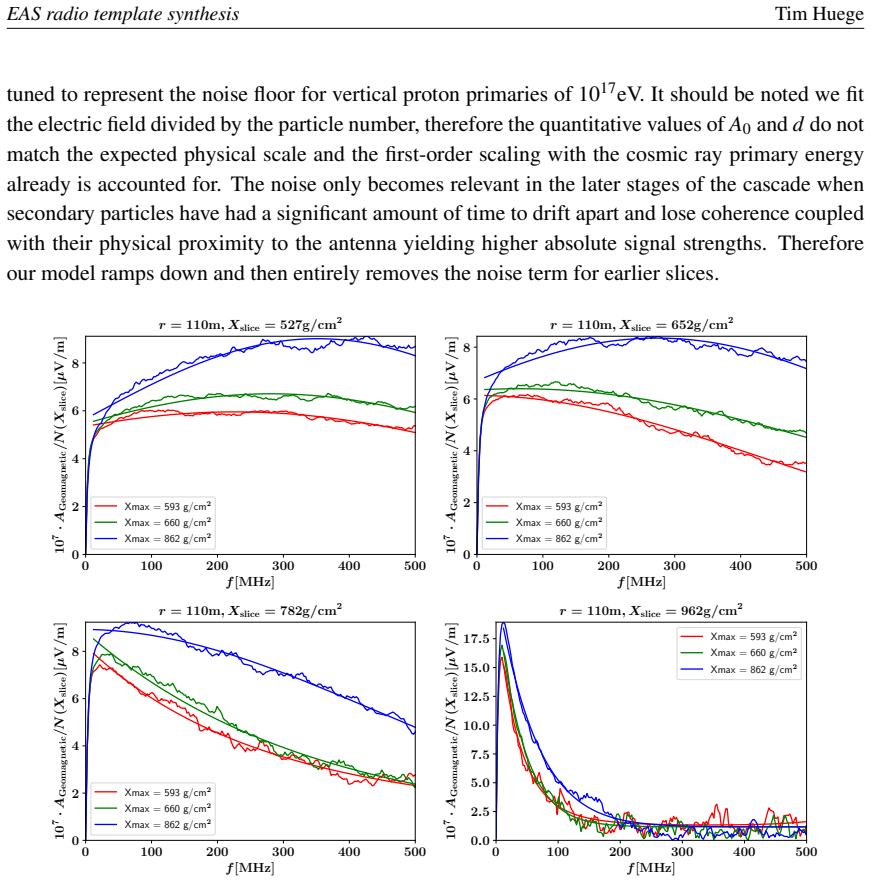
The central object is a longitudinal slice of the shower: particles in a narrow slant-depth interval $X$ to $X+\mathrm{d}X$ are treated as one macroscopic source, and their radio pulse is computed with the full endpoint formalism. Three pieces carry the argument. First, the particle number $N(X)$ along the cascade, well approximated by the Gaisser-Hillas function, supplies a first-order rescaling of each slice's amplitude. Second, the per-slice amplitude spectra, after division by $N(X)$, are fit with $A_{\mathrm{slice}}(f) = A_0\exp(b f + c f^2) + d$, where $d$ is a noise floor, so the fit captures how pulse shape and coherence evolve along the cascade. Third, the fitted coefficients $A_0$, $b$, $c$ are observed to depend smoothly on $X$, $r$, and $X_{\mathrm{max}}$, allowing analytic interpolation for arbitrary target showers. Summing the rescaled, spectrum-corrected slices yields the synthesized signal (Eq. 5.1).
What would settle it
Run air-shower simulations with substantially reduced thinning (or full particle tracking) for several primaries and energies, and compare the per-slice amplitude spectra and synthesized pulses against the model predictions; if the fitted coefficients $A_0$, $b$, $c$ for a given slice, antenna position, and $X_{\mathrm{max}}$ differ by more than the shower-to-shower fluctuations, or if the synthesized pulses diverge from the full-simulation result beyond the stated accuracy, the claimed universality fails.
Extended reading notes
Core claim
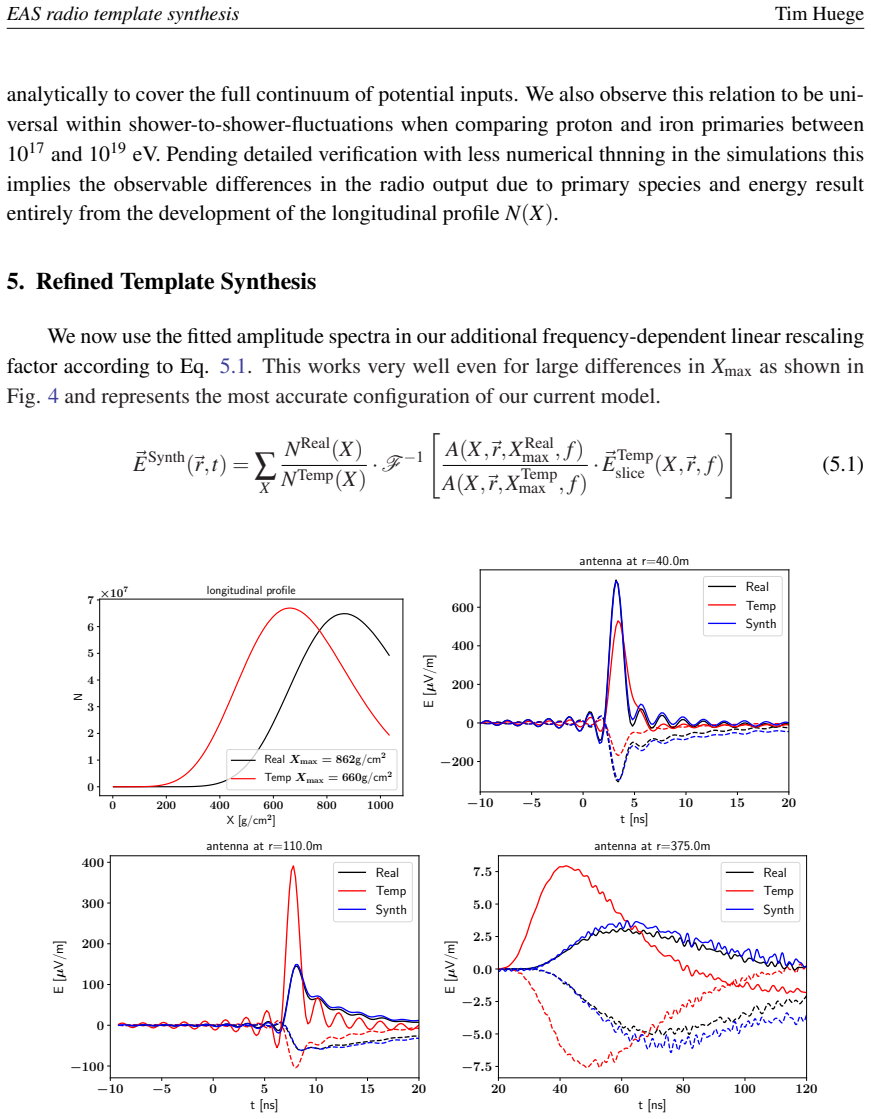
The paper's central claim is that the observable radio emission of a cosmic-ray air shower can be synthesized from template simulations by slicing the developing particle cascade into slabs of slant depth, rescaling each slab's simulated pulse by the particle-number ratio $N_{\mathrm{Real}}(X)/N_{\mathrm{Temp}}(X)$ (Eq. 3.2), and additionally multiplying the frequency-domain amplitude by a spectral correction built from fits of the form $A_0\exp(b f + c f^2) + d$ whose coefficients depend only on slant depth $X$, lateral distance $r$, and shower maximum $X_{\mathrm{max}}$ (Eq. 5.1). Within the controlled test conditions of vertical proton-induced showers at $10^{17}\ \mathrm{eV}$, the synthesized pulses reproduce the full simulation almost perfectly at lateral distances inside and on the Cherenkov ring, and to a good approximation also outside it, where a simpler no-correction synthesis and the spectral correction each have complementary strengths. The paper interprets this as evidence that the radio emission from small sections of an air shower is universal once accounted for by the longitudinal cascade profile and $X_{\mathrm{max}}$-dependent evolution.
Load-bearing premise
The load-bearing premise is that per-slice amplitude spectra, once normalized by particle number, are universal functions of only slant depth, lateral distance, and shower maximum, so coefficients fitted on a few simulated showers can be analytically interpolated to any target; the paper itself flags that this universality still needs detailed verification with less numerical thinning.
Editorial extensions
If this is right
- A shower-array experiment could compute radio predictions for many antennas per event without running a full simulation per antenna, removing a major computational bottleneck.
- Minimum-chi$^2$ reconstruction of shower maximum becomes feasible at higher primary energies where full Monte Carlo coverage is sparse.
- If the demonstrated accuracy holds generally, the model could replace Monte Carlo simulation in most common analysis methods, with synthesized pulses used as lookup templates.
- The apparent universality implies that primary species and energy differences are encoded entirely in the longitudinal profile $N(X)$, so the amplitude model may need calibration on only a small set of simulated showers.
- The near-perfect match inside the Cherenkov ring suggests the empirical correction captures real cascade-development effects, paving the way toward a fully analytical radio emission model.
Reading between the lines
- A natural testable extension would apply the synthesis to inclined showers, where the slant-depth slicing is not a simple function of altitude and the Cherenkov ring geometry changes; failure there would demarcate the model's validity.
- Because the correction is empirical, comparing its fitted coefficients to analytic expectations from coherent emission theory could reveal which cascade properties actually drive the spectral shape.
- The current slice-by-slice fit of $A_0$, $b$, $c$ could be replaced by a surrogate model to accelerate interpolation across the full parameter space of energy, species, zenith angle, and magnetic field geometry.
- The noise-floor term $d$ in Eq. 4.2, tuned for $10^{17}$ eV vertical protons, would need re-calibration for other primaries and geometries; quantifying the sensitivity of synthesis accuracy to this term would indicate when the model transfers.
Signed reviews
Editorial analysis
A structured set of objections, weighed in public.
Referee Report
Summary. The paper proposes a semi-analytical synthesis model for radio emission from cosmic-ray air showers. The authors slice CoREAS simulations of the particle cascade in slant depth X and rescale each slice's radio signal by the ratio of particle numbers between a target shower and a template shower (Eq. 3.2). To account for different cascade evolutions, they fit per-slice amplitude spectra with an exponential-plus-noise form (Eq. 4.1) and obtain analytic dependences of the fit coefficients on Xmax, which they then use as a frequency-domain correction factor in the refined synthesis (Eq. 5.1). The model is demonstrated for a vertical 10^17 eV proton shower with Xmax = 862 g/cm^2 synthesized from a template with Xmax = 660 g/cm^2, for antennas at 40 m, 110 m, and 375 m from the core. The paper concludes that a fast and precise radio signal synthesis model has been developed within the controlled test conditions.
Significance. If the claimed universality holds, the approach could substantially reduce the computational cost of predicting radio signals from air showers for arrays such as LOFAR and SKA, because it replaces full Monte Carlo simulations with a library of templates plus analytic rescaling. The paper's idea of treating individual cascade slices as universal radio emitters is interesting and complements existing work on integral observables. The authors are explicit that the universality of the per-slice amplitude spectra is pending verification with less numerical thinning, and that the current procedure is not yet suitable for automatic bulk application. These caveats are appropriately stated, but they also delimit the validity of the central claim.
major comments (3)
- [Section 4, Eqs. (4.1) and (4.2)] The load-bearing premise of the refined synthesis is that the per-slice amplitude spectra, after fitting Eq. (4.1) with the noise floor of Eq. (4.2), are universal functions of X, r, and Xmax for proton and iron primaries between 10^17 and 10^19 eV. The paper itself states this is 'pending detailed verification with less numerical thinning in the simulations.' Since the fit coefficients A0, b, and c are extracted from CoREAS simulations that use numerical thinning, and since the paper reports fit divergences for X > 950 g/cm^2 where noise dominates, it is not established that the fitted coefficient surfaces are properties of the air shower rather than artifacts of the thinning settings. If thinning changes A0, b, or c, the analytic Xmax interpolation used in Eq. (5.1) is not controlled. The authors should either demonstrate insensitivity of the fitted coefficients to thinning or remove the universality claim until such a test is performed.
- [Sections 3-5, Figs. 2 and 4] The validation shown in Figs. 2 and 4 uses one 'real' shower (Xmax = 862 g/cm^2) and one template shower (Xmax = 660 g/cm^2) for a single geometry (vertical proton, 10^17 eV). The manuscript does not state whether the 'real' shower was excluded from the sample used to fit the Xmax dependences of A0, b, and c. If it was not excluded, then part of the agreement in Fig. 4 is a re-description of the fit rather than a prediction. The authors should clarify this and, ideally, validate on a held-out shower from a different primary species or energy. Quantitative error metrics (e.g., relative trace difference or cross-correlation between real and synthesized pulses) should also be reported, because the current 'near-perfect' and 'almost perfectly' claims rest on visual inspection of overlaid time series.
- [Section 5, Fig. 4] The paper acknowledges that the refined synthesis is less accurate at large lateral distances (r = 375 m) than the simple rescaling of Eq. (3.2), and that the current procedure is 'not yet suitable for automatic bulk application.' This directly qualifies the central claim of a fast and precise synthesis model. The authors should quantify the accuracy of both the simple and refined methods across the full lateral range and specify the domain in which the refined method is preferable to the simple rescaling. In particular, the loss of accuracy at low frequencies (below 20 MHz) should be characterized, because it affects the practical bandwidth used by radio detectors.
minor comments (4)
- [Section 4] There is a typo in the phrase 'less numerical thnning in the simulations'; it should read 'less numerical thinning.'
- [Introduction] The notation '⃗v×⃗v× ⃗B' on page 1 would be clearer as 'v⃗ × (v⃗ × B⃗)' to avoid ambiguity about the cross-product order.
- [Eq. (5.1)] The inverse Fourier transform operator F^{-1} is not defined in the text; it should be explicitly identified as the inverse Fourier transform with respect to frequency f.
- [Figures 2 and 4] The figure captions do not state the simulation settings (thinning level, number of antennas, bandpass details) used to produce the overlays; adding these would make the comparison reproducible.
Circularity Check
Validation shower is in the coefficient-fit sample: Eq. 5.1's correction interpolates the target's own fitted spectrum, so the displayed synthesis is partly in-sample.
-
fitted input called prediction
[Section 4 (coefficient fitting) and Section 5, Eq. (5.1), Fig. 4; cf. Fig. 3]
"For our refined synthesis model we compare the spectral coefficients A0, b and c for many showers to their respective shower maximum Xmax and derive an analytic fit for each slice and antenna position separately. … We now use the fitted amplitude spectra in our additional frequency-dependent linear rescaling factor according to Eq. 5.1."
The correction factor in Eq. 5.1 is A(X,r,Xmax_real,f)/A(X,r,Xmax_temp,f), where A is the analytic surface obtained by fitting Eq. 4.1 to slice amplitude spectra of simulated showers. The validation 'Real' shower in Fig. 4 has Xmax=862 g/cm2, and the same Xmax=862 g/cm2 is one of the fitted cases displayed in Fig. 3. The paper does not state that this Real shower was excluded from the coefficient fits. Therefore the successful 'synthesis' is an interpolation of the fitted spectral surface evaluated at the target shower's own Xmax, not an independent out-of-sample prediction; the agreement partly reduces to the fit from which the target's correction was derived.
full rationale
The simple rescaling chain (Eqs. 3.1-3.2) is not circular: it is a physical N(X)-ratio rescaling of template slices and can be applied to a target once the target's longitudinal profile is known. The refined correction is where the problem lies. In Sec. 4 the authors fit the slice amplitude spectra of 'many showers' with Eq. 4.1 and interpolate the coefficients A0, b, c as functions of X, r, Xmax. They then validate Eq. 5.1 against a 'Real' shower with Xmax=862 g/cm2 (Fig. 4) using a template with Xmax=660 g/cm2. The same Xmax=862 g/cm2 case is among the fitted spectra shown in Fig. 3. Since the paper never states that this Real shower was excluded from the coefficient fits, the match in Fig. 4 is an interpolation of the fitted spectral surface, i.e. an in-sample check. The central claim is therefore partly a re-description of the fit rather than an out-of-sample prediction. The universality of the per-slice spectra (Sec. 4) is explicitly left pending verification with less numerical thinning; that is an unvalidated premise, not a circular step. No load-bearing self-citation chains or imported uniqueness theorems are present. Overall: partial circularity in the validation of the refined synthesis, but the template concept itself has independent physical content.
Assumptions & free parameters
free parameters (2)
- Per-slice, per-antenna spectral coefficients A0, b, c =
Fitted to CoREAS slice spectra; Xmax dependence from analytic fits
- Noise floor parameter d for late slices =
Tuned expression in Eq. 4.2 for vertical protons at 10^17 eV
assumptions (5)
- domain assumption CoREAS endpoint formalism correctly computes coherent radio emission from the simulated particle cascade
- domain assumption Only electrons and positrons contribute to the radio signal
- domain assumption The direct sum of slice signals equals the physical field at every antenna position
- domain assumption Within a slice, the coherent electric field is directly proportional to the particle number N(X)
- ad hoc to paper Per-slice amplitude spectra are universal functions of X, r, and Xmax across primary species and energy
Cite this review
Pith. "Pith review of Universality and template synthesis of cosmic ray air shower radio emission." pith.science (2026). https://pith.science/paper/OFNMUX4X
@misc{pith2026190809543,
  author       = {Pith},
  title        = {Pith review of: Universality and template synthesis of cosmic ray air shower radio emission},
  year         = {2026},
  howpublished = {\url{https://pith.science/paper/OFNMUX4X}},
  note         = {Machine review of arXiv:1908.09543}
}
read the original abstract
Accurate prediction of the radio emission from cosmic ray air showers relies on computationally demanding Monte Carlo simulations such as CoREAS. We aim to expedite this process via a semi-analytical synthesis model while maintaining high accuracy by using simulated radio pulses as templates. We present our key concept for template processing focusing on the development of the particle cascade and its empirical effect on the locally produced radio signal. In this context the universality of the radio emission from small sections of an air shower also becomes important where most previous studies focus on integral quantities observable at far distances.
Figures


Figures from the paper (1 more)
Reference graph
Works this paper leans on
- [9]
- [1]
-
[2]
T. Huege. In: Physics Reports 620 (Mar. 2016), pp. 1–52
work page 2016
-
[3]
E. Holt. “Simulationsstudie für ein großskaliges Antennenfeld zur Detektion von Radioe- mission ausgedehnter Luftschauer”. Diploma Thesis. KIT, 2013
work page 2013
-
[4]
O. Scholten, K. Werner, and F. Rusydi. In: Astropart. Phys. 29 (2008), pp. 94–103
work page 2008
-
[5]
K. D. de Vries et al. In: Phys. Rev. Letters 107.6, 061101 (Aug. 2011), p. 061101
work page 2011
- [6]
- [7]
Show all 12 references
-
[8]
T. K. Gaisser and A. M. Hillas. In: ICRC 8 (Jan. 1977), p. 353
1977
-
[10]
Huege and H
T. Huege and H. Falcke. In: Astroparticle Physics 24.1-2 (Sept. 2005), pp. 116–136
2005
-
[11]
Welling, C
C. Welling, C. Glaser, and A. Nelles. In: arXiv e-prints (May 2019), arXiv:1905.11185
2019 arXiv
-
[12]
Buitink et al
S. Buitink et al. In: Phys. Rev. D 90.8, 082003 (Oct. 2014), p. 082003. 7
2014
Reviewed August 14, 2026 · model on record in the stance chip above.
Discussion (0). Continue with ORCID to comment.