REVIEW 2 major objections 7 minor 44 references
Constructing Self-motivated Pyramid Curriculums for Cross-Domain Semantic Segmentation: A Non-Adversarial Approach
T0 review · 2 major / 7 minor · reviewed 2026-08-14 · deepseek-v4-flash
Pith's one-line read A segmentation network can adapt to a new visual domain by building a self-made pyramid of pixel, patch, and whole-image pseudo-labels, matching adversarial methods without a discriminator.
desk verdict The CDA/ST connection is the real contribution and the ablation is convincing, but the SOTA claim is not protocol-matched, so the exact numbers need a rerun before they can be taken at face value. read the letter →
The pith
A machine-rendered reading of the paper's core claim, the machinery that carries it, and where it could break.
The reading
What carries the argument
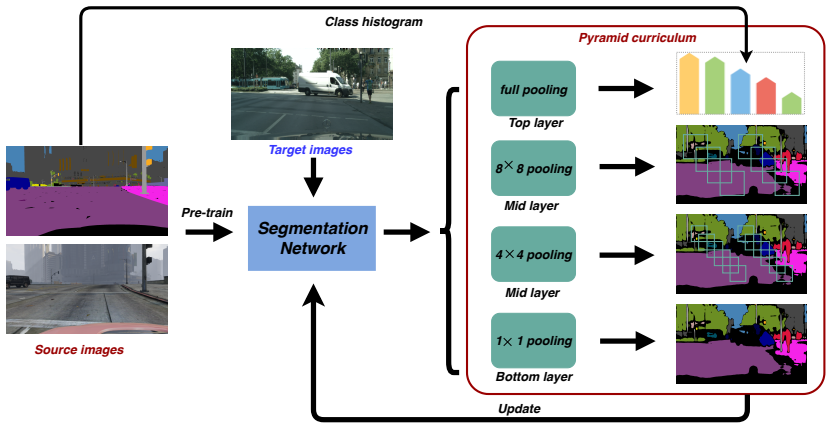
The load-bearing object is the self-motivated pyramid curriculum. At each iteration, the network's pixel-wise softmax output is thresholded to select confident pixel pseudo-labels, average-pooled over 4x4 and 8x8 squares and thresholded to label each square, and averaged over the whole image to produce a class distribution. Each layer contributes a cross-entropy term to the loss—the top layer with weight λ1 = 1, the combined pixel and square layers with weight λ2 = 0.5—alongside the source-domain cross-entropy. Because the properties are derived from the network's own earlier predictions, no logistic regression, support vector machine, or discriminator network is needed.
What would settle it
Compute the precision of the pseudo-labels generated by Eq. (3) against manual labels on a held-out subset of target images (e.g., Cityscapes validation) during the first fine-tuning iterations. If the confident predictions disagree with manual labels at a rate comparable to the final misclassification rate, the self-training signal is corrupted; likewise, if removing all pseudo-label layers changes mIoU negligibly, the pyramid's contribution is not the claimed one.
Extended reading notes
Core claim
PyCDA's central claim is that curriculum domain adaptation and self-training are the same algorithm at different granularities: both push the network's predictions toward a target-domain property via cross-entropy, whether that property is a whole-image or region label distribution (curriculum adaptation) or a per-pixel pseudo-label (self-training). The paper's method unions the two sets of properties into a three-level pyramid. The bottom layer is a set of pixels whose argmax softmax probability exceeds 0.5; the middle layers are 4x4 and 8x8 squares labeled by thresholding the average-pooled prediction; the top layer is a full-image class distribution equal to the mean of the source label distributions. All three layers are inferred from the segmentation network itself and applied as cross-entropy losses to update it. The paper reports that PyCDA outperforms the original curriculum adaptation and self-training and rivals or beats adversarial methods on the two benchmark settings, with mean intersection-over-union (mIoU) of 47.4 on GTAV→Cityscapes and 53.3 on SYNTHIA→Cityscapes using a ResNet-101 backbone.
Load-bearing premise
The load-bearing premise is that the network's own confident predictions on unlabeled target images, thresholded at 0.5, are accurate enough to serve as pseudo ground truth; if those predictions are systematically biased, the curriculum reinforces the bias rather than correcting it.
Editorial extensions
If this is right
- Any segmentation network with a pixel-wise softmax can be adapted with this recipe; the extra machinery is an average-pooling layer and thresholding, so training remains a single-network optimization.
- Because the pyramid layers are populated by the network's own confident predictions, the method sidesteps the minmax optimization and the discriminator tuning that adversarial domain adaptation requires.
- The reported results on GTAV→Cityscapes (mIoU 47.4 with ResNet-101) and SYNTHIA→Cityscapes (mIoU* 53.3) place PyCDA at or above adversarial baselines, indicating that posterior regularization alone is competitive in this setting.
- The ablation shows that each layer contributes: 'top + bottom' and 'top + pixel squares' both beat CDA and ST alone, and the full pyramid improves further, so the benefit comes from combining granularities.
- The superpixel-based curriculum of CDA can be replaced by fixed pixel squares of 4x4 and 8x8 with comparable accuracy and much lower computation, making the curriculum practical at scale.
Reading between the lines
- The same 'self-motivated' trick could be applied to other dense prediction tasks: any model that emits per-pixel probabilities could generate its own curriculum of region-level pseudo-labels, for example for depth estimation or panoptic segmentation.
- The fixed 0.5 threshold and the source-mean top-layer prior are the two free choices most likely to limit generalization; adapting the threshold per class or estimating the target prior online from the network's own predictions would be natural extensions.
- Since PyCDA is orthogonal to image-level style transfer and adversarial feature alignment, combining it with those methods should improve further—the paper itself notes its results could be boosted by style transfer.
- For target domains whose class distribution differs sharply from the source (for instance, a city with different road layouts), the top-layer prior transferred from the source mean could mislead training; a target-aware prior is a plausible robustness fix.
Signed reviews
Editorial analysis
A structured set of objections, weighed in public.
Referee Report
Summary. This paper proposes PyCDA, a non-adversarial method for unsupervised domain adaptation of semantic segmentation networks from synthetic source domains to real target domains. The method unifies curriculum domain adaptation (CDA) and self-training (ST) by constructing a three-level pyramid of target-domain properties: pixel-level pseudo-labels thresholded from the network's softmax output (Eq. 3), pseudo-labels for small squared regions obtained by average-pooled predictions (Eq. 4), and a full-image class distribution that is taken from the mean source-domain label distribution. The training objective in Eq. 5 combines source cross-entropy with cross-entropy losses on these pyramid properties. Experiments on GTA V to Cityscapes and SYNTHIA to Cityscapes report state-of-the-art mIoU numbers with VGG-16, ResNet-38, and ResNet-101 backbones, and ablations show that each pyramid layer contributes to the final result.
Significance. The conceptual connection between curriculum domain adaptation and self-training is genuinely interesting, and the resulting algorithm is simple, well specified, and computationally lighter than adversarial alternatives. If the empirical claims hold under a matched protocol, this would be a valuable contribution: it would demonstrate that a carefully constructed pseudo-label pyramid can rival or exceed adversarial output-space alignment without a discriminator or minimax optimization. The paper also includes useful ablations, including a comparison between pixel squares and superpixels and a sensitivity study over square sizes in the appendix. However, the headline state-of-the-art claim currently rests on a comparison protocol in which PyCDA trains on fewer target images than the prior baselines, so the central empirical claim is not yet established as apples-to-apples.
major comments (2)
- [§4.1, Tables 1 and 2] The headline comparison is not protocol-matched. Section 4.1 states that 500 Cityscapes training images are randomly selected for validation and only the remaining 2,475 images serve as unlabeled target training data, and both table captions explicitly note that all prior methods except CDA use the full 2,975-image training set and do not hold out a validation set. Because the amount of unlabeled target data is a well-known factor in unsupervised domain adaptation, the reported mIoU advantages over ROAD, CyCADA, CLAN, ADVENT, and OutputAdapt do not by themselves establish that PyCDA is state of the art. The authors should provide a matched comparison: either train PyCDA on all 2,975 target images (with model selection performed without excluding a fixed 500-image split from training, or with the split used only for early stopping after training on all images) and evaluate on the same Cityscapes validation set, or report baseline numbers under the reduced 2,475-image protocol. In addition, the test-stage adabn step described in Section 4.1 should be stated for each baseline; if adabn is applied only to PyCDA, its isolated contribution should be quantified by an ablation without adabn.
- [§3.2, Eq. (3)] The entire pyramid below the top layer is generated from the network's own softmax outputs after thresholding at 0.5 (Eq. 3), so the method's success hinges on the pseudo-labels being sufficiently accurate. The paper provides no sensitivity analysis for this threshold, no report of pseudo-label precision or recall during training, and no ablation comparing Eq. (3) with alternative self-paced policies such as the class-balanced scheme in [43]. Since biased pseudo-labels can reinforce systematic errors in self-training, the robustness of the reported gains to this design choice should be demonstrated, for example by sweeping the threshold in {0.3, 0.5, 0.7} and by measuring the agreement of accepted pseudo-labels with the network's final predictions or with confident regions of the source-trained model.
minor comments (7)
- [§3.2] There is a typo in the sentence about superpixels versus pixel squares: "as demonstrated beblow" should read "as demonstrated below."
- [Eq. (5)] The definition of P in Eq. (5) is confusing because P^1_t was introduced in Eq. (1) for CDA as label distributions over images or regions, while in Eq. (5) it appears to denote only the pixel-square layers; please clarify which layers are included in P and why the top-layer full-image distribution is handled by the separate second term.
- [Figure 2] The pooling labels in Figure 2 should be written as 1x1, 4x4, 8x8, and full pooling rather than "1 1 pooling", "4 4 pooling", and "8 8 pooling" for readability.
- [Tables 1 and 2] Some cell values are missing or not directly comparable across methods (for example, FCAN reports only the overall mIoU and uses original-resolution inputs, and OutputAdapt is pretrained on MS COCO in addition to ImageNet); a short note summarizing which numbers are cited from original papers and which are rerun under the current implementation would improve transparency.
- [Section 4.2] The sentence "PyCDA gives rise to the best results thus far" should be qualified as "best among the compared protocols" until the matched comparison requested above is provided.
- [References] Reference [30] is formatted inconsistently with the other entries; the author names should follow the same surname-initial style used throughout the bibliography.
- [General] No code or random-seed information is provided; a reproducibility statement with code release, training details for each backbone, and the number of runs would substantially strengthen the paper.
Circularity Check
No significant circularity: the paper's derivation is self-contained and its claims are benchmarked against external test labels; the self-training loop is the method, not a hidden reduction.
full rationale
The paper's central mechanism is self-training: the segmentation network generates thresholded pseudo-labels (Eq. 3 and the analogous pooled-square rule) and is then trained to match them (Eq. 5). This is an explicitly stated algorithmic loop, not a disguised derivation of a result from its own conclusion. The 'desired' top-layer label distribution is taken from the source domain ('we transfer to it the mean of the label distributions of all source domain images'), so it is a source statistic rather than a target-fitted quantity. The middle-layer pseudo-labels are averages of the network's own predictions, again an explicit self-training design. No parameter is fitted to the reported test numbers; hyperparameters (lambda1 = 1, lambda2 = 0.5, learning rate) are set via a held-out validation split. The paper cites prior work by a co-author (CDA, [38,39]), but that work is an externally published method with its own reported results, and the present paper improves on it while also comparing against adversarial methods; the self-citation is not load-bearing. The only serious concern is that the SOTA comparison is not protocol-matched because PyCDA trains on 2,475 target images while most baselines use all 2,975, but that is an experimental-design caveat affecting fairness of comparison, not circularity in the derivation. No equation is shown to equal another by construction, and no fitted parameter is renamed as a prediction. Therefore no circular step meets the evidentiary bar.
Assumptions & free parameters
free parameters (5)
- lambda_1 =
1
- lambda_2 =
0.5
- pseudo_label_threshold =
0.5
- pixel_square_sizes =
4x4 and 8x8
- initial_learning_rate =
0.016
assumptions (4)
- domain assumption The mean label distribution of the source domain transfers to the target domain.
- domain assumption The network's high-confidence predictions are reliable enough to serve as pseudo-labels.
- domain assumption Small pixel squares mostly cover a single semantic class.
- ad hoc to paper Combining the CDA and ST regularizers with fixed hyperparameters improves adaptation.
Cite this review
Pith. "Pith review of Constructing Self-motivated Pyramid Curriculums for Cross-Domain Semantic Segmentation: A Non-Adversarial Approach." pith.science (2026). https://pith.science/paper/42DJ6LSX
@misc{pith2026190809547,
  author       = {Pith},
  title        = {Pith review of: Constructing Self-motivated Pyramid Curriculums for Cross-Domain Semantic Segmentation: A Non-Adversarial Approach},
  year         = {2026},
  howpublished = {\url{https://pith.science/paper/42DJ6LSX}},
  note         = {Machine review of arXiv:1908.09547}
}
read the original abstract
We propose a new approach, called self-motivated pyramid curriculum domain adaptation (PyCDA), to facilitate the adaptation of semantic segmentation neural networks from synthetic source domains to real target domains. Our approach draws on an insight connecting two existing works: curriculum domain adaptation and self-training. Inspired by the former, PyCDA constructs a pyramid curriculum which contains various properties about the target domain. Those properties are mainly about the desired label distributions over the target domain images, image regions, and pixels. By enforcing the segmentation neural network to observe those properties, we can improve the network's generalization capability to the target domain. Motivated by the self-training, we infer this pyramid of properties by resorting to the semantic segmentation network itself. Unlike prior work, we do not need to maintain any additional models (e.g., logistic regression or discriminator networks) or to solve minmax problems which are often difficult to optimize. We report state-of-the-art results for the adaptation from both GTAV and SYNTHIA to Cityscapes, two popular settings in unsupervised domain adaptation for semantic segmentation.
Figures

Figures from the paper (1 more)

Reference graph
Works this paper leans on
-
[43]
Vijaya Kumar, and Jinsong Wang
Yang Zou, Zhiding Yu, B.V .K. Vijaya Kumar, and Jinsong Wang. Unsupervised domain adaptation for semantic seg- mentation via class-balanced self-training. In ECCV, 2018. 2, 3, 4, 5, 6, 7 Appendix
work page 2018
-
[1]
Liang-Chieh Chen, George Papandreou, Iasonas Kokkinos, Kevin Murphy, and Alan L. Yuille. Deeplab: Semantic im- age segmentation with deep convolutional nets, atrous con- volution, and fully connected crfs. IEEE Transactions on Pattern Analysis and Machine Intelligence , 40(4):834–848,
-
[2]
Rethinking atrous convolution for seman- tic image segmentation
Liang-Chieh Chen, George Papandreou, Florian Schroff, and Hartwig Adam. Rethinking atrous convolution for seman- tic image segmentation. arXiv preprint arXiv:1706.05587 ,
-
[3]
Encoder-decoder with atrous separable convolution for semantic image segmentation
Liang-Chieh Chen, Yukun Zhu, George Papandreou, Florian Schroff, and Hartwig Adam. Encoder-decoder with atrous separable convolution for semantic image segmentation. In ECCV, 2018. 1, 2
work page 2018
-
[4]
Road: Reality ori- ented adaptation for semantic segmentation of urban scenes
Yuhua Chen, Wen Li, and Luc Van Gool. Road: Reality ori- ented adaptation for semantic segmentation of urban scenes. In CVPR, 2018. 2, 3, 5, 6, 7
work page 2018
-
[5]
No more discrimi- nation: Cross city adaptation of road scene segmenters
Yi-Hsin Chen, Wei-Yu Chen, Yu-Ting Chen, Bo-Cheng Tsai, Yu-Chiang Frank Wang, and Min Sun. No more discrimi- nation: Cross city adaptation of road scene segmenters. In ICCV, 2017. 2
work page 2017
-
[6]
The cityscapes dataset for semantic urban scene understanding
Marius Cordts, Mohamed Omran, Sebastian Ramos, Timo Rehfeld, Markus Enzweiler, Rodrigo Benenson, Uwe Franke, Stefan Roth, and Bernt Schiele. The cityscapes dataset for semantic urban scene understanding. In CVPR,
-
[7]
Curriculum model adaptation with synthetic and real data for semantic foggy scene understanding
Dengxin Dai, Christos Sakaridis, Simon Hecker, and Luc Van Gool. Curriculum model adaptation with synthetic and real data for semantic foggy scene understanding. Interna- tional Journal of Computer Vision, pages 1–23, 2019. 2
work page 2019
Show all 44 references
-
[8]
Tsang, and Dong Xu
Lixin Duan, Ivor W. Tsang, and Dong Xu. Domain trans- fer multiple kernel learning. IEEE Transactions on Pattern Analysis and Machine Intelligence, 34(3):465–479, 2012. 2
2012
-
[9]
Tsang, and Jiebo Luo
Lixin Duan, Dong Xu, Ivor W. Tsang, and Jiebo Luo. Visual event recognition in videos by learning from web data.IEEE Transactions on Pattern Analysis and Machine Intelligence, 34(9):1667–1680, 2012. 2
2012
-
[10]
Mark Everingham, S. M. Ali EslamiEmail, Luc Van Gool, Christopher K. I. Williams, John Winn, and Andrew Zisser- man. The pascal visual object classes challenge: A retrospec- tive. International Journal of Computer Vision , 111(1):98– 136, 2015. 6
2015
-
[11]
Self- ensembling for visual domain adaptation
Geoff French, Michal Mackiewicz, and Mark Fisher. Self- ensembling for visual domain adaptation. In ICLR, 2018. 2
2018
-
[12]
Learn- ing attributes equals multi-source domain generalization
Chuang Gan, Tianbao Yang, and Boqing Gong. Learn- ing attributes equals multi-source domain generalization. In CVPR, 2016. 2
2016
-
[13]
Domain-adversarial train- ing of neural networks
Yaroslav Ganin, Evgeniya Ustinova, Hana Ajakan, Pas- cal Germain, Hugo Larochelle, Franc ¸ois Laviolette, Mario Marchand, and Victor Lempitsky. Domain-adversarial train- ing of neural networks. Journal of Machine Learning Re- search, 17(59):1–35, 2016. 2
2016
-
[14]
Connecting the dots with landmarks: Discriminatively learning domain- invariant features for unsupervised domain adaptation
Boqing Gong, Kristen Grauman, and Fei Sha. Connecting the dots with landmarks: Discriminatively learning domain- invariant features for unsupervised domain adaptation. In ICML, 2013. 2
2013
-
[15]
Geodesic flow kernel for unsupervised domain adaptation
Boqing Gong, Yuan Shi, Fei Sha, and Kristen Grauman. Geodesic flow kernel for unsupervised domain adaptation. In CVPR, 2012. 2
2012
-
[16]
Deep residual learning for image recognition
Kaiming He, Xiangyu Zhang, Shaoqing Ren, and Jian Sun. Deep residual learning for image recognition. In CVPR,
-
[17]
Efros, and Trevor Dar- rell
Judy Hoffman, Eric Tzeng, Taesung Park, Jun-Yan Zhu, Phillip Isola, Kate Saenko, Alexei A. Efros, and Trevor Dar- rell. Cycada: Cycle consistent adversarial domain adapta- tion. In ICML, 2018. 2, 3, 5, 6
2018
-
[18]
Fcns in the wild: Pixel-level adversarial and constraint-based adaptation
Judy Hoffman, Dequan Wang, Fisher Yu, and Trevor Darrell. Fcns in the wild: Pixel-level adversarial and constraint-based adaptation. arXiv preprint arXiv:1612.02649, 2016. 2, 7
2016 arXiv
-
[19]
Conditional generative adversarial network for struc- tured domain adaptation
Weixiang Hong, Zhenzhen Wang, Ming Yang, and Junsong Yuan. Conditional generative adversarial network for struc- tured domain adaptation. In CVPR, 2018. 2
2018
-
[20]
Adaptive batch normalization for practical do- main adaptation
Yanghao Li, Naiyan Wang, Jianping Shi, Xiaodi Hou, and Jiaying Liu. Adaptive batch normalization for practical do- main adaptation. Pattern Recognition, 80:109–117, 2018. 6
2018
-
[21]
RefineNet: Multi-path refinement networks for high- resolution semantic segmentation
Guosheng Lin, Anton Milan, Chunhua Shen, and Ian Reid. RefineNet: Multi-path refinement networks for high- resolution semantic segmentation. In CVPR, 2017. 1
2017
-
[22]
Lawrence Zitnick
Tsung-Yi Lin, Michael Maire, Serge Belongie, James Hays, Pietro Perona, Deva Ramanan, Piotr Dollr, and C. Lawrence Zitnick. Microsoft coco: Common objects in context. In ECCV, 2014. 6, 7
2014
-
[23]
Fully convolutional networks for semantic segmentation
Jonathan Long, Evan Shelhamer, and Trevor Darrell. Fully convolutional networks for semantic segmentation. In CVPR, 2015. 1, 2, 6
2015
-
[24]
Mingsheng Long, Yue Cao, Jianmin Wang, and Michael I. Jordan. Learning transferable features with deep adaptation networks. In ICML, 2015. 2
2015
-
[25]
Mingsheng Long, Han Zhu, Jianmin Wang, and Michael I. Jordan. Deep transfer learning with joint adaptation net- works. In ICML, 2017. 2
2017
-
[26]
Taking a closer look at domain shift: Category- level adversaries for semantics consistent domain adaptation
Yawei Luo, Liang Zheng, Tao Guan, Junqing Yu, and Yi Yang. Taking a closer look at domain shift: Category- level adversaries for semantics consistent domain adaptation. arXiv preprint arXiv:1809.09478, 2018. 2, 3, 5, 6, 7
2018 arXiv
-
[27]
Image to image translation for domain adaptation
Zak Murez, Soheil Kolouri, David Kriegman, Ravi Ra- mamoorthi, and Kyungnam Kim. Image to image translation for domain adaptation. In CVPR, 2018. 2, 3
2018
-
[28]
Richter, Vibhav Vineet, Stefan Roth, and Vladlen Koltun
Stephan R. Richter, Vibhav Vineet, Stefan Roth, and Vladlen Koltun. Playing for data: Ground truth from computer games. In ECCV, 2016. 1, 5
2016
-
[29]
German Ros, Laura Sellart, Joanna Materzynska, David Vazquez, and Antonio M. Lopez. The synthia dataset: A large collection of synthetic images for semantic segmenta- tion of urban scenes. In CVPR, 2016. 5
2016
-
[30]
A dirt-t approach to unsupervised domain adaptation
Shu Rui, Bui Hung H., Narui Hirokazu, and Ermon Stefano. A dirt-t approach to unsupervised domain adaptation. In ICLR, 2018. 2
2018
-
[31]
Imagenet large scale visual recognition challenge
Olga Russakovsky, Jia Deng, Hao Su, Jonathan Krause, San- jeev Satheesh, Sean Ma, Zhiheng Huang, Andrej Karpathy, Aditya Khosla, Michael Bernstein, and et al. Imagenet large scale visual recognition challenge. International Journal of Computer Vision, 115(3):211–252, 2015. 6, 7
2015
-
[32]
Maximum classifier discrepancy for unsuper- vised domain adaptation
Kuniaki Saito, Kohei Watanabe, Yoshitaka Ushiku, and Tat- suya Harada. Maximum classifier discrepancy for unsuper- vised domain adaptation. In CVPR, 2018. 2, 6
2018
-
[33]
Learning from synthetic data: Addressing domain shift for semantic segmentation
Swami Sankaranarayanan, Yogesh Balaji, Arpit Jain, Ser Nam Lim, and Rama Chellappa. Learning from synthetic data: Addressing domain shift for semantic segmentation. In CVPR, 2018. 2, 3
2018
-
[34]
Very deep convo- lutional networks for large-scale image recognition
Karen Simonyan and Andrew Zisserman. Very deep convo- lutional networks for large-scale image recognition. arXiv preprint arXiv:1409.1556, 2014. 6
2014 arXiv
-
[35]
Learning to adapt structured output space for semantic seg- mentation
Yi-Hsuan Tsai, Wei-Chih Hung, Samuel Schulter, Ki- hyuk Sohn, Ming-Hsuan Yang, and Manmohan Chandraker. Learning to adapt structured output space for semantic seg- mentation. In CVPR, 2018. 2, 3, 5, 6, 7
2018
-
[36]
Advent: Adversarial entropy mini- mization for domain adaptation in semantic segmentation
Tuan-Hung Vu, Himalaya Jain, Maxime Bucher, Matthieu Cord, and Patrick Perez. Advent: Adversarial entropy mini- mization for domain adaptation in semantic segmentation. In CVPR, 2019. 5, 6, 7
2019
-
[37]
Wider or deeper: Revisiting the resnet model for visual recognition
Zifeng Wu, Chunhua Shen, and Anton van den Hengel. Wider or deeper: Revisiting the resnet model for visual recognition. arXiv preprint arXiv:1611.10080, 2016. 6
2016 arXiv
-
[38]
A curriculum domain adaptation approach to the se- mantic segmentation of urban scenes
Yang Zhang, Philip David, Hassan Foroosh, and Boqing Gong. A curriculum domain adaptation approach to the se- mantic segmentation of urban scenes. IEEE Transactions on Pattern Analysis and Machine Intelligence, pages 1–1, 2019. 2, 3, 4, 5, 6, 7
2019
-
[39]
Curricu- lum domain adaptation for semantic segmentation of urban scenes
Yang Zhang, Philip David, and Boqing Gong. Curricu- lum domain adaptation for semantic segmentation of urban scenes. In ICCV, 2017. 2
2017
-
[40]
Fully convolutional adaptation networks for semantic segmentation
Yiheng Zhang, Zhaofan Qiu, Ting Yao, Dong Liu, and Tao Mei. Fully convolutional adaptation networks for semantic segmentation. In CVPR, 2018. 2, 3, 5, 6, 7
2018
-
[41]
Pyramid scene parsing network
Hengshuang Zhao, Jianping Shi, Xiaojuan Qi, Xiaogang Wang, and Jiaya Jia. Pyramid scene parsing network. In CVPR, 2017. 1, 2, 6
2017
-
[42]
Penalizing top performers: Conservative loss for semantic segmentation adaptation
Xinge Zhu, Hui Zhou, Ceyuan Yang, Jianping Shi, and Dahua Lin. Penalizing top performers: Conservative loss for semantic segmentation adaptation. In ECCV, 2018. 2, 3
2018
-
[44]
top + bot- tom
Number of middle layers Table 1: Results (mIoUs%) on GTA V to Cityscapes ob- tained by inserting different middle layers to the pyramid. Square Size - +4 +8 +16 +32 +64 +128 mIoU 46.3 46.9 47.4 47.5 47.5 47.3 47.0 We report in Table 1 the experimental results of differ- ent nu...
Reviewed August 14, 2026 · model on record in the stance chip above.
Discussion (0). Continue with ORCID to comment.