REVIEW 3 major objections 4 minor 56 references
Data-driven retrieval of primary plane-wave responses
T0 review · 3 major / 4 minor · reviewed 2026-08-14 · deepseek-v4-flash
Pith's one-line read A data-domain Marchenko scheme, adapted to plane-wave sources, retrieves transmission-loss-compensated primary reflection responses directly from point-source data, enabling multiple-free reverse time migration without model information…
desk verdict Plane-wave extension of data-domain Marchenko is a genuine, if incremental, advance; the dipping-wave approximation needs quantification and the validation needs metrics before it's fully convincing. read the letter →
The pith
A machine-rendered reading of the paper's core claim, the machinery that carries it, and where it could break.
The reading
What carries the argument
The machinery is the projected Marchenko focusing function: the up-going projected focusing function $V^-(\mathbf{x}'_0, t, \bar{T}_2)$ is defined by integrating the subsurface focusing function against the direct transmission response, so that the unknowns live entirely at the acquisition surface. It is retrieved by solving the coupled equations $V^- = \Theta R_{\mathrm{PW}} + \Theta R V^+_m$ and $V^+_m = \Theta R^\star V^-$, which combine into the Neumann series above. The load-bearing identity is that the final event of $V^-$ at the window boundary is the transmission-loss-compensated primary in the plane-wave response; this makes the method fully data-driven, with no velocity model, no picking, and no adaptive subtraction. The same linear operator $I - \Theta R \Theta R^\star$ is applied to every gather, which is why plane-wave and blended-source data can be processed simultaneously.
What would settle it
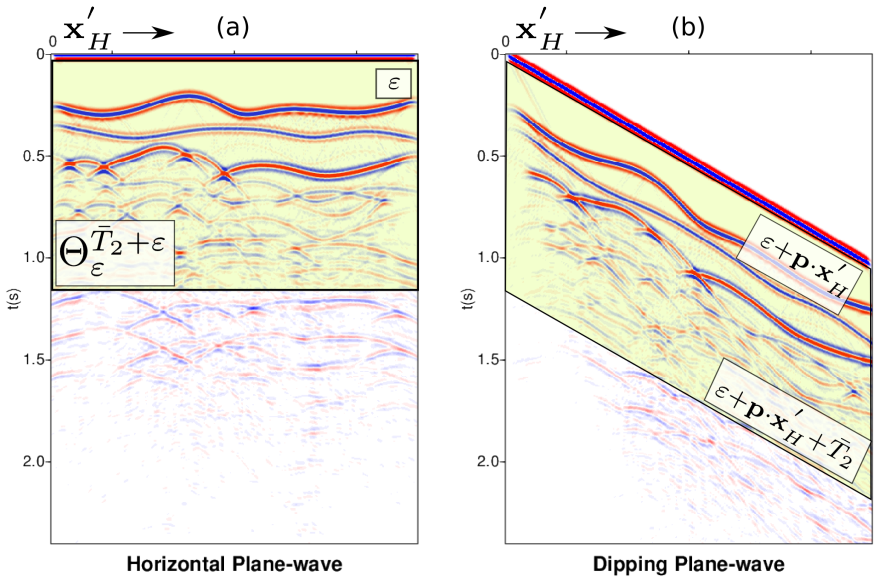
In a strongly laterally heterogeneous 2D model, compare the approximate muting-window boundary $\epsilon + \bar{T}_2 + \mathbf{p} \cdot \mathbf{x}'_H$ with the exact two-way traveltime $T_2(\mathbf{x}'_0, \mathbf{p}, z_i)$ for a known reflector; if the difference exceeds about one source-wavelet period anywhere along the receiver line, Eq. 30 will place the wrong event at the window boundary, and the retrieved gather should not match an independently computed primary-only gather.
Extended reading notes
Core claim
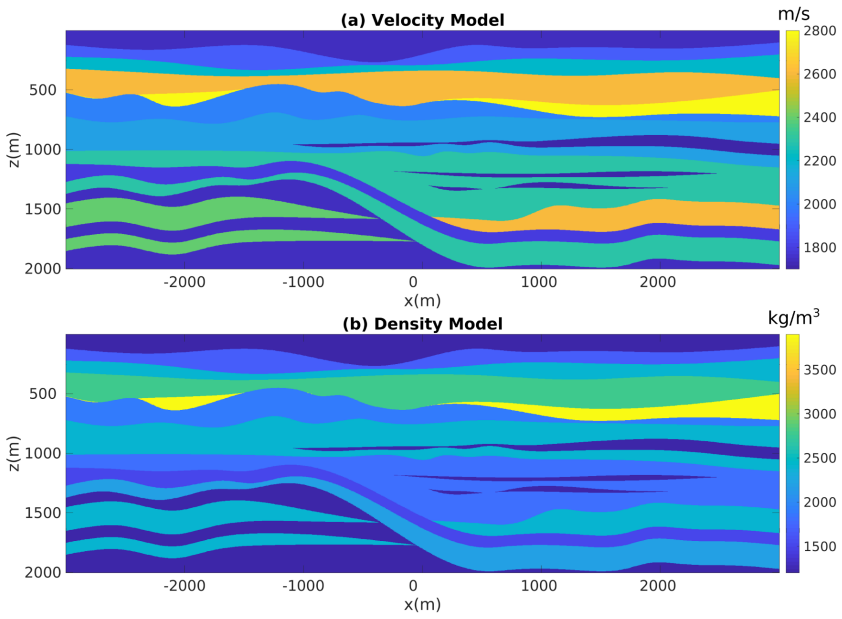
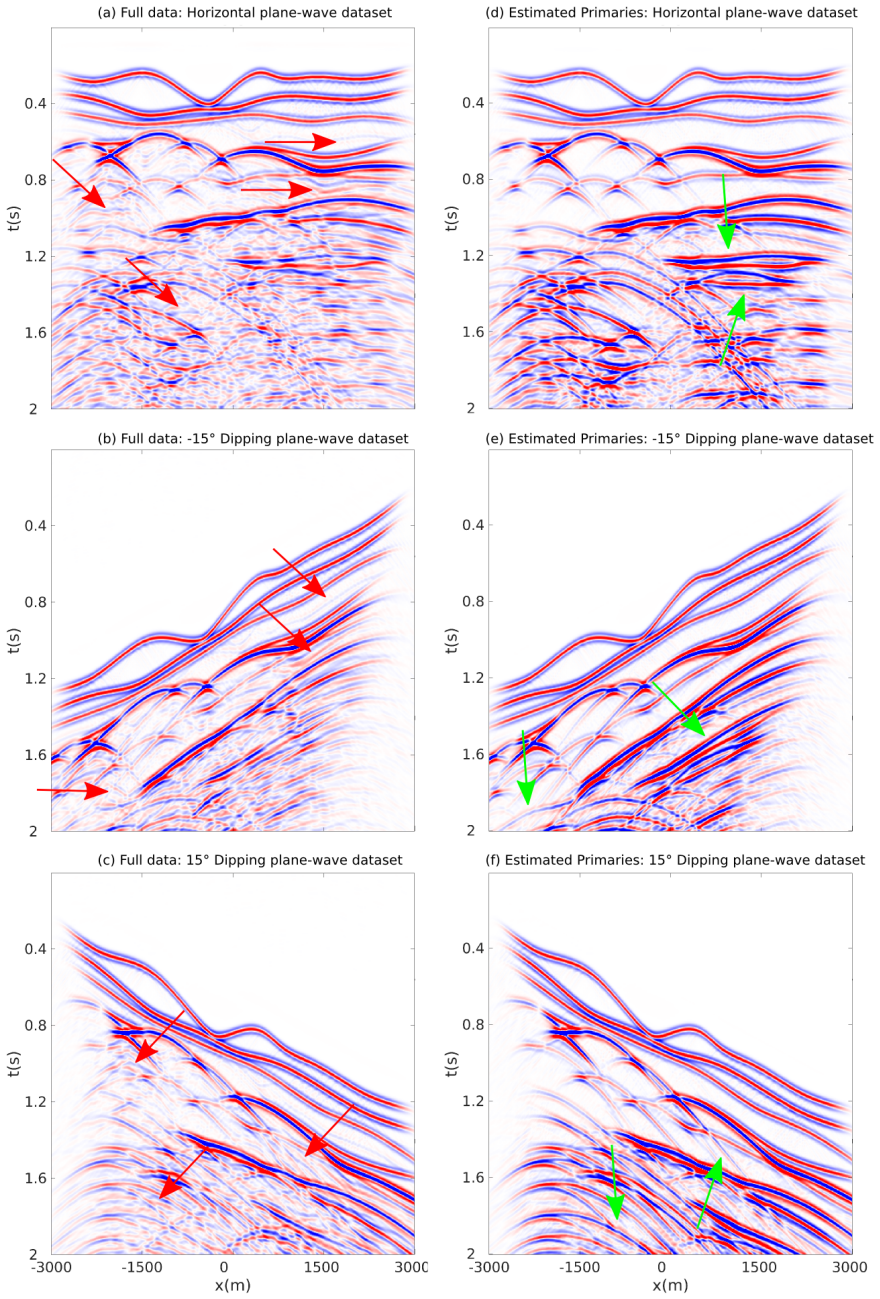
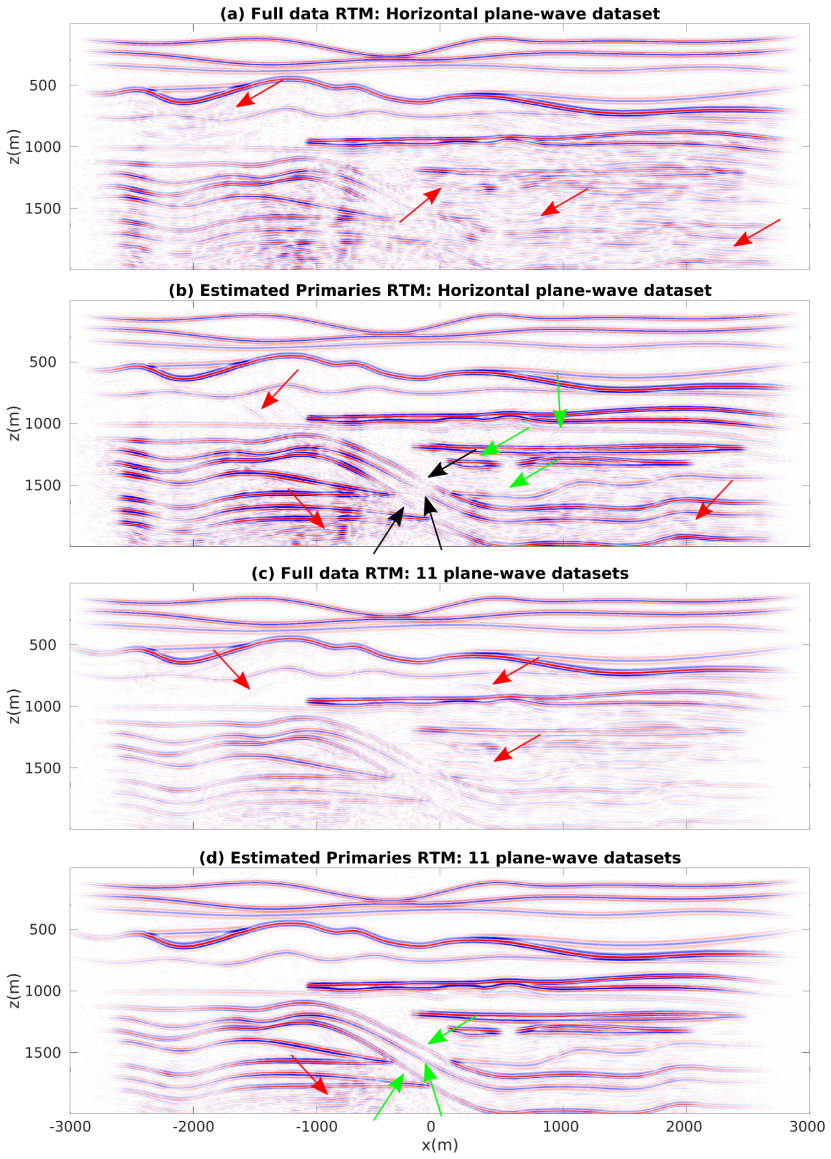
The core discovery is that surface-projected Marchenko focusing functions, when integrated over the acquisition surface, satisfy the same kind of coupled equations as the point-source case, with the plane-wave response replacing the point-source response in the source term. For a horizontal plane-wave source, the projected focusing function $V^-$ obeys $(I - \Theta R \Theta R^\star) V^- = \Theta R_{\mathrm{PW}}$, where $R$ is the convolution operator built from the measured point-source reflection response, $R^\star$ is its time-reversed version, $\Theta$ the muting window with endpoint $\bar{T}_2$, and $R_{\mathrm{PW}}$ the horizontal plane-wave reflection response. The series solution $V^- = \Theta R_{\mathrm{PW}} + \sum_{M=1}^{\infty} (\Theta R \Theta R^\star)^M \Theta R_{\mathrm{PW}}$ has, as its last event, a transmission-loss-compensated primary; stacking the results for all $\bar{T}_2$ reconstructs the primary-only plane-wave gather. The same construction works for dipping plane waves after shifting the window by $\mathbf{p} \cdot \mathbf{x}'_H$, with the upper boundary approximated as parallel to the lower one so that no subsurface information is required. Numerical tests on 2D models with thin layers, diffractors, and dipping interfaces show that migrating the retrieved gathers yields images largely free of internal-multiple artefacts, with dipping interfaces recovered when several angle gathers are stacked.
Load-bearing premise
The load-bearing premise is that, for dipping plane waves, the time interval used to isolate the primary can be chosen as a straight band of constant thickness across the receiver line, with the top boundary just a shifted copy of the bottom boundary; if true two-way traveltimes to reflectors bend away from that straight band in complex media, the retrieved primary is no longer guaranteed to be a primary.
Editorial extensions
If this is right
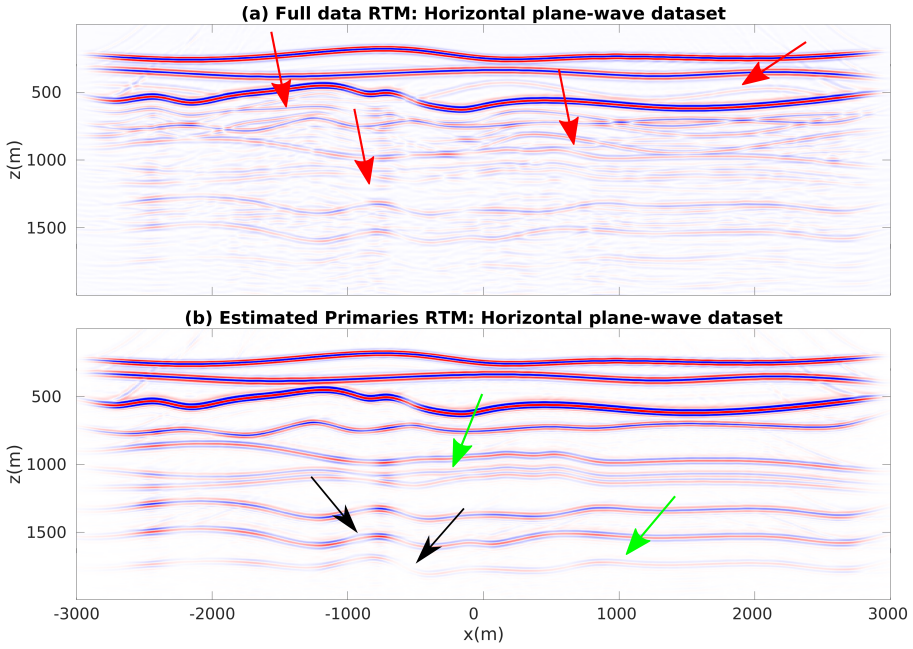
- A single demultipled horizontal plane-wave gather migrated once can yield a multiple-free image for gently dipping structures, as demonstrated in the first numerical test.
- Dipping-plane-wave retrieval extends illumination: stacking 11 retrieved gathers with angles between -25 and 25 degrees resolves dipping interfaces that are barely visible with horizontal illumination alone.
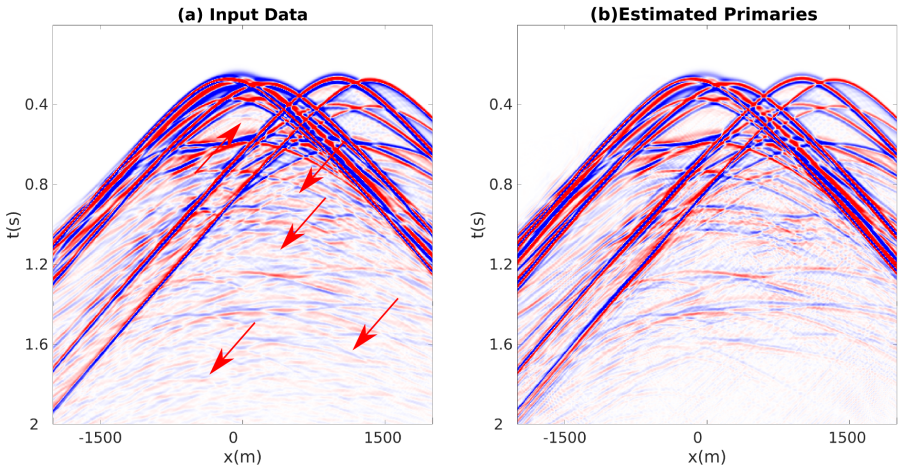
- Because the operator is linear and gather-independent, blended-source data with different source spectra can be demultipled in one pass, matching the sum of individual point-source results to within 0.1 percent in the numerical test.
- The retrieved primary gathers feed standard plane-wave reverse time migration without any modification, so the method slots directly into existing imaging workflows.
Reading between the lines
- The parallel-muting-window approximation for dipping plane waves is the point most worth testing; comparing Eq. 30 retrievals against independently computed primaries in strongly laterally heterogeneous media would quantify where the straight-window assumption breaks.
- Because the same operator is applied to every plane-wave angle, the marginal cost of adding an extra angle gather is essentially one application of the series; this makes large stacks of angle gathers computationally attractive, though the paper only demonstrates a stack of 11 gathers.
- The same surface-projected focusing logic could extend to other areal source geometries, such as curved wavefronts or focused beams, as long as the source delays can be folded into the muting-window definition; the paper restricts itself to plane waves.
Signed reviews
Editorial analysis
A structured set of objections, weighed in public.
Referee Report
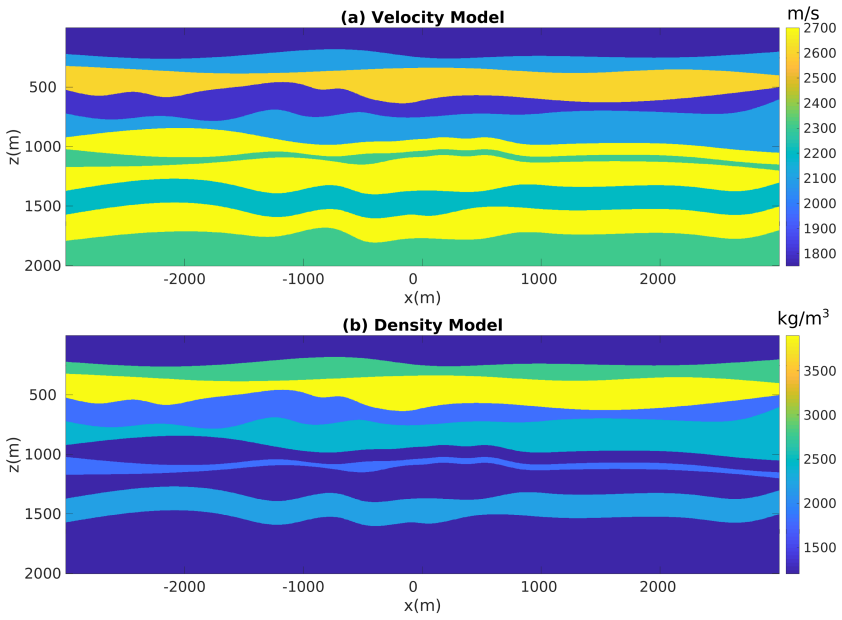
Summary. The paper extends data-domain Marchenko primary-synthesis methods from point-source gathers to plane-wave source responses. It defines plane-wave projected focusing functions V^- and V_m^+ and derives series solutions (Eqs. 22 and 30) that, when evaluated for all constant two-way-time windows and storing results at the window end time, yield estimates of transmission-loss-compensated primary plane-wave reflections. The method is tested on two synthetic 2D acoustic models. For a gently dipping model, horizontal plane-wave data produce a multiple-free migrated image. For a more complex model with thin layers, diffractors and dipping layers, horizontal and dipping plane-wave gathers are processed and stacked, yielding a cleaner image than migrating the full data. The paper claims the algorithm is fully data-driven, requires no picking, and needs only a small number of plane-wave gathers for imaging.
Significance. If the claims hold, the method is a useful extension of data-domain Marchenko methods: it offers a computationally cheaper alternative to point-source primary synthesis for plane-wave migration, and it is fully data-driven in the sense that no model information enters the multiple-elimination step. The paper builds on published theory (Zhang et al. 2019b; Meles et al. 2018) rather than introducing free parameters fitted to data, and the numerical examples are performed with independent finite-difference modeling. The main novelty, the dipping-plane-wave extension, rests on an approximation that is not quantified, and the validation is entirely visual. The core horizontal-plane-wave derivation appears sound, but the load-bearing approximation in Section 3.3 and the absence of quantitative convergence and error analysis mean the paper is not yet at the standard for publication without revision.
major comments (3)
- [Section 3.3, Eq. (30)] The claim that the upper muting boundary can be replaced by the model-independent expression epsilon + \bar{T}_2 + p·x'_H is not justified. For a laterally heterogeneous or dipping medium, T_2(x'_0,p,z_i) - p·x'_H varies with x'_0, so the upper boundary of the muting window is not exactly parallel to the lower boundary epsilon + p·x'_H. Storing results at t = \bar{T}_2 + p·x'_H then does not necessarily sample the primary event. The paper asserts this approximation "in analogy to the previous cases" without proof, error bound, or sensitivity analysis. Since this approximation is the only mechanism that makes the dipping-plane-wave algorithm model-independent, the central claim of Section 3.3 is not established. Please either prove the approximation under stated conditions, quantify its error for the models in Section 4, or restrict the dipping-plane-wave claims to media where it holds.
- [Section 4, 'first 20 terms' (Eqs. 22/30)] The numerical examples compute only the first 20 terms of the Neumann series, with no convergence test. The series representation is the basis for retrieving primaries, and a reader cannot tell whether 20 terms are sufficient for the models shown. Please show a convergence plot (e.g., energy of successive partial sums, or difference between 10, 20, and 30 terms) for at least one representative gather. Without this, the examples do not demonstrate that the truncated series produces the claimed primaries.
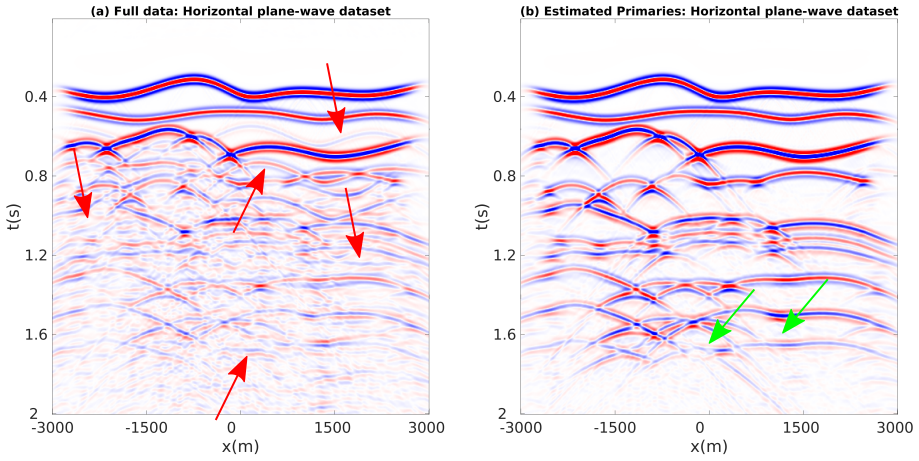
- [Section 4, Figs. 3-7] The validation is qualitative. The paper claims transmission-loss compensation and primary retrieval, but no quantitative metric is given: there is no comparison against a directly modeled primary-only response, no amplitude or traveltime error measurement, and no signal-to-noise ratio for the demultipled gathers. Because the method is intended to produce true-amplitude primaries suitable for migration, a quantitative check (e.g., normalized L2 error against a synthetic primary-only dataset, or a measure of multiple suppression in the migrated image) is needed to support the strength of the claims.
minor comments (4)
- [Section 4, paragraph 2] The text refers to "the estimated primaries in Fig. 6(d)" when discussing the horizontal plane-wave case, but Fig. 6(d) corresponds to the -15 degree dipping plane wave; the horizontal-plane-wave primaries are shown in Fig. 6(e). Please correct the figure reference.
- [Eqs. (26)-(30)] The lower muting boundary is written as \epsilon + p·x'_H, but p·x'_H can be negative, while the physical time interval should start at a nonnegative small value for the retrieved events to be causal. A brief clarification of the allowed range of p and of the resulting lower boundary would help.
- [Discussion, Eq. (31) and following paragraph] The statement that "the window operators discussed here are the same for each input data" is accurate for horizontal plane waves but not for dipping plane waves, where the operator depends on p through the p·x'_H term. The sentence should be qualified to avoid over-generalization.
- [Abstract and Introduction] The abstract says the scheme "operates on plane-wave datasets," but the input is the full point-source reflection response; the output is a plane-wave primary response. This distinction is clear in the body but could be emphasized in the abstract to avoid misleading readers.
Circularity Check
No significant circularity: the plane-wave primary retrieval is a data-driven extension of a published, externally validated point-source method, with no fitted parameters and no output redefined as input.
full rationale
The central retrieval equations (Eqs. 22 and 30) are genuine extensions of the point-source data-domain Marchenko algorithm. They are not tautological: V- is defined as an integral of the point-source projected focusing function, and the plane-wave primary is then obtained by solving a Neumann series with data-driven muting windows. The property that the last event of v- is a transmission-loss-compensated primary is imported from Zhang et al. (2019b), a published, peer-reviewed derivation with explicit assumptions (acoustic medium, one-sided illumination, co-located sources and receivers) that do not include the plane-wave output itself; this is independent support rather than circular self-citation. The numerical tests use independently constructed synthetic velocity/density models and finite-difference data; no parameter is fitted to the retrieved primary gathers, and migration results are compared with known reflectors. The dipping-plane-wave step in Section 3.3 approximates the upper muting boundary as parallel to the lower boundary, which is an untested accuracy assumption in laterally heterogeneous media, but it is a correctness risk, not a circular reduction. The paper's reliance on the authors' own prior work is load-bearing but does not reduce the central claim to a self-citation: the priors are concrete, reproducible derivations, and the plane-wave extension adds new structure. No step equates the prediction with an input by definition, and no fitted parameter is renamed as a prediction. Therefore the paper is not circular.
Assumptions & free parameters
assumptions (4)
- domain assumption The medium is acoustic and the acquisition surface is reflection-free, with one-sided illumination from co-located point sources and receivers.
- standard math The Neumann series (I - Theta R Theta R*)^-1 converges under standard convergence conditions.
- domain assumption The last event of V- at t = T2 is a transmission loss compensated primary reflection in the plane-wave response.
- ad hoc to paper For dipping plane-waves, the upper boundary of the muting window can be approximated as model-independent: T2(x'_0,p,z_i)+eps = eps + T2_bar + p.x'_H.
Cite this review
Pith. "Pith review of Data-driven retrieval of primary plane-wave responses." pith.science (2026). https://pith.science/paper/EKGQV5HK
@misc{pith2026190809554,
  author       = {Pith},
  title        = {Pith review of: Data-driven retrieval of primary plane-wave responses},
  year         = {2026},
  howpublished = {\url{https://pith.science/paper/EKGQV5HK}},
  note         = {Machine review of arXiv:1908.09554}
}
read the original abstract
Seismic images provided by reverse time migration can be contaminated by artefacts associated with the migration of multiples. Multiples can corrupt seismic images, producing both false positives, i.e. by focusing energy at unphysical interfaces, and false negatives, i.e. by destructively interfering with primaries. Multiple prediction / primary synthesis methods are usually designed to operate on point source gathers, and can therefore be computationally demanding when large problems are considered. A computationally attractive scheme that operates on plane-wave datasets is derived by adapting a data-driven point source gathers method, based on convolutions and cross-correlations of the reflection response with itself, to include plane-wave concepts. As a result, the presented algorithm allows fully data-driven synthesis of primary reflections associated with plane-wave source responses. Once primary plane-wave responses are estimated, they are used for multiple-free imaging via plane-wave reverse time migration. Numerical tests of increasing complexity demonstrate the potential of the proposed algorithm to produce multiple-free images from only a small number of plane-wave datasets.
Figures
Figures from the paper (5 more)
Reference graph
Works this paper leans on
-
[1]
S., Ravasi, M., Broggini, F., Robertsson, J
Becker, T. S., Ravasi, M., Broggini, F., Robertsson, J. O., et al. (2018). Sparse inversion of the coupled M archenko equations for simultaneous source wavelet and focusing functions estimation. In 80th EAGE Conference and Exhibition 2018 , number Th P9 15
work page 2018
-
[2]
Behura, J. and Snieder, R. (2013). Imaging direct as well as scattered events in microseismic data using inverse scattering theory. In SEG Technical Program Expanded Abstracts 2013 , pages 2019--2023. Society of Exploration Geophysicists
work page 2013
-
[3]
Brackenhoff, J., Thorbecke, J., and Wapenaar, K. (2019). Monitoring of induced distributed double-couple sources using M archenko-based virtual receivers. Solid Earth , 10:1301--1319
work page 2019
-
[4]
Broggini, F., Snieder, R., and Wapenaar, K. (2012). Focusing the wavefield inside an unknown 1 D medium: Beyond seismic interferometry. Geophysics , 77(5):A25--A28
work page 2012
-
[5]
Broggini, F., Snieder, R., and Wapenaar, K. (2014). Data-driven wavefield focusing and imaging with multidimensional deconvolution: Numerical examples for reflection data with internal multiples. Geophysics , 79(3):WA107--WA115
work page 2014
-
[6]
Claerbout, J. F. (1985). Imaging the E arth's interior . Blackwell scientific publications Oxford
work page 1985
-
[7]
da Costa Filho, C., Meles, G., Curtis, A., Ravasi, M., and Kritski, A. (2017a). Imaging strategies using focusing functions with applications to a N orth S ea field. Geophysical Journal International , 213(1):561--573
work page 2017
-
[8]
da Costa Filho, C. A., Meles, G. A., and Curtis, A. (2017b). Elastic internal multiple analysis and attenuation using M archenko and interferometric methods. Geophysics , 82(2):Q1--Q12
work page 2017
Show all 56 references
-
[9]
A., Ravasi, M., Curtis, A., and Meles, G
da Costa Filho , C. A., Ravasi, M., Curtis, A., and Meles, G. A. (2014). Elastodynamic Green's function retrieval through single-sided M archenko inverse scattering . Physical Review E , 90(6):063201
2014
-
[10]
and Schuster, G
Dai, W. and Schuster, G. T. (2013). Plane-wave least-squares reverse-time migration. Geophysics , 78(4):S165--S177
2013
-
[11]
Dragoset, B., Verschuur, E., Moore, I., and Bisley, R. (2010). A perspective on 3 D surface-related multiple elimination. Geophysics , 75(5):75A245--75A261
2010
-
[12]
Dukalski, M., Mariani, E., and de Vos, K. (2019). Handling short-period scattering using augmented M archenko autofocusing. Geophysical Journal International , 216(3):2129--2133
2019
-
[13]
Fokkema, J. T. and van den Berg, P. M. (1993). Seismic applications of acoustic reciprocity . Elsevier
1993
-
[14]
H., Etgen, J., Dellinger, J., and Whitmore, D
Gray, S. H., Etgen, J., Dellinger, J., and Whitmore, D. (2001). Seismic migration problems and solutions. Geophysics , 66(5):1622--1640
2001
-
[15]
Jakubowicz, H. (1998). Wave equation prediction and removal of interbed multiples. In SEG Technical Program Expanded Abstracts 1998 , pages 1527--1530. Society of Exploration Geophysicists
1998
-
[16]
Jia, X., Guitton, A., and Snieder, R. (2018). A practical implementation of subsalt M archenko imaging with a G ulf of M exico data set. Geophysics , 83(5):S409--S419
2018
-
[17]
G., Zhu, W., Rufaii, K
Kelamis, P. G., Zhu, W., Rufaii, K. O., and Luo, Y. (2006). Land multiple attenuation—the future is bright. In SEG Technical Program Expanded Abstracts 2006 , pages 2699--2703. Society of Exploration Geophysicists
2006
-
[18]
L \"o er, K., Curtis, A., and Meles, G. A. (2016). Relating source-receiver interferometry to an inverse-scattering series to derive a new method to estimate internal multiples. Geophysics , 81(3):Q27--Q40
2016
-
[19]
McMechan, G. A. (1983). p-x imaging by localized slant stacks of t-x data. Geophysical Journal International , 72(1):213--221
1983
-
[20]
A., L \" o er, K., Ravasi, M., Curtis, A., and da Costa Filho , C
Meles, G. A., L \" o er, K., Ravasi, M., Curtis, A., and da Costa Filho , C. A. (2015). Internal multiple prediction and removal using M archenko autofocusing and seismic interferometry . Geophysics , 80(1):A7--A11
2015
-
[21]
A., van der Neut, J., van Dongen, K
Meles, G. A., van der Neut, J., van Dongen, K. W. A., and Wapenaar, K. (2019). Wavefield finite time focusing with reduced spatial exposure. The Journal of the Acoustical Society of America , 145(6):3521--3530
2019
-
[22]
A., Wapenaar, K., and Thorbecke, J
Meles, G. A., Wapenaar, K., and Thorbecke, J. (2018). Virtual plane-wave imaging via M archenko redatuming. Geophysical Journal International , 214(1):508--519
2018
-
[23]
Mulder, W. A. and Plessix, R.-E. (2004). A comparison between one-way and two-way wave-equation migration. Geophysics , 69(6):1491--1504
2004
-
[24]
Ravasi, M. (2017). Rayleigh- M archenko redatuming for target-oriented, true-amplitude imaging. Geophysics , 82(6):S439--S452
2017
-
[25]
A., and Meles, G
Ravasi, M., Vasconcelos, I., Kritski, A., Curtis, A., da Costa, C. A., and Meles, G. A. (2016). Target-oriented Marchenko imaging of a North Sea field . Geophysical Journal International , 205(1):99--104
2016
-
[26]
and Wapenaar, K
Reinicke, C. and Wapenaar, K. (2019). Elastodynamic single-sided homogeneous G reen’s function representation: Theory and numerical examples. Wave Motion , 89:245--264
2019
-
[27]
Rietveld, W., Berkhout, A., and Wapenaar, C. P. A. (1992). Optimum seismic illumination of hydrocarbon reservoirs. Geophysics , 57(10):1334--1345
1992
-
[28]
Schultz, P. S. and Claerbout, J. F. (1978). Velocity estimation and downward continuation by wavefront synthesis. Geophysics , 43(4):691--714
1978
-
[29]
and Wapenaar, K
Slob, E. and Wapenaar, K. (2014). Data-driven inversion of gpr surface reflection data for lossless layered media. In The 8th European Conference on Antennas and Propagation (EuCAP 2014) , pages 3378--3382. IEEE
2014
-
[30]
and Wapenaar, K
Slob, E. and Wapenaar, K. (2017). Theory for M archenko imaging of marine seismic data with free surface multiple elimination. In 79th EAGE Conference and Exhibition 2017
2017
-
[31]
Slob, E., Wapenaar, K., Broggini, F., and Snieder, R. (2014). Seismic reflector imaging using internal multiples with M archenko-type equations. Geophysics , 79(2):S63--S76
2014
-
[32]
Staring, M., Pereira, R., Douma, H., van der Neut, J., and Wapenaar, K. (2018). Source-receiver M archenko redatuming on field data using an adaptive double-focusing method. Geophysics , 83(6):S579--S590
2018
-
[33]
L., Sen, M
Stoffa, P. L., Sen, M. K., Seifoullaev, R. K., Pestana, R. C., and Fokkema, J. T. (2006). Plane-wave depth migration. Geophysics , 71(6):S261--S272
2006
-
[34]
ten Kroode, F. (2002). Prediction of internal multiples. Wave Motion , 35(4):315--338
2002
-
[35]
Thorbecke, J., Slob, E., Brackenhoff, J., van der Neut, J., and Wapenaar, K. (2017). Implementation of the M archenko method. Geophysics , 82(6):WB29--WB45
2017
-
[36]
van Borselen, R. (2002). Fast-track, data-driven interbed multiple removal-a N orth S ea data example. In 64th EAGE Conference & Exhibition , number F-40
2002
-
[37]
and Fokkema, J
van der Neut, J. and Fokkema, J. (2018). One-dimensional M archenko inversion in stretched space. In Proceedings of the International Workshop on Medical Ultrasound Tomography: 1.-3. Nov. 2017, Speyer, Germany , pages 15--24. KIT Scientific Publishing
2018
-
[38]
L., van Wijk, K., Singh, S., Slob, E., and Wapenaar, K
van der Neut, J., Johnson, J. L., van Wijk, K., Singh, S., Slob, E., and Wapenaar, K. (2017). A M archenko equation for acoustic inverse source problems. The Journal of the Acoustical Society of America , 141(6):4332--4346
2017
-
[39]
van der Neut, J., Vasconcelos, I., and Wapenaar, K. (2015a). On G reen's function retrieval by iterative substitution of the coupled M archenko equations. Geophysical Journal International , 203(2):792--813
2015
-
[40]
and Wapenaar, K
van der Neut, J. and Wapenaar, K. (2016). Adaptive overburden elimination with the multidimensional M archenko equation. Geophysics , 81(5):T265--T284
2016
-
[41]
van der Neut, J., Wapenaar, K., Thorbecke, J., and Slob, E. (2015b). Practical challenges in adaptive M archenko imaging. In SEG Technical Program Expanded Abstracts 2015 , pages 4505--4509. Society of Exploration Geophysicists
2015
-
[42]
Wang, X., Ji, X., Liu, H., and Luo, Y. (2018). Fast plane-wave reverse time migration. Geophysics , 83(6):S549--S556
2018
-
[43]
Wapenaar, K., Brackenhoff, J., Thorbecke, J., van der Neut, J., Slob, E., and Verschuur, E. (2018). Virtual acoustics in inhomogeneous media with single-sided access. Scientific Reports , 8(1):2497
2018
-
[44]
Wapenaar, K., Broggini, F., and Snieder, R. (2012). Creating a virtual source inside a medium from reflection data: heuristic derivation and stationary-phase analysis . Geophysical Journal International , 190(2):1020--1024
2012
-
[45]
Wapenaar, K., Thorbecke, J., van der Neut, J., Broggini, F., Slob, E., and Snieder, R. (2014). M archenko imaging . Geophysics , 79(3):WA39--WA57
2014
-
[46]
B., Gasparotto, F
Weglein, A. B., Gasparotto, F. A., Carvalho, P. M., and Stolt, R. H. (1997). An inverse-scattering series method for attenuating multiples in seismic reflection data. Geophysics , 62(6):1975--1989
1997
-
[47]
Whitmore, N. D. (1983). Iterative depth migration by backward time propagation. In SEG Technical Program Expanded Abstracts 1983 , pages 382--385. Society of Exploration Geophysicists
1983
-
[48]
Wiggins, J. W. (1988). Attenuation of complex water-bottom multiples by wave-equation-based prediction and subtraction. Geophysics , 53(12):1527--1539
1988
-
[49]
Yilmaz, \"O . (2001). Seismic data analysis: Processing, inversion, and interpretation of seismic data . Society of Exploration Geophysicists
2001
-
[50]
and Slob, E
Zhang, L. and Slob, E. (2019). Free-surface and internal multiple elimination in one step without adaptive subtraction. Geophysics , 84(1):A7--A11
2019
-
[51]
and Slob, E
Zhang, L. and Slob, E. (2020a). A fast algorithm for multiple elimination and transmission compensation in primary reflections . Geophysical Journal International . ggaa005
2020
-
[52]
and Slob, E
Zhang, L. and Slob, E. (2020b). A field data example of M archenko multiple elimination. Geophysics , 85(2):S65--S70
2020
-
[53]
and Staring, M
Zhang, L. and Staring, M. (2018). Marchenko scheme based internal multiple reflection elimination in acoustic wavefield. Journal of Applied Geophysics , 159:429--433
2018
-
[54]
Zhang, L., Thorbecke, J., Wapenaar, K., and Slob, E. (2019a). Data-driven internal multiple elimination and its consequences for imaging: A comparison of strategies. Geophysics , 84(5):S365--S372
2019
-
[55]
Zhang, L., Thorbecke, J., Wapenaar, K., and Slob, E. (2019b). Transmission compensated primary reflection retrieval in data domain and consequences for imaging. Geophysics , 84(4):Q27--Q36
2019
-
[56]
Zhu, J., Lines, L., and Gray, S. (1998). Smiles and frowns in migration/velocity analysis. Geophysics , 63(4):1200--1209
1998
Reviewed August 14, 2026 · model on record in the stance chip above.
Discussion (0). Continue with ORCID to comment.