REVIEW 2 major objections 4 minor 37 references
Low-temperature monoclinic layer stacking in atomically thin CrI$_3$ crystals
T0 review · 2 major / 4 minor · reviewed 2026-08-14 · deepseek-v4-flash
Pith's one-line read Raman shows thin CrI3 remains monoclinic down to 5 K.
desk verdict A clean symmetry-based Raman method confirms that thin CrI3 stays monoclinic at low T, but the key thin-flake claim rests on a single sample and an unquantified temperature check. read the letter →
The pith
A machine-rendered reading of the paper's core claim, the machinery that carries it, and where it could break.
The reading
What carries the argument
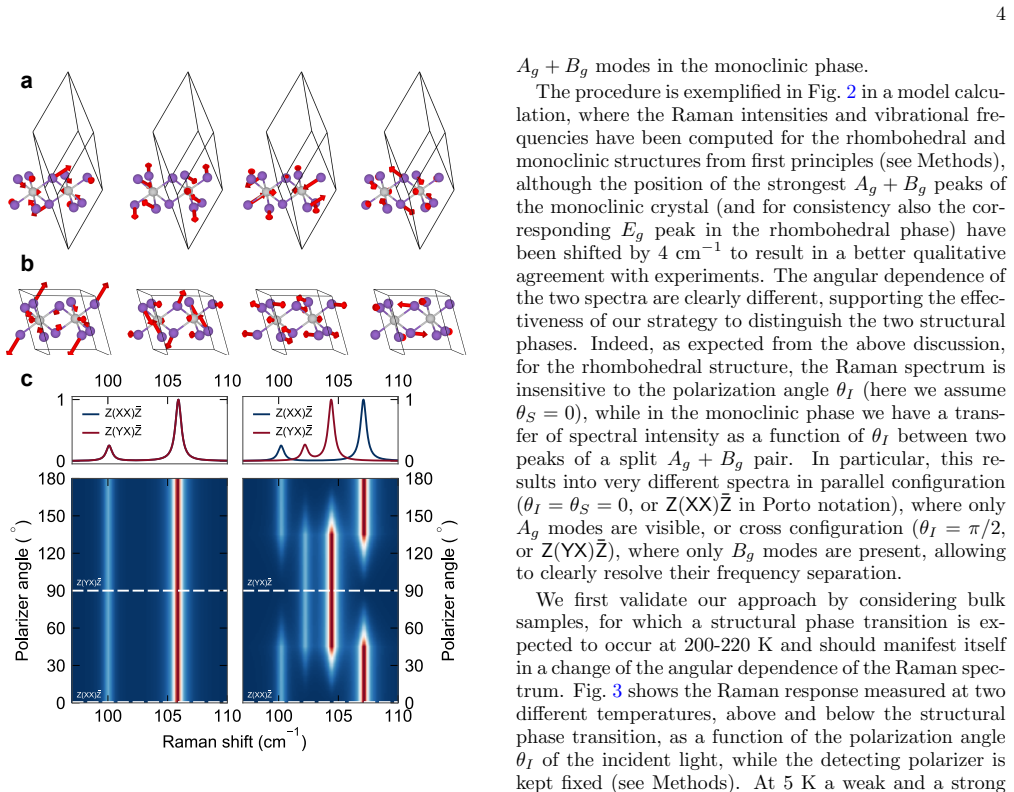
The central object is the polarization-resolved Raman response of the phonon modes around 100 cm−1. In the backscattering geometry, the intensity of a Raman mode depends on the cumulative angle θ = θI + θS between incident and scattered linear polarizations. For a degenerate Eg pair in the rhombohedral phase the two modes conspire so that the summed intensity is independent of θ; in the monoclinic phase the splitting yields an Ag mode whose intensity scales as cos²θ and a Bg mode scaling as sin²θ, so the two peaks exchange intensity out of phase as the polarization is rotated. This out-of-phase oscillation is the signature that survives in thin flakes and lets the authors identify the phase even when the peaks are close and the signal is weak.
What would settle it
Measure the polarization-resolved Raman spectrum of a thin CrI3 flake while independently determining the local temperature from the Stokes/anti-Stokes ratio with stated uncertainty, using several laser powers so the zero-heating limit can be extrapolated; if at a true local temperature below 200 K the flake's split Ag/Bg pattern becomes polarization-independent, the claim of a persistent monoclinic phase is wrong. A complementary check is a direct structural probe, such as electron diffraction or scanning transmission electron microscopy, on the same flake at low temperature: rhombohedral stacking there would also falsify the claim.
Extended reading notes
Core claim
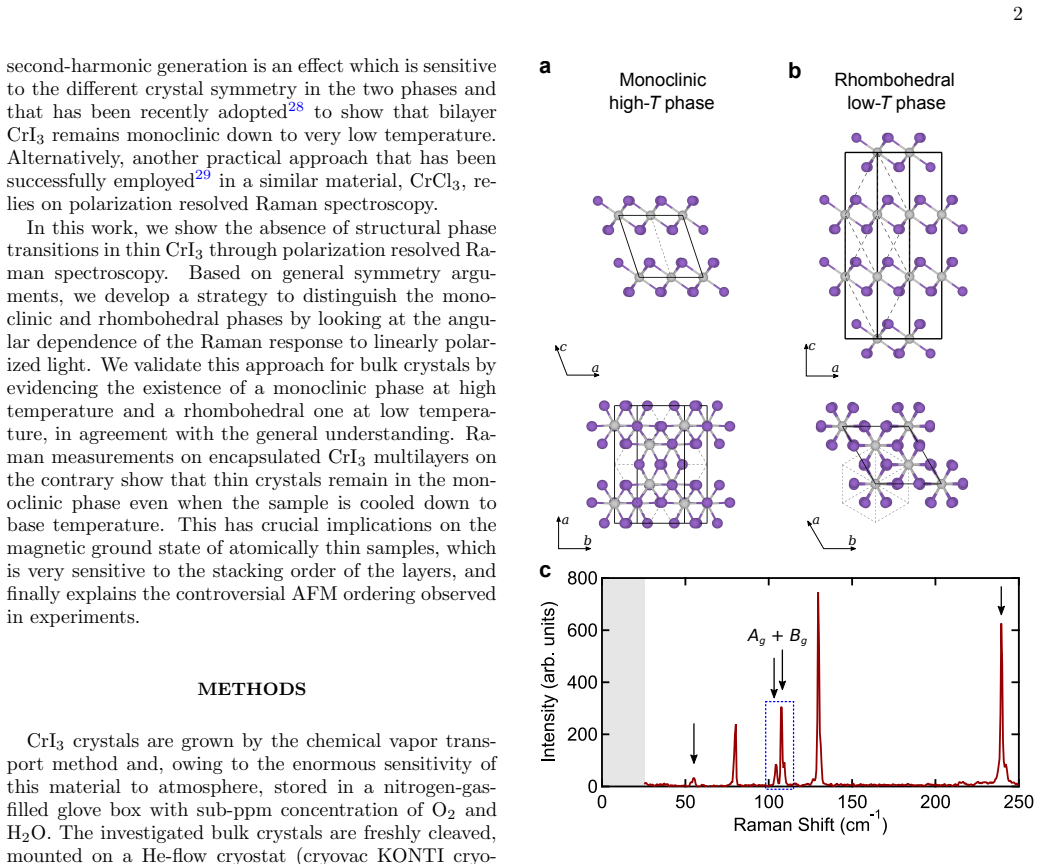
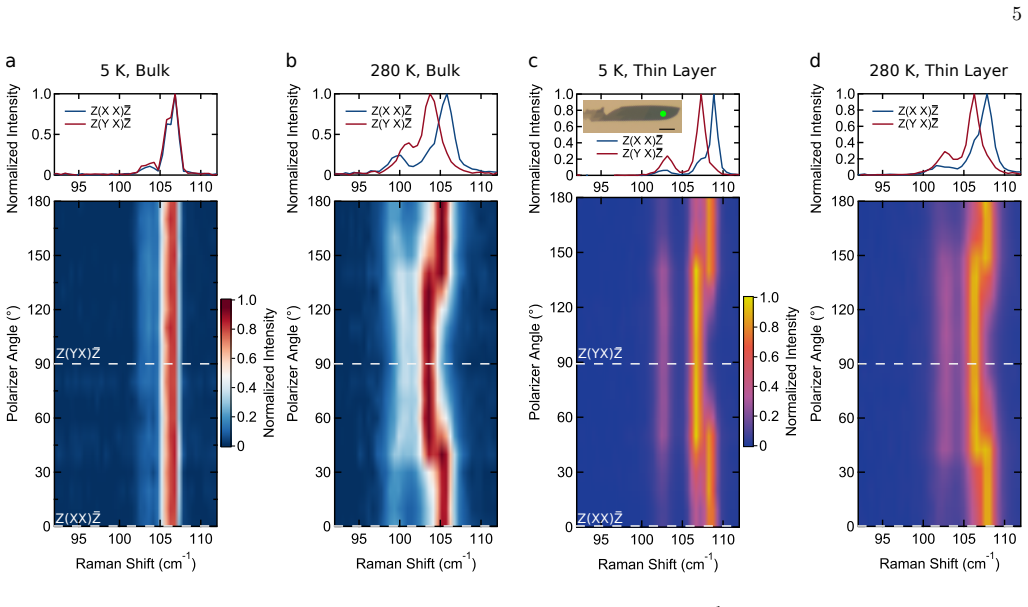
The central claim is that atomically thin CrI3 crystals remain in the monoclinic stacking phase at all temperatures investigated, in contrast to bulk crystals which transform to a rhombohedral phase below roughly 200 K. The evidence is the angular dependence of Raman peaks near 100 cm−1: in the rhombohedral phase degenerate Eg modes give an intensity that is independent of the polarization angle, whereas in the monoclinic phase each Eg mode splits into Ag and Bg components whose intensities oscillate in opposition as the incident polarization is rotated. Bulk samples show the expected switch from oscillating to flat angular patterns on cooling, while a 4 nm (about six-layer) flake shows the oscillating monoclinic pattern at both 280 K and 5 K. Since the magnetic ordering temperature of the thin crystal is about 51 K, the flake is still in the monoclinic phase when antiferromagnetism sets in, matching the stacking predicted to favour antiferromagnetic interlayer coupling.
Load-bearing premise
The conclusion rests on the assumption that the Stokes/anti-Stokes intensity ratio really measures the local temperature of the laser spot and that this local temperature stays below the roughly 200 K phase transition while the cryostat is at 5 K; if laser heating kept the flake above the transition, the monoclinic pattern would be the high-temperature phase and the claim would collapse.
Editorial extensions
If this is right
- Thin exfoliated CrI3 multilayers should be antiferromagnetic between layers at low temperature, because the monoclinic stacking is the one predicted to favour antiferromagnetic interlayer exchange.
- The observed critical temperature of about 51 K in thin crystals is the natural antiferromagnetic ordering temperature of the monoclinic phase, distinct from the 61 K ferromagnetic transition of bulk rhombohedral CrI3.
- A structural switch in a thin flake, induced by pressure, puncture, or other perturbation, should flip the interlayer magnetic coupling to ferromagnetic, offering a route to switch magnetism by changing stacking.
- The anomalous feature near 51 K in bulk magnetization may come from surface layers that, like thin flakes, remain monoclinic while the interior becomes rhombohedral.
- Polarization-resolved Raman of the split Ag/Bg pairs can serve as a general probe of stacking phase in van der Waals magnets too thin for conventional diffraction.
Reading between the lines
- A testable extension would be to repeat the polarization-resolved Raman measurement on the same flake while simultaneously imaging the local temperature from the anti-Stokes/Stokes ratio, to rule out laser-heating artefacts with quantified uncertainty.
- The same strategy could be applied to other layered magnets with stacking-dependent exchange, where exfoliation may trap a high-temperature stacking that determines the magnetic ground state.
- If free-surface suppression of the transition is real, then bulk crystals with different surface terminations or different capping layers might show different proportions of monoclinic surface regions, which could be probed by depth-dependent or spatially resolved Raman maps.
- The monoclinic-to-rhombohedral barrier is apparently high enough at low temperature to keep thin flakes in a metastable stacking indefinitely; this suggests that once a flake is switched to rhombohedral by pressure, it may remain there after pressure release, enabling non-volatile magnetic state control.
Signed reviews
Editorial analysis
A structured set of objections, weighed in public.
Referee Report
Summary. The paper addresses a known puzzle in CrI3: bulk crystals are ferromagnetic interlayer at low temperature in the rhombohedral phase, while thin multilayers show antiferromagnetic interlayer coupling. The authors propose that thin exfoliated crystals remain in the high-temperature monoclinic stacking phase down to low temperature, which would, according to prior first-principles calculations, produce antiferromagnetic interlayer exchange. They develop a polarization-resolved Raman signature based on group theory: in the rhombohedral phase the relevant Eg modes produce a polarization-independent spectrum, while in the monoclinic phase the split Ag/Bg pairs oscillate out of phase with the incident polarization angle. They validate the approach on bulk CrI3, where the expected monoclinic-to-rhombohedral transition is observed near 200-220 K. For one encapsulated 4 nm thick flake, they observe monoclinic-type polarization-dependent Raman spectra at both 280 K and 5 K and conclude that thin multilayers do not undergo the structural transition. The paper links this to the earlier first-principles prediction of AFM interlayer ordering in the monoclinic stacking.
Significance. If the central claim is correct, the paper resolves an important discrepancy in the field of two-dimensional magnetism: it provides a structural explanation for why thin CrI3 multilayers exhibit antiferromagnetic interlayer exchange while bulk CrI3 is ferromagnetic, and it connects to the observed lower critical temperature in thin flakes. The group-theoretic derivation of the polarization signature is clean and is validated convincingly on bulk samples, which is an important strength. The paper also makes a falsifiable prediction about the connection between stacking order and interlayer magnetism. The main weaknesses are that the decisive low-temperature thin-flake conclusion rests on a single flake and on an anti-Stokes/Stokes temperature check that is asserted but not quantitatively reported.
major comments (2)
- [Results, 'As temperature plays a crucial role...' paragraph] The manuscript states that the Stokes/anti-Stokes intensity ratio was used in the entire spectral range to ensure that the probed sample area remains below the phase-transition temperature, but it reports no extracted temperatures, no uncertainties, and no laser-power dependence. This is load-bearing because the 5 K thin-flake spectra are the only evidence for the central no-transition claim: if laser heating kept the illuminated area above about 200 K, the observed monoclinic pattern would be the equilibrium high-temperature phase and the conclusion would be false. Given that CrI3 is a low-thermal-conductivity insulator and the excitation is 60 µW at 532 nm, I ask the authors to report the local temperatures extracted from the anti-Stokes/Stokes ratios for each measurement (including the thin flake at nominal 5 K), with uncertainties, and ideally a laser-power dependence test.
- [Fig. 3c-d and the corresponding Results paragraph] The general conclusion that atomically thin multilayers remain in the monoclinic phase at low temperature is drawn from a single 4 nm flake. No data from additional flakes, different thicknesses, or different encapsulation conditions are presented, so the title and abstract claim about thin CrI3 crystals is broader than the supporting evidence. A single flake could be pinned in the monoclinic phase by local strain, defects, or the encapsulation process. I recommend either measuring additional flakes or explicitly limiting the conclusion to the measured flake and indicating that reproducibility across samples remains to be established.
minor comments (4)
- [Fig. 2 caption and Methods] The first-principles Raman spectra in Fig. 2 are shifted by 4 cm-1 to improve qualitative agreement with experiment, but the unshifted frequencies are not reported. Please provide the unshifted values and clarify that the rigid shift does not affect the relative Ag/Bg splitting, which is the quantity used for phase identification.
- [Derivation around Eq. (5)-(6)] The assumption a ≈ −c (and |a| ≈ |e|) is asserted rather than derived; it would be helpful to state explicitly that this expectation is confirmed by the DFT Raman tensors or by the bulk Raman data, so that the reader can assess the robustness of Eq. (6).
- [Abstract and Conclusion] The phrase 'we solve this controversy' in the abstract overstates the conclusiveness of a single-flake experiment; a more measured phrasing such as 'we present evidence that' would better match the data shown.
- [Methods] There is a typo in '1800 groves/mm'; it should read 'grooves'.
Circularity Check
No significant circularity: the Raman phase discrimination is symmetry-based and bulk-validated, and the magnetic interpretation rests on independent prior DFT results.
full rationale
The paper's derivation chain is self-contained rather than circular. The phase-discrimination strategy is built analytically from the standard Raman intensity expression (Eq. 1) and the symmetry-allowed Raman tensors for the C2h and C3i point groups (Eqs. 2 and 3). From these, the polarization-angle independence of the degenerate Eg mode intensity (Eq. 5) and the out-of-phase oscillation of split Ag/Bg pairs (Eq. 6) follow by direct algebra, with no fitted parameters entering the symmetry argument. The approach is then validated against an external benchmark: bulk CrI3, whose known monoclinic-to-rhombohedral transition at 200-220 K is correctly detected in the measured polarization patterns at 280 K and 5 K. The thin-flake assignment is made by applying the same pre-established criterion to the 4 nm flake data, not by fitting the flake spectra to force a phase. The 4 cm^-1 shift applied to theoretical peak positions in Fig. 2 is explicitly cosmetic and does not affect the angular intensity dependence that distinguishes the phases. The final inference—that persistent monoclinic stacking explains the antiferromagnetic interlayer order in thin crystals—is imported from previously published DFT studies (Refs. 12, 20-24), several of which are independent of the present authors; it is not derived from a fit within this paper. The paper itself flags the Stokes/anti-Stokes temperature check as an experimental safeguard, and although the numeric temperatures are not reported, this is a possible experimental limitation rather than a circular construction. No prediction in the paper reduces by definition to an input, and no load-bearing conclusion depends solely on a self-citation chain.
Assumptions & free parameters
free parameters (1)
- DFT Raman peak shift =
4 cm^-1
assumptions (4)
- standard math Raman tensors for Ag, Bg, and Eg modes follow the matrix forms in Eq. (2) and (3) from point-group symmetry of C2h and C3i.
- domain assumption For the relevant modes, the Raman tensor components satisfy a ≈ -c and |a| ≈ |e|, so that R_yy ≈ -R_xx.
- domain assumption The probed sample area is at the nominal cryostat temperature, i.e., laser heating is negligible or correctly corrected via Stokes/anti-Stokes ratio.
- domain assumption Prior first-principles results (Refs. 12, 20-24) correctly predict that monoclinic stacking yields AFM interlayer exchange and rhombohedral stacking yields FM exchange.
Cite this review
Pith. "Pith review of Low-temperature monoclinic layer stacking in atomically thin CrI$_3$ crystals." pith.science (2026). https://pith.science/paper/6JJGGGMM
@misc{pith2026190809607,
  author       = {Pith},
  title        = {Pith review of: Low-temperature monoclinic layer stacking in atomically thin CrI$_3$ crystals},
  year         = {2026},
  howpublished = {\url{https://pith.science/paper/6JJGGGMM}},
  note         = {Machine review of arXiv:1908.09607}
}
abstract
Chromium triiodide, CrI$_3$, is emerging as a promising magnetic two-dimensional semiconductor where spins are ferromagnetically aligned within a single layer. Potential applications in spintronics arise from an antiferromagnetic ordering between adjacent layers that gives rise to spin filtering and a large magnetoresistance in tunnelling devices. This key feature appears only in thin multilayers and it is not inherited from bulk crystals, where instead neighbouring layers share the same ferromagnetic spin orientation. This discrepancy between bulk and thin samples is unexpected, as magnetic ordering between layers arises from exchange interactions that are local in nature and should not depend strongly on thickness. Here we solve this controversy and show through polarization resolved Raman spectroscopy that thin multilayers do not undergo a structural phase transition typical of bulk crystals. As a consequence, a different stacking pattern is present in thin and bulk samples at the temperatures at which magnetism sets in and, according to previous first-principles simulations, this results in a different interlayer magnetic ordering. Our experimental findings provide evidence for the strong interplay between stacking order and magnetism in CrI$_3$, opening interesting perspectives to design the magnetic state of van der Waals multilayers.
Figures
Reference graph
Works this paper leans on
-
[1]
author author B. Huang , author G. Clark , author E. Navarro-Moratalla , author D. R. \ Klein , author R. Cheng , author K. L. \ Seyler , author D. Zhong , author E. Schmidgall , author M. A. \ McGuire , author D. H. \ Cobden , author W. Yao , author D. Xiao , author P. Jarillo-Herrero ,\ and\ author X. Xu ,\ doi:10.1038/nature22391 title Layer-dependent ...
-
[2]
author author C. Gong , author L. Li , author Z. Li , author H. Ji , author A. Stern , author Y. Xia , author T. Cao , author W. Bao , author C. Wang , author Y. Wang , author Z. Q. \ Qiu , author R. J. \ Cava , author S. G. \ Louie , author J. Xia ,\ and\ author X. Zhang ,\ doi:10.1038/nature22060 title Discovery of intrinsic ferromagnetism in two-dimens...
-
[3]
author author K. S. \ Burch , author D. Mandrus ,\ and\ author J.-G. \ Park ,\ doi:10.1038/s41586-018-0631-z title Magnetism in two-dimensional van der Waals materials ,\ journal Nature \ volume 563 ,\ pages 47 ( year 2018 ). Stop Burch_review_2018
-
[4]
author author C. Gong \ and\ author X. Zhang ,\ doi:10.1126/science.aav4450 title Two-dimensional magnetic crystals and emergent heterostructure devices ,\ journal Science \ volume 363 ( year 2019 ). Stop Gong_review_2019
-
[5]
author author M. Gibertini , author M. Koperski , author A. F. \ Morpurgo ,\ and\ author K. S. \ Novoselov ,\ doi:10.1038/s41565-019-0438-6 title Magnetic 2D materials and heterostructures ,\ journal Nature Nanotechnology \ volume 14 ,\ pages 408 ( year 2019 ). Stop Gibertini_review_2019
-
[6]
author author Y. Deng , author Y. Yu , author Y. Song , author J. Zhang , author N. Z. \ Wang , author Z. Sun , author Y. Yi , author Y. Z. \ Wu , author S. Wu , author J. Zhu , author J. Wang , author X. H. \ Chen ,\ and\ author Y. Zhang ,\ doi:10.1038/s41586-018-0626-9 title Gate-tunable room-temperature ferromagnetism in two-dimensional Fe _3 GeTe _2 ,...
-
[7]
author author Z. Fei , author B. Huang , author P. Malinowski , author W. Wang , author T. Song , author J. Sanchez , author W. Yao , author D. Xiao , author X. Zhu , author A. F. \ May , author W. Wu , author D. H. \ Cobden , author J.-H. \ Chu ,\ and\ author X. Xu ,\ doi:10.1038/s41563-018-0149-7 title Two-dimensional itinerant ferromagnetism in atomica...
-
[8]
author author M. A. \ McGuire , author H. Dixit , author V. R. \ Cooper ,\ and\ author B. C. \ Sales ,\ doi:10.1021/cm504242t title Coupling of Crystal Structure and Magnetism in the Layered, Ferromagnetic Insulator CrI3 ,\ journal Chemistry of Materials \ volume 27 ,\ pages 612 ( year 2015 ). Stop McGuire2015
Show all 37 references
-
[9]
author author J. F. \ Dillon \ and\ author C. E. \ Olson ,\ doi:10.1063/1.1714194 title Magnetization, Resonance, and Optical Properties of the Ferromagnet CrI _3 ,\ journal Journal of Applied Physics \ volume 36 ,\ pages 1259 ( year 1965 ). Stop Dillon1965
-
[10]
Song , author X
author author T. Song , author X. Cai , author M. W.-Y. \ Tu , author X. Zhang , author B. Huang , author N. P. \ Wilson , author K. L. \ Seyler , author L. Zhu , author T. Taniguchi , author K. Watanabe , author M. A. \ McGuire , author D. H. \ Cobden , author D. Xiao , autho...
-
[11]
author author D. R. \ Klein , author D. MacNeill , author J. L. \ Lado , author D. Soriano , author E. Navarro-Moratalla , author K. Watanabe , author T. Taniguchi , author S. Manni , author P. Canfield , author J. Fern \'a ndez-Rossier ,\ and\ author P. Jarillo-Herrero ,\ doi...
-
[12]
Wang , author I
author author Z. Wang , author I. Guti \'e rrez-Lezama , author N. Ubrig , author M. Kroner , author M. Gibertini , author T. Taniguchi , author K. Watanabe , author A. Imamo g lu , author E. Giannini ,\ and\ author A. F. \ Morpurgo ,\ doi:10.1038/s41467-018-04953-8 title Very...
-
[13]
author author H. H. \ Kim , author B. Yang , author T. Patel , author F. Sfigakis , author C. Li , author S. Tian , author H. Lei ,\ and\ author A. W. \ Tsen ,\ doi:10.1021/acs.nanolett.8b01552 title One Million Percent Tunnel Magnetoresistance in a Magnetic van der Waals Hete...
-
[14]
Thiel , author Z
author author L. Thiel , author Z. Wang , author M. A. \ Tschudin , author D. Rohner , author I. Guti \'e rrez-Lezama , author N. Ubrig , author M. Gibertini , author E. Giannini , author A. F. \ Morpurgo ,\ and\ author P. Maletinsky ,\ doi:10.1126/science.aav6926 title Probin...
-
[15]
Jiang , author J
author author S. Jiang , author J. Shan ,\ and\ author K. F. \ Mak ,\ doi:10.1038/s41563-018-0040-6 title Electric-field switching of two-dimensional van der Waals magnets ,\ journal Nature Materials \ volume 17 ,\ pages 406 ( year 2018 ). Stop Jiang2018field
-
[16]
Jiang , author L
author author S. Jiang , author L. Li , author Z. Wang , author K. F. \ Mak ,\ and\ author J. Shan ,\ doi:10.1038/s41565-018-0135-x title Controlling magnetism in 2D CrI _3 by electrostatic doping ,\ journal Nature Nanotechnology \ volume 13 ,\ pages 549 ( year 2018 ). Stop Ji...
-
[17]
Jiang , author L
author author S. Jiang , author L. Li , author Z. Wang , author J. Shan ,\ and\ author K. F. \ Mak ,\ doi:10.1038/s41928-019-0232-3 title Spin tunnel field-effect transistors based on two-dimensional van der Waals heterostructures ,\ journal Nature Electronics \ volume 2 ,\ pa...
-
[18]
Song , author M
author author T. Song , author M. W.-Y. \ Tu , author C. Carnahan , author X. Cai , author T. Taniguchi , author K. Watanabe , author M. A. \ McGuire , author D. H. \ Cobden , author D. Xiao , author W. Yao ,\ and\ author X. Xu ,\ doi:10.1021/acs.nanolett.8b04160 title Voltage...
-
[19]
Djurdji c \' c Mijin , author A
author author S. Djurdji c \' c Mijin , author A. S S olaji c \' c , author J. Pe s s i c \' c , author M. S S c \' c epanovi c \' c , author Y. Liu , author A. Baum , author C. Petrovic , author N. Lazarevi c \' c ,\ and\ author Z. V. \ Popovi c \' c ,\ doi:10.1103/PhysRevB.9...
-
[20]
Sivadas , author S
author author N. Sivadas , author S. Okamoto , author X. Xu , author C. J. \ Fennie ,\ and\ author D. Xiao ,\ doi:10.1021/acs.nanolett.8b03321 title Stacking-Dependent Magnetism in Bilayer CrI3 ,\ journal Nano Letters \ volume 18 ,\ pages 7658 ( year 2018 ). Stop Sivadas2018
-
[21]
Soriano , author C
author author D. Soriano , author C. Cardoso ,\ and\ author J. Fern \'a ndez-Rossier ,\ https://arxiv.org/abs/1807.00357 title Interplay between interlayer exchange and stacking in CrI _3 ,\ journal arXiv:1807.00357 \ ( year 2018 ). Stop Soriano2018
2018 arXiv
-
[22]
author author S. W. \ Jang , author M. Y. \ Jeong , author H. Yoon , author S. Ryee ,\ and\ author M. J. \ Han ,\ doi:10.1103/PhysRevMaterials.3.031001 title Microscopic understanding of magnetic interactions in bilayer CrI _ 3 ,\ journal Phys. Rev. Materials \ volume 3 ,\ pag...
-
[23]
Jiang , author C
author author P. Jiang , author C. Wang , author D. Chen , author Z. Zhong , author Z. Yuan , author Z.-Y. \ Lu ,\ and\ author W. Ji ,\ doi:10.1103/PhysRevB.99.144401 title Stacking tunable interlayer magnetism in bilayer CrI _ 3 ,\ journal Phys. Rev. B \ volume 99 ,\ pages 14...
-
[24]
Lei , author B
author author C. Lei , author B. L. \ Chittari , author K. Nomura , author N. Banerjee , author J. Jung ,\ and\ author A. H. \ MacDonald ,\ https://arxiv.org/abs/1902.06418 title Magnetoelectric Response of Antiferromagnetic Van der Waals Bilayers ,\ journal arXiv:1902.06418 \...
1902 arXiv
-
[25]
Song , author Z
author author T. Song , author Z. Fei , author M. Yankowitz , author Z. Lin , author Q. Jiang , author K. Hwangbo , author Q. Zhang , author B. Sun , author T. Taniguchi , author K. Watanabe , author M. A. \ McGuire , author D. Graf , author T. Cao , author J.-H. \ Chu , autho...
1905 arXiv
-
[26]
Li , author S
author author T. Li , author S. Jiang , author N. Sivadas , author Z. Wang , author Y. Xu , author D. Weber , author J. E. \ Goldberger , author K. Watanabe , author T. Taniguchi , author C. J. \ Fennie , author K. F. \ Mak ,\ and\ author J. Shan ,\ https://arxiv.org/abs/1905....
1905 arXiv
-
[27]
Chen , author Z
author author W. Chen , author Z. Sun , author L. Gu , author X. Xu , author S. Wu ,\ and\ author C. Gao ,\ https://arxiv.org/abs/1906.03383 title Direct observation of van der Waals stacking dependent interlayer magnetism ,\ journal arXiv:1906.03383 \ ( year 2019 ). Stop Chen2019
1906 arXiv
-
[28]
Sun , author Y
author author Z. Sun , author Y. Yi , author T. Song , author G. Clark , author B. Huang , author Y. Shan , author S. Wu , author D. Huang , author C. Gao , author Z. Chen , author M. McGuire , author T. Cao , author D. Xiao , author W.-T. \ Liu , author W. Yao , author X. Xu ...
1904 arXiv
-
[29]
author author D. R. \ Klein , author D. MacNeill , author Q. Song , author D. T. \ Larson , author S. Fang , author M. Xu , author R. A. \ Ribeiro , author P. C. \ Canfield , author E. Kaxiras , author R. Comin ,\ and\ author P. Jarillo-Herrero ,\ https://arxiv.org/abs/1903.00...
1903 arXiv
-
[30]
Giannozzi , author S
author author P. Giannozzi , author S. Baroni , author N. Bonini , author M. Calandra , author R. Car , author C. Cavazzoni , author D. Ceresoli , author G. L. \ Chiarotti , author M. Cococcioni , author I. Dabo , author A. Dal Corso , author S. de Gironcoli , author S. Fabris...
-
[31]
Giannozzi , author O
author author P. Giannozzi , author O. Andreussi , author T. Brumme , author O. Bunau , author M. Buongiorno Nardelli , author M. Calandra , author R. Car , author C. Cavazzoni , author D. Ceresoli , author M. Cococcioni , author N. Colonna , author I. Carnimeo , author A. Dal...
-
[32]
Thonhauser , author S
author author T. Thonhauser , author S. Zuluaga , author C. A. \ Arter , author K. Berland , author E. Schr\"oder ,\ and\ author P. Hyldgaard ,\ doi:10.1103/PhysRevLett.115.136402 title Spin Signature of Nonlocal Correlation Binding in Metal-Organic Frameworks ,\ journal Phys....
-
[33]
Dion , author H
author author M. Dion , author H. Rydberg , author E. Schr\"oder , author D. C. \ Langreth ,\ and\ author B. I. \ Lundqvist ,\ doi:10.1103/PhysRevLett.92.246401 title Van der Waals Density Functional for General Geometries ,\ journal Phys. Rev. Lett. \ volume 92 ,\ pages 24640...
-
[34]
Lee , author E
author author K. Lee , author E. D. \ Murray , author L. Kong , author B. I. \ Lundqvist ,\ and\ author D. C. \ Langreth ,\ doi:10.1103/PhysRevB.82.081101 title Higher-accuracy van der Waals density functional ,\ journal Phys. Rev. B \ volume 82 ,\ pages 081101 ( year 2010 ). ...
-
[35]
Togo \ and\ author I
author author A. Togo \ and\ author I. Tanaka ,\ doi:10.1016/j.scriptamat.2015.07.021 title First principles phonon calculations in materials science ,\ journal Scr. Mater. \ volume 108 ,\ pages 1 ( year 2015 ). Stop Togo2015
2015 doi
-
[36]
Prandini , author A
author author G. Prandini , author A. Marrazzo , author I. E. \ Castelli , author N. Mounet ,\ and\ author N. Marzari ,\ doi:10.1038/s41524-018-0127-2 title Precision and efficiency in solid-state pseudopotential calculations ,\ journal npj Computational Materials \ volume 4 ,...
-
[37]
author author S. D. \ McGrane , author D. S. \ Moore , author P. M. \ Goodwin ,\ and\ author D. M. \ Dattelbaum ,\ doi:10.1366/14-07503 title Quantitative Tradeoffs between Spatial , Temporal , and Thermometric Resolution of Nonresonant Raman Thermometry for Dynamic Experiment...
Reviewed August 14, 2026 · model on record in the stance chip above.
Discussion (0). Continue with ORCID to comment.