REVIEW 3 major objections 4 minor 28 references
Integrated Information Theory and Isomorphic Feed-Forward Philosophical Zombies
T0 review · 3 major / 4 minor · reviewed 2026-08-14 · deepseek-v4-flash
Pith's one-line read Two circuits with identical state-transition diagrams can have opposite values of the integrated-information measure $\Phi$, differing only by a permutation of binary labels, so the paper argues any theory of consciousness must be…
desk verdict A clean mathematical construction that gives IIT critics a sharper zombie argument, but the paper's own conclusion overstates its case by sliding from automata isomorphism to functional equivalence. read the letter →
The pith
A machine-rendered reading of the paper's core claim, the machinery that carries it, and where it could break.
The reading
What carries the argument
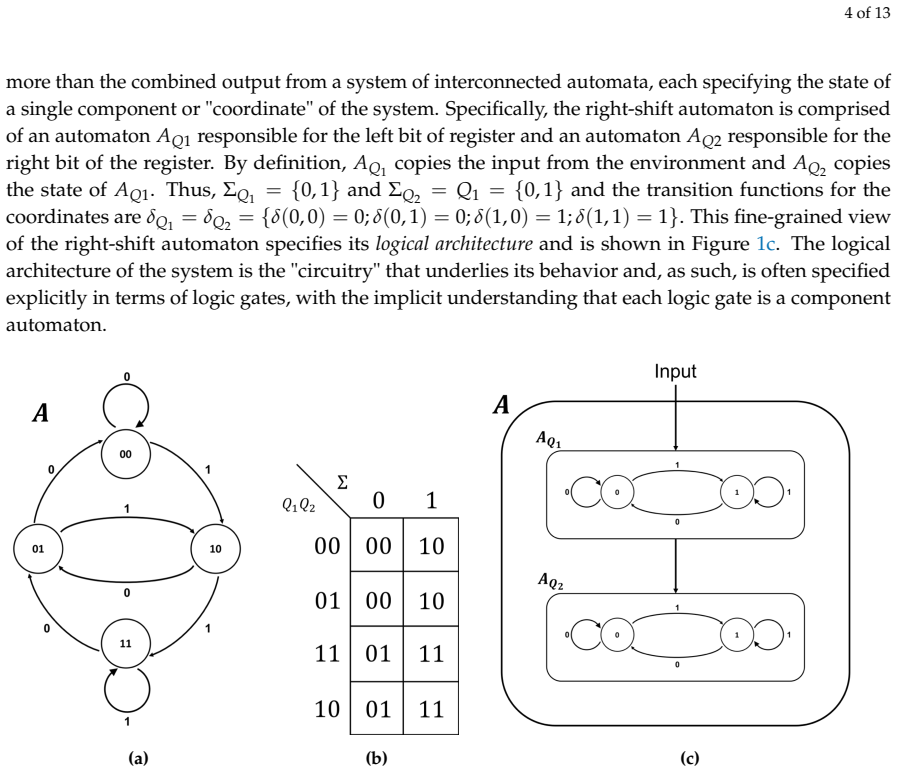
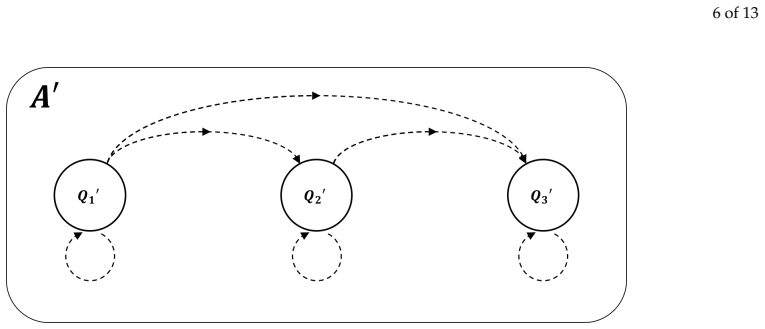
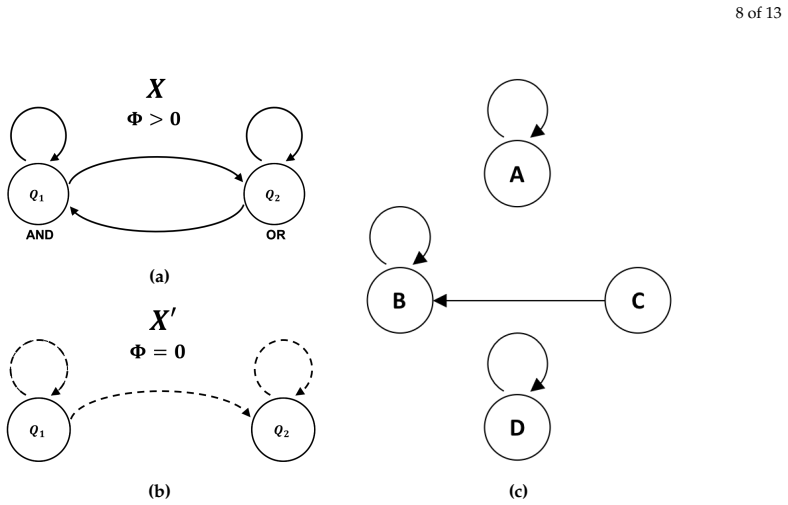
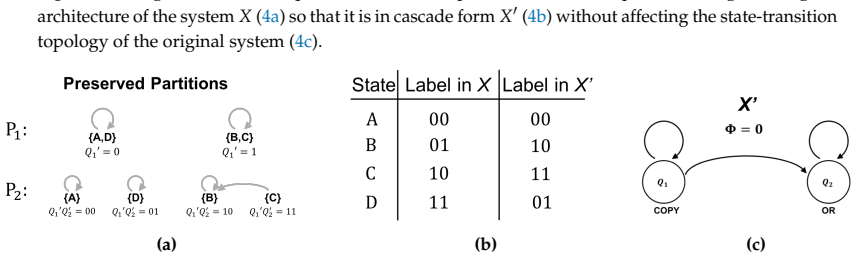
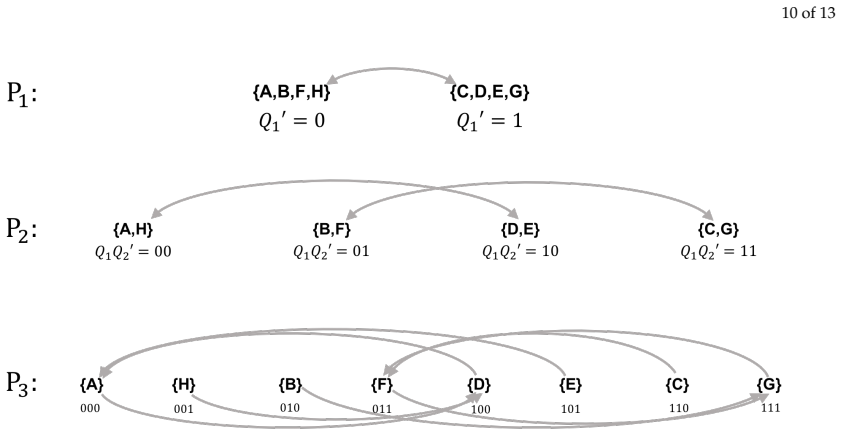
The central object is the preserved partition of a finite-state automaton's state space: a grouping of states into blocks such that every state in a block transitions to a single block. A nested sequence of preserved partitions, each splitting the previous blocks evenly in half, supplies the coordinates of a new automaton whose logic gates are read off from block-to-block transitions. For the paper's examples, this sequence yields a cascade, or strictly feed-forward, architecture with the same global state-transition diagram as the original feedback architecture. The cascade form guarantees $\Phi = 0$ because any unidirectional partition of it leaves the dynamics unchanged, while the original circuit has $\Phi > 0$. This machinery isolates the effect of internal labeling: the isomorphism is a dictionary between representations, and the only mathematical difference between the two systems is the permutation of binary labels used to instantiate the same computation.
What would settle it
Take a concrete finite-state automaton with feedback and enumerate every bijective relabeling of its internal states, constructing each as a distinct logical architecture. The paper's claim predicts that at least one relabeling yields a strictly feed-forward architecture with $\Phi = 0$ while the original has $\Phi > 0$ under the standard $\Phi$ algorithm; if no such relabeling exists for any finite-state automaton, or if every relabeling of a given transition diagram yields the same $\Phi$ value, the central claim is falsified.
Extended reading notes
Core claim
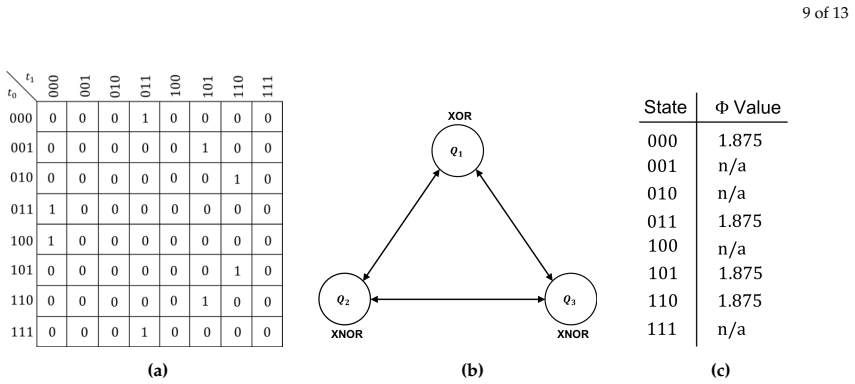
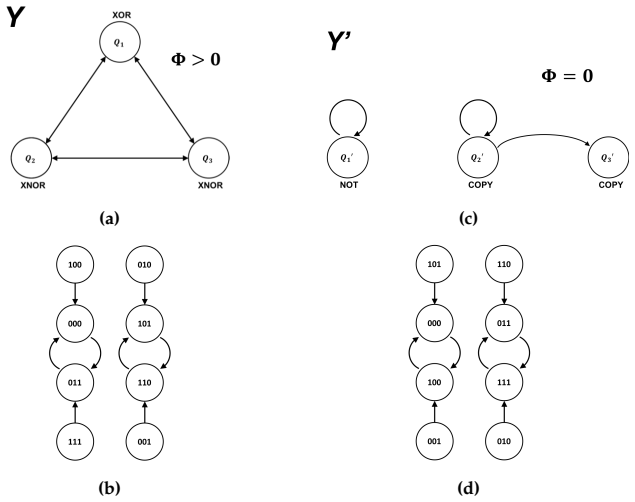
The central claim is that a system satisfying the integrated-information criteria for consciousness ($\Phi > 0$) can have an isomorphic counterpart that is a philosophical zombie by the same theory's standards ($\Phi = 0$), where the isomorphism is a bijective relabeling of internal binary states that preserves every state transition. The authors demonstrate this by explicit construction: an AND/OR feedback pair and a three-bit XNOR/XOR/XOR system are each decomposed into cascade form through a nested sequence of preserved partitions. In the decomposed system information flows strictly forward, so any unidirectional partition leaves the transition probability matrix unchanged, forcing $\Phi = 0$ for all states; yet the global state-transition diagram is exactly the original diagram with states renamed. The paper concludes that $\Phi$ depends on the internal representation of a computation, not on the computation itself, and that any quantitative measure of consciousness should be invariant under such isomorphisms: measurable differences in consciousness must correspond to measurable differences in the state-transition function.
Load-bearing premise
The argument depends on treating a bijective relabeling of internal binary states as producing the same computation with no physical or semantic difference; if the actual physical wiring or the environment can privilege one labeling over another, then the isomorphic zombie is not genuinely equivalent and the challenge to $\Phi$ collapses.
Editorial extensions
If this is right
- Any measure of consciousness that satisfies the proposed invariance criterion will assign identical values to isomorphic circuits, so it cannot single out physical feedback as a necessary condition for consciousness in these examples.
- The integrated-information measure $\Phi$, as currently defined, fails the criterion: isomorphic systems exist with $\Phi > 0$ and $\Phi = 0$.
- The two members of each pair cannot be told apart by an outside observer tracking state transitions; if one is conscious and the other is not, the difference is causally silent in the state dynamics.
- The invariance criterion is necessary but not sufficient for a theory of consciousness to be free of philosophical zombies; further constraints are still required.
- Consciousness measures should be evaluated on equivalence classes of physical implementations that realize the same state-transition topology, rather than on a single wiring diagram.
Reading between the lines
- Editor's inference: the same invariance test could be applied to other causal-structure theories of consciousness or to measures of causal emergence; any such measure that changes under a bijective relabeling of internal states would face the same isomorphic-zombie problem.
- Editor's inference: the examples suggest a sharper, computable claim: enumerating all bijective relabelings of a given transition diagram and computing $\Phi$ for each isomorphic circuit would quantify how much of $\Phi$ is labeling artifact rather than graph structure.
- Editor's inference: if the invariance criterion is accepted, the integrated-information framework would need to define $\Phi$ on the quotient of circuits under isomorphism, effectively turning $\Phi$ into a graph-theoretic quantity on the state-transition diagram.
- Editor's inference: because $\Phi$ is independent of computation on the paper's account, any future theory making $\Phi$ central must explain why organisms would evolve high-$\Phi$ wirings rather than their equivalent low-$\Phi$ isomorphic counterparts.
Signed reviews
Editorial analysis
A structured set of objections, weighed in public.
Referee Report
Summary. This manuscript challenges Integrated Information Theory (IIT) by constructing feedback systems with Φ>0 and isomorphic feed-forward systems with Φ=0. The authors work with finite-state automata and use preserved partitions to produce cascade decompositions that preserve the global state-transition diagram up to a bijective relabeling. The two worked examples are an AND/OR system mapped to COPY/OR and a three-element system with two XNOR gates and one XOR mapped to a NOT/COPY/COPY cascade. The paper argues that because the only apparent difference between the two realizations is a permutation of binary labels, Φ is sensitive to functionally arbitrary internal representation, and it proposes that any quantitative theory of consciousness should be invariant under isomorphisms of the state-transition diagram.
Significance. If the central claim were fully established, this would be a significant challenge to IIT: it would exhibit equal-size, equal-state-count systems with identical global state-transition graphs but different IIT verdicts. The examples are explicit and reproducible, and the paper is commendably clear that the invariance criterion is a proposal rather than a theorem. The main weakness is that the conclusion depends on identifying 'computation' with the unlabeled global state-transition topology, which is precisely the functionalist premise that IIT's constitutive decomposition into physical mechanisms rejects. The manuscript acknowledges this alternative in Section 3.1 but does not refute it, so the paper is best read as a conditional critique that sharpens the philosophical disagreement rather than as a definitive refutation of IIT.
major comments (3)
- [Abstract and Section 3 (Figures 6–8)] The claim that the only mathematical difference between Y and Y′ is a permutation of binary labels is inaccurate with respect to IIT's formal objects. IIT defines Φ on a transition probability matrix together with a specified decomposition into physical elements (Oizumi et al. 2014). The two systems differ in element-level wiring—two XNOR gates and one XOR with cyclic coupling versus NOT/COPY/COPY in cascade—and the bijection h maps global states but does not map the element decomposition. Therefore Y and Y′ are not isomorphic in the mathematical category in which Φ is defined, and the conclusion that Φ is sensitive to 'functionally arbitrary' labeling requires the additional premise that the unlabeled global transition topology is the correct notion of function. The paper should state this premise explicitly and defend it, or the conclusion should be weakened to a conditional one.
- [Section 3.1] The proposed invariance criterion ('any quantitative theory of consciousness ... should be invariant under isomorphisms') is a normative assertion, not a consequence of IIT's axioms or of the preceding mathematical construction. The manuscript acknowledges that IIT defines behavior in terms of the specific logical implementation and dismisses this as untestable from outside. But the untestability of a constitutive assumption from a third-person perspective does not refute it; the hard problem is precisely that such assumptions are not directly observable. The paper therefore does not so much refute IIT as locate the disagreement in the choice between functionalist and implementation-based notions of computation. This is a legitimate contribution, but the abstract and title overstate the result as demonstrating the existence of isomorphic zombies rather than zombies under a contested functionalist criterion.
- [Section 2.3.1 (Figure 4)] The first example begins by 'leaving off the binary labels' of the physical AND/OR system and treating the unlabeled diagram as the computation. This move is not neutral: the labels of a physical circuit are determined by the outputs of its gates, and an isomorphic relabeling forces a different gate implementation (COPY/OR instead of AND/OR). The statement that both systems 'operate on the same support' conflates the abstract state set with the physical states of the circuits. The 'isomorphism' is between the abstract directed graph and the relabeled graph, not between the two physical circuits, so the phrase 'only a permutation' should be reserved for the global state-transition diagram and explicitly accompanied by the caveat that the physical architectures differ.
minor comments (4)
- [Section 3] There is a typo: 'Karnuagh maps' should be 'Karnaugh maps'.
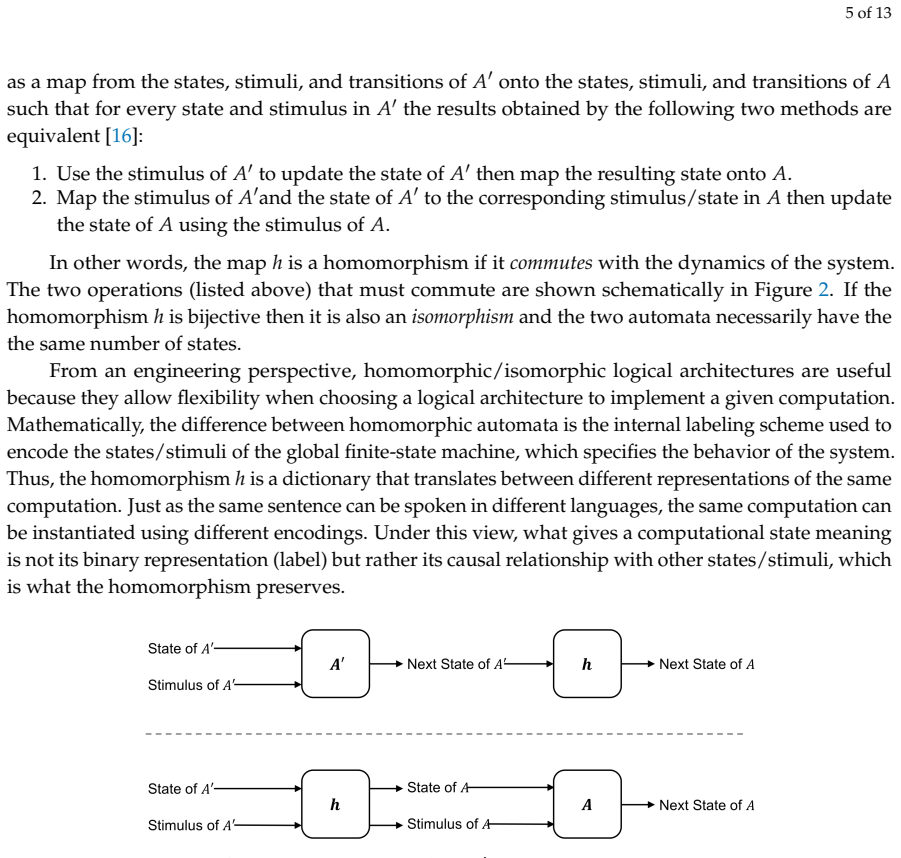
- [Section 2.2] The definition of a homomorphism refers to a map on states, stimuli, and transitions, but the commuting diagram in Figure 2 and the subsequent examples use only a single input symbol (the passage of time). The paper would be clearer if it explicitly stated that the input alphabet is trivial in the examples and that the isomorphism is of the underlying deterministic state-transition graph.
- [Figure 8 caption] The caption says the two diagrams 'differ only by a permutation of labels'; given the difference in gate wiring, this should be qualified as 'at the level of the global state-transition diagram' to avoid contradicting the paper's own Section 3.1 discussion of the alternative interpretation.
- [Acknowledgements] The word 'feed-back' should be 'feedback' for consistency with the rest of the text.
Circularity Check
No circularity: the isomorphic zombie is constructed directly from automata theory, the Phi values are computed from the transition probability matrices, and the invariance criterion is an explicitly stated philosophical premise rather than a disguised input.
full rationale
The paper's central result—that a feedback system with Phi > 0 can be accompanied by an isomorphic feed-forward system with Phi = 0—is established by explicit construction, not assumed. Section 2.3.1 builds the cascade counterpart X' from a nested sequence of preserved partitions, and Section 3 does the same for Y, with the global state-transition diagrams shown to differ only by a relabeling (Figures 5, 7, 8). The claim that the cascade system has Phi = 0 follows from IIT's own unidirectional partition rule applied to the transition probability matrix (Section 2.2), and the positive Phi values for the feedback systems are checked against the independent PyPhi toolbox [25]. No load-bearing step reduces to a fitted parameter or to the paper's own prior results: the automata-theoretic facts cited (Krohn-Rhodes, preserved partitions from Arbib/Hartmanis) are external and used to motivate the construction, and there are no self-citations. The paper explicitly acknowledges in Section 3.1 that an alternative, implementation-level interpretation exists, 'for example as IIT adopts,' and concedes the hard problem cannot adjudicate it. The final recommendation that consciousness measures be invariant under isomorphisms is a normative criterion built on the premise that behavior is defined by state-transition topology; that is a philosophical assumption, not a circular derivation from or reduction to the paper's own definitions.
Assumptions & free parameters
assumptions (4)
- standard math Krohn-Rhodes theorem
- standard math Preserved partitions yield isomorphic cascade decompositions
- domain assumption IIT's partition rule for feed-forward systems
- domain assumption Functionalist equivalence of isomorphic automata
Cite this review
Pith. "Pith review of Integrated Information Theory and Isomorphic Feed-Forward Philosophical Zombies." pith.science (2026). https://pith.science/paper/OFPCCBN2
@misc{pith2026190809621,
  author       = {Pith},
  title        = {Pith review of: Integrated Information Theory and Isomorphic Feed-Forward Philosophical Zombies},
  year         = {2026},
  howpublished = {\url{https://pith.science/paper/OFPCCBN2}},
  note         = {Machine review of arXiv:1908.09621}
}
abstract
Any theory amenable to scientific inquiry must have testable consequences. This minimal criterion is uniquely challenging for the study of consciousness, as we do not know if it is possible to confirm via observation from the outside whether or not a physical system knows what it feels like to have an inside - a challenge referred to as the "hard problem" of consciousness. To arrive at a theory of consciousness, the hard problem has motivated the development of phenomenological approaches that adopt assumptions of what properties consciousness has based on first-hand experience and, from these, derive the physical processes that give rise to these properties. A leading theory adopting this approach is Integrated Information Theory (IIT), which assumes our subjective experience is a "unified whole", subsequently yielding a requirement for physical feedback as a necessary condition for consciousness. Here, we develop a mathematical framework to assess the validity of this assumption by testing it in the context of isomorphic physical systems with and without feedback. The isomorphism allows us to isolate changes in $\Phi$ without affecting the size or functionality of the original system. Indeed, we show that the only mathematical difference between a "conscious" system with $\Phi>0$ and an isomorphic "philosophical zombies" with $\Phi=0$ is a permutation of the binary labels used to internally represent functional states. This implies $\Phi$ is sensitive to functionally arbitrary aspects of a particular labeling scheme, with no clear justification in terms of phenomenological differences. In light of this, we argue any quantitative theory of consciousness, including IIT, should be invariant under isomorphisms if it is to avoid the existence of isomorphic philosophical zombies and the epistemological problems they pose.
Figures
Figures from the paper (5 more)
Reference graph
Works this paper leans on
-
[1]
Neural correlates of consciousness in humans
Rees, G.; Kreiman, G.; Koch, C. Neural correlates of consciousness in humans. Nature Reviews Neuroscience 2002, 3, 261
work page 2002
-
[2]
Facing Up to the Problem of Consciousness
Chalmers, D.J. Facing Up to the Problem of Consciousness. Journal of Consciousness Studies 1995, 2, 200–19
work page 1995
-
[3]
Searle, J.R. Minds, brains, and programs. Behavioral and brain sciences 1980, 3, 417–424
work page 1980
-
[4]
Consciousness as integrated information: a provisional manifesto
Tononi, G. Consciousness as integrated information: a provisional manifesto. The Biological Bulletin 2008, 215, 216–242
work page 2008
-
[5]
From the phenomenology to the mechanisms of consciousness: integrated information theory 3.0
Oizumi, M.; Albantakis, L.; Tononi, G. From the phenomenology to the mechanisms of consciousness: integrated information theory 3.0. PLoS computational biology 2014, 10, e1003588
work page 2014
-
[6]
Integrated information theory: from consciousness to its physical substrate
Tononi, G.; Boly, M.; Massimini, M.; Koch, C. Integrated information theory: from consciousness to its physical substrate. Nature Reviews Neuroscience 2016, 17, 450
work page 2016
-
[7]
A mathematical theory of communication
Shannon, C.E. A mathematical theory of communication. Bell system technical journal 1948, 27, 379–423
work page 1948
-
[8]
An information integration theory of consciousness
Tononi, G. An information integration theory of consciousness. BMC neuroscience 2004, 5, 42
work page 2004
Show all 28 references
-
[9]
Integrated information in discrete dynamical systems: motivation and theoretical framework
Balduzzi, D.; Tononi, G. Integrated information in discrete dynamical systems: motivation and theoretical framework. PLoS computational biology 2008, 4, e1000091
2008
-
[10]
Godfrey-Smith, P .Theory and reality: An introduction to the philosophy of science; University of Chicago Press, 2009
2009
-
[11]
Computing Machinery and Intelligence
Turing, A. Computing Machinery and Intelligence. Mind 1950, 59, 433–433
1950
-
[12]
Why and how we are not zombies
Harnad, S. Why and how we are not zombies. Journal of Consciousness Studies 1995, 1, 164–167
1995
-
[13]
The unfolding argument: Why IIT and other causal structure theories cannot explain consciousness
Doerig, A.; Schurger, A.; Hess, K.; Herzog, M.H. The unfolding argument: Why IIT and other causal structure theories cannot explain consciousness. Consciousness and Cognition 2019, 72, 49 – 59. doi:https://doi.org/10.1016/j.concog.2019.04.002
2019 doi
-
[14]
Algebraic theory of machines
Krohn, K.; Rhodes, J. Algebraic theory of machines. I. Prime decomposition theorem for finite semigroups and machines. Transactions of the American Mathematical Society 1965, 116, 450–464
1965
-
[15]
Cascade synthesis of finite-state machines
Zeiger, H.P . Cascade synthesis of finite-state machines. Information and Control 1967, 10, 419–433
1967
-
[16]
Algebraic theory of machines, languages, and semi-groups; Academic Press, 1968
Arbib, M.; Krohn, K.; Rhodes, J. Algebraic theory of machines, languages, and semi-groups; Academic Press, 1968
1968
-
[17]
Automata Studies.(AM-34); Vol
Shannon, C.E.; McCarthy, J. Automata Studies.(AM-34); Vol. 34, Princeton University Press, 2016. 13 of 13
2016
-
[18]
Effective Theories for Circuits and Automata
DeDeo, S. Effective Theories for Circuits and Automata. Chaos (Woodbury, N.Y.) 2011, 21, 037106. doi:10.1063/1.3640747
2011 doi
-
[19]
A decomposition theorem for probabilistic transition systems
Maler, O. A decomposition theorem for probabilistic transition systems. Theoretical Computer Science 1995, 145, 391–396
1995
-
[20]
Improved measures of integrated information
Tegmark, M. Improved measures of integrated information. PLoS computational biology 2016, 12, e1005123
2016
-
[21]
Evolution of Integrated Causal Structures in Animats Exposed to Environments of Increasing Complexity
Albantakis, L.; Hintze, A.; Koch, C.; Adami, C.; Tononi, G. Evolution of Integrated Causal Structures in Animats Exposed to Environments of Increasing Complexity. PLOS Computational Biology 2014, 10, 1–19. doi:10.1371/journal.pcbi.1003966
2014 doi
-
[22]
Algebraic structure theory of sequential machines (prentice-hall international series in applied mathematics); Prentice-Hall, Inc., 1966
Hartmanis, J. Algebraic structure theory of sequential machines (prentice-hall international series in applied mathematics); Prentice-Hall, Inc., 1966
1966
-
[23]
Hierarchical coordinate systems for understanding complexity and its evolution, with applications to genetic regulatory networks
Egri-Nagy, A.; Nehaniv, C.L. Hierarchical coordinate systems for understanding complexity and its evolution, with applications to genetic regulatory networks. Artificial Life 2008, 14, 299–312
2008
-
[24]
Computational Holonomy Decomposition of Transformation Semigroups
Egri-Nagy, A.; Nehaniv, C.L. Computational Holonomy Decomposition of Transformation Semigroups. arXiv preprint arXiv:1508.06345 2015
2015 arXiv
-
[25]
PyPhi: A toolbox for integrated information theory
Mayner, W.G.; Marshall, W.; Albantakis, L.; Findlay, G.; Marchman, R.; Tononi, G. PyPhi: A toolbox for integrated information theory. PLoS computational biology 2018, 14, e1006343
2018
-
[26]
The map method for synthesis of combinational logic circuits
Karnaugh, M. The map method for synthesis of combinational logic circuits. Transactions of the American Institute of Electrical Engineers, Part I: Communication and Electronics 1953, 72, 593–599
1953
-
[27]
How can Physics Underlie the Mind
Ellis, G. How can Physics Underlie the Mind. Springer2016 2016
2016
-
[28]
Top-down causation by information control: from a philosophical problem to a scientific research programme
Auletta, G.; Ellis, G.F.; Jaeger, L. Top-down causation by information control: from a philosophical problem to a scientific research programme. Journal of the Royal Society Interface 2008, 5, 1159–1172
2008
Reviewed August 14, 2026 · model on record in the stance chip above.
Discussion (0). Continue with ORCID to comment.