REVIEW 3 major objections 4 minor 14 references
Probing the high energy spectrum of neutral pions in ultra-high energy proton-Air interactions
T0 review · 3 major / 4 minor · reviewed 2026-08-14 · deepseek-v4-flash
Pith's one-line read The slope of the low muon-number tail at the ground is a direct probe of the high-energy neutral-pion spectrum of the first proton-air collision.
desk verdict Competent proceedings paper with a useful calibration result, but the abstract's 'direct link' to the neutral-pion spectrum overstates what the simulation actually shows. read the letter →
The pith
A machine-rendered reading of the paper's core claim, the machinery that carries it, and where it could break.
The reading
What carries the argument
The paper's central object is the exponential low tail of the ground muon-number distribution for proton-induced showers, quantified by its slope $\Lambda_\mu$. That slope is interpreted through a weighted first-interaction energy variable $\alpha_1 = \sum_i (E_{{\rm had},i}/E_0)^\beta$, with $\beta = \log(m)/\log(m_{\rm tot})$ from the Heitler-Matthews cascade model; this variable encodes how the first interaction splits energy between the hadronic and electromagnetic sectors. A calibration curve between $\Lambda_\mu$ and $\Lambda_{\rm had}$, obtained by reweighting simulated showers, is what lets a ground measurement stand in for the first-interaction energy flow. The neutral-pion spectrum enters through $E_{\rm had} = 1 - E_{\rm em}$, since $\pi^0 \to \gamma\gamma$ feeds the electromagnetic component and the highest-energy pions carry the information about fast leading particles.
What would settle it
If, on real data with good statistics, the low-$N_\mu$ tail slope changed with atmospheric depth or with the amount of later shower development while the first-interaction energy flow were held fixed, the claimed direct link would fail; a direct test would be to compare the $\Lambda_{\rm had}$ inferred from $\Lambda_\mu$ at approximately $10^{17}$ eV with the same quantity measured by forward LHC experiments at 13 TeV.
Extended reading notes
Core claim
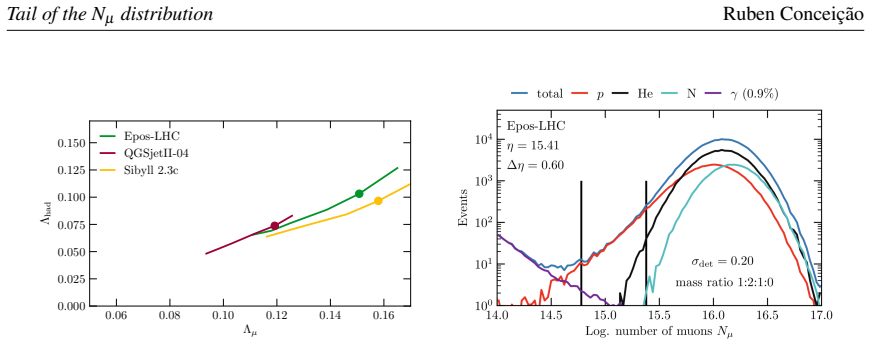
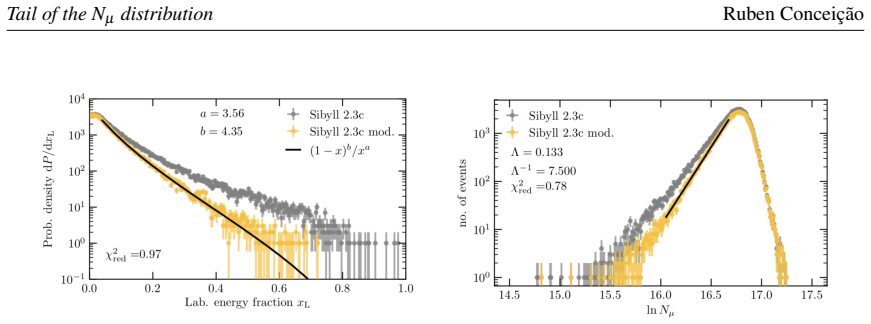
The central claim is that the shape of the shower-to-shower muon-number distribution, specifically its exponential tail at low $N_\mu$, is controlled by the first hadronic interaction of the primary proton. The paper defines $\Lambda_\mu$ as the slope of this tail and shows, by reweighting simulated showers from a large ensemble, that $\Lambda_\mu$ is tied to $\Lambda_{\rm had}$, the slope of the distribution of the hadronic energy fraction $E_{\rm had}/E_0$ deposited by that first interaction. Because the electromagnetic sector is fed almost entirely by neutral pions, fluctuations of $E_{\rm had}/E_0$ are the same as fluctuations of the electromagnetic energy fraction, so $\Lambda_{\rm had}$ in turn reflects the inclusive high-energy tail of the neutral-pion spectrum. Simulation with QGSJET-II.04, EPOS-LHC, and SIBYLL 2.3c shows that modifying the neutral-pion inclusive cross-section at large $x_L$ moves $\Lambda_\mu$, and that a mixed composition of 25% protons, 50% helium, and 25% nitrogen still permits a clean measurement of the proton tail when the muon number is smeared by 20%.
Load-bearing premise
The link between the measured low-muon tail slope and the first-interaction hadronic-energy slope is universal across hadronic models and remains valid in real mixed-composition data; the paper demonstrates it only by reweighting simulated showers, not by analytic derivation.
Editorial extensions
If this is right
- A ground array that collects on the order of 3000 proton-like showers could distinguish among the tested hadronic interaction models using the low-$N_\mu$ tail slope alone.
- The same measurement at cosmic-ray energies around $10^{17}$ eV could be confronted with LHC forward measurements at $\sqrt{s}=13$ TeV, offering a direct accelerator-to-cosmic-ray cross-check.
- If the calibration holds, $\Lambda_\mu$ becomes a measurement of the fluctuation of the hadronic energy fraction in the first interaction at $\sqrt{s}\sim100$ TeV, where no collider data exist.
- A suppression of neutral-pion production at large $x_L$ shifts the muon tail, so the tail slope provides a test of high-rapidity multiparticle production and of possible violations of longitudinal scaling at ultra-high energies.
- The measurement remains feasible even under a pessimistic mixed composition with abundant helium, provided enough showers are recorded.
Reading between the lines
- A natural extension the authors do not spell out: the same tail analysis could be applied to the electromagnetic component, such as shower-maximum depth or ground electrons, to separate first-interaction energy flow from subsequent shower physics and cross-check the muon-based calibration.
- If the model-dependent step between $\Lambda_{\rm had}$ and the neutral-pion spectrum cannot be sharpened, the practical reach of the method may be limited to detecting qualitative deviations from standard-model expectations, such as an anomalous leading-particle energy fraction, rather than a precise spectrum.
- The technique effectively converts the atmosphere into a forward detector for $\sqrt{s}\sim100$ TeV proton-air collisions; a dedicated measurement of $\Lambda_\mu$ as a function of primary energy could map the onset of any new high-energy behavior.
- An obvious testable extension is to apply the tail-slope method to existing high-statistics data sets and compare the derived $\Lambda_{\rm had}$ at overlapping energies with forward LHC measurements; any mismatch would pinpoint either the calibration or new physics.
Signed reviews
Editorial analysis
A structured set of objections, weighed in public.
Referee Report
Summary. This proceedings paper claims that the slope of the low-number tail of the muon-number distribution, Λ_mu, measured at the ground in ultra-high-energy cosmic-ray air showers is a direct probe of properties of the first hadronic interaction, specifically the fraction of primary energy transferred to the hadronic component and, more strongly, the high-energy tail of the neutral-pion energy spectrum. The study uses CONEX simulations of proton-induced showers at 10^19 eV and 67° zenith angle with a 1 GeV muon threshold. Section 3.1 establishes a simulation-based calibration between Λ_mu and the slope Λ_had of the first-interaction hadronic-energy fraction distribution, and shows that Λ_mu can be extracted in a mixed-composition scenario with 20% muon-number smearing. Section 3.2 reports that suppressing high-x_L neutral-pion production in SIBYLL 2.3c changes the N_mu tail, and the authors argue that this connects Λ_mu to the pion spectrum. The paper also discusses experimental precision and connections to LHC forward measurements.
Significance. If the claimed connection holds, this observable would provide a new way to access first-interaction physics at center-of-mass energies around 100 TeV, beyond current accelerators, using existing or planned cosmic-ray observatories such as the Pierre Auger Observatory. The paper has notable strengths: the simulation setup is clearly stated, statistical bands are shown, the mixed-composition and detector-smearing analysis is a useful feasibility check, and the comparison across three post-LHC hadronic models is informative. The central limitation, however, is that the evidence supports sensitivity to the first-interaction hadronic/electromagnetic energy split, not yet a model-independent sensitivity to the neutral-pion spectral shape. The abstract's phrase 'direct link' overstates what the presented simulations establish.
major comments (3)
- [Sec. 3.2, Fig. 5] The simulation that suppresses high-x_L neutral-pion production changes not only the spectral shape of the π0 distribution but also the total electromagnetic energy fraction E_em = 1 - E_had, and hence α1 in Eq. (2.1). The observed change in the N_mu tail is therefore fully compatible with Λ_mu tracking only the hadronic/electromagnetic energy split, with no demonstrated sensitivity to the shape of the π0 spectrum beyond its contribution to that split. To support the central claim, the authors should show a control test where the π0 spectral shape is varied while E_had/E0 (or α1) is held fixed, or provide a quantitative decomposition showing that Λ_mu carries information about the shape independently of the first moment.
- [Sec. 3.1, Fig. 3 (left)] The calibration between Λ_mu and Λ_had is obtained by selecting simulated showers from a large ensemble and fitting the response, rather than from a physical derivation or an out-of-sample test. The claim that the relation is independent of hadronic models is supported only by three post-LHC models that share common assumptions about the leading-particle and energy-flow behavior. The figure shows model-dependent lines, so the 'independently of the hadronic interaction models' assertion requires a stronger demonstration, for example a model with a deliberately different first-interaction energy-flow distribution or a cross-validation on independent simulation sets.
- [Abstract vs. Sec. 3.2, final paragraph] The abstract claims that the slope of the low-N_mu tail is 'a direct link to the high energy spectrum of neutral pions,' but the text explicitly states that the derived function relating Λ_mu to the π0 spectrum 'has some dependence on the details of the hadronic interaction models.' This is an internal inconsistency in the level of claim. Either the abstract should be softened to reflect the model-dependent calibration, or the paper should provide an estimate of the systematic uncertainty and demonstrate that the model dependence does not affect the qualitative conclusion.
minor comments (4)
- [Sec. 4] There is an encoding artifact in the text: 'protons.¢aMoreover' should read 'protons. Moreover'. Also, 'the slope of theNµ' is missing a space.
- [Fig. 3 (left), caption] The caption reads 'Conversion between Λµ and Λα,' but the text and axes use Λ_had; please make the notation consistent.
- [Eq. (2.2)] The symbols m and m_tot are not defined precisely enough; it is unclear whether they refer to charged multiplicity, total hadronic multiplicity, or something else. Please clarify in the text.
- [Introduction and Conclusions] The paper uses the words 'prove' and 'proved' for statements obtained from a finite set of simulations; 'demonstrate' or 'show' would be more accurate and appropriate for a proceedings contribution.
Circularity Check
The central premise that the N_mu tail shape is governed by first-interaction hadronic energy flow is load-bearing and imported from the authors' own prior paper [8]; the new calibration and pion-spectrum simulations add independent content but do not break the self-citation chain.
-
self citation load bearing
[Section 2, paragraph after Eq. (2.2): 'It is shown in [8] that α1 distribution...']
"It is shown in [8] that α1 distribution of the first interaction is enough to describe the main features (the width1 and exponential tail) while the rest of the shower contributes only to the overall value of Nµ."
The paper's derivation chain starts from the assertion that the shape of the N_mu distribution, especially its exponential tail, is determined by the first-interaction hadronic-energy flow. That foundational assertion is not re-derived here; it is lifted verbatim from [8], a prior paper by the same authors (Cazon, Conceição, Riehn). The subsequent argument uses this premise as established: Sec. 3.1 identifies the measured slope Lambda_mu with Lambda_had, and Sec. 3.2 extends this to the neutral-pion spectrum. Because the load-bearing premise is a self-citation rather than an independently validated, externally benchmarked result, the first link of the claimed 'direct link' reduces to the authors' own earlier work. The new simulation calibrations in Sec.
full rationale
No equation-level tautology was found: alpha1 is defined from first-interaction hadronic energies, and Lambda_had is defined as the slope of the Ehad/E0 distribution; the mapping from Lambda_mu to Lambda_had is a simulation-based calibration, not a definitional identity. Similarly, the pion-spectrum sensitivity shown in Sec. 3.2 is a Monte Carlo check, not a fitted parameter renamed as a prediction. The main circularity-adjacent issue is the load-bearing self-citation to [8]: the paper's starting point that N_mu fluctuations and the exponential tail are governed by the first interaction is imported from the same group's earlier work. This is not a fully circular derivation because the calibration curves and the pion-spectrum simulation are new and falsifiable in principle, and the paper even admits that the Lambda_mu-to-pion-spectrum function retains model dependence. That admission weakens the abstract's 'direct link' claim, but it is an overstatement/correctness concern rather than a definitional circularity. Overall, the central claim retains independent simulation content, but the foundational premise is self-cited, so a moderate score of 4 is appropriate.
Assumptions & free parameters
free parameters (3)
- Beta (power-law index in alpha1) =
Not stated numerically; model-dependent via first-interaction multiplicities
- N_mu tail fit range =
Not specified; indicated by vertical bars in Fig. 3 (right)
- Detector N_mu smearing =
20% (Gaussian smearing assumed)
assumptions (5)
- domain assumption The shape of the N_mu distribution, especially its low tail, is essentially determined by the first interaction, while later interactions only affect the average.
- domain assumption Ehad/E0 is strongly correlated with N_mu in the low tail, and the tail of the N_mu distribution is dominated by Ehad/E0.
- ad hoc to paper A calibration curve between Lambda_mu and Lambda_had derived from simulations is independent of the hadronic interaction model.
- domain assumption The Heitler-Matthews relation beta = log(m)/log(mtot) describes the energy/multiplicity scaling of muon production.
- domain assumption CONEX and the three hadronic interaction models adequately describe air-shower development and muon transport for this purpose.
Cite this review
Pith. "Pith review of Probing the high energy spectrum of neutral pions in ultra-high energy proton-Air interactions." pith.science (2026). https://pith.science/paper/XNJRRR7L
@misc{pith2026190809668,
  author       = {Pith},
  title        = {Pith review of: Probing the high energy spectrum of neutral pions in ultra-high energy proton-Air interactions},
  year         = {2026},
  howpublished = {\url{https://pith.science/paper/XNJRRR7L}},
  note         = {Machine review of arXiv:1908.09668}
}
read the original abstract
The interaction of ultra-high energy cosmic rays with the atmosphere nuclei has long been seen as a unique opportunity to study hadronic interactions above energies attainable by accelerators. However, so far the multiparticle production properties of the first interaction have been difficult to assess as they are masked by the many interactions that outline the shower development. In this work, we demonstrate, that relevant properties of the ultra-high energy first interaction can be accessed through the analysis of the shower-to-shower distribution of muons arriving at the ground. In particular, it is shown that the slope of the low-tail of the number of muon distribution measured at the ground is a direct link to the high energy spectrum of neutral pions produced in the interaction of the primary protons. In this presentation, it will also address the experimental feasibility of such measurements and their connection with physical quantities being currently measured at the Large Hadron Collider.
Figures


Figures from the paper (2 more)

Reference graph
Works this paper leans on
-
[1]
A model for the transport of muons in extensive air showers
L. Cazon, R. Conceição, M. Pimenta and E. Santos, A model for the transport of muons in extensive air showers, Astropart. Phys. 36 (2012) 211–223, [1201.5294]
work page Pith review arXiv 2012
-
[2]
S. Andringa, L. Cazon, R. Conceição and M. Pimenta, The Muonic longitudinal shower profiles at production, Astropart. Phys. 35 (2012) 821–827, [1111.1424]
arXiv 2012
-
[3]
P IERRE AUGER collaboration, A. Aab et al., Muons in air showers at the Pierre Auger Observatory: Mean number in highly inclined events, Phys. Rev. D91 (2015) 032003, [1408.1421]
arXiv 2015
-
[4]
T ELESCOPE ARRAY collaboration, R. U. Abbasi et al., Study of muons from ultrahigh energy cosmic ray air showers measured with the Telescope Array experiment, Phys. Rev. D98 (2018) 022002, [1804.03877]
work page Pith review arXiv 2018
-
[5]
Ostapchenko, Monte Carlo treatment of hadronic interactions in enhanced Pomeron scheme: I
S. Ostapchenko, Monte Carlo treatment of hadronic interactions in enhanced Pomeron scheme: I. QGSJET-II model, Phys. Rev. D83 (2011) 014018, [1010.1869]
arXiv 2011
- [6]
- [7]
-
[8]
L. Cazon, R. Conceição and F. Riehn, Probing the energy spectrum of hadrons in proton air interactions at ultrahigh energies through the fluctuations of the muon content of extensive air showers, Phys. Lett. B784 (2018) 68–76, [1803.05699]
work page Pith review arXiv 2018
Show all 14 references
-
[9]
Matthews, A Heitler model of extensive air showers, Astropart
J. Matthews, A Heitler model of extensive air showers, Astropart. Phys. 22 (2005) 387–397
2005
-
[10]
Abreu et al., Measurement of the proton-air cross-section at√s = 57 TeV with the Pierre Auger Observatory, Phys
P IERRE AUGER collaboration, P. Abreu et al., Measurement of the proton-air cross-section at√s = 57 TeV with the Pierre Auger Observatory, Phys. Rev. Lett. 109 (2012) 062002, [1208.1520]
2012 arXiv
-
[11]
Aab et al., Depth of maximum of air-shower profiles at the Pierre Auger Observatory
P IERRE AUGER collaboration, A. Aab et al., Depth of maximum of air-shower profiles at the Pierre Auger Observatory. II. Composition implications, Phys. Rev. D90 (2014) 122006, [1409.5083]
2014 arXiv
-
[12]
Chatrchyan et al., Measurement of pseudorapidity distributions of charged particles in proton-proton collisions at√s = 8 TeV by the CMS and TOTEM experiments, Eur
CMS, TOTEM collaboration, S. Chatrchyan et al., Measurement of pseudorapidity distributions of charged particles in proton-proton collisions at√s = 8 TeV by the CMS and TOTEM experiments, Eur. Phys. J.C74 (2014) 3053, [1405.0722]
2014 arXiv
-
[13]
Adriani et al., Measurements of longitudinal and transverse momentum distributions for neutral pions in the forward-rapidity region with the LHCf detector, Phys
LHC F collaboration, O. Adriani et al., Measurements of longitudinal and transverse momentum distributions for neutral pions in the forward-rapidity region with the LHCf detector, Phys. Rev. D94 (2016) 032007, [1507.08764]
2016 arXiv
-
[14]
Aab et al., Prototype muon detectors for the AMIGA component of the Pierre Auger Observatory, JINST 11 (2016) P02012, [1605.01625]
P IERRE AUGER collaboration, A. Aab et al., Prototype muon detectors for the AMIGA component of the Pierre Auger Observatory, JINST 11 (2016) P02012, [1605.01625]. 7
2016 arXiv
Reviewed August 14, 2026 · model on record in the stance chip above.
Discussion (0). Continue with ORCID to comment.