REVIEW 3 major objections 4 minor 30 references
Finite volume corrections of non-diagonal form factors
T0 review · 3 major / 4 minor · reviewed 2026-08-14 · deepseek-v4-flash
Pith's one-line read The paper proves that mu-term corrections to non-diagonal finite-volume form factors are residues of the F-term integral.
desk verdict A careful and internally consistent residue calculation that cross-checks the F-term formula against mu-terms, conditional on a one-particle regularization that is extended to multiparticle form factors without proof. read the letter →
The pith
A machine-rendered reading of the paper's core claim, the machinery that carries it, and where it could break.
The reading
What carries the argument
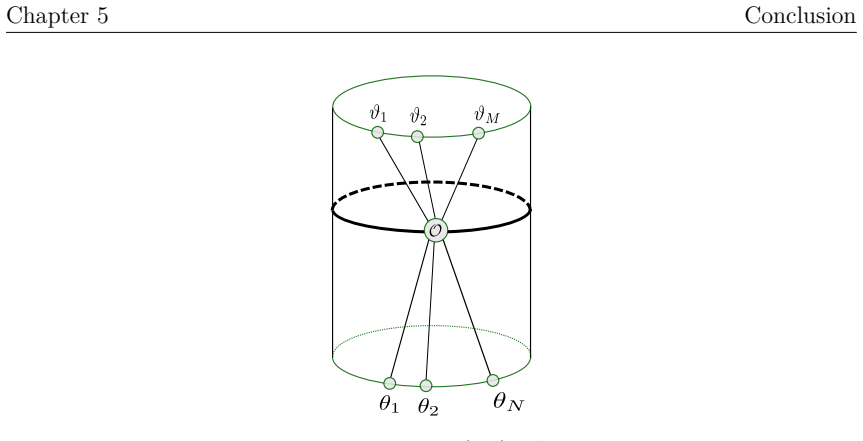
The load-bearing object is the regulated form factor $F^r_{M+N+2}(v+i\pi,\{\vartheta+i\pi/2\},v,\{\theta-i\pi/2\})$, defined by subtracting the kinematical pole of the pair of mirror particles symmetrically, together with the contour rule (3.30): the F-term integral is evaluated by averaging two contours that pick residues at $v=\theta_k\pm i\pi/6$, where the two S-matrix poles of the Lee-Yang model sit. The residues of the integrand evaluate to $\pm 2i\,\delta u_{k\mp}$, the same corrections to the fusion angle that bound-state quantization produces from the exponentialized Bethe-Yang equations (3.23). The bootstrap equation $S(\theta)=S(\theta+iu)S(\theta-iu)$ and the S-matrix pole structure at the fusion angle connect these residues to the mu-term formula (4.5).
What would settle it
Compute the F-term integral (4.11) numerically for a two-particle state in the scaling Lee-Yang model without using the residue expansion, and compare it with the mu-term formula (4.5). Any disagreement beyond the stated exponential accuracy would disprove the claimed identity. A direct test is to compare the residue-corrected analytic prediction for $\langle 0|\Phi|\{1,-1\}\rangle_L$ with the exact finite-volume value obtained by the truncated conformal-space numerical method at volumes $mL\sim 6$ to $12$; a systematic gap at the expected order would refute the paper's central claim.
Extended reading notes
Core claim
The paper's central discovery is a contour-residue identity. For a non-diagonal finite-volume form factor with elementary in-state rapidities $\{\bar\theta^{(0)}\}$, the mu-term correction $\delta^{(\mu)}F_N(\{\bar\theta^{(0)}\})$ of equation (4.5)—derived by representing each physical particle as a pair of constituents with complex rapidities $\bar\theta^{(0)}_k\pm i(u+\delta\bar u_k)$ and expanding the finite-volume normalization—equals the sum of residues $$\frac12\sum_{k,\pm}\pm i\,\mathrm{Res}_{v\to\bar\$theta^{{(0)}}$_k\mp i\pi/6}\left\{F^r_{N+2}(v+i\pi,v,\{\bar\$theta^{{(0)}}$_j-i\pi/2\})e^{-mL\$\cosh$ v}\right\},$$ where $F^r$ is the regulated form factor with the kinematical pole subtracted. The equality is shown by computing the residues of the S-matrix poles in the F-term integrand and using the bootstrap equation to convert the residue terms into the $\delta u_{k\pm}$ quantities of bound-state quantization. This proves the suspected relation between the F-term and mu-term formalisms and thereby underpins the formal derivation of the F-term formula.
Load-bearing premise
The calculation assumes that the regularization of the squared delta function, $2\pi\delta(u-v)=i/(u-v+i\epsilon)-i/(u-v-i\epsilon)$, justified for the one-particle form factor, remains valid when applied to the general multiparticle matrix element; if it does not, the residue sum need not produce the mu-terms.
Editorial extensions
If this is right
- The F-term integral, evaluated with the contour rule (3.30), contains the mu-term corrections; no separate treatment of bound-state constituents is needed to obtain the leading exponential volume dependence.
- The equality confirms the formal F-term formula of the companion paper for non-diagonal form factors, since the same residue structure that reproduces the mu-terms is built into the regulated form factor.
- The dictionary between the two schemes can be run in reverse: higher-order corrections from bound-state quantization suggest how to construct the corresponding integral terms for higher exponential orders.
- Because the derivation uses only the form-factor axioms and the S-matrix pole structure, the same F-term/mu-term equivalence is expected in other diagonal scattering theories with fusion, with the fusion angle $u$ replaced by the model-specific value.
- In the diagonal limit, the relation connects the non-diagonal F-term to the known exact finite-volume diagonal form factors, providing an independent consistency check on both approaches.
Reading between the lines
- The same mechanism suggests a numerical shortcut: for multi-particle states, one could evaluate the F-term correction by the residue sum at the shifted rapidities instead of the full integral, isolating the bound-state contributions directly.
- The contour picture suggests that mu-term and F-term corrections are two residues of a single meromorphic integrand; iterating the bound-state expansion to higher orders could yield a constructive route to higher exponential corrections.
- A testable extension is to repeat the residue calculation in another integrable theory with a fusion channel, replacing the Lee-Yang fusion angle by the model-specific value; agreement would indicate the relation is generic rather than model-dependent.
Signed reviews
Editorial analysis
A structured set of objections, weighed in public.
Referee Report
Summary. This MSc thesis develops the leading exponential finite-volume corrections to non-diagonal form factors in the scaling Lee-Yang model. It first reviews integrable quantum field theory, the bootstrap, and finite-volume methods, then derives the μ-term correction δ^(μ)F_N from bound-state quantization (§4.1, App. B) and the F-term correction from the mirror-model trace (§4.2.1, Eqs. (4.8)–(4.10)). The central result is that evaluating the F-term integral (4.11) with the contour prescription (3.30) and taking the residues at v=θ_k±iπ/6 reproduces the μ-term formula (4.5), thereby establishing the suspected F/μ correspondence for elementary form factors. The appendices contain the residue algebra and the derivation of the μ-term from bound-state quantization.
Significance. If the correspondence holds, the thesis provides a nontrivial consistency check between two independent finite-volume schemes: the bound-state quantization of [15] and the mirror-model F-term formula of [16]. The residue calculation in App. C is detailed and internally consistent as far as the text allows one to check, and the matching with (4.5) is not a trivial identity. The pedagogical introduction is also useful. However, the proof is conditional on a regularization of the squared delta function whose multiparticle validity is not established, and the explicit computation covers only elementary form factors; the generalization to arbitrary non-diagonal matrix elements is asserted rather than demonstrated.
major comments (3)
- [§4.1–§4.2, footnote 1] The multiparticle F-term formula relies on regularizing the squared delta function as 2πδ(u−v)=i/(u−v+iϵ)−i/(u−v−iϵ) and on the statement that this is correct 'by using this everywhere'. The reference [28] justifies this regularization for the one-particle form factor only. For N>1 the integrand contains S-matrix prefactors and multiparticle form factors in the disconnected terms, and the residue calculation at v=θ_k±iπ/6 depends directly on the resulting double-pole structure. The validity of the regularization for the multiparticle matrix element is therefore load-bearing and is not derived. Please provide a derivation, or an explicit reduction to the one-particle case, or state clearly that the equality between the residues of (4.11) and the μ-term (4.5) is conditional on this regularization.
- [Chapter 4, footnote 1] The explicit residue calculation is performed only for elementary form factors ⟨0|O|{n}⟩_L, while the title and abstract claim the result for general non-diagonal form factors ⟨{m}|O|{n}⟩_L. The extension is justified by a non-mixing argument stated in a footnote: poles belonging to the in- or outgoing set do not contribute to the μ-terms of the other set. This assertion is not demonstrated. Because the F-term integrand (4.8) and the residue formula (4.14) contain products over both sets of rapidities, an explicit argument is needed to show that the two sets decouple. Without it, the paper's central claim is established only for elementary form factors, and the general statement should be presented as an extrapolation unless the missing argument is supplied.
- [Abstract and §4.2] The F-term formula (4.8)–(4.10) and the contour rule (3.30) are imported from [16], which is co-authored by the thesis author. The comparison with the μ-term from bound-state quantization is therefore a consistency check between two prescriptions rather than an independent derivation of the F-term formula. This is a legitimate and useful result, but the abstract's wording — 'proves the suspected relation' and 'underpins the formal derivation' — overstates the logical status. The paper should state explicitly that the F-term formula is assumed and that the calculation verifies the residue/μ-term correspondence conditional on that assumption and on the delta-function regularization.
minor comments (4)
- [Eq. (C.6)] In the displayed formula for δ^(μ)F_N, the first sum appears to contain δ¯u_k both inside and outside the braces, which would give a term quadratic in δ¯u_k and contradict Eq. (4.5). Please check whether this is a typographical error and correct it.
- [§2.1.2 and §2.2] There are minor typographical issues: 'model sepcific' should be 'model specific', and 'Schwartz's theorem' should be 'Schwarz's theorem'.
- [Figure 5.1] The TCSA comparison shown in Fig. 5.1 is imported from [16] and is presented without error bars. Please state the numerical uncertainty of the TCSA data or refer the reader to the original source for the error estimate.
- [§3.2.3] The term 'F-term' is used for both the exponential integral in Eq. (3.15) and the derivative correction to the rapidities. Consider using a consistent notation (e.g., 'F-term integral' and 'F-term rapidity shift') to avoid confusion.
Circularity Check
No significant circularity: the F-term-to-mu-term correspondence is derived as a genuine cross-check, not assumed.
full rationale
The thesis's central claim is that the residue sum of the F-term integral (4.11), evaluated with the contour rule (3.30), reproduces the mu-term expression delta^(mu)F_N in (4.5). Equation (4.5) is derived independently in Sec. 4.1 and App. B from bound-state quantization, while the residue computation in Sec. 4.2.2 and App. C starts from the F-term formula (4.8)-(4.10) and the S-matrix/bootstrap input (3.16)-(3.17). The two calculations share neither the mu-term expression nor the F-term integrand as an input; the equality is a derived identity. The F-term formula itself is imported from [16], a paper coauthored by the thesis author, and the squared-delta regularization is imported from [28] and extended from the one-particle case to the multiparticle case; these are stated assumptions and a minor self-citation, but they are not circular because the cited prior work does not assume the target mu-term equality. The TCSA comparison in Fig. 5.1 is imported from [16] as an external numerical benchmark, not as an input to the derivation. No step reduces by construction to its own input, so no significant circularity is found.
Assumptions & free parameters
assumptions (4)
- domain assumption The S-matrix has the Lee-Yang bound-state pole structure S(θ) ≈ iΓ²/(θ−2iu) and −iΓ²/(θ−iu) (eq. 3.17), and satisfies the bootstrap equation S(θ)=S(θ+iu)S(θ−iu) (eq. 3.16).
- domain assumption The form factor axioms (2.25)-(2.29), especially the kinematical and dynamical pole axioms, fix the singularities and residues used in the regulated form factors.
- domain assumption The finite-volume form factor formula (3.32) from Pozsgay and Takacs correctly describes the leading polynomial-volume approximation for non-diagonal matrix elements.
- domain assumption The F-term formula (4.8)-(4.10), including the delta-function regularization in §4.2.1, is valid for general multiparticle non-diagonal form factors.
Cite this review
Pith. "Pith review of Finite volume corrections of non-diagonal form factors." pith.science (2026). https://pith.science/paper/6AHRRNWK
@misc{pith2026190809704,
  author       = {Pith},
  title        = {Pith review of: Finite volume corrections of non-diagonal form factors},
  year         = {2026},
  howpublished = {\url{https://pith.science/paper/6AHRRNWK}},
  note         = {Machine review of arXiv:1908.09704}
}
abstract
This thesis presents L\"uscher's $\mu$- and $F$-term corrections to volume dependence of non-diagonal finite volume form factors in the scaling Lee-Yang model. An explicit calculation proves the suspected relation that the $\mu$-terms known previously from bound state quantization can be obtained from the $F$-term integrals by modifying the contour of integration such that it picks up residues of appropriate poles in the integrand. The fact that these two different approaches for getting the $\mu$-terms give the same result underpins the formal derivation of the $F$-term in arXiv:1904.00492 which was not known until recently. In the meantime, the notions of integrable quantum field theories and those related to their treatment in finite volume are introduced to help understand the topic for readers not familiar with it.
Figures


Figures from the paper (17 more)







Reference graph
Works this paper leans on
-
[16]
Leading exponential finite size corrections for non-diagonal form factors
Z. Bajnok, M. Lajer, B. Szepfalvi, and I. Vona, `` Leading exponential finite size corrections for non-diagonal form factors ,'' http://dx.doi.org/10.1007/JHEP07(2019)173 JHEP 07 (2019) 173 , http://arxiv.org/abs/1904.00492 arXiv:1904.00492 [hep-th]
work page Pith review arXiv 2019
-
[28]
Field theoretical derivation of L\"uscher's formula and calculation of finite volume form factors
Z. Bajnok, J. Balog, M. Lajer, and C. Wu, `` Field theoretical derivation of Luscher's formula and calculation of finite volume form factors ,'' http://dx.doi.org/10.1007/JHEP07(2018)174 JHEP 07 (2018) 174 , http://arxiv.org/abs/1802.04021 arXiv:1802.04021 [hep-th]
work page Pith review arXiv 2018
-
[15]
Luscher's mu-term and finite volume bootstrap principle for scattering states and form factors
B. Pozsgay, `` Luscher's mu-term and finite volume bootstrap principle for scattering states and form factors ,'' http://dx.doi.org/10.1016/j.nuclphysb.2008.04.021 Nucl. Phys. B802 (2008) 435--457 , http://arxiv.org/abs/0803.4445 arXiv:0803.4445 [hep-th]
work page Pith review arXiv 2008
-
[1]
Z. Bajnok, `` How Integrability Works (for AdS/CFT) ,'' http://dx.doi.org/10.5506/APhysPolB.47.2451 Acta Phys. Polon. B47 (2016) 2451--2477
-
[2]
Mussardo, Statistical field theory
G. Mussardo, Statistical field theory . Oxford Univ. Press, New York, NY, 2010
work page 2010
-
[3]
Z. Bajnok and L. S amaj, ``Introduction to integrable many-body systems III ,'' Acta Physica Slovaca. Reviews and Tutorials 61 no. 2, (2011) 129--271
work page 2011
-
[4]
Dorey, `` Exact S-matrices ,'' in Conformal field theories and integrable models
P. Dorey, `` Exact S-matrices ,'' in Conformal field theories and integrable models. Proceedings, Eotvos Graduate Course, Budapest, Hungary, August 13-18, 1996 , pp. 85--125. 1996. http://arxiv.org/abs/hep-th/9810026 arXiv:hep-th/9810026 [hep-th]
arXiv 1996
-
[5]
R. Rajaraman, Solitons and Instantons: An Introduction to Solitons and Instantons in Quantum Field Theory . North-Holland Publishing Company, 1982
work page 1982
Show all 30 references
-
[6]
R. J. Eden, P. V. Landshoff, D. I. Olive, and J. C. Polkinghorne, The analytic S-matrix . Cambridge Univ. Press, Cambridge, 1966
1966
-
[7]
A. B. Zamolodchikov, `` Thermodynamic Bethe Ansatz in Relativistic Models. Scaling Three State Potts and Lee-Yang Models ,'' http://dx.doi.org/10.1016/0550-3213(90)90333-9 Nucl. Phys. B342 (1990) 695--720
1990 doi
-
[8]
Mitra, `` Elasticity, Factorization and S-matrices in (1+1)-Dimensions ,'' http://dx.doi.org/10.1016/0370-2693(77)90063-6 Phys
P. Mitra, `` Elasticity, Factorization and S-matrices in (1+1)-Dimensions ,'' http://dx.doi.org/10.1016/0370-2693(77)90063-6 Phys. Lett. 72B (1977) 62--64
1977 doi
-
[9]
S. R. Coleman and H. J. Thun, `` On the Prosaic Origin of the Double Poles in the Sine-Gordon S-matrix ,'' http://dx.doi.org/10.1007/BF01609466 Commun. Math. Phys. 61 (1978) 31
1978 doi
-
[10]
J. L. Cardy and G. Mussardo, `` S-matrix of the Yang-Lee Edge Singularity in Two-Dimensions ,'' http://dx.doi.org/10.1016/0370-2693(89)90818-6 Phys. Lett. B225 (1989) 275--278
1989 doi
-
[11]
H. M. Babujian, A. Fring, M. Karowski, and A. Zapletal, `` Exact form-factors in integrable quantum field theories: The Sine-Gordon model ,'' http://dx.doi.org/10.1016/S0550-3213(98)00737-8 Nucl. Phys. B538 (1999) 535--586 , http://arxiv.org/abs/hep-th/9805185 arXiv:hep-th/980...
1999 arXiv
-
[12]
Mussardo, `` Off critical statistical models: Factorized scattering theories and bootstrap program ,'' http://dx.doi.org/10.1016/0370-1573(92)90047-4 Phys
G. Mussardo, `` Off critical statistical models: Factorized scattering theories and bootstrap program ,'' http://dx.doi.org/10.1016/0370-1573(92)90047-4 Phys. Rept. 218 (1992) 215--379
1992 doi
-
[13]
Karowski and P
M. Karowski and P. Weisz, `` Exact Form-Factors in (1+1)-Dimensional Field Theoretic Models with Soliton Behavior ,'' http://dx.doi.org/10.1016/0550-3213(78)90362-0 Nucl. Phys. B139 (1978) 455--476
1978 doi
-
[14]
Luscher, `` Volume Dependence of the Energy Spectrum in Massive Quantum Field Theories
M. Luscher, `` Volume Dependence of the Energy Spectrum in Massive Quantum Field Theories. 1. Stable Particle States ,'' http://dx.doi.org/10.1007/BF01211589 Commun. Math. Phys. 104 (1986) 177
1986 doi
-
[17]
S. J. van Tongeren, `` Introduction to the thermodynamic Bethe ansatz ,'' http://arxiv.org/abs/1606.02951 arXiv:1606.02951 [hep-th] . [J. Phys.A49,no.32,323005(2016)]
2016 arXiv
-
[18]
Bajnok, ``Integr \'a lhat \'o modellek \'e s az A d S / CFT megfeleltet \'e s,''
Z. Bajnok, ``Integr \'a lhat \'o modellek \'e s az A d S / CFT megfeleltet \'e s,''
-
[19]
Teschner, `` On the spectrum of the Sinh-Gordon model in finite volume ,'' http://dx.doi.org/10.1016/j.nuclphysb.2008.01.021 Nucl
J. Teschner, `` On the spectrum of the Sinh-Gordon model in finite volume ,'' http://dx.doi.org/10.1016/j.nuclphysb.2008.01.021 Nucl. Phys. B799 (2008) 403--429 , http://arxiv.org/abs/hep-th/0702214 arXiv:hep-th/0702214 [hep-th]
2008 arXiv
-
[20]
Bajnok and O
Z. Bajnok and O. el Deeb, `` Form factors in the presence of integrable defects ,'' http://dx.doi.org/10.1016/j.nuclphysb.2010.02.004 Nucl. Phys. B832 (2010) 500--519 , http://arxiv.org/abs/0909.3200 arXiv:0909.3200 [hep-th]
2010 arXiv
-
[21]
Pozsgay, I
B. Pozsgay, I. M. Szecsenyi, and G. Takacs, `` Exact finite volume expectation values of local operators in excited states ,'' http://dx.doi.org/10.1007/JHEP04(2015)023 JHEP 04 (2015) 023 , http://arxiv.org/abs/1412.8436 arXiv:1412.8436 [hep-th]
2015 arXiv
-
[22]
Dorey and R
P. Dorey and R. Tateo, `` Excited states by analytic continuation of TBA equations ,'' http://dx.doi.org/10.1016/S0550-3213(96)00516-0 Nucl. Phys. B482 (1996) 639--659 , http://arxiv.org/abs/hep-th/9607167 arXiv:hep-th/9607167 [hep-th]
1996 arXiv
-
[23]
Pozsgay and G
B. Pozsgay and G. Takacs, `` Form-factors in finite volume I: Form-factor bootstrap and truncated conformal space ,'' http://dx.doi.org/10.1016/j.nuclphysb.2007.06.027 Nucl. Phys. B788 (2008) 167--208 , http://arxiv.org/abs/0706.1445 arXiv:0706.1445 [hep-th]
2008 arXiv
-
[24]
Pozsgay and G
B. Pozsgay and G. Takacs, `` Form factors in finite volume. II. Disconnected terms and finite temperature correlators ,'' http://dx.doi.org/10.1016/j.nuclphysb.2007.07.008 Nucl. Phys. B788 (2008) 209--251 , http://arxiv.org/abs/0706.3605 arXiv:0706.3605 [hep-th]
2008 arXiv
-
[25]
Bajnok and C
Z. Bajnok and C. Wu, `` Diagonal form factors from non-diagonal ones ,'' http://arxiv.org/abs/1707.08027 arXiv:1707.08027 [hep-th]
-
[26]
Leclair and G
A. Leclair and G. Mussardo, `` Finite temperature correlation functions in integrable QFT ,'' http://dx.doi.org/10.1016/S0550-3213(99)00280-1 Nucl. Phys. B552 (1999) 624--642 , http://arxiv.org/abs/hep-th/9902075 arXiv:hep-th/9902075 [hep-th]
1999 arXiv
-
[27]
B. Pozsgay, `` Form factor approach to diagonal finite volume matrix elements in Integrable QFT ,'' http://dx.doi.org/10.1007/JHEP07(2013)157 JHEP 07 (2013) 157 , http://arxiv.org/abs/1305.3373 arXiv:1305.3373 [hep-th]
2013 arXiv
-
[29]
P. D. Powell, `` Calculating Determinants of Block Matrices ,'' http://arxiv.org/abs/1112.4379 arXiv:1112.4379 [math.NA]
-
[30]
write newline
" write newline "" before.all 'output.state := FUNCTION blank.sep after.quote 'output.state := FUNCTION fin.entry output.state after.quoted.block = 'skip 'add.period if write newline FUNCTION new.block output.state before.all = 'skip output.state after.quote = after.quoted.blo...
Reviewed August 14, 2026 · model on record in the stance chip above.
Discussion (0). Continue with ORCID to comment.