REVIEW 6 minor 1 cited by
Searches for Exotic Hadrons at GlueX
T0 review · 0 major / 6 minor · reviewed 2026-08-14 · deepseek-v4-flash
Pith's one-line read Near-threshold photoproduction of J/psi at 9 GeV shows no pentaquark signal and bounds the Pc branching fraction to a few percent or less.
desk verdict A transparent GlueX proceedings that correctly defers to the published PRL for its central numbers; the genuinely new material is preliminary light-meson spectra, and the main open question is whether the e+e- analysis accounts for J/psi–Bethe–Heitler interference. read the letter →
The pith
A machine-rendered reading of the paper's core claim, the machinery that carries it, and where it could break.
The reading
What carries the argument
The argument runs on exclusive charmonium photoproduction measured through the decay $J/\psi\to e^+e^-$ with a reconstructed proton. Because the absolute detection efficiencies are still being determined, the cross section is obtained by normalizing the $J/\psi$ yield to the QED-calculated non-resonant process $\gamma p\to e^+e^-p$ in the same data, using Monte Carlo only for the relative efficiency. For the pentaquark part of the analysis, the machinery is vector meson dominance: the photon couples to a vector meson that scatters into the $P_c$, leaving a single free parameter, $B(P_c\to J/\psi p)$, which is then bounded by fitting a Breit-Wigner plus the non-resonant model of Ref. [34] to the beam-energy-dependent cross section.
What would settle it
Scan the same energy range with the full data set and compute the $J/\psi$ photoproduction cross section using an absolute efficiency calibration instead of the QED normalization; if the cross-section points move by more than the quoted uncertainties or a peak appears at one of the $P_c$ masses, the current upper limits and their exclusion claim would be overturned.
Extended reading notes
Core claim
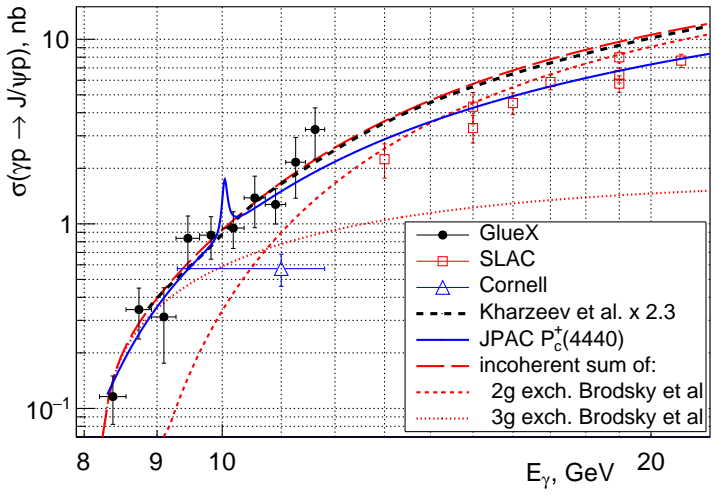
The central claim is that the total cross section for exclusive $J/\psi$ photoproduction near threshold, measured with a polarized photon beam at energies up to about 11 GeV, rises with beam energy in a way that is consistent with the predictions of Brodsky et al. when a substantial three-gluon-exchange component is included, and that the spectra show no statistically significant contribution from the $P_c$ pentaquark candidates. With a fitted yield of $469\pm22$ $J/\psi\to e^+e^-$ events, the authors set model-dependent 90% confidence upper limits of 4.6%, 2.3%, and 3.8% on $B(P_c\to J/\psi p)$ for the $P_c(4312)$, $P_c(4440)$, and $P_c(4457)$, respectively, and 90% confidence upper limits of 4.6, 1.8, and 3.9 nb on $\sigma_{\rm peak}(\gamma p\to P_c)\times B(P_c\to J/\psi p)$. The paper concludes that these limits already exclude some molecular models of the $P_c$ internal structure.
Load-bearing premise
The results depend on the assumption that the detector's unknown absolute efficiency cancels when the $J/\psi$ yield is compared with the calculated rate of ordinary electron-positron production, and that the way a pentaquark would appear in this reaction is correctly described by the adopted model.
Editorial extensions
If this is right
- If the limits hold, molecular models of the $P_c$ states that predict $B(P_c\to J/\psi p)$ of order a few percent or more are disfavored, tightening the set of viable internal-structure explanations.
- The measured cross-section shape becomes a data point for models of the nucleon's gluonic field, especially the high-$x$ gluon contribution and the trace-anomaly term in the nucleon mass.
- The QED-normalization technique demonstrates a path to absolute charmonium cross sections before the full efficiency calibration of the detector is complete, and can be reused for other channels.
- With the full data set projected to contain more than 1500 $J/\psi$ events, the same analysis can be extended to measure the $t$-dependence and to search for additional charmonium states near threshold.
Reading between the lines
- A natural extension is to compare the $t$-dependence of the full data set with the two-gluon and three-gluon exchange curves; the paper's energy-dependent comparison cannot fully separate the two contributions, but $t$-slopes should.
- The same normalization strategy could be applied to other exclusive channels the experiment can reach, such as $\psi(2S)$ or $\eta_c$ production, giving a broader near-threshold charmonium program with the existing data.
- Because the quoted branching-fraction limits scale roughly as $(2J+1)$ under the vector-meson-dominance assumption, any future determination of the $P_c$ spin-parity would rescale the bounds accordingly, extending the paper's stated caveat.
- The less-model-dependent limits on $\sigma_{\rm peak}\times B$ can serve as a benchmark for future higher-luminosity searches for $P_c$ photoproduction.
Editorial analysis
A structured set of objections, weighed in public.
Referee Report
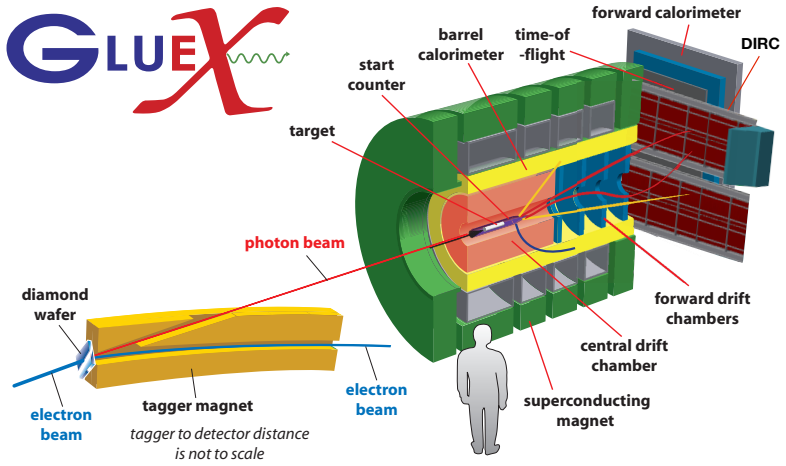
Summary. This is a conference proceedings from the GlueX Collaboration, summarizing the status of searches for exotic hadrons with the first phase of GlueX data. It reviews the detector and the path toward hybrid-meson amplitude analyses, shows preliminary spectra for pion-pair and eta-pion final states, and devotes a section to charmonium photoproduction near threshold. The main quantitative results are the observation of 469 +/- 22 J/psi events in the gamma p -> J/psi p, J/psi -> e+e- channel (Fig. 4), the total J/psi photoproduction cross section as a function of beam energy (Fig. 5), and 90% CL upper limits on B(Pc -> J/psi p) of 4.6%, 2.3%, and 3.8% for Pc(4312), Pc(4440), and Pc(4457), together with limits on sigma_peak x B. The text is explicit that the absolute efficiencies are still under study, that the Pc limits depend on vector meson dominance and on the model of Ref. [34], and that the analysis has since been published in Physical Review Letters [8].
Significance. If the results hold, the J/psi photoproduction cross section near threshold is a valuable new measurement in a region where only old 1970s data existed, and it provides input to models of the nucleon's gluonic structure. The Pc upper limits, although model-dependent, are genuine constraints on the branching fractions and are quoted as excluding some molecular-model predictions; the paper is appropriately careful to label them model-dependent. The manuscript is a proceedings: it does not contain a complete derivation but explicitly cites the peer-reviewed PRL [8] for the full analysis. Strengths include its transparency about preliminary systematic status and its use of external, non-fit model inputs for the limits; the upper limits are constraints on B(Pc -> J/psi p), not values obtained by fitting that parameter, so there is no circularity in the argument.
minor comments (6)
- [CHARMONIUM PRODUCTION NEAR THRESHOLD] The proceedings would be more self-contained if this section explicitly stated that the treatment of the interference between the J/psi -> e+e- amplitude and the non-resonant Bethe-Heitler gamma p -> e+e- p continuum, and the size of the resulting systematic shift, are described in the published analysis [8]; the current text describes only an incoherent Gaussian-plus-polynomial fit and a QED normalization, so the reader cannot tell from the proceedings alone whether this systematic was included.
- [CHARMONIUM PRODUCTION NEAR THRESHOLD] The sentence quoting the upper limits on B(Pc -> J/psi p) states 'assuming JP(Pc) at 90% confidence level' but does not list the assumed spin-parity values for Pc(4312), Pc(4440), and Pc(4457); since the limits scale as (2J+1), please provide the values or point to the table in Ref. [8].
- [CHARMONIUM PRODUCTION NEAR THRESHOLD] The curve labeled 'Kharzeev et al. x 2.3' in Fig. 5 is not explained in the text or caption; state that this is the model prediction scaled by 2.3 and why.
- [Abstract] The abstract uses 'closed-charm pentaquark,' which is not the standard terminology; 'hidden-charm pentaquark' is the usual term and is less ambiguous.
- [Introduction] There are several typos, including 'Jefferson Lab in has recently been built' (missing object), 'Mandalstam-t', and 'separatation'; a careful proofread is needed.
- [Summary] The claim that the upper limits 'already exclude some molecular models' would be more useful if the specific molecular-model predictions that are excluded were cited or briefly stated.
Circularity Check
No significant circularity: the cross-section measurement and Pc upper limits are data-driven results normalized to external QED calculations and external model assumptions, not fitted inputs renamed as predictions.
full rationale
The paper's central results are the measured J/psi photoproduction total cross section and upper limits on P_c production, neither of which is obtained by fitting the quantity that is then claimed as a prediction. The J/psi yield (N(J/psi)=469±22) is extracted from a Gaussian-plus-linear fit to the e+e- invariant mass spectrum, and the absolute cross section is obtained by normalizing this yield to the QED-calculated non-resonant gamma p -> e+e- p continuum; this is an external theoretical normalization, not an equivalence between input and output. The P_c branching-fraction upper limits are set using the external JPAC model [34] and the vector-meson-dominance assumption, and they are reported as model-dependent limits rather than as fitted values. No parameter is fitted to the P_c signal and then labeled a prediction. The only self-citation to the GlueX PRL [8] points to the peer-reviewed publication of the same analysis and is not used as an unverified authority to justify the derivation. The QED normalization, incoherent-background assumption, and VMD modeling are potential sources of systematic uncertainty and model dependence, but they do not make the derivation circular. The paper is self-contained in its analysis chain, with external benchmarks and theoretical models used as calibration and interpretation inputs, so the circularity score is 0.
Assumptions & free parameters
assumptions (5)
- domain assumption The non-resonant gamma p -> e+e- p cross section is calculable with standard QED and can be used for absolute normalization.
- domain assumption Pc photoproduction proceeds via Vector Meson Dominance with a single coupling.
- domain assumption The non-resonant gamma p -> J/psi p background shape and Pc line shapes are described by the model of Ref. [34].
- domain assumption Hybrid meson masses and exotic quantum numbers are predicted by lattice QCD.
- domain assumption The LHCb pentaquark candidates Pc(4312), Pc(4440), Pc(4457) exist with the reported masses.
Cite this review
Pith. "Pith review of Searches for Exotic Hadrons at GlueX." pith.science (2026). https://pith.science/paper/GI4ZULM4
@misc{pith2026190809711,
  author       = {Pith},
  title        = {Pith review of: Searches for Exotic Hadrons at GlueX},
  year         = {2026},
  howpublished = {\url{https://pith.science/paper/GI4ZULM4}},
  note         = {Machine review of arXiv:1908.09711}
}
abstract
The search for hybrid mesons and the detailed study of their spectrum is the primary goal of the GlueX Experiment in Hall D at Jefferson Lab. The identification and study of hybrid mesons promises to provide unique insight into gluonic degrees of freedom in QCD and the nature of confinement. The experiment combines an intense photon beam with linear polarization peaking around 9 GeV incident on a liquid hydrogen target with a nearly hermetic spectrometer, allowing for the comprehensive study of charged and neutral particle final states. The first phase of the experiment has recently concluded, yielding a photoproduction data set of unprecedented size and quality. We report on the status of the analysis of this data, including measurements of polarization observables, progress in spectroscopic measurements of light mesons, and the measurement of the photoproduction of $J/\psi$ near threshold, which is providing critical insight into the nature of the LHCb closed-charm pentaquark candidates.
Figures


Figures from the paper (2 more)

Forward citations
Cited by 1 Pith paper
-
What do we know about the confinement mechanism?
Restricting maximal-center-gauge maximization to a Gaussian-distributed subset of random gauge copies reproduces the SU(2) string tension, with ad hoc corrections needed at beta=2.7.
Reference graph
Works this paper leans on
-
[34]
A. Blin, C. Fernandez - Ramirez, A. Jackura, V . Mathieu, V . Mokeev, A. Pilloni, and A. Szczepaniak, Phys. Rev. D 94, 034002 (2016)
work page 2016
- [8]
-
[1]
Tanabashi et al
M. Tanabashi et al. (Particle Data Group), Phys. Rev. D 98, 030001 (2018) and 2019 update
2018
-
[2]
C. A. Meyer and E. S. Swanson, Prog. Part. Nucl. Phys. 82, 21?58 (2015)
work page 2015
-
[3]
J. J. Dudek, R. G. Edwards, P. Guo, and C. E. Thomas [Hadron Spectrum Collaboration], Phys. Rev. D 88, 094505 (2013)
work page 2013
- [4]
- [5]
-
[6]
H. Al Ghoul et al. (GlueX Collaboration), Phys. Rev. C 95 042201 (2017)
work page 2017
Show all 35 references
-
[7]
Dobbs, for the GlueX Collaboration, PoS Hadron2017, 047 (2018)
S. Dobbs, for the GlueX Collaboration, PoS Hadron2017, 047 (2018)
2018
-
[9]
Barbosa et al., Nucl
F. Barbosa et al., Nucl. Instrum. Meth. A 795, 376 (2015)
2015
-
[10]
Dugger et al., Nucl
M. Dugger et al., Nucl. Instrum. Meth. A 867, 115 (2017)
2017
-
[11]
Pooser et al., Nucl
E. Pooser et al., Nucl. Instrum. Meth. A 927, 330 (2019)
2019
-
[12]
Van Haarlem et al., Nucl
Y . Van Haarlem et al., Nucl. Instrum. Meth. A 622, 142 (2010)
2010
-
[13]
Papandreou et al., Nucl
Z. Papandreou et al., Nucl. Instrum. Meth. A 596, 338 (2008); A.E. Baulin et al., Nucl. Instrum. Meth. A 715, 48 (2013)
2008
-
[14]
Berdnikov, V . V . et al., Instr. Exp. Tech. 58, 25 (2015)
2015
-
[15]
Moriya et al., Nucl
K. Moriya et al., Nucl. Instrum. Meth. A 726, 60 (2013)
2013
-
[16]
Austregesilo, elsewhere in these Proceedings
A. Austregesilo, elsewhere in these Proceedings
-
[17]
Fegan, elsewhere in these Proceedings
S. Fegan, elsewhere in these Proceedings
-
[18]
McGinley, elsewhere in these Proceedings
W. McGinley, elsewhere in these Proceedings
-
[19]
Wickramaarachchi, elsewhere in these Proceedings
N. Wickramaarachchi, elsewhere in these Proceedings
-
[20]
Stevens, elsewhere in these Proceedings
J. Stevens, elsewhere in these Proceedings
-
[21]
Ernst, elsewhere in these Proceedings
A. Ernst, elsewhere in these Proceedings
-
[22]
Li, elsewhere in these Proceedings
H. Li, elsewhere in these Proceedings
-
[23]
ρ(1450) andρ(1700)
Mini-review on “ ρ(1450) andρ(1700)” in Ref. [1]
-
[24]
Abe et al
K. Abe et al. (SLAC Hybrid Facility Photon Collaboration), Phys. Rev. Lett. 53, 751 (1984)
1984
-
[25]
Brodsky, E
S. Brodsky, E. Chudakov, P. Hoyer, and J. Laget, Phys. Lett. B 498, 23 (2001)
2001
-
[26]
Kharzeev, H
D. Kharzeev, H. Satz, A. Syamtomov, and G. Zinovev, Nucl.Phys. A 661, 568 (1999)
1999
-
[27]
Hatta and D.-L
Y . Hatta and D.-L. Yang, Phys. Rev. D 98, 074003 (2018)
2018
-
[28]
Aaij et al
R. Aaij et al. (LHCb Collaboration), Phys. Rev. Lett. 115, 072001 (2015)
2015
-
[29]
Aaij et al
R. Aaij et al. (LHCb Collaboration), Phys. Rev. Lett. 117, 082002 (2016)
2016
-
[30]
Aaij et al
R. Aaij et al. (LHCb Collaboration), Phys. Rev. Lett. 122, 222001 (2019)
2019
-
[31]
Wang, X.-H
Q. Wang, X.-H. Liu, and Q. Zhao, Phys. Rev. D 92, 034022 (2015)
2015
-
[32]
Kubarovsky and M
V . Kubarovsky and M. B. V oloshin, Phys. Rev. D 92, 031502 (2015)
2015
-
[33]
Karliner and J
M. Karliner and J. Rosner, Phys. Lett. B 752, 329 (2016)
2016
-
[35]
Guo, U.-G
F.-K. Guo, U.-G. Meiner, W. Wang, and Z. Yang, Phys. Rev. D 92, 071502 (2015); X. H. Liu, Q. Wang, and Q. Zhao, Phys. Lett. B 757, 231 (2016); M. Mikhasenko, arXiv:1507.06552 (2015)
2015 arXiv
Reviewed August 14, 2026 · model on record in the stance chip above.
Discussion (0). Continue with ORCID to comment.