REVIEW 3 major objections 5 minor 37 references
Electron Heating by Debye-Scale Turbulence in Guide-Field Reconnection
T0 review · 3 major / 5 minor · reviewed 2026-08-14 · deepseek-v4-flash
Pith's one-line read This paper uses high-resolution MMS spacecraft data to argue that Debye-scale Buneman and beam-mode waves, not laminar meandering motion, thermalize the electron jet in guide-field reconnection by trapping and phase-mixing it.
desk verdict A well-executed MMS case study that makes a strong causal claim about Debye-scale turbulence heating electrons in guide-field reconnection, but the single-event evidence does not yet exclude spatial mixing. read the letter →
The pith
A machine-rendered reading of the paper's core claim, the machinery that carries it, and where it could break.
The reading
What carries the argument
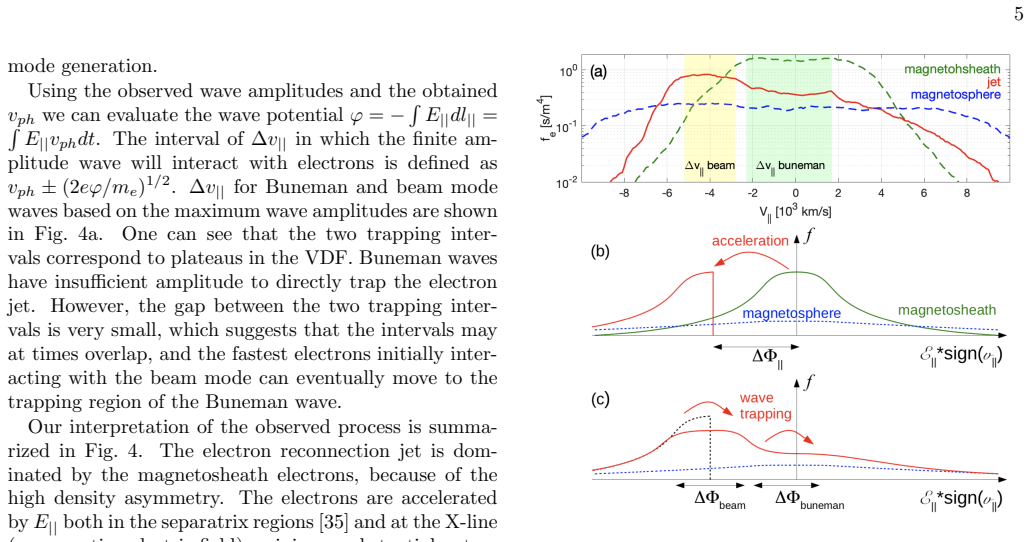
The mechanism is two-step wave-particle trapping by Buneman and beam modes. Buneman waves are slow, electrostatic, parallel-propagating waves with phase speed near the ion thermal speed, driven by the current of the accelerated electron jet; beam modes are faster electrostatic waves driven by the same beam. The paper computes each wave's trapping interval in parallel velocity, $v_{ph} \pm (2e\phi/m_e)^{1/2}$, from the measured wave potential $\phi = \int E_\parallel v_{ph} dt$, and shows that these intervals bracket the plateaus in the measured one-dimensional electron velocity distribution. The fast beam mode traps the high-energy part of the jet; the slow Buneman mode traps the low-energy part, and the near-overlap of the two intervals lets electrons move from one resonance to the other, causing irreversible phase mixing and thermalization. Linear dispersion analysis on the observed distributions supports the mode identifications.
What would settle it
Measure simultaneous electron distributions at two MMS spacecraft separated along the magnetic field inside a guide-field diffusion region. If the plateau persists in regions where the wave amplitudes (and therefore trapping intervals) are negligible, or if the distribution is everywhere identical to the local superposition of the two source populations with no time evolution toward a plateau, the causal link from Buneman and beam waves to heating would be falsified. A quantitative check: if the measured plateau width substantially exceeds the wave-trapping range $v_{ph} \pm (2e\phi/m_e)^{1/2}$ for all observed wave bursts, trapping cannot account for the plateau.
Extended reading notes
Core claim
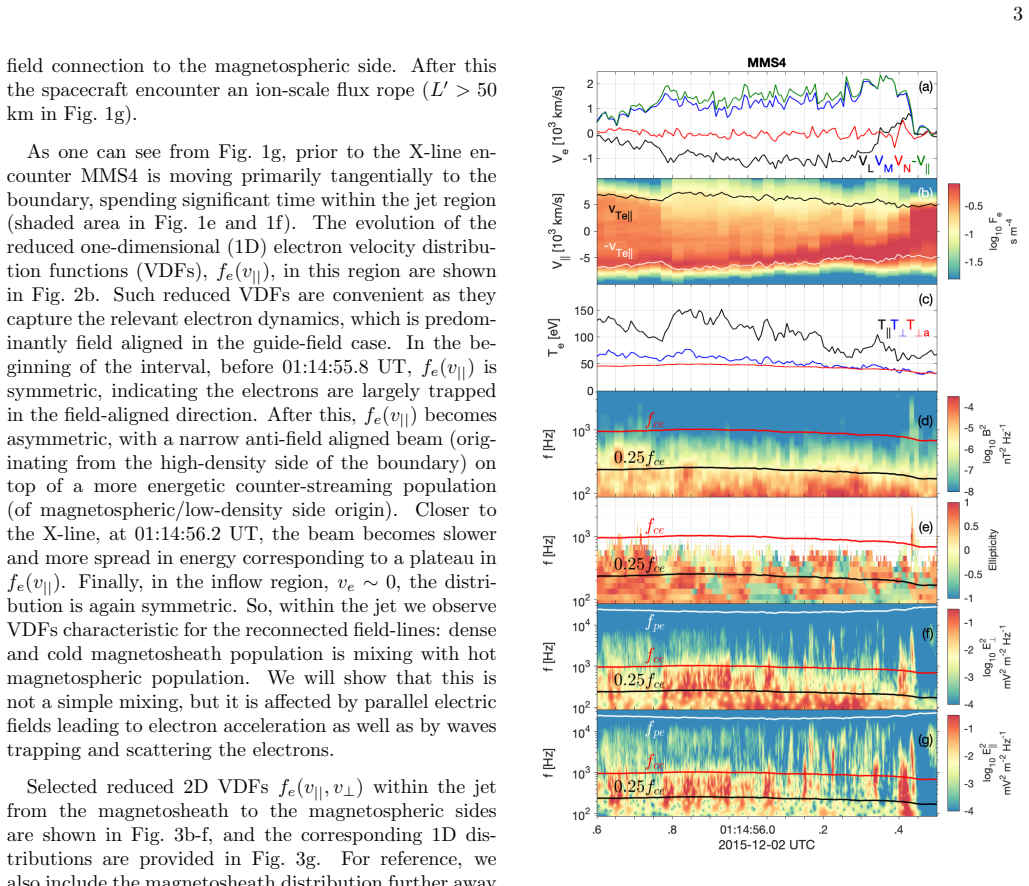
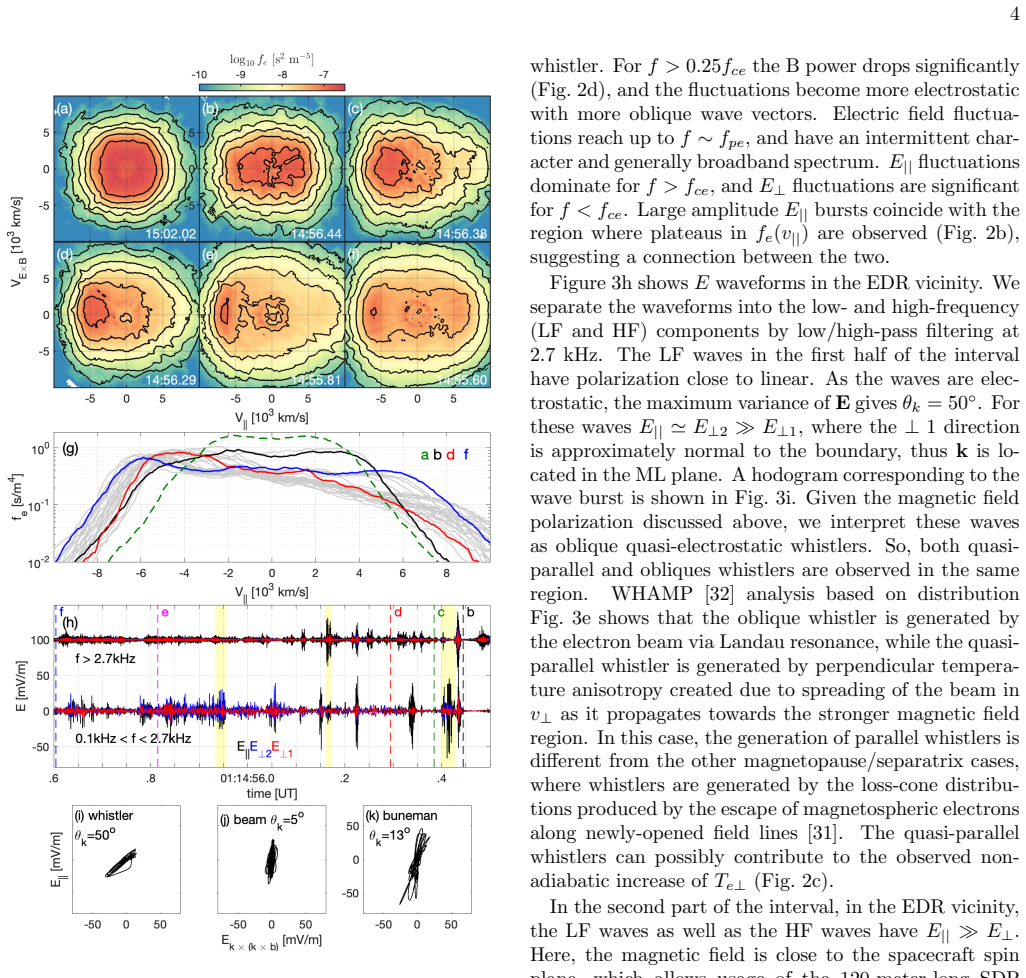
The central discovery is observational evidence that Debye-scale electrostatic waves thermalize the reconnection electron jet at the X-line. In the December 2, 2015 MMS crossing of the asymmetric magnetopause with guide field $B_M \approx 20$ nT, the authors identify an electron-scale current sheet with jet speed $v_e \simeq 2300$ km/s ($M_{e\perp} \simeq 0.55$) and predominantly field-aligned flow. Large-amplitude $E_\parallel$ bursts appear exactly where plateaus form in $f_e(v_\parallel)$. Using interferometry they measure wave phase speeds: slow low-frequency waves at 150--300 km/s (the Buneman mode) and fast high-frequency waves about ten times faster (the beam mode), both with wavelengths of 10--20 Debye lengths. The trapping intervals $v_{ph} \pm (2e\phi/m_e)^{1/2}$ computed from the measured wave potentials overlap the observed plateaus. The jet is first accelerated by $E_\parallel$ (a potential of about 80 V, comparable to $T_e$); fast beam modes then trap the high-energy part of the jet, slow Buneman waves trap the low-energy part, and the combined action erases the beam into a plateau. Observed parallel temperature increases by a factor of about 2.5 and perpendicular temperature by a factor of 2, with the perpendicular increase exceeding adiabatic betatron heating.
Load-bearing premise
The plateau in the electron velocity distribution is caused by wave trapping and phase mixing, rather than being merely the spatial overlap of the cold magnetosheath beam and the hot magnetospheric population as the spacecraft crosses from one side to the other.
Editorial extensions
If this is right
- Electron heating in guide-field reconnection is local and fast: the jet's directed energy is converted to heat within about 0.1 s, the jet transit time, rather than through gradual adiabatic processes.
- The parallel temperature increase by a factor of about 2.5 and the non-adiabatic perpendicular heating require wave-particle interactions, with quasi-parallel whistlers generated by beam anisotropy contributing to perpendicular heating.
- Slow Buneman waves with phase speed near the ion thermal speed couple electrons to ions, providing anomalous drag and resistivity in the diffusion region, which can influence the reconnection rate.
- The same turbulence-driven thermalization should operate in other guide-field reconnection sites in space and astrophysical plasmas where fast electron beams are present.
Reading between the lines
- If the phase-mixing interpretation generalizes, the heating rate in guide-field reconnection should scale with the measured wave energy density and jet speed; this can be tested statistically across many MMS diffusion-region crossings by comparing temperature increase to $E_\parallel$ wave power.
- The spatial-mixing alternative could be tested with particle-in-cell simulations that initialize counter-streaming cold and hot electron populations and ask whether a plateau forms only when self-consistent Buneman and beam waves are present, or by Liouville mapping the two source populations without waves.
- The proposed mechanism makes electron heating irreversible and not describable by a scalar potential, implying that fluid or adiabatic treatments of the electron diffusion region will systematically underpredict electron temperature in guide-field events.
- If Buneman waves provide anomalous resistivity, the reconnection electric field itself may be regulated by the turbulence, suggesting a feedback loop between electron heating and the reconnection rate.
Signed reviews
Editorial analysis
A structured set of objections, weighed in public.
Referee Report
Summary. The manuscript reports MMS observations of Debye-scale electrostatic turbulence in the diffusion region of asymmetric magnetopause reconnection with a moderate guide field on 2 December 2015. The authors identify an electron-scale current sheet near the X-line, a fast field-aligned electron jet, large-amplitude parallel electric field fluctuations, and a plateau in the reduced parallel electron velocity distribution. Using interferometric phase-velocity measurements and WHAMP stability analysis, they interpret the low-frequency slow waves as Buneman modes and the high-frequency fast waves as beam modes, and show that the trapping intervals of these waves overlap the plateau in the VDF. They conclude that the jet is thermalized by irreversible phase mixing driven by these waves, transferring jet kinetic energy into electron thermal energy, and argue that such turbulence plays an important role in guide-field reconnection.
Significance. If the causal claim holds, this would be an important observational confirmation of predicted streaming instabilities in guide-field reconnection, showing that the electron diffusion region is not laminar and that electrostatic turbulence provides fast electron heating. The strengths of the paper are the high-quality MMS data, the careful identification of the EDR/ECS using Grad-Shafranov reconstruction and FOTE, and the concrete comparison between measured wave trapping intervals and VDF plateaus. The WHAMP analysis links the observed distributions to candidate modes, and the use of SDP interferometry to measure phase velocities is a valuable technique. However, the central causal claim rests on a single event, and the spatial-mixing alternative for the plateau is not quantitatively excluded; the irreversibility of the inferred phase mixing is also not demonstrated. The paper is therefore significant but currently falls short of establishing the headline conclusion.
major comments (3)
- [Paragraph after Fig. 2 and Fig. 4a] The central claim that the plateau in fe(v||) is formed by wave trapping and phase mixing is not distinguished from a spatial-superposition origin. The spacecraft crosses the EDR at vN = -75 km/s, so each 30 ms FPI distribution averages over roughly 2 km in space, comparable to de = 1.5 km. A density-weighted superposition of the cold magnetosheath beam (Fig. 3a) and the hot magnetospheric counter-streaming population, mapped along B through the inferred accelerating potential ΔΦ|| ~ 80 V, could produce a broad flat fe(v||) and also raise Te||. The sentence 'this is not a simple mixing' is an assertion, not a quantitative test. The authors should compute the mixed VDF from the measured source distributions and compare it with the observed plateau, or otherwise rule out mixing using density and temperature moments or multi-spacecraft constraints. This is load-bearing because the abstract's causal claim requires wave-particle interaction rather than spatial averaging.
- ['Our interpretation...' paragraph and Fig. 4c] The irreversibility of the inferred thermalization is not demonstrated. The data are a single spatial/temporal snapshot along the spacecraft trajectory; the sequence 'beam -> plateau -> beam' in Fig. 2b could reflect the spatial structure of the two source populations rather than wave-driven relaxation. Trapping by finite-amplitude waves is reversible unless accompanied by phase-space filamentation or wave damping, and no evidence is presented that the plateau persists after wave activity ceases, nor is a quantitative heating rate from the measured wave amplitudes compared with the observed Te|| increase. To support the 'irreversible phase mixing' and 'fast thermalization' claims, the authors need a time-resolved demonstration of plateau formation or damping, a quantitative energy budget, or a supporting simulation. Without this, the central mechanism remains plausible but unproven.
- [Page 5, Buneman-wave trapping discussion] The proposed two-stage mechanism, in which the fastest electrons are first trapped by the beam mode and then transferred to the Buneman-wave trapping region, is presented as a suggestion ('the intervals may at times overlap') rather than as a demonstrated process. Since the Buneman waves cannot directly trap the initial jet, the claimed thermalization by the pair of modes depends on this overlap and on the assumed coupling between the two trapping regions. The authors should quantify the degree of overlap using the measured wave amplitudes and phase speeds, or test the two-stage scenario against the observed VDF evolution; otherwise the statement that both modes cause thermalization is not supported.
minor comments (5)
- [Fig. 3, hodogram analysis] The directions ⊥1 and ⊥2 used in the hodogram description are not defined; please specify how these perpendicular directions are defined relative to B and the boundary normal.
- [Page 3, beam-speed argument] The statement that 'the peak of the beam follows closely -vTe||' is used to infer that beam energy is transformed into parallel heating; clarify the reference frame and explicitly state that this is an inference from the VDF sequence rather than a direct measurement.
- [Fig. 3g caption] The grey lines are said to show 'all the other distributions during this time interval,' but the time interval is not specified; please state the exact interval covered.
- [Page 4, phase-velocity errors] The text states that errors in vph estimates are below 30% and refers to Ref. [34]; it would be helpful to state the number of wave packets used for the interferometric estimates and the typical scatter.
- [Reference list] Reference [24] appears to contain a typo in the journal name ('Gephys. Res. Lett.'); it should be 'Geophys. Res. Lett.'.
Circularity Check
No significant circularity: the trapping intervals are computed from measured wave fields and phase velocities, then compared with observed VDF plateaus as an independent test.
full rationale
The paper's central claim is that Buneman waves and beam modes thermalize the reconnection electron jet. The derivation chain is observational rather than definitional. Wave phase velocities are measured by spacecraft interferometry, wave potentials are obtained by integrating the measured parallel electric field along the measured phase velocity, and the trapping interval is computed from the standard single-particle resonance condition. This interval is then compared with the observed parallel VDF plateau, so the plateau is not used to define the trapping width. The mode identifications are supported by WHAMP stability calculations for a model distribution based on the observations, but the instability analysis is not fitted to the observed wave frequencies and does not itself determine the trapping range. The paper does not rename a fitted parameter as a prediction; the central quantitative comparison, 'the two trapping intervals correspond to plateaus in the VDF,' uses independent inputs. Several self-citations appear, but only for standard or previously published methods (interferometry, Liouville mapping, Grad-Shafranov reconstruction, prior Buneman-wave reports), and none of these carries the load-bearing inference that the waves cause irreversible phase mixing. The alternative that the VDF plateau is a spatial superposition of two source populations is a possible competing interpretation, but that is a correctness or evidence concern, not a circularity: the paper explicitly asserts 'this is not a simple mixing' and offers correlational wave-trapping evidence, but it does not define the heating conclusion into existence. Under the stated criteria, no step reduces by construction to its own input.
Assumptions & free parameters
free parameters (1)
- Inferred field-aligned accelerating potential ΔΦ|| =
~80 V (≈ Te)
assumptions (5)
- domain assumption The electron dynamics is predominantly field-aligned in the moderate guide-field case, so reduced 1D VDFs fe(v||) capture the relevant physics.
- domain assumption The observed time series can be converted to spatial structure using a constant boundary velocity (Taylor hypothesis); the structure is time-stationary during the 0.1 s interval.
- domain assumption Grad-Shafranov reconstruction assumes 2D magnetic topology invariant along M and a steady co-moving frame.
- domain assumption WHAMP linear dispersion analysis with a model distribution based on the observed jet and background correctly identifies the observed modes as Buneman and beam modes.
- ad hoc to paper The observed VDF plateau is formed by wave trapping and phase mixing rather than by spatial mixing of the two source populations.
Cite this review
Pith. "Pith review of Electron Heating by Debye-Scale Turbulence in Guide-Field Reconnection." pith.science (2026). https://pith.science/paper/PORJFGM5
@misc{pith2026190809724,
  author       = {Pith},
  title        = {Pith review of: Electron Heating by Debye-Scale Turbulence in Guide-Field Reconnection},
  year         = {2026},
  howpublished = {\url{https://pith.science/paper/PORJFGM5}},
  note         = {Machine review of arXiv:1908.09724}
}
read the original abstract
We report electrostatic Debye-scale turbulence developing within the diffusion region of asymmetric magnetopause reconnection with moderate guide field using observations by the Magnetospheric Multiscale (MMS) mission. We show that Buneman waves and beam modes cause efficient and fast thermalization of the reconnection electron jet by irreversible phase mixing, during which the jet kinetic energy is transferred into thermal energy. Our results show that the reconnection diffusion region in the presence of a moderate guide field is highly turbulent, and that electrostatic turbulence plays an important role in electron heating.
Figures

Figures from the paper (1 more)
Reference graph
Works this paper leans on
-
[1]
M. Fujimoto, I. Shinohara, and H. Kojima, Space Sci. Rev. 160, 123 (2011)
work page 2011
-
[2]
2c), indicating non- adiabatic heating
The Te⊥ increase cannot be attributed to adiabatic betatron heating alone (T⊥a in Fig. 2c), indicating non- adiabatic heating. We note that the peak of the beam in Fig. 2b follows closely−vT e||, which indicates that the energy gained through the accelerating potential ∆Φ || (discussed later) is transformed into the parallel heating gradually. To investig...
work page 2016
-
[3]
H. S. Fu, A. Vaivads, Y. V. Khotyaintsev, M. Andr´ e, J. B. Cao, V. Olshevsky, J. P. Eastwood, and A. Retin` o, Geophys. Res. Lett. 44, 37 (2017)
work page 2017
-
[4]
Y. V. Khotyaintsev, D. B. Graham, C. Norgren, and A. Vaivads, Frontiers in Astronomy and Space Sciences 6, 70 (2019)
work page 2019
-
[5]
T. Lindstedt, Y. V. Khotyaintsev, A. Vaivads, M. Andr´ e, R. C. Fear, B. Lavraud, S. Haaland, and C. J. Owen, Annales Geophysicae 27, 4039 (2009)
work page 2009
- [6]
-
[7]
J. Egedal, W. Daughton, A. Le, and A. L. Borg, Physics of Plasmas 22, 101208 (2015), arXiv:1504.08045 [physics.plasm-ph]
work page Pith review arXiv 2015
-
[8]
G. Lapenta, S. Markidis, A. Divin, M. V. Goldman, and D. L. Newman, Geophys. Res. Lett. 381, L17104 (2011), arXiv:1108.2492 [physics.plasm-ph]
work page Pith review arXiv 2011
Show all 37 references
-
[9]
Divin, G
A. Divin, G. Lapenta, S. Markidis, D. L. Newman, and M. V. Goldman, Phys. of Plasmas 19, 042110 (2012)
2012
-
[10]
Viberg, Y
H. Viberg, Y. Khotyaintsev, A. Vaivads, M. Andre, and J. Pickett, Geophys. Res. Lett. 40, 1032 (2013)
2013
-
[11]
J. C. Holmes, R. E. Ergun, R. Nakamura, O. Roberts, 6 F. D. Wilder, and D. L. Newman, Journal of Geophysical Research: Space Physics n/a (2019), 10.1029/2019JA026974
2019 doi
-
[12]
L.-J. Chen, M. Hesse, S. Wang, D. Gershman, R. Er- gun, C. Pollock, R. Torbert, N. Bessho, W. Daughton, J. Dorelli, B. Giles, R. Strangeway, C. Russell, Y. Khotyaintsev, J. Burch, T. Moore, B. Lavraud, T. Phan, and L. Avanov, Geophysical Research Letters 43, 6036 (2016)
2016
-
[13]
R. B. Torbert, J. L. Burch, T. D. Phan, M. Hesse, M. R. Argall, J. Shuster, R. E. Ergun, L. Alm, R. Naka- mura, and K. J. Genestreti, Science 362, 1391 (2018), arXiv:1809.06932 [physics.space-ph]
2018 arXiv
-
[14]
P. A. Mu˜ noz and J. B¨ uchner, Phys. Rev. E98, 043205 (2018), arXiv:1705.01054 [physics.plasm-ph]
2018 arXiv
-
[15]
J. F. Drake, M. Swisdak, C. Cattell, M. A. Shay, B. N. Rogers, and A. Zeiler, Science 299, 873 (2003)
2003
-
[16]
H. Che, J. F. Drake, and M. Swisdak, Nature (London) 474, 184 (2011)
2011
-
[17]
H. Che, J. F. Drake, M. Swisdak, and M. L. Goldstein, Physics of Plasmas 20, 061205 (2013), arXiv:1211.6036 [physics.plasm-ph]
2013 arXiv
-
[18]
Che, Physics of Plasmas 24, 082115 (2017), arXiv:1702.06109 [physics.space-ph]
H. Che, Physics of Plasmas 24, 082115 (2017), arXiv:1702.06109 [physics.space-ph]
2017 arXiv
-
[19]
Y. V. Khotyaintsev, D. B. Graham, C. Norgren, E. Eriks- son, W. Li, A. Johlander, A. Vaivads, M. Andr´ e, P. L. Pritchett, and A. Retin` o, Geophys. Res. Lett. 43, 5571 (2016)
2016
-
[20]
D. B. Graham, Y. V. Khotyaintsev, C. Norgren, A. Vaivads, M. Andre, J. F. Drake, J. Egedal, M. Zhou, O. L. Contel, J. M. Webster, B. Lavraud, I. Kacem, V. Genot, C. Jacquey, A. C. Rager, D. J. Gershman, J. L. Burch, and R. E. Ergun, J. Geophys. Res. (2019), 10.1029/2019JA027155
2019 doi
-
[21]
Pollock, T
C. Pollock, T. Moore, A. Jacques, J. Burch, U. Gliese, Y. Saito, T. Omoto, L. Avanov, A. Barrie, and V. Coffey, Space Sci. Rev. 199, 331 (2016)
2016
-
[22]
C. T. Russell, B. J. Anderson, W. Baumjohann, K. R. Bromund, D. Dearborn, D. Fischer, G. Le, H. K. Lein- weber, D. Leneman, W. Magnes, J. D. Means, M. B. Moldwin, R. Nakamura, D. Pierce, F. Plaschke, K. M. Rowe, J. A. Slavin, R. J. Strangeway, R. Torbert, C. Ha- gen, I. Jernej...
2014 doi
-
[23]
Lindqvist, G
P.-A. Lindqvist, G. Olsson, R. B. Torbert, B. King, M. Granoff, D. Rau, G. Needell, S. Turco, I. Dors, P. Beckman, J. Macri, C. Frost, J. Salwen, A. Eriksson, L. ˚Ahl´ en, Y. V. Khotyaintsev, J. Porter, K. Lappalainen, R. E. Ergun, W. Wermeer, and S. Tucker, Space Sci. Rev. (20...
2014 doi
-
[24]
R. E. Ergun, S. Tucker, J. Westfall, K. A. Goodrich, D. M. Malaspina, D. Summers, J. Wallace, M. Karlsson, J. Mack, N. Brennan, B. Pyke, P. Withnell, R. Torbert, J. Macri, D. Rau, I. Dors, J. Needell, P.-A. Lindqvist, G. Olsson, and C. M. Cully, Space Sci. Rev. (2014), 10.1007...
2014 doi
-
[25]
A. C. Rager, J. C. Dorelli, D. J. Gershman, V. Uritsky, L. A. Avanov, R. B. Torbert, J. L. Burch, R. E. Ergun, J. Egedal, and C. Schiff, Gephys. Res. Lett. 45, 578 (2018)
2018
-
[26]
J. L. Burch, T. E. Moore, R. B. Torbert, and B. L. Giles, Space Sci. Rev. (2015), 10.1007/s11214-015-0164-9
2015 doi
-
[27]
Norgren, D
C. Norgren, D. B. Graham, Y. V. Khotyaintsev, M. Andr´ e, A. Vaivads, L. J. Chen, P. A. Lindqvist, G. T. Marklund, R. E. Ergun, W. Magnes, R. J. Strangeway, C. T. Russell, R. B. Torbert, W. R. Paterson, D. J. Ger- shman, J. C. Dorelli, L. A. Avanov, B. Lavraud, Y. Saito, B. L....
2016
-
[28]
L. N. Hau and B. U. ¨O. Sonnerup, J. Geophys. Res. 104, 6899 (1999)
1999
-
[29]
H. S. Fu, A. Vaivads, Y. V. Khotyaintsev, V. Olshevsky, M. Andr´ e, J. B. Cao, S. Y. Huang, A. Retin` o, and G. Lapenta, Journal of Geophysical Research (Space Physics) 120, 3758 (2015)
2015
-
[30]
Eriksson, A
E. Eriksson, A. Vaivads, D. B. Graham, A. Divin, Y. V. Khotyaintsev, E. Yordanova, M. Andr´ e, B. L. Giles, C. J. Pollock, C. T. Russell, O. L. Contel, R. B. Torbert, R. E. Ergun, P.-A. Lindqvist, and J. L. Burch, Geophysical Research Letters 45, 8081 (2018)
2018
-
[31]
Egedal, A
J. Egedal, A. Le, P. L. Pritchett, and W. Daughton, Physics of Plasmas 18, 102901 (2011)
2011
-
[32]
D. B. Graham, A. Vaivads, Y. V. Khotyaintsev, and M. Andr´ e, Journal of Geophysical Research (Space Physics) 121, 1934 (2016)
2016
-
[33]
Ronnmark, Plasma Physics 25, 699 (1983)
K. Ronnmark, Plasma Physics 25, 699 (1983)
1983
-
[34]
D. B. Graham, Y. V. Khotyaintsev, A. Vaivads, and M. Andr´ e, Geophys. Res. Lett.42, 215 (2015)
2015
-
[35]
Steinvall, Y
K. Steinvall, Y. V. Khotyaintsev, D. B. Graham, A. Vaivads, P. A. Lindqvist, C. T. Russell, and J. L. Burch, Geophys. Res. Lett. 46, 55 (2019)
2019
-
[36]
Egedal, W
J. Egedal, W. Daughton, J. F. Drake, N. Katz, and A. Lˆ e, Physics of Plasmas16, 050701 (2009)
2009
-
[37]
L. Chen, N. Bessho, B. Lefebvre, H. Vaith, A. Asnes, O. Santolik, A. Fazakerley, P. Puhl-Quinn, A. Bhat- tacharjee, Y. Khotyaintsev, P. Daly, and R. Torbert, Physics of Plasmas 16, 056501 (2009)
2009
Reviewed August 14, 2026 · model on record in the stance chip above.
Discussion (0). Continue with ORCID to comment.