REVIEW 5 major objections 6 minor 38 references
An Introduction to Advanced Machine Learning : Meta Learning Algorithms, Applications and Promises
T0 review · 5 major / 6 minor · reviewed 2026-08-14 · deepseek-v4-flash
Pith's one-line read This chapter argues that meta-learning, or learning to learn, is the advanced machine learning paradigm that can solve few-shot, one-shot, and zero-shot learning by reusing prior experience.
desk verdict A broad but careless meta-learning survey: useful only as an entry-level draft, and unreliable due to misattributions and a garbled equation. read the letter →
The pith
A machine-rendered reading of the paper's core claim, the machinery that carries it, and where it could break.
The reading
What carries the argument
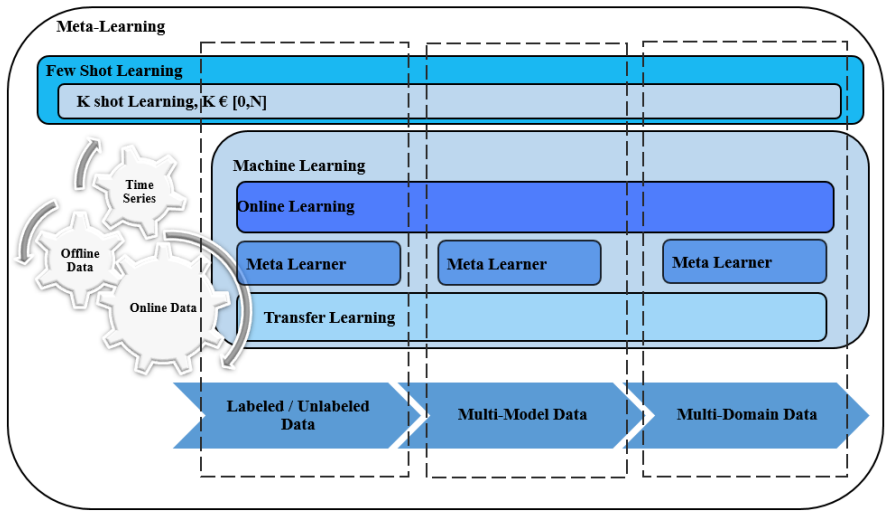
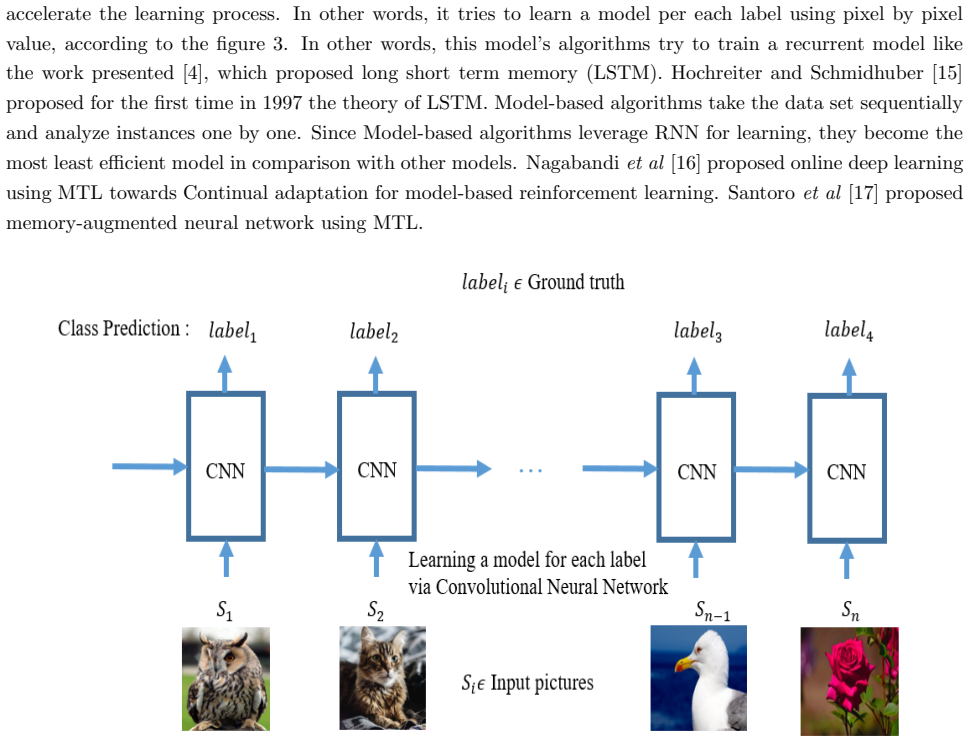
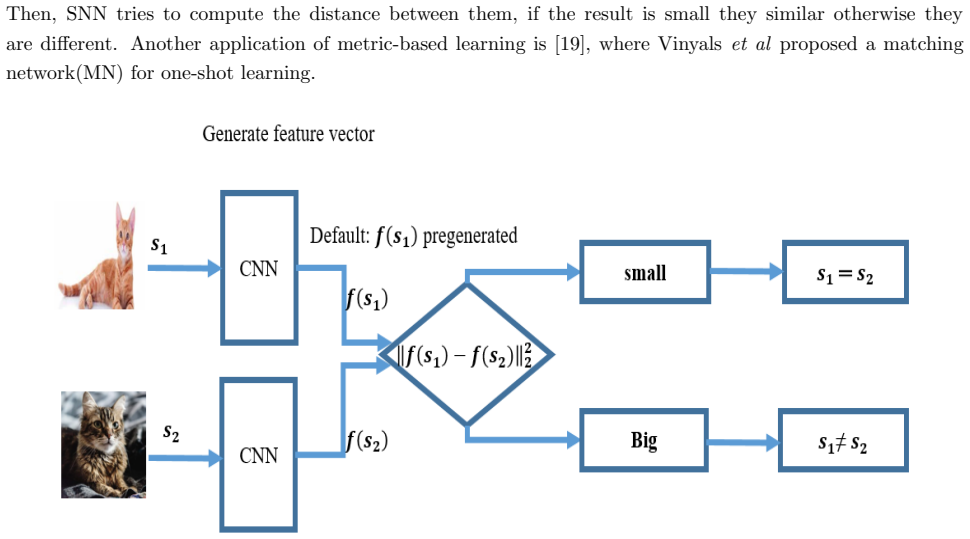
The organizing device is a three-way taxonomy of meta-learning algorithms. Model-based MTL trains a recurrent or memory-augmented network that ingests data sequentially and updates hyper-parameters from a few examples; metric-based MTL learns a comparison space and classifies by distance between encoded inputs; gradient-descent-based MTL adjusts parameters so that one or a few gradient steps generalize to a new task, MAML being the canonical case. The taxonomy does the argumentative work: Table 2 places more than twenty cited algorithms into cells of this three-by-three promise structure, so the whole field appears to converge on few-shot, one-shot, and zero-shot learning. The meta-training / meta-testing layer distinction then frames how these promises are realized.
What would settle it
Run the datasets the cited few-shot papers use (for instance Omniglot and miniImageNet at 1-shot and 5-shot) across all three taxonomy families and compare against plain fine-tuning of a pretrained network; if none of the three families beats that baseline on held-out classes, the claim that MTL unlocks low-shot learning is contradicted.
Extended reading notes
Core claim
The central claim is that meta-learning (MTL) is the advanced machine learning paradigm for emerging problems: an agent that learns to learn can use past tasks to choose a non-fixed inductive bias and adapt quickly to a new task, unlike base learning where the bias is fixed in advance. The paper partitions MTL research into model-based algorithms (networks that update their own hyper-parameters, typically recurrent or memory-augmented), metric-based algorithms (similarity learners such as Siamese and matching networks), and gradient-descent-based algorithms (optimization-based meta-learners, with MAML, Model-Agnostic Meta-Learning, as the flagship). It then attaches these families to three promises: few-shot learning, one-shot learning as its special case, and zero-shot learning via mapping from a semantic space to a vector space. It also motivates an online MTL setting in which past experience is exploited while tasks arrive sequentially, citing an existing regret-based meta-learner. The chapter's contribution is this three-way taxonomy and its promise map, not a new algorithm or benchmark.
Load-bearing premise
The argument rests on the assumption that every important meta-learning method fits into one of three categories—model-based, metric-based, or gradient-descent-based—and that the papers selected to represent those categories actually deliver the promised few-shot, one-shot, and zero-shot abilities.
Editorial extensions
If this is right
- If the promise holds, deployed systems can recognize new classes from a handful of labeled examples, which matters wherever labeling is expensive or data arrives fast.
- One-shot learning becomes the k=1 special case of few-shot learning, so progress in few-shot benchmarks should transfer directly to one-shot settings.
- Zero-shot learning would let an agent classify classes it has never seen by exploiting semantic descriptions of those classes.
- An online MTL agent would combine sequential task arrival with experience reuse, giving a path from the current one-task-at-a-time learning paradigm toward continual lifelong learning.
Reading between the lines
- Because this is an introductory survey, the experimental weight behind its promises lives in the cited papers; a reader who wants to verify the promises should examine those evaluations directly.
- The chapter motivates online MTL but does not give it a formal objective; defining it as regret minimization over sequentially revealed tasks with meta-learned priors would make the promise testable.
- The taxonomy leaves no explicit cell for hybrids that combine metric similarity with gradient-based adaptation; checking whether such hybrids beat all three pure families on common few-shot benchmarks would test the taxonomy's completeness.
Signed reviews
Editorial analysis
A structured set of objections, weighed in public.
Referee Report
Summary. This manuscript, an arXiv preprint labeled as a chapter, presents an introductory survey of meta-learning (MTL). It organizes MTL into model-based, metric-based, and gradient-descent-based categories and discusses few-shot learning, one-shot learning, and zero-shot learning as the main promised applications. The abstract states that the chapter introduces emerging challenges and investigates how autonomous agents can learn to learn. The paper relies on prior work by the same authors [1,2] for background on optimization and on external foundational works, such as MAML, Matching Networks, and the LSTM meta-learner, for the central content. It also states that it motivates and presents the online MTL problem setting, but the submitted text does not contain a new formalization or substantive discussion of that setting.
Significance. The paper is positioned as a pedagogical survey rather than as an original research contribution. If its taxonomy and table of methods were accurate, it could serve as a useful introduction; it gathers a set of influential meta-learning references and groups them into three families, and it does not reuse fitted parameters or derivations from cited work in a circular way. However, the survey's significance is currently compromised by several checkable errors: a garbled task-distribution equation, misattributed methods in Table 2, and at least one statement in Section 3.3 that contradicts the behavior of the methods being cited. These errors directly affect the central claim that the proposed taxonomy covers the field and that MTL promises to solve emerging few-shot, one-shot, and zero-shot learning problems. The paper offers no original evidence for these promise claims, so as written it cannot be considered a reliable survey.
major comments (5)
- [Section 4, equation for Ti] The displayed equation "Ti = Ík i=1(L(xi ,/y.alti), q(xi), q(xt +1|xt , qt))" is not a valid or meaningful expression; the symbols "/y.alti" and the mixing of a loss function L with an input distribution q(x_i) and a transition q(x_{t+1}|x_t,q_t) do not correspond to a standard task distribution, and the expression is not a faithful rendering of the corresponding notation in Finn et al. [20]. Because this equation is the only formal specification of the few-shot/one-shot task setting, it should be replaced with a correct definition, such as a task T_i consisting of a sampled set of input-output pairs with a task distribution, or the passage should explicitly quote the relevant equation from [20].
- [Table 2, row [18]] The row for Koch et al. [18] lists the proposed method as "MIL" (Meta Imitation Learning), but [18] is the Siamese-network paper for one-shot image recognition; MIL is the method of Finn et al. [28]. This is a concrete misattribution in the central survey table and needs to be corrected.
- [Table 2, row [27]] The row for "Low-shot learning from imaginary data" [27] is classified as metric-based. That paper generates synthetic training examples from a hallucination network and does not learn a metric space, so grouping it with metric-based methods misrepresents its mechanism. The paper should be reclassified, or an explicit justification for the metric-based label should be provided.
- [Section 3.3] The sentence stating that gradient-descent-based MTL "does not rely on small number of samples" is the opposite of what the cited methods do: Ravi and Larochelle [4] and Finn et al. [20] are explicitly few-shot learning methods designed for fast adaptation from small support sets. This claim should be corrected or removed.
- [Sections 1, 4.1, and 4.3] The introduction promises that the chapter will "motivate and present the online MTL problem setting," but no such setting is formalized anywhere in the text; the only mention of online MTL is a citation to Finn et al. [36] in Section 4.1. Similarly, Section 4.3 asserts without evidence that ZSL "promised to yield a result better than FSL and OSL," even though ZSL is a different problem setting rather than a method that dominates the other two. Either add the promised formulation and supporting evidence, or delete these claims.
minor comments (6)
- [Throughout] "Gradient decent" should read "gradient descent" in Section 3.3, Table 2, and figure labels.
- [Section 4] There are several typos: "equitation" should be "equation," "bootstraping" should be "bootstrapping," "converg" should be "converge," and "decent work" should be "considerable work."
- [Table 2] The table lists the zero-shot visual imitation paper by Pathak et al. twice, as [33] and [34], with different venues; the authors should verify whether these are distinct publications or duplicates.
- [Section 2] The notation "Pi x D -> M" is unexplained; the symbols should be defined or the formula removed.
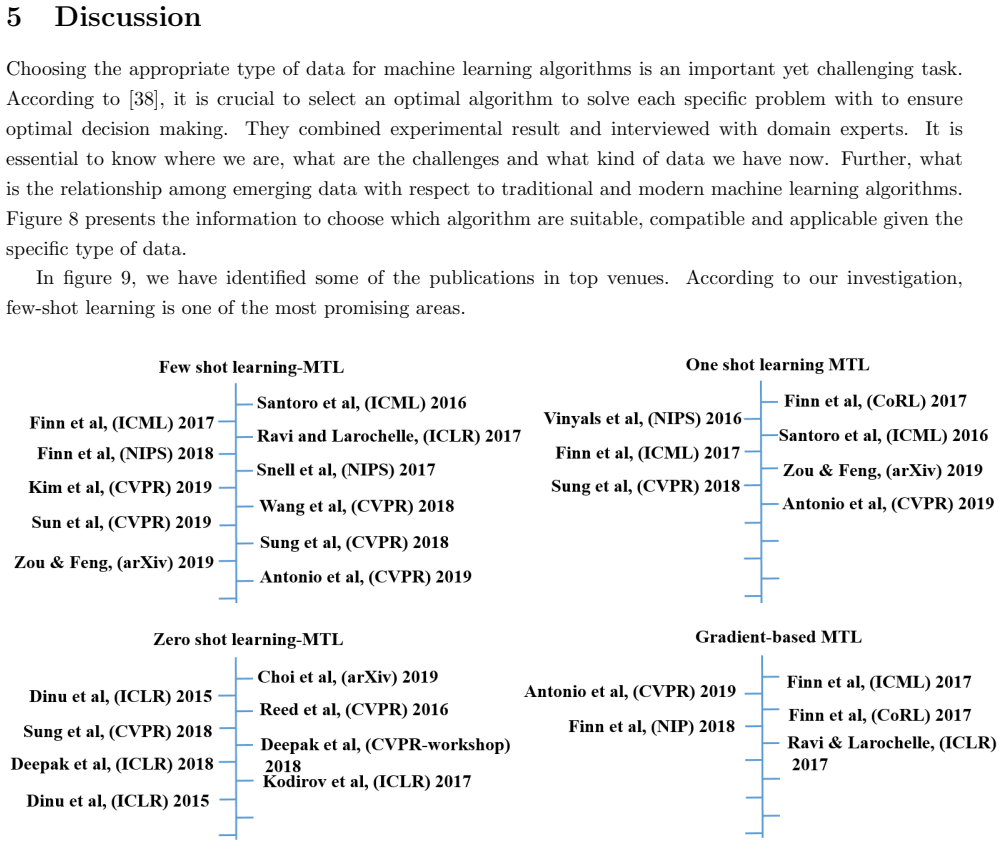
- [Figures 7-9] Figures 7-9 are referenced in the text but their content is not described or interpreted sufficiently for a stand-alone survey; explanatory captions and discussion should be added.
- [Table 1] The abbreviation list uses "fSL" for few-shot learning while the text uses "FSL"; the notation should be made consistent.
Circularity Check
No significant circularity: the paper is a literature survey whose self-citations are background material and whose claims rest on external cited works.
full rationale
This is an introductory survey, not a derivation paper. The abstract references the authors' own earlier work [1,2] on optimization for offline data, but that material is used only to motivate the survey's subject, meta-learning, and is never invoked to justify a prediction or a formal result. The paper's central statements, that meta-learning enables few-shot, one-shot, and zero-shot learning, are supported by citations to external works such as MAML [20], matching networks [19], and online meta-learning [36]; those citations are independent evidence rather than a self-citation chain. There are no fitted parameters, no equations that are defined in terms of the quantity they purport to predict, and no uniqueness theorem imported from the authors' prior work. The garbled equation in Section 4 and the Table 2 misclassifications, such as Koch et al. labelled MIL, are accuracy and quality problems, not circularity: they do not make the survey's claims true by construction. The paper's phrasing in Section 1 that it will 'present the online MTL problem setting' is not backed by a new formulation, but the paper itself cites Finn et al. [36] for online meta-learning, so this is a novelty or exposition issue rather than a circularity. Thus no circular step meets the evidentiary standard required by the review rules, and the appropriate finding is no significant circularity.
Assumptions & free parameters
assumptions (1)
- domain assumption The selected literature in Table 2 is representative of the entire meta-learning field and supports the proposed three-way taxonomy.
Cite this review
Pith. "Pith review of An Introduction to Advanced Machine Learning : Meta Learning Algorithms, Applications and Promises." pith.science (2026). https://pith.science/paper/7M7HS4CK
@misc{pith2026190809788,
  author       = {Pith},
  title        = {Pith review of: An Introduction to Advanced Machine Learning : Meta Learning Algorithms, Applications and Promises},
  year         = {2026},
  howpublished = {\url{https://pith.science/paper/7M7HS4CK}},
  note         = {Machine review of arXiv:1908.09788}
}
read the original abstract
In [1, 2], we have explored the theoretical aspects of feature extraction optimization processes for solving largescale problems and overcoming machine learning limitations. Majority of optimization algorithms that have been introduced in [1, 2] guarantee the optimal performance of supervised learning, given offline and discrete data, to deal with curse of dimensionality (CoD) problem. These algorithms, however, are not tailored for solving emerging learning problems. One of the important issues caused by online data is lack of sufficient samples per class. Further, traditional machine learning algorithms cannot achieve accurate training based on limited distributed data, as data has proliferated and dispersed significantly. Machine learning employs a strict model or embedded engine to train and predict which still fails to learn unseen classes and sufficiently use online data. In this chapter, we introduce these challenges elaborately. We further investigate Meta-Learning (MTL) algorithm, and their application and promises to solve the emerging problems by answering how autonomous agents can learn to learn?.
Figures

Figures from the paper (6 more)


Reference graph
Works this paper leans on
-
[36]
Chelsea Finn, Aravind Rajeswaran, Sham Kakade, and Sergey Levine. Online meta-learning. arXiv preprint arXiv:1902.08438, 2019
arXiv 1902
-
[20]
Model-agnostic meta-learning for fast adaptation of deep networks
Chelsea Finn, Pieter Abbeel, and Sergey Levine. Model-agnostic meta-learning for fast adaptation of deep networks. In Proceedings of the 34th International Conference on Machine Learning-Volume 70 , pages 1126–1135. JMLR. org, 2017
work page 2017
-
[18]
Siamese neural networks for one-shot image recognition
Gregory Koch, Richard Zemel, and Ruslan Salakhutdinov. Siamese neural networks for one-shot image recognition. In ICML deep learning workshop , volume 2, 2015
work page 2015
-
[28]
One-shot visual imitation learning via meta-learning
Chelsea Finn, Tianhe Yu, Tianhao Zhang, Pieter Abbeel, and Sergey Levine. One-shot visual imitation learning via meta-learning. In 1st Conference on Robot Learning (CoRL) , 2017
work page 2017
-
[27]
Low-shot learning from imaginary data
Yu-Xiong Wang, Ross Girshick, Martial Hebert, and Bharath Hariharan. Low-shot learning from imaginary data. In The IEEE Conference on Computer Vision and Pattern Recognition (CVPR) , June 2018
work page 2018
-
[4]
Optimization as a model for few-shot learning
Sachin Ravi and Hugo Larochelle. Optimization as a model for few-shot learning. In International Con- ference on Learning Representations (ICLR), pages 281–288, 2017
work page 2017
-
[1]
F Ghareh Mohammadi, M Hadi Amini, and Hamid R. Arabnia. Evolutionary computation, optimization and learning algorithms for data science. arXiv preprint arXiv: 1908.08006 , 2019
work page Pith review arXiv 1908
- [2]
Show all 38 references
-
[3]
Evolutionary principles in self-referential learning
Jurgen Schmidhuber. Evolutionary principles in self-referential learning. Diploma thesis, 1987
1987
-
[5]
A perspective view and survey of meta-learning
Ricardo Vilalta and Youssef Drissi. A perspective view and survey of meta-learning. Artificial intelligence review, 18(2):77–95, 2002
2002
-
[6]
Approximation to bayes risk in repeated play
James Hannan. Approximation to bayes risk in repeated play. Contributions to the Theory of Games , 3:97–139, 1957
1957
-
[7]
Prediction, learning, and games
Nicolo Cesa-Bianchi and Gabor Lugosi. Prediction, learning, and games . Cambridge university press, 2006
2006
-
[8]
Rule-based machine learning methods for functional prediction
Sholom M Weiss and Nitin Indurkhya. Rule-based machine learning methods for functional prediction. Journal of Artificial Intelligence Research , 3:383–403, 1995
1995
-
[9]
Advances in electronic phenotyping: from rule-based definitions to machine learning models
Juan M Banda, Martin Seneviratne, Tina Hernandez-Boussard, and Nigam H Shah. Advances in electronic phenotyping: from rule-based definitions to machine learning models. Annual review of biomedical data science, 1:53–68, 2018
2018
-
[10]
Artificial neural networks-based machine learning for wireless networks: A tutorial
Mingzhe Chen, Ursula Challita, Walid Saad, Changchuan Yin, and M´ erouane Debbah. Artificial neural networks-based machine learning for wireless networks: A tutorial. IEEE Communications Surveys & Tutorials, 2019
2019
-
[11]
Cost-sensitive support vector machines
Arya Iranmehr, Hamed Masnadi-Shirazi, and Nuno Vasconcelos. Cost-sensitive support vector machines. Neurocomputing, 343:50–64, 2019. 15
2019
-
[12]
Integrated parallel k-nearest neighbor algorithm
Rashmi Agrawal. Integrated parallel k-nearest neighbor algorithm. In Smart Intelligent Computing and Applications, pages 479–486. Springer, 2019
2019
-
[13]
The conformal bootstrap: Theory, numerical tech- niques, and applications
David Poland, Slava Rychkov, and Alessandro Vichi. The conformal bootstrap: Theory, numerical tech- niques, and applications. Reviews of Modern Physics , 91(1):015002, 2019
2019
-
[14]
Learning a synaptic learning rule
Yoshua Bengio, Samy Bengio, and Jocelyn Cloutier. Learning a synaptic learning rule . Universit´ e de Montr´ eal, D´ epartement d’informatique et de recherche . . . , 1990
1990
-
[15]
Long short-term memory.Neural computation, 9(8):1735–1780, 1997
Sepp Hochreiter and J¨ urgen Schmidhuber. Long short-term memory.Neural computation, 9(8):1735–1780, 1997
1997
-
[16]
Deep online learning via meta-learning: Continual adaptation for model-based rl
Anusha Nagabandi, Chelsea Finn, and Sergey Levine. Deep online learning via meta-learning: Continual adaptation for model-based rl. arXiv preprint arXiv:1812.07671 , 2018
2018 arXiv
-
[17]
Meta- learning with memory-augmented neural networks
Adam Santoro, Sergey Bartunov, Matthew Botvinick, Daan Wierstra, and Timothy Lillicrap. Meta- learning with memory-augmented neural networks. In International conference on machine learning , pages 1842–1850, 2016
2016
-
[19]
Matching networks for one shot learning
Oriol Vinyals, Charles Blundell, Timothy Lillicrap, Daan Wierstra, et al. Matching networks for one shot learning. In Advances in neural information processing systems , pages 3630–3638, 2016
2016
-
[21]
How to train your maml
Antreas Antoniou, Harrison Edwards, and Amos Storkey. How to train your maml. arXiv preprint arXiv:1810.09502, 2018
2018 arXiv
-
[22]
Probabilistic model-agnostic meta-learning
Chelsea Finn, Kelvin Xu, and Sergey Levine. Probabilistic model-agnostic meta-learning. In Advances in Neural Information Processing Systems, pages 9516–9527, 2018
2018
-
[23]
Prototypical networks for few-shot learning
Jake Snell, Kevin Swersky, and Richard Zemel. Prototypical networks for few-shot learning. In Advances in Neural Information Processing Systems , pages 4077–4087, 2017
2017
-
[24]
Hierarchical meta learning
Yingtian Zou and Jiashi Feng. Hierarchical meta learning. arXiv preprint arXiv:1904.09081 , 2019
1904 arXiv
-
[25]
Learning to compare: Relation network for few-shot learning
Flood Sung, Yongxin Yang, Li Zhang, Tao Xiang, Philip HS Torr, and Timothy M Hospedales. Learning to compare: Relation network for few-shot learning. In Proceedings of the IEEE Conference on Computer Vision and Pattern Recognition, pages 1199–1208, 2018. 16
2018
-
[26]
Edge-labeling graph neural network for few-shot learning
Jongmin Kim, Taesup Kim, Sungwoong Kim, and Chang D Yoo. Edge-labeling graph neural network for few-shot learning. In Proceedings of the IEEE Conference on Computer Vision and Pattern Recognition , pages 11–20, 2019
2019
-
[29]
Learning deep representations of fine-grained visual descriptions
Scott Reed, Zeynep Akata, Honglak Lee, and Bernt Schiele. Learning deep representations of fine-grained visual descriptions. In Proceedings of the IEEE Conference on Computer Vision and Pattern Recognition , pages 49–58, 2016
2016
-
[30]
Improving zero-shot learning by mitigating the hubness problem
Angeliki Lazaridou Georgiana Dinu and Marco Baroni. Improving zero-shot learning by mitigating the hubness problem. In Proceedings of the 3rd International Conference on Learning Representations (ICLR 2015). workshop track, 2015
2015
-
[31]
Semantic autoencoder for zero-shot learning
Elyor Kodirov, Tao Xiang, and Shaogang Gong. Semantic autoencoder for zero-shot learning. In Proceed- ings of the IEEE Conference on Computer Vision and Pattern Recognition , pages 3174–3183, 2017
2017
-
[32]
Zero-shot learning and knowledge transfer in music classification and tagging
Jeong Choi, Jongpil Lee, Jiyoung Park, and Juhan Nam. Zero-shot learning and knowledge transfer in music classification and tagging. arXiv preprint arXiv:1906.08615 , 2019
1906 arXiv
-
[33]
Zero-shot visual imitation
Deepak Pathak, Parsa Mahmoudieh, Guanghao Luo, Pulkit Agrawal, Dian Chen, Yide Shentu, Evan Shelhamer, Jitendra Malik, Alexei A Efros, and Trevor Darrell. Zero-shot visual imitation. In Proceedings of the IEEE Conference on Computer Vision and Pattern Recognition Workshops , p...
2018
-
[34]
Efros, and Trevor Darrell
Deepak Pathak, Parsa Mahmoudieh, Guanghao Luo, Pulkit Agrawal, Dian Chen, Yide Shentu, Evan Shelhamer, Jitendra Malik, Alexei A. Efros, and Trevor Darrell. Zero-shot visual imitation. InInternational Conference on Learning Representations (ICLR), 2018
2018
-
[35]
Human-level concept learning through probabilistic program induction
Brenden M Lake, Ruslan Salakhutdinov, and Joshua B Tenenbaum. Human-level concept learning through probabilistic program induction. Science, 350(6266):1332–1338, 2015
2015
-
[37]
Meta-transfer learning for few-shot learning
Qianru Sun, Yaoyao Liu, Tat-Seng Chua, and Bernt Schiele. Meta-transfer learning for few-shot learning. In Proceedings of the IEEE Conference on Computer Vision and Pattern Recognition, pages 403–412, 2019
2019
-
[38]
Atmseer: Increasing transparency and controllability in automated machine learn- ing
Qianwen Wang, Yao Ming, Zhihua Jin, Qiaomu Shen, Dongyu Liu, Micah J Smith, Kalyan Veeramacha- neni, and Huamin Qu. Atmseer: Increasing transparency and controllability in automated machine learn- ing. In Proceedings of the 2019 CHI Conference on Human Factors in Computing Sys...
2019
Reviewed August 14, 2026 · model on record in the stance chip above.
Discussion (0). Continue with ORCID to comment.