REVIEW 3 major objections 4 minor 37 references
Structures of the Massive Vector Boson Propagators at Finite Temperature Illuminated by the Goldstone Equivalence Gauge
T0 review · 3 major / 4 minor · reviewed 2026-08-14 · deepseek-v4-flash
Pith's one-line read This paper argues that heating a massive vector boson partially resurrects the Goldstone boson it swallowed at zero temperature, as a tachyonic branch cut that can be approximated by two quasi-poles.
desk verdict A plausible but incompletely-validated decomposition of the thermal massive vector propagator, with the quasi-pole replacement as the main open issue. read the letter →
The pith
A machine-rendered reading of the paper's core claim, the machinery that carries it, and where it could break.
The reading
What carries the argument
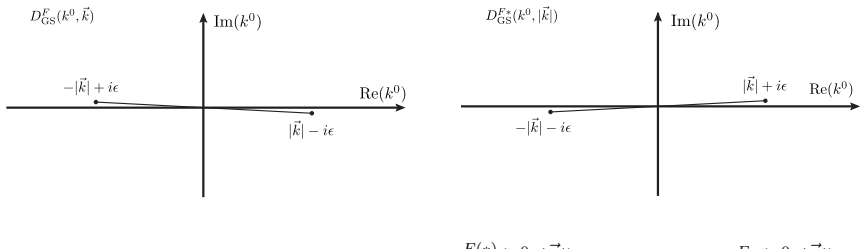
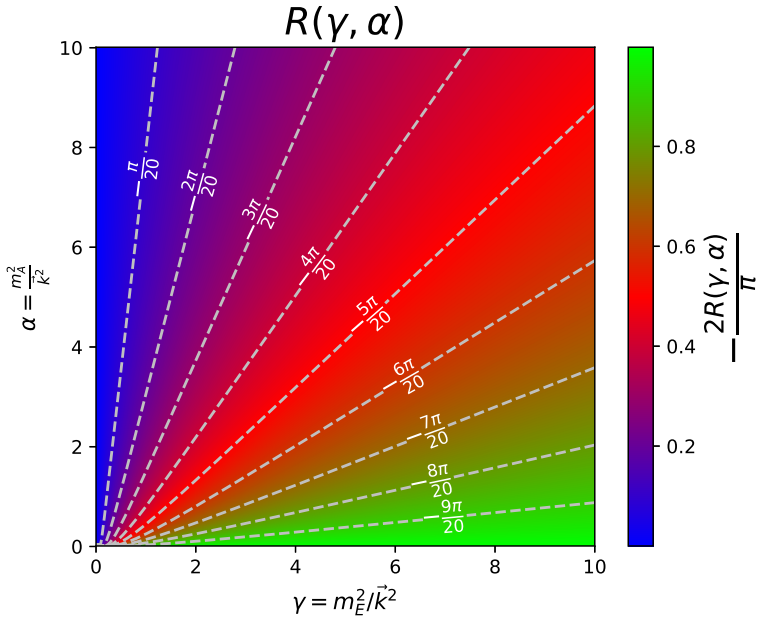
The Goldstone equivalence gauge is the central tool: a light-cone gauge condition $n_\mu A^\mu=0$ with $n^\mu=(1,-\hat{\mathbf{k}})$ that separates the propagator into transverse, longitudinal, and pure Goldstone projectors $P_T$, $P_L$, $P_G$, so the 'eating' of the Goldstone boson is visible as a cancellation between the $k^2=m_A^2$ pole of the longitudinal projector and the $k^2=0$ pole of the Goldstone projector. The paper feeds the thermal self-energy $\Pi_{L,T}$ into this decomposition to obtain the resummed propagator and the Goldstone component. The quasi-pole approximation is the load-bearing mechanism: it replaces the tachyonic branch cut by two poles with residue $Z_{GS}=-2R(\gamma,\alpha)/\pi$, where $R(\gamma,\alpha)$ is a numerically tabulated spectral integral depending on $\gamma=m_E^2/\mathbf{k}^2$ and $\alpha=m_A^2/\mathbf{k}^2$, and $R(\gamma,\alpha)\to-\pi/2$ in the crossover limit $m_A\to0$. This turns a continuum contribution into an external-leg Goldstone boson with a rescaling factor.
What would settle it
Compute the exact inclusive cross-section for a simple process, such as fermion-antifermion annihilation into a pair of massive vector bosons, by integrating the full branch-cut spectral functions of the resummed Goldstone and vector propagators, and compare it with the quasi-pole external-leg Feynman-rule result; a mismatch larger than the neglected thermal widths would show the quasi-pole replacement fails. Alternatively, check the sum rule that the longitudinal residue plus $Z_{GS}$ plus the transverse and longitudinal branch-cut residues saturate the full spectral weight of the propagator.
Extended reading notes
Core claim
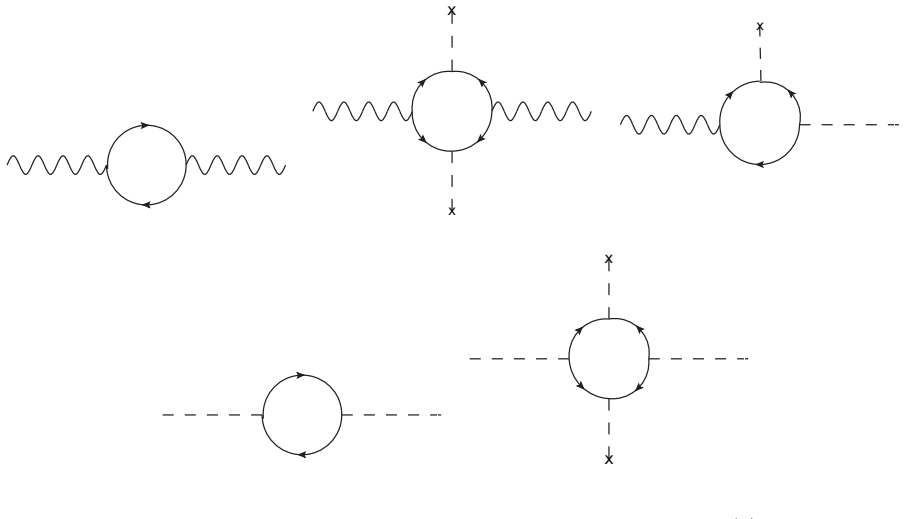
The central claim is that in a finite-temperature plasma the longitudinal polarization of an originally massive vector boson decouples from the Goldstone boson as the temperature rises, and the eaten Goldstone degree of freedom reappears inside a tachyonic branch cut rather than vanishing. In the hard thermal loop approximation, the resummed Goldstone component of the propagator is $\Delta_F^{GS}(k)=\frac{k^2-\Pi_L(k)+i\epsilon}{k^2-m_A^2-\Pi_L(k)+i\epsilon}\frac{i}{k^2+i\epsilon}$, whose $k^2=0$ pole is cancelled by the numerator structure of $\Pi_L$, leaving a branch cut between $k_0=-|\mathbf{k}|$ and $k_0=|\mathbf{k}|$. The paper approximates that branch cut by two poles at $k_0=\pm(|\mathbf{k}|-i\epsilon)$ whose residues are fixed by the spectral integral $R(\gamma,\alpha)$, giving a Goldstone wave-function factor $Z_{GS}=-2R(\gamma,\alpha)/\pi$. It then derives external-leg Feynman rules in which transverse modes, longitudinal modes, and the recovered Goldstone boson all appear as quasi-particles, with the Goldstone fraction suppressed by $m_A/m'_A$ as the thermal mass grows. The same structure is shown to reappear in the $R_\xi$ and Coulomb gauges, and the mixing case relevant to $\gamma$-$Z$ is treated with a $2\times2$ propagator matrix.
Load-bearing premise
The whole construction rests on replacing the continuous band of tachyonic frequencies in the Goldstone channel by two sharp poles carrying the integrated spectral weight up to a small cutoff, with no quantitative bound on the error this introduces.
Editorial extensions
If this is right
- Internal propagators of massive vector bosons at finite temperature can be written in a separated transverse, longitudinal, and Goldstone form, so inclusive loop calculations decompose into identifiable physical modes.
- External longitudinal vector boson legs carry $\sqrt{Z_L}$ and the shifted polarization vector of the paper, whose Goldstone component shrinks as $m_A/m'_A$, making the longitudinal mode increasingly plasmon-like at high temperature.
- External Goldstone legs carry $\sqrt{Z_{GS}}$ with $Z_{GS}=-2R(\gamma,\alpha)/\pi\le1$, allowing tree-level estimates of processes with Goldstone bosons in the plasma near the electroweak crossover.
- The transverse and longitudinal branch-cut quasi-poles have residues one to two orders of magnitude smaller than the Goldstone residue, so neglecting them is a controlled approximation in the regime considered.
- In the $R_\xi$ gauge the same Goldstone branch cut is distributed through the vector sector, the double poles are shown to be non-physical via Ward-Takahashi identities, and the same $\Delta_F^{GS}$ result is reproduced; for $\gamma$-$Z$ mixing with $m_B=0$ the Goldstone component has a closed form.
Reading between the lines
- Editorial inference: the quasi-pole replacement could be tested numerically by computing an exact inclusive rate from the full branch-cut spectral function and comparing it with the $\sqrt{Z_{GS}}$ tree-level result, which would supply the error estimate the paper leaves open.
- Editorial inference: applying the same decomposition to non-Abelian vector bosons would expose whether self-interaction widths smear the Goldstone quasi-poles beyond recognition, a regime the toy $U(1)$ model cannot address.
- Editorial inference: if the picture holds, sterile-neutrino and dark-matter production near the electroweak crossover should include $\sqrt{Z_{GS}}$ external Goldstone legs; the paper locates this application but does not compute any cross-section.
Editorial analysis
A structured set of objections, weighed in public.
Referee Report
Summary. This paper studies the finite-temperature structure of an originally massive vector boson propagator using the 'Goldstone equivalence gauge.' The author decomposes the full propagator into transverse, longitudinal, and Goldstone components and derives a compact expression, Eq. (27). The Goldstone component (33) is shown to develop a tachyonic branch cut, which the paper approximates by two 'quasi-poles' at k0 = ±(|k| − iε) with an integrated spectral weight Z_GS given by Eqs. (39)–(44). External-leg Feynman rules for the vector boson and the recovered Goldstone boson are then proposed in Sec. IV. The paper also sketches the R_ξ gauge and two-gauge-boson mixing generalizations.
Significance. The paper addresses a real gap in the literature: the fate of the Goldstone degree of freedom for massive vector bosons in a thermal plasma, and the practical need for simplified external-leg rules. The propagator decomposition (27) and the identification of the Goldstone component (33) are useful and appear to follow from standard HTL inputs and the extended Ward-Takahashi identity. The qualitative picture—longitudinal polarization shedding Goldstone content, which reappears as a branch cut—is physically appealing and clearly presented. However, the central quantitative claim, namely that the branch cut can be replaced by quasi-poles with a single wave-function renormalization Z_GS, is not rigorously established; no error estimate or benchmark against exact spectral integrals is provided. Thus the advertised 'mathematically equivalent' tree-level method is not yet demonstrated.
major comments (3)
- [Sec. IV, Eq. (39)] The quasi-pole approximation replaces the entire tachyonic branch cut k0 ∈ [−|k|, |k|] of ΔF_GS in Eq. (33) by two poles at k0 = ±(|k| − iε) with the integrated spectral weight collected into Z_GS = −2R(γ,α)/π (Eqs. (41), (44)). This collapsing is exact only if the rest of the integrand in the spectral representation (34) is effectively independent of k0 over the whole cut. The paper justifies it only by the observation that the spectral function 'peaks in the vicinity of the branch points' when m_A^2 ≪ m_E^2; it gives no error bound, no validity domain in (m_A, m_E, |k|), and no comparison with an exact inclusive sum-rule calculation. Because the external-leg Feynman rules in Sec. IV and the Sec. I claim of mathematical equivalence to lowest-order inclusive calculations both rely on this approximation, the authors should add a quantitative benchmark (e.g., compute a simple inclusive rate exactly and with the quasi-pole prescription) and state the regime in which the approximation holds.
- [Sec. V] The manuscript explicitly states that 'the cancellation of the ξ-dependence in computing the physical observables is currently beyond our ability.' This leaves the gauge independence of the quasi-pole picture undemonstrated, and yet the abstract claims that 'similar results are shown in other gauges, especially in the R_ξ gauge.' Moreover, the derivation leading to Eq. (49) is only sketched, with the author noting 'We omitted some of the cumbersome formula calculations' and 'We then omit the rest of the calculations.' For the advertised generality to be credible, the authors should either provide the full R_ξ derivation or clearly state that the ξ-independence is conjectural.
- [Sec. III, Eq. (33)] The Goldstone propagator is obtained by neglecting Π_U(k) with the statement that 'Π_U changes slowly as k changes,' but no quantitative estimate is given. Since the branch-cut structure and the quasi-pole residues are derived from Eq. (33), a non-negligible Π_U could alter both R(γ,α) and the external-leg rules. The authors should estimate the size of Π_U contributions in the HTL regime or restrict the validity of the result to the case Π_U ≈ 0.
minor comments (4)
- [Throughout] There are several typos and grammatical errors, including 'Feynmann' for 'Feynman', 'intruitive', 'feliticiously', 'priory knowledges', and 'Golsone' in the abstract; these should be corrected.
- [Sec. II, Eq. (4)] The use of √k^2 in the polarization vectors is formally ambiguous for spacelike momenta, which are exactly the region where the branch cut lives; the authors should specify the chosen branch of the square root in the off-shell polarization vectors.
- [Sec. IV, Eqs. (42)-(43)] The nine-parameter fit for R(γ,α) is presented without any measure of its accuracy or the range of (γ,α) over which it is reliable; please include the residuals or a comparison with the numerical data.
- [Sec. VI, Eq. (67)] The sentence 'Earnest analysis can still show that the k^2 = 0 poles had been replaced by a branch cut' is unclear (the plural 'poles' is confusing) and the analysis is not shown; please clarify and provide the derivation of Eq. (67).
Circularity Check
No significant circularity: the central results are derived from stated HTL inputs and Ward-Takahashi identities; the quasi-pole replacement is an openly labeled approximation with computed spectral weights, not a fitted prediction.
full rationale
The derivation chain is self-contained rather than circular. The thermal propagator (27) is obtained by resumming self-energy strings with the extended Ward-Takahashi identities (22)-(24) and the standard HTL self-energies (28), and the Goldstone component (33) follows algebraically from (27). The central quasi-pole step is explicitly presented as an approximation: the paper states 'As an approximation, we can replace the two halves of the branch cut ... with two poles' (Sec. IV), and the residue (39) is defined as an integral of the actual spectral function, computed numerically in (41) as R(γ,α), from which Z_GS = -2R(γ,α)/π is defined in (44). Nothing is fitted to a target physical observable; the nine-constant fit (42)-(43) is an auxiliary numerical parametrization of an already-computed integral, not an input to the physics. The external-leg rules are proposed under this stated approximation rather than presented as exact equivalences, so there is no hidden fitted parameter renamed as a prediction. Citations to the Goldstone-equivalence gauge and the decomposition formalism (Refs. [12,13]) supply the starting gauge/framework, but the thermal statements are derived within the paper; no load-bearing uniqueness theorem from the authors' prior work is invoked. The lack of an explicit error bound on the quasi-pole approximation is a legitimate accuracy/validity concern, but it is not circularity. Score 0.
Assumptions & free parameters
free parameters (2)
- m_E (HTL thermal mass parameter)
- R(gamma,alpha) fitting constants A-I =
A=1.5339, B=0.16484, C=0.47210, D=0.20252, E=2.5680e-22, F=15.64287469, G=4.82049e-4, H=0.26394, I=5.15737e-3
assumptions (6)
- domain assumption HTL expressions for Pi_L and Pi_T (Weldon forms, Eq. (28)) are taken as input.
- domain assumption Extended Ward-Takahashi identity in the broken phase, k*_M Pi^{MN}=0, remains valid at finite temperature.
- domain assumption Pi_U(k) can be eliminated by shifting to the temperature-dependent minimum of the effective potential and thereafter neglected.
- domain assumption Thermal widths (decay widths of the quasiparticles) are ignored when finding on-shell poles.
- standard math The Goldstone equivalence gauge-fixed tree-level propagator and its projection decomposition from Refs. [12,13] extend to off-shell momenta as in Eqs. (6), (10)-(14).
- ad hoc to paper In R_xi gauge, xi-dependent poles and double poles cancel in physical observables via Ward identities.
invented entities (1)
-
Quasi-pole (recovered Goldstone boson)
Cite this review
Pith. "Pith review of Structures of the Massive Vector Boson Propagators at Finite Temperature Illuminated by the Goldstone Equivalence Gauge." pith.science (2026). https://pith.science/paper/EVN6NU3M
@misc{pith2026190809796,
  author       = {Pith},
  title        = {Pith review of: Structures of the Massive Vector Boson Propagators at Finite Temperature Illuminated by the Goldstone Equivalence Gauge},
  year         = {2026},
  howpublished = {\url{https://pith.science/paper/EVN6NU3M}},
  note         = {Machine review of arXiv:1908.09796}
}
abstract
Inspired by the Goldstone equivalence gauge, we study the thermal corrections to an originally massive vector boson by checking the poles and branch cuts. We find that part of the Goldstone boson is spewed out from the longitudinal polarization, becoming a branch cut which can be approximated by the "quasi-poles" in the thermal environment. In this case, physical Goldstone boson somehow partly recovers. We also show the Feynmann rules for the "external legs" of these vector boson as well as the recovered Goldstone boson, expecting to simplify the vector boson participated process calculations by adopting the similar "tree-level" logic as in the zero temperature situation. Gauge boson mixing case are also discussed. Similar results are shown in other gauges, especially in the $R_\xi$ gauge.
Figures

Figures from the paper (1 more)
Reference graph
Works this paper leans on
- [1]
- [2]
- [3]
- [4]
-
[5]
F. P. Huang, K. Kadota, T. Sekiguchi, and H. Tashiro, Phys. Rev. D97, 123001 (2018), 1803.08230
arXiv 2018
-
[6]
M. L. Bellac, Thermal Field Theory , Cambridge Monographs on Mathe- matical Physics (Cambridge University Press, 2011), ISBN 9780511885068, 9780521654777, URL http://www.cambridge.org/mw/academic/subjects/physics/ theoretical-physics-and-mathematical-physics/thermal-field-theory?format=AR
work page 2011
- [7]
- [8]
Show all 37 references
- [9]
- [10]
-
[11]
Kunszt and D
Z. Kunszt and D. E. Soper, Nucl. Phys. B296, 253 (1988)
1988
- [12]
-
[13]
J. Chen, T. Han, and B. Tweedie, JHEP 11, 093 (2017), 1611.00788
2017 arXiv
-
[14]
N. P. Landsman and C. G. van Weert, Phys. Rept. 145, 141 (1987)
1987
-
[15]
Buchmuller, Z
W. Buchmuller, Z. Fodor, T. Helbig, and D. Walliser, Annals Phys. 234, 260 (1994), hep- ph/9303251
1994
-
[16]
M. S. Chanowitz and M. K. Gaillard, Nucl. Phys. B261, 379 (1985)
1985
-
[17]
H. A. Weldon, Phys. Rev. D26, 1394 (1982)
1982
-
[18]
Frenkel and J
J. Frenkel and J. C. Taylor, Nucl. Phys. B374, 156 (1992)
1992
-
[19]
Braaten and R
E. Braaten and R. D. Pisarski, Phys. Rev. D45, R1827 (1992)
1992
- [20]
- [21]
-
[22]
M. Endo, T. Moroi, M. M. Nojiri, and Y. Shoji, Phys. Lett. B771, 281 (2017), 1703.09304
2017 arXiv
-
[23]
Tanabashi, K
M. Tanabashi, K. Hagiwara, K. Hikasa, K. Nakamura, Y. Sumino, F. Takahashi, J. Tanaka, K. Agashe, G. Aielli, C. Amsler, et al. (Particle Data Group), Phys. Rev. D98, 030001 (2018), 27 URL https://link.aps.org/doi/10.1103/PhysRevD.98.030001
2018 doi
-
[24]
Bertone, D
G. Bertone, D. Hooper, and J. Silk, Phys. Rept. 405, 279 (2005), hep-ph/0404175
2005 arXiv
-
[25]
L. J. Hall, K. Jedamzik, J. March-Russell, and S. M. West, JHEP 03, 080 (2010), 0911.1120
2010 arXiv
-
[26]
Lello, D
L. Lello, D. Boyanovsky, and R. D. Pisarski, Phys. Rev. D95, 043524 (2017), 1609.07647
2017 arXiv
- [27]
- [28]
- [29]
- [30]
- [31]
- [32]
-
[33]
Batell, T
B. Batell, T. Han, and B. Shams Es Haghi, Phys. Rev. D97, 095020 (2018), 1704.08708
2018 arXiv
-
[34]
Batell, T
B. Batell, T. Han, D. McKeen, and B. Shams Es Haghi, Phys. Rev. D97, 075016 (2018), 1709.07001
2018 arXiv
- [35]
-
[36]
Allahverdi, Y
R. Allahverdi, Y. Gao, B. Knockel, and S. Shalgar, Phys. Rev. D95, 075001 (2017), 1612.03110
2017 arXiv
-
[37]
Bandyopadhyay, E
P. Bandyopadhyay, E. J. Chun, R. Mandal, and F. S. Queiroz, Phys. Lett. B788, 530 (2019), 1807.05122. 28
2019 arXiv
Reviewed August 14, 2026 · model on record in the stance chip above.
Discussion (0). Continue with ORCID to comment.