REVIEW 4 major objections 5 minor 13 references
A Comparison of Adaptive and Template Matching Techniques for Radio-Isotope Identification
T0 review · 4 major / 5 minor · reviewed 2026-08-14 · deepseek-v4-flash
Pith's one-line read This paper claims that adaptive classifiers (a dense neural network and a convolutional neural network) outperform template matching in gamma-ray isotope identification, being both more accurate and far faster, but the dense network…
desk verdict A useful, carefully built benchmark comparing four isotope-ID algorithms on simulated spectra, but the abstract overstates the case: the DNN collapses at 8 m and the results are all simulation-based. read the letter →
The pith
A machine-rendered reading of the paper's core claim, the machinery that carries it, and where it could break.
The reading
What carries the argument
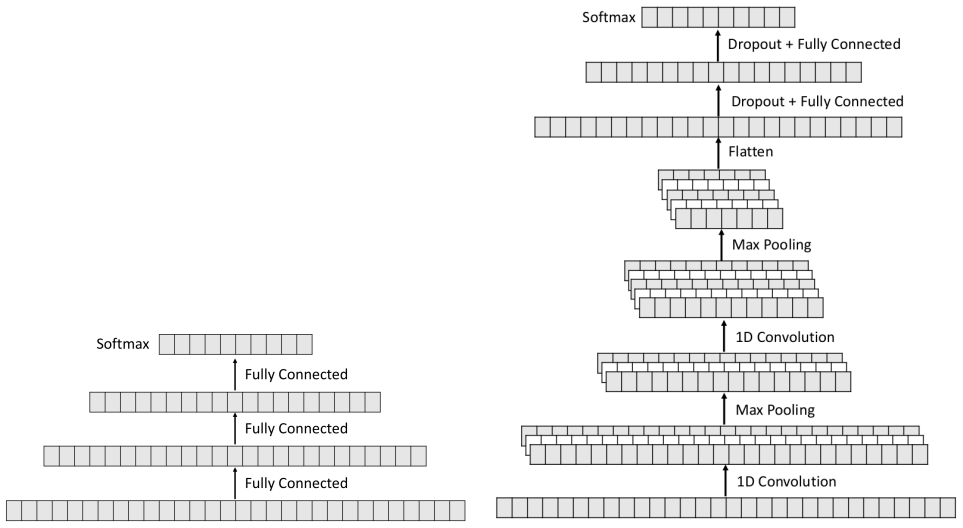
The comparison is carried by four classifiers. Two are non-adaptive template matchers: both minimize an objective over a background amplitude $n_b$ and a signal amplitude $n_s$ for a linear model $f(E|n_b,n_s)=n_b f_b(E)+n_s f_s(E)$, using either the binned Poisson log-likelihood $\Lambda$ or the chi-squared statistic $\chi^2$, then select the isotope by a Kolmogorov–Smirnov probability with a 5% signal-fraction floor. The two adaptive methods are a dense neural network (DNN) and a one-dimensional convolutional neural network (CNN); the CNN's convolution and max-pooling layers assume local structure—photopeaks and Compton continua—across the 1014 energy bins, while the DNN treats each bin independently. All four are evaluated on the same Poisson-sampled ensembles with known ground truth, which is what makes a direct accuracy comparison meaningful.
What would settle it
Collect a labeled dataset of real measured gamma-ray spectra—for example, field recordings of 192Ir, 137Cs, and 60Co at 1, 4, and 8 m with known activities and backgrounds—and run the same four classifiers on it; if the adaptive methods no longer outperform the log-likelihood template matcher, or the CNN fails to generalize to a distance not used in training, the paper's ranking would not transfer to operations.
Extended reading notes
Core claim
On Poisson-sampled spectra built from GADRAS templates representing 13 backgrounds and 9 isotopes at 6 distances and 11 dwell times, the authors find that adaptive classifiers—a dense neural network and a convolutional neural network—outperform both template-matching baselines (chi-squared and log-likelihood) in overall isotope-class accuracy, and that the log-likelihood objective is consistently more accurate than chi-squared in the low-statistics regime. They also find that the trained networks classify spectra in seconds while template matching takes hours on the same hardware. The DNN performs at least as well as every other method at the training distance of 4 m, but at the unseen 8 m distance it collapses and mislabels most sources as 192Ir; the CNN, which uses local spectral structure through convolution and pooling, generalizes to 8 m. The paper's central claim is that adaptive methods are more accurate and computationally efficient than non-adaptive in cases of operational interest, with the CNN as the safest adaptive choice when the deployment distance differs from training.
Load-bearing premise
The entire accuracy ranking is measured on simulated spectra, and the authors assume these simulations are representative enough of real operational measurements that the same ranking would hold in the field.
Editorial extensions
If this is right
- Replacing chi-squared with the log-likelihood objective in deployed template-matching software should improve accuracy in low-count operational conditions, where chi-squared is not statistically justified.
- Trained neural networks, if they generalize beyond their training geometry, reduce classification time from hours to seconds, enabling real-time isotope identification on portable detectors.
- The CNN's successful generalization to an unseen 8 m distance suggests that convolutional architectures, which exploit the local energy structure of gamma-ray spectra, are better suited to isotope identification when training data come from a limited set of distances.
- The DNN's collapse at 8 m shows that a dense network can overfit to a single training distance, so adaptive methods should be validated at multiple distances before field deployment.
- Per-isotope results identify 192Ir as the most difficult isotope for the non-adaptive methods even at long dwell times, so detection algorithms may need extra attention for this source.
Reading between the lines
- If the simulation-to-field gap is real, the choice to train only at 4 m could be a hidden liability: any deployment at a different geometry risks reproducing the DNN's failure, suggesting that training on a mix of distances would be a cheap, testable improvement.
- The CNN's advantage at 8 m hints that physics-informed inductive biases (local peak structure) matter more than model capacity for out-of-distribution generalization; a hybrid that initializes from a log-likelihood template fit and refines with a CNN might be worth testing.
- The reported speed difference of seconds versus hours, if it holds on real data, would make adaptive classifiers attractive for real-time portal monitors and handheld devices, but trustworthiness on out-of-distribution backgrounds would have to be established first.
- A concrete extension would be to train the networks on spectra from all six distances instead of only 4 m; the authors' data already exist, so the experiment is purely computational and would directly show how much of the DNN's 8 m failure is due to distribution shift rather than model class.
Signed reviews
Editorial analysis
A structured set of objections, weighed in public.
Referee Report
Summary. The manuscript compares four gamma-ray isotope-identification algorithms—chi-squared template matching, binned log-likelihood template matching, a dense neural network (DNN), and a convolutional neural network (CNN)—on Poisson-sampled GADRAS spectra spanning 6 source-to-detector distances, 11 dwell-times, 9 isotopes, and 13 background templates. Accuracy is reported as a function of dwell-time and distance, along with confusion matrices at 8 m, and the paper argues that adaptive methods are more accurate and computationally cheaper than non-adaptive methods in operational regimes.
Significance. If the reported accuracy rankings hold, the paper would support replacing chi-squared template matching with log-likelihood or neural-network classifiers in operational isotope-identification software. The experimental design is a genuine strength: 7.7 million simulated spectra per ensemble, known ground truth, a clear train/test split at fixed distances, and randomized hyperparameter search. The most valuable and credible result is the negative finding that the CNN generalizes to 8 m while the DNN collapses, which is documented in Figures 7 and 8. However, the headline conclusion overstates the evidence: the DNN's failure at 8 m is part of the studied operational range, so the abstract's 'adaptive methods are more accurate' claim is only defensible for the CNN, not for adaptive methods jointly.
major comments (4)
- [Section 4, Figures 7 and 8] The text in Section 4 states that 'in all cases the DNN performs comparably, or better, than the other methods considered,' but the same section reports that at 4 m 'the DNN ... fails at selecting background even at long dwell-times' and at 8 m 'the DNN was overfitting to the training dataset, misidentifying most isotopes as 192Ir.' Figures 7 and 8 confirm the 8 m collapse. These statements are mutually inconsistent, and because the Abstract's headline accuracy claim rests on pooling the DNN with the CNN, the conclusion must be rephrased to report the CNN (and the likelihood method in low-statistics regimes) separately from the DNN, and to present the DNN's 8 m failure as an explicit limitation.
- [Section 3.2, Figures 4 and 5] The neural networks were trained only on spectra simulated at 4 m, yet the central conclusion is stated over the full 1–8 m range. The DNN's deterioration at 8 m is therefore not merely an unusual corner case; it is an out-of-distribution failure inside the claimed operational envelope. The authors should either retrain with distance-augmented training sets (including 8 m) or restrict the adaptive-accuracy claim to the CNN at distances within the training distribution, reporting the 8 m results as a generalization test rather than as part of the favorable comparison.
- [Section 3.1 and Table 1] The template-matching methods use a fixed 5% signal-fraction threshold (ns fraction) to decide whether a fitted source is distinguishable from background, and this threshold is not varied or justified. In low-count and low-signal-to-background regimes (e.g., the 8 m configurations in Table 1), this threshold directly controls how often sources are reported as background and can materially change the accuracy comparisons. A sensitivity analysis over a range of thresholds is needed to establish that the reported ranking of template methods is not an artifact of this choice.
- [Figures 4–7] Accuracy curves are presented without error bars, confidence intervals, or statistical tests. Each cell contains 1.3e4 spectra, so binomial sampling errors are small but not negligible for close comparisons, particularly between chi-squared and log-likelihood at short dwell-times and between CNN and DNN at intermediate distances. Reporting uncertainties or, at minimum, per-point confidence intervals would make the 'comparably or better' language quantitatively supported.
minor comments (5)
- [Section 2.1] There are several typographical errors, including 'crated' for 'created', 'T emplates' in the section heading, and 'An major disadvantage' should be 'A major disadvantage'.
- [Table 1 and Figures 2, 6–8] The isotope labeled '207Th' does not correspond to a known isotope; if the intended nuclide is 207Bi or 207Tl, the symbol and the corresponding template should be corrected for physical accuracy.
- [Section 2] The parenthetical 'class imbalance problems?, 2' contains an unexplained question mark and should be cleaned up before publication.
- [Figure 5] The horizontal axis in Figure 5 is labeled with distances 1 through 8, but measurements were taken only at 1, 2, 4, 5, 6, and 8 m; using discrete distance labels would avoid implying interpolation at 3 and 7 m.
- [References] Reference [4] is marked 'in DRAFT'; the published version should cite the final arXiv or journal version once available.
Circularity Check
No circularity: the comparison is a self-contained empirical benchmark whose conclusions are measured out-of-sample results, not relabeled fit parameters.
full rationale
The paper reports an empirical comparison of isotope identification algorithms on simulated gamma-ray spectra. Test spectra are Poisson samples drawn from the same GADRAS templates used to construct the template-matching libraries and to train the neural networks; this is standard practice for controlled algorithm comparison and, if anything, favors the non-adaptive template methods because they use the exact asymptotic shapes that generated the test data. The adaptive models were trained at a source-detector distance of 4 m and evaluated on held-out simulated data at several distances, so the reported accuracy is a genuine out-of-sample measurement rather than a fitted value renamed as a prediction. The paper's own text reports that the DNN overfits at 8 m and misidentifies most isotopes as 192Ir, which demonstrates that the adaptive methods are not forced to win by construction. Self-citations, such as Ref. [1] for network architecture and Refs. [3,5-7] for related prior work, are background references and are not load-bearing: the accuracy, runtime, and confusion results are computed in this paper from the described simulations. The acknowledged limitation that modeled data may not fully reproduce real-world complications is an external-validity caveat, not a circularity. No derivation step reduces to its own input, and no fitted constant is presented as an independent prediction.
Assumptions & free parameters
free parameters (3)
- Source activities in Table 1 =
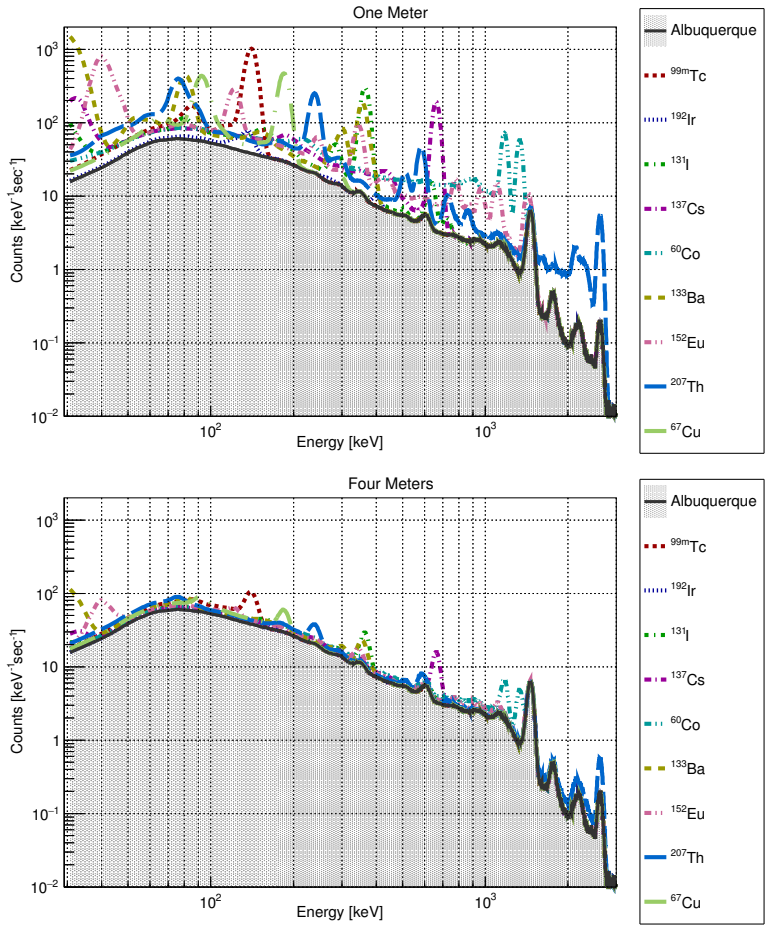
9 isotopes, e.g., 99mTc 6756.72 s-1, 192Ir 422.314 s-1 at 1 m
- Neural network hyperparameters =
DNN: 1 layer, 128 neurons, lr=1.1e-4, dropout=0.86; CNN: 32 filters, lr=1.3e-3, 14 nodes (Table 2)
- Signal fraction threshold for template matching =
5% (ns >= 0.05)
assumptions (5)
- domain assumption GADRAS modeled templates represent real detector response and backgrounds closely enough for the comparison to be operationally meaningful
- domain assumption Poisson sampling of asymptotic templates produces realistic spectral ensembles for training and testing
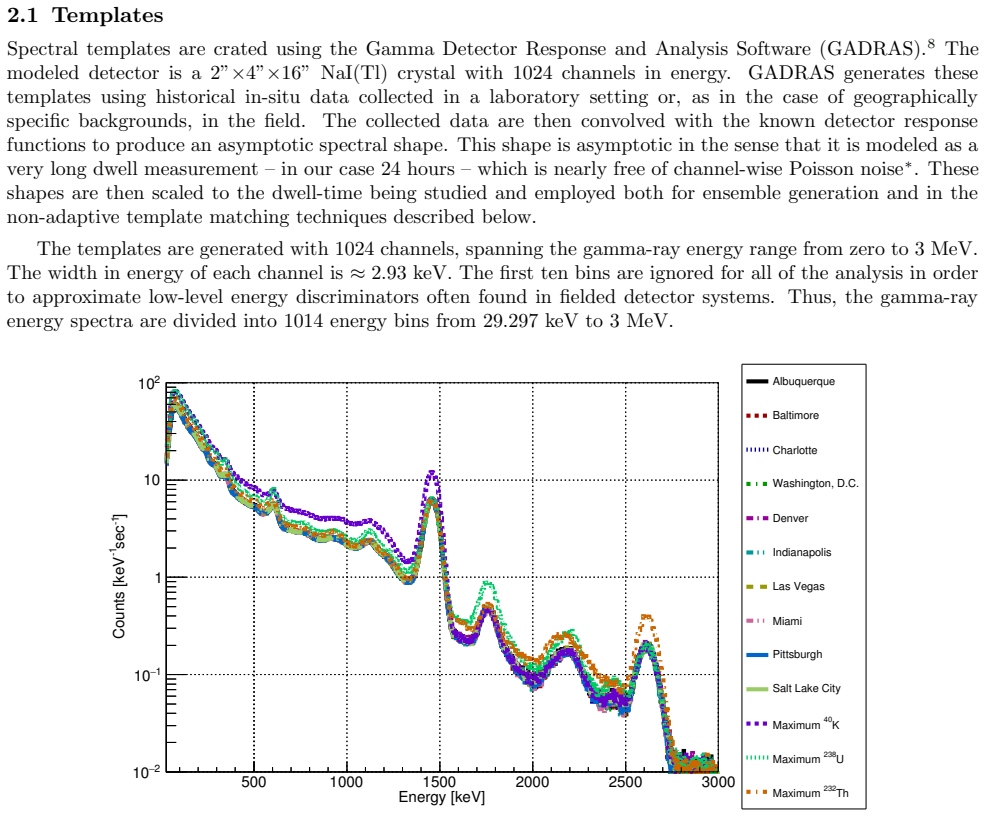
- domain assumption The 13 background templates (10 cities plus maximized K, U, Th) span operational background variability
- standard math Standard binned Poisson likelihood and chi-squared objective functions apply to these spectra
- domain assumption Trained networks generalize from the 4 m training distance to other distances
Cite this review
Pith. "Pith review of A Comparison of Adaptive and Template Matching Techniques for Radio-Isotope Identification." pith.science (2026). https://pith.science/paper/EHI7KHNY
@misc{pith2026190809816,
  author       = {Pith},
  title        = {Pith review of: A Comparison of Adaptive and Template Matching Techniques for Radio-Isotope Identification},
  year         = {2026},
  howpublished = {\url{https://pith.science/paper/EHI7KHNY}},
  note         = {Machine review of arXiv:1908.09816}
}
read the original abstract
We compare and contrast the effectiveness of a set of adaptive and non-adaptive algorithms for isotope identification based on gamma-ray spectra. One dimensional energy spectra are simulated for a variety of dwell-times and source to detector distances in order to reflect conditions typically encountered in radiological emergency response and environmental monitoring applications. We find that adaptive methods are more accurate and computationally efficient than non-adaptive in cases of operational interest.
Figures
Figures from the paper (5 more)



Reference graph
Works this paper leans on
-
[1]
A comparison of machine learning methods for automated gamma-ray spectroscopy,
Kamuda, M., Zhao, J., and Huff, K., “A comparison of machine learning methods for automated gamma-ray spectroscopy,” Nuclear Instruments and Methods in Physics Research, Section A: Accelerators, Spectrome- ters, Detectors and Associated Equipment (1 2018)
work page 2018
-
[2]
Anomaly detection in gamma ray spectra: A machine learning perspective,
Sharma, S., Bellinger, C., Japkowicz, N., Berg, R., and Ungar, K., “Anomaly detection in gamma ray spectra: A machine learning perspective,” 2012 IEEE Symposium on Computational Intelligence for Security and Defence Applications (July 2012). IEEE Xplore: 31 August 2012
work page 2012
-
[3]
Threat determination for radiation detection from the remote sensing laboratory,
Ford, W. P., Hague, E., McCullough, T., Moore, E. T., and Turk, J., “Threat determination for radiation detection from the remote sensing laboratory,” Proceedings of the SPIE 10644, 106440G (2018)
work page 2018
-
[4]
Analysis of gamma-ray spectrum using transfer learning,
Moore, E. T. et al., “Analysis of gamma-ray spectrum using transfer learning,” https://arxiv.org/ (2019). in DRAFT
work page 2019
-
[5]
Algorithm development for targeted isotopics,
Moore, E. T., Ford, W. P., Hague, E. J., and Turk, J. L., “Algorithm development for targeted isotopics,” (2018)
work page 2018
-
[6]
Algorithm development for targeted isotopics,
Moore, E. T., Ford, W. P., Hague, E. J., and Turk, J. L., “Algorithm development for targeted isotopics,” Site-Directed Research and Development - FY 2018 (2019)
work page 2019
-
[7]
Machine learning for gamma spectra,
Hague, E. J., Ford, W. P., McCullough, T., Moore, E. T., and Turk, J., “Machine learning for gamma spectra,” Symposium on Radiation Measurements and Applications Ann Arbor , Michigan (June 13, 2018)
work page 2018
-
[8]
Steve M. Horne, et al., “GADRAS-DRF 18.5 users manual.” Accessed: March 2019
work page 2019
Show all 13 references
-
[9]
CERN ROOT data analysis framework
Rene Brun, et al., “CERN ROOT data analysis framework.” Accessed: March 2019
2019
-
[10]
The RooFit toolkit for data modeling
Wouter Verkerke and David Kirkby, “The RooFit toolkit for data modeling.” Accessed: March 2019
2019
-
[11]
Maximum-likelihood method
Michiel Hazewinkel, “Maximum-likelihood method.” Accessed: March 2019
2019
-
[12]
Evaluation of pooling operations in convolutional architectures for object recognition,
Scherer, D., M¨ uller, A., and Behnke, S., “Evaluation of pooling operations in convolutional architectures for object recognition,” in [ Artificial Neural Networks – ICANN 2010 ], Diamantaras, K., Duch, W., and Iliadis, L. S., eds., 92–101, Springer Berlin Heidelberg, Berlin, ...
2010
-
[13]
Random search for hyper-parameter optimization,
Bergstra, J. and Bengio, Y., “Random search for hyper-parameter optimization,” Journal of Machine Learn- ing Research 13, 281–305 (2012)
2012
Reviewed August 14, 2026 · model on record in the stance chip above.
Discussion (0). Continue with ORCID to comment.