REVIEW 3 major objections 5 minor 3 cited by
Probing the freeze-in mechanism in dark matter models with $U(1)^\prime$ gauge extensions
T0 review · 3 major / 5 minor · reviewed 2026-08-14 · deepseek-v4-flash
Pith's one-line read In a U(1)B-L gauge extension, a thermalized dark photon produces freeze-in dark matter with a nearly mass-independent relic abundance, fixing g_BL around 10^{-6} for r ~ 1.
desk verdict A solid, well-explained pheno paper that turns freeze-in in U(1)B-L into a concrete XENON1T target; the central argument holds and it deserves a serious referee despite a moderate reproducibility gap. read the letter →
The pith
A machine-rendered reading of the paper's core claim, the machinery that carries it, and where it could break.
The reading
What carries the argument
The central object is the temperature-induced mass mixing between the dark photon $A'$ and the Standard Model $U(1)$ gauge fields, parametrized by $\theta_{BL} = (q'_{\rm eff}/q_{\rm eff})(g'/e)$ after electroweak symmetry breaking and $\theta_{BL} = (8/11)(g_{BL}/g_Y)$ before it, where $q_{\rm eff}$ and $q'_{\rm eff}$ are the effective charge and charge-mixing degrees of freedom of the plasma. This mixing gives $A'$ its couplings to SM fermions and is the source of plasmon and hypercharge-plasmon decays into dark matter. The second ingredient is the pair of freeze-in production channels, SM-fermion annihilation $\bar f f \to \chi\bar\chi$ (scaling as $g_{BL}^2 g_{DM}^2$) and dark-photon annihilation $A'A' \to \chi\bar\chi$ (scaling as $g_{DM}^4$), whose competition is controlled by $r = g_{BL}/g_{DM}$. The approximate scaling $Y \propto g^4 M_{\rm Pl}/m_\chi$ makes the final abundance nearly mass-independent.
What would settle it
A measurement that fixed the dark matter relic abundance while ruling out the entire predicted horizontal band ($g_{BL}$ near $10^{-6}$ for $1\,\mathrm{MeV} < m_{A'} < 1\,\mathrm{GeV}$) in fixed-target searches would falsify the scenario; alternatively, a precise finite-temperature computation showing that $A'$ does not thermalize for $g_{BL} \sim 10^{-6}$ would invalidate the production calculation.
Extended reading notes
Core claim
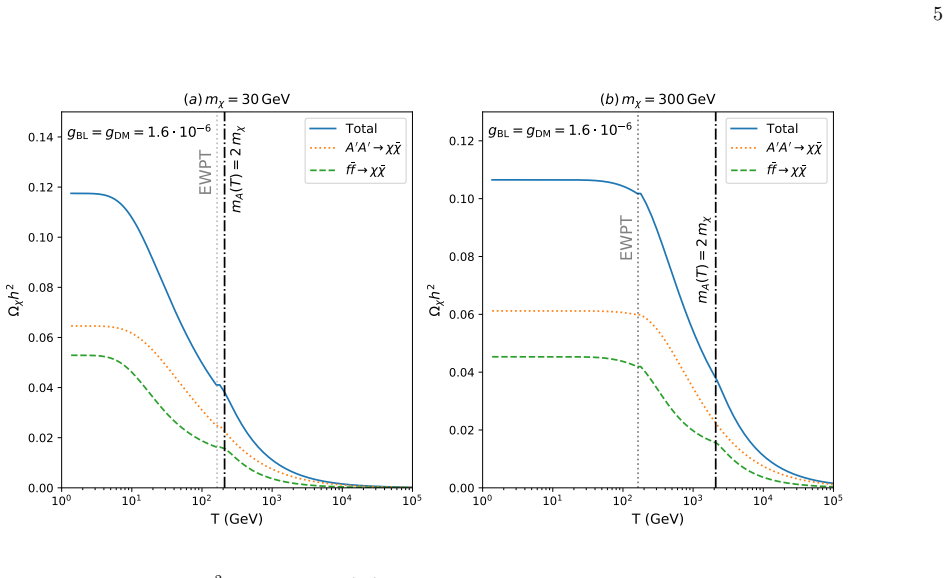
For a Dirac fermion dark matter candidate $\chi$ charged under $U(1)_{B-L}$ with mediator $A'$, the authors find that freeze-in production from a thermalized $A'$ bath gives a relic abundance $\Omega_\chi h^2 \approx (0.16 r^{-4} + 0.12 r^{-2})(g_{BL}/(2\times 10^{-6}))^4$, where $r = g_{BL}/g_{DM}$. The yield is almost independent of $m_\chi$ and independent of $m_{A'}$, so the relic-density requirement selects a narrow horizontal band in the $g_{BL}$--$m_{A'}$ plane, around $g_{BL} \sim 10^{-6}$ for $r$ of order unity. The calculation includes temperature-induced mixing between $A'$ and the SM hypercharge boson before electroweak symmetry breaking and with the photon afterward, and includes decays of the resulting plasmon mass eigenstates into $\chi\chi$ when kinematically open. Translating the relic abundance to direct detection, the authors find XENON1T excludes a noticeable region near $m_\chi = 30$ GeV for $r = 3$, with future experiments extending the reach.
Load-bearing premise
The central calculation assumes that the dark photon reaches thermal equilibrium with the Standard Model bath at temperatures near the dark matter mass, which requires $g_{BL} \gtrsim 10^{-7}$; if the coupling is below that or the interaction rate is overestimated, the $A'A' \to \chi\chi$ channel and the plasmon-decay contributions would be too large.
Editorial extensions
If this is right
- The relic-density target in the $g_{BL}$--$m_{A'}$ plane is an exactly horizontal band, independent of $m_{A'}$, for dark matter masses between about 1 GeV and 1 TeV.
- In the target region, $A'$ is long-lived enough to be searched for in fixed-target and beam-dump experiments such as SeaQuest, SHiP, FASER, and NA62.
- Direct-detection rates are enhanced whenever $m_{A'}$ is below about 16 MeV for a recoil threshold of 1.1 keV, so XENON1T already excludes $m_\chi$ around 30 GeV for $r = 3$, and LZ will extend the reach.
- For $r \gg 1$, the direct-detection cross-section and the relic abundance depend on the same combination $g_{BL}^2 g_{DM}^2$, so direct searches directly probe the freeze-in parameter space; for $r \ll 1$ the direct-detection rate is suppressed by $r^2$.
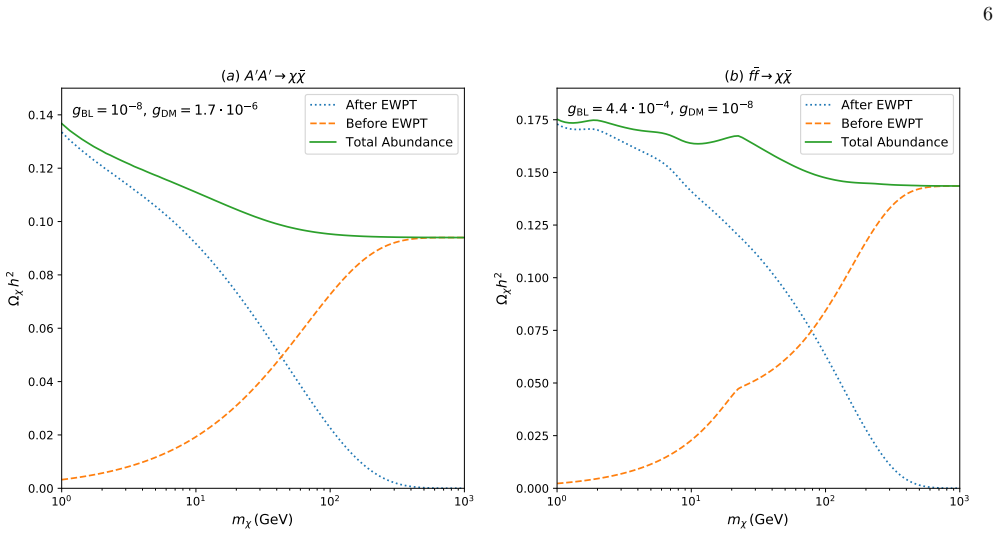
- Before the electroweak phase transition, hypercharge plasmon decays add a non-negligible production source, so the full thermal history must be split at $T_c = 164$ GeV.
Reading between the lines
- The same thermal-mixing framework could be applied to a scalar or Majorana dark matter candidate; the $A'A' \to \chi\chi$ channel would have different velocity and coupling factors, so the exact target band would shift by an order-one amount that this paper does not compute.
- For $g_{BL}$ between roughly $10^{-8}$ and $10^{-7}$, the assumed $A'$ thermalization becomes marginal; in that sub-range the freeze-in yield would be suppressed and the derived direct-detection constraints would not apply in their stated form.
- The horizontal target band suggests a model-independent experimental strategy: any experiment covering $g_{BL}$ near $10^{-6}$ for MeV-scale mediators tests freeze-in across a wide dark matter mass range, independent of the mediator mass.
- In $B-L$ extensions where right-handed neutrinos are lighter than $A'$, the $A'$ decays to neutrinos would shorten its lifetime and weaken fixed-target signals; the paper assumes heavy right-handed neutrinos and does not explore this branch.
Editorial analysis
A structured set of objections, weighed in public.
Referee Report
Summary. The paper studies freeze-in production of a Dirac fermion dark matter candidate in a U(1)_{B-L} gauge extension with a light new gauge boson A'. It assumes that A' thermalises with the Standard Model plasma for g_BL ≳ 10^-7, and includes the resulting production channels f fbar → χχ, A'A' → χχ, and plasmon / hypercharge-plasmon decays, accounting for temperature-induced mixing between A' and the SM hypercharge/photon before and after electroweak symmetry breaking. The relic abundance is computed with a modified version of micrOMEGAs 5 and summarised by the approximate formula Ωχ h^2 ≈ (0.16 r^-4 + 0.12 r^-2)(g_BL / 2×10^-6)^4, which is stated to be independent of mA' for mA' < 1 GeV and only weakly dependent on mχ. Matching to the Planck abundance gives g_BL around 10^-6 for r of order unity. The paper then uses DDCalc 2 and XENON1T data to derive direct-detection constraints, finding that XENON1T already excludes part of the parameter plane for mχ ≈ 30 GeV and r = 3, and compares these with accelerator and fixed-target constraints.
Significance. If the numerical implementation is confirmed, the paper provides a concrete and falsifiable freeze-in target in the (mA', g_BL) plane and demonstrates an interesting complementarity between direct detection and accelerator searches. The extension of the thermal-mixing and plasmon-decay formalism to temperatures above the electroweak phase transition is a useful step beyond previous work, and the use of the public DDCalc code for direct-detection bounds is a strength. The headline analytic formula Eq. (25), the approximate independence of the abundance on mA', and the explicit XENON1T exclusion regions are all testable statements that will be useful to the community. The main limitations are the unreleased modified micrOMEGAs implementation and the lack of an explicit validity range for the analytic fit, both of which currently prevent full independent verification.
major comments (3)
- [§III, Eq. (25) and Figs. 2–4] The central quantitative claim, that the freeze-in target is g_BL ≈ 2×10^-6 for r ≈ O(1), rests on the approximate formula Eq. (25), whose coefficients 0.16 and 0.12 are fitted to the authors' modified micrOMEGAs 5 implementation. The manuscript does not report the goodness of this fit, the residuals as a function of mχ and r, or the range of mA' over which the fit is valid, and the modified code is not made available. Because the relic-density target and all subsequent direct-detection constraints in Figs. 4–6 are built on this fit, I request that the authors either release the code, provide a benchmark table or plot comparing Eq. (25) with the full numerical solution over the parameter range r = 0.1–10, mχ = 1–1000 GeV and mA' = 1 MeV–100 GeV, or both. Without this, the accuracy of the headline coupling target cannot be independently assessed.
- [§III, first paragraph and Fig. 3(a)] The paper states that A' enters thermal equilibrium with the SM bath only for g_BL ≳ 10^-7, citing Ref. [11], yet the left panel of Fig. 3 uses g_BL = 10^-8 while assuming an equilibrium A' abundance for the A'A' → χχ channel. This is internally inconsistent. Either Fig. 3(a) is an extrapolation that should be labelled as such, or the Boltzmann calculation should solve for the A' abundance self-consistently in this regime. Relatedly, the r^-4 term in Eq. (25) relies on the equilibrium A' abundance; for r small enough that the required g_BL falls below 10^-7, this term will overestimate the yield. Please state explicitly the range of r, and hence g_BL, over which Eq. (25) is intended to apply.
- [§II.A, Eq. (7)] The temperature-induced mixing angle is computed with the perturbative expression θ = δm^2 / (m_A^2 - m_A'^2), which assumes that the mass splitting is large compared to δm^2. When mA' becomes comparable to the plasma frequency after EWSB, or to the hypercharge thermal mass before EWSB, the mixing is resonant and the two-state system must be diagonalised exactly. The numerical scan in Fig. 5 reaches mA' values up to O(100 GeV), so for mχ = 30 GeV there will be temperatures around T ~ mA'/g where such level crossings occur. Please demonstrate that the relic-density calculation, and therefore the derived direct-detection exclusions, are insensitive to this effect, or implement the full mass-matrix diagonalisation in the Boltzmann solver.
minor comments (5)
- [§III, near Fig. 2] The statement that freeze-in production is independent of mA' for mA' < 1 GeV is non-obvious; please give the physical reason (mA' much smaller than the relevant temperatures) and ideally show the numerical independence explicitly.
- [§II.A, Eq. (6)] Please define q'_eff explicitly, including color and generation factors, so that the signs and magnitudes in Table I are transparent to the reader.
- [Fig. 4 caption] The caption of the right panel should state the range of r and mχ used for the 'Freeze-in relic density target' band (presently 0.3 < r < 3 and 1 GeV < mχ < 1 TeV) directly in the caption, not only in the main text.
- [§III, first paragraph] The thermalisation condition g_BL ≳ 10^-7 is quoted from Ref. [11]; a short derivation or the relevant rate comparison would make the paper more self-contained.
- [§IV, Eq. (26)] The text uses 'g′ × gDM' loosely as an effective coupling; please define this combination explicitly and clarify how it is related to the coupling ratio r.
Circularity Check
No significant circularity; derivation is self-contained and benchmarked against external data.
full rationale
The paper's central claim is the relic abundance from freeze-in in a U(1)_{B-L} model with a thermalized dark photon. The relic abundance is obtained by solving the Boltzmann equation (Eq. 22) numerically with a modified micrOMEGAS 5 implementation, then matched to the externally measured Planck abundance [32]. The approximate expression Eq. (25) is explicitly presented as a fit to the authors' own numerical output, not as a first-principles prediction derived from inputs; using it to determine gBL is a parameter determination, not a circular step. The thermal-equilibrium premise for A' is supported by an external rate estimate [11], and the thermal mass-mixing formulas are cited from independent work [22,29]. Direct detection constraints use the independent XENON1T data [36] via DDCalc [35], and the scattering cross section (Eq. 26) follows from standard zero-temperature B-L couplings. The only self-citation, Ref. [30] used to justify distinguishing temperatures above and below the electroweak phase transition, is not load-bearing: the paper itself gives the mixing Lagrangian before and after EWSB and computes both regimes. No equation reduces to an input by construction, and no fitted parameter is renamed as a prediction. The calculation is self-contained against external benchmarks, so the circularity score is 0.
Assumptions & free parameters
free parameters (6)
- g_BL =
typically ~1e-6, fixed by Ωχh^2 = 0.12 for r ~ 1
- g_DM =
~1e-6 in the A'A'-dominated regime
- r = g_BL/g_DM =
scanned over 0.1 to 3
- mχ =
scanned 1 GeV to 1 TeV
- mA' =
scanned MeV to GeV
- analytic coefficients 0.16, 0.12 in Eq. (25) =
0.16, 0.12
assumptions (8)
- standard math Standard freeze-in Boltzmann equation with FRW cosmology
- domain assumption A' thermalizes with the SM bath for g_BL > 1e-7
- domain assumption Dark matter never enters thermal equilibrium
- domain assumption Finite-temperature gauge-boson mass and mixing formulas from Refs. [22,29]
- standard math No W3-A' mixing before EWSB
- domain assumption Three heavy right-handed neutrinos cancel anomalies and decouple
- domain assumption mA' > few MeV to satisfy BBN constraints
- domain assumption Running of g_Y with temperature is negligible
Cite this review
Pith. "Pith review of Probing the freeze-in mechanism in dark matter models with $U(1)^\prime$ gauge extensions." pith.science (2026). https://pith.science/paper/CZFYQW3A
@misc{pith2026190809834,
  author       = {Pith},
  title        = {Pith review of: Probing the freeze-in mechanism in dark matter models with $U(1)^\prime$ gauge extensions},
  year         = {2026},
  howpublished = {\url{https://pith.science/paper/CZFYQW3A}},
  note         = {Machine review of arXiv:1908.09834}
}
abstract
New gauge bosons at the MeV scale with tiny gauge couplings (so-called dark photons) can be responsible for the freeze-in production of dark matter and provide a clear target for present and future experiments. We study the effects of thermal mixing between dark photons and Standard Model gauge bosons and of the resulting plasmon decays on dark matter production before and after the electroweak phase transition. In the parameter regions preferred by the observed dark matter relic abundance, the dark photon is sufficiently long-lived to be probed with fixed-target experiments and light enough to induce direct detection signals. Indeed, current limits from XENON1T already constrain Dirac fermion dark matter in the GeV to TeV range produced via the freeze-in mechanism. We illustrate our findings for the case of a $U(1)_{B-L}$ gauge extension and discuss possible generalisations.
Figures

Figures from the paper (3 more)


Forward citations
Cited by 3 Pith papers
-
Probing Dark Matter freeze-in with long-lived particle signatures: MATHUSLA, HL-LHC and FCC-hh
Projected MATHUSLA, HL-LHC, and FCC-hh forward detector sensitivities probe Higgs-mediated freeze-in dark matter across parent masses up to about 10 TeV.
-
Dark Matter Constraints on Low Mass and Weakly Coupled B-L Gauge Boson
In a U(1)_{B-L} model with a Dirac singlet dark matter fermion, relic abundance constraints fix combinations of the dark matter and gauge couplings, and freeze-in scenarios leave parameter space that FASER, Belle II, ...
-
Searching for a light $Z'$ through Higgs production at the LHC
Existing LHC dilepton and four-lepton searches, reinterpreted for the minimal U(1)_{B-L} model, exclude gauge couplings down to about 5x10^-6 for a 0.25 GeV Z-prime at maximal Higgs mixing.
Reference graph
Works this paper leans on
- [11]
-
[1]
L. J. Hall, K. Jedamzik, J. March-Russell, and S. M. West, JHEP 03, 080 (2010), arXiv:0911.1120 [hep-ph]
arXiv 2010
-
[2]
Particle Physics Phenomenology after the Higgs Discovery
+ 2× 1 4 = 11 2 and (for a B−L gauge boson) q′ eff = 4. The thermal mass of the hypercharge gauge boson be- fore EWSB is then given by m2 Y =qeff g2 Y T 2 9 = 11 2 g2 YT 2 9 , (12) 4 f f χ χ γ/A′ A′ A′ χ χ FIG. 1. Production channels for freeze-in. Left: production from the annihilation of SM fermions f and ¯f. Right: production from the annihilation of dar...
-
[3]
X. Chu, T. Hambye, and M. H. G. Tytgat, JCAP 1205, 034 (2012), arXiv:1112.0493 [hep-ph]
arXiv 2012
-
[4]
X. Chu, Y. Mambrini, J. Quevillon, and B. Zaldivar, JCAP 1401, 034 (2014), arXiv:1306.4677 [hep-ph]
arXiv 2014
- [5]
- [6]
- [7]
Show all 39 references
-
[8]
Battaglieri et al
M. Battaglieri et al. , in U.S. Cosmic Visions: New Ideas in Dark Matter (2017) arXiv:1707.04591 [hep-ph]
2017 arXiv
-
[9]
Hambye, M
T. Hambye, M. H. G. Tytgat, J. Vandecasteele, and L. Vanderheyden, Phys. Rev. D98, 075017 (2018), arXiv:1807.05022 [hep-ph]
2018 arXiv
-
[10]
Knapen, T
S. Knapen, T. Lin, and K. M. Zurek, Phys. Rev. D96, 115021 (2017), arXiv:1709.07882 [hep-ph]
2017 arXiv
-
[12]
J. A. Evans, S. Gori, and J. Shelton, JHEP 02, 100 (2018), arXiv:1712.03974 [hep-ph]
2018 arXiv
-
[13]
R. H. Cyburt, B. D. Fields, K. A. Olive, and T.-H. Yeh, Rev. Mod. Phys. 88, 015004 (2016), arXiv:1505.01076 [astro-ph.CO]
2016 arXiv
-
[14]
Hufnagel, K
M. Hufnagel, K. Schmidt-Hoberg, and S. Wild, JCAP 1811, 032 (2018), arXiv:1808.09324 [hep-ph]. 10
2018 arXiv
- [15]
-
[16]
Berlin, S
A. Berlin, S. Gori, P. Schuster, and N. Toro, Phys. Rev. D98, 035011 (2018), arXiv:1804.00661 [hep-ph]
2018 arXiv
-
[17]
Alekhin et al
S. Alekhin et al. , Rept. Prog. Phys. 79, 124201 (2016), arXiv:1504.04855 [hep-ph]
2016 arXiv
-
[18]
J. L. Feng, I. Galon, F. Kling, and S. Trojanowski, Phys. Rev. D97, 035001 (2018), arXiv:1708.09389 [hep-ph]
2018 arXiv
-
[19]
Bauer, P
M. Bauer, P. Foldenauer, and J. Jaeckel, JHEP 07, 094 (2018), arXiv:1803.05466 [hep-ph]
2018 arXiv
- [20]
-
[21]
Fornengo, P
N. Fornengo, P. Panci, and M. Regis, Phys. Rev. D84, 115002 (2011), arXiv:1108.4661 [hep-ph]
2011 arXiv
-
[22]
Kahlhoefer, S
F. Kahlhoefer, S. Kulkarni, and S. Wild, JCAP 1711, 016 (2017), arXiv:1707.08571 [hep-ph]
2017 arXiv
-
[23]
Comelli and J
D. Comelli and J. R. Espinosa, Phys. Rev. D55, 6253 (1997), arXiv:hep-ph/9606438 [hep-ph]
1997 arXiv
-
[24]
H. An, R. Huo, and W. Liu, (2018), arXiv:1812.05699 [hep-ph]
2018 arXiv
-
[25]
Dvorkin, T
C. Dvorkin, T. Lin, and K. Schutz, Phys. Rev. D99, 115009 (2019), arXiv:1902.08623 [hep-ph]
2019 arXiv
-
[26]
Biswas and A
A. Biswas and A. Gupta, JCAP 1609, 044 (2016), [Ad- dendum: JCAP1705,no.05,A01(2017)], arXiv:1607.01469 [hep-ph]
2016 arXiv
-
[27]
Braaten and D
E. Braaten and D. Segel, Phys. Rev. D48, 1478 (1993), arXiv:hep-ph/9302213 [hep-ph]
1993 arXiv
-
[28]
G. G. Raffelt, Stars as laboratories for fundamental physics (1996)
1996
-
[29]
V. S. Rychkov and A. Strumia, Phys. Rev. D75, 075011 (2007), arXiv:hep-ph/0701104 [hep-ph]
2007 arXiv
-
[30]
Elmfors, K
P. Elmfors, K. Enqvist, and I. Vilja, Nucl. Phys. B412, 459 (1994), arXiv:hep-ph/9307210 [hep-ph]
1994 arXiv
-
[31]
Heeba, F
S. Heeba, F. Kahlhoefer, and P. St¨ ocker, JCAP 1811, 048 (2018), arXiv:1809.04849 [hep-ph]
2018 arXiv
-
[32]
B´ elanger, F
G. B´ elanger, F. Boudjema, A. Goudelis, A. Pukhov, and B. Zaldivar, Comput. Phys. Commun. 231, 173 (2018), arXiv:1801.03509 [hep-ph]
2018 arXiv
- [33]
-
[34]
Deniz et al
M. Deniz et al. (TEXONO), Phys. Rev. D81, 072001 (2010), arXiv:0911.1597 [hep-ex]
2010 arXiv
-
[35]
Bilmis, I
S. Bilmis, I. Turan, T. M. Aliev, M. Deniz, L. Singh, and H. T. Wong, Phys. Rev. D92, 033009 (2015), arXiv:1502.07763 [hep-ph]
2015 arXiv
-
[36]
Athron et al
P. Athron et al. (GAMBIT), Eur. Phys. J. C79, 38 (2019), arXiv:1808.10465 [hep-ph]
2019 arXiv
-
[37]
Aprile et al
E. Aprile et al. (XENON), Phys. Rev. Lett. 121, 111302 (2018), arXiv:1805.12562 [astro-ph.CO]
2018 arXiv
-
[38]
D. S. Akerib et al. (LUX-ZEPLIN), (2018), arXiv:1802.06039 [astro-ph.IM]
2018 arXiv
- [39]
Reviewed August 14, 2026 · model on record in the stance chip above.
Discussion (0). Continue with ORCID to comment.