REVIEW 4 major objections 6 minor 87 references
Magic-Angle Semimetals with Chiral Symmetry
T0 review · 4 major / 6 minor · reviewed 2026-08-14 · deepseek-v4-flash
Pith's one-line read Quasiperiodic, chirally symmetric hopping on a square lattice turns a Dirac semimetal into a flat-band metal at a critical hopping strength and, at maximum hopping, into a disorder-free critical phase with a diverging density of states…
desk verdict Solid, honest extension of magic-angle semimetals to chiral symmetry; the W=1 diverging DOS is interesting but not yet proven. read the letter →
The pith
A machine-rendered reading of the paper's core claim, the machinery that carries it, and where it could break.
The reading
What carries the argument
The load-bearing analytic object is a continuum low-energy Hamiltonian in which the quasiperiodic hopping enters as two incommensurate 'Higgs' mass fields $V(x)$ and $V(y)$ coupling two Dirac fermions; because the coupling matrices form a Clifford algebra, exact zero-mode bound states can be written down analytically, with decay lengths set by $(v_0/(q V))^{1/2}$. The paper combines this with kernel-polynomial-method computations of the density of states, a momentum-space multifractal analysis that diagnoses the 'unfreezing' of wavefunctions, and wavepacket dynamics for transport.
What would settle it
At $W=1$, compute the low-energy density of states exactly (for example with sparse shift-invert diagonalization) at system sizes beyond $L = 987$; if the apparent $|E|^{-0.32}$ divergence flattens or the exponent drifts systematically with $L$, the claim fails. Independently, count the zero-energy eigenstates of the pure quasiperiodic hopping matrix: the paper's picture predicts an extensive number of zero modes (a kernel growing linearly with area), whereas a non-extensive kernel would contradict the diverging-density-of-states mechanism.
Extended reading notes
Core claim
The central discovery is that the phase diagram at the Dirac node energy contains a semimetal-to-metal transition at $W_c = 0.485 \pm 0.005$ (for $Q = 2\pi F_{n-2}/F_n$) where the density-of-states slope diverges as $\rho'(0) \sim (W_c - W)^{-2}$ and the Dirac velocity vanishes linearly, $v \sim (W_c - W)$. At that point the low-energy miniband width is renormalized by roughly $10^{-8}$, and the zero-energy eigenstates delocalize in momentum space while remaining extended in real space. At maximal quasiperiodic hopping, $W = 1$, the paper reports a low-energy density of states diverging as $\rho(E) \sim |E|^{-0.32}$, giving a dynamical exponent $z \approx 3$, and a two-wavefunction correlation following Chalker scaling $C(E) \sim E^{-0.48}$ even though the model is deterministic. The paper also reports that commensurate values of $Q$ realize higher-order topological insulator phases, and that the chiral metal phase shows no reentrant semimetal, in contrast to the quasiperiodic-potential analogue.
Load-bearing premise
The conclusion of a diverging density of states and Chalker scaling at $W=1$ rests on treating the KPM expansion order $N_C$ as a true low-energy cutoff, so that the fitted exponents $x_{QP} \approx 0.32$ and $\mu \approx 0.48$ persist in the thermodynamic limit.
Editorial extensions
If this is right
- At the magic-angle transition the model produces essentially flat bands (width renormalized by about $10^{-8}$), making short-range interactions strongly relevant; this is presented as a stepping stone to correlated phases without the geometric complications of twisted bilayer graphene.
- In the pure quasiperiodic limit the low-energy states remain delocalized and critical, with $z \approx 3$, so transport is sub-diffusive even though no disorder is present.
- The observed Chalker scaling $C(E) \sim E^{-0.48}$ indicates multifractal enhancement of interactions, potentially stabilizing correlation-driven phases at $W = 1$.
- Because the metal is stabilized by topological zero modes, the model does not return to a semimetal at large $W$, in contrast to quasiperiodic-potential and complex-hopping models.
- Commensurate limits are higher-order topological insulators with corner modes, so tuning $Q$ interpolates between a topological band insulator and a chiral metal.
Reading between the lines
- If the exponent $0.32$ for the density-of-states divergence is confirmed at larger sizes, quasiperiodicity would reproduce the random chiral-class divergence despite having no rare regions, implying that the local single-bond hopping distribution, not disorder correlations, controls the universal low-energy singularity.
- The 'lines of vanishing hopping' mechanism is proposed but not proven; a direct finite-size computation of the kernel of the $W=1$ hopping matrix would settle whether the zero-mode count follows the sublattice imbalance $N_A - N_B$ as suggested.
- The Clifford-algebra zero-mode construction is not limited to two dimensions; applying the same construction to three-dimensional Weyl semimetals or staggered chiral lattices would test whether the magic-angle transition's universality is set by symmetry class alone.
- It remains open whether the $W=1$ phase is a true quantum critical point or a finite critical phase; the data suggest any finite bare hopping ($W<1$) removes the divergence, but the crossover regime near $W \approx 0.95$ is not fully resolved.
Signed reviews
Editorial analysis
A structured set of objections, weighed in public.
Referee Report
Summary. The manuscript studies a two-dimensional lattice model of Dirac semimetals with a chirally symmetric quasiperiodic hopping term, parameterized so that the clean Hamiltonian is recovered at W=0 and the purely quasiperiodic model at W=1. The central claims are: (i) the semimetal survives up to a critical quasiperiodic strength Wc=0.485±0.005, where the Dirac velocity vanishes and the system enters a chiral metallic phase; (ii) this transition coincides with a momentum-space delocalization or "unfreezing" of zero-energy wavefunctions; (iii) at W=1 the low-energy density of states diverges as ρ(E)∼|E|^{-0.32}, the wavefunctions exhibit Chalker scaling C(E)∼E^{-0.48}, and transport is sub-diffusive; and (iv) the chiral metal is qualitatively described by topological zero modes of an effective continuum Dirac theory. The paper combines kernel-polynomial-method (KPM) numerics, exact diagonalization, wavepacket dynamics, and perturbative continuum calculations. The semimetal-to-metal transition is supported by multiple independent diagnostics, including the NC scaling of ρ(0), the momentum-space IPR, the velocity exponent β=2±0.2, and twist-dispersion flat bands.
Significance. If the main claims hold, this is a substantial contribution: it identifies a deterministic, disorder-free analogue of chiral-class low-energy singularities and provides a tunable model for magic-angle-type flat bands in a setting accessible to cold-atom and metamaterial experiments. The paper's treatment of the semimetal-to-metal transition is particularly strong: Eq. (16) is a parameter-free second-order perturbative prediction that is compared with, not fitted to, the numerical Wc, and the transition is established through mutually consistent DOS, IPR, velocity, and dispersion diagnostics. The W=1 divergence and Chalker scaling are the most novel and most consequential claims; they are currently supported mainly by KPM cutoff scaling and by one correlation-function dataset, with the microscopic mechanism left unproven. The absence of documented reproducibility artifacts and the explicit discussion of limitations are commendable, but the strength of the W=1 claims needs additional numerical and analytical support before they can be regarded as established.
major comments (4)
- [Sec. IV B 1, Eq. (20), Fig. 14] The diverging-DOS claim rests entirely on the KPM cutoff scaling ρ(0)∼NC^{xQP} with xQP≈0.32, obtained at L=987 (or L=610) for two rational approximants and for one random comparison. The KPM broadening width δE=πD/NC is an energy cutoff only in an approximate sense, and a smooth spectrum with a narrow but non-divergent low-energy feature can produce a nearly power-law ρ(0) versus NC over the accessible range. An independent check is needed: for example, exact or Lanczos eigenvalues for L=144, 233, 377, 610 should be used to compute the low-energy DOS directly, to test whether the number of states per energy window grows with system size as expected for a true divergence, and to compare with the KPM extrapolation. Without such a check, the claim that ρ(E) diverges as |E|^{-0.32} in the thermodynamic limit is not yet load-bearing.
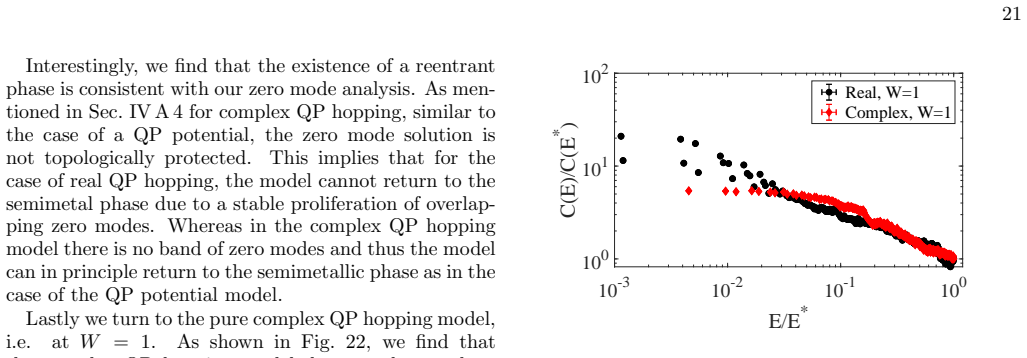
- [Sec. IV B 2, Eq. (12), Fig. 18] The Chalker-scaling claim C(E)∼E^{-0.48} is based on a single system size L=144, a single value of Q, and 300 states per realization. There is no finite-size scaling, no second quasiperiodic wavevector, and no test for whether the power-law window grows with L. Given that the exponent is extracted over about two decades and that the companion W=0.99 curve shows no power law, this is too fragile to support the abstract's claim of Chalker scaling. The authors should provide L dependence (e.g., L=233 and 377) and ideally a collapse or a demonstration that the exponent is stable, or explicitly soften the claim to "power-law-like correlations at accessible sizes."
- [Sec. VI, Fig. 20] The proposed mechanism for the diverging DOS—an extensive kernel of zero modes caused by lines of vanishing hopping—is explicitly left unproven, and the paper says the origin is left to future work. More importantly, the finite samples actually simulated do not have literally vanishing bonds; the QP hopping amplitudes are generically nonzero, so the disconnected-subregion picture of Fig. 20 does not apply directly to the numerics. The 'nearly zero' lines create weakly coupled clusters, and the KPM-smeared spectrum of such clusters could mimic a power law. To make the mechanism load-bearing, the authors need to quantify the imbalance NA−NB in the actual samples, show that the exact low-energy kernel scales extensively with L, and connect that kernel count to the DOS exponent, or else present the mechanism as a heuristic.
- [Sec. IV A 4, Eq. (19), Fig. 11 caption] The analytical zero-mode theory is used to characterize the chiral metal, but the Fig. 11 caption states that the analytical treatment overestimates the transition position by a factor of 2, and the estimate Wc(0 modes) contains an unspecified constant. This means the continuum theory with only the V1 and V4 harmonics is not currently a quantitative predictor of Wc. The authors should either provide a systematic derivation of the missing constant and the truncation criterion, or explicitly label the zero-mode construction as a qualitative picture that does not determine Wc. As written, the comparison of Eq. (19) with numerics is suggestive but not conclusive, and the overestimate should be discussed in the main text rather than only in a figure caption.
minor comments (6)
- [Sec. IV A 2, Fig. 5] The label "DDOS" in the sentence preceding Fig. 5 appears to be a typo; it should read "DOS."
- [Sec. III A, Eq. (7)] The notation for the dynamic exponent z is used with two different conventions later (via ρ(0)∼NC^{1-d/z} and via wavepacket spreading), and the tilde for the energy-averaged exponent is introduced only in Sec. III C. It would help to define both z and z-tilde in one place near Eq. (7) and to state explicitly that the two are not expected to be equal.
- [Sec. IV B 2, Fig. 16] The color and symbol definitions in Fig. 16 (blue vs red dots) are given only in the caption; the figure itself has no legend, which makes it hard to associate the binned and unbinned data in the printed figure.
- [Sec. II A] The choice of Fibonacci numbers L=Fn and Q=2πFn−2/L is stated, but the paper does not specify which Fibonacci indexing convention is used (e.g., F_1=F_2=1 or F_0=F_1=1); this ambiguity affects the meaning of Q in the finite-size approximants.
- [Sec. IV B 1, Fig. 14] The power-law fits for xQP and xR are shown as red dashed lines, but the fit range and the number of points used in each fit are not reported; adding these details would allow the reader to assess the stability of the exponents.
- [Appendix A, Fig. 22] The comparison with the complex random model would be more informative if the authors stated whether the quoted yR≈0.17 is obtained with the same Jackson-kernel broadening and system-size choices as the real random model; minor inconsistencies in numerical protocols are easy to overlook.
Circularity Check
No circularity found: the magic-angle condition and zero-mode wavefunctions are parameter-free analytic results compared with, not fitted to, numerics, and the W=1 exponents are fits reported as evidence rather than predictions of fitted inputs.
full rationale
The paper's derivation chain is self-contained. The magic-angle condition v=0 in Eq. (16) follows from a second-order perturbative self-energy calculation in Appendix B1 with no free parameters; it is compared with the numerically determined W_c=0.485±0.005 (Fig. 4), and where it deviates the disagreement is stated (Figs. 3 and 11 caption). The topological zero-mode wavefunctions in Eq. (19) are derived from an explicit continuum Dirac reduction with stated leading harmonics V1 and V4; the analytic treatment is admitted to overestimate the transition by a factor of two in the Fig. 11 caption, so it is not tuned to the data. The W=1 diverging-DOS exponent x_QP≈0.32 and Chalker exponent μ≈0.48 are obtained by fitting KPM and eigenfunction data (Figs. 14 and 18) and are presented as numerical evidence, not as predictions of separately fitted parameters. The relation ρ(0)~(NC)^{x_QP} is an ansatz motivated by KPM broadening; the paper explicitly leaves the microscopic origin of the zero-mode pile-up to future work (Sec. VI, Fig. 20), which is a completeness and robustness caveat, not a circular step. Self-citations to Refs. [27,28] supply the conceptual framework (magic-angle semimetals, momentum-space delocalization, unfreezing) and comparison exponents, but the new model's phase diagram, DOS, multifractal spectra, and wavepacket dynamics are computed in this paper. No equation reduces to its own input by construction, and no fitted parameter is relabeled as a prediction.
Assumptions & free parameters
free parameters (1)
- const. in zero-mode stability estimate
assumptions (8)
- standard math Two-copy decomposition into pi-flux models: the single-particle Hamiltonian is a direct sum of two pi-flux models (Sec. II, Eq. 2).
- domain assumption Quasiperiodic systems have no rare regions.
- domain assumption Fibonacci rational approximates Q_L = 2pi F_n-2/F_n represent the incommensurate Q in the thermodynamic limit.
- domain assumption Continuum Dirac approximation with only leading harmonics V1 and V4 (Eq. 18) captures the low-energy physics.
- domain assumption Second-order perturbation theory, integrating out 2Q and 3Q processes, determines the velocity renormalization (Eq. 16).
- domain assumption KPM expansion order NC acts as a controlled low-energy cutoff for the DOS via rho(0) ~ NC^x (Eq. 20).
- standard math Poor-man's index theorem: sublattice imbalance in disconnected subregions yields zero modes.
- domain assumption Chalker scaling relation mu = [d - tau_R(2)]/z.
Cite this review
Pith. "Pith review of Magic-Angle Semimetals with Chiral Symmetry." pith.science (2026). https://pith.science/paper/3HB7B2NC
@misc{pith2026190809837,
  author       = {Pith},
  title        = {Pith review of: Magic-Angle Semimetals with Chiral Symmetry},
  year         = {2026},
  howpublished = {\url{https://pith.science/paper/3HB7B2NC}},
  note         = {Machine review of arXiv:1908.09837}
}
read the original abstract
We construct and solve a two-dimensional, chirally symmetric model of Dirac cones subjected to a quasiperiodic modulation. In real space, this is realized with a quasiperiodic hopping term. This hopping model, as we show, at the Dirac node energy has a rich phase diagram with a semimetal-to-metal phase transition at intermediate amplitude of the quasiperiodic modulation, and a transition to a phase with a diverging density of states and sub-diffusive transport when the quasiperiodic hopping is strongest. We further demonstrate that the semimetal-to-metal phase transition can be characterized by the multifractal structure of eigenstates in momentum space and can be considered as a unique "unfreezing" transition. This unfreezing transition in momentum space generates flat bands with a dramatically renormalized bandwidth in the metallic phase similar to the phenomena of the band structure of twisted bilayer graphene at the magic angle. We characterize the nature of this transition numerically as well as analytically in terms of the formation of a band of topological zero modes. For pure quasiperiodic hopping, we provide strong numerical evidence that the low-energy density of states develops a divergence and the eigenstates exhibit Chalker (quantum-critical) scaling despite the model not being random. At particular commensurate limits the model realizes higher-order topological insulating phases. We discuss how these systems can be realized in experiments on ultracold atoms and metamaterials.
Figures


Figures from the paper (20 more)






Reference graph
Works this paper leans on
-
[1]
twisting
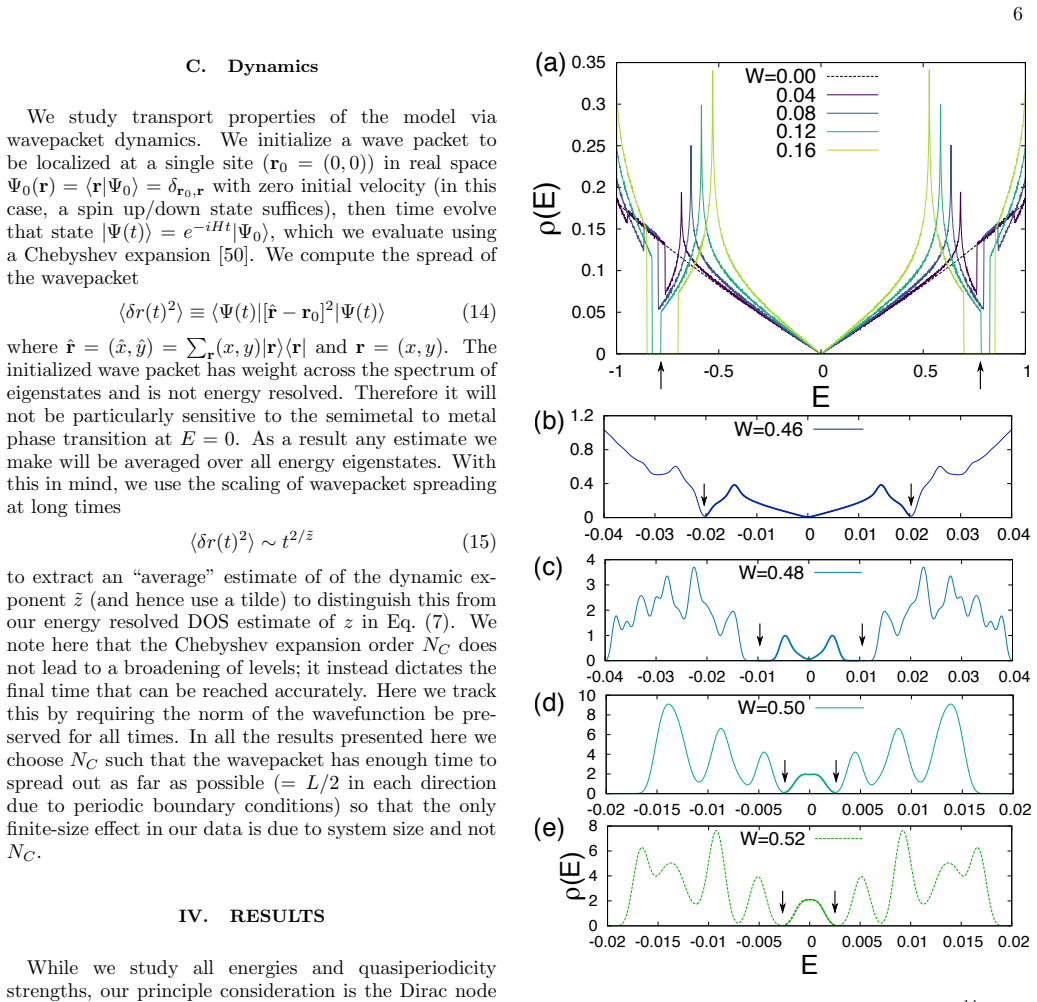
Formation of the Miniband(s) Introducing a weak QP hopping with Q close to π, creates dominant internode scattering that transfers mo- mentum QL and mixes degenerate states of equivalent 0 0.05 0.1 0.15 0.2 0.25 0.3 0.35 -1 -0.5 0 0.5 1 ρ(E) E (a) W=0.00 0.04 0.08 0.12 0.16 0 1 2 3 4 -0.04 -0.03 -0.02 -0.01 0 0.01 0.02 0.03 0.04 W=0.48 0 2 4 6 8 10 -0.02 ...
-
[2]
The semimetal is defined as having zero DOS at E = 0, and we find this is stable over a finite range of W (as shown in Figs
Density of states and velocity renormalization We first focus on the low-energy DOS at weak QP hop- ping strength. The semimetal is defined as having zero DOS at E = 0, and we find this is stable over a finite range of W (as shown in Figs. 1, 3, and 4). This can be seen clearly from the scaling of the zero-energy DOS with the KPM expansion order; in the semim...
-
[3]
ballistic peaks
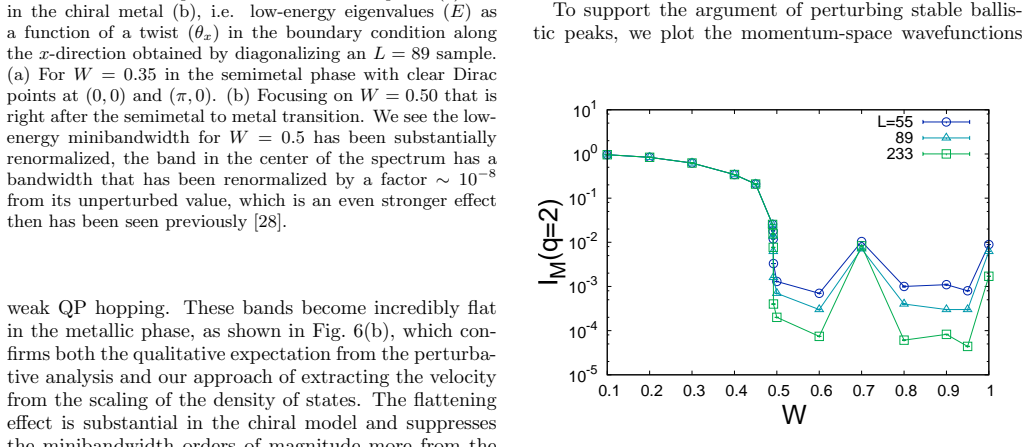
Wavefunction delocalization in momentum space We now connect the structure of the eigenvalues that we have probed through the DOS with the structure of the wavefunction. A complementary way to under- stand the transition is to study how the zero-energy plane-wave eigenstates are perturbed by the QP hop- ping. For the case of two-dimensional/three-dimensio...
-
[4]
magic- angle
A theory for the chiral metal phase in terms of topological zero modes For W > Wc(Q), we have seen how the low-energy eigenstates delocalize in momentum space, which induces well-defined patterns in the real-space structure of the wavefunction (see Fig. 11). There are a few key fea- tures that are unique to this chiral model and were not observed for a QP ...
-
[5]
Real-space Anderson localization and structure of the mobility edges Real-space Anderson localization in disordered systems of orthogonal and unitary chiral classes are special, be- cause the zero energy state is robust against localiza- tion [12, 14, 63], and tend to form a line of critical fixed points between Anderson localized states at finite en- ergy ...
-
[6]
Any low-energy divergence in the DOS will be rounded out to due the extrinsic effects of finite system size and KPM expansion order
Diverging low-energy density of states Focusing on the pure QP limitW = 1, we compute the DOS using KPM on very large system sizes ( L = 987) such that any low-energy divergence of the DOS is not affected by the mean level spacing on finite size systems. Any low-energy divergence in the DOS will be rounded out to due the extrinsic effects of finite system siz...
-
[7]
As plotted in Fig
Real-space wavefunctions at W = 1 Here, we focus on the pure QP hopping case ( W = 1). As plotted in Fig. 12(f), both low ( |E|≪ 1) and finite energy (|E|≈ 2.2− 2.5) delocalized states still appear in the pure QP hopping limit. This is very different from the expectation from the disordered problem where all finite- energy states are localized. Therefore, it...
-
[8]
Wavepacket Dynamics Lastly, we now study the wavepacket dynamics in the QP hopping model using an expansion of the time evo- lution operator in terms of Chebyshev polynomials. We are interested in the spread of the wavepacket⟨δr(t)2⟩ in the long-time limit, see Eq. (14). We initialize the state in an up-spin state localized to one lattice site. Then, 10-3...
Show all 87 references
-
[9]
The perturbative calculation of the self energy near the Γ point leads to Σ≃ W 2 J2 0 [ − E 2[1 + cos(Q)]−J0/p1 + 2 sec(Q/2) 2 ]
Perturbative Velocity Renormalization To second order in perturbation theory, it is sufficient to consider the truncated effective Hamiltonian Heff = h0 Wx,+ Wx,− Wy,+ Wy,− Wx,+ hx,+ 0 0 0 Wx,− 0 hx,− 0 0 Wy,+ 0 0 hy,+ 0 Wy,− 0 0 0 hy,− (B1) We introduced the notatio...
-
[10]
Here we map the problem to the dominant low-energy physics near the Dirac nodes
Topological bound states in the effective low-energy theory. Here we map the problem to the dominant low-energy physics near the Dirac nodes. The translationally invari- ant Hamiltonian may be expanded and, in first quanti- zation, takes the form H0 = v0/p 0 0 0 0 −v0/p 0 ...
-
[11]
Sachdev, Quantum phase transitions (Wiley Online Library, 2007)
S. Sachdev, Quantum phase transitions (Wiley Online Library, 2007)
2007
-
[12]
Goldenfeld, Lectures on phase transitions and the renormalization group (Addison-Wesley, Advanced Book Program, Reading, 1992)
N. Goldenfeld, Lectures on phase transitions and the renormalization group (Addison-Wesley, Advanced Book Program, Reading, 1992)
1992
-
[13]
P. W. Anderson, Phys. Rev. 109, 1492 (1958)
1958
-
[14]
Abrahams, P
E. Abrahams, P. W. Anderson, D. C. Licciardello, and T. V. Ramakrishnan, Phys. Rev. Lett. 42, 673 (1979)
1979
-
[15]
P. A. Lee and T. V. Ramakrishnan, Rev. Mod. Phys. 57, 287 (1985)
1985
-
[16]
Evers and A
F. Evers and A. D. Mirlin, Rev. Mod. Phys. 80, 1355 (2008)
2008
-
[17]
Basko, I
D. Basko, I. Aleiner, and B. Altshuler, Annals of Physics 321, 1126 (2006)
2006
-
[18]
I. V. Gornyi, A. D. Mirlin, and D. G. Polyakov, Phys. Rev. Lett. 95, 206603 (2005)
2005
-
[19]
Nandkishore and D
R. Nandkishore and D. A. Huse, Annual Review of Con- densed Matter Physics 6, 15 (2015)
2015
-
[20]
D. A. Abanin, E. Altman, I. Bloch, and M. Serbyn, Rev. Mod. Phys. 91, 021001 (2019)
2019
-
[21]
F. J. Dyson, Phys. Rev. 92, 1331 (1953)
1953
-
[22]
Gade and F
R. Gade and F. Wegner, Nucl. Phys. B 360, 213 (1991)
1991
-
[23]
Gade, Nucl
R. Gade, Nucl. Phys. B 398, 499 (1993)
1993
-
[24]
Motrunich, K
O. Motrunich, K. Damle, and D. A. Huse, Phys. Rev. B 65, 064206 (2002)
2002
-
[25]
Mudry, S
C. Mudry, S. Ryu, and A. Furusaki, Phys. Rev. B 67, 064202 (2003)
2003
-
[26]
H¨ afner, J
V. H¨ afner, J. Schindler, N. Weik, T. Mayer, S. Balakr- ishnan, R. Narayanan, S. Bera, and F. Evers, Physical review letters 113, 186802 (2014)
2014
-
[27]
P. M. Ostrovsky, I. V. Protopopov, E. J. K¨ onig, I. V. Gornyi, A. D. Mirlin, and M. A. Skvortsov, Phys. Rev. Lett. 113, 186803 (2014)
2014
-
[28]
Ferreira and E
A. Ferreira and E. R. Mucciolo, Physical review letters 115, 106601 (2015)
2015
-
[29]
N. Weik, J. Schindler, S. Bera, G. C. Solomon, and F. Evers, Physical Review B 94, 064204 (2016)
2016
-
[30]
Sanyal, K
S. Sanyal, K. Damle, and O. I. Motrunich, Phys. Rev. Lett. 117, 116806 (2016)
2016
-
[31]
I. L. Aleiner and K. B. Efetov, Phys. Rev. Lett. 97, 24 236801 (2006)
2006
-
[32]
Altland, Phys
A. Altland, Phys. Rev. Lett. 97, 236802 (2006)
2006
-
[33]
J. H. Pixley, D. A. Huse, and S. Das Sarma, Phys. Rev. X 6, 021042 (2016)
2016
-
[34]
J. H. Pixley, D. A. Huse, and S. Das Sarma, Phys. Rev. B 94, 121107 (2016)
2016
-
[35]
J. H. Pixley, Y.-Z. Chou, P. Goswami, D. A. Huse, R. Nandkishore, L. Radzihovsky, and S. Das Sarma, Phys. Rev. B 95, 235101 (2017)
2017
-
[36]
J. H. Wilson, J. H. Pixley, P. Goswami, and S. Das Sarma, Phys. Rev. B 95, 155122 (2017)
2017
-
[37]
J. H. Pixley, J. H. Wilson, D. A. Huse, and S. Gopalakr- ishnan, Phys. Rev. Lett. 120, 207604 (2018)
2018
-
[38]
Y. Fu, E. K¨ onig, J. Wilson, Y.-Z. Chou, and J. Pixley, arXiv preprint arXiv:1809.04604 (2018)
2018 arXiv
-
[39]
Mastropietro, arXiv preprint arXiv:2003.01499 (2020)
V. Mastropietro, arXiv preprint arXiv:2003.01499 (2020)
2020 arXiv
-
[40]
G. Li, A. Luican, J. M. B. Lopes dos Santos, A. H. Cas- tro Neto, A. Reina, J. Kong, and E. Y. Andrei, Nature Physics 6, 109 (2010)
2010
-
[41]
Bistritzer and A
R. Bistritzer and A. H. MacDonald, Proceedings of the National Academy of Sciences 108, 12233 (2011)
2011
-
[42]
J. L. dos Santos, N. Peres, and A. C. Neto, Phys. Rev. B 86, 155449 (2012)
2012
-
[43]
Tarruell, D
L. Tarruell, D. Greif, T. Uehlinger, G. Jotzu, and T. Esslinger, Nature 483, 302 (2012)
2012
-
[44]
Aidelsburger, M
M. Aidelsburger, M. Lohse, C. Schweizer, M. Atala, J. T. Barreiro, S. Nascimbene, N. Cooper, I. Bloch, and N. Goldman, Nature Physics 11, 162 (2015)
2015
-
[45]
Fl¨ aschner, B
N. Fl¨ aschner, B. Rem, M. Tarnowski, D. Vogel, D.-S. L¨ uhmann, K. Sengstock, and C. Weitenberg, Science 352, 1091 (2016)
2016
-
[46]
Weinberg, C
M. Weinberg, C. Staarmann, C. ¨Olschl¨ ager, J. Simonet, and K. Sengstock, 2D Materials 3, 024005 (2016)
2016
-
[47]
Gonz´ alez-Tudela and J
A. Gonz´ alez-Tudela and J. I. Cirac, Phys. Rev. A 100, 053604 (2019)
2019
-
[48]
Weiße, G
A. Weiße, G. Wellein, A. Alvermann, and H. Fehske, Rev. Mod. Phys. 78, 275 (2006)
2006
-
[49]
Altland and M
A. Altland and M. R. Zirnbauer, Physical Review B 55, 1142 (1997)
1997
-
[50]
Devakul and D
T. Devakul and D. A. Huse, Phys. Rev. B 96, 214201 (2017)
2017
-
[51]
Tarnopolsky, A
G. Tarnopolsky, A. J. Kruchkov, and A. Vishwanath, Phys. Rev. Lett. 122, 106405 (2019)
2019
-
[52]
J. T. Chalker and G. J. Daniell, Phys. Rev. Lett. 61, 593 (1988)
1988
-
[53]
Chalker, Physica A: Statistical Mechanics and its Ap- plications 167, 253 (1990)
J. Chalker, Physica A: Statistical Mechanics and its Ap- plications 167, 253 (1990)
1990
-
[54]
M. V. Feigel’man, L. B. Ioffe, V. E. Kravtsov, and E. A. Yuzbashyan, Phys. Rev. Lett. 98, 027001 (2007)
2007
-
[55]
M. S. Foster and E. A. Yuzbashyan, Phys. Rev. Lett. 109, 246801 (2012)
2012
-
[56]
M. S. Foster, H.-Y. Xie, and Y.-Z. Chou, Phys. Rev. B 89, 155140 (2014)
2014
-
[57]
I. S. Burmistrov, I. V. Gornyi, and A. D. Mirlin, Phys. Rev. Lett. 108, 017002 (2012)
2012
-
[58]
W. A. Benalcazar, B. A. Bernevig, and T. L. Hughes, Science 357, 61 (2017)
2017
-
[59]
M. J. Park, Y. Kim, G. Y. Cho, and S. Lee, Phys. Rev. Lett. 123, 216803 (2019)
2019
-
[60]
Fehske, R
H. Fehske, R. Schneider, and A. Weiße, Computational many-particle physics, Vol. 739 (Springer, 2007)
2007
-
[61]
Huckestein, Rev
B. Huckestein, Rev. Mod. Phys. 67, 357 (1995)
1995
-
[62]
C. d. C. Chamon, C. Mudry, and X.-G. Wen, Phys. Rev. Lett. 77, 4194 (1996)
1996
-
[63]
Cuevas and V
E. Cuevas and V. E. Kravtsov, Phys. Rev. B 76, 235119 (2007)
2007
-
[64]
Chou and M
Y.-Z. Chou and M. S. Foster, Phys. Rev. B 89, 165136 (2014)
2014
-
[65]
Y. V. Fyodorov and A. D. Mirlin, Phys. Rev. B 55, R16001 (1997)
1997
-
[66]
A. W. W. Ludwig, M. P. A. Fisher, R. Shankar, and G. Grinstein, Phys. Rev. B 50, 7526 (1994)
1994
-
[67]
H. E. Castillo, C. de C. Chamon, E. Fradkin, P. M. Gold- bart, and C. Mudry, Phys. Rev. B 56, 10668 (1997)
1997
-
[68]
Carpentier and P
D. Carpentier and P. Le Doussal, Phys. Rev. E 63, 026110 (2001)
2001
-
[69]
Horovitz and P
B. Horovitz and P. L. Doussal, Phys. Rev. B 65, 125323 (2002)
2002
-
[70]
Jackiw and C
R. Jackiw and C. Rebbi, Phys. Rev. D 13, 3398 (1976)
1976
-
[71]
Jackiw and P
R. Jackiw and P. Rossi, Nuclear Physics B 190, 681 (1981)
1981
-
[72]
Zhang, Science Bulletin 64, 495 (2019)
L. Zhang, Science Bulletin 64, 495 (2019)
2019
-
[73]
E. J. K¨ onig, P. M. Ostrovsky, I. V. Protopopov, and A. D. Mirlin, Phys. Rev. B 85, 195130 (2012)
2012
-
[74]
It belongs to the chiral orthogonal class
The real hopping model in this work can be decomposed into two decoupled π-flux hopping models. It belongs to the chiral orthogonal class
-
[75]
L = 610 is a large enough L to suppress this rounding at the expansion orders we consider here
-
[76]
Chhabra and R
A. Chhabra and R. V. Jensen, Phys. Rev. Lett. 62, 1327 (1989)
1989
-
[77]
Z. Wu, L. Zhang, W. Sun, X.-T. Xu, B.-Z. Wang, S.-C. Ji, Y. Deng, S. Chen, X.-J. Liu, and J.-W. Pan, Science 354, 83 (2016)
2016
-
[78]
Q. Chen, Y. He, C.-C. Chien, and K. Levin, Reports on Progress in Physics 72, 122501 (2009)
2009
-
[79]
Greiner, I
M. Greiner, I. Bloch, O. Mandel, T. W. H¨ ansch, and T. Esslinger, Physical Review Letters 87, 160405 (2001)
2001
-
[80]
K¨ ohl, H
M. K¨ ohl, H. Moritz, T. St¨ oferle, K. G¨ unter, and T. Esslinger, Phys. Rev. Lett. 94, 080403 (2005)
2005
-
[81]
C. W. Peterson, W. A. Benalcazar, T. L. Hughes, and G. Bahl, Nature 555, 346 (2018)
2018
-
[82]
A. J. Koll´ ar, M. Fitzpatrick, and A. A. Houck, Nature 571, 45 (2019)
2019
-
[83]
A. B. Khanikaev and G. Shvets, Nature Photonics 11, 763 (2017)
2017
-
[84]
L. M. Nash, D. Kleckner, A. Read, V. Vitelli, A. M. Turner, and W. T. Irvine, Proceedings of the National Academy of Sciences 112, 14495 (2015)
2015
-
[85]
Y. Cao, V. Fatemi, A. Demir, S. Fang, S. L. Tomarken, J. Y. Luo, J. D. Sanchez-Yamagishi, K. Watanabe, T. Taniguchi, E. Kaxiras, R. C. Ashoori, and P. Jarillo- Herrero, Nature 556, 80 (2018)
2018
-
[86]
Y. Cao, V. Fatemi, S. Fang, K. Watanabe, T. Taniguchi, E. Kaxiras, and P. Jarillo-Herrero, Nature 556, 43 (2018)
2018
-
[87]
M. Inui, S. Trugman, and E. Abrahams, Physical Review B 49, 3190 (1994)
1994
Reviewed August 14, 2026 · model on record in the stance chip above.
Discussion (0). Continue with ORCID to comment.