REVIEW 1 major objections 4 minor 1 cited by
A White Dwarf with Transiting Circumstellar Material Far Outside the Roche Limit
T0 review · 1 major / 4 minor · reviewed 2026-08-14 · deepseek-v4-flash
Pith's one-line read A white dwarf shows deep, irregularly shaped transits every 107.2 days, caused by planetary debris on a highly eccentric orbit far beyond the Roche limit.
desk verdict Second white dwarf with transiting planetary debris, and the first with multi-week transits on a ~107-day period; the discovery is solid, and the main caveat is the period is derived from only three transits. read the letter →
The pith
A machine-rendered reading of the paper's core claim, the machinery that carries it, and where it could break.
The reading
What carries the argument
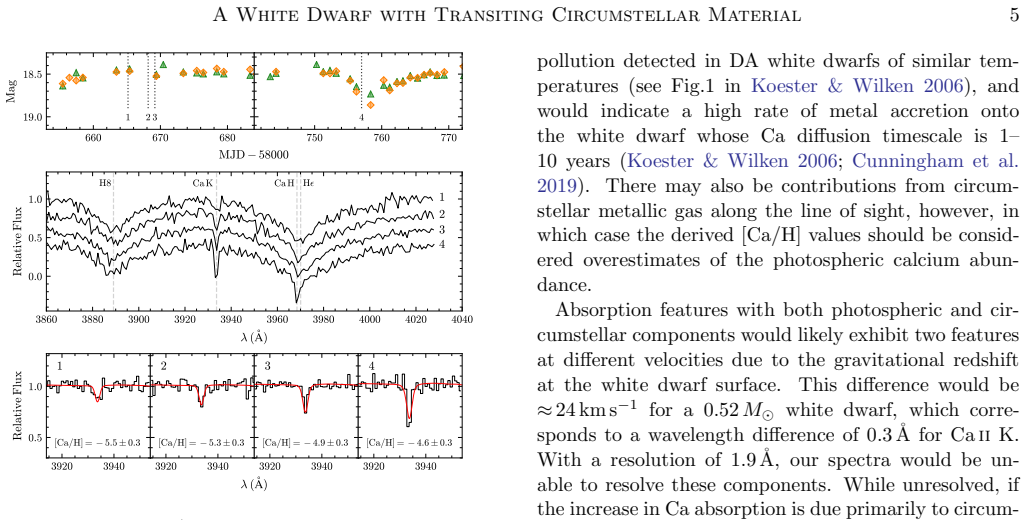
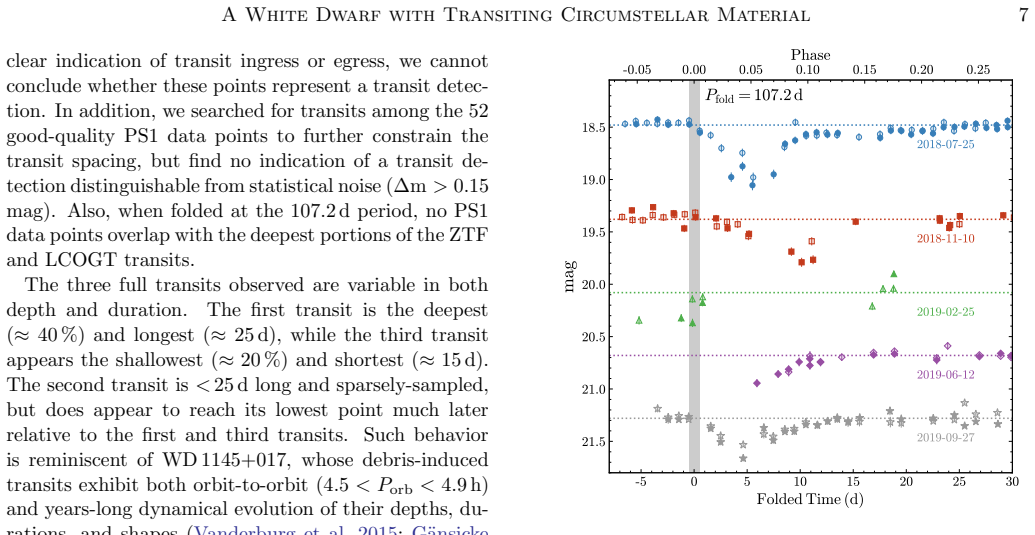
The load-bearing object is the folded transit light curve. The authors align the start times of three full transits and one partial egress on a period of $P \approx 107.2$ d, then convert that period into a semimajor axis with Kepler's third law and bound the eccentricity by identifying the Roche limit, $r_R \approx 1.5\,R_\odot$, with the periastron distance. The irregular, event-to-event variation in transit depth ($20$–$45\%$), duration ($15$–$25$ days), and shape is the evidence that the transiting material is an extended debris stream rather than a coherent body. The Ca II K absorption line, present both in and out of transit and strongest near a $15\%$ transit depth, is the secondary mechanism linking the photometric dips to metallic circumstellar gas or enhanced photospheric accretion.
What would settle it
Monitor the system across several predicted epochs: if the deep, irregular $15$–$25$ day flux dips do not begin at the phase-zero times predicted by the $107.2$-day ephemeris, or if those start times drift by more than the scatter among the three known transits, the claim that $107.2$ days is the orbital period fails.
Extended reading notes
Core claim
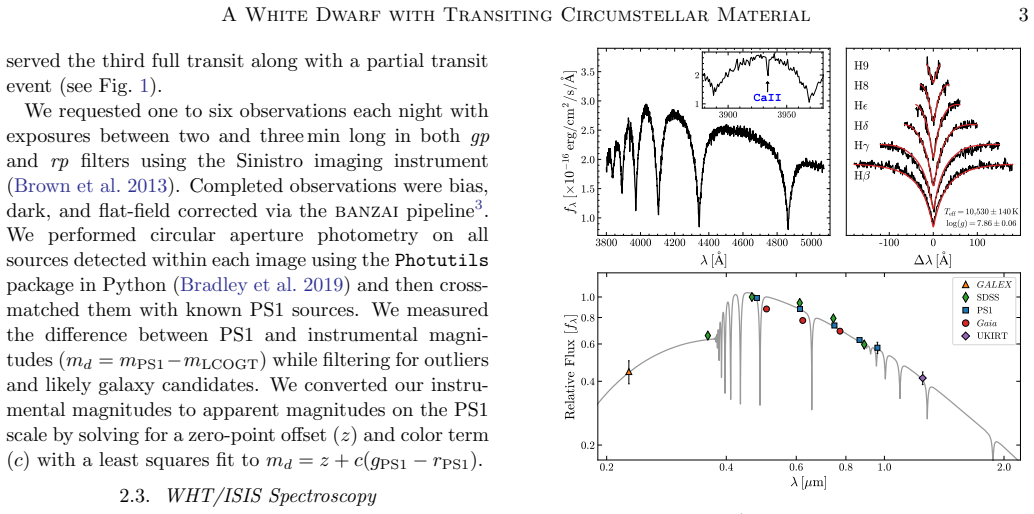
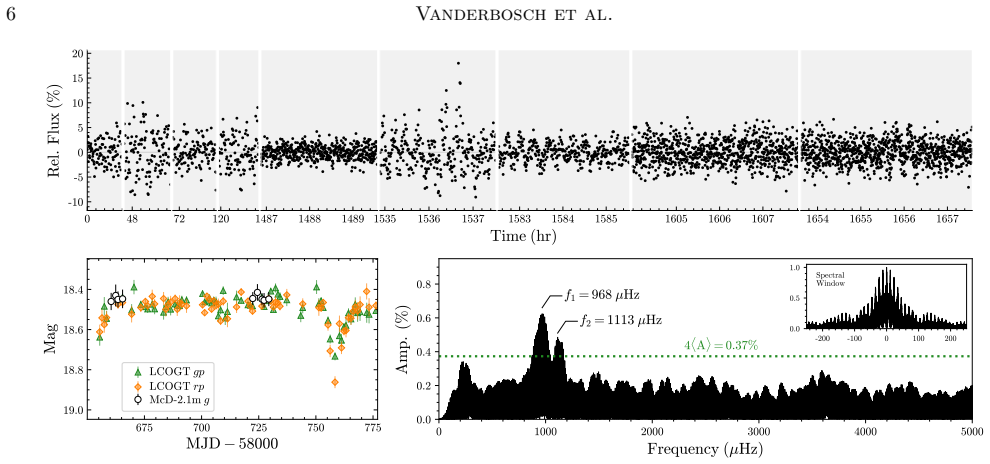
The central discovery is observational. ZTF J0139+5245 is a hydrogen-atmosphere white dwarf (spectral type DA) with $T_{\mathrm{eff}} = 10{,}530 \pm 140$ K, $\log(g) = 7.86 \pm 0.06$, and mass $\approx 0.52\,M_\odot$ at a distance of about $173$ pc. Its light curve, assembled from public survey photometry and follow-up monitoring, contains three full transits and one partial transit that phase-fold to a repeat spacing of $107.2$ days. The transits vary from event to event, with depths of roughly $20$–$45\%$ and durations of $15$–$25$ days, and the Ca II H and K lines are present at all phases, appearing stronger during transit. The star also lies in the ZZ Ceti instability strip, the region where hydrogen-atmosphere white dwarfs pulsate, and shows two pulsation periods near 900 and 1030 s. The authors argue that if the $107.2$-day spacing is the orbital period, Kepler's third law gives a semimajor axis $a \approx 76.4\,R_\odot$ ($0.355$ AU); using the Roche limit for an asteroid-density body, $r_R \approx 1.5\,R_\odot$, as the periastron distance forces an eccentricity $e > 0.97$ and an apastron near $150\,R_\odot$ ($0.70$ AU). The long, irregular transits cannot be produced by a single solid body, so the paper concludes the occulting material is an extended, evolving stream of debris, with the canonical tidal disruption of a small rocky body as one viable origin and rotational fission or late planetary-system unpacking as alternatives.
Load-bearing premise
The paper's orbital geometry rests on the assumption that the $\approx 107.2$-day spacing between transit starts is the true orbital period of the debris, an inference drawn from only three full transits and part of a fourth, with no formal uncertainty.
Editorial extensions
If this is right
- ZTF J0139+5245 becomes the second known white dwarf with transiting planetary debris, and the first whose transits recur on a timescale of months rather than hours.
- If the $107.2$-day spacing is the true orbital period, the debris occupies a semimajor axis of $\approx 0.355$ AU, far outside the Roche limit, and must have eccentricity $e > 0.97$ to reach the Roche limit at periastron.
- The observed transit-to-transit changes in depth, duration, and shape imply the debris stream is dynamically evolving on the orbital timescale, extending the behavior seen in the first transiting-debris white dwarf to a much longer period.
- Because the star is also a ZZ Ceti pulsator, the system offers a rare chance to tie asteroseismic measurements of a white dwarf to an ongoing or recent debris-accretion episode.
- The apparent strengthening of Ca II absorption during transit motivates high-resolution spectroscopy across a full orbital cycle to separate photospheric and circumstellar components.
Reading between the lines
- Pith inference: if the $107.2$-day spacing is a precession or beat period rather than the true orbital period, the inferred semimajor axis and eccentricity do not describe the physical orbit; repeated monitoring of transit-start times for phase drift would settle this.
- Pith inference: the $15$–$25$ day transit durations imply the occulting cloud spans a large azimuthal arc of the orbit, so multi-band photometry through ingress and egress could reveal whether larger and smaller grains are spatially sorted along the stream.
- Pith inference: the $\approx 24$ km s$^{-1}$ gravitational redshift of this white dwarf offers a clean way to separate photospheric from circumstellar calcium; a high-resolution Ca II K time series across a transit should show a second velocity component if the extra absorption is truly circumstellar.
Signed reviews
Editorial analysis
A structured set of objections, weighed in public.
Referee Report
Summary. The paper reports the discovery of a DA white dwarf, ZTF J0139+5245, that exhibits deep (20-45%), long-duration (15-25 day) transit-like dips recurring approximately every 107.2 days in public ZTF DR2 photometry and follow-up LCOGT photometry. Spectroscopic follow-up yields Teff = 10,530 +/- 140 K, log(g) = 7.86 +/- 0.06, and M = 0.52 +/- 0.03 Msun, and reveals Ca II H and K absorption that varies in strength, with the strongest absorption observed during one in-transit spectrum. High-speed McDonald photometry shows variability at 900 and 1030 s, consistent with ZZ Ceti pulsations. The authors interpret the transits as circumstellar debris, derive a semi-major axis of 0.355 AU if the 107.2 d spacing is the orbital period, and infer a very high eccentricity (e > 0.97) if the material reaches the Roche limit at periastron. They discuss tidal disruption, rotational fission, and late planetary system unpacking as possible origins.
Significance. If correct, this is the second white dwarf known to host transiting planetary debris and the first with transits occurring far outside the Roche limit on a long (greater than about 100 d) period. The discovery is valuable because it extends the WD 1145+017 phenomenon to a very different orbital regime and provides a new observational window into debris disk evolution and tidal disruption. The paper uses public ZTF data and provides clear follow-up photometry and spectroscopy; the white dwarf identification from Balmer lines is solid. The main weakness is the lack of a formal period determination and the unaddressed 2:1 alias, which affects the derived orbital parameters but not the core discovery of transiting circumstellar material.
major comments (1)
- [Sec. 3.4 and Fig. 5] The 107.2 d period is determined by eye from three full transits (2018-07-25, 2018-11-10, 2019-06-12) and a partial egress near 2019-09-27, with no formal uncertainty and no period search. The observed spacings are approximately 108 d, 214 d, and 107 d, so the data are equally consistent with P approximately 107.2 d (with one inconclusive event near 2019-02-25) or with P approximately 214.4 d (with two transits per orbit at two nodes). Because Sec. 4.1 uses P = 107.2 d to derive a = 0.355 AU and e > 0.97, this is a load-bearing assumption. Please either (a) present a periodogram or chi-square scan over a plausible period range (for example 50-300 d) and quote a period with an uncertainty, or (b) explicitly state that the recurrence time is not uniquely determined, that the 2:1 alias cannot be excluded, and that the orbital parameters in Sec. 4.1 are therefore provisional. The qualitative conclusion that the transiting material lies far outside the Roche limit is unaffected by a factor-of-two change in period, but the numerical values should be presented with this caveat.
minor comments (4)
- [Abstract and Sec. 3.2] The phrase 'line of site' appears in the abstract and in Sec. 3.2; it should be 'line of sight.'
- [Fig. 5] The folded light curve in Fig. 5 is vertically shifted for each transit, which makes quantitative comparison of depths difficult; consider also showing an unshifted phase-folded light curve in a single band so readers can assess the actual depth variations.
- [Sec. 3.1] The systematic uncertainty statement '1.2 % Teff' is ambiguous; it should be written as '1.2% of Teff' or '0.012 Teff' to avoid confusion.
- [Sec. 4.1] The text would benefit from an explicit statement that the eccentricity e > 0.97 is derived under the assumption that the debris reaches the Roche limit at periastron; while this is stated, making it more prominent would help readers distinguish the measured quantities from the adopted model.
Circularity Check
No significant circularity: the transits, depths, and durations are observed quantities; the orbital interpretation uses standard Keplerian mechanics and is not fed back as a fitted prediction.
full rationale
The paper's central claims are observational: deep, irregular transits recur every ≈107.2 d, with measured depths and durations, identified from ZTF and LCOGT photometry. The orbital period is inferred by phase-folding observed transit start times, a direct measurement rather than a model output. The semi-major axis and eccentricity follow from Kepler's third law and an adopted Roche-limit periastron assumption; these are standard mechanics applied after the fact, not fit parameters used to generate the transits. The mass estimate is a scaling relation depending on assumed grain properties and explicitly does not feed back into any prediction of transit timing or depth. The Ca II absorption analysis uses standard atmosphere modeling, and the authors explicitly flag the 2-sigma significance and unresolved photospheric-versus-circumstellar interpretation. No load-bearing step reduces to a fitted input or to a self-citation chain. The paper even hedges the eccentricity as 'cannot yet be confirmed,' further confirming that the orbital interpretation is speculative rather than circular. Thus no circularity is present.
Assumptions & free parameters
free parameters (3)
- Particle radius r_d in mass estimate =
1 micron (assumed)
- Particle density rho_d in mass estimate =
2 g/cm^3 (assumed)
- Interstellar extinction E(B-V), A_V =
0.12, 0.38
assumptions (4)
- domain assumption The 107.2-day transit spacing is the orbital period of the transiting material.
- domain assumption The transiting material is on a highly eccentric orbit that brings it near or within the Roche limit at periastron.
- domain assumption The dips are caused by a flat rectangular cloud of non-overlapping opaque spheres for the mass estimate.
- standard math The white dwarf atmospheric parameters are derived using 1D LTE models with 3D corrections and standard cooling models.
Cite this review
Pith. "Pith review of A White Dwarf with Transiting Circumstellar Material Far Outside the Roche Limit." pith.science (2026). https://pith.science/paper/UKTDZFO6
@misc{pith2026190809839,
  author       = {Pith},
  title        = {Pith review of: A White Dwarf with Transiting Circumstellar Material Far Outside the Roche Limit},
  year         = {2026},
  howpublished = {\url{https://pith.science/paper/UKTDZFO6}},
  note         = {Machine review of arXiv:1908.09839}
}
abstract
We report the discovery of a white dwarf exhibiting deep, irregularly shaped transits, indicative of circumstellar planetary debris. Using Zwicky Transient Facility DR2 photometry of ZTF$\,$J013906.17+524536.89 and follow-up observations from the Las Cumbres Observatory, we identify multiple transit events that recur every ${\approx}\,107.2\,$d, much longer than the $4.5{-}4.9\,$h orbital periods observed in WD$\,$1145+017, the only other white dwarf known with transiting planetary debris. The transits vary in both depth and duration, lasting $15{-}25\,$d and reaching $20{-}45\,\%$ dips in flux. Optical spectra reveal strong Balmer lines, identifying the white dwarf as a DA with $T_{\mathrm{eff}}=10{,}530\pm140\,\mathrm{K}$ and $\log(g)=7.86\pm0.06$. A $\mathrm{Ca\,II\,K}$ absorption feature is present in all spectra both in and out of transit. Spectra obtained during one night at roughly $15\,\%$ transit depth show increased $\mathrm{Ca\,II\,K}$ absorption with a model atmospheric fit suggesting $[\mathrm{Ca/H}]=-4.6\pm0.3$, whereas spectra taken on three nights out of transit have $[\mathrm{Ca/H}]$ of -5.5, -5.3, and -4.9 with similar uncertainties. While the $\mathrm{Ca\,II\,K}$ line strength varies by only 2-sigma, we consider a predominantly interstellar origin for Ca absorption unlikely. We suggest a larger column density of circumstellar metallic gas along the line of site or increased accretion of material onto the white dwarf's surface are responsible for the Ca absorption, but further spectroscopic studies are required. In addition, high-speed time series photometry out of transit reveals variability with periods of 900 and 1030$\,$s, consistent with ZZ Ceti pulsations.
Figures

Figures from the paper (2 more)
Forward citations
Cited by 1 Pith paper
-
First planetesimals from DESI DR1: 12 highly metal-rich white dwarfs
Twelve white dwarfs from DESI DR1 have accreted debris resembling inner-Solar-System rock, with two systems likely accreting water-rich planetesimals.
Reference graph
Works this paper leans on
-
[1]
P., Alexandroff, R., Allende Prieto, C., et al
Ahn, C. P., Alexandroff, R., Allende Prieto, C., et al. 2012, ApJS, 203, 21 Astropy Collaboration, Robitaille, T. P., Tollerud, E. J., et al. 2013, A&A, 558, A33 Astropy Collaboration, Price-Whelan, A. M., Sip˝ ocz, B. M., et al. 2018, AJ, 156, 123
work page 2012
- [2]
-
[3]
C., Kulkarni, S
Bellm, E. C., Kulkarni, S. R., Graham, M. J., et al. 2019, PASP, 131, 018002
2019
-
[4]
Boyajian, T. S., LaCourse, D. M., Rappaport, S. A., et al. 2016, MNRAS, 457, 3988
work page 2016
-
[5]
2019, astropy/photutils: v0.6, , , doi:10.5281/zenodo.2533376
Bradley, L., Sip˝ ocz, B., Robitaille, T., et al. 2019, astropy/photutils: v0.6, , , doi:10.5281/zenodo.2533376. https://doi.org/10.5281/zenodo.2533376
-
[6]
1993, A&A, 271, 482
Breger, M., Stich, J., Garrido, R., et al. 1993, A&A, 271, 482
1993
-
[7]
M., Baliber, N., Bianco, F
Brown, T. M., Baliber, N., Bianco, F. B., et al. 2013, PASP, 125, 1031
2013
-
[8]
Camacho, J., Torres, S., Garc´ ıa-Berro, E., et al. 2014, A&A, 566, A86
work page 2014
Show all 69 references
-
[9]
L., Elyajouri, M., & Monreal-Ibero, A
Capitanio, L., Lallement, R., Vergely, J. L., Elyajouri, M., & Monreal-Ibero, A. 2017, A&A, 606, A65
2017
-
[10]
2012, Planet
Carry, B. 2012, Planet. Space Sci., 73, 98
2012
-
[11]
C., Magnier, E
Chambers, K. C., Magnier, E. A., Metcalfe, N., et al. 2016, arXiv e-prints, arXiv:1612.05560
2016 arXiv
-
[12]
2019, MNRAS, 488, 2503
Cunningham, T., Tremblay, P.-E., Freytag, B., Ludwig, H.-G., & Koester, D. 2019, MNRAS, 488, 2503
2019
-
[13]
H., & L´ opez-Morales, M
Debes, J. H., & L´ opez-Morales, M. 2008, ApJL, 677, L43
2008
-
[14]
H., & Sigurdsson, S
Debes, J. H., & Sigurdsson, S. 2002, ApJ, 572, 556
2002
-
[15]
H., Walsh, K
Debes, J. H., Walsh, K. J., & Stark, C. 2012, ApJ, 747, 148
2012
-
[16]
J., & Liu, M
Dupuy, T. J., & Liu, M. C. 2012, ApJS, 201, 19
2012
-
[17]
A., et al
Dye, S., Lawrence, A., Read, M. A., et al. 2018, MNRAS, 473, 5113
2018
-
[18]
W., Riello, M., De Angeli, F., et al
Evans, D. W., Riello, M., De Angeli, F., et al. 2018, A&A, 616, A4
2018
-
[19]
Fitzpatrick, E. L. 1999, PASP, 111, 63
1999
-
[20]
2001, PASP, 113, 409
Fontaine, G., Brassard, P., & Bergeron, P. 2001, PASP, 113, 409
2001
-
[21]
Frewen, S. F. N., & Hansen, B. M. S. 2014, MNRAS, 439, 2442
2014
-
[22]
J., Tonry, J
Fulton, B. J., Tonry, J. L., Flewelling, H., et al. 2014, ApJ, 796, 114 Gaia Collaboration, Brown, A. G. A., Vallenari, A., et al. 2018, A&A, 616, A1 G¨ ansicke, B. T., Schreiber, M. R., Toloza, O., et al. 2019, Nature, 576, 61 G¨ ansicke, B. T., Aungwerojwit, A., Marsh, T. R....
2014
-
[23]
Kenyon, S. J. 2015, ApJ, 812, 167
2015
-
[24]
T., Steeghs, D., & Koester, D
Girven, J., G¨ ansicke, B. T., Steeghs, D., & Koester, D. 2011, MNRAS, 417, 1210
2011
-
[25]
C., Warren, S
Hewett, P. C., Warren, S. J., Leggett, S. K., & Hodgkin, S. T. 2006, MNRAS, 367, 454
2006
-
[26]
B., & Bergeron, P
Holberg, J. B., & Bergeron, P. 2006, AJ, 132, 1221
2006
-
[27]
S., Babler, B
Indebetouw, R., Mathis, J. S., Babler, B. L., et al. 2005, ApJ, 619, 931
2005
-
[28]
2010, in Society of Photo-Optical Instrumentation Engineers (SPIE) Conference Series, Vol
Kaiser, N., Burgett, W., Chambers, K., et al. 2010, in Society of Photo-Optical Instrumentation Engineers (SPIE) Conference Series, Vol. 7733, Proc. SPIE, 77330E
2010
-
[29]
O., & Winget, D
Kanaan, A., Kepler, S. O., & Winget, D. E. 2002, A&A, 389, 896 A White Dwarf with Transiting Circumstellar Material 11
2002
-
[30]
J., & Bromley, B
Kenyon, S. J., & Bromley, B. C. 2017, ApJ, 844, 116
2017
-
[31]
2010, Mem
Koester, D. 2010, Mem. Soc. Astron. Italiana, 81, 921
2010
-
[32]
T., & Farihi, J
Koester, D., G¨ ansicke, B. T., & Farihi, J. 2014, A&A, 566, A34
2014
-
[33]
2006, A&A, 453, 1051
Koester, D., & Wilken, D. 2006, A&A, 453, 1051
2006
-
[34]
1997, A&A, 328, 544
Jenkner, H. 1997, A&A, 328, 544
1997
-
[35]
Liebert, J., Bergeron, P., & Holberg, J. B. 2005, ApJS, 156, 47
2005
-
[36]
2018, A&A, 616, A2
Lindegren, L., Hern´ andez, J., Bombrun, A., et al. 2018, A&A, 616, A2
2018
-
[37]
1984, MNRAS, 208, 763
Livio, M., & Soker, N. 1984, MNRAS, 208, 763
1984
-
[38]
A., Schlafly, E., Finkbeiner, D., et al
Magnier, E. A., Schlafly, E., Finkbeiner, D., et al. 2013, ApJS, 205, 20
2013
- [39]
-
[40]
Marsh, T. R. 1989, PASP, 101, 1032
1989
-
[41]
C., Fanson, J., Schiminovich, D., et al
Martin, D. C., Fanson, J., Schiminovich, D., et al. 2005, ApJL, 619, L1
2005
-
[42]
J., Laher, R
Masci, F. J., Laher, R. R., Rusholme, B., et al. 2019, PASP, 131, 018003
2019
-
[43]
Burleigh, M. R. 2006, Nature, 442, 543
2006
-
[44]
A., et al
Morrissey, P., Schiminovich, D., Barlow, T. A., et al. 2005, ApJL, 619, L7
2005
-
[45]
O., & Clemens, J
Kepler, S. O., & Clemens, J. C. 2006, ApJ, 640, 956
2006
-
[46]
J., & Villaver, E
Mustill, A. J., & Villaver, E. 2012, ApJ, 761, 121
2012
-
[47]
2018, MNRAS, 476, 3939 Nebot G´ omez-Mor´ an, A., G¨ ansicke, B
Bonsor, A. 2018, MNRAS, 476, 3939 Nebot G´ omez-Mor´ an, A., G¨ ansicke, B. T., Schreiber, M. R., et al. 2011, A&A, 536, A43
2018
-
[48]
Nelemans, G., & Tauris, T. M. 1998, A&A, 335, L85
1998
-
[49]
T., Bellm, E
Patterson, M. T., Bellm, E. C., Rusholme, B., et al. 2019, PASP, 131, 018001
2019
-
[50]
L., Vanderburg, A., et al
Rappaport, S., Gary, B. L., Vanderburg, A., et al. 2018, MNRAS, 474, 933
2018
-
[51]
A., Levine, A., & Winn, J
Rappaport, S., Sanchis-Ojeda, R., Rogers, L. A., Levine, A., & Winn, J. N. 2013, ApJL, 773, L15
2013
-
[52]
2019, MNRAS, 485, 2681 Redfield, S., Farihi, J., Cauley, P
Rappaport, S., Zhou, G., Vanderburg, A., et al. 2019, MNRAS, 485, 2681 Redfield, S., Farihi, J., Cauley, P. W., et al. 2017, ApJ, 839, 42
2019
-
[53]
E., Bentley, R
Schaefer, B. E., Bentley, R. O., Boyajian, T. S., et al. 2018, MNRAS, 481, 2235 Schlafly, E. F., & Finkbeiner, D. P. 2011, ApJ, 737, 103
2018
-
[54]
L., Martin, R
Smallwood, J. L., Martin, R. G., Livio, M., & Lubow, S. H. 2018, MNRAS, 480, 57
2018
-
[55]
1984, MNRAS, 210, 189
Soker, N., Livio, M., & Harpaz, A. 1984, MNRAS, 210, 189
1984
-
[56]
2013, Astrophysics Source Code Library, ascl:1304.004
Thompson, S., & Mullally, F. 2013, Astrophysics Source Code Library, ascl:1304.004
2013
-
[57]
E., Montgomery, M
Thompson, S. E., Montgomery, M. H., von Hippel, T., et al. 2010, ApJ, 714, 296
2010
-
[58]
E., Bergeron, P., & Gianninas, A
Tremblay, P. E., Bergeron, P., & Gianninas, A. 2011, ApJ, 730, 128
2011
-
[59]
E., Ludwig, H
Tremblay, P. E., Ludwig, H. G., Steffen, M., & Freytag, B. 2013, A&A, 559, A104
2013
-
[60]
A., Rappaport, S., et al
Vanderburg, A., Johnson, J. A., Rappaport, S., et al. 2015, Nature, 526, 546
2015
-
[61]
2016, Royal Society Open Science, 3, 150571
Veras, D. 2016, Royal Society Open Science, 3, 150571
2016
-
[62]
Veras, D., & G¨ ansicke, B. T. 2015, MNRAS, 447, 1049
2015
-
[63]
M., Bonsor, A., & G¨ ansicke, B
Veras, D., Leinhardt, Z. M., Bonsor, A., & G¨ ansicke, B. T. 2014, MNRAS, 445, 2244
2014
-
[64]
M., Eggl, S., & G¨ ansicke, B
Veras, D., Leinhardt, Z. M., Eggl, S., & G¨ ansicke, B. T. 2015, MNRAS, 451, 3453
2015
-
[65]
H., & Makarov, V
Veras, D., McDonald, C. H., & Makarov, V. V. 2020, MNRAS, 492, 5291 von Hippel, T., & Thompson, S. E. 2007, ApJ, 661, 477
2020
-
[66]
A., Bolte, M., & Koester, D
Williams, K. A., Bolte, M., & Koester, D. 2009, ApJ, 693, 355
2009
-
[67]
G., Farihi, J., G¨ ansicke, B
Wilson, T. G., Farihi, J., G¨ ansicke, B. T., & Swan, A. 2019, MNRAS, 487, 133
2019
-
[68]
R., & Parsons, S
Zorotovic, M., Schreiber, M. R., & Parsons, S. G. 2014, A&A, 568, L9
2014
-
[69]
2010, ApJ, 722, 725
Zuckerman, B., Melis, C., Klein, B., Koester, D., & Jura, M. 2010, ApJ, 722, 725
2010
Reviewed August 14, 2026 · model on record in the stance chip above.
Discussion (0). Continue with ORCID to comment.