REVIEW 3 major objections 6 minor 48 references
Chondrule Formation by the Jovian Sweeping Secular Resonance
T0 review · 3 major / 6 minor · reviewed 2026-08-14 · deepseek-v4-flash
Pith's one-line read The Jovian sweeping secular resonance, moving inward as the disk depleted, drove 50-2000 km planetesimals to eccentricities above 0.6 and converted 4-9% of chondrule precursors between 1.5 and 3 AU into chondrules.
desk verdict The sweeping-secular-resonance excitation of 50–2000 km planetesimals is a real dynamical result and the paper's best contribution; the 4–9% chondrule yield is a model-conditioned estimate, not a measurement. read the letter →
The pith
A machine-rendered reading of the paper's core claim, the machinery that carries it, and where it could break.
The reading
What carries the argument
The load-bearing object is the Jovian sweeping secular resonance, the location in the disk where a planetesimal's apsidal precession rate matches Jupiter's, so that Jupiter's gravitational pull coherently stretches the orbit over many cycles; that location migrates inward as the disk surface density decays exponentially with timescale τdep. On either side of the resonance, gas drag acts as a size filter: aerodynamic drag dominates for planetesimals below about 50 km, tidal (Lindblad) drag dominates above about 2000 km, and the weakly coupled intermediate sizes are free to reach high eccentricity. The same drag laws set the speed of the sweep and the gas density during heating, and the probability calculation combines the bow-shock cross-section with a settled dust scale height to turn each high-eccentricity encounter into a chondrule-forming event.
What would settle it
Measure isotopic ages of the oldest chondrules and compare with the time Jupiter opened its gap: the model requires Jupiter to already be massive before the first chondrules, no later than about 0.7 Myr after the CAIs, and requires chondrule production to be spread over roughly 1-2 Myr as the resonance sweeps the belt. A chondrule dated earlier than Jupiter's gap opening, or an age spread much shorter than about 1 Myr, would rule the scenario out.
Extended reading notes
Core claim
The central discovery is a single causal chain. After Jupiter opens a gap, the location where Jupiter's apsidal precession rate matches a planetesimal's precession rate, the secular resonance called ν5, moves inward as the disk mass falls. Planetesimals in the 50-2000 km size range are weakly coupled to the gas: small ones are damped by aerodynamic drag, and larger ones migrate inward too fast under tidal drag, but this middle group can be excited to eccentricities above 0.6 before gas drag stops them. Their bow shocks then heat chondrule precursors; the model finds most heating occurs in high-velocity shocks (vrel ≈ 12-18 km/s), in gas depleted to 1-10% of the minimum-mass solar nebula, and inside about 2.5 AU, giving a 4-9% probability that a precursor between 1.5 and 3 AU becomes a chondrule. The same sweep implies the disk depleted on a timescale of about 1 Myr and that Jupiter formed before the chondrules, no more than 0.7 Myr after the CAIs.
Load-bearing premise
The results depend on the disk losing mass as a single global exponential decay of an MMSN-like surface density with a fixed gap around Jupiter, with no photoevaporation, radial transport, or gap evolution included.
Editorial extensions
If this is right
- The 4-9% chondrule fraction matches the observationally estimated fraction of the present asteroid belt, so no separate heating mechanism is required once Jupiter formed.
- Chondrule ages should trace the resonance sweep: production is spread over roughly 1-2 disk depletion timescales, with most chondrules forming 1-3 Myr after the CAIs.
- Jupiter must have been massive enough to open a gap before the first chondrules, placing its formation no later than about 0.7 Myr after the CAIs.
- The solar nebula's depletion timescale is about 1 Myr, consistent with inferred disk lifetimes around young stars.
- Chondrule-producing planetesimals are confined to roughly 50-2000 km in radius; smaller and larger bodies are damped or migrate away before they can heat precursors.
Reading between the lines
- If the mechanism is robust, the same resonance sweep that made chondrules should have also shaped the asteroid belt's dynamical structure and mass deficit, so a combined model of chondrule yield and belt clearing could sharpen the timing predictions.
- A straightforward test is to rerun the sweep with photoevaporation-driven depletion instead of pure exponential decay; if the resonance then passes through the belt faster, the predicted chondrule fraction and age spread would change in ways that isotopic chronologies could check.
- The model's concentration of heating inside about 2.5 AU predicts a radial gradient in chondrule flash-heating signatures, so chondrules from parent bodies that formed farther out should show weaker or absent chondrule textures.
Signed reviews
Editorial analysis
A structured set of objections, weighed in public.
Referee Report
Summary. The paper proposes that, as the protoplanetary disk depletes exponentially, the Jovian sweeping secular resonance excites 50-2000 km planetesimals in the 1.5-3.5 AU region to eccentricities larger than 0.6. The authors argue that bow shocks driven by these highly eccentric planetesimals can heat chondrule precursors, and they compute an average chondrule formation probability of about 4-9% between 1.5 and 3.0 AU. The dynamical mechanism is developed with a semi-analytic secular model and N-body simulations (HERMIT4), including parameter variations in disk depletion timescale, tidal damping strength, Jupiter's eccentricity, and the presence of Saturn. From the model, the authors further infer that the disk depletion timescale was approximately 1 Myr and that Jupiter formed no more than 0.7 Myr after CAIs.
Significance. If the dynamical result holds, this is an attractive and physically motivated solution to the long-standing difficulty of exciting planetesimals to the high eccentricities required for bow-shock chondrule formation. The agreement between the semi-analytic secular treatment and the N-body simulations is a genuine strength, and the paper explicitly models size-dependent aerodynamic and tidal gas drag. The model also produces falsifiable predictions: the disk depletion timescale, the timing of Jupiter's formation, and the size range of the planetesimals responsible for chondrule heating. These are concrete, testable outcomes that go beyond a purely qualitative scenario. The principal weakness is that the headline 4-9% chondrule fraction rests on several adopted scalings that are not varied or propagated as uncertainties, so the quantitative claim is less robust than the dynamical mechanism itself.
major comments (3)
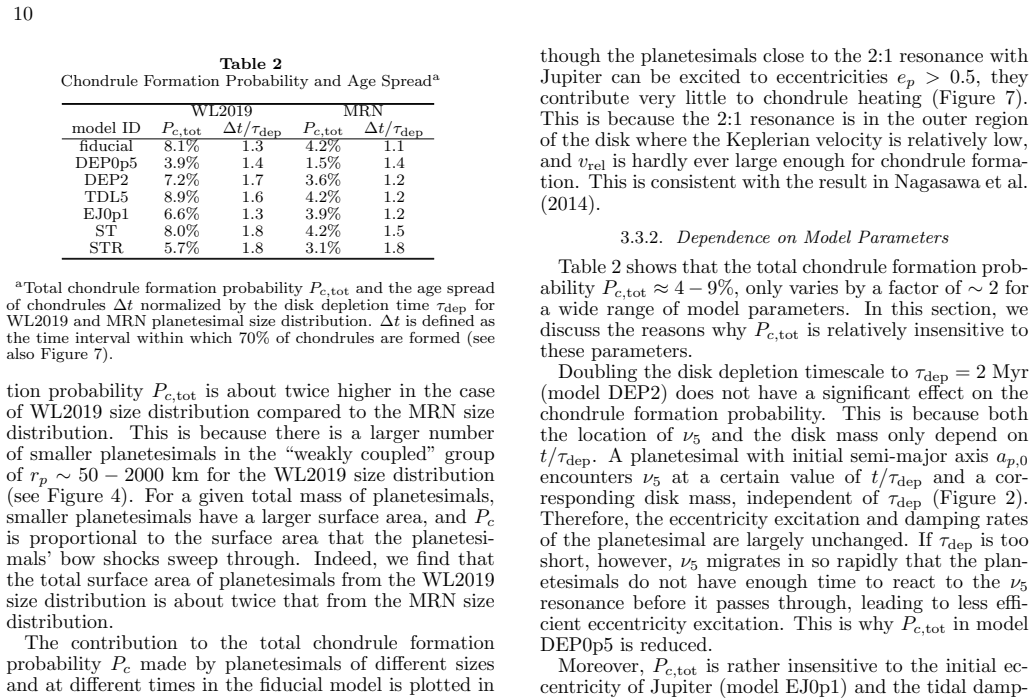
- [§2.3, Eq. (32), Table 2] The chondrule formation probability Pc is directly proportional to the assumed planetesimal surface density (fixed at 1% of the initial gas surface density in Section 3.3.1) and to the assumed shock cross-section σc = π(1.6rp)^2 applied to all planetesimal sizes. The paper itself notes that the Morris et al. (2012) calibration is for rp > 500 km and that σc should approach πrp^2 for smaller bodies. The WL2019 vs. MRN comparison in Table 2 already shows a factor-of-two sensitivity to the size distribution; combining a more standard MMSN solid-to-gas normalization of ~0.4% with a geometric cross-section for the dominant rp < 500 km population would reduce the fiducial WL2019 value from 8.1% to roughly 2%. This places the quoted range at the edge of, if not below, the observational constraints discussed in Section 3.3.3. The authors should either justify these choices with additional evidence or explicitly propagate their uncertainty into the quoted 4-9% range.
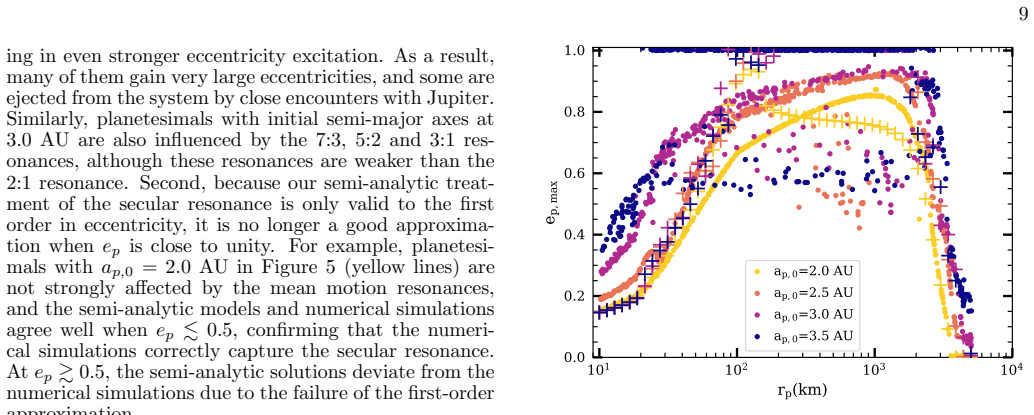
- [§3.3, Figure 4, Figure 7] The adopted WL2019 planetesimal size distribution is evaluated at 1 Myr, but in the fiducial model the chondrule-forming resonance sweep occurs at t/τdep ≈ 2.5-4.5 (Figure 7), i.e., at 2.5-4.5 Myr after t=0 for τdep=1 Myr. The planetesimal population can evolve through growth, collisional fragmentation, and dynamical depletion over this interval, so the size distribution at the actual epoch of chondrule formation may differ from the 1 Myr distribution used in Figure 4. The paper does not test this sensitivity; the WL2019/MRN comparison brackets only two static choices, not an evolutionary sequence. This uncertainty directly affects the headline yield and should be addressed with a time-dependent size distribution or a sensitivity test.
- [§2.1.1, Eqs. (6)-(7), §4] The inferred constraints τdep ≈ 1 Myr and 'Jupiter formed no more than 0.7 Myr after CAIs' rely on the assumption that the disk depletes as a global exponential decay with a fixed gap around Jupiter (Eqs. 6-7). While the paper appropriately labels this as an idealized prescription, it does not explore alternative depletion histories, such as inside-out clearing by photoevaporation or a time-variable gap width. Because the timing of the ν5 resonance sweep and the gas density at the time of heating are both consequences of this single depletion law, the quoted timing constraints are conditional on that law. The authors should either show that the main conclusions are robust to a broader class of depletion profiles or soften the statements in Section 4 and the abstract.
minor comments (6)
- [Table 2 and abstract] The DEP0p5 model yields Pc,tot = 3.9% (WL2019) and 1.5% (MRN), both outside the 'about 4-9%' range quoted in the abstract and Section 5. Please qualify the range, for example '4-9% for τdep = 1-2 Myr,' or revise the abstract accordingly.
- [§3.3.3] The comparison between the model's Pc (fraction of precursors that are heated) and the observational constraints on the current abundance of chondrules in the asteroid belt and IDPs is not direct, because the observed abundance also depends on survival, transport, and dilution processes. Please clarify this relationship or soften the claim of consistency.
- [Eq. (13)] The phrase 'where the numerator is evaluated at time t = 0' is ambiguous, since dϖp,J/dt does not depend on the disk density and is constant in this formulation. Consider writing the equation with explicit time dependence to avoid confusion.
- [Figure 2] The curve labels 'with gap' and 'without gap' are clear, but the y-axis extends to 4 AU while the bulk of the asteroid belt lies inside 3.5 AU; a brief note that the resonance only reaches the belt at late times would aid the reader.
- [§2.1.2] The condition 'ep,η ≪ 1' should be written as 'ep ≪ 1 and η ≪ 1' to avoid the implication that ep and η appear as a product.
- [§4.2] The statement that 'the sweeping secular resonance seems to be hardly avoidable' is stronger than the idealized disk model warrants; consider softening it to reflect the dependence on the assumed depletion law.
Circularity Check
Minor circularity in the 'τdep≈1 Myr' implication; the eccentricity-excitation mechanism and Pc calculation are otherwise self-contained.
-
fitted input called prediction
[Abstract; Section 2.1.1 (Eq. 7); Section 4.1]
"We set the parameter τdep = 1 Myr in our fiducial model, and explore the effect of varying τdep in Section 3.3. ... This is consistent with a disk depletion time of τdep≈ 1 Myr. ... Our model implies that the disk depletion timescale is τdep≈ 1 Myr."
The abstract presents τdep≈1 Myr as a model implication, but τdep is a free parameter set to 1 Myr in the fiducial model. The model's chondrule age spread scales by construction with τdep: the ν5 resonance location depends only on t/τdep (Eq. 13), and Table 2 gives Δt/τdep ≈ 1.3. Therefore the observed age spread is used to recover the same input parameter that was adopted in the fiducial run—a consistency check with the assumed value, not an independent prediction from the sweeping-resonance dynamics.
full rationale
The central dynamical claim—that 50–2000 km planetesimals reach e>0.6 via the Jovian sweeping secular resonance—is supported by standard secular theory (Eqs. 4–5, 8–13) and checked against N-body integrations (Figures 5–6), so it is not circular. The chondrule formation probability Pc is computed from Eq. 32 with an assumed planetesimal surface density of 1% of the initial gas disk and adopted size distributions; while this makes the 4–9% yield assumption-sensitive (Table 2 shows roughly a factor-two change between the WL2019 and MRN size distributions), that is a model-assumption uncertainty rather than a derivation that reduces to its own output. Self-citations to Zheng et al. (2017) are methodological and not load-bearing; the key dynamics come from external references (Murray & Dermott; Ward 1981; Nagasawa et al. 2003) and independent N-body checks. The only mild circular step is the abstract's statement that the model implies τdep≈1 Myr, since τdep was set to 1 Myr in the fiducial model and the age spread is proportional to τdep by construction. The paper itself acknowledges in Section 4.1 that τdep need not be constant, further weakening the 'implies' phrasing.
Assumptions & free parameters
free parameters (8)
- Disk depletion timescale tau_dep =
1 Myr (fiducial); 0.5 and 2 Myr explored
- Planetesimal surface density fraction =
0.01 (1% of initial gas surface density)
- Gap inner and outer radii =
Rin=4.5 AU, Rout=6 AU
- Chondrule precursor radius and density =
a_d=1 mm, rho_d=1 g/cm^3
- Vertical turbulence diffusion coefficient alpha_z =
7.8e-4
- Bow shock cross-section factor =
1.6 (sigma_c = pi (1.6 rp)^2)
- Planetesimal internal density prescription =
1.0 g/cm^3 (rp<=18 km), rp/18 g/cm^3 (18-100 km), 50/9 g/cm^3 (>=100 km)
- Planetesimal size distribution =
WL2019 at 1 Myr; MRN dN/drp proportional to rp^-3.5 for comparison
assumptions (8)
- standard math Secular perturbation theory with Laplace coefficients describes Jupiter's eccentricity forcing (Eqs. 4-5)
- domain assumption Aerodynamic and tidal gas drag formulas of Adachi et al. 1976 and Kominami & Ida 2002 give the orbital damping rates (Eqs. 19-28)
- domain assumption The disk precession rates follow Ward 1981 for a power-law disk with a gap (Eqs. 8-12)
- ad hoc to paper The gas disk evolves as a global exponential decay of an MMSN-like surface density with a fixed gap (Eqs. 6-7)
- domain assumption Jupiter formed before the depletion, at its present-day semi-major axis and eccentricity, and opened a gap
- domain assumption Planetesimals are initially on circular orbits in the 1.5-3.5 AU region
- domain assumption Chondrule precursors are well-coupled to the gas and distributed with scale height Hc from Xu et al. 2017
- domain assumption Shock heating and evaporation limits follow Iida et al. 2001 (their Eqs. 37-38)
Cite this review
Pith. "Pith review of Chondrule Formation by the Jovian Sweeping Secular Resonance." pith.science (2026). https://pith.science/paper/OGNWB57J
@misc{pith2026190809840,
  author       = {Pith},
  title        = {Pith review of: Chondrule Formation by the Jovian Sweeping Secular Resonance},
  year         = {2026},
  howpublished = {\url{https://pith.science/paper/OGNWB57J}},
  note         = {Machine review of arXiv:1908.09840}
}
abstract
Chondrules are silicate spheroids found in meteorites, serving as important fossil records of the early solar system. In order to form chondrules, chondrule precursors must be heated to temperatures much higher than the typical conditions in the current asteroid belt. One proposed mechanism for chondrule heating is the passage through bow shocks of highly eccentric planetesimals in the protoplanetary disk in the early solar system. However, it is difficult for planetesimals to gain and maintain such high eccentricities. In this paper, we present a new scenario in which planetesimals in the asteroid belt region are excited to high eccentricities by the Jovian sweeping secular resonance in a depleting disk, leading to efficient formation of chondrules. We study the orbital evolution of planetesimals in the disk using semi-analytic models and numerical simulations. We investigate the dependence of eccentricity excitation on the planetesimal's size as well as the physical environment, and calculate the probability for chondrule formation. We find that 50 - 2000 km planetesimals can obtain eccentricities larger than 0.6 and cause effective chondrule heating. Most chondrules form in high velocity shocks, in low density gas, and in the inner disk. The fraction of chondrule precursors which become chondrules is about 4 - 9 % between 1.5 - 3 AU. Our model implies that the disk depletion timescale is $\tau_\mathrm{dep}\approx 1~\mathrm{Myr}$, comparable to the age spread of chondrules; and that Jupiter formed before chondrules, no more than 0.7 Myr after the formation of the CAIs.
Figures


Figures from the paper (7 more)




Reference graph
Works this paper leans on
-
[1]
Aarseth, S. J. 2003, Gravitational N-Body Simulations, 430
work page 2003
-
[2]
1976, Progress of Theoretical Physics, 56, 1756
Adachi, I., Hayashi, C., & Nakazawa, K. 1976, Progress of Theoretical Physics, 56, 1756
1976
- [3]
- [4]
-
[5]
2014, Protostars and Planets VI, 667
Baruteau, C., Crida, A., Paardekooper, S.-J., et al. 2014, Protostars and Planets VI, 667
2014
-
[6]
Bryden, G., Chen, X., Lin, D. N. C., Nelson, R. P., & Papaloizou, J. C. B. 1999, ApJ, 514, 344
work page 1999
- [7]
-
[8]
Connolly, Jr., H. C., Desch, S. J., Ash, R. D., & Jones, R. H. 2006, Transient Heating Events in the Protoplanetary Nebula, ed. D. S. Lauretta & H. Y. McSween, 383–397
work page 2006
Show all 48 references
-
[9]
J., Ciesla, F
Desch, S. J., Ciesla, F. J., Hood, L. L., & Nakamoto, T. 2005, in Astronomical Society of the Pacific Conference Series, Vol. 341, Chondrites and the Protoplanetary Disk, ed. A. N. Krot, E. R. D. Scott, & B. Reipurth, 849
2005
-
[10]
J., Morris, M
Desch, S. J., Morris, M. A., Connolly, H. C., & Boss, A. P. 2012, Meteoritics and Planetary Science, 47, 1139
2012
-
[11]
L., & Lin, D
Dobbs-Dixon, I., Li, S. L., & Lin, D. N. C. 2007, ApJ, 660, 791
2007
-
[12]
P., Stammler, S
Dullemond, C. P., Stammler, S. M., & Johansen, A. 2014, ApJ, 794, 91 D¨ urmann, C., & Kley, W. 2015, A&A, 574, A52
2014
-
[13]
Epstein, P. S. 1924, Phys. Rev., 23, 710
1924
-
[14]
M., & Nelson, R
Fendyke, S. M., & Nelson, R. P. 2014, MNRAS, 437, 96
2014
-
[15]
E., Lada, E
Haisch, Jr., K. E., Lada, E. A., & Lada, C. J. 2001, ApJ, 553, L153
2001
-
[16]
1981, Progress of Theoretical Physics Supplement, 70, 35
Hayashi, C. 1981, Progress of Theoretical Physics Supplement, 70, 35
1981
-
[17]
2001, Icarus, 153, 430
Iida, A., Nakamoto, T., Susa, H., & Nakagawa, Y. 2001, Icarus, 153, 430
2001
-
[18]
2002, Icarus, 157, 43
Kominami, J., & Ida, S. 2002, Icarus, 157, 43
2002
-
[19]
S., Burkhardt, C., Budde, G., & Kleine, T
Kruijer, T. S., Burkhardt, C., Budde, G., & Kleine, T. 2017, Proceedings of the National Academy of Science, 114, 6712
2017
-
[20]
S., Touboul, M., Fischer-G¨ odde, M., et al
Kruijer, T. S., Touboul, M., Fischer-G¨ odde, M., et al. 2014, Science, 344, 1150
2014
-
[21]
R., Boley, A
Mann, C. R., Boley, A. C., & Morris, M. A. 2016, ApJ, 818, 103 13
2016
-
[22]
S., Rumpl, W., & Nordsieck, K
Mathis, J. S., Rumpl, W., & Nordsieck, K. H. 1977, ApJ, 217, 425
1977
-
[23]
Meibom, A., & Clark, B. E. 1999, Meteoritics and Planetary Science, 34, 7
1999
-
[24]
A., Boley, A
Morris, M. A., Boley, A. C., Desch, S. J., & Athanassiadou, T. 2012, ApJ, 752, 27
2012
-
[25]
D., & Dermott, S
Murray, C. D., & Dermott, S. F. 1999, Solar system dynamics
1999
-
[26]
2011, ApJ, 737, 37
Muto, T., Takeuchi, T., & Ida, S. 2011, ApJ, 737, 37
2011
-
[27]
Nagasawa, M., Lin, D. N. C., & Ida, S. 2003, ApJ, 586, 1374
2003
-
[28]
Nagasawa, M., Lin, D. N. C., & Thommes, E. 2005, ApJ, 635, 578
2005
-
[29]
K., Tanaka, H., et al
Nagasawa, M., Tanaka, K. K., Tanaka, H., et al. 2014, ApJ, 794, L7
2014
-
[30]
2011, MNRAS, 410, 293
Paardekooper, S.-J., Baruteau, C., & Kley, W. 2011, MNRAS, 410, 293
2011
-
[31]
Papaloizou, J. C. B., & Larwood, J. D. 2000, MNRAS, 315, 823 Ribas, ´A., Bouy, H., & Mer´ ın, B. 2015, A&A, 576, A52
2000
-
[32]
Richert, A. J. W., Getman, K. V., Feigelson, E. D., et al. 2018, MNRAS, 477, 5191
2018
-
[33]
Scott, E. R. D. 2007, Annual Review of Earth and Planetary Sciences, 35, 577
2007
-
[34]
Sears, D. W. G. 1998, ApJ, 498, 773
1998
-
[35]
Sears, D. W. G., & Dodd, R. T. 1988, Overview and classification of meteorites, ed. J. F. Kerridge & M. S. Matthews, 3–31
1988
-
[36]
I., & Sunyaev, R
Shakura, N. I., & Sunyaev, R. A. 1973, A&A, 24, 337
1973
-
[37]
H., Shang, H., Gounelle, M., Glassgold, A
Shu, F. H., Shang, H., Gounelle, M., Glassgold, A. E., & Lee, T. 2001, ApJ, 548, 1029
2001
-
[38]
Thommes, E., Nagasawa, M., & Lin, D. N. C. 2008, ApJ, 676, 728
2008
-
[39]
C., & Craig, H
Urey, H. C., & Craig, H. 1953, Geochim. Cosmochim. Acta, 4, 36
1953
-
[40]
J., & Levison, H
Walsh, K. J., & Levison, H. F. 2019, Icarus, 329, 88
2019
-
[41]
Ward, W. R. 1981, Icarus, 47, 234 —. 1988, Icarus, 73, 330
1981
-
[42]
R., Colombo, G., & Franklin, F
Ward, W. R., Colombo, G., & Franklin, F. A. 1976, Icarus, 28, 441
1976
-
[43]
J., Marzari, F., & Hood, L
Weidenschilling, S. J., Marzari, F., & Hood, L. L. 1998, Science, 279, 681
1998
-
[44]
Whipple, F. L. 1972, in From Plasma to Planet, ed. A. Elvius, 211
1972
-
[45]
Xu, Z., Bai, X.-N., & Murray-Clay, R. A. 2017, ApJ, 847, 52
2017
-
[46]
Zheng, X., Lin, D. N. C., & Kouwenhoven, M. B. N. 2017, ApJ, 836, 207
2017
-
[47]
Zhou, J.-L., & Lin, D. N. C. 2007, ApJ, 666, 447
2007
-
[48]
Zuckerman, B., Forveille, T., & Kastner, J. H. 1995, Nature, 373, 494
1995
Reviewed August 14, 2026 · model on record in the stance chip above.
Discussion (0). Continue with ORCID to comment.