REVIEW 3 major objections 4 minor 14 references
Nonconservation of Energy and Loss of Determinism II: Colliding with an Open Set
T0 review · 3 major / 4 minor · reviewed 2026-08-14 · deepseek-v4-flash
Pith's one-line read An actually infinite set of colliding balls is logically inconsistent.
desk verdict A clear, honest philosophy-of-physics paper; the new numerics are solid, but the claim that actual infinity is logically inconsistent rests on an asserted barrier rather than a fully derived contradiction. read the letter →
The pith
A machine-rendered reading of the paper's core claim, the machinery that carries it, and where it could break.
The reading
What carries the argument
The load-bearing structure is the configuration of an infinite array of zero-size point masses with an accumulation point at the origin, together with an approaching point mass. The contradiction is generated by the collision rule that a moving point mass transfers all its momentum to an identical stationary point mass and stops, which implies the traveling ball can never reach a stationary ball because infinitely many others shield the leftmost one, yet it also cannot pass through the infinite array. In the finite approximation, the machinery is the elementary elastic collision law $v_{\mathrm{new}} = \frac{M-m}{M+m} v$, iterated to give $v_{AB} = \left(\frac{m_{AB}-1}{m_{AB}+1}\right)^{n+1}$ for $n$ identical unit-mass stationary balls, which determines the approaching ball's final velocity as a function of its mass and the number of balls.
What would settle it
The central claim would be settled by finding an explicit solution of the collision equations in which a point mass passes through an infinite accumulating set of stationary point masses without stopping, or by a finite-system simulation in which the approaching ball's final velocity fails to approach the value $\left(\frac{m_{AB}-1}{m_{AB}+1}\right)^{n+1}$ as $n$ increases.
Extended reading notes
Core claim
The central claim is that a configuration of an actually infinite set of stationary point masses at the Zeno points $1, \frac12, \frac14, \ldots$ plus an identical point mass moving at constant speed toward the origin is logically inconsistent. The inconsistency is expressed by four incompatible conditions: the stationary point masses sit at the Zeno points; the traveling point mass moves uniformly and reaches the origin; a moving point mass stops only when it coincides with a stationary one and otherwise continues at constant speed; and the traveling point mass comes to rest before reaching the point $1$. Since these cannot all hold, any conclusion drawn from the scenario—such as the claim that the ball vanishes at the origin, or that energy and determinism fail—is a non sequitur. The paper therefore restricts mechanics to finite or potentially infinite systems and supports this with numerical simulations of finite systems whose behavior approaches a well-defined limit.
Load-bearing premise
The conclusion that the approaching ball cannot pass the origin assumes that an infinite set of zero-size point masses with an accumulation point forms an impenetrable barrier; that assumption is asserted rather than derived from collision mechanics, and if the ball could traverse the measure-zero gaps between point masses, the contradiction would not follow.
Editorial extensions
If this is right
- If actual infinity is excluded from mechanics, the Zeno-ball supertask no longer demonstrates energy nonconservation or indeterminism.
- For any finite number of stationary balls, energy and momentum are conserved; the potential-infinite limit inherits these conservation laws.
- The inconsistency is present at all times, not just at the moment of arrival at the accumulation point, so no instantaneous disappearance or creation can be singled out.
- The domain restriction would also block the time-reversed scenario in which a ball spontaneously appears at the accumulation point.
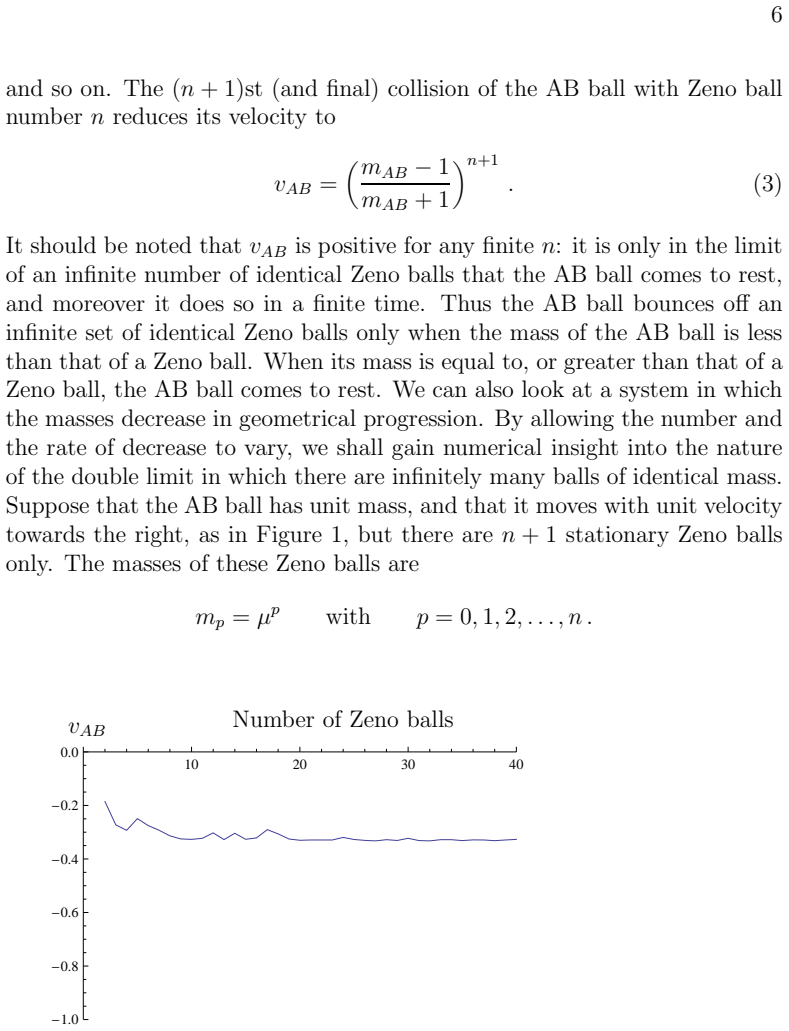
- In finite systems of identical stationary balls, the approaching ball rebounds when lighter than a stationary ball and, when equal or heavier, its final velocity tends to zero as the number of balls grows.
Reading between the lines
- The inconsistency may be an artifact of idealizing point masses as both zero-size and impenetrable; a model with finite-radius balls or with point masses that can pass one another would not produce the contradiction, suggesting the impenetrability assumption carries the argument.
- The same prohibition on actual infinity would apply to any physical idealization that relies on an infinite collection, such as infinite lattices or thermodynamic limits, which are usually treated as potential limits; drawing that boundary is left open.
- The paper's finite-system asymptotics yield a concrete check: simulate an incoming ball against a growing chain of stationary balls with decreasing masses and test whether the final velocity converges to the predicted limit, which would test the domain restriction without invoking actual infinity.
Signed reviews
Editorial analysis
A structured set of objections, weighed in public.
Referee Report
Summary. The paper considers the Alper–Bridger variant of the Zeno-balls supertask, in which a ball approaches an actually infinite set of point masses located at Zeno points. It argues that the four stated conditions describing this system are logically inconsistent, so that the correct response to supertask arguments for energy non-conservation and indeterminism is to exclude actual infinities from the domain of Newtonian and relativistic mechanics, keeping only finite or potentially infinite systems. The paper derives the final velocity of the moving ball for finite systems of identical balls and presents numerical simulations for geometrically decreasing masses, using these to infer the behavior of the potentially infinite system.
Significance. If the inconsistency claim is correct, the paper would provide a principled resolution of a long-standing debate: supertask-based violations of energy conservation and determinism would be shown not to follow from mechanics, because the scenarios that generate them involve an actual infinity, which falls outside the domain of the laws. The finite-n formula (3) is transparent and useful, and the paper is commendably explicit about the 'discontinuity at infinity' and about the stipulative character of the proposed domain restriction. However, the central logical proof is compressed, and the numerical inference for the potential-infinite case is not rigorously grounded; both points need attention before the main conclusion is established.
major comments (3)
- [§2, conditions (1)–(4) and Fig. 1] The central claim that the Alper–Bridger system is logically inconsistent is asserted too quickly. The sentence 'an infinite number of Zeno balls should have blocked its way' is not derived in the text; condition (3) only says that the moving ball comes to rest when it occupies the same position as a stationary ball, and it does not explicitly say that it remains at rest thereafter. Please expand the argument: after reaching the origin, the AB ball would coincide with a Zeno ball at each time 2^{-k}; by condition (3) and Newton's first law it would then remain at rest, so at time 1 it would have to be both at position 1/2 (from the rest at t=1/2) and at position 1 (from constant motion), a contradiction. If 'comes to rest' is intended as only an instantaneous event, an explicit axiom of permanent rest is needed; as printed, the inconsistency is conditional on an unstated reading.
- [§3, Figs. 2–4 and the Cesàro-mean passage] The inference from the finite-n simulations to the potential-infinite behaviour relies on the Cesàro mean, but the authors explicitly note that the sequence v_AB does not converge as n→∞. A Cesàro mean is a summability method, not a physical law; different summation methods generally give different limits, so the 'asymptote' read off the smoothed curves is a numerical extrapolation rather than a consequence of Newtonian mechanics. Please either prove (or state as a definition) that the potential-infinite final velocity is the Cesàro or other specified mean of the finite-n results, or present the finite-n results only as numerical illustrations and refine the claim that 'we can easily answer the question as to what happens to the AB ball.'
- [§4, 'forced by logic' and 'we stipulate'] There is a tension between saying that the restriction to potential infinity is 'forced by logic' and the later statement that 'we stipulate that systems involving an actual infinity of elements do not lie within the domain' of mechanics. If the restriction is stipulated, then the paper has not shown that Laraudogoitia-style conclusions are non sequiturs; it has chosen a convention that avoids them. Please state clearly which claim is intended: either the scenario is inconsistent under the stated physical rules (which requires the proof requested above), or the ban is a definitional choice, in which case 'forced by logic' should be withdrawn.
minor comments (4)
- [Appendix] The collision-update equations in the Appendix appear to have the coefficients in the formula for vnew_{k-1} interchanged; for equal masses the printed formula leaves v_{k-1} unchanged, which contradicts the equal-mass collision behavior described in §3. Please verify and correct the formula.
- [References] References [5] and [9] are the same Alper–Bridger paper and should be consolidated; references [3] and [7] are cited as 'to be published' and should be updated with publication data.
- [Miscellaneous typos] The author affiliation line contains 'Netherland s' with a stray space, and §4 contains 'familiar' for 'familiar'; these typos should be corrected.
- [Figure 6] Figure 6's vertical axis labels appear garbled ('10 10 10 10'); please relabel the logarithmic axis with proper powers of ten.
Circularity Check
No significant circularity: the §2 inconsistency is argued from the stated collision conditions, the finite-n simulations are independent checks, and the domain restriction is an explicit stipulation rather than a fitted prediction.
full rationale
The paper's central derivation is the inconsistency claim in Section 2. That claim is argued directly from the four listed conditions (stationary point masses at Zeno points; a moving AB ball; the equal-mass collision rule "when the moving mass point occupies the same position as a stationary mass point, it comes to rest"; and rest before reaching point 1), not from any fitted parameter or from prior papers. The finite-n calculations in Section 3 are independent numerical integrations of the elastic collision formula and are not used to fit the contradiction. The conclusion that restricting mechanics to finite or potentially infinite systems restores conservation and determinism is openly stipulated rather than derived: the paper states that the physicist "defines an infinite system to be the conceptual result of allowing a finite system to grow without bound" and later says "To remove the absurdity we stipulate that systems involving an actual infinity of elements do not lie within the domain of Newtonian, or of Einsteinian mechanics." These are explicit definitional choices, not hidden reductions. Self-citations to the authors' previous work I, [4], and [7] are background: they support the generalized relativistic version, time-reversal properties, and prior treatments of isomorphic systems, but the Section 2 contradiction does not reduce to those citations. The only genuinely contestable move is the sentence "But this is also impossible, since an infinite number of Zeno balls should have blocked its way," which is asserted rather than derived from the stated conditions; that is a missing justification or correctness risk, not a circular step, because the conclusion is not presupposed by the premises. Thus the derivation is self-contained in the sense relevant to circularity analysis.
Assumptions & free parameters
free parameters (2)
- mu =
0.5, 0.7, 0.95 in figures
- m_AB =
varied from below 1 to 10000 (log scale)
assumptions (4)
- domain assumption Equal-mass elastic collision of point masses in one dimension exchanges velocities; general collision formula v_new = (M-m)/(M+m)v.
- domain assumption The Zeno balls are point masses at exactly the Zeno points, with no ball at the accumulation point.
- domain assumption An infinite physical system is understood as the limit of finite systems, and physical quantities are those with finite limits.
- standard math Classical logic, including ex falso quodlibet, is used to reject the actual-infinite scenario once its conditions are inconsistent.
Cite this review
Pith. "Pith review of Nonconservation of Energy and Loss of Determinism II: Colliding with an Open Set." pith.science (2026). https://pith.science/paper/5L5KKJ6M
@misc{pith2026190809865,
  author       = {Pith},
  title        = {Pith review of: Nonconservation of Energy and Loss of Determinism II: Colliding with an Open Set},
  year         = {2026},
  howpublished = {\url{https://pith.science/paper/5L5KKJ6M}},
  note         = {Machine review of arXiv:1908.09865}
}
read the original abstract
An actual infinity of colliding balls can be in a configuration in which the laws of mechanics lead to logical inconsistency. It is argued that one should therefore limit the domain of these laws to a finite, or only a potentially infinite number of elements. With this restriction indeterminism, energy non-conservation and (creatio ex nihilo) no longer occur. A numerical analysis of finite systems of colliding balls is given, and the asymptotic behavior that corresponds to the potentially infinite system is inferred.
Figures


Figures from the paper (3 more)


Reference graph
Works this paper leans on
-
[1]
Stanford Encyclopedia of Phi- losophy, Chapter 12 (2004)
Mendell, H.: Aristotle and Mathematics. Stanford Encyclopedia of Phi- losophy, Chapter 12 (2004). http://plato.stanford.edu/entries/aristotle-mathematics/#12
work page 2004
-
[2]
P´ erez Laraudogoitia, J.: A Beautiful Supertask. Mind 105, 81-83 (1996)
work page 1996
-
[3]
Infinitely many colliding balls
Atkinson, D., Johnson, P.: Nonconservation of Energy and Loss of De- terminism I. Infinitely many colliding balls. to be published in Founda- tions of Physics
-
[4]
Atkinson, D.: Losing energy in classical, relativistic and quantum me - chanics. Stud. Hist. Phil. Mod. Phys. 38, 170-180 (2007). Atkinson, D.: A relativistic Zeno process. Synthese 160, 5-12 (2008)
work page 2007
-
[5]
Alper, J.S., Bridger, M.: Newtonian Supertasks: A Critical Analysis . Synthese 114, 335-369 (1998)
work page 1998
-
[6]
British Journal for the Philosophy of Science 56, 179188 (2005)
Angel, L.: Evens and Odds in Newtonian Collision Mechanics. British Journal for the Philosophy of Science 56, 179188 (2005)
work page 2005
-
[7]
To be published in Philosophical Studies
Peijnenburg, J., Atkinson, D.: Lamps, cubes, balls and walls, Zeno problems and solutions”. To be published in Philosophical Studies
-
[8]
British Journal for the Philosophy of Science 49, pp
Earman, J., Norton, J.D.: Comments on Laraudogoitia’s ‘Classical P ar- ticle Dynamics, Indeterminism and a Supertask. British Journal for the Philosophy of Science 49, pp. 123-33 (1998)
work page 1998
Show all 14 references
-
[9]
Synthese 114, pp
Alper, J.S., Bridger, M.: Newtonian Supertasks: A Critical Analysis . Synthese 114, pp. 335-69 (1998)
1998
-
[10]
and Norton, J.D.: What is a New - tonian System? The Failure of Energy Conservation and Determinism in Supertasks
Alper, J.S., Bridger, M., Earman, J. and Norton, J.D.: What is a New - tonian System? The Failure of Energy Conservation and Determinism in Supertasks. Synthese 124, pp. 281-93 (2000)
2000
-
[11]
, Bridger, M., Alper, J.S.: Two Ways of L ooking at a Newtonian Supertask
P´ erez Laraudogoitia, J. , Bridger, M., Alper, J.S.: Two Ways of L ooking at a Newtonian Supertask. Synthese 131, pp. 173-189 (2002)
2002
-
[12]
Syn- these 131, pp
P´ erez Laraudogoitia, J.: On the Dynamics of Alper and Bridger. Syn- these 131, pp. 157-171 (2002). 15
2002
-
[13]
Dordrecht ; Boston : D
Earman, J.: A Primer on Determinism. Dordrecht ; Boston : D. Reidel Pub. Co. (1986)
1986
-
[14]
In [2006] Philosophy of Science Assoc
Norton, J.D.: The Dome: An Unexpectedly Simple Failure of Determ in- ism. In [2006] Philosophy of Science Assoc. 20th Biennial Mtg (Vanco u- ver): PSA 2006 Symposia
2006
Reviewed August 14, 2026 · model on record in the stance chip above.
Discussion (0). Continue with ORCID to comment.