REVIEW 5 major objections 5 minor 71 references
Planar pinning induced, lowering of vortex dimensionality and low field melting in a single crystal of Ba0.6K0.4Fe2As2
T0 review · 5 major / 5 minor · reviewed 2026-08-14 · deepseek-v4-flash
Pith's one-line read A pnictide superconductor melts its vortex lattice at fields of only tens of gauss, and the authors trace the cause to planar defects that reduce the vortices to nearly one dimension.
desk verdict Low-field 'melting' claim in a pnictide is intriguing and systematic, but the vortex-liquid identification is not proven; deserves refereeing with a demand for stronger evidence. read the letter →
The pith
A machine-rendered reading of the paper's core claim, the machinery that carries it, and where it could break.
The reading
What carries the argument
The load-bearing mechanism is the planar pinning geometry: arrays of strong, linear crystalline defects running along the c-axis and arranged in planes through the crystal thickness. These planes lower the local lower critical field, guide vortex penetration, confine vortices to nearly one dimension, and serve as nucleation sites for melting. The quantitative anchor is the low-field Lindemann melting form B_m approximately (Phi_0 / 4 $lambda^{2}$) [ln(4 pi $c_L^{2}$ / ((3 pi)^(1/4)) * xi_0 / ($\lambda$ T))]^{-2}, with c_L = 0.14; the same criterion with c_L = 0.2 supplies the high-field melting boundary. The experimental instrument is differential magneto-optical imaging, in which the difference between images taken at applied fields separated by 1 G is used to map local changes in vortex density: regions where the local field change exceeds the applied step are read as vortex liquid.
What would settle it
Image the same crystal at about 30 G and 33.5 K with a local probe capable of resolving individual vortices, such as scanning Hall microscopy. If the bright finger-like regions that show a field change larger than 1 G contain a static, ordered vortex arrangement rather than a fluctuating liquid, the central claim is falsified; a negative control, applying the same field modulation above the critical temperature, should show no such contrast, and if it does, the interpretation fails.
Extended reading notes
Core claim
The paper's central claim is that in Ba0.6K0.4Fe2As2 the dilute vortex solid melts into a vortex liquid at applied fields of order 10 to 50 G, well below the interaction-dominated rigid solid that appears above roughly 200 G. The evidence is a local change in vortex density of about 3 G, seen with differential magneto-optical imaging in response to a 1 G field step, at fixed positions inside the crystal where bright finger-like fronts enter from the edges. The melting boundary B_m(T) follows the low-field Lindemann melting line with c_L = 0.14, using lambda_0 about 200 nm and anisotropy gamma about 1.22. Magnetization scaling with D = 1.2 plus or minus 0.1 and angular-dependent hysteresis indicate that the vortices behave as nearly one-dimensional objects, which the paper attributes to planar arrays of extended defects crossing the sample thickness; these planes lower the local lower critical field, act as nucleation sites, and make the vortices strongly susceptible to thermal fluctuations. The region below B_m(T) is interpreted as a disordered low-field glassy vortex solid, and B_int(T) marks the boundary above which vortex-vortex interactions dominate.
Load-bearing premise
The load-bearing premise is that bright regions in the differential magneto-optical images, where the local field change exceeds the applied 1 G step, unambiguously indicate a vortex liquid phase; if those regions are instead weakly pinned zones responding strongly to field modulation, the melting line, the phase diagram, and the dimensionality argument all lose their foundation.
Editorial extensions
If this is right
- The low-field melting boundary lies close to the theoretically predicted Lindemann line, with the small offset attributed to the reduced vortex dimensionality.
- The vortex state between the liquid phase and the interaction boundary is a soft vortex solid; only above B_int(T) does a rigid, interaction-dominated solid form, and that solid melts on the high-field line that nearly coincides with the irreversibility line.
- The melting signature is observable only above about 0.4 Tc; below that temperature, strong pinning produces irreversibility that masks the transition.
- The entropy change estimated across the transition is small, about 0.001 k_B per Fe2As2 layer, which explains why the transition is difficult to detect without local imaging.
- The linear, finger-like shape of the nucleated liquid puddles is taken as direct evidence for melting initiated along the planar defect arrays, in contrast to circular puddles seen in other layered superconductors.
Reading between the lines
- If the planar defect arrays are the cause, then engineering or destroying such planes, for example by irradiation or by comparing crystals with different defect densities, should switch the low-field melting on or off; a controlled crystal series would test the mechanism directly.
- The quasi-one-dimensional vortex behavior implied by D about 1.2 places the vortex state near the threshold where thermal fluctuations prevent ordering, so even modest changes in disorder or anisotropy could shift the melting field substantially, making low-field melting a sensitive probe of pinning geometry.
- The same differential magneto-optical signature could be searched for in other iron-based superconductors with naturally occurring planar defects, and in samples with deliberately introduced columnar defects, to see whether low-field melting is generic or specific to this defect geometry.
- If melting indeed nucleates at the sample edge along the defect planes, then sample shape and edge conditions, not just bulk pinning, will determine where and when the liquid appears; this could affect magnetic hysteresis and current-carrying performance of practical conductors.
Signed reviews
Editorial analysis
A structured set of objections, weighed in public.
Referee Report
Summary. The manuscript reports a low-field (tens of gauss) vortex solid-to-liquid melting transition in a single crystal of Ba0.6K0.4Fe2As2 (Tc = 38 K), detected by differential magneto-optical (DMO) imaging. Bright finger-like regions with local field response δBz > δBa = 1 G are interpreted as a vortex liquid; the melting boundary Bm(T) is extracted from the maximum of (δBz − 1) and compared with the Lindemann-criterion low-field melting line of Blatter et al. (Eq. 1) using cL = 0.14. The authors further argue from magnetization scaling (D = 1.2 ± 0.1) and angular-dependent hysteresis loops that planar arrays of c-axis extended defects lower the vortex dimensionality, enhancing thermal fluctuations and precipitating the low-field melting. A phase diagram is constructed containing low-field glass, liquid, soft solid, rigid solid, and high-field melting regions.
Significance. If correct, this would be one of the first reports of low-field vortex melting in a pnictide superconductor and an unusual example of disorder-induced lowering of vortex dimensionality promoting thermal fluctuations. The DMO data are systematic, reproducible between isothermal and isofield runs, and the observed finger-like fronts have a clear field and temperature evolution. These are genuine strengths. However, the central identification of bright DMO regions with a vortex liquid is indirect, no bulk thermodynamic discontinuity is shown, and the comparison with theory is weakened by a fit-versus-prediction ambiguity for the Lindemann number. The physical picture is interesting and plausible, but the evidence as presented is not yet conclusive.
major comments (5)
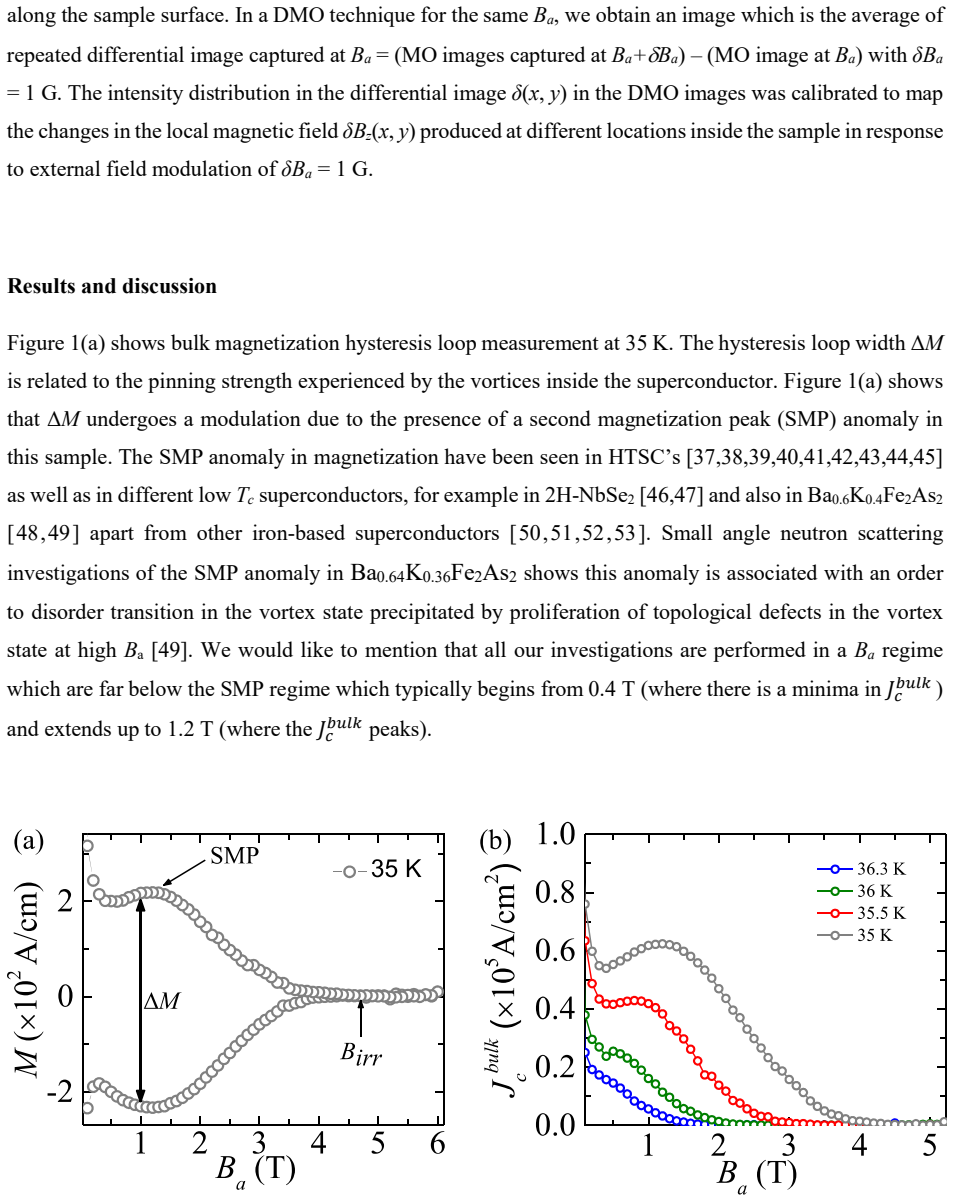
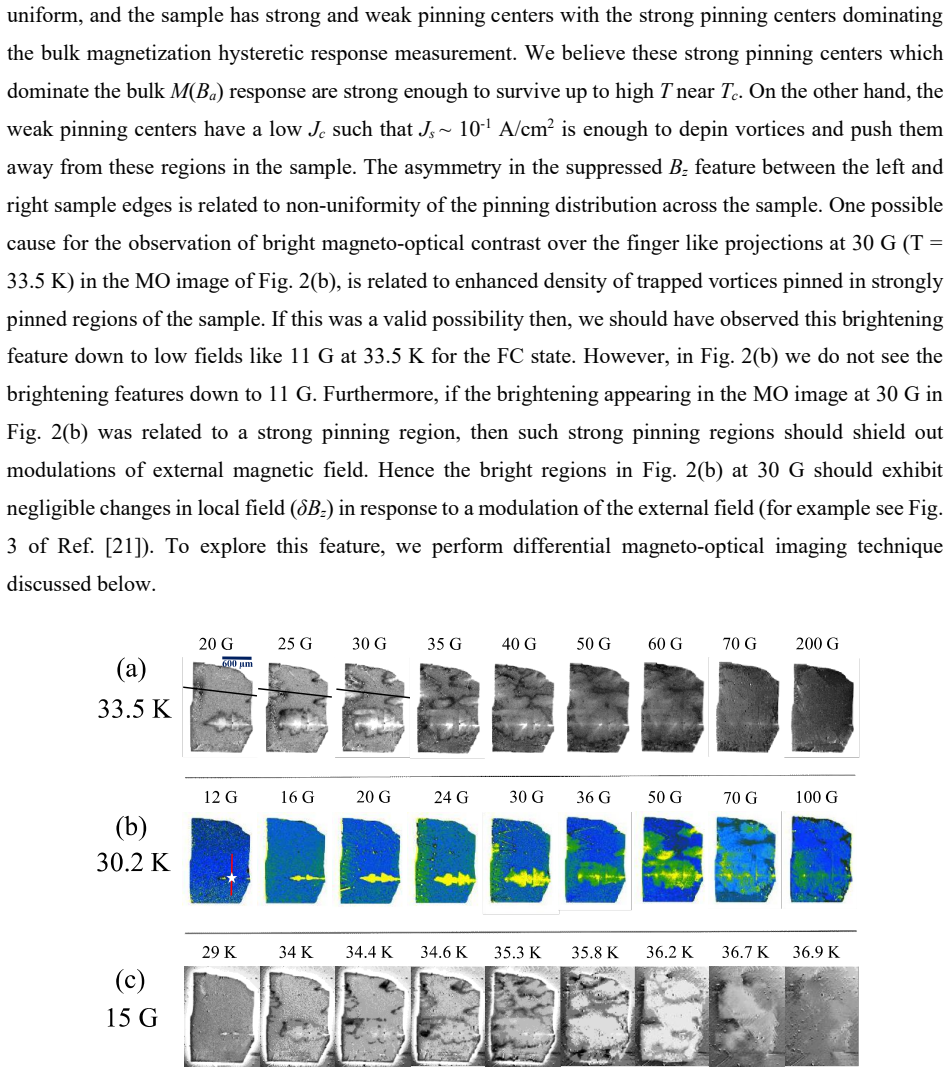
- [Results and discussion, Figs. 3 and 4 and Supplementary Fig. 1] The identification of bright regions with δBz > 1 G as a vortex liquid is not uniquely established. The authors' own Supplementary Fig. 1 shows that the same crystal batch permits preferential flux penetration along linear defect planes at fields below the bulk Bc1 in a zero-field-cooled state. In the field-cooled DMO measurements, a 1 G modulation can therefore produce locally enhanced δBz along these weak-pinning channels through nonlinear critical-state or geometrical-barrier response of the vortex solid, without any phase transition. The text argues only that strong-pinning regions would screen the modulation; it does not rule out enhanced response of weak-pinning channels, which are documented in the same crystal and coincide with the bright features. A control measurement across the bright-front boundary, or an independent local probe such as AC susceptibility or transport, is needed to confirm the liquid assignment.
- [Fig. 4(c), Eq. (1)] The agreement with the theoretical low-field melting line is partly constructed. The caption of Fig. 4(c) calls the red line a "fit to the low field melting line (Bm), equation 1", while the text calls it a "plot of eqn. (1) using cL = 0.14", and the abstract refers to the "theoretically predicted" melting line. If cL = 0.14 was adjusted to match the data, then the claimed proximity to the Lindemann line is not an independent test. The authors should state explicitly whether cL is fitted or fixed a priori, report the fitted value with confidence bounds if it is fitted, and show the comparison for a fixed, standard Lindemann number.
- [Fig. 4(b) and determination of Bm(T)] The melting field is defined as the maximum of a broad peak in (δBz − 1), not by an abrupt change in local field or in bulk magnetization. At 30.2 K the peak in (δBz − 1) extends roughly from 16 G to 50 G, so the choice of its maximum as the thermodynamic melting boundary is not self-evident. No bulk magnetization step or calorimetric anomaly is presented; the claimed change of about 3 G is a local DMO response, not a thermodynamic discontinuity. A high-resolution bulk magnetization, heat-capacity, or AC-susceptibility measurement across Bm(T) would be required to support the interpretation as a true phase transition.
- [Fig. 5(a) and entropy estimate (p. 17)] The claim of near-one-dimensional vortices rests on a scaling collapse with D = 1.2 ± 0.1 as a free parameter. This value is close enough to two-dimensional behavior that the collapse alone is not a strong discriminator, especially because the scaling window is very narrow and the collapse quality is not quantified. In addition, the entropy difference estimated in the text, dS ≈ 0.0008 kB per Fe2As2 layer, is extremely small and would produce a negligible bulk signal; this undercuts, rather than supports, the interpretation that the bright DMO features represent a thermodynamic first-order melting step.
- [Fig. 5(e) and angular-dependent magnetization] The proposed planar arrays of extended c-axis defects are inferred from angular-dependent magnetization and from the same DMO images used to define the melting line; no direct microstructural verification (e.g., TEM, electron backscatter diffraction, or decoration) is provided. Since the defect planes carry the entire dimensionality-reduction argument, the identification of the defect geometry should be supported by an independent structural observation or by an imaging method that resolves the defect planes directly.
minor comments (5)
- [p. 17] The sentence "We have removed the supplementary fig.1 as well as discussion about the second criteria" is an editorial remnant that must be removed; it is also inconsistent with the supplementary material, which contains Fig. 1, and the "second criteria" is never defined.
- [Fig. 4(c) caption] The caption and the text should use consistent wording: the red line cannot be both a "fit" and a "plot" of Eq. (1) with a fixed parameter unless the fitting procedure is fully disclosed.
- [Notation, Figs. 3 and 4] The notation δBa and dBa is used interchangeably in captions and text; please use a single symbol consistently.
- [Scaling analysis, Fig. 5(a)] The phrase "T/Tc(0) < 1%" is ambiguous: it should be clarified whether the analysis is restricted to temperatures within 1% of Tc, and the scaling collapse should be quantified (e.g., with residuals or a chi-square value) rather than shown only by eye.
- [Throughout] Several equations in the extracted text are garbled by LaTeX rendering issues (e.g., the expression for Js and Eq. (1)); the typeset equations should be checked carefully in the final version.
Circularity Check
The 'theoretically predicted' low-field melting line is a fit (cL = 0.14), and the vortex-liquid detection is built into the DMO bright-region labeling, so the central claim is only partially independent.
-
fitted input called prediction
[Fig. 4(c) caption and the paragraph introducing eqn (1), 'Results and discussion'.]
"The observed vortex melting phenomena is traced on a field temperature phase diagram and which lies very close to theoretically predicted Lindemann criteria based low field melting line. Our analysis shows a Lindemann number cL = 0.14 associated with the low field melting. ... The red color solid line is a fit to the low field melting line (Bm), equation 1 (see text below). ... In Fig. 4(c) the red line is a plot of eqn. (1) using cL = 0.14 [1]."
The paper presents eqn (1) with cL = 0.14 as 'theoretically predicted', yet the Fig. 4(c) caption calls the same red line 'a fit to the low field melting line'. If cL is obtained by fitting eqn (1) to the measured Bm(T) points, as the caption's wording and the phrase 'our analysis shows a Lindemann number cL = 0.14' imply, then the close agreement between data and the 'predicted' line is partly constructed by the fit rather than independently predicted. The paper never states that cL was fixed a priori, and a one-parameter fit cannot be called a parameter-free prediction.
-
self definitional
[Fig. 3 caption and the interpretation following Fig. 4(a)-(b).]
"gray (blue in Fig. (b)) region represents vortex density region δBz = dBa = 1 G and bright (yellow in Fig. (b)) region represents enhanced vortex density region with δBz > 1 G (vortex liquid; VL)."
The phase label 'vortex liquid; VL' is attached in the caption to every DMO-bright region (δBz > δBa = 1 G) by definition. The subsequent text identifies 'the brightening ... is related to vortex melting phase transition' and traces Bm(T) using the same bright regions. The detection of melting therefore reduces to threshold labeling unless an independent physical test establishes that δBz > 1 G is a thermodynamic phase transition; the paper argues this, but the caption's definitional labeling means the bare observation is not independent evidence. The alternate weak-pinning-channel and geometrical-barrier explanations are not quantitatively excluded.
full rationale
The paper's central experimental content—a reproducible, field/temperature-dependent change in local δBz at low fields and an apparent dimensional crossover in magnetization scaling—is not itself circular. The Lindemann line comparison, however, is weakened by the fit-versus-prediction ambiguity for cL, and the DMO bright-region identification is loaded into the caption as 'vortex liquid'. These two steps make the headline 'first low-field vortex melting in a pnictide' only partially independent of its own assumptions. The self-citations (Refs. 21, 24, 34, 36, 46, 47, 72) are methodological and do not by themselves create a load-bearing circular chain; the low-field melting formula is attributed to Blatter et al. (Ref. 1), an external source. An appended editorial remnant, 'We have removed the supplementary fig.1 as well as discussion about the second criteria', explicitly flags a missing piece of the phase-identification discussion, which further reduces confidence but is not itself a circular step. Overall score 6: one 'theoretically predicted' line is a fit, and the phase identification is partly definitional, so there is partial circularity in the central claim.
Assumptions & free parameters
free parameters (4)
- Lindemann number cL =
0.14
- Penetration depth at zero temperature λ0 =
≈ 200 nm
- Vortex dimensionality D =
1.2 ± 0.1
- Anisotropy γ =
1.22 ± 0.11
assumptions (4)
- domain assumption Lindemann criterion for vortex melting, ⟨u²⟩ = cL² a0², with cL an empirical constant.
- domain assumption Low-field melting formula (eqn 1) taken from Refs [1,15] for a clean, pin-free 3D vortex lattice.
- domain assumption Scaling collapse hypothesis (Refs 64-69) relating M(T,H) to vortex dimensionality D.
- ad hoc to paper DMO response δBz > δBa marks a vortex liquid phase.
invented entities (1)
-
Planar arrays of extended linear defects (defect planes) extending along the c-axis
Cite this review
Pith. "Pith review of Planar pinning induced, lowering of vortex dimensionality and low field melting in a single crystal of Ba0.6K0.4Fe2As2." pith.science (2026). https://pith.science/paper/X2ZDGGUY
@misc{pith2026190809897,
  author       = {Pith},
  title        = {Pith review of: Planar pinning induced, lowering of vortex dimensionality and low field melting in a single crystal of Ba0.6K0.4Fe2As2},
  year         = {2026},
  howpublished = {\url{https://pith.science/paper/X2ZDGGUY}},
  note         = {Machine review of arXiv:1908.09897}
}
read the original abstract
Theoretically, the vortex melting phenomenon occurs at both low and high magnetic fields at a fixed temperature. While the high field melting has been extensively investigated in high Tc cuprates, the low field melting phenomena in the presence of disorder hasn't been well explored. Using bulk magnetization measurement and high-sensitivity differential magneto-optical imaging technique, we detect a low-field vortex melting phenomenon in a single crystal of Ba0.6K0.4Fe2As2. The low field melting is accompanied by a significant change in local magnetization ~ 3 G, which decreases with increasing applied field. The observed vortex melting phenomena is traced on a field temperature phase diagram and which lies very close to theoretically predicted Lindemann criteria based low field melting line. Our analysis shows a Lindemann number cL = 0.14 associated with the low field melting. Imaging of low-field vortex melting features shows the process nucleates via formation of extended finger-like projections which spreads across the sample with increasing field or temperature, before entering into an interaction-dominated vortex solid phase regime. Magnetization scaling analysis shows that the dimensionality of melting vortex state is close to one. Angular dependence of bulk magnetization hysteresis loop in our sample shows the presence of extended defects. From our studies, we propose the sample contains a peculiar geometry of extended defects arranged in a plane in the sample, with these planes extending through the sample thickness. In the weak intervortex interaction limit, we argue that reduced vortex dimensionality due to pinning by these peculiar extended defect planes strongly enhances thermal fluctuations. It is these extended defects planes, which we propose are promoting low dimensional vortex melting in the pnictide system.
Figures

Figures from the paper (2 more)


Reference graph
Works this paper leans on
-
[1]
G. Blatter, M. V. Fiegel’man, V. B. Geshkenbein, A. I. Larkin, and V. M. Vinokur, Rev. Mod. Phys. 66, 1125 (1994)
work page 1994
-
[2]
A. A. Abrikosov, Zh. Eksp. Teor. Fiz. 32, 1442-1452 (1957); [Sov. Phys. JETP 5, 1174-1182 (1957)]
work page 1957
-
[3]
D. R. Nelson, Phys. Rev. Lett. 60, 1973 1988; D. R. Nelson and H. S. Seung, Phys. Rev. B 39, 9153 (1989)
work page 1989
-
[4]
P. L. Gammel,L. F. Schneemeyer, J. V. Waszczak, and D. J. Bishop, Phys. Rev. Lett. 61, 1666 (1988)
work page 1988
-
[5]
E. H. Brandt, Phys. Rev. Lett 63, 1106 (1989)
work page 1989
-
[6]
E. H. Brandt, Int. J. Mod. Phys. B 5, 751 (1991)
work page 1991
-
[7]
E. H. Brandt, Rep. Prog. Phys. 58, 1465 (1995)
work page 1995
-
[8]
M. A. Moore, Phys. Rev. B 39, 136 (1989); A. Houghton, R. A. Pelcovits, and A. Sudbø, Phys. Rev. B 40, 6763 (1989)
work page 1989
Show all 71 references
-
[9]
P. L. Gammel, L. F. Schneemeyer, and D. J. Bishop, Phys. Rev. Lett 66, 953 (1991)
1991
-
[10]
D. S. Fisher, M. P. A. Fisher, and D. A. Huse, Phys. Rev. B 43, 130 (1991)
1991
-
[11]
Giamarchi and P Le Doussal, Phys
T. Giamarchi and P Le Doussal, Phys. Rev. Lett. 72, 1530 (1994); Phys. Rev. B 52, 1242 (1995) and references therein
1994
-
[12]
Gingras and D
M. Gingras and D. A. Huse, Phys. Rev. B 53, 15193 (1996)
1996
-
[13]
Giamarchi and Pierre Le Doussal, Spin Glasses and Random Fields , A
T. Giamarchi and Pierre Le Doussal, Spin Glasses and Random Fields , A. P. Young ed., (World Scientific, Singapore, 1998)
1998
-
[14]
Natterman and S
T. Natterman and S. Scheidl, Adv. Phys. 49, 607 (2000)
2000
-
[15]
Blatter, V
G. Blatter, V. B. Geshkenbein, A. Larkin, and H. Nordborg, Phys. Rev. B 54, 72 (1996)
1996
-
[16]
Blatter and B
G. Blatter and B. Ivlev, Phys. Rev. B 50, 10272 (1994); L. I. Glazman and A. E. Koshelev, Phys. Rev. B 43, 2835 (1991)
1994
-
[17]
R. B. van Dover, L. F. Schneemeyer, E. M. Gyorgy, and J. V. Waszczak, Phys. Rev. B 39, 4800(R) (1989); D. E. Farrell, J. P. Rice, and D. M. Ginsberg, Phys. Rev. Lett. 67, 1165 (1991); H. Safar, P. L. Gammel, D. A. Huse, D. J. Bishop, J. P. Rice, and D. M. Ginsberg, Phys. Rev. ...
1989
-
[18]
Zeldov, D
E. Zeldov, D. Majer, M. Konczykowski, V. B. Geshkenbein, V. M. Vinokur, and H. Shtrikman, Nature 375, 373 (1995)
1995
-
[19]
Schilling, R
A. Schilling, R. A. Fisher, N. E. Phillips, U. Welp, D. Dasgupta, W. K. Kwok, and G. W. Crabtree, Nature 382, 791 (1996)
1996
-
[20]
Colson, M
S. Colson, M. Konczykowski, M. B. Gaifullin, Y. Matsuda, P. Gierlowski, M. Li, P. H. Kes, and C. J. van der Beek, Phys. Rev. Lett. 90, 137002 (2003)
2003
-
[21]
S. S. Banerjee, A. Soibel, Y. Myasoedov, M. Rappaport, E. Zeldov, M. Menghini, Y. Fasano, F. de la Cruz, C. J. van der Beek, M. Konczykowski, and T. Tamegai, Phys. Rev. Lett. 90, 087004 (2003)
2003
-
[22]
M. J. W. Dodgson, A. E. Koshelev, V. B. Geshkenbein, and G. Blatter, Phys. Rev. Lett. 84, 2698 (2000). 23 A. Crisan, S. J. Bending, Z. Z. Li, and H. Raffy, Supercond. Sci. Technol. 24 115001 (2011)
2000
-
[24]
G. Shaw, P. Mandal, S. S. Banerjee, and T. Tamegai, New J. Phys. 14, 083042 (2012)
2012
-
[25]
J. P. Lv, and Q. H. Chen, Phys. Rev. B 78, 144507 (2008)
2008
-
[26]
Q. H. Chen, Q. M. Nie, J. P. Lv, and T. C. Au Yeung, New J. Phys. 11, 035003 (2009)
2009
-
[27]
Avraham et
N. Avraham et. al., Nature 411, 451 (2001)
2001
-
[28]
Y. Yin, M. Zech, T. L. Williams, X. F. Wang, G. Wu, X. H. Chen, and J. E. Hoffman Phys. Rev. Lett. 102, 097002 (2009)
2009
-
[29]
C. L. Song, Y. Yin, M. Zech, T. Williams, M. M. Yee, G. F. Chen, J. L. Luo, N. L. Wang, E. W. Hudson, and J. E. Hoffman, Phys. Rev. B 87, 214519 (2013)
2013
-
[30]
C. J. van der Beek et. al., Phys. Rev. B 81, 174517 (2010)
2010
-
[31]
Shan, Nat
L. Shan, Nat. Phys.7, 325 (2011)
2011
-
[32]
H. K. Mak, P. Burger, L. Cevey, T. Wolf, C. Meingast, and R. Lortz, Phys. Rev. B 87, 214523 (2013)
2013
-
[33]
T. Taen, F. Ohtake, H. Akiyama, H. Inoue, Y. Sun, S. Pyon, T. Tamegai, and H. Kitamura, Phys. Rev. B 88, 224514 (2013)
2013
-
[34]
Mandal, D
P. Mandal, D. Chowdhury, S. S. Banerjee, and T. Tamegai, Rev. Sci. Instrum. 83, 123906 (2012)
2012
-
[35]
A. A. Polyanskii, D. M. Feldmann, and D. C. Larbalestier, Magneto-optical characterization techniques Handbook of Superconducting Materials,2 ed D. A. Cardwell and D. S. Ginley (Bristol: Institute of Physics Publishing, 2003)
2003
-
[36]
Soibel, E
A. Soibel, E. Zeldov, M. Rappaport, Y. Myasoedov, T. Tamegai, S. Ooi, M. Konczykowski, and V. B. Geshkenbein, Nature 406, 282–7 (2000); A. Soibel, Y. Myasoedov, M. L. Rappaport, T. Tamegai, S. S. Banerjee and E. Zeldov, Phys. Rev. Lett. 87, 167001 (2001)
2000
-
[37]
Daeumling, J
M. Daeumling, J. M. Seuntjens, and D. C. Larbalestier, Nature (London) 346, 332-335 (1990); M. F. Goffman, J. A. Herbsommer, F. de la Cruz, T. W. Li, and P. H. Kes, Phys. Rev. B 57, 3663 (1998) and references therein. 21
1990
-
[38]
Tamegai, Y
T. Tamegai, Y. Iye, I. Oguro, and K.Kishio, Physica C 213, 33 (1993); B. Khaykovich, E. Zeldov, D. Majer, T. W. Li, P. H. Kes and M. Konczykowski, Phys. Rev. Lett. 76, 2555 (1996)
1993
-
[39]
Ertas and D
D. Ertas and D. R. Nelson, Physica C 272, 79 (1996)
1996
-
[40]
Khaykovich, M
B. Khaykovich, M. Konczykowski, E. Zeldov, R. A. Doyle, D. Majer, P. H. Kes, and T. W. Li, Phys. Rev. B 56, 517(R) (1997)
1997
-
[41]
Deligiannis, P
K. Deligiannis, P. A. J. de Groot, M. Oussena, S. Pinfold, R. Langan, R. Gangon, and L. Taillefer, Phys. Rev. Lett. 79, 2121 (1997); H. Ku¨pfer, Th. Wolf, C. Lessing, A. A. Zhukov, X. Lancon, R. Meier-Hirmer, W. Schauer, and H. Wu¨hl, Phys. Rev. B 58, 2886 (1998); S. Okayasu a...
1997
-
[42]
Giller, A
D. Giller, A. Shaulov, R. Prozorov, Y. Abulafia, Y. Wolfus, L. Burlachkov, Y. Yeshurun, E. Zeldov, V. M. Vinokur, J. L. Peng, and R. L. Greene, Phys. Rev. Lett. 79, 2542 (1997)
1997
-
[43]
Nishizaki, T
T. Nishizaki, T. Naito and N. Kobayashi, Phys. Rev. B 58, 11169 (1998); Physica C 282-287, 2117 1997; 317-318, 645 (1999)
1998
-
[44]
Giller, A
D. Giller, A. Shaulov, Y. Yeshurun, and J. Giapintzakis, Phys. Rev. B 60, 106 (1999)
1999
-
[45]
Kokkaliaris, P
S. Kokkaliaris, P. A. J. de Groot, S. N. Gordeev, A. A. Zhukov, R. Gagnon, and L. Taillefer, Phys. Rev. Lett. 82, 5116 (1999)
1999
-
[46]
S. S. Banerjee et al., Phys. Rev. B 62, 11838 (2000)
2000
-
[47]
Mohan, J
S. Mohan, J. Sinha, S. S. Banerjee, and Y. Myasoedov, Phys. Rev. Lett. 98, 027003 (2007)
2007
-
[48]
H. Yang, H. Q. Luo, Z. S. Wang, and H. H. Wen, Appl. Phys. Lett. 93, 142506 (2008)
2008
-
[49]
Demirdiş, C
S. Demirdiş, C. J. van der Beek, S. Mühlbauer, Y. Su, and T. Wolf, J. Phys. Cond. Matt. 28, 425701 (2016)
2016
-
[50]
Prozorov, N
R. Prozorov, N. Ni, M. A. Tanatar, V. G. Kogan, R. T. Gordon, C. Martin, E. C. Blomberg, P. Prommapan, J. Q. Yan, S. L. Bud’ko, and P. C. Canfield, Phys. Rev. B 78, 224506 (2008)
2008
-
[51]
Prozorov, M
R. Prozorov, M. A. Tanatar, E. C. Blomberg, P. Promma-pan, R. T. Gordon, N. Ni, S. L. Bud’ko, and P. C. Canfield, Physica C 469, 667 (2009)
2009
-
[52]
Prozorov, M
R. Prozorov, M. A. Tanatar, N. Ni, A. Kreyssig, S. Nandi, S. L. Bud’ko, A. I. Goldman, and P. C. Canfield, Phys. Rev. B 80, 174517 (2009)
2009
-
[53]
Nakajima, Y
Y. Nakajima, Y. Tsuchiya, T. Taen, T. Tamegai, S. Okayasu, and M. Sasase, Phys. Rev. B 80, 012510 (2009)
2009
-
[54]
C. P. Bean, Rev. Mod. Phys. 36, 31 (1964)
1964
-
[55]
H. P. Wiesinger, F. M. Sauerzopf, and H. W. Weber, Physica C 203, 121 (2003)
2003
-
[56]
Zeldov, A
E. Zeldov, A. I. Larkin, V. B. Geshkenbein, M. Konczykowski, D. Majer, B. Khaykovich, V. M. Vinokur, and H. Shtrikman, Phys. Rev. Lett. 73, 1428 (1994). 22
1994
-
[57]
Khaykovich, M
B. Khaykovich, M. Konczykowski, K. Teitelbaum, E. Zeldov, H. Shtrikman, and M. Rappaport, Phys. Rev. B 57, 14088(R) (1998)
1998
-
[58]
E. H. Brandt, Phys. Rev. B 59, 2269 (1999)
1999
-
[59]
R. J. Wijngaarden, K. Heeck, H. J. W. Spoelder, R. Surdeanu, and R. Griessen, Physica C 295, 177 (1998)
1998
-
[60]
E. H. Brandt, G. P. Mikitik, and E. Zeldov, J. Exp. Theor. Phys.117, 439 (2013)
2013
-
[61]
P. E. Goa, H. Hauglin, A. A. F. Olsen, D. Shantsev, and T. H. Johansen, Appl. Phys. Lett. 82, 79 (2003)
2003
-
[62]
U. Welp, R. Xie, A. E. Koshelev, W. K. Kwok, H. Q. Luo, Z. S. Wang, G. Mu, and H. H. Wen, Phys. Rev. B 79, 094505 (2009)
2009
-
[63]
Gurevich, Rep
A. Gurevich, Rep. Prog. Phys. 74, 124501 (2011)
2011
-
[64]
U. Welp, S. Fleshier, W. K. Kwok, R. A. Klemm, V. M. Vinokur, J. Downey, B. Veal, and G. W. Crabtree, Phys. Rev. Lett. 67, 3180 (1991)
1991
-
[65]
Tesanovic, L
Z. Tesanovic, L. Xing, L. Bulaevskii, Q. Li, and M. Suenaga, Phys. Rev. Lett 69, 3563 (1992)
1992
-
[66]
Q. Li, K. Shibutani, M. Suenaga, I. Shigaki, and R. Ogawa, Phys. Rev B 48, 9877 (1993)
1993
-
[67]
A. Wahl, V. Hardy, F. Warmont, A. Maignan, M. P. Delamare, and Ch. Simon, Phys. Rev. B 55, 3929 (1997)
1997
-
[68]
Rosenstein, B
B. Rosenstein, B. Ya. Shapiro, R. Prozorov, A. Shaulov, and Y. Yeshurun, Phys. Rev. B 63, 134501 (2001)
2001
-
[69]
Salem-Sugui, L
S. Salem-Sugui, L. Ghivelder, A. D. Alvarenga, J. L. Pimentel, H. Luo, Zh. Wang, and H. H. Wen, Phys Rev. B 80, 014518 (2009)
2009
-
[71]
N. D. Mermin and H. Wagner, Phys. Rev. Lett. 17, 1133 (1966)
1966
-
[72]
Sen et al, Phys
P. Sen et al, Phys. Rev. Lett. 80, 4092 (2001); S. S. Banerjee et. al. Phys. Rev. Lett. 93, 097002 (2004). Planar pinning induced, lowering of vortex dimensionality and low field melting in a single crystal of Ba0.6K0.4Fe2As2: Supplementary Material Ankit Kumar1, Sayantan Ghos...
2001
-
[73]
Tinkham, Introduction to Superconductivity, second edition, (Mc Graw-Hill, Inc., New York, 1996)
M. Tinkham, Introduction to Superconductivity, second edition, (Mc Graw-Hill, Inc., New York, 1996)
1996
Reviewed August 14, 2026 · model on record in the stance chip above.
Discussion (0). Continue with ORCID to comment.