REVIEW 4 major objections 4 minor 39 references
Collisionally inhomogeneous Bose-Einstein condensates with a linear interaction gradient
T0 review · 4 major / 4 minor · reviewed 2026-08-14 · deepseek-v4-flash
Pith's one-line read A linear interaction gradient alone makes a Bose–Einstein condensate form, collapse, and regenerate soliton-like density peaks, as captured by the nonpolynomial Schrödinger equation with three-body loss.
desk verdict A genuine first experimental realization of a linear interaction gradient in a BEC, with clear observations of soliton-like peak formation, decay, and cascades; the modeling is honest but quantitatively fitted rather than predictive. read the letter →
The pith
A machine-rendered reading of the paper's core claim, the machinery that carries it, and where it could break.
The reading
What carries the argument
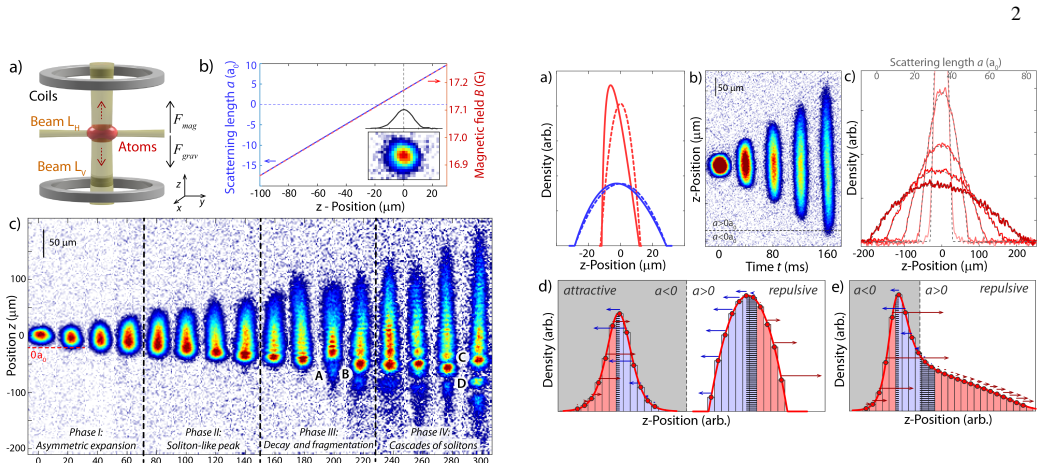
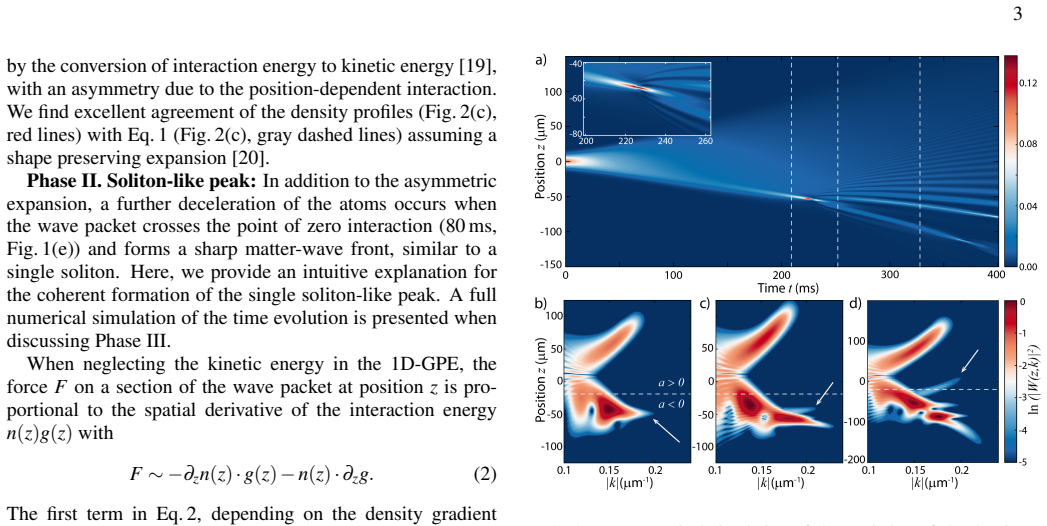
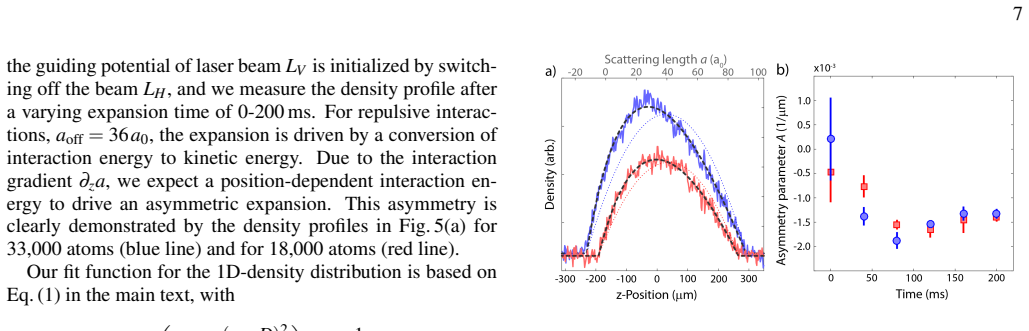
The load-bearing object is the position-dependent coupling $g(z)=g_{\rm off} + (\partial_z g)\,z$, carved from the cesium Feshbach spectrum by a magnetic field gradient that also levitates the cloud, so that $a(z)$ crosses zero over the extent of the wave packet. The dynamics are modelled with the nonpolynomial Schrödinger equation (NPSE)—a 1D effective equation with a Gaussian radial ansatz and a local width $\sigma(z,t)$ that depends on the local density and scattering length—supplemented by an imaginary three-body loss term, $-i\hbar L_3 N^2/(6\pi^2 a_r^4 \sigma^4)\,|f|^4$, which arrests the collapse of the soliton-like peak. The paper also introduces a two-term force decomposition, $F \sim -\partial_z n\cdot g - n\cdot\partial_z g$, the second term always accelerating sections toward smaller scattering lengths, which explains the asymmetric expansion and the coherent formation of the peak; and it applies a Gabor/Morlet wavelet transform to the simulated wave function to localise wave packets in position and momentum, revealing the counter-propagating reflection off the decaying soliton.
What would settle it
Independently measure the three-body loss coefficient $L_3$ for cesium at the relevant magnetic fields, for example from loss-rate curves in a uniform, non-levitated cloud, and then, without adjusting it, compare the NPSE prediction for the soliton decay time, the roughly $8\,\mu\mathrm{m}$ ripple spacing, and its slow increase with the absorption images; a mismatch beyond the stated uncertainties in atom number and trap frequencies would show the model is missing physics on the attractive side.
Extended reading notes
Core claim
The central claim is that a linear gradient of the s-wave scattering length, $a(z)=a_{\rm off} + (\partial_z a)\,z$, generated by a magnetic field gradient across a Feshbach resonance, acts as a coherent engine for matter-wave solitons. Starting from a repulsively interacting condensate in quasi-one-dimensional geometry, the authors observe a soliton-like peak form spontaneously on the attractive side as the cloud expands, grow and shrink as it moves toward stronger attraction, then decay at a well-defined time; the decay emits a counter-propagating wave packet that interferes with the incoming flow and creates a periodic ripple pattern, and for large atom numbers the ripples on the attractive side re-collapse into further soliton-like peaks. They argue that the mechanism is the competition between the density-gradient force, which spreads repulsive sections and contracts attractive sections, and the interaction-gradient force, which always pushes atoms toward smaller scattering lengths. Numerical integration of the nonpolynomial Schrödinger equation with a three-body loss term reproduces the phases, the soliton decay time, and the counter-propagating wave packets, and the authors use Gabor wavelet decompositions of the simulated wave function to identify the soliton, the reflected wave, and its propagation into the repulsive region.
Load-bearing premise
The interpretation stands or falls on the nonpolynomial Schrödinger equation with a three-body loss term being quantitatively reliable for the dense attractive side of the cloud—the authors note that the effective-action minimisation can have non-negligible corrections for large scattering lengths and loss, and they set the loss coefficient $L_3 = 5\times10^{-28}\,\mathrm{cm^6/s}$ specifically to match the observed soliton decay time.
Editorial extensions
If this is right
- A steady linear interaction gradient is sufficient to create bright soliton-like structures from a repulsive condensate; no modulational-instability seeding, interference pattern, or interaction quench is needed.
- Three-body loss does not merely destroy the soliton-like peak; it sets the collapse time and, through the emitted counter-propagating wave packet, seeds the ripple pattern that later turns into new solitons.
- The counter-propagating wave packet is a partial reflection of the incoming matter wave off the sharp edges of the decaying soliton, and the resulting interference ripples propagate across the zero-crossing of the scattering length without changing character.
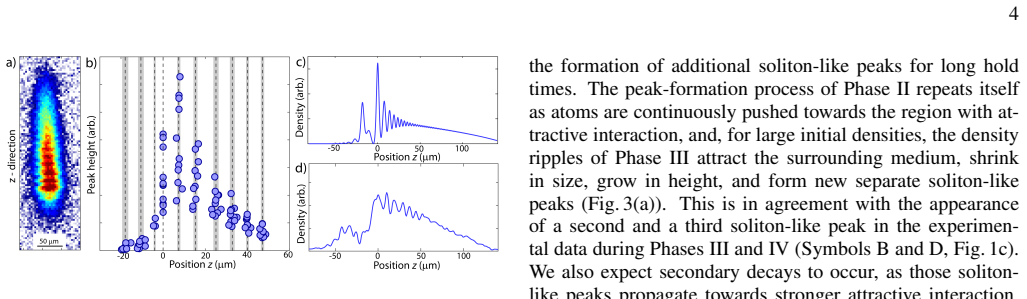
- For sufficiently large initial atom numbers, the attractive-side ripples collapse one after another, producing a cascade of soliton-like peaks that can repeat, so the gradient acts as a self-sustaining source of solitons.
Reading between the lines
- If the reflection picture is right, the amplitude and velocity of the counter-propagating wave packet should scale predictably with the soliton's sharpness and the gradient strength; measuring that scaling would test the mechanism without relying on the full simulation.
- The same design—a spatially varying nonlinearity that pushes energy into a localised structure until loss or dispersion makes it emit—should appear in other nonlinear wave media, such as optics or hydrodynamics, where a graded nonlinear coefficient could produce a similar cascade.
- By engineering $a(z)$ beyond a linear ramp, for example using the Feshbach spectrum or an additional optical resonance, the cascade timing and direction could be controlled, potentially offering a deterministic matter-wave soliton source or a probe of collapse in low dimensions.
Editorial analysis
A structured set of objections, weighed in public.
Referee Report
Summary. The paper reports an experimental study of a quasi-1D Bose-Einstein condensate whose s-wave scattering length varies linearly along the axial direction, so that a single matter wave expands into both repulsive and attractive regions. The authors observe four dynamical phases: asymmetric expansion, formation of a soliton-like density peak, decay of this peak with counter-propagating density ripples, and cascades of subsequent soliton-like peaks. They model the dynamics with the nonpolynomial Schrödinger equation (NPSE) augmented by a three-body loss term, and use a Gabor wavelet decomposition of the simulated wave function to interpret the observed structures as reflection and interference of counter-propagating wave packets. The central claim is that the NPSE with three-body loss reproduces the observed matter-wave dynamics, thereby explaining the collapse and cascade mechanisms.
Significance. If the central claim holds, this is a valuable first experimental demonstration of collisionally inhomogeneous quantum gas dynamics with a linear interaction gradient, in a regime that connects to bright soliton physics, collapse, and nonlinear pattern formation. The experiment itself is carefully done: the levitation scheme cancels gravity and the field gradient, the zero-crossing is precisely calibrated, and the four phases are clearly visible in absorption images independently of any model. Credit is also due for providing the NPSE simulations, for using wavelet analysis to visualize position- and momentum-resolved structures, and for openly documenting parameter uncertainties in the Supplemental Material. The quantitative agreement, however, rests on a fitted three-body loss coefficient and on a model whose regime of validity is acknowledged to be marginal in the high-density attractive region, so the predictive power of the model is not yet fully established.
major comments (4)
- [Supplemental II.B (Uncertainties of experimental parameters)] The claimed quantitative agreement for the soliton decay time is weakened because the three-body loss coefficient L3 is explicitly chosen to best match the observed decay time. The text states that L3 = 5e-28 cm^6/s was selected because it 'best matches' the experimentally observed decay, within a range spanning an order of magnitude. This makes the decay-time comparison a fit rather than an independent test. The paper should show the simulated decay time as a function of L3 across the quoted uncertainty range (including the resulting uncertainty in the decay time), and should temper the abstract's 'well reproduced' phrasing accordingly.
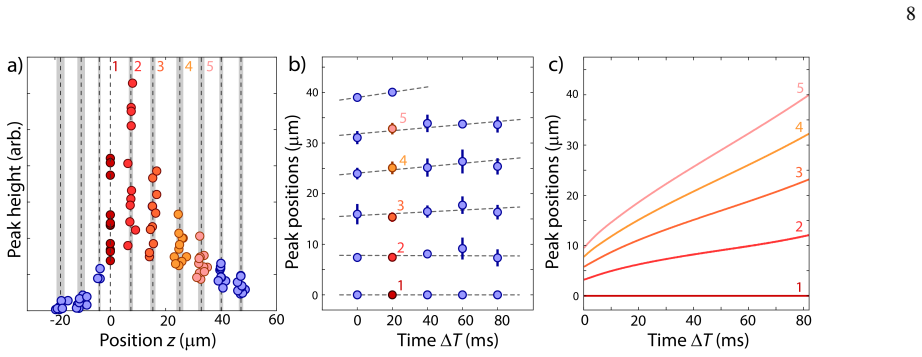
- [Supplemental II.C (Density ripples, Fig. 6)] The quantitative reproduction of the ripple spacing, which is the other quantitative observable, is not achieved. Figure 6 shows that the simulated inter-peak distances grow from approximately 3 um to 10 um over 80 ms, while the measured spacings remain near 8 um with only a slow increase. The authors attribute this to different reference times and approximate knowledge of simulation parameters, but no quantitative assessment of these uncertainties is provided. Please provide a quantitative comparison, for example simulated ripple spacings with uncertainty bands arising from the listed parameter uncertainties, or explicitly state that the model reproduces the ripple pattern only qualitatively.
- [Supplemental I.B (Three-Body Loss)] The manuscript concedes that the effective-action minimization underlying the NPSE 'can have non-negligible corrections for large values of |a| and L3.' The soliton-like peak grows and shrinks precisely in the high-density, strongly attractive regime where these corrections matter, and the cascade and self-interference interpretation is drawn from the NPSE wave function in this regime. Please quantify the regime of validity along the actual trajectory, for example by checking the condition n|a|^3 << 1 and the smallness of the corrections in Eq. (8) for the parameters used in Figure 3, and discuss the impact on the interpreted mechanism if this condition is violated.
- [Main text, Phase III and Fig. 3] The counter-propagating wave packet and the self-interference interpretation are identified through the wavelet decomposition of the simulated NPSE wave function, not directly in the experimental absorption images. The experimental evidence consists of density ripples whose spacing is only qualitatively reproduced. The paper should explicitly distinguish model-inferred mechanisms from directly observed phenomena, and should discuss whether any experimental observable (e.g., the constancy of the ripple spacing across the zero-crossing) uniquely supports the counter-propagating-wave picture rather than, say, a purely local pattern-formation process.
minor comments (4)
- [References] References [27] and [34] cite the same paper (Salasnich, Parola, and Reatto, Phys. Rev. A 65, 043614 (2002)); please merge or disambiguate them.
- [Main text, Phase III] There is a typo in the phrase 'partial reection' in the discussion of the counter-propagating wave packet; it should read 'partial reflection'.
- [Fig. 1(c) and main text] The symbols A, B, C, and D are referenced in the text to identify peaks, but they are not labeled in Fig. 1(c); adding labels to the figure would improve clarity.
- [Supplemental II.C] The statement that the reference time is defined as 'a point in time after the decay of the soliton' is vague; specify the actual hold time or a precise criterion used for the experimental data in Fig. 6.
Circularity Check
Reported agreement for soliton decay time rests on a fitted three-body loss coefficient, but the core qualitative observations are independent of the model.
-
fitted input called prediction
[Supplemental Material, Section II.B, 'Uncertainties of experimental parameters']
"We performed numerical simulations covering L3 parameters from 5×10⁻²⁸ to 5×10⁻²⁷ (cm6/s), in accordance with experimental limits. For the lowest values of L3 we observe that the soliton decay occurs around 220 ms, and for the highest ones, we saw that the soliton decays approximately 40 ms later. We found that for a value of L3 = 5× 10⁻²⁸ (cm6/s) the time of the soliton decay best matches the experimentally observed ones."
The three-body loss coefficient L3 is a free parameter in the NPSE simulation. The authors scan L3 over the experimentally allowed range and select the value that reproduces the observed soliton decay time (simulated 220 ms versus observed ~200 ms). The abstract and main text then cite the agreement as evidence that the matter-wave dynamics is 'well reproduced' by the NPSE with three-body loss. For the decay-time observable this is not an independent prediction: the agreement is imposed by the parameter choice, because the fit target is the same quantity later presented as confirmation. Other features, such as the asymmetric expansion, ripple pattern, and cascades, were not used to set L3 and remain independent support, so the circularity is partial rather than total.
full rationale
The core experimental observations, including the asymmetric expansion, soliton-like peak formation, decay, ripple pattern, and cascades of solitons, are direct absorption-imaging data and are not constructed by the numerical model. The simulation's qualitative reproduction of these observed features provides independent evidence. The clear circular step is the soliton decay time: the authors explicitly choose L3 = 5×10⁻²⁸ cm6/s because it 'best matches' the observed decay time, so claiming that decay-time agreement as model validation reduces to a parameter fit. The paper itself also notes in Supplemental Material Section I.B that the effective-action minimization behind the NPSE can have non-negligible corrections for large |a| and L3, which is a model-reliability caveat rather than a circularity. Because the fitted parameter affects a central quantitative claim but not the existence of the observed phenomena, a moderate partial-circularity score is appropriate. No load-bearing self-citation chain or definitional circularity was found.
Assumptions & free parameters
free parameters (1)
- Three-body loss coefficient L3 =
5e-28 cm^6/s
assumptions (5)
- domain assumption Dilute gas mean-field description (n|a|^3 << 1), so the 3D Gross-Pitaevskii equation applies.
- domain assumption The nonpolynomial Schrodinger equation reduction via a Gaussian radial ansatz, neglecting the longitudinal second derivative of the transverse wavefunction compared to the radial Laplacian.
- domain assumption Three-body loss is a local short-range process described by the L3 term from Ref. [29].
- domain assumption The scattering length a(B) near the zero crossing is known from coupled-channel calculations and a Bloch oscillation calibration.
- domain assumption The magnetic field gradient exactly compensates gravity, with residual vertical forces below about 1e-5 g.
Cite this review
Pith. "Pith review of Collisionally inhomogeneous Bose-Einstein condensates with a linear interaction gradient." pith.science (2026). https://pith.science/paper/6RBQKHFQ
@misc{pith2026190810021,
  author       = {Pith},
  title        = {Pith review of: Collisionally inhomogeneous Bose-Einstein condensates with a linear interaction gradient},
  year         = {2026},
  howpublished = {\url{https://pith.science/paper/6RBQKHFQ}},
  note         = {Machine review of arXiv:1908.10021}
}
read the original abstract
We study the evolution of a collisionally inhomogeneous matter wave in a spatial gradient of the interaction strength. Starting with a Bose-Einstein condensate with weak repulsive interactions in quasi-one-dimensional geometry, we monitor the evolution of a matter wave that simultaneously extends into spatial regions with attractive and repulsive interactions. We observe the formation and the decay of soliton-like density peaks, counter-propagating self-interfering wave packets, and the creation of cascades of solitons. The matter-wave dynamics is well reproduced in numerical simulations based on the nonpolynomial Schroedinger equation with three-body loss, allowing us to better understand the underlying behaviour based on a wavelet transformation. Our analysis provides new understanding of collapse processes for solitons, and opens interesting connections to other nonlinear instabilities.
Figures

Figures from the paper (3 more)
Reference graph
Works this paper leans on
-
[1]
Transport in an inhomogeneous in- teracting one-dimensional system,
I. Safi and H. J. Schulz, “Transport in an inhomogeneous in- teracting one-dimensional system,” Phys. Rev. B 52, R17040– R17043 (1995)
work page 1995
-
[2]
Andreev-Like Reflec- tions with Cold Atoms,
A. J. Daley, P. Zoller, and B. Trauzettel, “Andreev-Like Reflec- tions with Cold Atoms,” Phys. Rev. Lett.100, 110404 (2008)
work page 2008
-
[3]
Negative-Mass Hydrodynamics in a Spin-Orbitcoupled Bose- Einstein Condensate,
M. A. Khamehchi, Khalid Hossain, M. E. Mossman, Yong- ping Zhang, Th. Busch, M. McNeil Forbes, and P. Engels, “Negative-Mass Hydrodynamics in a Spin-Orbitcoupled Bose- Einstein Condensate,” Phys. Rev. Lett.118, 155301 (2017)
work page 2017
-
[4]
Negative-Mass Effects in Spin-Orbit Coupled Bose-Einstein Condensates,
David Colas, Fabrice P. Laussy, and Matthew J. Davis, “Negative-Mass Effects in Spin-Orbit Coupled Bose-Einstein Condensates,” Phys. Rev. Lett.121, 055302 (2018)
work page 2018
-
[5]
Influence of nearly resonant light on the scattering length in low-temperature atomic gases,
P. O. Fedichev, Yu Kagan, G. V . Shlyapnikov, and J. T. M. Walraven, “Influence of nearly resonant light on the scattering length in low-temperature atomic gases,” Phys. Rev. Lett. 77, 2913–2916 (1996)
work page 1996
-
[6]
Observation of Optically Induced Feshbach Resonances in Collisions of Cold Atoms,
F. K. Fatemi, K. M. Jones, and P. D. Lett, “Observation of Optically Induced Feshbach Resonances in Collisions of Cold Atoms,” Phys. Rev. Lett.85, 4462–4465 (2000)
work page 2000
-
[7]
Tuning the Scattering Length with an Optically Induced Feshbach Resonance,
M. Theis, G. Thalhammer, K. Winkler, M. Hellwig, G. Ruff, R. Grimm, and J. Hecker Denschlag, “Tuning the Scattering Length with an Optically Induced Feshbach Resonance,” Phys. Rev. Lett. 93, 123001 (2004)
work page 2004
-
[8]
Control of a magnetic Feshbach resonance with laser light,
Dominik M. Bauer, Matthias Lettner, Christoph V o, Gerhard Rempe, and Stephan D ¨urr, “Control of a magnetic Feshbach resonance with laser light,” Nat. Phys.5, 339–342 (2009)
work page 2009
Show all 39 references
-
[9]
Quantum Dynamics with Spatiotemporal Control of Interac- tions in a Stable Bose-Einstein Condensate,
Logan W. Clark, Li-Chung Ha, Chen-Yu Xu, and Cheng Chin, “Quantum Dynamics with Spatiotemporal Control of Interac- tions in a Stable Bose-Einstein Condensate,” Phys. Rev. Lett. 115, 155301 (2015)
2015
-
[10]
Submicron Spatial Modulation of an Interatomic Interaction in a Bose-Einstein Condensate,
Rekishu Yamazaki, Shintaro Taie, Seiji Sugawa, and Yoshiro Takahashi, “Submicron Spatial Modulation of an Interatomic Interaction in a Bose-Einstein Condensate,” Phys. Rev. Lett. 105, 050405 (2010)
2010
-
[11]
Controlling Condensate Collapse and Expansion with an Optical Feshbach Resonance,
Mi Yan, B. J. DeSalvo, B. Ramachandhran, H. Pu, and T. C. Killian, “Controlling Condensate Collapse and Expansion with an Optical Feshbach Resonance,” Phys. Rev. Lett.110, 123201 (2013). 5
2013
-
[12]
Designer Spatial Control of Interactions in Ultracold Gases,
N. Arunkumar, A. Jagannathan, and J. E. Thomas, “Designer Spatial Control of Interactions in Ultracold Gases,” Phys. Rev. Lett. 122, 040405 (2019)
2019
-
[13]
Matter-wave solitons of collisionally inhomo- geneous condensates,
G. Theocharis, P. Schmelcher, P. G. Kevrekidis, and D. J. Frantzeskakis, “Matter-wave solitons of collisionally inhomo- geneous condensates,” Phys. Rev. A72, 033614 (2005)
2005
-
[14]
Dynamical trapping and transmission of matter-wave solitons in a collisionally inhomogeneous environ- ment,
G. Theocharis, P. Schmelcher, P. G. Kevrekidis, and D. J. Frantzeskakis, “Dynamical trapping and transmission of matter-wave solitons in a collisionally inhomogeneous environ- ment,” Phys. Rev. A74, 053614 (2006)
2006
-
[15]
Soliton oscillations in collisionally inho- mogeneous attractive Bose-Einstein condensates,
P Niarchou, G Theocharis, P G Kevrekidis, P Schmelcher, and D J Frantzeskakis, “Soliton oscillations in collisionally inho- mogeneous attractive Bose-Einstein condensates,” Phys. Rev. A 76, 023615 (2007)
2007
-
[16]
Matter-wave solitons with a periodic, piecewise-constant scattering length,
A. S. Rodrigues, P. G. Kevrekidis, Mason A. Porter, D. J. Frantzeskakis, P. Schmelcher, and A. R. Bishop, “Matter-wave solitons with a periodic, piecewise-constant scattering length,” Phys. Rev. A 78, 013611 (2008)
2008
-
[17]
Inter- ferometric measurement of micro- g acceleration with levitated atoms,
A Di Carli, C. D. Colquhoun, S. Kuhr, and E. Haller, “Inter- ferometric measurement of micro- g acceleration with levitated atoms,” New J. Phys.21, 053028 (2019)
2019
-
[18]
Excitation Modes of Bright Matter-Wave Solitons,
Andrea Di Carli, Craig D. Colquhoun, Grant Henderson, Stu- art Flannigan, Gian-Luca Oppo, Andrew J. Daley, Stefan Kuhr, and Elmar Haller, “Excitation Modes of Bright Matter-Wave Solitons,” Phys. Rev. Lett.123, 123602 (2019)
2019
-
[19]
Optimized production of a ce- sium BoseEinstein condensate,
T. Kraemer, J. Herbig, M. Mark, T. Weber, C. Chin, H.- C. N ¨agerl, and R. Grimm, “Optimized production of a ce- sium BoseEinstein condensate,” Appl. Phys. B 79, 1013–1019 (2004)
2004
-
[20]
See Supplemental Material for additional information
-
[21]
Spontaneous Soliton Formation and Modulational Instability in Bose-Einstein Condensates,
L. D. Carr and J. Brand, “Spontaneous Soliton Formation and Modulational Instability in Bose-Einstein Condensates,” Phys. Rev. Lett. 92, 040401 (2004)
2004
-
[22]
Pulsed atomic soliton laser,
L. D. Carr and J. Brand, “Pulsed atomic soliton laser,” Phys. Rev. A 70, 033607 (2004)
2004
-
[23]
Forma- tion of matter-wave soliton trains by modulational instability,
Jason H. V . Nguyen, De Luo, and Randall G. Hulet, “Forma- tion of matter-wave soliton trains by modulational instability,” Science 356, 422–426 (2017)
2017
-
[24]
Formation of a Matter-Wave Bright Soliton,
L. Khaykovich, “Formation of a Matter-Wave Bright Soliton,” Science 296, 1290–1293 (2002)
2002
-
[25]
Controlled formation and reflec- tion of a bright solitary matter-wave,
A. L. Marchant, T. P. Billam, T. P. Wiles, M. M. H. Yu, S. A. Gardiner, and S. L. Cornish, “Controlled formation and reflec- tion of a bright solitary matter-wave,” Nat. Commun. 4, 1865 (2013)
2013
-
[26]
Cesium bright matter-wave solitons and soliton trains,
Tadej Me ˇznarˇsiˇc, Tina Arh, Jure Brence, Jaka Pi ˇsljar, Katja Gosar, ˇZiga Gosar, Rok ˇZitko, Erik Zupaniˇc, and Peter Jegli ˇc, “Cesium bright matter-wave solitons and soliton trains,” Phys. Rev. A 99, 033625 (2019)
2019
-
[27]
Effective wave equa- tions for the dynamics of cigar-shaped and disk-shaped Bose condensates,
L. Salasnich, A. Parola, and L. Reatto, “Effective wave equa- tions for the dynamics of cigar-shaped and disk-shaped Bose condensates,” Phys. Rev. A65, 043614 (2002)
2002
-
[28]
Collapse dynamics of trapped Bose-Einstein condensates,
L. Santos and G. V . Shlyapnikov, “Collapse dynamics of trapped Bose-Einstein condensates,” Phys. Rev. A 66, 011602(R) (2002)
2002
-
[29]
Col- lapse and Bose-Einstein Condensation in a Trapped Bose Gas with Negative Scattering Length,
Yu Kagan, A. E. Muryshev, and G. V . Shlyapnikov, “Col- lapse and Bose-Einstein Condensation in a Trapped Bose Gas with Negative Scattering Length,” Phys. Rev. Lett.81, 933–937 (1998)
1998
-
[30]
Intermittent Implosion and Pattern Formation of Trapped Bose-Einstein Condensates with an Attractive Interaction,
Hiroki Saito and Masahito Ueda, “Intermittent Implosion and Pattern Formation of Trapped Bose-Einstein Condensates with an Attractive Interaction,” Phys. Rev. Lett. 86, 1406–1409 (2001)
2001
-
[31]
Observation of a modulational instability in Bose- Einstein condensates,
P. J. Everitt, M. A. Sooriyabandara, M. Guasoni, P. B. Wigley, C. H. Wei, G. D. McDonald, K. S. Hardman, P. Manju, J. D. Close, C. C. N. Kuhn, S. S. Szigeti, Y . S. Kivshar, and N. P. Robins, “Observation of a modulational instability in Bose- Einstein condensates,” Phys. Rev....
2017
-
[32]
Controllable Soliton Emission from a Bose- Einstein Condensate,
Mar ´ıa I. Rodas-Verde, Humberto Michinel, and V ´ıctor M. P´erez-Garc´ıa, “Controllable Soliton Emission from a Bose- Einstein Condensate,” Physical Review Letters 95, 153903 (2005)
2005
-
[33]
Cold bose gases with large scat- tering lengths,
S. Cowell, H. Heiselberg, I. E. Mazets, J. Morales, V . R. Pand- haripande, and C. J. Pethick, “Cold bose gases with large scat- tering lengths,” Phys. Rev. Lett.88, 210403 (2002)
2002
-
[34]
Effective wave equa- tions for the dynamics of cigar-shaped and disk-shaped bose condensates,
L. Salasnich, A. Parola, and L. Reatto, “Effective wave equa- tions for the dynamics of cigar-shaped and disk-shaped bose condensates,” Phys. Rev. A65, 043614 (2002)
2002
-
[35]
The norms and variances of the Gabor, Morlet and general harmonic wavelet functions,
I. Simonovski and M. Bolteˇzar, “The norms and variances of the Gabor, Morlet and general harmonic wavelet functions,” Jour- nal of Sound and Vibration 264, 545–557 (2003)
2003
-
[36]
Evidence for efimov quantum states in an ul- tracold gas of caesium atoms,
T. Kraemer, M. Mark, P. Waldburger, J. G. Danzl, C. Chin, B. Engeser, A. D. Lange, K. Pilch, A. Jaakkola, H. C. N ¨agerl, and R. Grimm, “Evidence for efimov quantum states in an ul- tracold gas of caesium atoms,” Nature440, 315 (2006)
2006
-
[37]
Control of interaction-induced dephasing of bloch oscillations,
M. Gustavsson, E. Haller, M. J. Mark, J. G. Danzl, G. Rojas- Kopeinig, and H.-C. N ¨agerl, “Control of interaction-induced dephasing of bloch oscillations,” Phys. Rev. Lett. 100, 080404 (2008)
2008
-
[38]
Fesh- bach resonances, weakly bound molecular states, and coupled- channel potentials for cesium at high magnetic fields,
Martin Berninger, Alessandro Zenesini, Bo Huang, Walter Harm, Hanns-Christoph N ¨agerl, Francesca Ferlaino, Rudolf Grimm, Paul S. Julienne, and Jeremy M. Hutson, “Fesh- bach resonances, weakly bound molecular states, and coupled- channel potentials for cesium at high magnetic ...
2013
-
[39]
Figures 3(b,c,d) in the main text display |W (z, k)|2 at the given times, showing different wave packets that move at a given positionz with different wave numbers k
for definitions). Figures 3(b,c,d) in the main text display |W (z, k)|2 at the given times, showing different wave packets that move at a given positionz with different wave numbers k. II. EXPERIMENTAL METHODS A. Asymmetric expansion in phase I We studied the density profile of ...
Reviewed August 14, 2026 · model on record in the stance chip above.
Discussion (0). Continue with ORCID to comment.