REVIEW 2 major objections 6 minor 42 references
A prototype industrial laser system for cold atom inertial sensing in space
T0 review · 2 major / 6 minor · reviewed 2026-08-14 · deepseek-v4-flash
Pith's one-line read An industrial laser system built from frequency-doubled telecom lasers can drive a cold atom space gradiometer.
desk verdict Useful engineering validation of a telecom-based laser system for cold atom space gradiometry, but the most critical spec—Raman linewidth <10 kHz—is not actually demonstrated by the reported beatnote. read the letter →
The pith
A machine-rendered reading of the paper's core claim, the machinery that carries it, and where it could break.
The reading
What carries the argument
The central object is a master–slave optical architecture on fibered telecom components. A master laser at 1560 nm is locked to a rubidium saturated-absorption line after frequency doubling; slave lasers are offset-locked to it, one detuned by about 98 GHz at 780 nm for the Bloch elevator through a 49 GHz offset before doubling, and two Raman lasers locked together at 780 nm to suppress phase noise from path separation. The output light is built up by erbium-doped fiber amplifiers, frequency-doubled in waveguide PPLN crystals, and gated by acousto-optic modulators. This chain is what carries the argument: each mission function maps to a telecom-style subsystem that can be fiber-spliced, swapped, or made redundant, which is why the authors can claim both the performance and the space-readiness.
What would settle it
Take the Raman 1 output and measure its optical spectrum with a self-heterodyne method or against a reference laser whose linewidth is known to be well below 10 kHz. If the measured full width at half maximum exceeds 10 kHz, the claim that the system meets all mission specifications is wrong.
Extended reading notes
Core claim
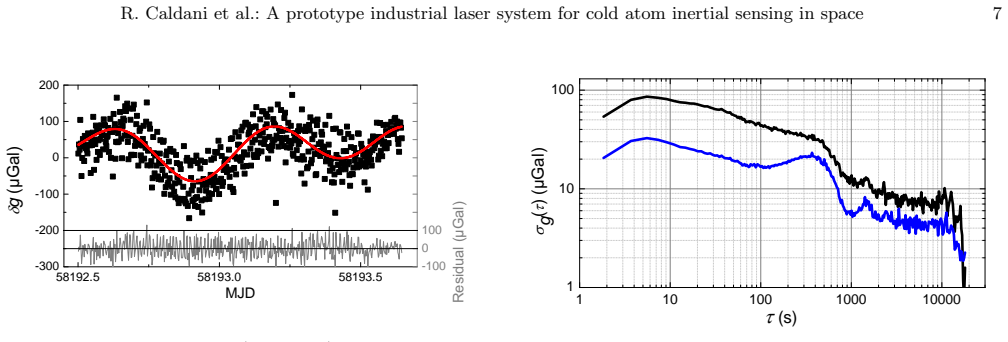
The central claim is that a single prototype unit built from telecom C-band lasers at 1560 nm, frequency doubled to the rubidium D2 line at 780 nm, contains and operates all the laser functions of a cold atom inertial sensor: a master laser locked by saturated absorption, offset-locked cooling and Raman slaves, a detuned Bloch elevator channel, and two Raman lasers phase-locked together to avoid spurious sidebands. Tested on a ground-based atom interferometer, each function—detection, magneto-optical trapping and molasses cooling, Bloch-elevator launching, and Raman-pulse interrogation—was found to behave like the laboratory system it replaced. The gravity measurements followed tidal variations, with a short-term sensitivity of $8\times10^{-8}g$ at 1 s, and the system ran for weeks without human supervision. The paper concludes that the system complies with the mission specifications and that the industrial telecom architecture is a viable basis for a future space gradiometer.
Load-bearing premise
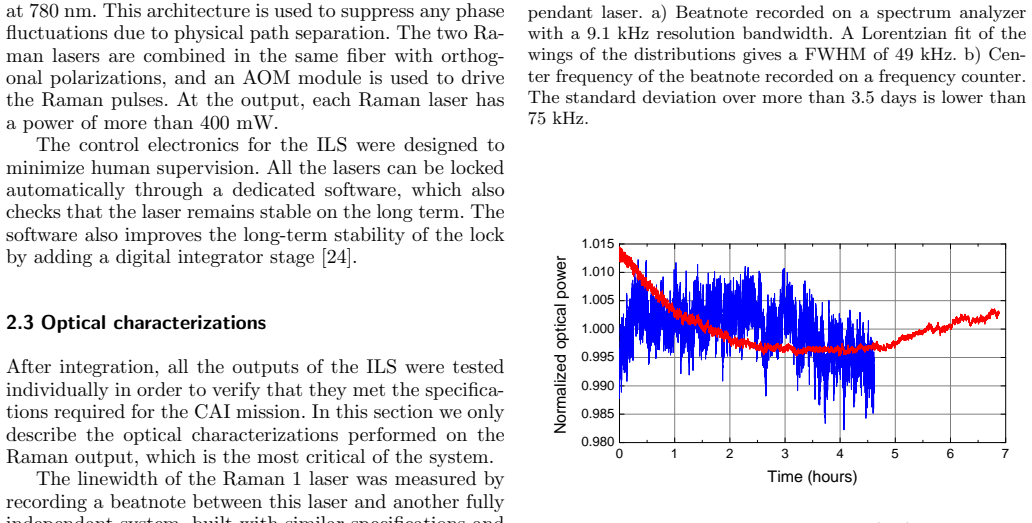
The entire compliance claim stands on the unverified assumption that the Raman 1 laser is narrower than 10 kHz, but the available beatnote only bounds the sum of its width and that of an insufficiently characterized reference laser to 49 kHz.
Editorial extensions
If this is right
- A future space gravity gradiometer can be designed around frequency-doubled telecom lasers rather than custom free-space laboratory lasers, shrinking size and increasing component reliability.
- The same master–slave architecture can be retuned for other atom species or other mission targets, since outputs are set by offset-lock setpoints and AOM frequencies.
- The remaining work is concentrated on the PPLN waveguide frequency-doubling modules, which need environmental hardening before flight.
- Gravity measurements with a simple alternation of Raman wavevector orientations, rather than the full four-configuration protocol, are sufficient if the two-photon light shift is calibrated first.
Reading between the lines
- The authors' linewidth data only prove Raman 1 is below about 29 kHz unless the test reference laser is near 40 kHz; a calibration of that reference would settle the strongest specification claim.
- The excess phase noise in counter-propagating measurements points to high-frequency Raman phase noise; a direct test would be whether lengthening the Raman pulses reduces the per-shot phase noise toward the 8 mrad detection-noise floor.
- Since both Raman outputs share a common phase reference, the same unit should be able to drive a two-cloud gradiometer; running the prototype on two vertically separated interferometers would test the differential-mode noise directly.
- The one component the paper flags as not space-qualified, the PPLN waveguide doubler, is the natural place to focus environmental testing; a thermal-vacuum and radiation campaign on packaged crystals would determine the next TRL step.
Signed reviews
Editorial analysis
A structured set of objections, weighed in public.
Referee Report
Summary. This manuscript reports the design, optical characterization, and ground-based functional testing of an industrial prototype laser system (ILS) for a future cold-atom space gradiometer. The ILS uses frequency-doubled telecom lasers at 1560 nm to generate 780 nm light for cooling, detection, Bloch elevator, and Raman interferometry. The authors measure the Raman beat linewidth and power stability, then validate each function on a ground-based atom interferometer: detection noise near the quantum projection limit, MOT atom numbers consistent with the home-made system, a 2 microkelvin molasses temperature, Bloch elevator launch efficiencies, interferometer phase noise for durations 2T up to 160 ms, and gravity residuals that follow tidal variations. The central claim is that the system meets all mission specifications and reaches Technology Readiness Level 4.
Significance. The paper's main strength is that the ILS is validated against external benchmarks rather than only self-consistency: atom numbers and detection noise are compared with a home-made laser system, the detection noise is compared with the quantum projection limit, and the gravity signal is compared with a local tide model. No fitted free parameters are used to claim agreement. If the Raman linewidth compliance is properly established, the result is significant: it demonstrates that an industrial telecom-based laser architecture can drive a cold-atom gradiometer and is a credible path toward space qualification. The quantitative functional tests (MOT, molasses, Bloch oscillations, interferometer, tidal gravity) provide solid evidence that the system works as intended.
major comments (2)
- [Section 2.3, Fig. 2] The compliance claim for the most critical specification, the Raman 1 linewidth below 10 kHz, is not established by the reported measurement. The beatnote FWHM of 49 kHz is the sum of the linewidths of Raman 1 and the reference laser, but the reference linewidth is only stated to be higher than 20 kHz. With a Lorentzian sum, the data therefore bound the Raman 1 linewidth below 29 kHz (49 minus 20 kHz), not below 10 kHz. Inferring the stated compliance requires the reference linewidth to be about 39 kHz or larger, a value that is neither measured nor documented in the paper. The statement that the beat is compatible with the specifications of the two diodes does not provide the needed bound. Since the conclusion states that the system complies with all mission specifications, this load-bearing point must be fixed: either report a direct linewidth measurement or a measured and qualified value of the reference laser linewidth together with the resulting bound.
- [Section 2.3, final paragraph] The sentence stating that all the other outputs have a similar behaviour to what has been presented is the only quantitative support for the cooling, detection, and Bloch-laser specifications in Table 1. No data are shown for their linewidth, power stability, or detuning accuracy. The functional tests in Section 3 demonstrate that these outputs operate correctly in the experiment, but they do not directly establish the numerical specifications listed in Table 1. If the conclusion's compliance claim is retained, the paper should either present these characterizations or restrict the claim to the outputs actually measured.
minor comments (6)
- [Section 2.3 and Section 3.3] There are several typographical errors: independant in Section 2.3, functionnality in Section 3.3, propotype and additionnal in Section 4, and sysnthesizer in Section 3.3.
- [PACS line] The PACS line contains the template placeholder PACS-key discribing text of that key and should be replaced or removed.
- [Figure 6] The axis labels in Figure 6 contain garbled symbols such as /s61540 and /s61511; the authors should ensure the final PDF renders the intended Greek characters.
- [Figure 8b] The corrected launch-efficiency data shown as empty squares are presented without uncertainties; please state how the correction was applied and include error bars or a clear statement of the uncertainty.
- [Section 3.5, Table 2] The claim that the excess phase noise is compatible with the expected phase noise calculated from the power spectral density of Raman phase fluctuations is not verifiable from the manuscript; showing the measured or calculated power spectral density, or a reference, would strengthen the interpretation.
- [Section 2.3, power stability] The power-stability specification of 0.1 percent over 2 s is only discussed qualitatively; please provide a quantitative Allan deviation or rms value over a 2 s window for the Raman outputs.
Circularity Check
No circularity: the ILS validation rests on external benchmarks and physical limits; the linewidth-compliance gap is an evidentiary weakness, not a circular derivation.
full rationale
The paper's central claim is that the prototype industrial laser system (ILS) meets mission specifications for a cold-atom space gradiometer. The validation of this claim is performed against external references rather than against quantities defined by the ILS itself. The Raman linewidth is measured via a beatnote with an independent laser system from prior work [20]; the detection noise is compared to the quantum projection noise limit; the cooling and detection performances are compared to the SYRTE home-made laser system [23]; and the gravity measurements are compared to a local tide model. No free parameter is fitted to the data and then renamed as a prediction, and no derived quantity is built into its own input. The mission specifications are adopted from earlier concept studies [1,13], not reverse-engineered from the measurements presented here. The weakest point of the paper is the Raman 1 linewidth compliance argument: the 49 kHz beatnote FWHM against a reference laser whose linewidth is only bounded below by 20 kHz does not by itself establish that Raman 1 is below the 10 kHz specification. However, that is a question of evidential sufficiency and measurement interpretation, not of circularity, because the reference laser is an independent system and the stated lower bound is not derived from the desired conclusion. The self-citations to [20] and [23] are normal references to prior hardware and do not carry the load of the argument in a way that reduces the validation to itself. Overall, no circular step is present, and the non-finding is the appropriate outcome.
Assumptions & free parameters
assumptions (4)
- domain assumption The mission specifications from Trimeche et al. [1] define the correct requirements for the CAI space gradiometer laser system.
- standard math The beatnote FWHM equals the sum of the two individual laser linewidths (Lorentzian lines).
- ad hoc to paper The reference laser used for the beatnote has a linewidth sufficiently high (on the order of 40 kHz) to allow inferring the Raman 1 linewidth is below 10 kHz.
- domain assumption The ground-based atom sensor, with only the bottom interferometer operating, is a valid testbed for validating all laser functions.
Cite this review
Pith. "Pith review of A prototype industrial laser system for cold atom inertial sensing in space." pith.science (2026). https://pith.science/paper/7MZIX6VD
@misc{pith2026190810058,
  author       = {Pith},
  title        = {Pith review of: A prototype industrial laser system for cold atom inertial sensing in space},
  year         = {2026},
  howpublished = {\url{https://pith.science/paper/7MZIX6VD}},
  note         = {Machine review of arXiv:1908.10058}
}
read the original abstract
We present the design, realization, characterization and testing of an industrial prototype of a laser system, which is based on frequency doubling of telecom lasers and features all key functionalities to drive a cold atom space gradiometer based on the architecture proposed in [Trimeche et al, 2019]. Testing was performed by implementing the laser system onto a ground based atomic sensor currently under development. The system reaches a Technology Readiness Level (TRL) of 4, corresponding to an operational validation in a controlled environment. The optical architecture of the system can be adapted to other space mission scenarios.
Figures


Figures from the paper (5 more)


Reference graph
Works this paper leans on
-
[1]
A. Trimeche, B. Battelier, D. Becker, A. Bertoldi, P. Bouyer, C. Braxmaier, E. Charron, R. Corgier, M. Cor- nelius, K. Douch, arXiv e-prints arXiv:1903.09828 (2019), 1903.09828
arXiv 2019
-
[2]
Z.K. Hu, B.L. Sun, X.C. Duan, M.K. Zhou, L.L. Chen, S. Zhan, Q.Z. Zhang, J. Luo, Physical Review A 88 (2013)
work page 2013
- [3]
-
[4]
F. Sorrentino, Q. Bodart, L. Cacciapuoti, Y.H. Lien, M. Prevedelli, G. Rosi, L. Salvi, G.M. Tino, Phys. Rev. A 89 (2014)
work page 2014
- [5]
- [6]
-
[7]
R. Karcher, A. Imanaliev, S. Merlet, F.P.D. Santos, New Journal of Physics 20, 113041 (2018)
work page 2018
-
[8]
P. Asenbaum, C. Overstreet, T. Kovachy, D.D. Brown, J.M. Hogan, M.A. Kasevich, Physical Review Letters 118 (2017)
work page 2017
Show all 42 references
-
[9]
Overstreet, P
C. Overstreet, P. Asenbaum, T. Kovachy, R. Notermans, J.M. Hogan, M.A. Kasevich, Physical Review Letters 120 (2018)
2018
-
[10]
Barrett, L
B. Barrett, L. Antoni-Micollier, L. Chichet, B. Battelier, T. L´ ev` eque, A. Landragin, P. Bouyer, Nature Communi- cations 7, 13786 (2016)
2016
-
[11]
Becker, M.D
D. Becker, M.D. Lachmann, S.T. Seidel, H. Ahlers, A.N. Dinkelaker, J. Grosse, O. Hellmig, H. M¨ untinga, V. Schkol- nik, T. Wendrich et al., Nature 562, 391 (2018)
2018
-
[12]
Elliott, M.C
E.R. Elliott, M.C. Krutzik, J.R. Williams, R.J. Thompson, D.C. Aveline, npj Microgravity 4, 16 (2018)
2018
-
[13]
Carraz, C
O. Carraz, C. Siemes, L. Massotti, R. Haagmans, P. Sil- vestrin, Microgravity Science and Technology 26, 139 (2014)
2014
-
[14]
Hogan, D.M.S
J.M. Hogan, D.M.S. Johnson, S. Dickerson, T. Kovachy, A. Sugarbaker, S.w. Chiow, P.W. Graham, M.A. Kase- vich, B. Saif, S. Rajendran et al., General Relativity and Gravitation 43, 1953 (2011)
2011
-
[15]
Altschul, Q.G
B. Altschul, Q.G. Bailey, L. Blanchet, K. Bongs, P. Bouyer, L. Cacciapuoti, S. Capozziello, N. Gaaloul, D. Giulini, J. Hartwig et al., Advances in Space Research 55, 501 (2015)
2015
-
[16]
Chiow, J
S.w. Chiow, J. Williams, N. Yu, Phys. Rev. A 92, 063613 (2015)
2015
-
[17]
Hogan, M.A
J.M. Hogan, M.A. Kasevich, Phys. Rev. A 94, 033632 (2016)
2016
-
[18]
G.M. Tino, A. Bassi, G. Bianco, K. Bongs, P. Bouyer, L. Cacciapuoti, S. Capozziello, X. Chen, M.L. Chiofalo, A. Derevianko et al., arXiv e-prints arXiv:1907.03867 (2019), 1907.03867
2019 arXiv
-
[19]
Bidel, N
Y. Bidel, N. Zahzam, C. Blanchard, A. Bonnin, M. Cadoret, A. Bresson, D. Rouxel, M.F. Lequentrec- Lalancette, Nature Communications 9, 627 (2018)
2018
-
[20]
M´ enoret, P
V. M´ enoret, P. Vermeulen, N. Le Moigne, S. Bonvalot, P. Bouyer, A. Landragin, B. Desruelle, Scientific Reports 8, 123000 (2018)
2018
-
[21]
Cheinet, F
P. Cheinet, F. Pereira Dos Santos, T. Petelski, J. Le Gou¨ et, J. Kim, K. Therkildsen, A. Clairon, A. Landragin, Applied Physics B 84, 643 (2006)
2006
-
[22]
Schmidt, M
M. Schmidt, M. Prevedelli, A. Giorgini, G.M. Tino, A. Pe- ters, Applied Physics B 102, 11 (2011)
2011
-
[23]
Merlet, L
S. Merlet, L. Volodimer, M. Lours, F. Pereira Dos Santos, Applied Physics B 117, 749 (2014)
2014
-
[24]
L´ ev` eque, L
T. L´ ev` eque, L. Antoni-Micollier, B. Faure, J. Berthon, Ap- plied Physics B 116, 997 (2014)
2014
-
[25]
Schkolnik, O
V. Schkolnik, O. Hellmig, A. Wenzlawski, J. Grosse, A. Kohfeldt, K. D¨ oringshoff, A. Wicht, P. Windpassinger, K. Sengstock, C. Braxmaier et al., Applied Physics B 122, 217 (2016)
2016
-
[26]
Cheng, K
Y. Cheng, K. Zhang, L.L. Chen, W.J. Xu, Q. Luo, M.K. Zhou, Z.K. Hu, AIP Advances 7, 095211 (2017)
2017
-
[27]
Zhang, J
X. Zhang, J. Zhong, B. Tang, X. Chen, L. Zhu, P. Huang, J. Wang, M. Zhan, Applied Optics 57, 6545 (2018)
2018
-
[28]
Thompson, M
R.J. Thompson, M. Tu, D.C. Aveline, N. Lundblad, L. Maleki, Opt. Express 11, 1709 (2003)
2003
-
[29]
Theron, Y
F. Theron, Y. Bidel, E. Dieu, N. Zahzam, M. Cadoret, A. Bresson, Optics Communications 393, 152 (2017)
2017
-
[30]
Kovachy, J.M
T. Kovachy, J.M. Hogan, A. Sugarbaker, S.M. Dickerson, C.A. Donnelly, C. Overstreet, M.A. Kasevich, Phys. Rev. Lett. 114, 143004 (2015)
2015
-
[31]
M¨ untinga, H
H. M¨ untinga, H. Ahlers, M. Krutzik, A. Wenzlawski, S. Arnold, D. Becker, K. Bongs, H. Dittus, H. Duncker, N. Gaaloul et al., Phys. Rev. Lett. 110, 093602 (2013)
2013
-
[32]
Corgier, S
R. Corgier, S. Amri, W. Herr, H. Ahlers, J. Rudolph, D. Gu´ ery-Odelin, E.M. Rasel, E. Charron, N. Gaaloul, New Journal of Physics 20, 055002 (2018)
2018
-
[33]
Carraz, R
O. Carraz, R. Charri` ere, M. Cadoret, N. Zahzam, Y. Bidel, A. Bresson, Phys. Rev. A 86, 033605 (2012)
2012
-
[34]
Caldani, K.X
R. Caldani, K.X. Weng, S. Merlet, F. Pereira Dos Santos, Physical Review A 99, 033601 (2019)
2019
-
[35]
Langlois, R
M. Langlois, R. Caldani, A. Trimeche, S. Merlet, F. Pereira dos Santos, Physical Review A 96 (2017)
2017
-
[36]
Lautier, L
J. Lautier, L. Volodimer, T. Hardin, S. Merlet, M. Lours, F.P.D. Santos, A. Landragin, Appl. Phys. Lett. 105, 144102 (2014)
2014
-
[37]
Trimeche, M
A. Trimeche, M. Langlois, S. Merlet, F. Pereira Dos Santos, Physical Review Applied 7 (2017) R. Caldani et al.: A prototype industrial laser system for cold atom inertial sensing in space 9
2017
-
[38]
Le Gou¨ et, T
J. Le Gou¨ et, T. Mehlsta¨ ubler, J. Kim, S. Merlet, A. Cla- iron, A. Landragin, F. Pereira Dos Santos, Applied Physics B 92, 133 (2008)
2008
-
[39]
Merlet, J
S. Merlet, J. Le Gou¨ et, Q. Bodart, A. Clairon, A. Landra- gin, F. Pereira Dos Santos, P. Rouchon, Metrologia 46, 87 (2009)
2009
-
[40]
Louchet-Chauvet, T
A. Louchet-Chauvet, T. Farah, Q. Bodart, A. Clairon, A. Landragin, S. Merlet, F.P. Dos Santos, New Journal of Physics 13, 065025 (2011)
2011
-
[41]
European Space Agency, Technology readiness levels handbook for space applications (2008), https://artes.esa.int/sites/default/files/TRL Handbook.pdf
2008
-
[42]
Ertmer, C
W. Ertmer, C. Schubert, T. Wendrich, M. Gilowski, M. Zaiser, T.v. Zoest, E. Rasel, C.J. Bord´ e, A. Clairon, Landragin et al., Experimental Astronomy 23, 611 (2009)
2009
Reviewed August 14, 2026 · model on record in the stance chip above.
Discussion (0). Continue with ORCID to comment.