REVIEW 1 major objections 5 minor 67 references
Hybrid quantum computation gate with trapped ion system
T0 review · 1 major / 5 minor · reviewed 2026-08-14 · deepseek-v4-flash
Pith's one-line read A single trapped 171Yb+ ion implements a spin-controlled beam splitter between two motional modes, enabling swap tests, single-shot parity measurement, and NOON-state generation.
desk verdict First trapped-ion conditional beam splitter, carefully demonstrated with multiple cross-checks; minor gaps in data sharing and spin-echo calibration, but the central claim holds. read the letter →
The pith
A machine-rendered reading of the paper's core claim, the machinery that carries it, and where it could break.
The reading
What carries the argument
The central object is the conditional beam splitter unitary $\hat{U}_{\mathrm{CBS}} = \exp(-i \frac{\pi}{2} |e\rangle\langle e|(\hat{a}^\dagger \hat{b} + \hat{a}\hat{b}^\dagger))$, a beam-splitter transformation on two motional modes that acts only when the ion's internal state is $|e\rangle$. It is generated by a state-dependent optical dipole force from a running optical lattice whose beat note matches the difference of the radial trap frequencies, $\omega_L = |\omega_x - \omega_y|$. To keep the spin coherent during the interaction, the gate is split into two halves with a $\pi$ pulse between them; the Supplemental Material proves the algorithms still work using the beam-splitter identities $\hat{U}_{\mathrm{BS}}(t,\pi) = \hat{U}_{\mathrm{BS}}^\dagger(t,0)$ and $\hat{U}_{\mathrm{BS}}(t,0)\hat{U}_{\mathrm{BS}}(t,0) = \hat{U}_{\mathrm{BS}}(2t,0)$.
What would settle it
Prepare the two modes in $|1,0\rangle$ with the spin in $|e\rangle$, apply a single CBS pulse of duration $\pi/(2\xi)$, and measure the full two-mode phonon distribution: the swap to $|0,1\rangle$ must occur with the same success probability as the Fredkin table, and any significant population in other Fock states—especially states with axial-mode phonons—would show the interaction is not the ideal CBS. The same pulse applied with the spin in $|g\rangle$ must leave $|1,0\rangle$ unchanged; any swap there would falsify the spin conditioning.
Extended reading notes
Core claim
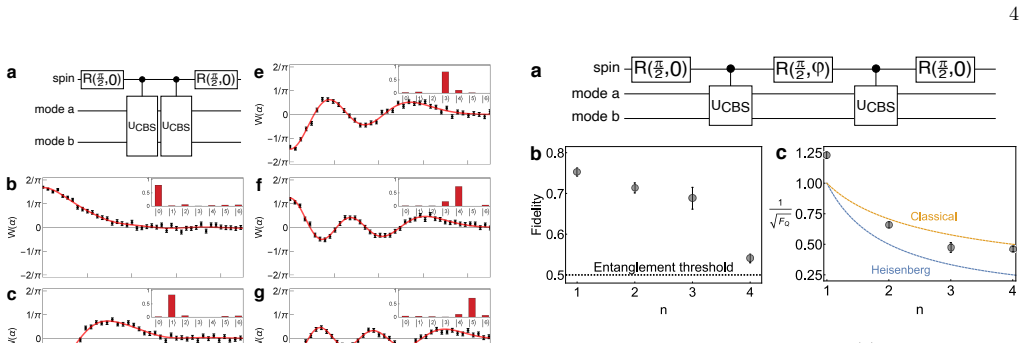
The central claim is that the conditional beam splitter Hamiltonian $\hat{H}_{\mathrm{CBS}} = \hbar \xi |e\rangle\langle e|(\hat{a}^\dagger \hat{b} + \hat{a}\hat{b}^\dagger)$ is physically realized when a state-dependent optical lattice is driven at the difference frequency of the two radial modes, and that for $\tau \approx 400\,\mu\mathrm{s}$ it produces $\hat{U}_{\mathrm{CBS}} = \exp(-i\xi\tau |e\rangle\langle e|(\hat{a}^\dagger \hat{b} + \hat{a}\hat{b}^\dagger))$ with $\xi\tau = \pi/2$, which swaps Fock states of the two modes only when the spin is in $|e\rangle$: $\hat{U}_{\mathrm{CBS}}|e,n,m\rangle = (-i)^{n+m}|e,m,n\rangle$ while $|g,n,m\rangle$ is unchanged. This is established by the Fredkin truth table with average success $0.82 \pm 0.01$ without SPAM correction, swap-test oscillations whose contrast equals Fock-state overlaps up to $n,m=5$, single-shot parity measurements yielding Wigner functions for Fock states $n=0$ through $6$, and NOON-state fidelities above the separability bound for $n=1$ through $4$. The authors note that the spin-echo pulse sequence used to protect spin coherence does not preserve Eq. (2) exactly, but the measurement outcomes of all three algorithms remain unchanged.
Load-bearing premise
The load-bearing premise is that during each half of the gate the interaction is exactly the intended mode-swapping operation, with no stray coupling to the axial mode, no motional heating, and no phase error in the reversal pulse; the argument that the spin-echo modification leaves the algorithms intact relies entirely on this.
Editorial extensions
If this is right
- The CBS gate provides the non-Gaussian operation needed, together with Gaussian gates, for universal continuous-variable quantum computation on trapped ions.
- The swap test built from the CBS gate gives a direct readout of state overlap and phonon-number statistics, demonstrated by reconstructing a coherent state with $|\alpha|^2 = 1.9(2)$.
- Single-shot parity measurement enables direct Wigner-function reconstruction of motional states, demonstrated for Fock states $n=0$ through $6$.
- The constant-depth NOON-state circuit produces entangled states with quantum Fisher information above the classical bound for $n=2$ through $4$, with fidelity limited by motional dephasing.
- Combined with a parity operation, the CBS gate realizes a CSWAP gate, opening the way to exponential-swap algorithms such as quantum principal component analysis and matrix inversion.
Reading between the lines
- If the radial-mode coherence time can be extended, the same constant-depth circuit should produce NOON states with $n>4$, where the current fidelity is limited by dephasing that scales as $|n_a-n_b|^2$.
- A natural next experiment would implement the full CSWAP using the paper's Eq. (4) with an ancilla mode in vacuum; a truth-table measurement would separate the CBS phase factor from the parity-corrected swap and test the construction directly.
- The swap-test capability could be applied to quantum fingerprinting or digital signatures using motional states, applications the paper lists for CSWAP but does not demonstrate.
- Because the gate acts on two modes of a single ion, scaling to multi-ion registers would require either shuttling or coupling modes across ions; the CBS gate would be the natural primitive for such an extension.
Signed reviews
Editorial analysis
A structured set of objections, weighed in public.
Referee Report
Summary. The paper reports an experimental realization of a conditional beam splitter (CBS) gate acting on the two radial motional modes of a single trapped 171Yb+ ion, where the gate operation is conditioned on the internal spin state. The authors characterize the gate through a complete eight-state Fredkin-type truth table with an uncorrected success probability of 0.82 ± 0.01, and then demonstrate three applications: swap-test measurements of the overlap between motional states, single-shot parity measurement enabling Wigner function reconstruction of Fock states n = 0 to 6, and deterministic generation of NOON states with n = 1 to 4. To mitigate spin decoherence, the authors split each CBS gate into two halves and insert a microwave pi pulse, a spin-echo technique that modifies the exact evolution; the Supplemental Material provides algebraic proofs that the algorithm outcomes are unchanged.
Significance. If the claims hold, this is a significant experimental advance for hybrid discrete-variable/continuous-variable quantum computation with trapped ions: it demonstrates a non-Gaussian gate with a complete truth table and uses it in several nontrivial applications. The paper benefits from a thorough characterization: the eight-state truth table uses 10,000 experiments per input, the overlap measurement yields |α|^2 = 1.9(2) consistent with the independent Fourier-analysis value 1.8(1), and the Wigner functions for Fock states up to n = 6 clearly display negative values. The supplement contains parameter-free derivations of all algorithmic identities starting from the beam-splitter Hamiltonian, which is a strength. The main weakness is the experimental validation of the spin-echo-modified sequence, which is load-bearing for the application claims.
major comments (1)
- [Main text, spin-echo paragraph; Supplemental Material, Eqs. (S4)–(S6)] The equivalence between the ideal CBS algorithms and the spin-echo-modified sequences is proven in the supplement only under the identities U_BS(t,π) = U_BS†(t,0) and U_BS(t,0)U_BS(t,0) = U_BS(2t,0). These identities are algebraically exact for an ideal beam-splitter Hamiltonian, but they require that the two halves of every split gate have exactly equal coupling strength and exactly opposite phase, with no residual coupling to the axial mode and no motional heating during the ~400 µs gate. The manuscript explicitly concedes that 'applying the spin echo does not preserve the transformation Eq. (2) exactly' and refers to the supplement for proof; however, no experimental characterization of the phase reversal or amplitude matching between the two halves is provided, and no comparison is shown of swap-test contrast, Fredkin truth-table success, or NOON fidelity with and without echo. Because all reported applications (swap test, parity/Wigner measurement, and NOON generation) are executed with the echo-modified sequence, any imperfection in the cancellation propagates as first-order corrections to the extracted overlap amplitudes, Wigner-function fit populations, and NOON fidelities. I recommend that the authors provide a direct calibration of the echo phase reversal (for example, by measuring the output state for a known input with and without the echo sequence) or demonstrate that the extracted quantities are insensitive to plausible phase errors and amplitude mismatches.
minor comments (5)
- [Supplemental Material, Eq. (S5)] The argument of the second U_BS is written as 'π/4π' instead of 'π/4ξ'; this typo should be corrected.
- [Main text, Introduction] 'scability' should be 'scalability'.
- [Main text, spin-echo paragraph] The statement that spin echo is 'integrated into the gate sequence' is ambiguous; the paper should specify explicitly which data sets (Fredkin truth table versus swap-test/Wigner/NOON) were taken with the echo-modified sequence, since the truth table may have been taken without echo.
- [Supplemental Material, NOON state analysis] For n = 3, the correction for the degenerate |1,1> component uses an upper-bound estimate; the manuscript should state explicitly that the resulting fidelity is a lower bound and include the associated systematic uncertainty in the reported error bars.
- [Figure 2b] The gate success probability 0.82 ± 0.01 is quoted without SPAM correction; the text already states this, but it would be helpful to note the expected SPAM error contribution.
Circularity Check
No circularity: the CBS gate and all algorithms are derived from the stated Hamiltonian and independently benchmarked; self-citations are apparatus methods only.
full rationale
The central derivation is self-contained and not circular. The CBS transformation Eq. (2) follows algebraically from the stated Hamiltonian Eq. (1) with tau = pi/(2*xi), and the swap-test, parity, and NOON circuits are evaluated directly from that unitary in the main text and the Supplemental Material (Eqs. S1-S10 and the NOON analysis). The experimental validation is by direct benchmark: the Fredkin truth-table success probability is measured as 0.82 +/- 0.01, the coherent-state overlap extracted from the swap test is cross-checked against an independent blue-sideband Fourier analysis (|alpha|^2 = 1.9(2) versus 1.8(1)), and the parity oscillations and NOON fidelities are measured quantities rather than derived predictions. The Wigner-function and NOON analyses do fit data to extract populations and coherences, but those fits are not presented as independent predictions and do not feed back into the derivation of the gate. Self-citations [21,22,28,31] supply the Raman-laser and state-dependent dipole-force apparatus; they are independent, externally established experimental techniques and are not invoked to prove the target gate or any uniqueness claim. The acknowledged spin-echo caveat, that the echo does not preserve Eq. (2) exactly, is an approximation whose Supplemental proof uses exact ideal-beam-splitter identities; it is a conditional algebraic argument, not a reduction of the result to its own input. Whether the echo phase reversal is perfectly calibrated is an experimental robustness question, not a circularity of the derivation. No load-bearing step reduces by definition to its own input.
Assumptions & free parameters
free parameters (2)
- Wigner-state populations d_n for n=0 to 6 =
not tabulated; shown in Fig. 4 insets
- NOON density-matrix elements P_{n,0}, P_{0,n}, and rho_{n0,0n} =
not tabulated; used in Fig. 5
assumptions (3)
- domain assumption The running-lattice state-dependent dipole force with beat note omega_L = |omega_x - omega_y| exactly realizes H_CBS of Eq. (1) on the two radial modes.
- standard math Spin-echo modified unitary still preserves algorithm outputs because U_BS(t,pi) = U_BS-dagger(t,0) and U_BS(t,0)U_BS(t,0) = U_BS(2t,0).
- domain assumption Projective readout of the internal spin via fluorescence faithfully projects the motional mode after blue or red sideband pulses without disturbing it.
Cite this review
Pith. "Pith review of Hybrid quantum computation gate with trapped ion system." pith.science (2026). https://pith.science/paper/336PHK6M
@misc{pith2026190810117,
  author       = {Pith},
  title        = {Pith review of: Hybrid quantum computation gate with trapped ion system},
  year         = {2026},
  howpublished = {\url{https://pith.science/paper/336PHK6M}},
  note         = {Machine review of arXiv:1908.10117}
}
abstract
The hybrid approach to quantum computation simultaneously utilizes both discrete and continuous variables which offers the advantage of higher density encoding and processing powers for the same physical resources. Trapped ions, with discrete internal states and motional modes which can be described by continuous variables in an infinite dimensional Hilbert space, offer a natural platform for this approach. A nonlinear gate for universal quantum computing can be implemented with the conditional beam splitter Hamiltonian $|e\rangle \langle e| ( a^{\dagger} b + a b^{\dagger})$ that swaps the quantum states of two motional modes, depending on the ion's internal state. We realize such a gate and demonstrate its applications for quantum state overlap measurements, single-shot parity measurement, and generation of NOON states.
Figures


Figures from the paper (1 more)

Reference graph
Works this paper leans on
-
[1]
K. R. Brown, J. Kim, and C. Monroe, npj Quantum Information 2, 16034 (2016)
work page 2016
-
[2]
and measure the probability of finding the system in one of the states after applying the CBS transformation (Eq. 2). We measure the projection onto basis states by 3 con- secutive projective measurements onto the spin state |g⟩. We first perform state detection on the spin. If fluores- cence is not detected, the internal state is projected into |g⟩ and the ...
-
[3]
82 ± 0. 01. Generalization of the Fredkin gate to states |ψ ⟩, |φ⟩ in the Hilbert space of a larger dimension is the controlled- swap (CSW AP) gate, which applies the transformation CS |e,ψ,φ ⟩ = |e,φ,ψ ⟩ if the control qubit is in state |e⟩, and does not change the state if the control qubit is in state |g⟩. The CSW AP gate has a number of known ap- plic...
-
[4]
that the CBS and CSW AP gates are different due to the extra state dependent phase factor. However, for input states which are eigenstates of the parity operator ˆP both gates produce similar results. 3 An example is the measurement of overlap between two states, ⟨φ|ψ ⟩, also known as a swap test [38, 40]. With an initial state |g,ψ,φ ⟩, applying the circu...
-
[5]
In our experiment, the coherence time of the spin is ≈ 1.7 ms, which is comparable to the duration of a single CBS gate ( τ ≈ 400µ s). To alleviate the effects of spin decoherence (mainly due to magnetic field fluctuations), we integrate spin echo into the gate se- quence. A single CBS gate is split into two, each with a durationτ/ 2, and a microwave |g⟩ → |...
-
[6]
We begin by measuring the overlap between Fock states |ψ,φ ⟩ = |n,m ⟩, for n,m ∈ [0, 5]
exactly, but the outcomes of the algorithms remain unchanged [44]. We begin by measuring the overlap between Fock states |ψ,φ ⟩ = |n,m ⟩, for n,m ∈ [0, 5]. By varying the phase ϕ of the last microwave π/ 2-pulse with respect to the first from 0 to 2 π , we obtain the oscillating proba- bility (Eq. 3) to observe |e⟩ with amplitude equal to the overlap. We p...
-
[7]
C. D. Bruzewicz, J. Chiaverini, R. McConnell, and J. M. Sage, Applied Physics Reviews 6, 021314 (2019)
2019
-
[8]
T. Monz, D. Nigg, E. A. Martinez, M. F. Brandl, P. Schindler, R. Rines, S. X. Wang, I. L. Chuang, and R. Blatt, Science 351, 1068 (2016)
work page 2016
Show all 67 references
-
[9]
Debnath, N
S. Debnath, N. M. Linke, C. Figgatt, K. A. Landsman, K. Wright, and C. Monroe, Nature 536, 63 (2016)
2016
-
[10]
N. M. Linke, D. Maslov, M. Roetteler, S. Debnath, C. Figgatt, K. A. Landsman, K. Wright, and C. Mon- roe, Proceedings of the National Academy of Sciences 114, 3305 (2017)
2017
-
[11]
N. M. Linke, S. Johri, C. Figgatt, K. A. Landsman, A. Y. Matsuura, and C. Monroe, Phys. Rev. A 98, 052334 (2018)
2018
-
[12]
A. G. Fowler, M. Mariantoni, J. M. Martinis, and A. N. Cleland, Phys. Rev. A 86, 032324 (2012)
2012
-
[13]
Reiher, N
M. Reiher, N. Wiebe, K. M. Svore, D. Wecker, and M. Troyer, Proceedings of the National Academy of Sci- ences 114, 7555 (2017)
2017
-
[14]
Lloyd and S
S. Lloyd and S. L. Braunstein, Phys. Rev. Lett. 82, 1784 (1999)
1999
-
[15]
M. A. Nielsen and I. L. Chuang, Quantum Computation and Quantum Information: 10th Anniversary Edition 10 (Cambridge University Press, 2010)
2010
-
[16]
Lau and M
H.-K. Lau and M. B. Plenio, Phys. Rev. Lett. 117, 100501 (2016)
2016
-
[17]
Gottesman, A
D. Gottesman, A. Kitaev, and J. Preskill, Phys. Rev. A 64, 012310 (2001)
2001
-
[18]
S. L. Braunstein and P. van Loock, Rev. Mod. Phys. 77, 513 (2005)
2005
-
[19]
Y. Shen, Y. Lu, K. Zhang, J. Zhang, S. Zhang, J. Huh, and K. Kim, Chem. Sci. 9, 836 (2018)
2018
-
[20]
Ortiz-Gutirrez, B
L. Ortiz-Gutirrez, B. Gabrielly, L. F. Muoz, K. T. Pereira, J. G. Filgueiras, and A. S. Villar, Optics Com- munications 397, 166 (2017)
2017
-
[21]
D. M. Meekhof, C. Monroe, B. E. King, W. M. Itano, and D. J. Wineland, Phys. Rev. Lett. 76, 1796 (1996)
1996
-
[22]
Leibfried, D
D. Leibfried, D. M. Meekhof, B. E. King, C. Monroe, W. M. Itano, and D. J. Wineland, Phys. Rev. Lett. 77, 4281 (1996)
1996
-
[23]
Olmschenk, K
S. Olmschenk, K. C. Younge, D. L. Moehring, D. N. Mat- sukevich, P. Maunz, and C. Monroe, Phys. Rev. A 76, 052314 (2007)
2007
-
[24]
Fl¨ uhmann, T
C. Fl¨ uhmann, T. L. Nguyen, M. Marinelli, V. Negnevit- sky, K. Mehta, and J. P. Home, Nature 556, 513 (2019)
2019
-
[25]
C. F. Roos, T. Monz, K. Kim, M. Riebe, H. H¨ affner, D. F. V. James, and R. Blatt, Phys. Rev. A 77, 040302(R) (2008)
2008
-
[26]
S. Ding, G. Maslennikov, R. Habl¨ utzel, H. Loh, and D. Matsukevich, Phys. Rev. Lett. 119, 150404 (2017)
2017
-
[27]
S. Ding, G. Maslennikov, R. Habl¨ utzel, and D. Matsuke- vich, Phys. Rev. Lett. 119, 193602 (2017)
2017
-
[28]
S. Ding, G. Maslennikov, R. Habl¨ utzel, and D. Matsuke- vich, Phys. Rev. Lett. 121, 130502 (2018)
2018
-
[29]
Hybrid quantum computing,
S. Lloyd, “Hybrid quantum computing,” in Quantum In- formation with Continuous Variables , edited by S. L. Braunstein and A. K. Pati (Springer Netherlands, Dor- drecht, 2003) pp. 37–45
2003
-
[30]
U. L. Andersen, J. S. Neergaard-Nielsen, P. van Loock, and A. Furusawa, Nature Physics 11, 713 (2015)
2015
-
[31]
Mandel and E
L. Mandel and E. Wolf, Optical Coherence and Quantum Optics (Cambridge University Press, 1995)
1995
-
[32]
Ejtemaee and P
S. Ejtemaee and P. C. Haljan, Phys. Rev. Lett. 119, 043001 (2017)
2017
-
[33]
Hayes, D
D. Hayes, D. N. Matsukevich, P. Maunz, D. Hucul, Q. Quraishi, S. Olmschenk, W. Campbell, J. Mizrahi, C. Senko, and C. Monroe, Phys. Rev. Lett. 104, 140501 (2010)
2010
-
[34]
Leibfried, R
D. Leibfried, R. Blatt, C. Monroe, and D. Wineland, Rev. Mod. Phys. 75, 281 (2003)
2003
-
[35]
D. J. Wineland, C. Monroe, W. M. Itano, D. Leibfried, B. E. King, and D. M. Meekhof, J Res Natl Inst Stand Technol 103, 259 (1998)
1998
-
[36]
S. Ding, H. Loh, R. Hablutzel, M. Gao, G. Maslen- nikov, and D. Matsukevich, Phys. Rev. Lett. 113, 073002 (2014)
2014
-
[37]
Fredkin and T
E. Fredkin and T. Toffoli, Int J Theor Phys 21, 219 (1982)
1982
-
[38]
R. B. Patel, J. Ho, F. Ferreyrol, T. C. Ralph, and G. J. Pryde, Science Advances 2, e1501531 (2016)
2016
-
[39]
T. Ono, R. Okamoto, M. Tanida, H. F. Hofmann, and S. Takeuchi, Scientific Reports 7, 45353 (2017)
2017
-
[40]
Y. Y. Gao, B. J. Lester, K. S. Chou, L. Frunzio, M. H. Devoret, L. Jiang, S. M. Girvin, and R. J. Schoelkopf, Nature 566, 509 (2019)
2019
-
[41]
Zhang, J
K. Zhang, J. Thompson, X. Zhang, Y. Shen, Y. Lu, S. Zhang, J. Ma, V. Vedral, M. Gu, and K. Kim, arXiv:1907.12171
1907 arXiv
-
[42]
Filip, Phys
R. Filip, Phys. Rev. A 65, 062320 (2002)
2002
-
[43]
Buhrman, R
H. Buhrman, R. Cleve, J. Watrous, and R. de Wolf, Phys. Rev. Lett. 87, 167902 (2001)
2001
- [44]
- [45]
- [46]
-
[47]
Preskill, Quantum 2, 79 (2018)
J. Preskill, Quantum 2, 79 (2018)
2018
-
[48]
Jones, S
T. Jones, S. Endo, S. McArdle, X. Yuan, and S. C. Benjamin, Phys. Rev. A 99, 062304 (2019)
2019
-
[49]
See Supplemental Material at [URL] for details on incor- porating spin echo into the algorithms, and the experi- mental methods and data for NOON state analysis
-
[50]
Royer, Phys
A. Royer, Phys. Rev. A 15, 449 (1977)
1977
-
[51]
Bertet, A
P. Bertet, A. Auffeves, P. Maioli, S. Osnaghi, T. Meunier, M. Brune, J. M. Raimond, and S. Haroche, Phys. Rev. Lett. 89, 200402 (2002)
2002
-
[52]
S. M. Barnett and P. M. Radmore, Methods in Theoret- ical Quantum Optics (Oxford University Press, 2002)
2002
-
[53]
H.-K. Lau, R. Pooser, G. Siopsis, and C. Weedbrook, Phys. Rev. Lett. 118, 080501 (2017)
2017
-
[54]
Buˇ zek and M
V. Buˇ zek and M. Hillery,Phys. Rev. A 62, 022303 (2000)
2000
-
[55]
B. C. Sanders, Phys. Rev. A 40, 2417 (1989)
1989
-
[56]
P. Kok, H. Lee, and J. P. Dowling, Phys. Rev. A 65, 052104 (2002)
2002
-
[57]
M. W. Mitchell, J. S. Lundeen, and A. M. Steinberg, Nature 429, 161 (2004)
2004
-
[58]
Nagata, R
T. Nagata, R. Okamoto, J. L. O’Brien, K. Sasaki, and S. Takeuchi, Science 316, 726 (2007)
2007
-
[59]
I. Afek, O. Ambar, and Y. Silberberg, Science 328, 879 (2010)
2010
-
[60]
Zhang, M
J. Zhang, M. Um, D. Lv, J.-N. Zhang, L.-M. Duan, and K. Kim, Phys. Rev. Lett. 121, 160502 (2018)
2018
-
[61]
C. J. Myatt, B. E. King, Q. A. Turchette, C. A. Sack- ett, D. Kielpinski, W. M. Itano, C. Monroe, and D. J. Wineland, Nature 403, 269 (2000)
2000
-
[62]
X. Wang, J. Phys. A: Math. Gen. 34, 9577 (2001)
2001
-
[63]
Biamonte, P
J. Biamonte, P. Wittek, N. Pancotti, P. Rebentrost, N. Wiebe, and S. Lloyd, Nature 549, 195 (2017)
2017
-
[64]
A. W. Harrow, A. Hassidim, and S. Lloyd, Phys. Rev. Lett. 103, 150502 (2009)
2009
-
[65]
Lloyd, M
S. Lloyd, M. Mohseni, and P. Rebentrost, Nature Physics 10, 631 (2014)
2014
-
[66]
Introduction to quantum ther- modynamics: History and prospects,
R. Alicki and R. Kosloff, “Introduction to quantum ther- modynamics: History and prospects,” in Thermodynam- ics in the Quantum Regime: Fundamental Aspects and New Directions , edited by F. Binder, L. A. Correa, C. Gogolin, J. Anders, and G. Adesso (Springer Inter- national Pub...
2018
-
[67]
C. A. Sackett, D. Kielpinski, B. E. King, C. Langer, V. Meyer, C. J. Myatt, M. Rowe, Q. A. Turchette, W. M. Itano, D. J. Wineland, and C. Monroe, Nature 404, 256 (2000)
2000
Reviewed August 14, 2026 · model on record in the stance chip above.
Discussion (0). Continue with ORCID to comment.