REVIEW 4 major objections 4 minor 65 references
Role of higher twist effects in diffractive DIS and determination of diffractive parton distribution functions
T0 review · 4 major / 4 minor · reviewed 2026-08-14 · deepseek-v4-flash
Pith's one-line read Including a fitted higher-twist term proportional to $1/Q^2$ in the diffractive structure function $F_2$ improves the NLO QCD description of HERA diffractive deep-inelastic scattering data and changes the extracted gluon density.
desk verdict A competent NLO diffractive-PDF fit with a fitted higher-twist term, but the 'first-time' novelty is overstated and the twist-4 neglect needs quantitative support. read the letter →
The pith
A machine-rendered reading of the paper's core claim, the machinery that carries it, and where it could break.
The reading
What carries the argument
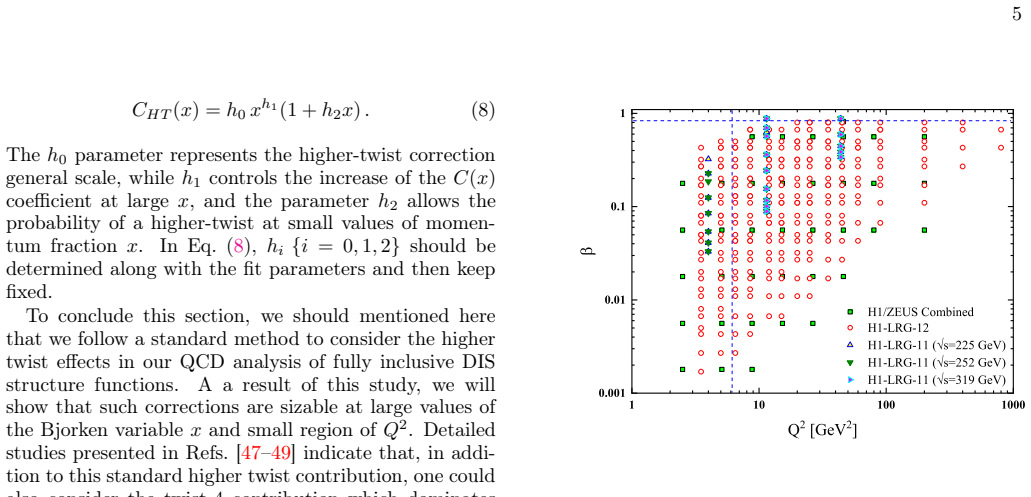
The load-bearing object is the phenomenological higher-twist factor applied to the diffractive $F_2$: $F_2(x,Q^2) = F_2^{\rm LT}(x,Q^2)\,(1 + C_{\rm HT}(x)/Q^2)$, with $C_{\rm HT}(x)=h_0 x^{h_1}(1+h_2 x)$. This is a $1/Q^2$ power correction whose three parameters are fitted simultaneously with the diffractive PDFs; the $x^{h_1}$ factor makes the correction grow at large $x$, and the $h_2$ term allows behavior at small $x$. The argument also relies on the $\beta\le 0.80$ cut to justify ignoring twist-4 contributions from longitudinal virtual photons, which would otherwise dominate the large-$\beta$ region.
What would settle it
Use the published PDF sets to predict the diffractive reduced cross sections at $Q^2=2.5$ and $5.09$ GeV$^2$ shown in the theory-to-data comparisons; those points were excluded from the fit, so the HT model either reproduces them better than the leading-twist model or it does not.
Extended reading notes
Core claim
The central claim is that a simple power-suppressed correction to the diffractive structure function $F_2$ is required to describe HERA diffractive DIS data at NLO accuracy. The paper shows that the diffractive reduced cross section is better reproduced when the leading-twist structure function is multiplied by $(1 + C_{\rm HT}(x)/Q^2)$ with $C_{\rm HT}(x)=h_0 x^{h_1}(1+h_2 x)$, and the three HT parameters are fitted together with the diffractive PDFs, giving $h_0=-25.798$, $h_1=2.536$, and $h_2=-1.381$. With a $\beta\le 0.80$ cut and $Q^2_{\rm min}=6.5$ GeV$^2$, the fit keeps 499 of 526 data points; the same fit without the HT term gives $\chi^2/{\rm dof}=1.052$, while with the HT term it gives $1.013$. The largest improvement comes from the largest rapidity-gap dataset, and the extracted gluon density at the input scale $Q_0^2=1.8$ GeV$^2$ is reduced at medium and large $z$. The authors conclude that HT effects are sizable at large $x$ and low $Q^2$ and that they should be included in diffractive PDF determinations.
Load-bearing premise
The whole fit improvement rests on the assumption that the higher-twist correction takes exactly the factorized form $F_2 = F_2^{\rm LT}\,(1 + h_0 x^{h_1}(1+h_2 x)/Q^2)$, acts only on $F_2$, and that target-mass and twist-4 effects are negligible after the $\beta\le 0.80$ and $Q^2\ge 6.5$ GeV$^2$ cuts.
Editorial extensions
If this is right
- Diffractive PDF fits can safely include data with $Q^2$ down to $6.5$ GeV$^2$ instead of $8.5$ GeV$^2$, adding more data points without degrading the fit quality.
- The extracted diffractive gluon density at the input scale is suppressed at medium and large $z$ when HT effects are included, so predictions for diffractive dijet and charm production built from this PDF set will differ from leading-twist-based sets.
- The combined HERA data improve from $\chi^2/{\rm dof}=1.052$ to $1.013$ when the HT term is added, with the largest single reduction coming from the largest rapidity-gap sample.
- The HT correction affects theoretical predictions most at low $Q^2$ and at medium $\beta$ values, gradually shifting to larger $\beta$ as $Q^2$ increases.
- Accounting for HT effects changes the shape and size of the extracted diffractive quark and gluon densities while leaving the size of their uncertainty bands largely unchanged.
Reading between the lines
- A direct extension would apply the same $C_{\rm HT}(x)/Q^2$ form to the longitudinal diffractive structure function $F_L^D$, not only to $F_2$; high-$y$ data could then discriminate between a genuine power correction and an effective rescaling of $F_2$.
- If the gluon suppression at medium and large $z$ is real, diffractive dijet rates at moderate $Q^2$ should fall below current NLO predictions based on leading-twist-only fits, a cross-check that existing HERA dijet samples could perform.
- The fitted $C_{\rm HT}(x)$ has a negative overall scale and an $x$-dependent shape; testing alternative forms such as $a(1-x)^p/Q^2$ or a twist-4-motivated term would show whether the improvement is robust or an artifact of the chosen parametrization.
- Releasing the $\beta\le 0.80$ cut and allowing an explicit twist-4 contribution would reveal whether the fitted higher-twist term is the standard $1/Q^2$ correction or a stand-in for missing large-$\beta$ physics.
Editorial analysis
A structured set of objections, weighed in public.
Referee Report
Summary. This paper presents an NLO QCD fit to HERA diffractive DIS data (H1 LRG-2011, H1 LRG-2012, and the H1/ZEUS combined dataset) using Regge factorization for the Pomeron and Reggeon contributions, the FONLL general-mass variable-flavor-number scheme for heavy quarks, and the APFEL/MINUIT toolchain. The claimed novelty is the inclusion of a phenomenological higher-twist (HT) correction to the diffractive structure function F2 of the form F2 = F2_LT (1 + C_HT(x)/Q^2) with C_HT(x) = h0 x^h1 (1 + h2 x), applied only to F2. The authors report that including this term improves the global chi^2 from 390.46 to 376.08 for the same 371 degrees of freedom, motivates lowering Q^2_min from 8.5 to 6.5 GeV^2 on the basis of a chi^2 scan, and leads to a gluon density that is suppressed at medium and large z while the quark density is enhanced at small z.
Significance. If the central claim is correct, the paper would justify extending diffractive PDF fits to lower Q^2 and would alter the extracted diffractive gluon at medium and large z, which is relevant for diffractive phenomenology at HERA and the LHC. The fit strategy is standard and the paper is transparent about datasets, parameterizations, and numerical tools, which is a strength. However, the evidence for the HT contribution is entirely in-sample: the three HT parameters are fitted to the same data used to claim the effect, the Q^2_min cut is chosen from the same chi^2 scan, the HT parameters are quoted without uncertainties, and the neglect of the twist-4 contribution to F_L is asserted rather than demonstrated. These issues are load-bearing for the abstract's claim of 'first evidence' for HT effects in diffractive DIS, so the manuscript requires substantial revision before that claim can be accepted.
major comments (4)
- [Sec. II.D, Eqs. (7)–(8) and Table II] The three higher-twist parameters h0, h1, and h2 are fitted to the data, yet Table II quotes them without uncertainties: h0 = -25.798, h1 = 2.536, h2 = -1.381. Since the paper's central claim is that these parameters are determined by the diffractive DIS data and improve the fit, the absence of uncertainties and of correlations with the PDF parameters makes it impossible to judge whether the HT term is statistically meaningful. The authors should provide Hessian uncertainties for h0, h1, h2, and ideally a correlation matrix with the other fitted parameters.
- [Sec. II.D and Sec. III.B] The statement that the twist-4 contribution to F_L from longitudinally polarized photons 'can be strongly reduced and safely ignored' after the beta <= 0.80 cut is an assertion, not a quantitative estimate. The reduced cross section in Eq. (1) depends on F_L through a y-dependent coefficient, while the fitted HT correction in Eq. (7) multiplies only F2. A residual twist-4 F_L term would therefore be partially absorbed by h0, h1, h2, biasing the extracted gluon. Since Ref. [47] found that including twist-4 changes the diffractive gluon, the authors should quantify the residual twist-4 contribution at the fitted beta <= 0.80 and Q^2 >= 6.5 GeV^2 points, or perform a robustness fit that includes a twist-4 F_L term.
- [Sec. III.B, Fig. 3] The choice Q^2_min = 6.5 GeV^2 is selected from a chi^2 scan performed on the same data that are then used to claim that HT effects improve the description. This data-driven cut selection makes the reported chi^2 improvement an in-sample statistic and can bias the apparent gain. The authors should provide an out-of-sample test, for example fitting at Q^2_min = 8.5 GeV^2 and then predicting the data below that cut, or using a hold-out subset of the combined dataset, and should separately show the stability of the HT parameters under this procedure.
- [Sec. IV, Table III] The improvement in global chi^2 from 390.46 to 376.08 for the same 371 dof is modest, especially given that it is achieved by adding three free parameters. The authors should report a significance test (e.g., an F-test or likelihood-ratio test) and should show that the improvement is not driven by a small number of data points; the largest per-dataset gain appears in H1-LRG-12, so pull distributions for that dataset would be informative. Without such a test, the abstract's wording that HT effects 'can improve the description of the data' overstates the strength of the evidence.
minor comments (4)
- [Global] The text contains several typographical issues: 'Difrractive' in the Section III title, 'heay quark' in Section II.C, 'This analysis are enriched' in the abstract, and 'HK19-DDPF' instead of 'HK19-DPDF' in the introduction.
- [Sec. II.D] The sentence 'hi should be determined along with the fit parameters and then keep fixed' is ambiguous; the authors should clarify whether the HT parameters are profiled, marginalized, or simply frozen at their best-fit values when the PDF uncertainties are computed.
- [Figs. 13–15] Several theory-to-data comparisons show data with Q^2 = 2.5 and 5.09 GeV^2, which lie below the chosen Q^2_min = 6.5 GeV^2 and are excluded from the fit. The text should state explicitly whether these low-Q^2 panels are genuine predictions of the fitted model or are included only as a qualitative illustration of the HT extrapolation.
- [Table I] The table lists 526 data points before cuts, and the text later says 499 points are included after cuts, implying 27 points excluded; this arithmetic is consistent, but the breakdown of how many points are removed by the beta, M_X, and Q^2 cuts separately would be helpful.
Circularity Check
Central evidence for HT effects is an in-sample fit: the HT parameters are fitted to the same data whose improved description is presented as the main result.
-
fitted input called prediction
[Sec. II.D (Eqs. 7-8), Sec. III.B (Fig. 3), Sec. IV (Table III)]
"F2(x,Q^2) = F^LT_2(x,Q^2)(1 + C_HT(x)/Q^2); C_HT(x) = h0 x^h1 (1 + h2 x); In Eq. (8), hi{i = 0, 1, 2} should be determined along with the fit parameters and then keep fixed. ... χ2/dof 390.46/371 = 1.052 376.079/371 = 1.013"
The paper's headline claim is that including HT effects improves the data description, but the HT parameters h0,h1,h2 are free parameters fitted to exactly the same datasets whose improved χ2 is then quoted. The no-HT model is the special case h0=0 of Eq. (7), so the HT fit is a nested model and its minimized χ2 cannot be worse than the no-HT χ2 on the same data; the decrease from 390.46 to 376.08 is thus guaranteed by construction, not an independent empirical discovery. The paper then presents the resulting curves as 'NLO theory predictions' for the fitted data, so the in-sample agreement is a fit rather than a prediction. The Q2_min=6.5 cut is also chosen from the same in-sample χ2 scan (Fig. 3), further optimizing the apparent improvement.
full rationale
The paper is a standard NLO QCD fit to HERA diffractive DIS data, and the extraction of diffractive PDFs from those data is not itself circular. The problematic step is the evidential use of the HT fit: the three parameters of the phenomenological HT term, Eq. (8), are determined by minimizing χ2 on the same datasets whose 'improved description' is presented in Table III and the abstract. Because h0=0 recovers the no-HT model, the HT fit is nested, so the raw χ2 decrease is mathematically forced; it cannot by itself establish that HT effects are required. The paper does include some genuinely out-of-sample comparisons, in Figs. 13-14, to data below Q2_min=6.5 that are excluded from the fit, and there the HT curves reduce data-theory differences qualitatively; this provides independent content but is not the basis of the headline claim. The assertion that the twist-4 contribution to F_L is 'strongly reduced and safely ignored' after the β≤0.80 cut (Sec. II.D) is an unquantified assumption and a correctness risk, but not circularity. Self-citations to GKG18 [13] and HK19 [18] are present but not load-bearing: the analysis uses standard parameterization forms and compares with those works rather than deriving its central result from them. Overall, one central evidential step is circular in the fitted-input sense, while the rest of the analysis is self-contained.
Assumptions & free parameters
free parameters (9)
- h0 (HT scale) =
-25.798
- h1 (HT slope) =
2.536
- h2 (HT curvature) =
-1.381
- alpha_IP(0) (Pomeron intercept) =
1.091 (Model), 1.090 (HT)
- alpha_IR(0) (Reggeon intercept) =
0.436 (Model), 0.437 (HT)
- A_IR (Reggeon normalization) =
6.279
- a_q, b_q, c_q (quark PDF shape) =
0.376/0.436, 1.699/1.541, 0.607/0.723
- a_g, b_g, c_g (gluon PDF shape) =
2.166/6.244, 0.545/0.831, 0.741/2.400
- Q^2_min kinematic cut =
6.5 GeV^2
assumptions (5)
- domain assumption Regge factorization: diffractive PDFs factor into x_IP-dependent fluxes and beta-dependent parton densities (Eq. 3).
- standard math NLO QCD factorization for diffractive structure functions, Eq. (2), with DGLAP evolution of diffractive PDFs.
- ad hoc to paper The higher-twist correction has the multiplicative form F2 = F2_LT (1 + C_HT(x)/Q^2) with C_HT(x)=h0 x^h1 (1+h2 x), applied only to F2 (Eqs. 7-8).
- domain assumption Twist-4 and target mass corrections are negligible for beta <= 0.80 and Q^2 >= 6.5 GeV^2.
- domain assumption Experimental systematic uncertainties can be treated by adding statistical and systematic errors in quadrature.
Cite this review
Pith. "Pith review of Role of higher twist effects in diffractive DIS and determination of diffractive parton distribution functions." pith.science (2026). https://pith.science/paper/T4SQEMOI
@misc{pith2026190810154,
  author       = {Pith},
  title        = {Pith review of: Role of higher twist effects in diffractive DIS and determination of diffractive parton distribution functions},
  year         = {2026},
  howpublished = {\url{https://pith.science/paper/T4SQEMOI}},
  note         = {Machine review of arXiv:1908.10154}
}
abstract
The current analysis aims to present the results of a QCD analysis of diffractive parton distribution functions (diffractive PDFs) at next-to-leading order (NLO) accuracy in perturbative QCD. In this new determination of diffractive PDFs, we use all available and up-to-date diffractive deep inelastic scattering (diffractive DIS) datasets from H1 and ZEUS Collaborations at HERA including the most recent H1/ZEUS combined measurements. In this analysis, we consider the heavy quark contributions to the diffractive DIS in the so-called framework of {\tt FONLL} general mass variable flavor number scheme (GM-VFNS). The uncertainties on the diffractive PDFs are calculated using the standard "Hessian error propagation" which served to provide a more realistic estimate of the uncertainties. This analysis are enriched, for the first time, by including the nonperturbative higher twist (HT) effects in the calculation of diffractive DIS cross sections which are particularly important at large-$x$ and low $Q^{2}$ regions. Then, the stability and reliability of the extracted diffractive PDFs are investigated upon inclusion of HT effects. We discuss the novel aspects of the approach used in this QCD fit, namely, optimized and flexible parameterizations of diffractive PDFs, the inclusion of HT effects, and considering the recent H1/ZEUS combined dataset. Finally, we present the extracted diffractive PDFs with and without the presence of HT effects, and discuss the fit quality and the stability upon variations of the kinematic cuts and the fitted datasets. We show that the inclusion of HT effects in diffractive DIS can improve the description of the data which leads, in general, to a very good agreement between data and theory predictions.
Figures


Figures from the paper (12 more)


Reference graph
Works this paper leans on
-
[47]
Precision de- termination of the strong coupling constant within a global PDF analysis,
R. D. Ballet al. [NNPDF Collaboration], “Precision de- termination of the strong coupling constant within a global PDF analysis,” Eur. Phys. J. C78, no. 5, 408 (2018), [arXiv:1802.03398 [hep-ph]]
arXiv 2018
-
[1]
Since the HERA diffractive DIS datasets could only constrain the sum of diffractive PDFs, and on the other hand, the avail- able data are not sufficient enough to constrain all shape parameters of the separate flavors, diffractive PDFs are usually parameterized as simple functional forms at the initial scale in terms of quark zfq(z,Q 2
-
[2]
and gluon 4 zfg(z,Q 2
-
[3]
The quark and antiquark dis- tributions are assumed to be equal,fu =fd =fs =f¯u = f ¯d =f¯s
distributions. The quark and antiquark dis- tributions are assumed to be equal,fu =fd =fs =f¯u = f ¯d =f¯s. It should be also noted that,z is the longitudinal mo- mentum fraction of the struck parton with respect to the diffractive exchange that differs toβ when the higher- order processes are also included. In the present work, the Pomeron partonic densiti...
-
[4]
=αqzβq(1−z)γq(1 +ηq √z), (4) zfg(z,Q 2
-
[5]
=αgzβg(1−z)γg(1 +ηg √z). (5) One should notice here that an extra factor exp[−0.001/(1−z)] is simply multiplied to the above pa- rameterizations, in order to ensure that they go to zero forz→ 1. Considering the above parameterizations, the parameters γq, γg, ηq and ηg have the freedom in our analysis to extract from the QCD fit, so that can get negative or...
work page 2010
-
[6]
The Structure of the Proton in the LHC Precision Era,
J. Gao, L. Harland-Lang and J. Rojo, “The Structure of the Proton in the LHC Precision Era,” Phys. Rept.742, 1 (2018), [arXiv:1709.04922 [hep-ph]]
arXiv 2018
-
[7]
A First Determination of Parton Distributions with Theoretical Uncertainties,
R. Abdul Khalek et al. , “A First Determination of Parton Distributions with Theoretical Uncertainties,” arXiv:1905.04311 [hep-ph]
arXiv 1905
Show all 65 references
-
[8]
Towards Ultimate Parton Distributions at the High-Luminosity LHC,
R. Abdul Khalek, S. Bailey, J. Gao, L. Harland-Lang and J. Rojo, “Towards Ultimate Parton Distributions at the High-Luminosity LHC,” Eur. Phys. J. C78, no. 11, 962 (2018), [arXiv:1810.03639 [hep-ph]]
2018 arXiv
-
[9]
Precision QCD at the LHC: from the structure of the proton to all-order resummations,
L. Rottoli, “Precision QCD at the LHC: from the structure of the proton to all-order resummations,” arXiv:1810.08257 [hep-ph]
-
[10]
Parton distributions and lattice QCD calculations: a community white paper,
H. W. Linet al., “Parton distributions and lattice QCD calculations: a community white paper,” Prog. Part. Nucl.Phys. 100, 107(2018), [arXiv:1711.07916[hep-ph]]
2018 arXiv
-
[11]
Modified structure of protons and neutrons in correlated pairs,
B. Schmookler et al. [CLAS Collaboration], “Modified structure of protons and neutrons in correlated pairs,” Nature 566, no. 7744, 354 (2019),
2019
-
[12]
Models for total, elastic and diffractive cross sections,
C. O. Rasmussen and T. Sjöstrand, “Models for total, elastic and diffractive cross sections,” Eur. Phys. J. C 78, no. 6, 461 (2018), [arXiv:1804.10373 [hep-ph]]
2018 arXiv
-
[13]
Hard diffraction in photoproduction with Pythia 8,
I. Helenius and C. O. Rasmussen, “Hard diffraction in photoproduction with Pythia 8,” Eur. Phys. J. C79, no. 5, 413 (2019), [arXiv:1901.05261 [hep-ph]]
2019 arXiv
-
[14]
Dijet production in diffrac- tive deep-inelastic scattering in next-to-next-to-leading order QCD,
D. Britzger, J. Currie, T. Gehrmann, A. Huss, J. Niehues and R. Žlebík, “Dijet production in diffrac- tive deep-inelastic scattering in next-to-next-to-leading order QCD,” Eur. Phys. J. C78, no. 7, 538 (2018), [arXiv:1804.05663 [hep-ph]]
2018 arXiv
-
[15]
Factor- ization for hard exclusive electroproduction of mesons in QCD,
J. C. Collins, L. Frankfurt and M. Strikman, “Factor- ization for hard exclusive electroproduction of mesons in QCD,” Phys. Rev. D56, 2982 (1997), [hep-ph/9611433]
1997 arXiv
-
[16]
Factorization in hard diffraction,
J. C. Collins, “Factorization in hard diffraction,” J. Phys. G 28, 1069 (2002), [hep-ph/0107252]
2002 arXiv
-
[17]
Proof of factorization for diffractive hard scattering,
J. C. Collins, “Proof of factorization for diffractive hard scattering,” Phys. Rev. D57, 3051 (1998), Erratum: [Phys. Rev. D61, 019902 (2000)], [hep-ph/9709499]
1998 arXiv
-
[18]
First global next-to-leading order determination of diffractive parton distribution functions and their uncertainties within the Fitter framework,
M. Goharipour, H. Khanpour and V. Guzey, “First global next-to-leading order determination of diffractive parton distribution functions and their uncertainties within the Fitter framework,” Eur. Phys. J. C78, no. 4, 309 (2018), [arXiv:1802.01363 [hep-ph]]
2018 arXiv
-
[19]
HERAFitter,
S. Alekhinet al., “HERAFitter,” Eur. Phys. J. C75, no. 7, 304 (2015). [arXiv:1410.4412 [hep-ph]]
2015 arXiv
-
[20]
Com- bined inclusive diffractive cross sections measured with forward proton spectrometers in deep inelasticep scat- tering at HERA,
F. D. Aaronet al. [H1 and ZEUS Collaborations], “Com- bined inclusive diffractive cross sections measured with forward proton spectrometers in deep inelasticep scat- tering at HERA,” Eur. Phys. J. C 72, 2175 (2012), [arXiv:1207.4864 [hep-ex]]
2012 arXiv
-
[21]
Measurement and QCD analysis of the diffractive deep-inelastic scattering cross-section at HERA,
A. Aktas et al. [H1 Collaboration], “Measurement and QCD analysis of the diffractive deep-inelastic scattering cross-section at HERA,” Eur. Phys. J. C48, 715 (2006), [hep-ex/0606004]
2006 arXiv
-
[22]
A QCD anal- ysis of ZEUS diffractive data,
S. Chekanovet al. [ZEUS Collaboration], “A QCD anal- ysis of ZEUS diffractive data,” Nucl. Phys. B831, 1 (2010), [arXiv:0911.4119 [hep-ex]]
2010 arXiv
-
[23]
Phenomenology of diffractive DIS in the framework of fracture functions and determination of diffractive parton distribution functions,
H. Khanpour, “Phenomenology of diffractive DIS in the framework of fracture functions and determination of diffractive parton distribution functions,” Phys. Rev. D 99, no. 5, 054007 (2019), [arXiv:1902.10734 [hep-ph]]
2019 arXiv
-
[24]
Parton distributions in the LHC era: MMHT 2014 PDFs,
L. A. Harland-Lang, A. D. Martin, P. Motylinski and R. S. Thorne, “Parton distributions in the LHC era: MMHT 2014 PDFs,” Eur. Phys. J. C75, no. 5, 204 (2015), [arXiv:1412.3989 [hep-ph]]
2015 arXiv
-
[25]
An Ordered analysis of heavy flavor production in deep inelastic scattering,
R. S. Thorne and R. G. Roberts, “An Ordered analysis of heavy flavor production in deep inelastic scattering,” Phys. Rev. D57, 6871 (1998), [hep-ph/9709442]
1998 arXiv
-
[26]
A Variable-flavor number scheme for NNLO,
R. S. Thorne, “A Variable-flavor number scheme for NNLO,” Phys. Rev. D 73, 054019 (2006), [hep- ph/0601245]
2006
-
[27]
AGlobalanalysisofinclusivediffractivecross sections at HERA,
C. Royon, L. Schoeffel, S. Sapeta, R. B. Peschanski and E.Sauvan, “AGlobalanalysisofinclusivediffractivecross sections at HERA,” Nucl. Phys. B781, 1 (2007), [hep- ph/0609291]
2007
-
[28]
Deep inelastic scattering with leading protons or large rapidity gaps at HERA,
S. Chekanovet al. [ZEUS Collaboration], “Deep inelastic scattering with leading protons or large rapidity gaps at HERA,” Nucl. Phys. B816, 1 (2009), [arXiv:0812.2003 [hep-ex]]
2009 arXiv
-
[29]
Measurement of the Diffractive Longitudinal Structure FunctionF D L at HERA,
F. D. Aaron et al. [H1 Collaboration], “Measurement of the Diffractive Longitudinal Structure FunctionF D L at HERA,”? Eur. Phys. J. C 71, 1836 (2011), [arXiv:1107.3420 [hep-ex]]
2011 arXiv
-
[30]
InclusiveMeasure- ment of Diffractive Deep-Inelastic Scattering at HERA,
F.D.Aaron et al. [H1Collaboration], “InclusiveMeasure- ment of Diffractive Deep-Inelastic Scattering at HERA,” Eur. Phys. J. C72, 2074 (2012), [arXiv:1203.4495 [hep- ex]]
2012 arXiv
-
[31]
Diffractive open charm production in deep-inelastic scattering and pho- toproduction at HERA,
A. Aktas et al. [H1 Collaboration], “Diffractive open charm production in deep-inelastic scattering and pho- toproduction at HERA,” Eur. Phys. J. C50, 1 (2007), [hep-ex/0610076]
2007 arXiv
-
[32]
Measurement of Beauty and Charm Photoproduction using Semi-muonic Decays in Dijet Events at HERA,
F. D. Aaronet al. [H1 Collaboration], “Measurement of Beauty and Charm Photoproduction using Semi-muonic Decays in Dijet Events at HERA,” Eur. Phys. J. C72, 2047 (2012), [arXiv:1205.2495 [hep-ex]]
2012 arXiv
-
[33]
Tests of QCD fac- torisation in the diffractive production of dijets in deep- inelastic scattering and photoproduction at HERA,
A. Aktas et al. [H1 Collaboration], “Tests of QCD fac- torisation in the diffractive production of dijets in deep- inelastic scattering and photoproduction at HERA,” Eur. Phys. J. C51, 549 (2007), [hep-ex/0703022]
2007 arXiv
-
[34]
Deep inelastic inclusive and diffractive scattering atQ2 values from 25 to 320 GeV2 with the ZEUS forward plug calorimeter,
S. Chekanovet al. [ZEUS Collaboration], “Deep inelastic inclusive and diffractive scattering atQ2 values from 25 to 320 GeV2 with the ZEUS forward plug calorimeter,” Nucl. Phys. B800, 1 (2008), [arXiv:0802.3017 [hep-ex]]
2008 arXiv
-
[35]
Study of deep inelastic inclusive and diffractive scattering with the ZEUS forward plug calorimeter,
S. Chekanovet al. [ZEUS Collaboration], “Study of deep inelastic inclusive and diffractive scattering with the ZEUS forward plug calorimeter,” Nucl. Phys. B713, 3 (2005), [hep-ex/0501060]
2005 arXiv
-
[36]
Dissociation of virtual photons in events with a leading proton at HERA,
S. Chekanov et al. [ZEUS Collaboration], “Dissociation of virtual photons in events with a leading proton at HERA,” Eur. Phys. J. C38, 43 (2004), [hep-ex/0408009]
2004 arXiv
-
[37]
Behaviorofdiffractiveparton distribution functions,
A.BereraandD.E.Soper, “Behaviorofdiffractiveparton distribution functions,” Phys. Rev. D53, 6162 (1996), [hep-ph/9509239]
1996 arXiv
-
[38]
Diffractive parton distributions from H1 data,
A. D. Martin, M. G. Ryskin and G. Watt, “Diffractive parton distributions from H1 data,” Phys. Lett. B644, 131 (2007), [hep-ph/0609273]
2007 arXiv
-
[39]
Hard diffractive scattering: Partons and QCD,
Z. Kunszt and W. J. Stirling, “Hard diffractive scattering: Partons and QCD,” hep-ph/9609245
-
[40]
The Third- order QCD corrections to deep-inelastic scattering by photon exchange,
J. A. M. Vermaseren, A. Vogt and S. Moch, “The Third- order QCD corrections to deep-inelastic scattering by photon exchange,” Nucl. Phys. B724, 3 (2005), [hep- ph/0504242]. 19
2005
-
[41]
Parton distributions for high-energy collisions,
M. Gluck, E. Reya and A. Vogt, “Parton distributions for high-energy collisions,” Z. Phys. C53, 127 (1992),
1992
-
[42]
APFEL: A PDF Evolution Library with QED corrections,
V. Bertone, S. Carrazza and J. Rojo, “APFEL: A PDF Evolution Library with QED corrections,” Com- put. Phys. Commun.185, 1647 (2014), [arXiv:1310.1394 [hep-ph]]
2014 arXiv
-
[43]
Heavy quarks in deep-inelastic scattering,
S. Forte, E. Laenen, P. Nason and J. Rojo, “Heavy quarks in deep-inelastic scattering,” Nucl. Phys. B834, 116 (2010), [arXiv:1001.2312 [hep-ph]]
2010 arXiv
-
[44]
Review of Particle Physics,
M. Tanabashi et al. [Particle Data Group], “Review of Particle Physics,” Phys. Rev. D98, no. 3, 030001 (2018),
2018
-
[45]
QCD Coupling from a Nonperturbative Determination of the Three- Flavor Λ Parameter,
M. Brunoet al. [ALPHA Collaboration], “QCD Coupling from a Nonperturbative Determination of the Three- Flavor Λ Parameter,” Phys. Rev. Lett.119, no. 10, 102001 (2017), [arXiv:1706.03821 [hep-lat]]
2017 arXiv
-
[46]
High precision determination ofαs fromaglobalfitofjetrates,
A. Verbytskyiet al., “High precision determination ofαs fromaglobalfitofjetrates,” [arXiv:1902.08158[hep-ph]]
1902 arXiv
-
[48]
Strong Running Coupling from the Gauge Sector of Domain Wall Lattice QCD with Physical Quark Masses,
S. Zafeiropoulos, P. Boucaud, F. De Soto, J. Rodríguez- Quintero and J. Segovia, “Strong Running Coupling from the Gauge Sector of Domain Wall Lattice QCD with Physical Quark Masses,” Phys. Rev. Lett.122, no. 16, 162002 (2019), [arXiv:1902.08148 [hep-ph]]
2019 arXiv
-
[49]
Minuit: A System for Function Minimization and Analysis of the Parameter Errors and Correlations,
F. James and M. Roos, “Minuit: A System for Function Minimization and Analysis of the Parameter Errors and Correlations,” Comput. Phys. Commun.10, 343 (1975)
1975
-
[50]
A Review of Target Mass Correc- tions,
I. Schienbein et al., “A Review of Target Mass Correc- tions,” J. Phys. G35, 053101 (2008), [arXiv:0709.1775 [hep-ph]]
2008 arXiv
-
[51]
Constraints on large-x parton distributions from new weak boson production and deep-inelastic scat- tering data,
A. Accardi, L. T. Brady, W. Melnitchouk, J. F. Owens and N. Sato, “Constraints on large-x parton distributions from new weak boson production and deep-inelastic scat- tering data,” Phys. Rev. D93, no. 11, 114017 (2016), [arXiv:1602.03154 [hep-ph]]
2016 arXiv
-
[52]
Diffractive parton distributions from the analysis with higher twist,
K. J. Golec-Biernat and A. Luszczak, “Diffractive parton distributions from the analysis with higher twist,” Phys. Rev. D76, no. 11, 114014 (2007), [arXiv:0704.1608 [hep- ph]]
2007 arXiv
-
[53]
Diffractive parton distributions from the analysis with higher twist,
K. Golec-Biernat, “Diffractive parton distributions from the analysis with higher twist,” AIP Conf. Proc.1105, no. 1, 205 (2009),
2009
-
[54]
Diffractive parton distributions from the saturation model,
K. J. Golec-Biernat and M. Wusthoff, “Diffractive parton distributions from the saturation model,” Eur. Phys. J. C 20, 313 (2001), [hep-ph/0102093]
2001 arXiv
-
[55]
Single-diffractive Drell?Yan pair pro- ductionattheLHC,
F. A. Ceccopieri, “Single-diffractive Drell?Yan pair pro- ductionattheLHC,” Eur.Phys.J.C 77, no.1, 56(2017), [arXiv:1606.06134 [hep-ph]]
2017 arXiv
-
[56]
Uncertainties of predictions from parton distributions. 2. Theoretical errors,
A. D. Martin, R. G. Roberts, W. J. Stirling and R. S. Thorne, “Uncertainties of predictions from parton distributions. 2. Theoretical errors,” Eur. Phys. J. C35, 325 (2004), [hep-ph/0308087]
2004 arXiv
-
[57]
Uncertainties of predictions from parton distribution functions. 2. The Hessian method,
J. Pumplin, D. Stump, R. Brock, D. Casey, J. Huston, J. Kalk, H. L. Lai and W. K. Tung, “Uncertainties of predictions from parton distribution functions. 2. The Hessian method,” Phys. Rev. D65, 014013 (2001), [hep- ph/0101032]
2001
-
[58]
Parton distributions for the LHC,
A. D. Martin, W. J. Stirling, R. S. Thorne and G. Watt, “Parton distributions for the LHC,” Eur. Phys. J. C63, 189 (2009), [arXiv:0901.0002 [hep-ph]]
2009 arXiv
-
[59]
Global Analysis of Nuclear Parton Distributions,
D. de Florian, R. Sassot, P. Zurita and M. Stratmann, “Global Analysis of Nuclear Parton Distributions,” Phys. Rev. D85, 074028 (2012), [arXiv:1112.6324 [hep-ph]]
2012 arXiv
-
[60]
Up- dating and optimizing error parton distribution function sets in the Hessian approach,
C. Schmidt, J. Pumplin, C. P. Yuan and P. Yuan, “Up- dating and optimizing error parton distribution function sets in the Hessian approach,” Phys. Rev. D98, no. 9, 094005 (2018), [arXiv:1806.07950 [hep-ph]]
2018 arXiv
-
[61]
EPS09: A New Generation of NLO and LO Nuclear Par- ton Distribution Functions,
K. J. Eskola, H. Paukkunen and C. A. Salgado, “EPS09: A New Generation of NLO and LO Nuclear Par- ton Distribution Functions,” JHEP0904, 065 (2009), [arXiv:0902.4154 [hep-ph]]
2009 arXiv
-
[62]
Measure- ment of dijet photoproduction for events with a lead- ing neutron at HERA,
S. Chekanov et al. [ZEUS Collaboration], “Measure- ment of dijet photoproduction for events with a lead- ing neutron at HERA,” Nucl. Phys. B827, 1 (2010), [arXiv:0909.3032 [hep-ex]]
2010 arXiv
-
[63]
Diffractive Di- jet Production with a Leading Proton inep Collisions at HERA,
V. Andreev et al. [H1 Collaboration], “Diffractive Di- jet Production with a Leading Proton inep Collisions at HERA,” JHEP1505, 056 (2015), [arXiv:1502.01683 [hep-ex]]
2015 arXiv
-
[64]
Measurement of Dijet Production in Diffractive Deep-Inelastic ep Scatter- ing at HERA,
V. Andreev et al. [H1 Collaboration], “Measurement of Dijet Production in Diffractive Deep-Inelastic ep Scatter- ing at HERA,” JHEP1503, 092 (2015), [arXiv:1412.0928 [hep-ex]]
2015 arXiv
-
[65]
Diffractive excitation inpp and pA collisions at high energies,
V. P. Gonçalves, R. P. da Silva and P. V. R. G. Silva, “Diffractive excitation inpp and pA collisions at high energies,” Phys. Rev. D 100, no. 1, 014019 (2019), [arXiv:1905.00806 [hep-ph]]
2019 arXiv
Reviewed August 14, 2026 · model on record in the stance chip above.
Discussion (0). Continue with ORCID to comment.