REVIEW 4 major objections 4 minor 1 cited by
Cluster reducibility of multiquark operators
T0 review · 4 major / 4 minor · reviewed 2026-08-14 · deepseek-v4-flash
Pith's one-line read The paper proves that multiquark gauge-invariant operators are cluster reducible: each decomposes exactly into products of ordinary hadronic operators.
desk verdict The operator decomposition is real and worth knowing; the claim that it rules out compact multiquark states is stronger than the proof supports. read the letter →
The pith
A machine-rendered reading of the paper's core claim, the machinery that carries it, and where it could break.
The reading
What carries the argument
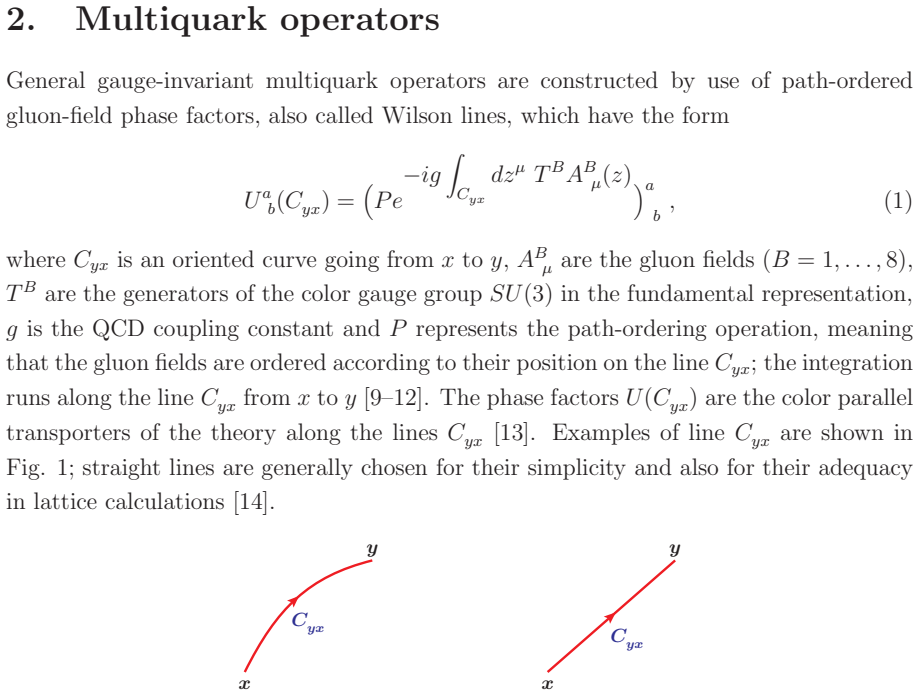
The load-bearing tool is the unit-determinant identity for the Wilson-line phase factors, $\det(U(C_{yx}))=1$, expressed through a contraction of two Levi-Civita symbols (Eq. (5)). Multiplying the multiquark operator by this trivial factor along the line joining the two Y-junctions, then applying the epsilon-contraction identity (Eq. (7)), rewires the color indices so that the operator falls apart into products of gauge-invariant bilinear (meson) and trilinear (baryon) operators. The backtracking relation $U(C_{yx})U(C_{xy})=1$ (Eq. (9)) then turns closed Wilson-loop factors into constants, leaving the decomposition purely hadronic.
What would settle it
Measure a tetraquark correlation function on the lattice at inter-cluster separations larger than the typical hadron size: if the connected Y-junction configuration remains the dominant gauge-field configuration and its energy grows without bound with separation, the assumption that color-singlet clusters do not confine each other would be falsified.
Extended reading notes
Core claim
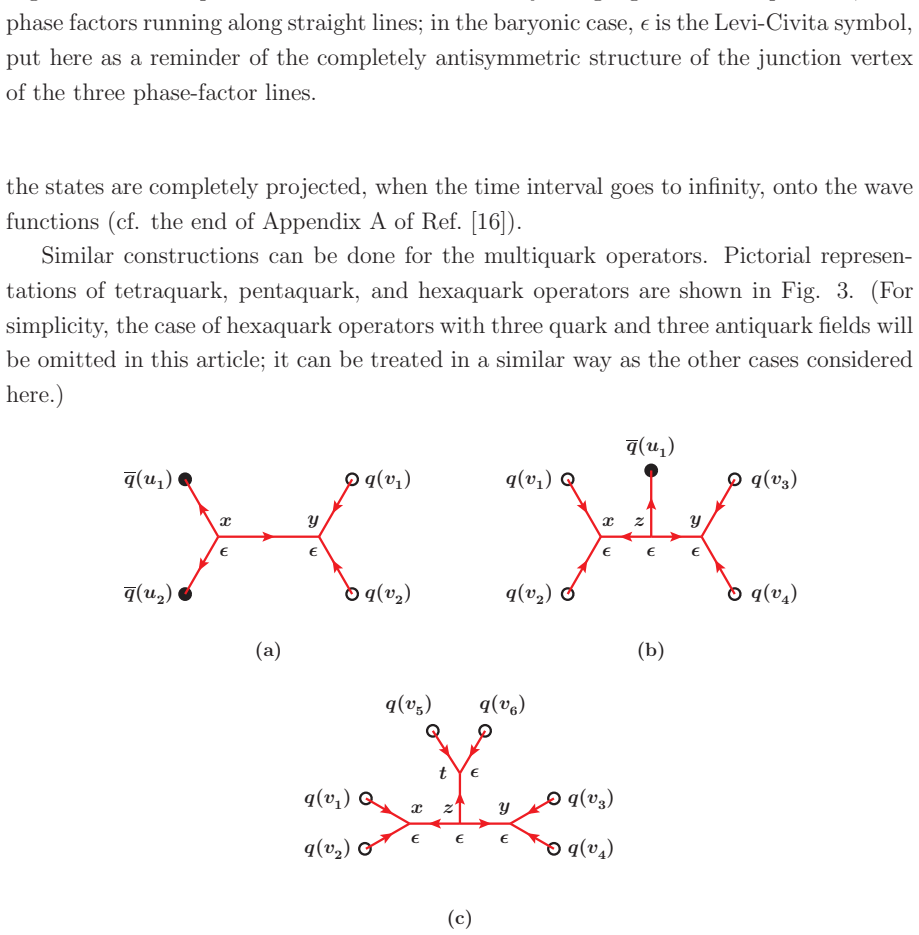
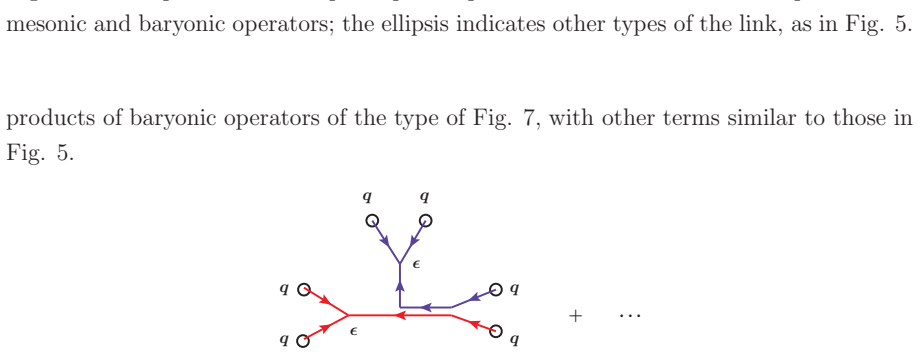
The paper establishes that any gauge-invariant multiquark operator built from Wilson lines and Y-shaped color junctions can be reexpressed exactly as a finite sum of products of ordinary hadronic operators. For the tetraquark, Eq. (8) gives six terms, each the product of two mesonic operators; two of the terms carry a Wilson-loop factor that reduces to a constant once the backtracking relation is used. The same insertion-of-determinant procedure decomposes pentaquarks into meson-baryon products and hexaquarks into baryon products, and it extends to SU(Nc). The paper reads this cluster reducibility as a general proof that completely confined, compact multiquark bound states do not exist, while connected Y-junction configurations still dominate at short distances.
Load-bearing premise
The conclusion that cluster reducibility forbids compact multiquark states rests on the premise that color-singlet hadronic clusters do not interact through confining forces; the paper states this but does not derive it.
Editorial extensions
If this is right
- Any tetraquark state described by a Y-junction operator must have a hadronic-molecular component at large cluster separations, since the operator content factorizes into products of meson operators.
- Pentaquark operators decompose into products of one baryonic and one or more mesonic operators; hexaquark operators decompose into products of baryonic operators.
- The same cluster decomposition holds in SU(Nc), with the number of mesonic or baryonic factors set by the number of external quark and antiquark lines.
- Hybrid operators containing gluon-field insertions are not cluster reducible because they lack two Y-junctions, so they remain the natural operator set for compact gluonic excitations.
- The boundary between the connected short-distance regime and the disconnected long-distance regime depends on quark masses, flavors, and quantum numbers, so neither the multiquark nor the molecular scheme is universally dominant.
Reading between the lines
- Beyond the paper: if cluster reducibility is exact, lattice studies of tetraquark correlators should show a sharp crossover in which disconnected hadron-like diagrams dominate once the inter-cluster separation exceeds roughly one hadron size; this is a measurable prediction.
- Beyond the paper: the decomposition supplies a natural operator basis for matching hadronic-molecular effective field theories to QCD, since every multiquark interpolating field is a sum of products of ordinary hadron operators whose short-distance constants can be organized by the same cluster decomposition.
- Beyond the paper: the proof's use of the backtracking relation to erase Wilson-loop factors suggests that contours with cusps or self-intersections deserve scrutiny; if that relation fails in such cases, surviving loop terms would leave a narrow opening for configurations that are not purely molecular.
Signed reviews
Editorial analysis
A structured set of objections, weighed in public.
Referee Report
Summary. This paper claims that Y-junction multiquark gauge-invariant operators built from Wilson lines and Levi-Civita junctions can be reexpressed as sums of products of ordinary mesonic and baryonic operators. The explicit proof is given for the tetraquark in Eq. (8), where the operator T is decomposed into six terms, each a product of two mesonic clusters with at most a Wilson-loop trace. The authors state that analogous decompositions hold for pentaquark, hexaquark, and SU(Nc) generalizations, and they conclude that cluster reducibility inhibits the formation of completely compact multiquark bound states, proposing a complementary multiquark/molecular description with an inner core and outer shell.
Significance. If the algebraic identities are correct, the tetraquark result Eq. (8) is a clean, parameter-free exact operator identity, derived from standard SU(3) group properties, and it has potential utility for lattice correlation functions and operator classification. However, the paper's broader physical conclusion goes beyond what the identity establishes, and the extensions to pentaquark, hexaquark, and SU(Nc) are not demonstrated at the same level of rigor. The central mathematical observation is useful, but the headline claim about nonexistence of compact multiquark states is not proven.
major comments (4)
- [§4 and §5] The summary statement in §5 that cluster reducibility 'provides a general proof of the nonexistence of completely confined or compact multiquark states' is not supported by the derivation. Equation (8) is an exact pointwise identity in the gauge field; it is kinematic and says nothing about the Hamiltonian, the spatial size of the states, or whether the operators create compact or extended configurations. The argument relies on the additional premise stated in §4, that hadronic clusters do not mutually have confining-type interactions, which is asserted rather than derived. Moreover, absence of confinement does not exclude compact bound states, since short-range nonconfining forces can produce small-size systems. The paper itself notes in §4 that the issue 'requires a more refined analysis' and in §5 describes an 'inner core' with connected string-junction-type interaction. The conclusion should be toned down to a qualitative physical expectation, not a proof.
- [§2, pentaquark and hexaquark] The cluster reducibility of pentaquark and hexaquark operators is asserted in words and pictures (Figs. 6 and 7) without the explicit algebraic identities that are provided for the tetraquark in Eq. (8). Since the abstract claims a general property of multiquark operators, these cases are load-bearing; please provide explicit decomposition formulas or a precise combinatorial algorithm that covers them. The hexaquark with three quarks and three antiquarks is also excluded, with no demonstration.
- [§3] The SU(Nc) extension states decompositions into products of (Nc−1) mesonic operators, etc., for tetraquark, pentaquark, and hexaquark generalizations, but no algebraic proof is given. The text says Eqs. (4), (5), and (7) are naturally extended, yet the contraction structure for junctions with (Nc−2) links is not demonstrated. If the SU(Nc) results are part of the paper's contribution, they need either explicit identities or a rigorous induction argument.
- [Abstract and §2] The claim that 'multiquark gauge-invariant operators can, in general, be decomposed' is too broad, because hybrid operators, Eqs. (10)-(11), are explicitly not cluster reducible. Please qualify the statement to the class of Y-junction operators with two junctions linked by phase-factor lines.
minor comments (4)
- [Eq. (8) and Fig. 5] When the backtracking relation (9) is used to set the Wilson loop to 3, the simplified form of Eq. (8) should be written out explicitly; the figure alone makes the factor of 3 and the resulting line contractions hard to check.
- [Eq. (5)] The factor 1/3! in the determinant is not visible in Eq. (8); state explicitly how it is absorbed in the contractions, since this is a common source of sign errors.
- [Abstract] The phrase 'in general' should be modified to indicate the restriction to Y-junction operators, as noted above.
- [Sec. 2, last paragraph] The sentence describing pentaquark and hexaquark decompositions would benefit from a precise statement that these include Wilson-loop factors, as in the tetraquark case.
Circularity Check
No circularity: the operator decomposition follows from standard Wilson-line and Levi-Civita identities, while the physical nonexistence conclusion rests on an additional dynamical premise that is not circularly imported.
full rationale
The central derivation, Eq. (8), is obtained by multiplying the tetraquark operator with the determinant identity Eq. (5), then applying the Levi-Civita identity Eq. (7) and the group product law Eq. (4). The Wilson-loop factor that remains is an independent gauge-invariant operator, not the target result, and the backtracking relation Eq. (9) is a standard property of path-ordered phase factors, cited to an external reference [18]. The proof is parameter-free, contains no fitted quantities, and does not rely on any self-citation: the authors' own prior works cited in the large-Nc discussion ([26], [27], [29]) and in the phase-factor background ([16]) are contextual or technical but are not load-bearing for the cluster-reducibility identity. The physical conclusion in Sec. 5, that cluster reducibility provides a general proof of nonexistence of completely confined or compact multiquark states, does depend on the premise in Sec. 4 that hadronic clusters do not mutually have confining-type interactions; however, that premise is an unproven dynamical assumption rather than a definitional or fitted input, and the paper itself flags that the issue 'requires a more refined analysis' and later describes an inner core with connected string-junction-type interaction. Such an overreach is a correctness or logical-gap concern, not a circularity. No step of the derivation reduces to its own input by construction, so the circularity score is 0.
Assumptions & free parameters
assumptions (5)
- standard math Wilson-line phase factors are elements of SU(3) with determinant equal to 1.
- standard math Levi-Civita contraction identity in Eq. (7).
- standard math Backtracking relation U(Cyx)U(Cxy)=1 in Eq. (9).
- domain assumption Interactions between color-singlet hadronic clusters are nonconfining.
- domain assumption Physical quantities are independent of the choice of Wilson-line paths.
Cite this review
Pith. "Pith review of Cluster reducibility of multiquark operators." pith.science (2026). https://pith.science/paper/FNCRE57A
@misc{pith2026190810164,
  author       = {Pith},
  title        = {Pith review of: Cluster reducibility of multiquark operators},
  year         = {2026},
  howpublished = {\url{https://pith.science/paper/FNCRE57A}},
  note         = {Machine review of arXiv:1908.10164}
}
read the original abstract
It is shown that the multiquark gauge-invariant operators can, in general, be decomposed into combinations of products of ordinary hadronic operators, exhibiting their cluster reducibility. The latter property inhibits the formation of completely compact multiquark bound states. Multiquark operators still play a crucial role in the description of exotic states in regions of configuration space where the hadronic clusters are close to each other. Our proof gives a foundation for a unified viewpoint, where the multiquark-type and the molecular-type approaches play complementary roles, at the gauge-invariant nonlocal operator level.
Figures

Figures from the paper (10 more)




Forward citations
Cited by 1 Pith paper
-
Hidden charm pentaquarks with color-octet substructure in QCD Sum Rules
QCD sum rules with color-octet two-cluster currents predict hidden-charm pentaquark masses of roughly 4.4-6.2 GeV for various spins, parities, and flavor contents.
Reference graph
Works this paper leans on
-
[1]
R. L. Jaffe, Phys. Rev. D 15 (1977) 281
work page 1977
-
[2]
R. L. Jaffe, Nucl. Phys. A 804 (2008) 25
work page 2008
-
[3]
Coleman, Aspects of Symmetry (Cambridge University Press, Cambridge, 1985), Chap
S. Coleman, Aspects of Symmetry (Cambridge University Press, Cambridge, 1985), Chap. 8
work page 1985
-
[4]
G. C. Rossi and G. Veneziano, Nucl. Phys. B 123 (1977) 507
1977
-
[5]
G. C. Rossi and G. Veneziano, JHEP 06 (2016) 041. arXiv:1603.05 830
work page 2016
-
[6]
R. Jaffe and F. Wilczek, Phys. Rev. Lett. 91 (2003) 232003. arX iv:hep-ph/0307341
arXiv 2003
-
[7]
E. V. Shuryak and I. Zahed, Phys. Lett. B 589 (2004) 21. arXiv :hep-ph/0310270
arXiv 2004
- [8]
Show all 64 references
-
[9]
Mandelstam, Ann
S. Mandelstam, Ann. Phys. (N.Y.) 19 (1962) 1
1962
-
[10]
Bia/suppress lynicki-Birula, Bull
I. Bia/suppress lynicki-Birula, Bull. Acad. Polon. Sci. 11 (1963) 135
1963
-
[11]
Mandelstam, Phys
S. Mandelstam, Phys. Rev. 175 (1968) 1580
1968
-
[12]
Nambu, Phys
Y. Nambu, Phys. Lett. B 80 (1979) 372
1979
-
[13]
Corrigan and B
E. Corrigan and B. Hasslacher, Phys. Lett. B 81 (1979) 181
1979
-
[14]
K. G. Wilson, Phys. Rev. D 10 (1974) 2445
1974
-
[15]
Yu. M. Makeenko and A. A. Migdal, Phys. Lett. B 97 (1980) 253
1980
-
[16]
Jugeau and H
F. Jugeau and H. Sazdjian, Nucl. Phys. B 670 (2003) 221. arXiv :hep-ph/0305021. 13
2003 arXiv
-
[17]
A. A. Migdal, Phys. Rep. 102 (1983) 199
1983
-
[18]
Makeenko, NATO Sci
Yu. Makeenko, NATO Sci. Ser. C 556 (2000) 285. arXiv:hep-th/ 0001047
2000
-
[19]
’t Hooft, Nucl
G. ’t Hooft, Nucl. Phys. B 72 (1974) 461
1974
-
[20]
Witten, Nucl
E. Witten, Nucl. Phys. B 160 (1979) 57
1979
-
[21]
Weinberg, Phys
S. Weinberg, Phys. Rev. Lett. 110 (2013) 261601
2013
-
[22]
Knecht and S
M. Knecht and S. Peris, Phys. Rev. D 88 (2013) 036016. arXiv:1 307.1267
2013
-
[23]
F.-K. Guo, L. Liu, U.-G. Meißner, and P. Wang, Phys. Rev. D 88 (2 013) 074506. arXiv:1308.2545
-
[24]
T. D. Cohen and R. F. Lebed, Phys. Rev. D 90 (2014) 016001. a rXiv:1403.8090
2014 arXiv
-
[25]
Maiani, A
L. Maiani, A. D. Polosa, and V. Riquer, JHEP 1606 (2016) 160. ar Xiv:1605.04839
2016 arXiv
-
[26]
Lucha, D
W. Lucha, D. Melikhov, and H. Sazdjian, Phys. Rev. D 96 (2017) 014022. arXiv:1706.06003
2017 arXiv
-
[27]
Lucha, D
W. Lucha, D. Melikhov, and H. Sazdjian, Eur. Phys. J. C 77 (201 7) 866. arXiv:1710.08316
-
[28]
Maiani, A
L. Maiani, A. D. Polosa, and V. Riquer, Phys. Rev. D 98 (2018) 05 4023. arXiv:1803.06883
2018 arXiv
-
[29]
Lucha, D
W. Lucha, D. Melikhov, and H. Sazdjian, Phys. Rev. D 98 (2018) 094011. arXiv:1810.09986
2018 arXiv
-
[30]
Maiani, V
L. Maiani, V. Riquer, and W. Wang, Eur. Phys. J. C 78 (2018) 101 1. arXiv:1810.07848
2018 arXiv
-
[31]
Weinberg, Phys
S. Weinberg, Phys. Rev. 137 (1965) B672
1965
-
[32]
M. B. Voloshin and L. B. Okun, JETP Lett. 23 (1976) 333 [Pisma Zh . Eksp. Teor. Fiz. 23 (1976) 369]
1976
-
[33]
De R´ ujula, H
A. De R´ ujula, H. Georgi, and S. L. Glashow, Phys. Rev. D 38 (19 77) 317
-
[34]
Amsler and N
C. Amsler and N. A. T¨ ornqvist, Phys. Rep. 389 (2004) 64
2004
-
[35]
Pav´ on Valderrama, Phys
M. Pav´ on Valderrama, Phys. Rev. D 85 (2012) 114037. arXiv:1204.2400. 14
2012 arXiv
-
[36]
F.-K. Guo, C. Hanhart, U.-G. Meißner, Q. Wang, Q. Zhao, and B.- S. Zou, Rev. Mod. Phys. 90 (2018) 015004. arXiv:1705.00141
2018 arXiv
-
[37]
Weinberg, Physica A 96 (1979) 327
S. Weinberg, Physica A 96 (1979) 327
1979
-
[38]
Gasser and H
J. Gasser and H. Leutwyler, Ann. Phys. (N.Y.) 158 (1984) 142
1984
-
[39]
A. V. Manohar, Lect. Notes Phys. 479 (1997) 311. arXiv:hep- ph/9606222
1997
-
[40]
H. G. Dosch, Phys. Rev. D 28 (1983) 412
1983
-
[41]
Alexandrou and G
C. Alexandrou and G. Koutsou, Phys. Rev. D 71 (2005) 014504 . arXiv:hep-lat/0407005
2005 arXiv
-
[42]
Okiharu, H
F. Okiharu, H. Suganuma, and T. T. Takahashi, Phys. Rev. Let t. 94 (2005) 192001. arXiv:hep-lat/0407001
2005 arXiv
-
[43]
Okiharu, H
F. Okiharu, H. Suganuma, and T. T. Takahashi, Phys. Rev. D 72 (2005) 014505. arXiv:hep-lat/0412012
2005 arXiv
-
[44]
Suganuma, T
H. Suganuma, T. Iritani, F. Okiharu, T. T. Takahashi, and A. Ya mamoto, AIP Conf. Proc. 1388 (2011) 195. arXiv:1103.4015
2011 arXiv
-
[45]
F. Lenz, J. T. Londergan, E. J. Moniz, R. Rosenfelder, M. Stin gl, and K. Yazaki, Ann. Phys. (N.Y.) 170 (1986) 65
1986
-
[46]
Carlson and V
J. Carlson and V. R. Pandharipande, Phys. Rev. D 43 (1991) 16 52
1991
-
[47]
Martens, C
G. Martens, C. Greiner, S. Leupold, and U. Mosel, Phys. Rev. D 73 (2006) 096004. arXiv:hep-ph/0603100
2006 arXiv
-
[48]
Vijande, A
J. Vijande, A. Valcarce, and J.-M. Richard, Phys. Rev. D 76 (20 07) 114013. arXiv:0707.3996
-
[49]
Vijande, A
J. Vijande, A. Valcarce, and J.-M. Richard, Phys. Rev. D 85 (20 12) 014019. arXiv:1111.5921
-
[50]
A. V. Manohar and M. B. Wise, Nucl. Phys. B 399 (1993) 17. arXiv:hep-ph/9212236
1993 arXiv
-
[51]
Bicudo, K
P. Bicudo, K. Cichy, A. Peters, and M. Wagner, Phys. Rev. D 93 (2016) 034501. arXiv:1510.03441
2016 arXiv
-
[52]
Bicudo, J
P. Bicudo, J. Scheunert, and M. Wagner, Phys. Rev. D 95 (201 7) 034502. arXiv:1612.02758. 15
-
[53]
Bicudo, M
P. Bicudo, M. Cardoso, O. Oliveira, and P. J. Silva, Phys. Rev. D 9 6 (2017) 074508. arXiv:1702.07789
2017 arXiv
-
[54]
Karliner and J
M. Karliner and J. L. Rosner, Phys. Rev. Lett. 119 (2017) 202001. arXiv:1707.07666
2017 arXiv
-
[55]
E. J. Eichten and C. Quigg, Phys. Rev. Lett. 119 (2017) 20200 2. arXiv:1707.09575
2017 arXiv
-
[56]
Quigg, in QCD and High Energy Interactions , Proceedings of the 53rd Rencontres de Moriond, edited by ´E
C. Quigg, in QCD and High Energy Interactions , Proceedings of the 53rd Rencontres de Moriond, edited by ´E. Aug´ e, J. Dumarchez, and J. Trˆ an Thanh Vˆ an, p. 127. arXiv:1804.04929
-
[57]
Esposito, A
A. Esposito, A. Pilloni, and A. D. Polosa, Phys. Lett. B 758 (2016 ) 292. arXiv:1603.07667
2016 arXiv
-
[58]
R. F. Lebed, R. E. Mitchell, and E. S. Swanson, Prog. Part. Nuc l. Phys. 93 (2017)
2017
-
[59]
Esposito, A
A. Esposito, A. Pilloni, and A. D. Polosa, Phys. Rep. 668 (2017) 1. arXiv:1611.07920
2017 arXiv
-
[60]
A. Ali, J. S. Lange, and S. Stone, Prog. Part. Nucl. Phys. 97 (2 017) 123. arXiv:1706.00610
-
[61]
S. L. Olsen, T. Skwarnicki, and D. Zieminska, Rev. Mod. Phys. 90 (2018) 1. arXiv:1708.04012
2018 arXiv
-
[62]
Karliner, J
M. Karliner, J. L. Rosner, and T. Skwarnicki, Ann. Rev. Nucl. Pa rt. Sci. 68 (2018)
2018
-
[63]
Brambilla, S
N. Brambilla, S. Eidelman, C. Hanhart, A. Nefediev, C.-P. Shen, C . E. Thomas, A. Vairo, and C.-Z. Yuan, arXiv:1907.07583
1907 arXiv
-
[64]
J. C. Collins and J. A. M. Vermaseren, arXiv:1606.01177. 16
Reviewed August 14, 2026 · model on record in the stance chip above.
Discussion (0). Continue with ORCID to comment.