REVIEW 3 major objections 6 minor 52 references
Segmentation Mask Guided End-to-End Person Search
T0 review · 3 major / 6 minor · reviewed 2026-08-14 · deepseek-v4-flash
Pith's one-line read Joint mask-guided training lifts person search to 86.3% mAP on CUHK-SYSU
desk verdict A useful partial-mask person search paper whose central claim needs a zero-mask control to actually hold up. read the letter →
The pith
A machine-rendered reading of the paper's core claim, the machinery that carries it, and where it could break.
The reading
What carries the argument
The load-bearing mechanism is a parallel mask branch attached to the shared ResNet feature maps $\mathbf{F}_p$ of each proposal. For proposals associated with labeled persons, the branch predicts a $2m \times 2m$ mask supervised by binary cross entropy, and the gradient flows into the same features used for detection and identification. A gating weight $\lambda$ (1 on images with mask labels, 0 otherwise) makes the mask loss a sparse, selective regularizer that teaches the shared representation to suppress background without ever seeing a mask for most pedestrians.
What would settle it
Run the exact same network and training schedule with the mask term disabled ($\lambda=0$) while keeping all other losses and the 1,833-image subset; if mAP on CUHK-SYSU gallery-100 stays at 86.3% instead of dropping toward the 75.5% OIM baseline, then the mask branch is not what carries the reported gain.
Extended reading notes
Core claim
On its own terms, the discovery is that a single Faster R-CNN-style person search network, trained with a multi-task loss that adds a binary cross-entropy mask loss on a branch over shared proposal features, learns pedestrian representations that no longer confuse background similarity with identity similarity. The mask branch sees only proposals matched to labeled persons, yet the identification features $\mathbf{f}_{id}$ become more discriminative because the shared features $\mathbf{F}_p$ are pushed to encode the foreground. On CUHK-SYSU with gallery size 100 the model reaches 86.3% mAP and 86.5% top-1, about 10.8 points of mAP over the joint detection-identification baseline OIM and about 3 points over the prior mask-guided two-stream method MGTS; the paper attributes the gap to joint end-to-end optimization of the three tasks rather than to explicit masking of inputs.
Load-bearing premise
The method assumes that mask supervision on only the labeled pedestrians in 16% of training images is enough to make the shared features background-invariant for all pedestrians, including the unlabeled ones the mask branch never sees.
Editorial extensions
If this is right
- Mask supervision can be partially labeled: annotating roughly 16% of training images is enough for the reported gain, so the approach lowers annotation cost compared with fully supervised segmentation.
- The joint optimization claim implies that combining detection, re-identification, and segmentation in one network outperforms the two-stream pipeline where masks are computed offline and detection and identification are handled separately.
- The reported robustness results on low-resolution and occlusion subsets (66.7% and 70.8% mAP) are much higher than prior joint models, suggesting mask-guided features help exactly where background and occlusion interfere.
- Because the mask branch is a relatively small addition on top of a Faster R-CNN/OIM architecture, the method can be dropped into other end-to-end person search frameworks.
Reading between the lines
- If partial mask guidance regularizes shared features this strongly, a testable extension is to replace human-labeled masks with masks from a pretrained instance segmentation model and compare mAP; a large drop would indicate precise labels matter, while a small drop would make the approach annotation-free.
- The paper compares against MGTS, which uses offline masks, but it does not isolate the contribution of the newly labeled dataset from the end-to-end design; an editor-level inference is that labeling the same 1,833 images and training the two-stream model with them as input masks would quantify how much of the 3-point gain comes from joint optimization rather than from annotation quality.
- The reported saturation at 15% mask coverage hints at a diminishing-returns curve; one could test on a different person-search benchmark with a similar partial-labeling protocol to see whether the 16% rule transfers or depends on CUHK-SYSU's identity statistics.
Signed reviews
Editorial analysis
A structured set of objections, weighed in public.
Referee Report
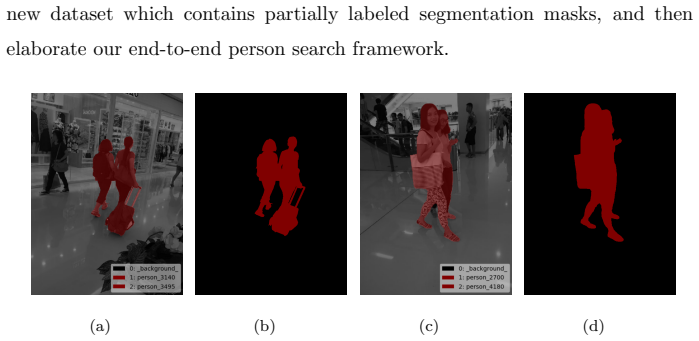
Summary. The paper proposes an end-to-end person search framework that jointly optimizes pedestrian detection, person re-identification, and pedestrian segmentation. A parallel mask branch is added on top of the shared feature maps and is trained with binary cross-entropy using manually annotated masks for a subset of CUHK-SYSU training images (1,833 images, about 16% of the training set, containing 2,815 labeled persons). At inference the mask branch is discarded and the Res5 features are used with Euclidean distance for retrieval. On CUHK-SYSU with gallery size 100, the method reports 86.3% mAP and 86.5% top-1 accuracy, which the authors call state-of-the-art. The paper also provides comparisons for varying gallery sizes, occlusion and low-resolution subsets, and an ablation study in which the proportion of images with mask annotations is varied from 3% to 100% of the labeled subset.
Significance. If the central claim is confirmed, the paper would make a useful contribution by showing that a relatively small number of precise segmentation-mask labels, integrated as an auxiliary loss, can improve person search in an end-to-end detector/identifier, and by releasing a partially masked extension of CUHK-SYSU. The method description is clear, the evaluation uses a standard benchmark, and the comparison set is broad. The main value rests on the attribution of the improvement to mask-guided feature learning and on the claim that partial labels suffice; the current evidence for both is incomplete because the ablation lacks a zero-mask control.
major comments (3)
- [Section 4.4, Table 4] The ablation lacks a 0% mask condition. At alpha=3% the model already reaches 85.1% mAP and 85.2% top-1, which is 9.6 mAP points above the published OIM baseline (75.5%), and increasing to Full changes mAP by only 1.2 points. Because the comparison to OIM conflates the mask branch with all other differences in the training recipe (ROIAlign, SGD schedule, two fully-connected heads, input resizing, and the specific subset of images selected for labeling), the reported improvements cannot be attributed to segmentation-mask supervision. The central claim that partial mask labels are sufficient rests on an unmeasured counterfactual: please train the identical model with lambda=0 in Eq. (7), or with no mask-labeled images at all, and report that row in Table 4.
- [Section 3.2, Eq. (6)] The mask branch is applied only to proposals associated with labeled persons; unlabeled pedestrians in the 1,833 mask-annotated images and all pedestrians in the remaining 9,373 training images never receive mask supervision. At inference, the feature for every detected pedestrian is produced by a network whose background-invariance has been directly trained on a small, selected subset. The paper should provide evidence that this supervision transfers to all gallery pedestrians, for example by reporting performance separately for labeled versus unlabeled test persons, or by studying a variant that also provides mask supervision for unlabeled persons.
- [Section 4.4, Table 4] All reported numbers are single-run results with no error bars or significance testing, although key comparisons differ by only 0.2 to 0.4 percentage points (e.g., alpha=3% vs alpha=6% gives 85.1 vs 85.3; alpha=15% vs Full gives identical values). Without repeated runs with different seeds, the claimed saturation of the performance curve and the claim that 16% labels are sufficient are not statistically established. Please report mean and standard deviation over at least three runs, or explicitly state that all results are single runs and treat the small differences in the ablation accordingly.
minor comments (6)
- [Abstract and Keywords] The abstract reads '86.5 top-1 accuracy' and should read '86.5% top-1 accuracy'; the keyword 'person searh' is a typo for 'person search'.
- [Section 3.1 and Table 3] The dataset name is misspelled as 'CHUK-SYSU' in Section 3.1 and as 'CHUK-SYSU dataset' in the conclusion; the correct name is CUHK-SYSU. Table 3 also contains the typo 'Occulusion' for 'Occlusion'.
- [Section 4.2] There are several typographical errors, including 'In paticular' for 'In particular', 'an novel' for 'a novel', and 'discrimitive' for 'discriminative'. These should be corrected in a final copyedit.
- [Figure 2 caption] The caption says 'The shadow regions in first and third columns indicate the labeled persons' and 'The second and fourth columns are their segmentation masks,' which is ambiguous because the figure appears to show four panels per row; please clarify which panels are the annotated images and which are the masks.
- [Section 4.3.1] The sentence 'Our framework achieved 3% gain compared with [15] on both mAP and top-1' is imprecise; the exact gains are 3.3 mAP points (83.0 to 86.3) and 2.8 top-1 points (83.7 to 86.5). Please quote exact numbers to avoid rounding ambiguity.
- [Section 3.1] The annotation statistics would be easier to verify if the paper stated how the 2,241 portions were formed (the division of 11,206 training images by 5) and whether the final selected 1,833 images are distributed across scenes similarly to the full training set; a sentence on this would strengthen the claim of uniform distribution.
Circularity Check
No significant circularity: the mask-guided person search system is an empirical architecture trained on external annotations and evaluated on a standard benchmark, with no derived quantity reducing to its own inputs.
full rationale
This paper makes no first-principles derivation or fitted-constant prediction that could reduce to its inputs. The central claim is that adding a parallel segmentation-mask branch with a masked cross-entropy loss (Eq. 6) to the multi-task loss (Eq. 7) improves person search. The mask supervision comes from external human annotations on a newly labeled subset of CUHK-SYSU, and evaluation is against the standard CUHK-SYSU gallery protocol used by prior methods. The reported 86.3% mAP and 86.5% top-1 are measured retrieval results, not quantities implied by the definitions of the losses. The comparison with OIM [17] is an empirical baseline comparison, not a circular step: the OIM loss is reused as a component, but the claimed benefit of mask guidance is not encoded in the OIM loss or in the evaluation metric. The paper's self-citations (e.g., IAN [18], by co-author Jimin Xiao) are used as related work and as a baseline, not as the justification for the mask branch's effectiveness. The ablation in Table 4 starts at 3% labeled images rather than 0%, which weakens the causal attribution of the gain to mask supervision and is a legitimate correctness/ablation concern, but it is not circularity: the 3%-mask experiment is a real configuration with external mask labels, and the conclusion is not forced by an equation matching input to output. No step exhibits self-definitional reasoning, renamed known results, or a load-bearing uniqueness theorem imported from the authors' own prior work. The honest finding is therefore no significant circularity.
Assumptions & free parameters
free parameters (2)
- Mask loss weight lambda =
1 for images with masks, 0 for images without
- Mask-labeled training proportion alpha =
16% (1,833 of 11,206 training images)
assumptions (3)
- domain assumption CUHK-SYSU ground-truth pedestrian boxes and identities are correct.
- domain assumption The hand-labeled segmentation masks are accurate and consistently annotated according to the stated rules.
- domain assumption A Mask R-CNN-style mask branch with binary cross-entropy loss is a suitable mechanism for guiding feature learning.
Cite this review
Pith. "Pith review of Segmentation Mask Guided End-to-End Person Search." pith.science (2026). https://pith.science/paper/JVBTJIMA
@misc{pith2026190810179,
  author       = {Pith},
  title        = {Pith review of: Segmentation Mask Guided End-to-End Person Search},
  year         = {2026},
  howpublished = {\url{https://pith.science/paper/JVBTJIMA}},
  note         = {Machine review of arXiv:1908.10179}
}
read the original abstract
Person search aims to search for a target person among multiple images recorded by multiple surveillance cameras, which faces various challenges from both pedestrian detection and person re-identification. Besides the large intra-class variations owing to various illumination conditions, occlusions and varying poses, background clutters in the detected pedestrian bounding boxes further deteriorate the extracted features for each person, making them less discriminative. To tackle these problems, we develop a novel approach which guides the network with segmentation masks so that discriminative features can be learned invariant to the background clutters. We demonstrate that joint optimization of pedestrian detection, person re-identification and pedestrian segmentation enables to produce more discriminative features for pedestrian, and consequently leads to better person search performance. Extensive experiments on benchmark dataset CUHK-SYSU, show that our proposed model achieves the state-of-the-art performance with 86.3% mAP and 86.5 top-1 accuracy respectively.
Figures


Figures from the paper (3 more)


Reference graph
Works this paper leans on
- [1]
-
[2]
A. Hermans, L. Beyer, B. Leibe, In defense of the triplet loss for person re-identification, arXiv preprint arXiv:1703.07737
-
[3]
S. Liao, Y. Hu, X. Zhu, S. Z. Li, Person re-identification by local maximal occurrence representation and metric learning, in: Proceedings of the IEEE conference on computer vision and pattern recognition, 2015, pp. 2197– 2206
work page 2015
-
[4]
D. Gray, H. Tao, Viewpoint invariant pedestrian recognition with an en- semble of localized features, in: European conference on computer vision, Springer, 2008, pp. 262–275
work page 2008
-
[5]
L. Wu, C. Shen, A. v. d. Hengel, Personnet: Person re-identification with deep convolutional neural networks, arXiv preprint arXiv:1601.07255. 20
-
[6]
F. Wang, W. Zuo, L. Lin, D. Zhang, L. Zhang, Joint learning of single-image and cross-image representations for person re-identification, in: Proceed- ings of the IEEE Conference on Computer Vision and Pattern Recognition, 2016, pp. 1288–1296
work page 2016
-
[7]
H. Zhao, M. Tian, S. Sun, J. Shao, J. Yan, S. Yi, X. Wang, X. Tang, Spindle net: Person re-identification with human body region guided fea- ture decomposition and fusion, in: Proceedings of the IEEE Conference on Computer Vision and Pattern Recognition, 2017, pp. 1077–1085
work page 2017
-
[8]
M. Tian, S. Yi, H. Li, S. Li, X. Zhang, J. Shi, J. Yan, X. Wang, Eliminating background-bias for robust person re-identification, in: Proceedings of the IEEE Conference on Computer Vision and Pattern Recognition, 2018, pp. 5794–5803
work page 2018
Show all 52 references
-
[9]
C.-P. Tay, S. Roy, K.-H. Yap, Aanet: Attribute attention network for per- son re-identifications, in: Proceedings of the IEEE Conference on Computer Vision and Pattern Recognition, 2019, pp. 7134–7143
2019
-
[10]
S. Li, S. Bak, P. Carr, X. Wang, Diversity regularized spatiotemporal atten- tion for video-based person re-identification, in: Proceedings of the IEEE Conference on Computer Vision and Pattern Recognition, 2018, pp. 369– 378
2018
-
[11]
W. Li, X. Zhu, S. Gong, Harmonious attention network for person re- identification, in: Proceedings of the IEEE Conference on Computer Vision and Pattern Recognition, 2018, pp. 2285–2294
2018
-
[12]
S. Ren, K. He, R. Girshick, J. Sun, Faster r-cnn: Towards real-time object detection with region proposal networks, in: Advances in neural informa- tion processing systems, 2015, pp. 91–99
2015
-
[13]
Ouyang, X
W. Ouyang, X. Wang, Joint deep learning for pedestrian detection, in: Proceedings of the IEEE International Conference on Computer Vision, 2013, pp. 2056–2063. 21
2013
-
[14]
Ouyang, X
W. Ouyang, X. Wang, A discriminative deep model for pedestrian detection with occlusion handling, in: 2012 IEEE Conference on Computer Vision and Pattern Recognition, IEEE, 2012, pp. 3258–3265
2012
-
[15]
D. Chen, S. Zhang, W. Ouyang, J. Yang, Y. Tai, Person search via a mask- guided two-stream cnn model, in: Proceedings of the European Conference on Computer Vision (ECCV), 2018, pp. 734–750
2018
-
[16]
T. Xiao, S. Li, B. Wang, L. Lin, X. Wang, End-to-end deep learning for person search, arXiv preprint arXiv:1604.01850 2 (2016) 2
2016 arXiv
-
[17]
T. Xiao, S. Li, B. Wang, L. Lin, X. Wang, Joint detection and identification feature learning for person search, in: Proceedings of the IEEE Conference on Computer Vision and Pattern Recognition, 2017, pp. 3415–3424
2017
-
[18]
J. Xiao, Y. Xie, T. Tillo, K. Huang, Y. Wei, J. Feng, Ian: the individual aggregation network for person search, Pattern Recognition 87 (2019) 332– 340
2019
-
[19]
Dalal, B
N. Dalal, B. Triggs, Histograms of oriented gradients for human detection, 2005
2005
-
[20]
P. F. Felzenszwalb, R. B. Girshick, D. McAllester, D. Ramanan, Object de- tection with discriminatively trained part-based models, IEEE transactions on pattern analysis and machine intelligence 32 (9) (2009) 1627–1645
2009
-
[21]
Doll´ ar, Z
P. Doll´ ar, Z. Tu, P. Perona, S. Belongie, Integral channel features
-
[22]
Zhang, C
S. Zhang, C. Bauckhage, A. B. Cremers, Informed haar-like features im- prove pedestrian detection, in: Proceedings of the IEEE conference on computer vision and pattern recognition, 2014, pp. 947–954
2014
-
[23]
W. Nam, P. Doll´ ar, J. H. Han, Local decorrelation for improved pedestrian detection, in: Advances in Neural Information Processing Systems, 2014, pp. 424–432. 22
2014
-
[24]
Filali, M
I. Filali, M. S. Allili, N. Benblidia, Multi-scale salient object detection us- ing graph ranking and global–local saliency refinement, Signal Processing: Image Communication 47 (2016) 380–401
2016
-
[25]
Cholakkal, J
H. Cholakkal, J. Johnson, D. Rajan, A classifier-guided approach for top- down salient object detection, Signal Processing: Image Communication 45 (2016) 24–40
2016
-
[26]
J. Dai, Y. Li, K. He, J. Sun, R-fcn: Object detection via region-based fully convolutional networks, in: Advances in neural information processing systems, 2016, pp. 379–387
2016
-
[27]
T.-Y. Lin, P. Doll´ ar, R. Girshick, K. He, B. Hariharan, S. Belongie, Feature pyramid networks for object detection, in: Proceedings of the IEEE con- ference on computer vision and pattern recognition, 2017, pp. 2117–2125
2017
-
[28]
Girshick, Fast r-cnn, in: Proceedings of the IEEE international confer- ence on computer vision, 2015, pp
R. Girshick, Fast r-cnn, in: Proceedings of the IEEE international confer- ence on computer vision, 2015, pp. 1440–1448
2015
-
[29]
Zhang, L
L. Zhang, L. Lin, X. Liang, K. He, Is faster r-cnn doing well for pedestrian detection?, in: European conference on computer vision, Springer, 2016, pp. 443–457
2016
-
[30]
Zheng, H
L. Zheng, H. Zhang, S. Sun, M. Chandraker, Y. Yang, Q. Tian, Person re-identification in the wild, in: Proceedings of the IEEE Conference on Computer Vision and Pattern Recognition, 2017, pp. 1367–1376
2017
-
[31]
Cheng, Y
D. Cheng, Y. Gong, S. Zhou, J. Wang, N. Zheng, Person re-identification by multi-channel parts-based cnn with improved triplet loss function, in: Proceedings of the iEEE conference on computer vision and pattern recog- nition, 2016, pp. 1335–1344
2016
-
[32]
R. R. Varior, M. Haloi, G. Wang, Gated siamese convolutional neural net- work architecture for human re-identification, in: European conference on computer vision, Springer, 2016, pp. 791–808. 23
2016
-
[33]
T. Xiao, H. Li, W. Ouyang, X. Wang, Learning deep feature representations with domain guided dropout for person re-identification, in: Proceedings of the IEEE conference on computer vision and pattern recognition, 2016, pp. 1249–1258
2016
-
[34]
McLaughlin, J
N. McLaughlin, J. Martinez del Rincon, P. Miller, Recurrent convolutional network for video-based person re-identification, in: Proceedings of the IEEE conference on computer vision and pattern recognition, 2016, pp. 1325–1334
2016
-
[35]
D. Yi, Z. Lei, S. Liao, S. Z. Li, Deep metric learning for person re- identification, in: 2014 22nd International Conference on Pattern Recogni- tion, IEEE, 2014, pp. 34–39
2014
-
[36]
W. Li, R. Zhao, T. Xiao, X. Wang, Deepreid: Deep filter pairing neural network for person re-identification, in: Proceedings of the IEEE conference on computer vision and pattern recognition, 2014, pp. 152–159
2014
-
[37]
H. Liu, J. Feng, M. Qi, J. Jiang, S. Yan, End-to-end comparative attention networks for person re-identification, IEEE Transactions on Image Process- ing 26 (7) (2017) 3492–3506
2017
-
[38]
W. Chen, X. Chen, J. Zhang, K. Huang, Beyond triplet loss: a deep quadru- plet network for person re-identification, in: Proceedings of the IEEE Con- ference on Computer Vision and Pattern Recognition, 2017, pp. 403–412
2017
-
[39]
Zheng, Z
L. Zheng, Z. Bie, Y. Sun, J. Wang, C. Su, S. Wang, Q. Tian, Mars: A video benchmark for large-scale person re-identification, in: European Conference on Computer Vision, Springer, 2016, pp. 868–884
2016
-
[40]
M. Geng, Y. Wang, T. Xiang, Y. Tian, Deep transfer learning for person re-identification, arXiv preprint arXiv:1611.05244
-
[41]
Y. Xu, B. Ma, R. Huang, L. Lin, Person search in a scene by jointly model- ing people commonness and person uniqueness, in: Proceedings of the 22nd ACM international conference on Multimedia, ACM, 2014, pp. 937–940. 24
2014
-
[42]
H. Liu, J. Feng, Z. Jie, K. Jayashree, B. Zhao, M. Qi, J. Jiang, S. Yan, Neural person search machines, in: Proceedings of the IEEE International Conference on Computer Vision, 2017, pp. 493–501
2017
-
[43]
Munjal, S
B. Munjal, S. Amin, F. Tombari, F. Galasso, Query-guided end-to-end person search, arXiv preprint arXiv:1905.01203
1905 arXiv
-
[44]
J. Long, E. Shelhamer, T. Darrell, Fully convolutional networks for se- mantic segmentation, in: Proceedings of the IEEE conference on computer vision and pattern recognition, 2015, pp. 3431–3440
2015
-
[45]
Y. Li, H. Qi, J. Dai, X. Ji, Y. Wei, Fully convolutional instance-aware se- mantic segmentation, in: Proceedings of the IEEE Conference on Computer Vision and Pattern Recognition, 2017, pp. 2359–2367
2017
-
[46]
Wada, labelme: Image Polygonal Annotation with Python, https:// github.com/wkentaro/labelme (2016)
K. Wada, labelme: Image Polygonal Annotation with Python, https:// github.com/wkentaro/labelme (2016)
2016
-
[47]
K. He, X. Zhang, S. Ren, J. Sun, Deep residual learning for image recog- nition, in: Proceedings of the IEEE conference on computer vision and pattern recognition, 2016, pp. 770–778
2016
-
[48]
K. He, G. Gkioxari, P. Doll´ ar, R. Girshick, Mask r-cnn, in: Proceedings of the IEEE international conference on computer vision, 2017, pp. 2961– 2969
2017
-
[49]
Y. Yan, Q. Zhang, B. Ni, W. Zhang, M. Xu, X. Yang, Learning context graph for person search, in: Proceedings of the IEEE Conference on Com- puter Vision and Pattern Recognition, 2019, pp. 2158–2167
2019
-
[50]
R. Zhao, W. Ouyang, X. Wang, Unsupervised salience learning for person re-identification, in: Proceedings of the IEEE Conference on Computer Vision and Pattern Recognition, 2013, pp. 3586–3593
2013
-
[51]
Koestinger, M
M. Koestinger, M. Hirzer, P. Wohlhart, P. M. Roth, H. Bischof, Large scale metric learning from equivalence constraints, in: 2012 IEEE conference on computer vision and pattern recognition, IEEE, 2012, pp. 2288–2295. 25
2012
-
[52]
Zheng, L
L. Zheng, L. Shen, L. Tian, S. Wang, J. Wang, Q. Tian, Scalable person re-identification: A benchmark, in: Proceedings of the IEEE international conference on computer vision, 2015, pp. 1116–1124. 26
2015
Reviewed August 14, 2026 · model on record in the stance chip above.
Discussion (0). Continue with ORCID to comment.