REVIEW 4 major objections 5 minor 24 references
Behavior-aware Service Access Control Mechanism using Security Policy Monitoring for SOA Systems
T0 review · 4 major / 5 minor · reviewed 2026-08-14 · deepseek-v4-flash
Pith's one-line read A SOA system can stop insider attacks by checking every service call against a per-user trustful behavior model and ending sessions once measured risk crosses a threshold.
desk verdict A readable runtime-monitoring design for SOA access control whose central security claim is unsupported: the behavior elements are assumed trustworthy and the experiments only show thresholds firing as coded. read the letter →
The pith
A machine-rendered reading of the paper's core claim, the machinery that carries it, and where it could break.
The reading
What carries the argument
The central mechanism is the trustful behavior model (TBM), a set of rules $\langle Id, Src, Dst \rangle$ generated from the service releasing model: each rule says that a consumer with a given identity may move from a current service URI to a target service URI. Alongside the TBM, checkpoints embedded in each service interface collect behavior elements (identity, current URI, target URI, timestamps, access counts) and send them to the monitor. The behavior-aware access control algorithm checks each request against the TBM, then evaluates risk measurement functions—unauthorized access risk (UAR), access retention risk (ARR), and access frequency risk (AFR)—and uses a threshold comparison $PF(R(e_i, t_i)) \in \{0,1\}$ to decide between returning the service interface, denying the request, terminating the session, or blacklisting the consumer.
What would settle it
Set up the same prototype with a consumer who can call a sensitive service's endpoint directly, bypassing the checkpoint JSP, or who can replay another consumer's behavior elements; if such requests are served and the monitor logs nothing, the claim that the mechanism can effectively monitor consumer behaviors at runtime is refuted.
Extended reading notes
Core claim
On the paper's own terms, the central claim is that adding a monitor—fed by checkpoints embedded in every service interface—to a single-trust-domain SOA system lets the service provider enforce per-consumer trustful behavior models: a request that does not match the consumer's TBM is denied, and when accumulated unauthorized-access risk (UAR) or access-frequency risk (AFR) exceeds a provider-set threshold, the consumer's session is terminated early. A consumer who crosses both UAR and AFR at the same time is added to a blacklist and barred from future sessions. The prototype evaluation is presented as evidence that the mechanism can monitor consumer behaviors in run time, respond when malicious behavior really occurs, and still perform acceptably as the TBM rule count grows.
Load-bearing premise
The mechanism assumes that every service invocation flows through the checkpoint scripts and that the behavior elements they collect (identity, current URI, target URI, timestamps, access counts) are authentic and cannot be spoofed, replayed, or bypassed.
Editorial extensions
If this is right
- If the mechanism works as claimed, a service provider can set per-consumer release policies and have them enforced continuously at runtime, so an authorized user who tries to reach a service outside their TBM gets no response.
- Once a consumer's unauthorized-access attempts or request frequency exceeds the provider-set threshold, the session is cut short before further damage, stopping high-frequency scraping or repeated probes of sensitive services mid-session.
- A consumer who simultaneously exceeds both unauthorized-access and frequency thresholds is blacklisted permanently, preventing repeat insider attempts in later sessions.
- Because TBM growth causes only a near-linear increase in response time, the mechanism can scale to larger SOA systems with more services and routes without a dramatic slowdown.
Reading between the lines
- The same checkpoint-and-TBM pattern could extend to multi-trust-domain SOA by having each provider publish its own TBM and having monitors validate cross-domain calls, though the paper explicitly leaves multi-domain monitoring as future work.
- The risk model only counts unauthorized attempts and access frequency; adding behavior elements such as data volume or operation type would catch slow, low-frequency data exfiltration that the current thresholds miss.
- Because non-matching requests are denied before being served, each UAR increment can double as forensic evidence: repeated failed attempts reveal which sensitive services a consumer probes, even when no single threshold is crossed.
Signed reviews
Editorial analysis
A structured set of objections, weighed in public.
Referee Report
Summary. The paper proposes a behavior-aware access control mechanism for single-trust-domain SOA systems. The service provider defines a service releasing policy (SRM), which is converted into per-consumer trustful behavior models (TBM) consisting of allowed transitions between service URIs. A monitor receives behavior elements collected by checkpoint scripts embedded in service interfaces, denies requests that do not match TBM, and computes risk scores UAR and AFR; if the risk evidence PF equals 1, the consumer's session is terminated or the consumer is blacklisted. The authors implement a Java/Tomcat prototype and report experiments on user-behavior supervision, dynamic access authorization, and response-time scaling with TBM size, concluding that the mechanism effectively monitors consumers and responds to malicious behavior in run time.
Significance. The TBM idea of converting a releasing policy into explicit allowed-transition rules is a reasonable and potentially useful way to express fine-grained behavioral policy for SOA, and the paper gives a systematic formal apparatus for that conversion. The prototype and the basic observation that response time grows roughly linearly with TBM size are also useful. However, the central claim that the mechanism can effectively detect and respond to malicious insider behavior is not established: the threat model is incomplete, the risk evaluation is definitionally tied to the enforcement threshold, and the formal definitions contain gaps that prevent verification. If the trust and evaluation issues were fixed, the contribution could be a solid systems paper on threshold-based behavioral enforcement; as submitted, the evidence supports only the narrower claim that requests outside TBM are refused and sessions are terminated after a preset counter or frequency threshold is exceeded.
major comments (4)
- [§3.1, §3.5] The runtime detection depends entirely on behavior elements collected by checkpoint scripts embedded in service interfaces and sent to the monitor, but the paper never specifies how these elements are authenticated, bound to server-side state, or protected from forgery. A malicious consumer could invoke a service endpoint directly without passing through the checkpoint, or could supply forged eid/esrc/edst values, and the monitor would see nothing or see a compliant transition. The single-trust-domain restriction in Section 2 does not remove this threat because the adversary the mechanism is designed to police is the authorized insider. The paper needs an explicit trust and integrity model, and the evaluation in Section 4 needs at least one scenario that attempts to bypass or forge the collected behavior elements.
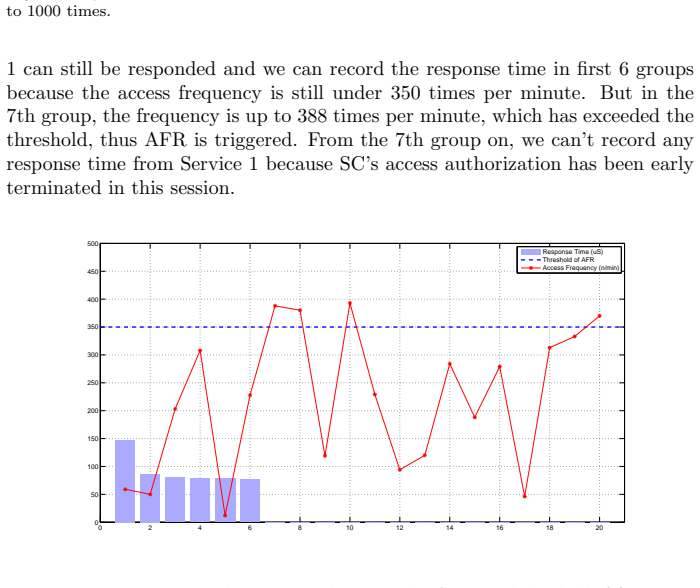
- [§3.4, §4.2.2] Risk evaluation is defined in Definitions 14 and 15 and Equation (10) so that PF=1 exactly when accumulated risk exceeds a preset threshold, and the dynamic-authorization evaluation in Section 4.2.2 sets theta(UAR)=1000 and theta(AFR)=350/min and then reports that the session is terminated when those thresholds are crossed. The 'detection' experiment therefore verifies the enforcement predicate by construction rather than testing whether malicious behavior is recognized. The paper should either evaluate against independently labeled attack behaviors and report false positives and false negatives, or explicitly reframe the contribution as threshold-based behavioral enforcement rather than malicious-behavior detection.
- [§3.4, §3.5] The risk model is not fully specified and contains inconsistencies that prevent a correctness check. Equation (4) defines the new risk as F(e_i, t_i) without ever defining F; Definition 11 defines UAF while the algorithm in Section 3.5 uses UAR without giving its definition; Section 3.5 contains the malformed expression 'P F(R(AF R)' rather than PF(AFR); and initial values for R(A, t_0) and R(e_t, t_0) are never given. A complete and computable definition of each risk measure, including initial conditions and update rules, is needed before the algorithm's behavior can be verified.
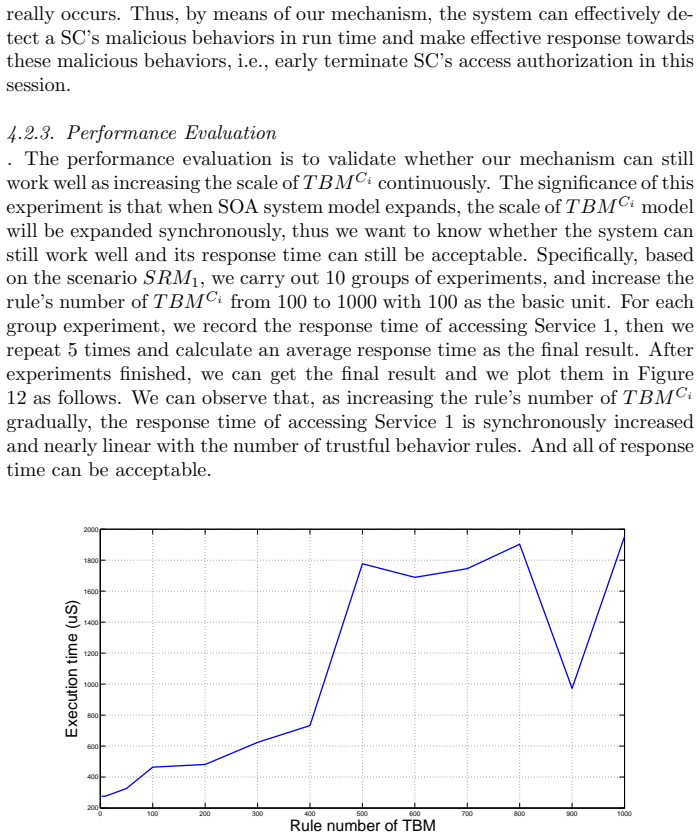
- [§4.2] The experimental evaluation exercises only the normal request path within the prototype: requests are generated against the intended interfaces, and no test tries to spoof behavior elements, call a service directly, replay another user's session, exceed permissions in a realistic attack pattern, or otherwise evade the checkpoint. Consequently the experiments cannot support the abstract's claim that the mechanism 'can effectively monitor consumer's behaviors and make effective responses when malicious behaviors really occur in run time.' In addition, the figure captions in Section 4 are numbered Figure 1-6 while the text refers to Figures 7-12, and the performance evaluation in Section 4.2.3 uses five repeats without reporting variance or confidence intervals.
minor comments (5)
- [§4.1] The text refers to 'the behavior-aware access control algorithm mentioned in section 4.5'; the algorithm is actually in Section 3.5.
- [Definition 9] Definition 9 says behavior elements are 'environment variables' but does not explain how these variables are populated, which of them come from the client, and which are determined by the server; this is directly relevant to the trust-model concern.
- [Definition 11] There is a typo in Definition 11: 'eid is SC's identify' should be 'eid is SC's identity.'
- [Section 5] Reference [16] appears twice in the same sentence, and several references, including [8], are incomplete or missing author information.
- [Equation (2)] The symbol t_i is used for both a transition and a time index in Definitions 7 and 10, which makes the formalism harder to follow and should be disambiguated.
Circularity Check
The 'malicious behavior detection' result reduces by construction to a hand-set threshold, making the central evaluation claim definitional rather than empirical.
-
self definitional
[Section 3.4 (Definitions 14-15, Eq. (9)-(10)), Section 3.5 algorithm, Section 4.2.2 evaluation]
"E(R(ei, ti)) = 1 − θ(ei)/R(ei, ti) (9) ... P F(R(ei, ti)) = { 1, E(R(ei, ti)) > 0; 0, E(R(ei, ti)) ≤ 0 } (10). ... We set the threshold of UAR to 1000 times, i.e., θ(UAR)=1000, which implies that the SC's access authorization will be early terminated in this session when his or her unauthorized access times exceeds 1000 times."
By Eq. (9)-(10), PF(R)=1 is algebraically equivalent to R(ei,ti)>θ(ei); the access-control algorithm terminates the session exactly when PF(UAR)=1 or PF(AFR)=1. The experiment defines 'malicious behavior' as the condition that the unauthorized-access count exceeds the hand-set threshold of 1000 (or the frequency exceeds 350/min). Observing termination under that condition is therefore a restatement of the defining equation, not an independent empirical confirmation that the mechanism detects malicious behavior. The conclusion that the mechanism 'can effectively detect malicious behaviors' reduces to the threshold chosen by the designer.
full rationale
The paper's derivation chain for the risk-evidence predicate is self-contained but definitional: risk R is accumulated by the formulas in Definitions 11-13, and risk evidence PF is defined via a threshold comparison, so the algorithm's response is determined by the same inequality used to define 'malicious'. Consequently, the Section 4.2.2 results demonstrate that the prototype implements Eq. (10), but they cannot validate the stronger claim of effective detection of malicious insider behavior independently of the hand-set thresholds. The TBM-based request filtering in Section 4.2.1 is likewise an enforcement check of the algorithm's own deny rule, although this is a normal conformance test. The self-citation of P-Spec [11] in Section 3.2 is a minor reuse of the authors' own policy language; since Definition 4 supplies the actual grammar used, this citation is not load-bearing for the result. No fitted parameters are passed off as predictions, and no uniqueness theorem is imported from the authors' prior work. Overall, the central 'detection' claim is partially circular because the measured outcome is equivalent by construction to the threshold input, warranting a score of 6 rather than a higher score.
Assumptions & free parameters
free parameters (2)
- UAR threshold theta(UAR) =
1000 unauthorized accesses
- AFR threshold theta(AFR) =
350 accesses per minute
assumptions (5)
- domain assumption Single trust domain: one service provider owns and defines security policy for the entire SOA system
- domain assumption Service calls are routed through embedded check points and the monitor sees all behavior elements
- domain assumption Consumer identity and private key CK_i provide reliable authentication
- ad hoc to paper The TBM conversion from SRM to transition rules preserves all relevant allowed behavior
- ad hoc to paper Risk thresholds theta(ei) can be set to separate malicious from benign behavior
Cite this review
Pith. "Pith review of Behavior-aware Service Access Control Mechanism using Security Policy Monitoring for SOA Systems." pith.science (2026). https://pith.science/paper/VVA4FI5Z
@misc{pith2026190810201,
  author       = {Pith},
  title        = {Pith review of: Behavior-aware Service Access Control Mechanism using Security Policy Monitoring for SOA Systems},
  year         = {2026},
  howpublished = {\url{https://pith.science/paper/VVA4FI5Z}},
  note         = {Machine review of arXiv:1908.10201}
}
read the original abstract
Service-oriented architecture (SOA) system has been widely utilized at many present business areas. However, SOA system is loosely coupled with multiple services and lacks the relevant security protection mechanisms, thus it can easily be attacked by unauthorized access and information theft. The existed access control mechanism can only prevent unauthorized users from accessing the system, but they can not prevent those authorized users (insiders) from attacking the system. To address this problem, we propose a behavior-aware service access control mechanism using security policy monitoring for SOA system. In our mechanism, a monitor program can supervise consumer's behaviors in run time. By means of trustful behavior model (TBM), if finding the consumer's behavior is of misusing, the monitor will deny its request. If finding the consumer's behavior is of malicious, the monitor will early terminate the consumer's access authorizations in this session or add the consumer into the Blacklist, whereby the consumer will not access the system from then on. In order to evaluate the feasibility of proposed mechanism, we implement a prototype system. The final results illustrate that our mechanism can effectively monitor consumer's behaviors and make effective responses when malicious behaviors really occur in run time. Moreover, as increasing the rule's number in TBM continuously, our mechanism can still work well.
Figures


Figures from the paper (3 more)

Reference graph
Works this paper leans on
-
[1]
A. Arsanjani, L. J. Zhang, M. Ellis, A. Allam, K. Channabasavaiah, A service-oriented reference architecture, It Professional 9 (3 ) (2007) 10–17
work page 2007
-
[2]
C. Momm, M. Gebhart, S. Abeck, A model-driven approach for mo nitor- ing business performance in web service compositions, in: Internat ional Conference on Internet and Web Applications and Services, 2009. 16
work page 2009
-
[3]
D. Guinard, V. Trifa, S. Karnouskos, P. Spiess, D. Savio, Inter acting with the soa-based internet of things: Discovery, query, selectio n, and on-demand provisioning of web services, IEEE Transactions on Ser vices Computing 3 (3) (2010) 223–235
work page 2010
-
[4]
I. R. Chen, J. Guo, F. Bao, Trust management for soa-based io t and its ap- plication to service composition, IEEE Transactions on Services Com puting 9 (3) (2017) 482–495
work page 2017
-
[5]
X. Ning, J. Ma, S. Cong, Z. Tao, Decentralized information flow ve rifi- cation framework for the service chain composition in mobile computin g environments, in: IEEE International Conference on Web Service s, 2013
work page 2013
-
[6]
W. J. Tolone, G. J. Ahn, T. Pai, S. P. Hong, Access control in colla borative systems, Acm Computing Surveys 37 (1) (2005) 29–41
work page 2005
-
[7]
R. Wonohoesodo, Z. Tari, A role based access control for web s ervices, in: IEEE International Conference on Services Computing, 2004
work page 2004
-
[8]
M. B. Salem, S. Hershkop, S. J. Stolfo, A Survey of Insider Atta ck Detection Research, 2008
work page 2008
Show all 24 references
-
[9]
T. S. Cook, D. Drusinksy, M. T. Shing, Specification, validation an d run- time monitoring of soa based system-of-systems temporal behav iors, in: IEEE International Conference on System of Systems Engineerin g, 2007
2007
-
[10]
Drusinsky, G
D. Drusinsky, G. Watney, Applying run-time monitoring to the de ep- impact fault protection engine, in: Software Engineering Workshop , 2003
2003
-
[11]
Y. Meng, Z. Huang, Z. Yu, C. Ke, Privacy-aware cloud service s election approach based on p-spec policy models and privacy sensitivities, Fu ture Generation Computer Systems 86 (2018) 1–11
2018
-
[12]
URL http://www.omg.org/spec/BPMN/2.0/
OMG, Business process model and notation (bpmn) version 2.0 ( 2011). URL http://www.omg.org/spec/BPMN/2.0/
2011
-
[13]
Rademakers, R
T. Rademakers, R. V. Liempd, Activiti in action: Executable bus iness processes in bpmn 2.0
-
[14]
Baresi, S
L. Baresi, S. Guinea, O. Nano, G. Spanoudakis, Comprehensive monitoring of bpel processes, IEEE Internet Computing 14 (3) (2010) 50–5 7
2010
-
[15]
Zhang, Z
H. Zhang, Z. Shao, Z. Hong, Runtime monitoring web services imp lemented in bpel, in: International Conference on Uncertainty Reasoning an d Knowl- edge Engineering, 2011
2011
-
[16]
G. Wu, J. Wei, T. Huang, Flexible pattern monitoring for ws-bpel through stateful aspect extension, in: IEEE International Conference on Web Ser- vices, 2008. 17
2008
-
[17]
M. Asim, A. Yautsiukhin, A. D. Brucker, B. Lempereur, Q. Shi, S ecurity Policy Monitoring of Composite Services, 2014
2014
-
[18]
Wetzstein, S
B. Wetzstein, S. Strauch, F. Leymann, Measuring performan ce metrics of ws-bpel service compositions, in: International Conference on N etworking and Services, 2009
2009
-
[19]
T. Ou, S. Wei, C. Guo, L. Jing, Visualized monitoring of virtual bus iness process for soa, in: IEEE International Conference on E-busine ss Engineer- ing, 2008
2008
-
[20]
Barbon, P
F. Barbon, P. Traverso, M. Pistore, M. Trainotti, Run-time mo nitoring of instances and classes of web service compositions, in: IEEE Intern ational Conference on Web Services, 2006
2006
-
[21]
Baresi, S
L. Baresi, S. Guinea, Dynamo: Dynamic monitoring of ws-bpel pr ocesses, in: International Conference on Service-oriented Computing, 20 05
-
[22]
Zmuda, M
D. Zmuda, M. Psiuk, K. Zielinski, Dynamic monitoring framework fo r the soa execution environment, Procedia Computer Science 1 (1) (201 0) 125– 133
-
[23]
N. E. Ioini, A. Garibbo, A. Sillitti, G. Succi, An Open Source Monitor ing Framework for Enterprise SOA, 2013
2013
-
[24]
C. Chen, A. Zaidman, H. G. Gross, A framework-based runtime monitoring approach for service-oriented software systems, in: Internat ional Workshop on Quality Assurance for Service-based Applications, 2011. 18
2011
Reviewed August 14, 2026 · model on record in the stance chip above.
Discussion (0). Continue with ORCID to comment.