REVIEW 3 major objections 5 minor 70 references
Blended Convolution and Synthesis for Efficient Discrimination of 3D Shapes
T0 review · 3 major / 5 minor · reviewed 2026-08-14 · deepseek-v4-flash
Pith's one-line read The paper introduces a single differentiable layer that projects 3D point clouds into a latent unit-ball space and convolves them with kernels that can both rotate and translate, achieving 94.2% on ModelNet10 and 91.8% on ModelNet40 at…
desk verdict A credible lightweight 3D classifier with a genuinely useful architecture, but the proof of the central convolution claim breaks exactly where the learned basis stops being orthogonal. read the letter →
The pith
A machine-rendered reading of the paper's core claim, the machinery that carries it, and where it could break.
The reading
What carries the argument
The load-bearing object is the complete orthogonal system $Z_{n,l,m}(r,\theta,\phi) = Q_{nl}(r)Y_{l,m}(\theta,\phi)$ in the unit ball, where $Q_{nl}$ is obtained by Gram-Schmidt orthogonalization (with respect to weight $r^2$) of $f_{nl}(r)\approx (-1)^l n\,e^{(n-l)r}$. The exponential form gives the radial part a shift property that makes kernel translation tractable in the spectral domain, while the spherical-harmonic part carries rotation through Wigner-D matrices. Making the orthogonalization coefficients $W_{nlkm}$ trainable relaxes orthogonality and converts the expansion into a learned latent projection; Theorem 1 then combines projection and roto-translational convolution into a single spectral formula, which the layer implements.
What would settle it
Compute the spatial-domain roto-translational convolution of a fixed input shape and kernel directly, and compare it with the spectral formula in Theorem 1 using the trained non-orthogonal basis; a discrepancy beyond numerical tolerance on a test set of synthetic functions in $\mathbb{B}^3$ would show the combined formula is not the convolution it claims to be.
Extended reading notes
Core claim
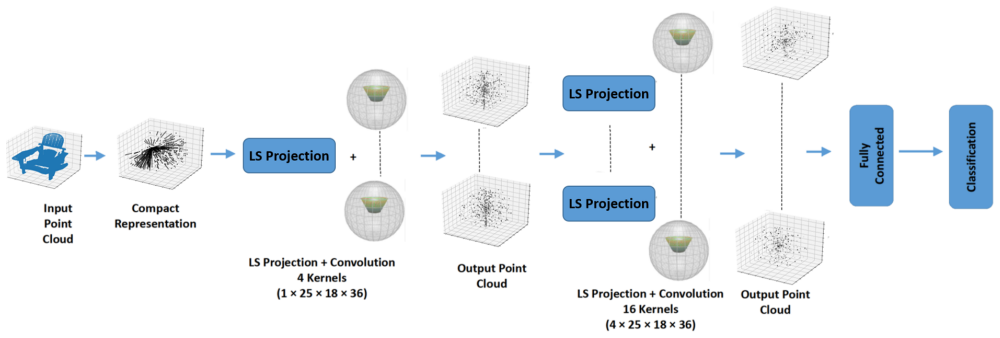
The paper claims that a set of functions complete in the unit ball $\mathbb{B}^3$—spherical harmonics in angle multiplied by a new orthogonalized radial family $Q_{nl}(r)$ built from an exponential-like base $f_{nl}(r) = (-1)^l n \sum_k ((n-l)r)^k/k!$—supports a convolution operation with both 3D rotational and 3D translational kernel movement. Relaxing orthogonality with trainable weights turns the same expansion into a learned latent-space projection that magnifies inter-class differences. Theorem 1 fuses the projection and the roto-translational convolution into one spectral-domain formula. With this layer, a deliberately shallow architecture achieves accuracy comparable to much deeper networks on ModelNet10/40 and strong retrieval results on McGill and SHREC'17, at far lower computational cost than point-based competitors.
Load-bearing premise
The paper's central formula is derived for an orthogonal basis and then assumed to transfer unchanged to the learned non-orthogonal basis; if the discarded cross-terms are not negligible, the implemented layer does not compute the claimed convolution.
Editorial extensions
If this is right
- Three trainable layers suffice for competitive ModelNet classification: 94.2% on ModelNet10 and 91.8% on ModelNet40, versus networks with dozens of layers.
- Inference cost drops to 1.31B FLOPs, several times lower than point-based competitors such as PointNet (14.70B), PointNet++ (26.04B), and DGCNN (44.27B) in the paper's comparison table.
- Kernel translation is a major contributor: ablating translation and keeping only rotation drops ModelNet10 accuracy from 94.2% to 80.2%, a 14% gap.
- The learned latent projection contributes even more: replacing learnable projection with fixed orthogonal projection drops accuracy by 20.3%.
- On dense, non-polar shapes such as brain scans, accuracy improves with more convolution layers (up to four), indicating the layer is not limited to simple shapes.
Reading between the lines
- If the transfer from orthogonal to learned non-orthogonal basis is valid, the same exponential radial-shift trick could produce translation-equivariant spectral convolution on other rotationally symmetric domains (2D disk, spherical shells), where only rotation has been handled so far.
- The density ablation (no accuracy change from very coarse to very fine grid sampling) suggests that geometric redundancy, not resolution, is the bottleneck; a testable extension is to apply the same compact-binning preprocessing to existing point-cloud networks and measure whether they keep accuracy at lower input cost.
- The two-stage training schedule implies the latent projection and the kernel weights settle into different roles; one could test whether the learned $\hat{Q}_{nl}$ coefficients concentrate energy on class-discriminative radial frequencies, which the paper does not visualize.
- The overfitting seen with three or four layers on ModelNet10, contrasted with gains on OASIS, suggests the spectral layer has high capacity and might benefit from regularization or normalization beyond the reported group normalization; the paper does not explore this.
Signed reviews
Editorial analysis
A structured set of objections, weighed in public.
Referee Report
Summary. The paper proposes Blended Convolution and Synthesis (BCS), a single differentiable layer that first projects an input 3D point cloud into a learned latent space using a truncated expansion in a basis of functions defined on the unit ball B^3, and then applies a spectral convolution operator that is claimed to support both rotation and translation of the convolution kernel. A three-layer architecture built on this layer is evaluated on ModelNet10, ModelNet40, McGill, SHREC'17, and OASIS datasets, reporting 94.2% accuracy on ModelNet10, 91.8% on ModelNet40, and 1.31B inference FLOPs. The central theoretical claim is Theorem 1, which states that latent-space projection and roto-translational convolution can be combined in a single spectral formula; the proof is given in Appendix B.
Significance. If the theoretical derivation were sound, the paper would make a noteworthy contribution: a lightweight 3D classifier with competitive accuracy, a compact representation of shapes, and a spectral convolution operator that supports both rotation and translation of kernels, going beyond prior spherical-harmonic and Zernike-based methods. The ablation study is reasonably thorough, and the low FLOPs are attractive. However, the load-bearing proof of Theorem 1 is invalid as written, and the completeness proof for the proposed basis is also not established. The empirical results may still be of interest, but they do not compensate for the unsupported central theoretical claim, especially because the learning (non-orthogonal) basis is exactly the component shown to provide the main empirical gain in the ablation study.
major comments (3)
- [Appendix B, Eqs. (29)-(36)] The proof of Theorem 1 is invalid at the transfer from the orthogonal to the non-orthogonal case. The radial part is derived by using the vanishing inner products of Q_km and Q_{n'l} to drop cross terms between Eq. (32) and Eq. (33), and then the manuscript states: 'for simplicity, we derive equations for the orthogonal case and use the same results for non-orthogonal case. In practice, this step does not reduce accuracy.' In the implemented layer, however, the basis is defined by Eq. (17) with trainable weights W_{nlkm}, so the Q_km are not orthogonal and the dropped cross terms are not zero. Therefore Eq. (36) is not the inner product of Eq. (11), and Theorem 1 does not establish that the network implements a roto-translational convolution in B^3. This is not a corner case: Section 5.3 reports that removing the learnable projection degrades accuracy by 20.3%, so the non-orthogonal basis is the component that carries the empirical gain.
- [Section 4.1.3, Eqs. (7)-(8)] The completeness proof is not valid as written. Eq. (7) expands ⟨Ψ, e^{2πikx}⟩ as a sum involving (2πikn)^n/n!, but the Taylor expansion of the exponential gives (2πik)^n, and the Fourier basis on L^2[0,1] requires all k∈Z, not only k=0,1,2,... . Moreover, from Eq. (8) the authors conclude that each ⟨Θ,r^k⟩ must be zero, but a sum of terms can vanish without each term vanishing; the equations for different (n,l) form a triangular system, and no argument is given that this system forces every moment to vanish. The conclusion may be true and provable by standard Weierstrass approximation, but the argument presented does not prove completeness of the functions used in the paper.
- [Appendix A, Table 6] Table 6 contains inconsistencies with the construction in Section 4.1.2. In particular, Q00 is listed as the zero polynomial, and Q33 contains an x^4 term even though Eq. (18) implies f_33 is constant and orthogonalization against lower-degree polynomials should not raise the degree. If Q00 is zero, the n=0 term in the reconstruction of Eq. (9) is identically zero, so the claimed complete basis cannot represent constant functions on B^3. These errors directly affect the claimed completeness of the derived basis and need to be fixed.
minor comments (5)
- [Main text Theorem 1, Eq. (12)] The theorem statement in the main text uses n' without defining it, and writes Y_l,m(θ,φ) on the right-hand side while the appendix version (Eq. 36) correctly uses Y_l,m(α,β); the two statements should be made consistent.
- [Section 4.1.3, Eq. (7)] The notation in Eq. (7) is garbled: the exponent should be evaluated at x, not at n, and the Fourier family over [0,1] should include negative frequencies for completeness.
- [Appendix B, sentence before Eq. (29)] The sentence 'In practice, this step does not reduce accuracy' is an empirical claim with no supporting measurement of the neglected cross terms; it should either be removed or supported by a quantitative experiment.
- [General] The text says the proof of Theorem 1 is in Appendix A at the end of Section 4.2, but the proof actually appears in Appendix B; the cross-reference should be corrected.
- [Table 6] Several polynomial coefficients in Table 6 appear to have been computed with limited precision (three decimal places); reporting exact rational coefficients or a verification script would help reproducibility.
Circularity Check
No circularity found: the reported accuracy is a trained outcome, the spectral convolution is an attempted derivation from the spatial definition, and the same-author citations are contextual rather than load-bearing.
full rationale
The paper does not exhibit any predicted quantity that is equal to a fitted input by construction. The latent-space projection in Sec. 4.1.4 makes the coefficients W_{nlkm} trainable and defines the spectral moments as inner products with the same learned basis; the ModelNet10/40 accuracies are then measured after training, so they are not forced by the definition of the layer. The convolution theorem in Appendix B begins from the spatial convolution definition in Eq. 11 and attempts to derive the spectral formula in Eq. 36; even if the derivation is incomplete or approximate, it is a proof attempt rather than a renaming of the conclusion. The same-author citations (refs. [46] and [47]) are used for motivation and for an experimental baseline; the new radial basis and the shift formula are developed in the present paper, so the central claim does not rest solely on a self-citation chain. The passage in Appendix B that says 'for simplicity, we derive equations for the orthogonal case and use the same results for non-orthogonal case. In practice, this step does not reduce accuracy' is an explicit, admitted proof gap: the cross terms discarded in Eq. 32 need not vanish for the learned non-orthogonal basis. This is a correctness or rigor defect, not a circular one, because the final formula is not equivalent to its inputs by definition. The main-text statement of Theorem 1 also contains notational inconsistencies (e.g., an undefined n' in Eq. 12), which further weaken the theorem without making the derivation circular. Accordingly, the circularity score is 0.
Assumptions & free parameters
free parameters (3)
- Grid intervals for compact representation =
r=25, theta=36, phi=18
- Truncation order of polynomial basis =
n=5
- Number of convolution layers =
2
assumptions (5)
- standard math Completeness of the complex exponential Fourier basis in L2[0,1]
- standard math Orthogonality and completeness of spherical harmonics Y_lm on S^2
- ad hoc to paper Approximation f_nl(r) approx (-1)^l n exp((n-l)r) for n large and small r
- ad hoc to paper The orthogonal-case derivation transfers to the non-orthogonal learnable basis
- domain assumption The input shape and kernel can be represented as square-integrable functions in B^3
Cite this review
Pith. "Pith review of Blended Convolution and Synthesis for Efficient Discrimination of 3D Shapes." pith.science (2026). https://pith.science/paper/OYLYTIQ3
@misc{pith2026190810209,
  author       = {Pith},
  title        = {Pith review of: Blended Convolution and Synthesis for Efficient Discrimination of 3D Shapes},
  year         = {2026},
  howpublished = {\url{https://pith.science/paper/OYLYTIQ3}},
  note         = {Machine review of arXiv:1908.10209}
}
abstract
Existing networks directly learn feature representations on 3D point clouds for shape analysis. We argue that 3D point clouds are highly redundant and hold irregular (permutation-invariant) structure, which makes it difficult to achieve inter-class discrimination efficiently. In this paper, we propose a two-faceted solution to this problem that is seamlessly integrated in a single `Blended Convolution and Synthesis' layer. This fully differentiable layer performs two critical tasks in succession. In the first step, it projects the input 3D point clouds into a latent 3D space to synthesize a highly compact and more inter-class discriminative point cloud representation. Since, 3D point clouds do not follow a Euclidean topology, standard 2/3D Convolutional Neural Networks offer limited representation capability. Therefore, in the second step, it uses a novel 3D convolution operator functioning inside the unit ball ($\mathbb{B}^3$) to extract useful volumetric features. We extensively derive formulae to achieve both translation and rotation of our novel convolution kernels. Finally, using the proposed techniques we present an extremely light-weight, end-to-end architecture that achieves compelling results on 3D shape recognition and retrieval.
Figures


Figures from the paper (1 more)

Reference graph
Works this paper leans on
- [1]
- [2]
-
[3]
S. Bai, X. Bai, Z. Zhou, Z. Zhang, and L. J. Latecki. Gift: A real-time and scalable 3d shape search engine. In Com- puter Vision and Pattern Recognition (CVPR), 2016 IEEE Conference on, pages 5023–5032. IEEE, 2016. 7, 8
work page 2016
-
[4]
F. S. Bashiri, R. Rostami, P. Peissig, R. M. D’Souza, and Z. Yu. An application of manifold learning in global shape descriptors. arXiv preprint arXiv:1901.02508, 2019. 8
work page Pith review arXiv 1901
-
[5]
Y . Ben-Shabat, M. Lindenbaum, and A. Fischer. 3d point cloud classification and segmentation using 3d modified fisher vector representation for convolutional neural networks.arXiv preprint arXiv:1711.08241, 2017. 7
arXiv 2017
-
[6]
J. L. Bentley. Multidimensional binary search trees used for associative searching. Communications of the ACM , 18(9):509–517, 1975. 1
work page 1975
- [7]
-
[8]
A. Bronstein, M. Bronstein, M. Ovsjanikov, and L. Guibas. Shape google: a computer vision approach to invariant shape retrieval. Proc. NORDIA, 1(4):6, 2009. 2
work page 2009
Show all 70 references
-
[9]
A. M. Bronstein, M. M. Bronstein, R. Kimmel, M. Mahmoudi, and G. Sapiro. A gromov-hausdorff framework with diffusion geometry for topologically-robust non-rigid shape matching. International Journal of Computer Vision, 89(2-3):266–286,
-
[10]
Canterakis
N. Canterakis. 3d zernike moments and zernike affine in- variants for 3d image analysis and recognition. In In 11th Scandinavian Conf. on Image Analysis. Citeseer, 1999. 3, 4
1999
-
[11]
Chen, X.-P
D.-Y . Chen, X.-P. Tian, Y .-T. Shen, and M. Ouhyoung. On visual similarity based 3d model retrieval. InComputer graph- ics forum, volume 22, pages 223–232. Wiley Online Library,
-
[12]
Cheraghian and L
A. Cheraghian and L. Petersson. 3dcapsule: Extending the capsule architecture to classify 3d point clouds. In 2019 IEEE Winter Conference on Applications of Computer Vision (WACV), pages 1194–1202, Jan 2019. 1
2019
-
[13]
Cheraghian, S
A. Cheraghian, S. Rahman, D. Campbell, and L. Petersson. Mitigating the hubness problem for zero-shot learning of 3d objects. In British Machine Vision Conference (BMVC’19),
-
[14]
Cheraghian, S
A. Cheraghian, S. Rahman, D. Campbell, and L. Petersson. Transductive zero-shot learning for 3d point cloud classifi- cation. In 2020 IEEE Winter Conference on Applications of Computer Vision (WACV), 2020. 1
2020
-
[15]
Cheraghian, S
A. Cheraghian, S. Rahman, and L. Petersson. Zero-shot learn- ing of 3d point cloud objects. In International Conference on Machine Vision Applications (MVA), 2019. 1
2019
-
[16]
T. S. Cohen, M. Geiger, J. Koehler, and M. Welling. Spherical cnns. arXiv preprint arXiv:1801.10130, 2018. 2, 3, 7
2018 arXiv
-
[17]
M. Elad, A. Tal, and S. Ar. Content based retrieval of vrml objectsan iterative and interactive approach. In Multimedia 2001, pages 107–118. Springer, 2002. 2
2001
-
[18]
Esteves, C
C. Esteves, C. Allen-Blanchette, A. Makadia, and K. Dani- ilidis. Learning so(3) equivariant representations with spheri- cal cnns. In The European Conference on Computer Vision (ECCV), September 2018. 2, 3, 8
2018
-
[19]
Flusser, J
J. Flusser, J. Boldys, and B. Zitov´a. Moment forms invariant to rotation and blur in arbitrary number of dimensions. IEEE Transactions on Pattern Analysis and Machine Intelligence, 25(2):234–246, 2003. 3
2003
-
[20]
A. F. Fotenos, M. A. Mintun, A. Z. Snyder, J. C. Morris, and R. L. Buckner. Brain volume decline in aging: evidence for a relation between socioeconomic status, preclinical alzheimer disease, and reserve. Archives of neurology, 65(1):113–120,
-
[21]
Furuya and R
T. Furuya and R. Ohbuchi. Deep aggregation of local 3d geometric features for 3d model retrieval. In BMVC, 2016. 7, 8
2016
-
[22]
X. Guo. Three dimensional moment invariants under rigid transformation. In International Conference on Computer Analysis of Images and Patterns, pages 518–522. Springer,
-
[23]
Y . Guo, M. Bennamoun, F. Sohel, M. Lu, J. Wan, and N. M. Kwok. A comprehensive performance evaluation of 3d local feature descriptors. International Journal of Computer Vision, 116(1):66–89, 2016. 3
2016
-
[24]
Z. Han, Z. Liu, C.-M. V ong, Y .-S. Liu, S. Bu, J. Han, and C. P. Chen. Deep spatiality: Unsupervised learning of spatially- enhanced global and local 3d features by deep neural network with coupled softmax. IEEE Transactions on Image Process- ing, 27(6):3049–3063, 2018. 8
2018
-
[25]
M.-K. Hu. Visual pattern recognition by moment invariants. IRE transactions on information theory, 8(2):179–187, 1962. 3
1962
-
[26]
Huang, H
J. Huang, H. Zhang, L. Yi, T. Funkhouser, M. Nießner, and L. J. Guibas. Texturenet: Consistent local parametrizations for learning from high-resolution signals on meshes. In Pro- ceedings of the IEEE Conference on Computer Vision and Pattern Recognition, pages 4440–4449, 2019. 2
2019
-
[27]
Jain and H
V . Jain and H. Zhang. A spectral approach to shape-based retrieval of articulated 3d models. Computer-Aided Design, 39(5):398–407, 2007. 2
2007
-
[28]
Jiang, D
C. Jiang, D. Wang, J. Huang, P. Marcus, M. Nießner, et al. Convolutional neural networks on non-uniform geometri- cal signals using euclidean spectral transformation. arXiv preprint arXiv:1901.02070, 2019. 2
1901 arXiv
-
[29]
Johns, S
E. Johns, S. Leutenegger, and A. J. Davison. Pairwise decom- position of image sequences for active multi-view recognition. In Computer Vision and Pattern Recognition (CVPR), 2016 IEEE Conference on, pages 3813–3822. IEEE, 2016. 7
2016
-
[30]
M. I. Khalil and M. M. Bayoumi. A dyadic wavelet affine in- variant function for 2d shape recognition. IEEE Transactions on Pattern Analysis and Machine Intelligence, 23(10):1152– 1164, 2001. 3
2001
-
[31]
S. H. Khan, M. Hayat, and N. Barnes. Adversarial training of variational auto-encoders for high fidelity image genera- tion. In Applications of Computer Vision (WACV), 2018 IEEE Winter Conference on, pages 1312–1320. IEEE, 2018. 3
2018
-
[32]
Klokov and V
R. Klokov and V . Lempitsky. Escape from cells: Deep kd- networks for the recognition of 3d point cloud models. In 2017 IEEE International Conference on Computer Vision (ICCV), pages 863–872. IEEE, 2017. 1, 7
2017
-
[33]
Kumawat and S
S. Kumawat and S. Raman. Lp-3dcnn: Unveiling local phase in 3d convolutional neural networks. In Proceedings of the IEEE Conference on Computer Vision and Pattern Recogni- tion, pages 4903–4912, 2019. 7
2019
-
[34]
G. Lavou´e. Combination of bag-of-words descriptors for ro- bust partial shape retrieval. The Visual Computer, 28(9):931– 942, 2012. 8
2012
-
[35]
J. Li, B. M. Chen, and G. H. Lee. So-net: Self- organizing network for point cloud analysis. arXiv preprint arXiv:1803.04249, 2018. 1, 7
2018 arXiv
-
[36]
Y . Li, R. Bu, M. Sun, and B. Chen. Pointcnn.arXiv preprint arXiv:1801.07791, 2018. 7
2018 arXiv
-
[37]
Y . Li, S. Pirk, H. Su, C. R. Qi, and L. J. Guibas. Fpnn: Field probing neural networks for 3d data. In Advances in Neural Information Processing Systems, pages 307–315, 2016. 3
2016
-
[38]
Lin and R
C. Lin and R. Chellappa. Classification of partial 2-d shapes using fourier descriptors. IEEE Transactions on Pattern Anal- ysis and Machine Intelligence, (5):686–690, 1987. 3
1987
-
[39]
Litman, A
R. Litman, A. Bronstein, M. Bronstein, and U. Castellani. Supervised learning of bag-of-features shape descriptors us- ing sparse coding. In Computer Graphics Forum, volume 33, pages 127–136. Wiley Online Library, 2014. 2
2014
-
[40]
Liu, Y .-M
W. Liu, Y .-M. Zhang, X. Li, Z. Yu, B. Dai, T. Zhao, and L. Song. Deep hyperspherical learning. In Advances in Neural Information Processing Systems, pages 3950–3960,
-
[41]
Maturana and S
D. Maturana and S. Scherer. V oxnet: A 3d convolutional neural network for real-time object recognition. In 2015 IEEE/RSJ International Conference on Intelligent Robots and Systems (IROS), pages 922–928. IEEE, 2015. 6, 7
2015
-
[42]
D. Meagher. Geometric modeling using octree encoding. Computer graphics and image processing , 19(2):129–147,
-
[43]
Papadakis, I
P. Papadakis, I. Pratikakis, T. Theoharis, G. Passalis, and S. Perantonis. 3d object retrieval using an efficient and com- pact hybrid shape descriptor. In Eurographics Workshop on 3D object retrieval, 2008. 8
2008
-
[44]
C. R. Qi, H. Su, K. Mo, and L. J. Guibas. Pointnet: Deep learning on point sets for 3d classification and segmenta- tion. Proc. Computer Vision and Pattern Recognition (CVPR), IEEE, 1(2):4, 2017. 1, 3, 7
2017
-
[45]
C. R. Qi, L. Yi, H. Su, and L. J. Guibas. Pointnet++: Deep hierarchical feature learning on point sets in a metric space. In Advances in Neural Information Processing Systems, pages 5099–5108, 2017. 1, 3, 7
2017
-
[46]
Ramasinghe, S
S. Ramasinghe, S. Khan, and N. Barnes. V olumetric convo- lution: Automatic representation learning in unit ball. arXiv preprint arXiv:1901.00616, 2019. 2, 3, 4, 7
1901 arXiv
-
[47]
Ramasinghe, S
S. Ramasinghe, S. Khan, N. Barnes, and S. Gould. Represen- tation learning on unit ball with 3d roto-translational equivari- ance. International Journal of Computer Vision, pages 1–23,
-
[48]
T. Reiss. Features invariant to linear transformations in 2d and 3d. In 11th IAPR International Conference on Pattern Recognition. Vol. III. Conference C: Image, Speech and Signal Analysis,, pages 493–496. IEEE, 1992. 3
1992
-
[49]
Riegler, A
G. Riegler, A. Osman Ulusoy, and A. Geiger. Octnet: Learn- ing deep 3d representations at high resolutions. In Proceed- ings of the IEEE Conference on Computer Vision and Pattern Recognition, pages 3577–3586, 2017. 1
2017
-
[50]
R. M. Rustamov. Laplace-beltrami eigenfunctions for defor- mation invariant shape representation. In Proceedings of the fifth Eurographics symposium on Geometry processing, pages 225–233. Eurographics Association, 2007. 2
2007
-
[51]
B. Shi, S. Bai, Z. Zhou, and X. Bai. Deeppano: Deep panoramic representation for 3-d shape recognition. IEEE Signal Processing Letters, 22(12):2339–2343, 2015. 7
2015
-
[52]
Simonovsky and N
M. Simonovsky and N. Komodakis. Dynamic edge- conditioned filters in convolutional neural networks on graphs. In Proc. CVPR, 2017. 7
2017
-
[53]
H. Su, S. Maji, E. Kalogerakis, and E. Learned-Miller. Multi- view convolutional neural networks for 3d shape recognition. In Proceedings of the IEEE international conference on com- puter vision, pages 945–953, 2015. 1, 7
2015
-
[54]
Suk and J
T. Suk and J. Flusser. Vertex-based features for recogni- tion of projectively deformed polygons. Pattern Recognition, 29(3):361–367, 1996. 3
1996
-
[55]
Tabia, H
H. Tabia, H. Laga, D. Picard, and P.-H. Gosselin. Covariance descriptors for 3d shape matching and retrieval. In Proceed- ings of the IEEE Conference on Computer Vision and Pattern Recognition, pages 4185–4192, 2014. 8
2014
-
[56]
Tatsuma and M
A. Tatsuma and M. Aono. Multi-fourier spectra descriptor and augmentation with spectral clustering for 3d shape retrieval. The Visual Computer, 25(8):785–804, Aug 2009. 8
2009
-
[57]
Q. M. Tieng and W. W. Boles. An application of wavelet- based affine-invariant representation. Pattern Recognition Letters, 16(12):1287–1296, 1995. 3
1995
-
[58]
D. V . Vranic and D. Saupe. Description of 3d-shape using a complex function on the sphere. In Multimedia and Expo,
-
[59]
D. V . Vranic, D. Saupe, and J. Richter. Tools for 3d-object retrieval: Karhunen-loeve transform and spherical harmon- ics. In Multimedia Signal Processing, 2001 IEEE Fourth Workshop on, pages 293–298. IEEE, 2001. 2
2001
-
[60]
C. Wang, B. Samari, and K. Siddiqi. Local spectral graph convolution for point set feature learning. In Proceedings of the European Conference on Computer Vision (ECCV), pages 52–66, 2018. 7
2018
-
[61]
Y . Wang, Y . Sun, Z. Liu, S. E. Sarma, M. M. Bronstein, and J. M. Solomon. Dynamic graph cnn for learning on point clouds. arXiv preprint arXiv:1801.07829, 2018. 7
2018 arXiv
-
[62]
Weiler, M
M. Weiler, M. Geiger, M. Welling, W. Boomsma, and T. Co- hen. 3d steerable cnns: Learning rotationally equivariant features in volumetric data. In S. Bengio, H. Wallach, H. Larochelle, K. Grauman, N. Cesa-Bianchi, and R. Garnett, editors, Advances in Neural Information Process...
2018
-
[63]
J. Wu, C. Zhang, T. Xue, B. Freeman, and J. Tenenbaum. Learning a probabilistic latent space of object shapes via 3d generative-adversarial modeling. In Advances in Neural Information Processing Systems, pages 82–90, 2016. 1, 3, 7
2016
-
[64]
Wu and K
Y . Wu and K. He. Group normalization. In Proceedings of the European Conference on Computer Vision (ECCV), pages 3–19, 2018. 6
2018
-
[65]
Z. Wu, S. Song, A. Khosla, F. Yu, L. Zhang, X. Tang, and J. Xiao. 3d shapenets: A deep representation for volumetric shapes. In Proceedings of the IEEE conference on computer vision and pattern recognition, pages 1912–1920, 2015. 6, 7
1912
-
[66]
J. Xie, Y . Fang, F. Zhu, and E. Wong. Deepshape: Deep learned shape descriptor for 3d shape matching and retrieval. In Proceedings of the IEEE Conference on Computer Vision and Pattern Recognition, pages 1275–1283, 2015. 2, 8
2015
-
[67]
J. Xie, M. Wang, and Y . Fang. Learned binary spectral shape descriptor for 3d shape correspondence. In Proceedings of the IEEE Conference on Computer Vision and Pattern Recog- nition, pages 3309–3317, 2016. 2
2016
-
[68]
T. Yu, J. Meng, and J. Yuan. Multi-view harmonized bilinear network for 3d object recognition. InProceedings of the IEEE Conference on Computer Vision and Pattern Recognition , pages 186–194, 2018. 6, 7
2018
-
[69]
H. Zeng, R. Zhang, X. Wang, D. Fu, and Q. Wei. Dempster– shafer evidence theory-based multi-feature learning and fu- sion method for non-rigid 3d model retrieval. IET Computer Vision, 13(3):261–266, 2018. 8 Appendix A Blended Convolution and Synthesis for Efficient Discriminati...
2018
-
[2002]
Proceedings
ICME’02. Proceedings. 2002 IEEE International Con- ference on, volume 1, pages 177–180. IEEE, 2002. 3
2002
Reviewed August 14, 2026 · model on record in the stance chip above.
Discussion (0). Continue with ORCID to comment.