REVIEW 3 major objections 4 minor 78 references
Urban flows prediction from spatial-temporal data using machine learning: A survey
T0 review · 3 major / 4 minor · reviewed 2026-08-14 · deepseek-v4-flash
Pith's one-line read This survey claims urban flow prediction methods fall into five families and maps the datasets and preprocessing steps researchers need to apply them.
desk verdict Useful orientation survey for newcomers, but the RL category mislabels control as prediction and the 'systematic' claim lacks a disclosed selection method. read the letter →
The pith
A machine-rendered reading of the paper's core claim, the machinery that carries it, and where it could break.
The reading
What carries the argument
The organizing device is a five-category taxonomy, anchored by the definitions of inflow and outflow on a grid-decomposed city. A city is partitioned into an $I \times J$ grid; each trajectory contributes to the inflow $x^{\text{in}}_{t,i,j}$ or outflow $x^{\text{out}}_{t,i,j}$ of a cell, and all cells form the tensor $X_t$. The taxonomy does the work of the survey: it sorts methods into statistics-based, traditional machine learning, deep learning, reinforcement learning, and transfer learning families, and lets the authors attach each family to the tasks where it is most useful. The data-preparation pipeline (map decomposition, handling missing/imbalanced/uncertain data) is the second load-bearing device, since it defines the common input side of all five families.
What would settle it
A reader could run a systematic keyword search over urban flow prediction papers from 2014 to 2019 and test whether every well-cited method falls into one of the five categories; finding a substantial family that fits none, such as purely graph-based or generative approaches, would refute the completeness of the taxonomy.
Extended reading notes
Core claim
The central claim is that the diverse literature on urban flow prediction can be organized into a small number of recurring building blocks. On the data side, flows are driven by four factor groups (daily activity patterns, anomalies, weather, and holidays), and raw spatial-temporal data must be prepared through map decomposition and handling of missing, imbalanced, and uncertain data. On the method side, the paper sorts the field into five categories and argues that deep learning methods, especially convolutional and recurrent networks, are currently the most effective at capturing temporal dependency and spatial correlation simultaneously; statistics-based and traditional machine learning methods suit short-term traffic flow prediction; reinforcement learning methods suit flow optimization; and transfer learning methods suit data-scarce cities. The paper also formalizes the common prediction target: given a grid map, each cell's inflow and outflow are aggregated into a tensor $X_t \in \mathbb{R}^{2 \times I \times J}$, and the task is to predict the next tensor $X_n$ from history.
Load-bearing premise
The usefulness of the review rests on the papers listed in Table 2 being representative of the field and accurately described, but the paper gives no explicit criteria for including or excluding papers.
Editorial extensions
If this is right
- A reader facing short-term traffic flow prediction can choose statistics-based or traditional machine learning methods first, since the survey reports these are accurate and efficient for that setting.
- A reader needing both temporal dependency and spatial correlation should consider deep learning methods, with residual-network and recurrent-convolutional hybrids as strong choices.
- Cities with little historical data can use transfer learning to borrow patterns from a data-rich city, with the caveat that source and target regions should have similar mobility patterns.
- Reinforcement learning is positioned not as a prediction method but as a control layer that consumes predictions to optimize traffic flow, such as adjusting speed limits or metro passenger inflow.
- The listed open datasets give a common starting ground for benchmarking new methods across taxi, bike-sharing, metro, weather, and road-network data.
Reading between the lines
- A testable extension is to apply the same five-category taxonomy to papers published after 2019; graph neural network methods, which appear only at the edge of this survey, may by now form a separate family rather than a variant of deep learning.
- The taxonomy implies a workflow: choose the data preparation pipeline first, then the method family; a natural next step would be a decision tree that maps task type, data availability, and prediction horizon to a recommended family.
- Because the survey period ends in 2019, its 'state of the art' claims are time-stamped; readers should treat the method rankings as historical baselines rather than current leaders.
Signed reviews
Editorial analysis
A structured set of objections, weighed in public.
Referee Report
Summary. This manuscript is a survey of urban flow prediction from spatial-temporal data. It organizes the data preparation pipeline into three stages, discusses trajectory preprocessing, classifies prediction methods into five categories (statistics-based, traditional machine learning, deep learning, reinforcement learning, and transfer learning), summarizes representative works in Table 2, lists public datasets, and outlines open challenges. The paper claims in the abstract and introduction to systematically review the field and to provide a taxonomy of prediction methods.
Significance. If revised appropriately, the survey could serve as a useful entry point for researchers entering urban flow prediction: it collects preprocessing techniques, key references, and public dataset links in one place, and the descriptions of standard methods such as ARIMA, SVR, DeepST, and ST-ResNet are mostly consistent with the original literature. The main scientific value is organizational rather than technical: the paper introduces no new methods or results. Its usefulness currently depends on the accuracy and representativeness of its literature selection, and on the internal consistency of its proposed taxonomy.
major comments (3)
- [Section 4.4 and Table 2] The 'Reinforcement learning-based methods' category does not contain flow prediction methods. The two cited works are control/optimization tasks: Walraven et al. [75] uses Q-learning to learn maximum-speed policies that optimize and proactively control traffic flow, and Jiang et al. [76] coordinates metro passenger inflow control to reduce stranded passengers. Neither is described as minimizing a prediction error on future flows, and neither is evaluated by a flow-forecast accuracy metric. Because the abstract and Section 4 claim that the paper classifies urban flows prediction methods into five categories, placing control methods inside a prediction taxonomy is internally inconsistent. The authors should rename this category (e.g., 'reinforcement learning for traffic control/optimization'), remove it from the prediction classification, or replace it with actual RL-based prediction works; the corresponding row in Table 2 should be adjusted accordingly.
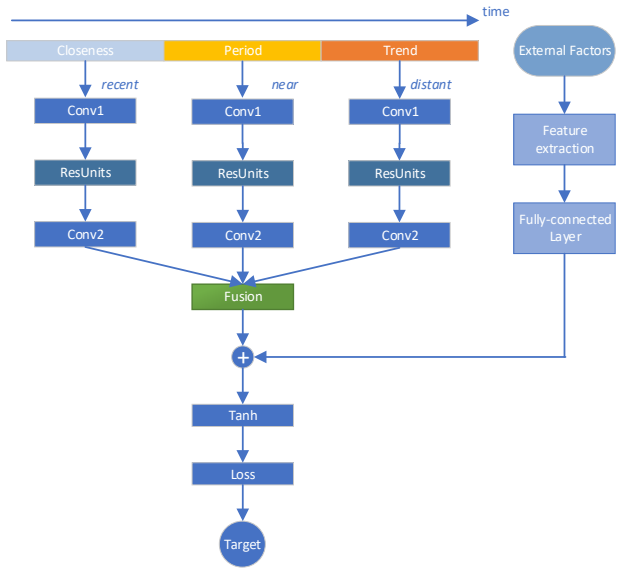
- [Section 4.3.1 and Figure 6] The statement that ST-ResNet 'outperforms other classical time-series and deep learning prediction methods' is presented as a fact without supporting comparative evidence in this manuscript. The original papers [43,45] presumably contain such comparisons, but the survey does not report any experimental results or explicitly attribute the claim to the original source results. As written, this is an unsupported empirical assertion in a section that otherwise only describes model architecture. The authors should either cite the original comparative experiments explicitly or qualify the statement as a claim reported in the cited papers.
- [Abstract, Section 1, and Section 8] The paper describes its contribution as 'systematically reviewed' in the abstract and Section 1, but Section 8 states that 'we are only able to cover a small fraction of work in this rapid growing area of research.' Additionally, Section 4 and Table 2 give no inclusion or exclusion criteria for selecting the summarized works, even though Section 5 presents the table as a summary of 'classic and representative works' from the recent five years. This internal contradiction and the undisclosed selection process undermine the central claim of a systematic review. The authors should state their search/selection criteria, clarify the intended scope, and either strengthen the coverage or temper the 'systematically reviewed' wording.
minor comments (4)
- [Throughout] The manuscript contains numerous typographical and grammatical errors that should be corrected, including 'grip map' for 'grid map' (Section 2.2), 'Howerver' (Section 2.2), 'revover' (Section 2.3.1), 'inblanced' (Section 2.3.2), 'Fox example' (Section 4.3.2), 'mostly like' (Section 4.3.1), and several others. A thorough language edit is needed.
- [Section 2.1 and Table 1] The classification of point data and network data across the three spatial-temporal data types is not fully explained; for example, 'Trajectory data' is listed as network data in Table 1, but trajectories are also discussed as moving point sequences in Section 3. Clarifying the distinction would help readers.
- [Section 4.3.1] The sentence 'But in short-term crowd flows prediction problem, the residual network structure of ST-ResNet can be removed to get much more better performance' is a bold practical recommendation that is not supported by any cited experiment in the survey. Either cite a source or soften the claim.
- [Section 7] The dataset list is useful, but some URLs are given without any indication of the data license, update frequency, or typical research usage. A short annotation for each dataset (e.g., 'taxi trip records in NYC, updated monthly') would increase the practical value.
Circularity Check
No circularity: a literature survey with no derived predictions or fitted parameters.
full rationale
This paper is a survey of urban flows prediction methods; it contains no derivations from which a predicted quantity is obtained, no fitted parameters, and no claimed new results that could reduce by construction to the survey's own inputs. The equations it includes (e.g., inflow/outflow definitions in Section 4.3.1, the transfer learning objective in Section 4.5) are explicitly borrowed from the cited works and are used for exposition, not as predictions validated in this paper. The paper's central claim is that it organizes existing methods into five categories and lists open datasets; such a claim is evaluated by the accuracy and representativeness of the review, not by any circular derivation. The self-citations that appear are to the authors' own prior methods (DeepST and ST-ResNet are referenced as external works with their own published evaluations), but the survey does not rest on those citations to justify an inference made here; it merely reports them. The admission in Section 8 that only 'a small fraction of work' is covered is a coverage limitation, not a circular step. The skeptical point about Section 4.4 placing traffic flow optimization/control methods under a prediction taxonomy is a potential correctness or scope concern, but it is not a circularity pattern: the taxonomy does not derive a result from its own inputs, and it does not fit a parameter and then rename it a prediction. Therefore the paper warrants a circularity score of 0.
Assumptions & free parameters
Cite this review
Pith. "Pith review of Urban flows prediction from spatial-temporal data using machine learning: A survey." pith.science (2026). https://pith.science/paper/CIMQMDEA
@misc{pith2026190810218,
  author       = {Pith},
  title        = {Pith review of: Urban flows prediction from spatial-temporal data using machine learning: A survey},
  year         = {2026},
  howpublished = {\url{https://pith.science/paper/CIMQMDEA}},
  note         = {Machine review of arXiv:1908.10218}
}
read the original abstract
Urban spatial-temporal flows prediction is of great importance to traffic management, land use, public safety, etc. Urban flows are affected by several complex and dynamic factors, such as patterns of human activities, weather, events and holidays. Datasets evaluated the flows come from various sources in different domains, e.g. mobile phone data, taxi trajectories data, metro/bus swiping data, bike-sharing data and so on. To summarize these methodologies of urban flows prediction, in this paper, we first introduce four main factors affecting urban flows. Second, in order to further analysis urban flows, a preparation process of multi-sources spatial-temporal data related with urban flows is partitioned into three groups. Third, we choose the spatial-temporal dynamic data as a case study for the urban flows prediction task. Fourth, we analyze and compare some well-known and state-of-the-art flows prediction methods in detail, classifying them into five categories: statistics-based, traditional machine learning-based, deep learning-based, reinforcement learning-based and transfer learning-based methods. Finally, we give open challenges of urban flows prediction and an outlook in the future of this field. This paper will facilitate researchers find suitable methods and open datasets for addressing urban spatial-temporal flows forecast problems.
Figures


Figures from the paper (3 more)


Reference graph
Works this paper leans on
-
[75]
E. Walraven, M. T. Spaan, B. Bakker, Traffic flow optimization: A reinforcement learning approach, Engineering Applications of Artificial Intelligence 52 (2016) 203–212
work page 2016
- [76]
- [1]
- [2]
-
[3]
D. Lee, D. Kulic, Y . Nakamura, Missing motion data recovery using factorial hidden markov models, in: 2008 IEEE International Conference on Robotics and Automation, IEEE, 2008, pp. 1722–1728
work page 2008
-
[4]
M. X. Hoang, Y . Zheng, A. K. Singh, Fccf: Forecasting citywide crowd flows based on big data, in: Proceedings of the 24th ACM SIGSPA- TIAL International Conference on Advances in Geographic Information Systems, ACM, 2016, p. 6
work page 2016
-
[5]
X. Yi, Y . Zheng, J. Zhang, T. Li, St-mvl: Filling missing values in geo-sensory time series data, in: Proceedings of the Twenty-Fifth International Joint Conference on Artificial Intelligence, 2016, pp. 2704–2710
work page 2016
- [6]
Show all 78 references
-
[7]
Beckmann, N
M. Beckmann, N. F. Ebecken, B. S. P. de Lima, A knn undersampling approach for data balancing, Journal of Intelligent Learning Systems and Applications 7 (04) (2015) 104
2015
-
[8]
R. Wang, S. Kwong, Y . Jia, Z. Huang, L. Wu, Mutual information based k-labelsets ensemble for multi-label classification, in: 2018 IEEE International Conference on Fuzzy Systems (FUZZ-IEEE), IEEE, 2018, pp. 1–7
2018
-
[9]
J. Gong, H. Kim, Rhsboost: Improving classification performance in imbalance data, Computational Statistics & Data Analysis 111 (2017) 1–13
2017
-
[10]
Khosravi, S
A. Khosravi, S. Nahavandi, D. Creighton, A. F. Atiya, Comprehensive review of neural network-based prediction intervals and new advances, IEEE Transactions on Neural Networks 22 (9) (2011) 1341–1356. 13
2011
-
[11]
Begoli, T
E. Begoli, T. Bhattacharya, D. Kusnezov, The need for uncertainty quantification in machine-assisted medical decision making, Nature Machine Intelligence 1 (1) (2019) 20
2019
-
[12]
Wang, D.-Y
H. Wang, D.-Y . Yeung, Towards bayesian deep learning: A framework and some existing methods, IEEE Transactions on Knowledge and Data Engineering 28 (12) (2016) 3395–3408
2016
-
[13]
Lakshminarayanan, A
B. Lakshminarayanan, A. Pritzel, C. Blundell, Simple and scalable predictive uncertainty estimation using deep ensembles, in: Advances in Neural Information Processing Systems, 2017, pp. 6402–6413
2017
-
[14]
S. S. Rangapuram, M. W. Seeger, J. Gasthaus, L. Stella, Y . Wang, T. Januschowski, Deep state space models for time series forecasting, in: Advances in Neural Information Processing Systems, 2018, pp. 7796–7805
2018
-
[15]
Atluri, A
G. Atluri, A. Karpatne, V . Kumar, Spatio-temporal data mining: A survey of problems and methods, ACM Computing Surveys 51 (4) (2018) 1–37
2018
-
[16]
Zheng, Trajectory data mining: An overview, ACM Transactions on Intelligent Systems and Technology (TIST) 6 (3) (2015) 1–41
Y . Zheng, Trajectory data mining: An overview, ACM Transactions on Intelligent Systems and Technology (TIST) 6 (3) (2015) 1–41
2015
-
[17]
T. M. T. Do, O. Dousse, M. Miettinen, D. Gatica-Perez, A probabilistic kernel method for human mobility prediction with smartphones, Pervasive and Mobile Computing 20 (2015) 13–28
2015
-
[18]
D. H. Douglas, T. K. Peucker, Algorithms for the reduction of the number of points required to represent a digitized line or its caricature, Classics in Cartography: Reflections on Influential Articles from Cartographica (2011) 15–28
2011
-
[19]
Keogh, S
E. Keogh, S. Chu, D. Hart, M. Pazzani, An online algorithm for segmenting time series, in: Proceedings of the IEEE International Conference on Data Mining, IEEE, 2001, pp. 289–296
2001
-
[20]
Meratnia, A
N. Meratnia, A. Rolf, Spatiotemporal compression techniques for moving point objects, in: Proceedings of the International Conference on Extending Database Technology, Springer, 2004, pp. 765–782
2004
-
[21]
J. Yuan, Y . Zheng, X. Xie, G. Sun, T-drive: Enhancing driving directions with taxi drivers’ intelligence, IEEE Transactions on Knowledge and Data Engineering 25 (1) (2012) 220–232
2012
-
[22]
Zheng, Y
Y . Zheng, Y . Chen, Q. Li, X. Xie, W.-Y . Ma, Understanding transportation modes based on gps data for web applications, ACM Transactions on the Web 4 (1) (2010) 1–36
2010
-
[23]
Zheng, L
Y . Zheng, L. Liu, L. Wang, X. Xie, Learning transportation mode from raw gps data for geographic applications on the web, in: Proceedings of the 17th International Conference on World Wide Web, ACM, 2008, pp. 247–256
2008
-
[24]
J. S. Greenfeld, Matching gps observations to locations on a digital map, in: Proceedings of the 81th Annual Meeting of the Transportation Research Board, 2002, pp. 164–173
2002
-
[25]
W. Chen, M. Yu, Z. Li, Y . Chen, Integrated vehicle navigation system for urban applications, in: Proceedings of International Conference Global Navigation Satellite System, 2003, pp. 15–22
2003
-
[26]
H. Yin, O. Wolfson, A weight-based map matching method in moving objects databases, in: Proceedings of the International Conference on Scientific & Statistical Database Management, IEEE, 2004, pp. 437–438
2004
-
[27]
M. A. Quddus, R. B. Noland, W. Y . Ochieng, A high accuracy fuzzy logic based map matching algorithm for road transport, Journal of Intelligent Transportation Systems 10 (3) (2006) 103–115
2006
-
[28]
O. Pink, B. Hummel, A statistical approach to map matching using road network geometry, topology and vehicular motion constraints, in: Proceedings of the 11th International IEEE Conference on Intelligent Transportation, IEEE, 2008, pp. 862–867
2008
-
[29]
Newson, J
P. Newson, J. Krumm, Hidden markov map matching through noise and sparseness, in: Proceedings of the 17th ACM SIGSPATIAL Interna- tional Conference on Advances in Geographic Information Systems, ACM, 2009, pp. 336–343
2009
-
[30]
J. Yuan, Y . Zheng, C. Zhang, X. Xie, G.-Z. Sun, An interactive-voting based map matching algorithm, in: Proceedings of the 2010 Eleventh International Conference on Mobile Data Management, IEEE Computer Society, 2010, pp. 43–52
2010
-
[31]
Y . Lou, C. Zhang, Y . Zheng, X. Xie, W. Wang, Y . Huang, Map-matching for low-sampling-rate gps trajectories, in: Proceedings of the 17th ACM SIGSPATIAL International Conference on Advances In Geographic Information Systems, ACM, 2009, pp. 352–361
2009
-
[32]
H. Alt, A. Efrat, G. Rote, C. Wenk, Matching planar maps, Journal of Algorithms 49 (2) (2003) 262–283
2003
-
[33]
Brakatsoulas, D
S. Brakatsoulas, D. Pfoser, R. Salas, C. Wenk, On map-matching vehicle tracking data, in: Proceedings of the 31st International Conference on Very Large Data Bases, VLDB Endowment, 2005, pp. 853–864
2005
-
[34]
X. Yi, J. Zhang, Z. Wang, T. Li, Y . Zheng, Deep distributed fusion network for air quality prediction, in: Proceedings of the 24th ACM SIGKDD International Conference on Knowledge Discovery and Data Mining, 2018, pp. 965–973
2018
-
[35]
X. Li, L. Peng, Y . Hu, J. Shao, T. Chi, Deep learning architecture for air quality predictions, Environmental Science and Pollution Research 23 (22) (2016) 22408–22417
2016
-
[36]
X. Li, L. Peng, X. Yao, S. Cui, Y . Hu, C. You, T. Chi, Long short-term memory neural network for air pollutant concentration predictions: Method development and evaluation, Environmental Pollution 231 (2017) 997–1004
2017
-
[37]
S. Du, T. Li, X. Gong, Z. Yu, Y . Huang, S.-J. Horng, A hybrid method for traffic flow forecasting using multimodal deep learning, arXiv preprint arXiv:1803.02099
-
[38]
N. G. Polson, V . O. Sokolov, Deep learning for short-term traffic flow prediction, Transportation Research Part C: Emerging Technologies 79 (2017) 1–17
2017
-
[39]
Y . Wu, H. Tan, L. Qin, B. Ran, Z. Jiang, A hybrid deep learning based traffic flow prediction method and its understanding, Transportation Research Part C: Emerging Technologies 90 (2018) 166–180
2018
-
[40]
D. Wang, Y . Yang, S. Ning, Deepstcl: A deep spatio-temporal convlstm for travel demand prediction, in: 2018 International Joint Conference on Neural Networks, IEEE, 2018, pp. 1–8
2018
-
[41]
J. Ke, H. Zheng, H. Yang, X. M. Chen, Short-term forecasting of passenger demand under on-demand ride services: A spatio-temporal deep learning approach, Transportation Research Part C: Emerging Technologies 85 (2017) 591–608
2017
-
[42]
H. Yao, F. Wu, J. Ke, X. Tang, Y . Jia, S. Lu, P. Gong, J. Ye, Deep multi-view spatial-temporal network for taxi demand prediction, arXiv preprint arXiv:1802.08714
-
[43]
Zhang, Y
J. Zhang, Y . Zheng, D. Qi, R. Li, X. Yi, T. Li, Predicting citywide crowd flows using deep spatio-temporal residual networks, Artificial Intelligence 259 (2018) 147–166
2018
-
[44]
W. Jin, Y . Lin, Z. Wu, H. Wan, Spatio-temporal recurrent convolutional networks for citywide short-term crowd flows prediction, in: Pro- 14 ceedings of the 2nd International Conference on Compute and Data Analysis, ACM, 2018, pp. 28–35
2018
-
[45]
Zhang, Y
J. Zhang, Y . Zheng, D. Qi, Deep spatio-temporal residual networks for citywide crowd flows prediction, in: Proceedings of the Thirty-First AAAI Conference on Artificial Intelligence, 2017, pp. 1655–1661
2017
-
[46]
S. E. Said, D. A. Dickey, Testing for unit roots in autoregressive-moving average models of unknown order, Biometrika 71 (3) (1984) 599–607
1984
-
[47]
Williams, P
B. Williams, P. Durvasula, D. Brown, Urban freeway traffic flow prediction: application of seasonal autoregressive integrated moving average and exponential smoothing models, Transportation Research Record: Journal of the Transportation Research Board (1644) (1998) 132–141
1998
-
[48]
R. J. Hyndman, Y . Khandakar, Automatic time series for forecasting: The forecast package for R, Monash University, Department of Econo- metrics and Business Statistics, 2007
2007
-
[49]
G. A. R. J. Hyndman, Forecasting: Principles and practice, Otexts.com
-
[50]
Zhang, Y
N. Zhang, Y . Zhang, H. Lu, Seasonal autoregressive integrated moving average and support vector machine models: prediction of short-term traffic flow on freeways, Transportation Research Record 2215 (1) (2011) 85–92
2011
-
[51]
Lippi, M
M. Lippi, M. Bertini, P. Frasconi, Short-term traffic flow forecasting: An experimental comparison of time-series analysis and supervised learning, IEEE Transactions on Intelligent Transportation Systems 14 (2) (2013) 871–882
2013
-
[52]
F. G. Habtemichael, M. Cetin, Short-term traffic flow rate forecasting based on identifying similar traffic patterns, Transportation research Part C: emerging technologies 66 (2016) 61–78
2016
-
[53]
Z. Zhu, B. Peng, C. Xiong, L. Zhang, Short-term traffic flow prediction with linear conditional gaussian bayesian network, Journal of Advanced Transportation 50 (6) (2016) 1111–1123
2016
-
[54]
Akagi, T
Y . Akagi, T. Nishimura, T. Kurashima, H. Toda, A fast and accurate method for estimating people flow from spatiotemporal population data, in: IJCAI, 2018, pp. 3293–3300
2018
-
[55]
Z. Liu, P. Zhou, Z. Li, M. Li, Think like a graph: Real-time traffic estimation at city-scale, IEEE Transactions on Mobile Computing PP (99) (2018) 1–1
2018
-
[56]
LeCun, L
Y . LeCun, L. Bottou, Y . Bengio, P. Haffner, Gradient-based learning applied to document recognition, Proceedings of the IEEE 86 (11) (1998) 2278–2324
1998
-
[57]
Krizhevsky, I
A. Krizhevsky, I. Sutskever, G. E. Hinton, Imagenet classification with deep convolutional neural networks, in: Advances in Neural Informa- tion Processing Systems, 2012, pp. 1097–1105
2012
-
[58]
R. J. Williams, D. Zipser, A learning algorithm for continually running fully recurrent neural networks, Neural Computation 1 (2) (1989) 270–280
1989
-
[59]
Sutskever, O
I. Sutskever, O. Vinyals, Q. V . Le, Sequence to sequence learning with neural networks, in: Advances in Neural Information Processing Systems, 2014, pp. 3104–3112
2014
-
[60]
Jiang, G
S. Jiang, G. A. Fiore, Y . Yang, J. Ferreira Jr, E. Frazzoli, M. C. Gonz ´alez, A review of urban computing for mobile phone traces: Current methods, challenges and opportunities, in: Proceedings of the 2nd ACM SIGKDD International Workshop on Urban Computing, ACM, 2013, pp. 1–9
2013
-
[61]
Calabrese, L
F. Calabrese, L. Ferrari, V . D. Blondel, Urban sensing using mobile phone network data: a survey of research, ACM Computing Surveys 47 (2) (2015) 1–20
2015
-
[62]
Y . Li, Y . Zheng, H. Zhang, L. Chen, Traffic prediction in a bike-sharing system, in: Proceedings of the 23rd SIGSPATIAL International Conference on Advances in Geographic Information Systems, ACM, 2015, pp. 33:1–33:10
2015
-
[63]
K. He, X. Zhang, S. Ren, J. Sun, Deep residual learning for image recognition, in: Proceedings of the IEEE International Conference on Computer Vision and Pattern Recognition, 2016, pp. 770–778
2016
-
[64]
J. A. Deri, F. Franchetti, J. M. Moura, Big data computation of taxi movement in new york city, in: 2016 IEEE International Conference on Big Data (Big Data), IEEE, 2016, pp. 2616–2625
2016
-
[65]
X. Zhan, Y . Zheng, X. Yi, S. V . Ukkusuri, Citywide traffic volume estimation using trajectory data, IEEE Transactions on Knowledge and Data Engineering 29 (2) (2017) 272–285
2017
-
[66]
Z. Zhao, W. Chen, X. Wu, P. C. Chen, J. Liu, Lstm network: a deep learning approach for short-term traffic forecast, IET Intelligent Transport Systems 11 (2) (2017) 68–75
2017
-
[67]
Z. Duan, Y . Yang, K. Zhang, Y . Ni, S. Bajgain, Improved deep hybrid networks for urban traffic flow prediction using trajectory data, IEEE Access 6 (2018) 31820–31827
2018
-
[68]
Jiang, L
W. Jiang, L. Zhang, Geospatial data to images: A deep-learning framework for traffic forecasting, Tsinghua Science and Technology 24 (1) (2019) 52–64
2019
-
[69]
Zhang, Y
J. Zhang, Y . Zheng, J. Sun, D. Qi, Flow prediction in spatio-temporal networks based on multitask deep learning, IEEE Transactions on Knowledge and Data Engineering (2019) 1–1
2019
-
[70]
Y . Liu, Z. Liu, R. Jia, Deeppf: A deep learning based architecture for metro passenger flow prediction, Transportation Research Part C: Emerging Technologies 101 (2019) 18–34
2019
-
[71]
X. Ma, J. Zhang, B. Du, C. Ding, L. Sun, Parallel architecture of convolutional bi-directional lstm neural networks for network-wide metro ridership prediction, IEEE Transactions on Intelligent Transportation Systems (2018) 1–11
2018
-
[72]
Y . Ning, Y . Huang, J. Li, Q. Liu, D. Yang, W. Zheng, H. Liu, St-drn: Deep residual networks for spatio-temporal metro stations crowd flows forecast, in: Proceedings of 2018 International Joint Conference on Neural Networks (IJCNN), IEEE, 2018, pp. 1–8
2018
-
[73]
D. Nam, H. Kim, J. Cho, R. Jayakrishnan, A model based on deep learning for predicting travel mode choice, in: Proceedings of the Transportation Research Board 96th Annual Meeting Transportation Research Board, Washington, DC, USA, 2017, pp. 8–12
2017
-
[74]
D. Chai, L. Wang, Q. Yang, Bike flow prediction with multi-graph convolutional networks, in: Proceedings of the 26th ACM SIGSPATIAL International Conference on Advances in Geographic Information Systems, ACM, 2018, pp. 397–400
2018
-
[77]
L. Wang, X. Geng, X. Ma, F. Liu, Q. Yang, Crowd flow prediction by deep spatio-temporal transfer learning, arXiv preprint arXiv:1802.00386
-
[78]
B. Wang, Z. Yan, J. Lu, G. Zhang, T. Li, Road traffic flow prediction using deep transfer learning, in: Data Science and Knowledge Engineer- ing for Sensing Decision Support: Proceedings of the 13th International FLINS Conference (FLINS 2018), V ol. 11, World Scientific, 2018, pp...
2018
Reviewed August 14, 2026 · model on record in the stance chip above.
Discussion (0). Continue with ORCID to comment.