REVIEW 4 major objections 4 minor 24 references
Smart Street Lights and Mobile Citizen Apps for Resilient Communication in a Digital City
T0 review · 4 major / 4 minor · reviewed 2026-08-14 · deepseek-v4-flash
Pith's one-line read A street light's Wi-Fi chip can be downclocked to create a hidden 8 MHz rescue channel that stays usable at 50 meters with about 88 kbit/s.
desk verdict The BBPLL downclocking trick is genuinely new and worth a serious referee, but the paper's central claim that the channel is secure and hidden is asserted, not tested, so it needs major revisions before acceptance. read the letter →
The pith
A machine-rendered reading of the paper's core claim, the machinery that carries it, and where it could break.
The reading
What carries the argument
The central mechanism is BBPLL downclocking on the ESP8266: the baseband phase-locked loop register that normally sets the IEEE 802.11 bandwidth can be adjusted at runtime to produce an 8 MHz signal, instead of the standard 20 MHz. This one register change makes the rescue mesh hidden and secure, since only other ESPs configured identically, or software-defined radios, can decode the frames, and it reduces interference with neighboring Wi-Fi channels. Two supporting mechanisms do the rest: in-situ sensor and camera processing on the street light, which triggers the morph from everyday to emergency mode, and state-based CRDTs in the middleware, which let the citizen app merge updates consistently across direct device-to-device links even when no central server is reachable.
What would settle it
Deploy a linear chain of three or more ESP8266 nodes spaced 50 meters apart in an urban setting with active 2.4 GHz Wi-Fi traffic, and measure end-to-end throughput, packet loss, and latency while relaying a 1 MB file over the 8 MHz channel; if per-hop reliability collapses or the aggregate throughput drops well below 88 kbit/s, or if an off-the-shelf Wi-Fi sniffer can detect or decode the downclocked frames, the claimed hidden city-wide rescue channel is not established.
Extended reading notes
Core claim
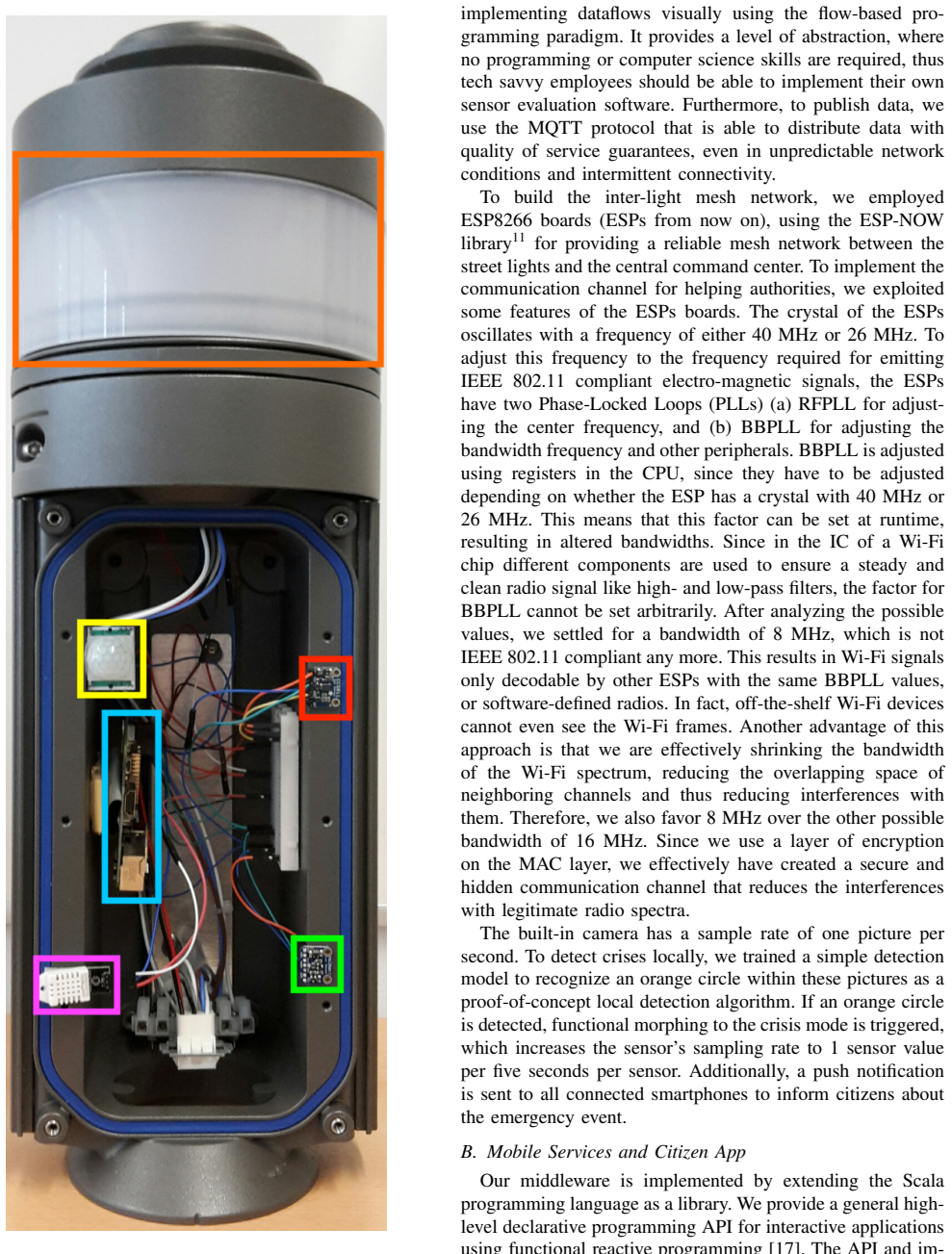
On its own terms, the paper establishes a secure and hidden rescue channel by reconfiguring the ESP8266's BBPLL register at runtime to produce an 8 MHz Wi-Fi signal that is not IEEE 802.11 compliant. Because off-the-shelf Wi-Fi devices cannot decode or even see these frames, and because the signal occupies a narrower band, the channel is both covert and low-interference while remaining usable between street lights at about 50 meters. The measurements show that transmission time depends on distance rather than bandwidth: sending 1 MB takes about 85 seconds at 1 meter (about 96 kbit/s), 92 kbit/s at 10 meters, and 88 kbit/s at 50 meters. Six 32-bit sensors sampled every 5 seconds produce about 0.0384 kbit/s, so the paper calculates that one 88 kbit/s hop could carry data from about 2,000 street lights and still leave room for responder communication. A prototype street light with temperature, humidity, light, CO2, motion sensors and a camera performs local crisis detection, then morphs to emergency mode with higher sampling rates and video forwarding, while the companion web app maintains eventual consistency through state-based CRDTs.
Load-bearing premise
The paper assumes that a few point-to-point measurements between two ESPs at up to 50 meters scale to a city-wide multi-hop mesh of roughly 2,000 street lights with acceptable throughput and reliability, but no multi-hop experiment, interference test, or real deployment is performed.
Editorial extensions
If this is right
- If the central claim holds, a city's existing street-light infrastructure can provide first responders with a secure, hidden communication channel at a marginal hardware cost of under one dollar per light for the ESP8266 chip.
- Crisis detection and response can be automated at the edge: sensors and a camera on each light evaluate the situation locally, raise the sampling rate during emergencies, and send pictures or video to a command center without relying on the public Internet.
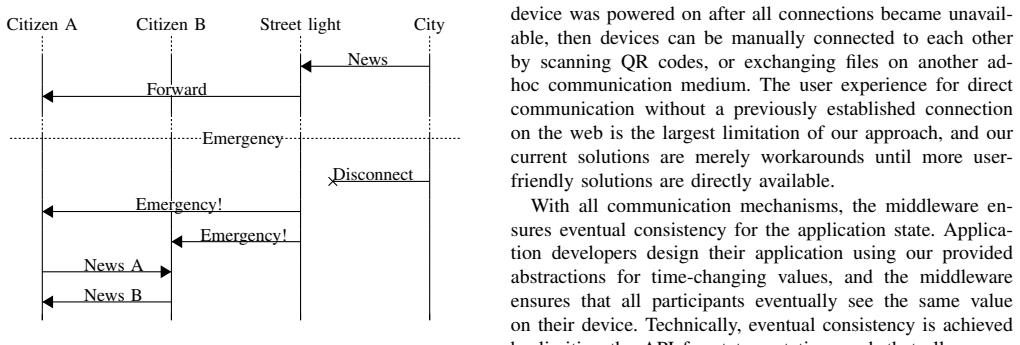
- Citizens who already use the zero-installation web app in everyday mode can keep receiving news and alerts during a crisis, because the middleware seamlessly shifts to device-to-device communication with eventual consistency.
- The measured independence of throughput from bandwidth means the hidden 8 MHz channel does not sacrifice speed relative to the standard 20 MHz mode on the same low-power hardware, preserving roughly 88 kbit/s at typical street-light spacing.
- The cost and power measurements suggest that retrofitting street lights with this sensing and communication package adds only a small fraction of the light's own cost and power draw, making city-wide deployment economically and energetically plausible.
Reading between the lines
- If the hidden 8 MHz channel really is invisible to commodity Wi-Fi receivers, the same runtime BBPLL trick could generalize to other 2.4 GHz IoT devices that expose the register, opening a low-cost side channel beyond rescue use; this depends on confirming invisibility with standard off-the-shelf sniffers.
- The paper's city-wide capacity argument jumps from point-to-point measurements to an assumed multi-hop mesh, so the most direct next experiment is a real chain of street-light ESPs under urban Wi-Fi congestion, measuring end-to-end throughput and packet loss at each hop.
- The trusted-forwarding design relies on pre-shared public keys acquired during everyday operation, which implies that citizens must adopt the app before a crisis for the first-responder message chain to work; how to establish that trust when adoption happens only during an emergency is left open.
Signed reviews
Editorial analysis
A structured set of objections, weighed in public.
Referee Report
Summary. This paper proposes a smart-city crisis-communication architecture built around smart street lights. The prototype street light hosts environmental sensors, a Wi-Fi access point, and an ESP8266-based mesh; in emergency mode, a 'covert' rescue channel is created by downclocking the ESP8266's BBPLL to 8 MHz, with MAC-layer encryption claimed to provide security. A zero-installation web app based on Scala middleware and CRDTs is presented to connect citizens to the infrastructure. The evaluation consists of point-to-point file-transfer measurements over the downclocked channel at 1, 10, and 50 m, a power/cost estimate, and round-trip time measurements for up to 58 messages in the citizen app. The paper concludes that the approach provides a secure and hidden channel with enough capacity for city-wide first-responder communication.
Significance. If the central claims hold, the paper would be a useful and low-cost contribution: it builds on a commercially available street light, makes source code available, reports direct empirical throughput measurements, and gives a concrete capacity calculation linking sensor data rates to the measured channel capacity. The downclocking trick is a genuinely interesting systems idea. However, the two headline properties of the proposed covert channel, hiddenness and security, are asserted but not measured, and the city-wide scaling conclusion is extrapolated from point-to-point tests. The paper is therefore an interesting feasibility study whose strongest claims are not yet substantiated by the evaluation.
major comments (4)
- [Sections IV-A and V-A] The paper's central novelty is a covert channel, but the hiddenness claim is never measured. Section IV-A asserts that off-the-shelf Wi-Fi devices 'cannot even see' the downclocked 8 MHz frames, supported only by the waterfall plot in Fig. 4. No experiment tests whether a commodity Wi-Fi adapter, a smartphone, or a software-defined radio using energy detection can detect the transmission. Because a non-standard 8 MHz signal still occupies spectrum, this assertion is nontrivial and needs a detection experiment with a defined threat model. Without such evidence, the concluding claim of a 'secure and hidden channel' is unsupported.
- [Section IV-A] The 'secure' part of the covert channel is also asserted rather than demonstrated. The text says 'we use a layer of encryption on the MAC layer' but does not specify the encryption algorithm, key management, integrity protection, or replay prevention. The citizen-app discussion mentions pre-shared public keys for known participants, but the rescue channel's security properties are not analyzed or tested. Since 'secure' is one of the two headline properties, the authors should either specify the security mechanism and analyze it, or explicitly limit their claim to 'undecodable by standard devices'.
- [Section V-A] The city-wide capacity argument assumes that about 2,000 street lights can be served in a single hop at 88 kbit/s and that street lights are roughly 50 m apart, but no multi-hop experiment, interference test, or deployment is presented. Point-to-point throughput at 50 m does not establish a city-wide mesh; packet loss, contention, and forwarding overhead are untested. The sentence 'we can build a secure and hidden channel ... with enough available bandwidth ... for city-wide communication' overreaches the data. This can be addressed by adding a small multi-hop test and by rephrasing the conclusion to describe a point-to-point capacity estimate.
- [Figure 5] The claim that 'the transmission time is not related to the bandwidth but only depends on the distance' is not supported by the reported data. The figure shows three distances and three bandwidths with no visible error bars or trial counts; the text mentions a standard error below 0.5 s 'not shown here,' which is insufficient. Without more trials and statistical detail, the apparent bandwidth independence may reflect ESP8266 saturation rather than a general property. Please provide trial counts, error bars, and confidence intervals.
minor comments (4)
- [Figure 6] The y-axis is labeled 'time (ms), size (kB)' for two different series; please use separate axes or a clearer legend to avoid ambiguity about which scale applies to which series.
- [Section V-A] The text says 'IEEE 802.11n can achieve 150 MBit/s' and later '63 Mbp/s'; please unify the notation to Mbit/s or Mbps and correct the typo.
- [Section III-B] In the paragraph on emergency mode, 'In interesting option is to include smartphones' should read 'An interesting option is to include smartphones.'
- [Section V-B] The power-consumption subsection refers to previous work [24] for more details; please state explicitly which numerical values are taken from [24] and which were newly measured here.
Circularity Check
No circularity: the feasibility result derives from direct measurements and arithmetic, not from its own inputs.
full rationale
The derivation chain in Section V-A starts from an observed hardware effect (the 8 MHz BBPLL downclocking shown in Fig. 4) and from direct point-to-point throughput measurements at 1, 10, and 50 meters (Fig. 5). The claimed capacity for roughly 2,000 street lights within one hop is obtained by dividing the measured 88 kbit/s by the stated sensor data rate of 0.0384 kbit/s; this is an arithmetic consequence of the measurements and the authors' own sensor configuration, not a fitted parameter renamed as a prediction. The 'secure and hidden' property is asserted in Section IV-A from the non-standard bandwidth and unspecified MAC-layer encryption rather than derived from an independent definition, so it is an evidentiary gap, not circular reasoning. The only self-citation, [24], supplies supporting figures for component power consumption and on-device image recognition; those figures are not the covert-channel result and the argument does not reduce to that citation. No equation in the paper is equivalent by construction to the quantity it claims to predict, and no uniqueness theorem or prior-work ansatz is used to force the design. Therefore no step is circular.
Assumptions & free parameters
assumptions (4)
- domain assumption Adjacent street lights are within radio range of roughly 50 m and the covert channel throughput measured between two ESPs is representative of a city-wide mesh.
- domain assumption Smartphone vendors do not allow ad-hoc mesh networks, so citizens cannot form direct device-to-device networks without the street light infrastructure.
- domain assumption Emergencies last at most a few days, after which normal infrastructure resumes.
- ad hoc to paper Downclocking the BBPLL to 8 MHz makes the Wi-Fi signals invisible to off-the-shelf devices and secure when combined with MAC-layer encryption.
Cite this review
Pith. "Pith review of Smart Street Lights and Mobile Citizen Apps for Resilient Communication in a Digital City." pith.science (2026). https://pith.science/paper/N7LR7PP4
@misc{pith2026190810233,
  author       = {Pith},
  title        = {Pith review of: Smart Street Lights and Mobile Citizen Apps for Resilient Communication in a Digital City},
  year         = {2026},
  howpublished = {\url{https://pith.science/paper/N7LR7PP4}},
  note         = {Machine review of arXiv:1908.10233}
}
read the original abstract
Currently, nearly four billion people live in urban areas. Since this trend is increasing, natural disasters or terrorist attacks in such areas affect an increasing number of people. While information and communication technology is crucial for the operation of urban infrastructures and the well-being of its inhabitants, current technology is quite vulnerable to disruptions of various kinds. In future smart cities, a more resilient urban infrastructure is imperative to handle the increasing number of hazardous situations. We present a novel resilient communication approach based on smart street lights as part of the public infrastructure. It supports people in their everyday life and adapts its functionality to the challenges of emergency situations. Our approach relies on various environmental sensors and in-situ processing for automatic situation assessment, and a range of communication mechanisms (e.g., public WiFi hotspot functionality and mesh networking) for maintaining a communication network. Furthermore, resilience is not only achieved based on infrastructure deployed by a digital city's municipality, but also based on integrating citizens through software that runs on their mobile devices (e.g., smartphones and tablets). Web-based zero-installation and platform-agnostic apps can switch to device-to-device communication to continue benefiting people even during a disaster situation. Our approach, featuring a covert channel for professional responders and the zero-installation app, is evaluated through a prototype implementation based on a commercially available street light.
Figures

Figures from the paper (2 more)


Reference graph
Works this paper leans on
-
[1]
Smart and digital city: A systematic literature review,
A. Cocchia, “Smart and digital city: A systematic literature review,” in Smart City. Springer, 2014, pp. 13–43
work page 2014
-
[2]
MapReduce: Simplified data processing on large clusters,
J. Dean and S. Ghemawat, “MapReduce: Simplified data processing on large clusters,” Commun. ACM, vol. 51, no. 1, pp. 107–113, Jan. 2008
work page 2008
-
[3]
Google’s MapReduce programming model — revisited,
R. L ¨ammel, “Google’s MapReduce programming model — revisited,” Science of Computer Programming , vol. 70, no. 1, pp. 1 – 30, 2008
work page 2008
-
[4]
The Stratosphere platform for big data analytics,
A. Alexandrov, R. Bergmann, S. Ewen, J.-C. Freytag, F. Hueske, A. Heise, O. Kao, M. Leich, U. Leser, V . Markl, F. Naumann, M. Peters, A. Rheinl ¨ander, M. J. Sax, S. Schelter, M. H ¨oger, K. Tzoumas, and D. Warneke, “The Stratosphere platform for big data analytics,” The VLDB Journal, 2014
work page 2014
-
[5]
Lightweight asynchronous snapshots for distributed dataflows,
P. Carbone, G. F ´ora, S. Ewen, S. Haridi, and K. Tzoumas, “Lightweight asynchronous snapshots for distributed dataflows,” CoRR, vol. abs/1506.08603, 2015. [Online]. Available: http://arxiv.org/abs/ 1506.08603
arXiv 2015
-
[6]
Global Sequence Protocol: A robust abstraction for replicated shared state,
S. Burckhardt, D. Leijen, J. Protzenko, and M. F ¨ahndrich, “Global Sequence Protocol: A robust abstraction for replicated shared state,” in 29th European Conf. on Object-Oriented Programming (ECOOP 2015) , 2015, pp. 568–590
work page 2015
-
[7]
AmbientTalk: Programming Responsive Mobile Peer-to-peer Applications with Actors,
T. Van Cutsem, E. Gonzalez Boix, C. Scholliers, A. Lombide Carreton, D. Harnie, K. Pinte, and W. De Meuter, “AmbientTalk: Programming Responsive Mobile Peer-to-peer Applications with Actors,” Computer Languages, Systems & Structures , vol. 40, no. 3-4, Oct. 2014
work page 2014
-
[8]
Keeping CALM: when distributed consistency is easy,
J. M. Hellerstein and P. Alvaro, “Keeping CALM: when distributed consistency is easy,” CoRR, vol. abs/1901.01930, 2019. [Online]. Available: http://arxiv.org/abs/1901.01930
arXiv 1901
Show all 24 references
-
[9]
Opensense: open community driven sensing of the environment,
K. Aberer, S. Sathe, D. Chakraborty, A. Martinoli, G. Barrenetxea, B. Faltings, and L. Thiele, “Opensense: open community driven sensing of the environment,” inACM SIGSPATIAL Int. Workshop on GeoStream- ing. ACM, 2010, pp. 39–42
2010
-
[10]
Mobile technologies and services for environmental monitoring: The Citi-Sense-MOB approach,
N. Castell, M. Kobernus, H.-Y . Liu, P. Schneider, W. Lahoz, A. J. Berre, and J. Noll, “Mobile technologies and services for environmental monitoring: The Citi-Sense-MOB approach,” Urban Climate , vol. 14, pp. 370–382, 2015
2015
-
[11]
Airsenseur: An open-designed multi-sensor platform for air quality monitoring,
M. Gerboles, L. Spinelle, A. Kotsev, M. Signorini, and L. Srl, “Airsenseur: An open-designed multi-sensor platform for air quality monitoring,” in 4th Scientific Meeting EuNetAir , 2015, pp. 3–5
2015
-
[12]
Open source hardware based sensor platform suitable for human gait identification,
C. Llamas, M. A. Gonz ´alez, C. Hern ´andez, and J. Vegas, “Open source hardware based sensor platform suitable for human gait identification,” Pervasive and Mobile Computing , vol. 38, pp. 154–165, 2017
2017
-
[13]
Usability engineering for successful open citizen science,
J. A. Wirwahn and T. Bartoschek, “Usability engineering for successful open citizen science,” in Free and Open Source Software for Geospatial (FOSS4G) Conference Proceedings, vol. 15, no. 1, 2015, p. 54
2015
-
[14]
Engineering of new participation instruments exemplified by electromobility, particulate matter and clean air policy-making,
N. Fr ¨oschle, “Engineering of new participation instruments exemplified by electromobility, particulate matter and clean air policy-making,” HMD Praxis der Wirtschaftsinformatik , vol. 54, no. 4, pp. 502–517, 2017
2017
-
[15]
Robust, real-time and autonomous monitoring of ecosystems with an open, low-cost, networked device,
S. S. Sethi, R. M. Ewers, N. S. Jones, C. D. L. Orme, and L. Picinali, “Robust, real-time and autonomous monitoring of ecosystems with an open, low-cost, networked device,” Methods in Ecology and Evolution , vol. 9, no. 12, pp. 2383–2387, 2018
2018
-
[16]
Real-time bioacoustics monitoring and automated species identification,
T. M. Aide, C. Corrada-Bravo, M. Campos-Cerqueira, C. Milan, G. Vega, and R. Alvarez, “Real-time bioacoustics monitoring and automated species identification,” PeerJ, vol. 1, p. e103, 2013
2013
-
[17]
REScala: Bridging between object-oriented and functional style in reactive applications,
G. Salvaneschi, G. Hintz, and M. Mezini, “REScala: Bridging between object-oriented and functional style in reactive applications,” in 13th Int. Conf. on Modularity , ser. MODULARITY , 2014
2014
-
[18]
Thread- safe reactive programming,
J. Drechsler, R. Mogk, G. Salvaneschi, and M. Mezini, “Thread- safe reactive programming,” Proc. ACM Program. Lang. , vol. 2, no. OOPSLA, pp. 107:1–107:30, Oct. 2018
2018
-
[19]
Distributed REScala: An update algorithm for distributed reactive programming,
J. Drechsler, G. Salvaneschi, R. Mogk, and M. Mezini, “Distributed REScala: An update algorithm for distributed reactive programming,” in ACM Int. Conf. on Object Oriented Programming Systems Languages and Applications, ser. OOPSLA, 2014
2014
-
[20]
Distributed system development with ScalaLoci,
P. Weisenburger, M. K ¨ohler, and G. Salvaneschi, “Distributed system development with ScalaLoci,” Proc. ACM Program. Lang. , vol. 2, no. OOPSLA, pp. 129:1–129:30, Oct. 2018
2018
-
[21]
Fault-tolerant distributed reactive programming,
R. Mogk, L. Baumg ¨artner, G. Salvaneschi, B. Freisleben, and M. Mezini, “Fault-tolerant distributed reactive programming,” in 32nd European Conf. on Object-Oriented Programming , 2018, pp. 1:1–1:26
2018
-
[22]
A comprehensive study of convergent and commutative replicated data types,
M. Shapiro, N. Pregui, C. Baquero, and M. Zawirski, “A comprehensive study of convergent and commutative replicated data types,” 2011
2011
-
[24]
Environmental monitoring using low-cost hardware and infrastructureless wireless communication,
L. Baumg ¨artner, A. Penning, P. Lampe, B. Richerzhagen, R. Steinmetz, and B. Freisleben, “Environmental monitoring using low-cost hardware and infrastructureless wireless communication,” in 2018 IEEE Global Humanitarian Technology Conference (GHTC) , Oct 2018, pp. 1–8
2018
-
[2018]
Available: http://arxiv.org/abs/1803.02750
[Online]. Available: http://arxiv.org/abs/1803.02750
Reviewed August 14, 2026 · model on record in the stance chip above.
Discussion (0). Continue with ORCID to comment.