REVIEW 3 major objections 7 minor 49 references
Movie Plot Analysis via Turning Point Identification
T0 review · 3 major / 7 minor · reviewed 2026-08-14 · deepseek-v4-flash
Pith's one-line read An end-to-end neural network identifies turning points in movie plots and maps them onto screenplay scenes, beating strong baselines.
desk verdict Genuinely useful dataset and solid synopsis-level results, but the abstract's end-to-end claim is contradicted by the paper's own Table 6. read the letter →
The pith
A machine-rendered reading of the paper's core claim, the machinery that carries it, and where it could break.
The reading
What carries the argument
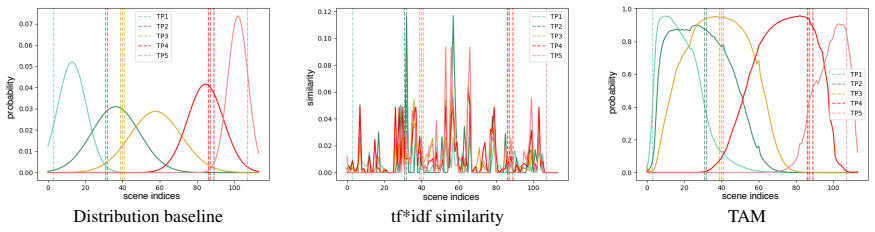
The load-bearing mechanism is a context interaction layer that treats a turning point as a segment boundary. For each sentence or scene, the model computes a left-context vector and a right-context vector by averaging the representations of neighboring segments, then enriches the segment's representation with the element-wise product, cosine similarity, and normalized dot product between the segment and each context. This makes the classifier sensitive to whether the segment sits at a topic shift. Around this, the architecture adds a bidirectional LSTM encoder for the whole narrative, one encoder per turning point type, and an entity-aware encoder that weighs words by attention after co-reference resolution. Training also uses distant supervision: the average position of each turning point in training synopses defines windows that constrain both labeling and scene projection.
What would settle it
On a freshly annotated test set, if the position-only distribution baseline matches or beats the topic-aware model on Partial Agreement, the claimed advantage of content-aware turning point projection fails. Concretely, the end-to-end model's Total Agreement would need to stay significantly above the 8.66% theory baseline on an independent set of 15 movies.
Extended reading notes
Core claim
The central claim is that turning points are identifiable automatically and that modeling them as topic boundaries helps. The paper's best synopsis model, a topic-aware model with per-turning-point views, reaches 41.33% Total Agreement on the test set versus 22.00% for the distribution baseline and 64.00% human agreement. On screenplays, the topic-aware model reaches 10.63% Total Agreement and 13.33% Partial Agreement using goldstandard synopsis labels, and the fully automatic end-to-end version reaches 7.87% and 9.33%, compared with 8.66% and 10.67% for the theory baseline. The intended reading is that lexical content, context, and expected position together, rather than position alone, locate the narrative beats.
Load-bearing premise
The whole comparison rests on treating human-annotated turning point scenes as the correct answer, even though two human annotators pick the exact same scenes only about 35% of the time; if those labels are too noisy, the reported scene-level results do not measure how well the model finds true turning points.
Editorial extensions
If this is right
- Automatic annotations can be generated for screenplays and synopses that lack them, giving a standard five-part segmentation of setup, complications, and aftermath.
- Summarization and question answering systems can first select turning-point segments instead of scanning the whole screenplay, narrowing the search space.
- The TRIPOD dataset provides a benchmark for other narrative-structure models to compare against.
- The same annotation scheme could be extended to more movies and to multimodal video, since turning points are defined at the plot level, not the text level.
Reading between the lines
- An evaluation centered on downstream summarization or question answering would test whether the segmentation carries practical value beyond the reported scene-level metrics.
- The expected-position prior could be made genre- or length-conditioned, since the paper reports variance in turning point positions and uses a single global window.
- The same architecture transfers naturally to other narrative forms, such as novels or TV episodes, that have act-like boundaries.
Signed reviews
Editorial analysis
A structured set of objections, weighed in public.
Referee Report
Summary. The paper proposes a new task, turning point (TP) identification in movies, and argues that the five canonical TPs of screenwriting theory (opportunity, change of plans, point of no return, major setback, climax) provide a plot segmentation useful for downstream summarization and question answering. The authors introduce TRIPOD, a dataset of 99 movies with sentence-level TP annotations for Wikipedia plot synopses and scene-level gold annotations for 15 screenplays. They develop a series of models — a BiLSTM sentence-contextualized classifier (CAM), a topic-aware variant (TAM) with a context-interaction layer that compares each sentence with its left and right context, TP-specific multi-view encoders, and entity-enriched inputs — and an end-to-end pipeline (Section 4.3) that feeds predicted synopsis TPs into a scene-projection model with position-window constraints. Experiments show that the synopsis-level models clearly beat position-based baselines (Table 4b), while the screenplay-level results (Table 6) are much weaker: the best system reaches TA 14.18% against a human agreement of 35.48%, and the end-to-end system (TAM End2end) is numerically below the Theory baseline. The paper also includes an AMT evaluation of synopsis highlights and a per-TP error analysis.
Significance. The synopsis-level contribution is genuine and well evidenced: TAM with TP-specific views reaches TA 38.57% versus 22.00% for the Theory and 28.00% for the Distribution baseline (Table 4b; +entities 41.33%), the per-TP distance analysis (Table 5) shows that the model tracks the relative difficulty pattern of human annotation, and the AMT ranking experiment provides independent, if modest, support. The paper also releases the TRIPOD dataset publicly, which is a real asset for follow-up work, and the task definition is clearly grounded in screenwriting theory rather than an ad hoc artifact. The weaknesses identified below concern claim calibration and evaluation rigor, not the absence of a useful contribution; the narrative-structure analysis task itself and the synopsis-level results are likely to be of interest to the computational literary analysis community.
major comments (3)
- [Abstract; §4.3; §6, Table 6] The abstract and the contributions list claim that the end-to-end model that 'identifies turning points in plot synopses and projects them onto scenes in screenplays' 'outperforms strong baselines based on ... the expected position of turning points.' In Table 6, however, the only row realizing that description, TAM End2end, attains TA 7.87 and PA 9.33, both below the Theory baseline (TA 8.66, PA 10.67); TAM End2end is better than the Theory baseline only on the distance metric D (10.16 vs 10.45). No significance test is reported, so the Section 6 statement that the end-to-end model 'still remains competitive against the baselines' is the strongest defensible characterization, and even that is questionable given that the Theory baseline is numerically better on both headline accuracy metrics. The synopsis-level results in Table 4b do support an outperformance claim (TAM + TP views: TA 38.57 vs 22.00 Theory and 28.00 Distribution), so the authors should either re-scope the abstract and Section 1 to the synopsis-level task, or provide significance tests demonstrating an end-to-end advantage.
- [§6, Table 6] The paragraph introducing Table 6 states that 'The best performing model is TAM' and uses that as support for the segmentation hypothesis, but the table shows CAM at TA 11.11 / PA 16.00 (and CAM + entities at 14.18 / 17.33), both above TAM's 10.63 / 13.33; TAM is better only on D (8.94 vs 10.23 and 10.15). If D is the primary evaluation metric, the paper should say so explicitly and justify that choice; otherwise the claim and the conclusion drawn from the table need to be corrected.
- [§3, Eq. (2); §6, Table 6] The screenplay-level gold standard has inter-annotator TA of 35.48% and PA of 56.67% over the six doubly annotated movies, and the best system in Table 6 reaches only 14.18% TA and 17.33% PA, far below the level at which two human annotators agree with each other. Because the test set contains only 15 movies evaluated with five-fold cross-validation, and no significance tests or per-fold breakdowns are reported, differences among systems in Table 6 (e.g., CAM vs TAM, TAM vs TAM End2end) cannot be reliably distinguished from annotation noise. The authors should add statistical testing or fold-level results and should explicitly discuss the ceiling imposed by the label noise when interpreting the comparisons in Table 6.
minor comments (7)
- [§6] The sentence 'we also experimented 3 with' contains a stray literal '3' and should read 'we also experimented with'.
- [Appendix C] The phrase 'An other such example' should read 'Another such example'.
- [§3] The abbreviation TA is used for two different quantities: the exact-sentence agreement in the synopsis annotation and the Jaccard-based scene-set agreement of Eq. (2); giving these distinct names would prevent confusion when comparing Tables 4 and 6.
- [§6, Fig. 4] The AMT evaluation reports no number of participants and no significance test for the ranking differences (goldstandard 1.87, TAM 1.98, distribution baseline 2.16); the claim that the human evaluation validates the model should be softened accordingly.
- [§6] TextTiling is mentioned as performing poorly, but no result is reported; since the paper has an appendix with available space, reporting the number would be preferable to an unreported comparison.
- [Appendix B] The context window size l is a key hyperparameter of the context interaction layer (two sentences for task 1, 20% of screenplay length for task 2), yet no sensitivity analysis is reported; a brief analysis would strengthen the claim that topic-boundary information, rather than the specific window choice, drives TAM's gains.
- [Appendix B] The data augmentation section states that multiple annotations were used 'whenever these were available and considered reliable,' but the reliability criterion is never specified; this should be clarified for reproducibility.
Circularity Check
No significant circularity: the models are empirical classifiers, position priors are fair baselines, and no prediction reduces to its inputs by construction.
full rationale
Detailed reading of the derivation chain finds no step where a claimed prediction is equivalent to its inputs by construction. The synopsis TP identifiers are trained classifiers evaluated against independent human annotations; the position priors (Table 3) are estimated from training synopses and used both in the distribution baseline and as an inference constraint, which is a legitimate use of a learned prior rather than a circular reduction. The screenplay projection similarly compares content-based models against theory and distribution baselines; although TAM End2end is numerically below the theory baseline in Table 6, that is an internal consistency issue, not a circular derivation. The use of the Scriptbase dataset from Gorinski and Lapata is a self-citation for data provenance, but it is not load-bearing: no uniqueness theorem or theoretical premise is imported from the authors' prior work. The paper explicitly discloses the low inter-annotator agreement on screenplay TPs (TA 35.48%, PA 56.67%; Section 3), which is a reliability limitation for evaluation, but it does not make the training objective or the test predictions circular. The only mild tuning concern is selecting a neighborhood of three scenes per TP from the goldstandard average of 1.77 scenes (Section 5), which is a hyperparameter choice informed by the test labels rather than a construction that forces the predicted peak; this deserves scrutiny as a potential evaluation leak but does not meet the bar of the prediction reducing to its input. Overall the central claim has independent empirical content.
Assumptions & free parameters
free parameters (3)
- Expected TP position windows (mu +/- sigma) =
TP1 11.39+/-6.72, TP2 31.86+/-11.26, TP3 50.65+/-12.15, TP4 74.15+/-8.40, TP5 89.43+/-4.74 percent (Table 3)
- TP-relevant scene neighborhood size =
3 scenes
- Context window size l =
2 sentences for synopsis task; 20% of screenplay length for screenplay task
assumptions (6)
- domain assumption There are exactly five turning points per movie, with fixed definitions and one occurrence each.
- domain assumption Wikipedia plot synopses are faithful enough to screenplays that sentences in synopses correspond to scenes in screenplays.
- domain assumption Manual annotations are reliable enough to serve as goldstandard despite low inter-annotator agreement.
- domain assumption Scenes are the correct textual unit for turning points in screenplays.
- domain assumption Pre-trained Universal Sentence Encoder embeddings provide useful semantic representations for TP prediction.
- standard math Standard supervised learning assumptions hold: train, development, and test splits are representative, and five-fold cross-validation estimates generalization.
Cite this review
Pith. "Pith review of Movie Plot Analysis via Turning Point Identification." pith.science (2026). https://pith.science/paper/LCC3FMCD
@misc{pith2026190810328,
  author       = {Pith},
  title        = {Pith review of: Movie Plot Analysis via Turning Point Identification},
  year         = {2026},
  howpublished = {\url{https://pith.science/paper/LCC3FMCD}},
  note         = {Machine review of arXiv:1908.10328}
}
read the original abstract
According to screenwriting theory, turning points (e.g., change of plans, major setback, climax) are crucial narrative moments within a screenplay: they define the plot structure, determine its progression and segment the screenplay into thematic units (e.g., setup, complications, aftermath). We propose the task of turning point identification in movies as a means of analyzing their narrative structure. We argue that turning points and the segmentation they provide can facilitate processing long, complex narratives, such as screenplays, for summarization and question answering. We introduce a dataset consisting of screenplays and plot synopses annotated with turning points and present an end-to-end neural network model that identifies turning points in plot synopses and projects them onto scenes in screenplays. Our model outperforms strong baselines based on state-of-the-art sentence representations and the expected position of turning points.
Figures


Figures from the paper (2 more)

Reference graph
Works this paper leans on
-
[1]
URL: " 'urlintro :=
ENTRY address author booktitle chapter edition editor howpublished institution journal key month note number organization pages publisher school series title type volume year eprint doi pubmed url lastchecked label extra.label sort.label short.list INTEGERS output.state before.all mid.sentence after.sentence after.block STRINGS urlintro eprinturl eprintpr...
-
[2]
write newline
" write newline "" before.all 'output.state := FUNCTION n.dashify 't := "" t empty not t #1 #1 substring "-" = t #1 #2 substring "--" = not "--" * t #2 global.max substring 't := t #1 #1 substring "-" = "-" * t #2 global.max substring 't := while if t #1 #1 substring * t #2 global.max substring 't := if while FUNCTION word.in bbl.in capitalize " " * FUNCT...
-
[3]
Apoorv Agarwal, Sriramkumar Balasubramanian, Jiehan Zheng, and Sarthak Dash. 2014 a . Parsing Screenplays for Extracting Social Networks from Movies . In Proceedings of the 3rd Workshop on Computational Linguistics for Literature, pages 50--58, Gothenburg, Sweden
work page 2014
-
[4]
Apoorv Agarwal, Sarthak Dash, Sriramkumar Balasubramanian, and Jiehan Zheng. 2014 b . Using Determinantal Point Processes for Clustering with Application to Automatically Generating and Drawing xkcd Movie Narrative Charts . In Proceedings of the 2nd Academy of Science and Engineering International Conference on Big Data Science and Computing, Stanford, California
work page 2014
-
[5]
Apoorv Agarwal, Jiehan Zheng, Shruti Kamath, Sriramkumar Balasubramanian, and Shirin Ann Dey. 2015. Key Female Characters in Film Have More to Talk About Besides Men: Automating the Bechdel Test . In Proceedings of the 2015 Conference of the North American Chapter of the Association for Computational Linguistics: Human Language Technologies, pages 830--84...
work page 2015
-
[6]
David Bamman, Brendan O’Connor, and Noah A Smith. 2013. Learning latent personas of film characters. In Proceedings of the 51st Annual Meeting of the Association for Computational Linguistics (Volume 1: Long Papers), volume 1, pages 352--361, Sofia, Bulgaria
work page 2013
-
[7]
David Bamman, Ted Underwood, and Noah A Smith. 2014. A bayesian mixed effects model of literary character. In Proceedings of the 52nd Annual Meeting of the Association for Computational Linguistics (Volume 1: Long Papers), volume 1, pages 370--379
work page 2014
-
[8]
John B Black and Robert Wilensky. 1979. An evaluation of story grammars. Cognitive science, 3(3):213--229
work page 1979
Show all 49 references
-
[9]
Daniel Cer, Yinfei Yang, Sheng-yi Kong, Nan Hua, Nicole Limtiaco, Rhomni St John, Noah Constant, Mario Guajardo-Cespedes, Steve Yuan, Chris Tar, et al. 2018. Universal sentence encoder. arXiv preprint arXiv:1803.11175
2018 arXiv
-
[10]
Nathanael Chambers and Dan Jurafsky. 2009. Unsupervised learning of narrative schemas and their participants. In Proceedings of the Joint Conference of the 47th Annual Meeting of the ACL and the 4th International Joint Conference on Natural Language Processing of the AFNLP: Vo...
2009
-
[11]
Snigdha Chaturvedi, Mohit Iyyer, and Hal Daume III. 2017. Unsupervised learning of evolving relationships between literary characters. In Thirty-First AAAI Conference on Artificial Intelligence
2017
-
[12]
Danqi Chen, Adam Fisch, Jason Weston, and Antoine Bordes. 2017. Reading wikipedia to answer open-domain questions. arXiv preprint arXiv:1704.00051
2017 arXiv
-
[13]
James E Cutting. 2016. Narrative theory and the dynamics of popular movies. Psychonomic bulletin & review, 23(6):1713--1743
2016
-
[14]
Cristian Danescu-Niculescu-Mizil, Justin Cheng andJon Kleinberg, and Lillian Lee. 2012. You had me at hello: How phrasing affects memorability. In Proceedings of the 50th Annual Meeting of the Association for Computational Linguistics: Long Papers--Volume 1, pages 892--901, ??
2012
-
[15]
Jacob Devlin, Ming-Wei Chang, Kenton Lee, and Kristina Toutanova. 2018. Bert: Pre-training of deep bidirectional transformers for language understanding. arXiv preprint arXiv:1810.04805
2018 arXiv
-
[16]
Dheeru Dua, Yizhong Wang, Pradeep Dasigi, Gabriel Stanovsky, Sameer Singh, and Matt Gardner. 2019. Drop: A reading comprehension benchmark requiring discrete reasoning over paragraphs. arXiv preprint arXiv:1903.00161
2019 arXiv
-
[17]
Ahmed Elgohary, Chen Zhao, and Jordan Boyd-Graber. 2018. A dataset and baselines for sequential open-domain question answering. In Proceedings of the 2018 Conference on Empirical Methods in Natural Language Processing, pages 1077--1083
2018
-
[18]
Mich Elsner. 2012. Character-based kernels for novelistic plot structure. In Proceedings of the 13th Conference of the European Chapter of the Association for Computational Linguistics, pages 634--644, Avignon, France
2012
-
[19]
David Elson and Kathleen McKeown. 2009. Extending and evaluating a platform for story understanding. In Proceedings of the AAAI 2009 Spring Symposium on Intelligent Narrative Technologies II, page ??, ??
2009
-
[20]
Lea Frermann, Shay B Cohen, and Mirella Lapata. 2018. Whodunnit? crime drama as a case for natural language understanding. Transactions of the Association of Computational Linguistics, 6:1--15
2018
-
[21]
Gustav Freytag. 1896. Freytag's technique of the drama: an exposition of dramatic composition and art. Scholarly Press
-
[22]
Philip John Gorinski and Mirella Lapata. 2015. Movie script summarization as graph-based scene extraction. In Proceedings of the 2015 Conference of the North American Chapter of the Association for Computational Linguistics: Human Language Technologies, pages 1066--1076
2015
-
[23]
Philip John Gorinski and Mirella Lapata. 2018. What’s this movie about? a joint neural network architecture for movie content analysis. In Proceedings of the 2018 Conference of the North American Chapter of the Association for Computational Linguistics: Human Language Technolo...
2018
-
[24]
Michael Hague. 2017. Storytelling Made Easy: Persuade and Transform Your Audiences, Buyers, and Clients -- Simply, Quickly, and Profitably. Indie Books International
2017
-
[25]
Marti A Hearst. 1997. Texttiling: Segmenting text into multi-paragraph subtopic passages. Computational linguistics, 23(1):33--64
1997
-
[26]
Sepp Hochreiter and J \"u rgen Schmidhuber. 1997. Long short-term memory. Neural computation, 9(8):1735--1780
1997
-
[27]
Mohit Iyyer, Anupam Guha, Snigdha Chaturvedi, Jordan Boyd-Graber, and Hal Daum \'e III. 2016. Feuding families and former friends: Unsupervised learning for dynamic fictional relationships. In Proceedings of the 2016 Conference of the North American Chapter of the Association ...
2016
-
[28]
Mandar Joshi, Eunsol Choi, Daniel S Weld, and Luke Zettlemoyer. 2017. Triviaqa: A large scale distantly supervised challenge dataset for reading comprehension. arXiv preprint arXiv:1705.03551
2017 arXiv
-
[29]
Diederik P Kingma and Jimmy Ba. 2014. Adam: A method for stochastic optimization. arXiv preprint arXiv:1412.6980
2014 arXiv
-
[30]
Tom \'a s Ko c isk \`y , Jonathan Schwarz, Phil Blunsom, Chris Dyer, Karl Moritz Hermann, G \'a abor Melis, and Edward Grefenstette. 2018. The narrativeqa reading comprehension challenge. Transactions of the Association of Computational Linguistics, 6:317--328
2018
-
[31]
Bernhard Kratzwald and Stefan Feuerriegel. 2018. Adaptive document retrieval for deep question answering. arXiv preprint arXiv:1808.06528
2018 arXiv
-
[32]
Christopher Manning, Mihai Surdeanu, John Bauer, Jenny Finkel, Steven Bethard, and David McClosky. 2014. The stanford corenlp natural language processing toolkit. In Proceedings of 52nd annual meeting of the association for computational linguistics: system demonstrations, pag...
2014
-
[33]
Nalisnick and Henry S
Eric T. Nalisnick and Henry S. Baird. 2013. Character-to-character sentiment analysis in shakespeare's plays. In Proceedings of the 51st Annual Meeting of the Association for Computational Linguistics, pages 479--483, Sofia, Bulgaria
2013
-
[34]
Tri Nguyen, Mir Rosenberg, Xia Song, Jianfeng Gao, Saurabh Tiwary, Rangan Majumder, and Li Deng. 2016. Ms marco: A human generated machine reading comprehension dataset. arXiv preprint arXiv:1611.09268
2016 arXiv
-
[35]
Adam Paszke, Sam Gross, Soumith Chintala, Gregory Chanan, Edward Yang, Zachary DeVito, Zeming Lin, Alban Desmaison, Luca Antiga, and Adam Lerer. 2017. Automatic differentiation in pytorch
2017
-
[36]
Patrice Pavis. 1998. Dictionary of the theatre: Terms, concepts, and analysis. University of Toronto Press
1998
-
[37]
Pranav Rajpurkar, Jian Zhang, Konstantin Lopyrev, and Percy Liang. 2016. Squad: 100,000+ questions for machine comprehension of text. arXiv preprint arXiv:1606.05250
2016 arXiv
-
[38]
Anil Ramakrishna, Nikolaos Malandrakis, Elizabeth Staruk, and Shrikanth Narayanan. 2015. A quantitative analysis of gender differences in movies using psycholinguistic normatives. In Proceedings of the 2015 Conference on Empirical Methods in Natural Language Processing., pages...
2015
-
[39]
Gerard Salton, Amit Singhal, Chris Buckley, and Mandar Mitra. 1996. Automatic text decomposition using text segments and text themes. In Proceedings of the the seventh ACM conference on Hypertext, pages 53--65, Bethesda, Maryland
1996
-
[40]
Maarten Sap, Marcella Cindy Prasettio, Ari Holtzman, Hannah Rashkin, and Yejin Choi. 2017. Connotation frames of power and agency in modern films. In Proceedings of the 2017 Conference on Empirical Methods in Natural Language Processing, pages 2329--2334, Copenhagen, Denmark
2017
-
[41]
Makarand Tapaswi, Yukun Zhu, Rainer Stiefelhagen, Antonio Torralba, Raquel Urtasun, and Sanja Fidler. 2016. Movieqa: Understanding stories in movies through question-answering. In Proceedings of the IEEE conference on computer vision and pattern recognition, pages 4631--4640
2016
-
[42]
Kristin Thompson. 1999. Storytelling in the new Hollywood: Understanding classical narrative technique. Harvard University Press
1999
-
[43]
Adam Trischler, Tong Wang, Xingdi Yuan, Justin Harris, Alessandro Sordoni, Philip Bachman, and Kaheer Suleman. 2016. Newsqa: A machine comprehension dataset. arXiv preprint arXiv:1611.09830
2016 arXiv
-
[44]
Paul Vicol, Makarand Tapaswi, Lluis Castrejon, and Sanja Fidler. 2018. Moviegraphs: Towards understanding human-centric situations from videos. In Proceedings of the IEEE Conference on Computer Vision and Pattern Recognition, pages 8581--8590
2018
-
[45]
Yizhong Wang, Kai Liu, Jing Liu, Wei He, Yajuan Lyu, Hua Wu, Sujian Li, and Haifeng Wang. 2018. Multi-passage machine reading comprehension with cross-passage answer verification. arXiv preprint arXiv:1805.02220
2018 arXiv
-
[46]
Johannes Welbl, Pontus Stenetorp, and Sebastian Riedel. 2018. Constructing datasets for multi-hop reading comprehension across documents. Transactions of the Association of Computational Linguistics, 6:287--302
2018
-
[47]
Ikuya Yamada, Akari Asai, Hiroyuki Shindo, Hideaki Takeda, and Yoshiyasu Takefuji. 2018. Wikipedia2vec: An optimized tool for learning embeddings of words and entities from wikipedia. arXiv preprint 1812.06280
2018 arXiv
-
[48]
Zhilin Yang, Peng Qi, Saizheng Zhang, Yoshua Bengio, William W Cohen, Ruslan Salakhutdinov, and Christopher D Manning. 2018. Hotpotqa: A dataset for diverse, explainable multi-hop question answering. arXiv preprint arXiv:1809.09600
2018 arXiv
-
[49]
Patrick Ye and Timothy Baldwin. 2008. Towards Automatic Animated Storyboarding . In Proceedings of the 23rd Association for the Advancement of Artificial Intelligence Conference on Artificial Intelligence, pages 578--583, Chicago, Illinois
2008
Reviewed August 14, 2026 · model on record in the stance chip above.
Discussion (0). Continue with ORCID to comment.