REVIEW 3 major objections 6 minor 66 references
Dust production in the debris disk around HR 4796 A
T0 review · 3 major / 6 minor · reviewed 2026-08-14 · deepseek-v4-flash
Pith's one-line read New SPHERE/ZIMPOL polarized-light images of the debris disk around HR 4796 A show that its one-sided brightness is best explained by small dust grains being released preferentially near the pericenter of a narrow, eccentric planetesimal…
desk verdict Strong new ZIMPOL-based case that HR 4796 A's brightness asymmetry is caused by dust released near pericenter, but the conclusion leans on an untested flat-disk assumption that deserves explicit scrutiny. read the letter →
The pith
A machine-rendered reading of the paper's core claim, the machinery that carries it, and where it could break.
The reading
What carries the argument
The load-bearing machinery is a Monte Carlo model of an eccentric planetesimal belt with grain-size-dependent radiation pressure. The dimensionless ratio $\beta(s)=F_{\rm rad}/F_{\rm grav}$ is computed from Mie scattering for each grain size; after a dust grain is released at a true anomaly drawn from a chosen collision prior (uniform, or Gaussian centered at pericenter with width $\delta\omega$), an analytic prescription updates the grain's semi-major axis, eccentricity, and argument of pericenter. Each bound grain's orbit is then populated with test particles and weighted by an enhancement factor that accounts for high-$\beta$ grains spending most of their orbit outside the birth ring. The model computes polarized scattering images with a Henyey-Greenstein phase function, and the parameters are fit to radial cuts by Markov chain Monte Carlo. The key controlling parameter is the width $\delta\omega$ of the release prior: only a normal prior centered at pericenter with a broad $\delta\omega\approx64^\circ$ reproduces the observed brightness difference between the two sides.
What would settle it
Measure the vertical structure of the ring with high-resolution imaging or model a warped disk to see whether the NE and SW sides are viewed at measurably different scattering angles; if a realistic polarized phase function plus a warp reproduces the observed NE/SW asymmetry with uniform dust release, the pericenter-concentrated collisions are not required.
Extended reading notes
Core claim
The paper's central claim is that small grains in the HR 4796 A debris disk are preferentially released close to the pericenter of the eccentric parent belt, and that this asymmetric release, not pericenter glow and not an outer shepherding planet, produces the observed NE/SW brightness asymmetry. The best-fit model places the parent planetesimal ring at reference radius $76.4\pm0.4$ au, with eccentricity $e=0.076_{-0.010}^{+0.016}$, width $\delta r=3.6^{+0.2}_{-0.2}$ au, and pericenter on the front side of the disk on the sky. The azimuthal concentration parameter $\delta\omega$ of the release prior is about $64^\circ$, meaning collisions that produce small dust happen preferentially in a wide sector around pericenter even though the parent bodies themselves spend more time near apocenter. With radiation pressure and this release geometry, the model matches the ZIMPOL radial cuts, reproduces mid-IR and ALMA images, and explains the sharp outer edge without invoking planet sculpting.
Load-bearing premise
The model assumes the disk is flat enough that both ends of the semi-major axis are viewed at the same scattering angle, so any brightness difference must come from dust density rather than from how dust scatters light.
Editorial extensions
If this is right
- The parent planetesimal belt is narrow, about 3.6 au wide, and slightly eccentric, so dust production in HR 4796 A is confined to a thin torus rather than a broad disk.
- Small dust is created at a higher rate near pericenter, so the azimuthal brightness of a debris ring can be read as a map of collision frequency, not just orbital density.
- The sharp outer edge needs no outer shepherding planet; radiation pressure on grains launched from an eccentric belt produces it.
- The same best-fit model simultaneously matches optical ZIMPOL radial profiles, mid-IR 18.1 and 24.5 micron images, and the ALMA 880 micron ring, so the inferred release geometry is consistent across grain sizes.
- The model predicts that the mid-IR brightness asymmetry should be stronger at 18.1 microns than at 24.5 microns, matching the visual trend in earlier observations.
Reading between the lines
- If the flat-disk assumption is relaxed, a warped or vertically thick ring could produce the same NE/SW contrast through slightly different scattering angles on the two sides; a vertical-structure measurement would tell whether the fitted $\delta\omega\approx64^\circ$ overstates the collision asymmetry.
- The pericenter-concentrated release is consistent with a recent giant collision between large eccentric planetesimals; if so, the NE/SW brightness contrast should fade over orbital timescales, and monitoring over years could check whether the system is in a transient post-impact state.
- Applying the same release-prior fitting to other eccentric debris rings would test whether asymmetric dust release near the pericenter is a general feature of collisionally active belts.
- A high signal-to-noise ALMA map of the large grains should show a nearly uniform azimuthal distribution, because large grains feel little radiation pressure; if the millimetre ring shows the same strong asymmetry as the optical light, the release-prior explanation would be challenged.
Signed reviews
Editorial analysis
A structured set of objections, weighed in public.
Referee Report
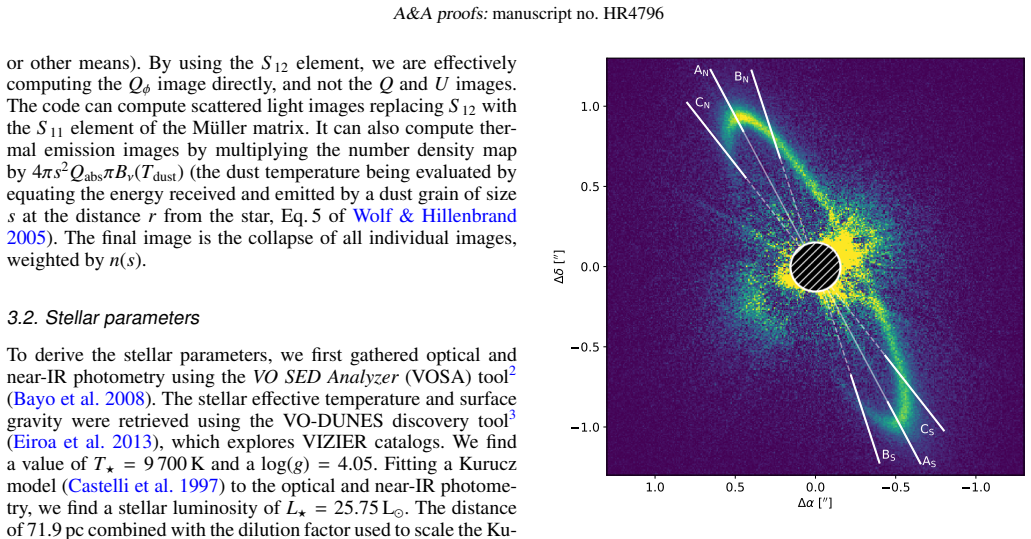
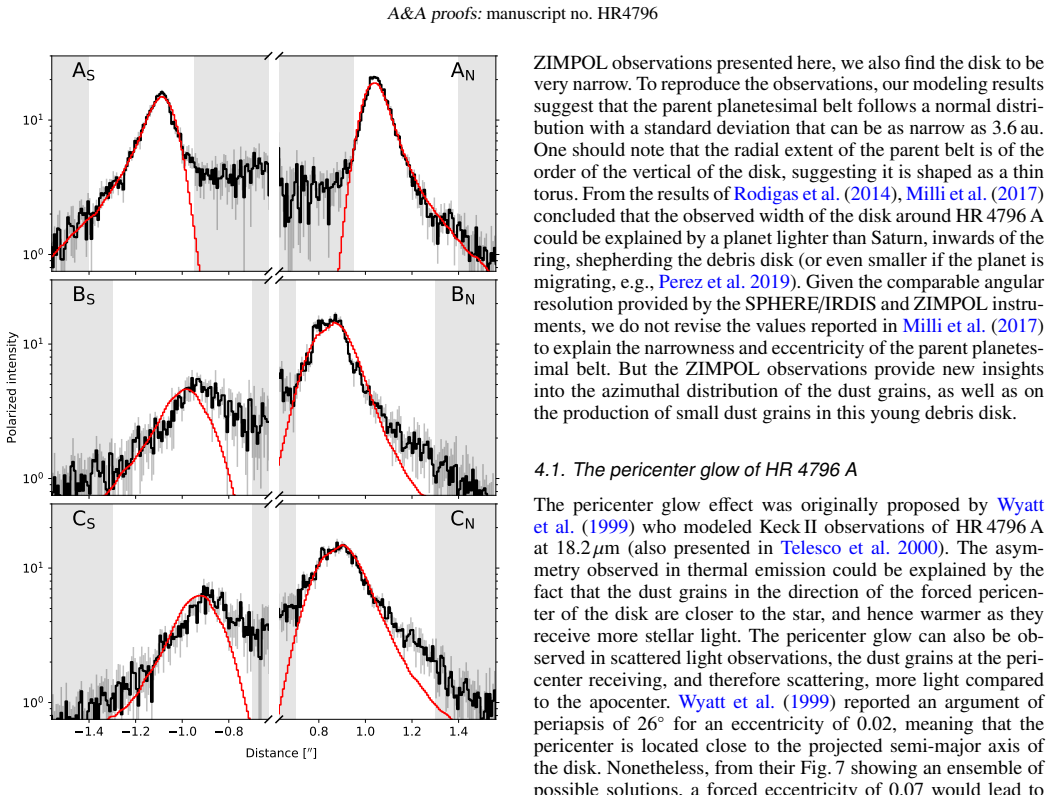
Summary. This paper presents VLT/SPHERE-ZIMPOL polarimetric observations of the debris disk around HR 4796 A and fits radial intensity profiles along and near the projected major axis with a parametric model that includes radiation pressure on dust grains. The free parameters are the reference radius, parent-belt width, eccentricity, argument of pericenter, position angle, and a parameter δω describing the width of a normal distribution of the mean anomaly at which dust grains are released. An MCMC exploration yields a best fit with r0 = 76.4 au, δr = 3.6 au, e = 0.076, ω = −254°, and δω = 63.9°, with the pericenter on the north/front side. The authors conclude that small dust grains must be preferentially released near the pericenter, implying more frequent collisions there, and that no outer shepherding planet is needed to truncate the disk. The best-fit model is compared visually with ALMA 880 µm and mid-IR images, and two speculative scenarios are proposed for the extended HST halo.
Significance. If the conclusions hold, the study provides one of the first direct constraints on the azimuthal distribution of dust production in a debris disk, with implications for collision models and planet-disk interactions. The modeling strategy is computationally light and the fit to the ZIMPOL radial profiles is compelling; the use of previously published ALMA and mid-IR data as independent cross-checks is a strength, as is the explicit exploration of the uniform-release counter-model in Fig. A.2. The paper is careful to separate the main fit from the speculative HST halo discussion. However, the central claim rests on the flat-disk/phase-function-cancellation assumption of Sec. 3.4 and on neglecting post-release grain-grain collisions, so the causal conclusion about collision rates is not uniquely established.
major comments (3)
- [Sec. 3.4] The central conclusion that small dust grains must be preferentially released near the pericenter rests on the assumption that the disk is flat enough for the NE and SW ansae to be observed at the same scattering angle, so that S12 cancels in the comparison. Because the model's only azimuthal degree of freedom is the release-prior width δω (Sec. 3.1), the fitted value δω = 63.9° becomes the sole mechanism for the brightness asymmetry; a warp, a vertical thickness gradient, or an asymmetric vertical profile could mimic the asymmetry without any pericenter-concentrated release. The paper provides no independent constraint on the flatness at the required level, nor a robustness test of this degeneracy. Please add a quantitative test (e.g., allowing a vertical offset or warp and checking whether a uniform release can reproduce the observed AN/AS profiles) or explicitly bound the allowed warp using the ZIMPOL data.
- [Sec. 3.1 and Sec. 5] The model interprets the fitted release distribution as the collisional release distribution, but grain-grain collisions after release are not included; the enhancement factor of Strubbe & Chiang (2006) is a steady-state lifetime correction, not a destruction term. For a disk with fractional luminosity ~5e-3, small grains may be destroyed on timescales comparable to or shorter than their orbital period, which would modify the azimuthal distribution that is compared to the data. The paper acknowledges this limitation and cites Löhne et al. (2017), but it does not quantify the effect on δω or on the statement that collisions happen more frequently near the pericenter. A quantitative estimate of the collisional lifetime versus orbital time, or a comparison with a model including collisions, is needed to support the causal claim.
- [Sec. 4.1 and Figs. 5-6] The agreement with ALMA 880 µm and mid-IR images is asserted on the basis of visual inspection only; no residuals, signal-to-noise metrics, or quantitative azimuthal comparisons are provided. Since these data were not used in the fit, they are legitimate independent cross-checks, but the abstract's claim of agreement with previously published datasets from near-IR to sub-mm wavelengths is stronger than the evidence presented. Please either add quantitative comparisons or soften the claim.
minor comments (6)
- [Abstract and Table 1] δr = 3.6 au is the standard deviation of a normal distribution, not the 'width' of the ring; using 'standard deviation' or converting to FWHM would avoid confusion.
- [Sec. 4.4.2] The adopted ISM density nH = 125 cm^-3 is outside the range 5-100 cm^-3 quoted in the same paragraph; the statement that this is 'on the higher end of the range' is inaccurate and should be corrected.
- [Sec. 3.4] The sentence 'since then it has been shown that this is not compatible with several studies...' lacks a citation and a clear subject; please rephrase and cite the relevant works.
- [Fig. 2 and Sec. 3.5] The model under-predicts the BN/CN profiles beyond 1 arcsec and the BS/CS peak positions are offset; a short discussion of these residuals would help the reader assess the fit quality.
- [Appendix A.2] The uniform-release comparison is shown only for the major-axis profiles; stating whether the off-axis cuts are similarly affected would strengthen the demonstration that δω is required.
- [Throughout] The text contains inconsistent spellings (e.g., 'different' vs 'different', 'Thebault' vs 'Thébault'); a careful proofread is needed.
Circularity Check
No significant circularity: the pericenter-release conclusion is a fitted model parameter with a uniform-release control and independent multi-wavelength cross-checks, not a prediction-by-construction.
full rationale
The central chain is: ZIMPOL radial profiles are fitted with an MCMC over r0, δr, ω, δω, e, and φ, where δω is the width of the assumed normal 'collisional distribution' (Sec. 3.1: 'To decide where the collision releasing a dust grain takes place, we use a prior distribution on the mean anomaly... The standard deviation when using the normal distribution is noted δω'). The best-fit δω = 63.9° is then reported as 'small dust grains must be preferentially released near the pericenter to explain the observed brightness asymmetry.' This is a parameter estimate with a physical interpretation, not a hidden second quantity predicted from the fit: the asymmetry is used to constrain δω, and the uniform-release model (Fig. A.2) is an explicit control showing that, within the adopted geometry, δω ≠ 0 is needed. The paper does not stop at the fit: it compares the best-fit model to previously published ALMA 880 μm and mid-IR 18.1/24.5 μm images as independent cross-checks, stating at Sec. 4.1 'we did not aim at fitting those observations.' No load-bearing step reduces to a self-citation: the phase-function discussion defers to Milli et al. (2019) but is explicitly declared not relevant for the major-axis comparison since both sides are observed at the same scattering angle, and the radiation-pressure treatment comes from external work (Lee & Chiang 2016; Wyatt et al. 1999). The flat-disk/same-scattering-angle assumption in Sec. 3.4 is a physical modeling assumption that affects robustness and scope, but it is not a circular reduction of the conclusion to its inputs. Therefore the derivation is self-contained and no circularity is identified.
Assumptions & free parameters
free parameters (7)
- r0 (reference radius) =
76.4 au (+0.4/-0.3)
- δr (parent belt width) =
3.6 au (+0.2/-0.2)
- ω (argument of periapsis) =
-254.3 deg (+1.8/-1.6)
- δω (collision release concentration) =
63.9 deg (+14.4/-11.3)
- e (eccentricity) =
0.076 (+0.016/-0.010)
- φ (position angle) =
-152.1 deg (+0.1/-0.1)
- Per-profile scaling factors (BN, BS, CN, CS) =
not tabulated
assumptions (8)
- domain assumption Dohnanyi (1969) collisional cascade size distribution, dn(s) ∝ s^-3.5 ds
- domain assumption Mie theory for radiation pressure and scattering efficiencies
- domain assumption Radiation-pressure orbital update equations (Eq. 3) from Wyatt et al. (1999), Wyatt (2006), and Lee & Chiang (2016)
- domain assumption Lifetime enhancement factor for high-beta grains (Sec. 3.1)
- domain assumption Thin-disk vertical dispersion with h/r = 0.04
- domain assumption Henyey-Greenstein polarized phase function with g = 0.3
- domain assumption Stellar parameters L* = 25.75 L_sun, M* = 1.31 M_sun, distance = 71.9 pc
- domain assumption Inclination fixed at 76.6 degrees
Cite this review
Pith. "Pith review of Dust production in the debris disk around HR 4796 A." pith.science (2026). https://pith.science/paper/V2URTTA4
@misc{pith2026190810378,
  author       = {Pith},
  title        = {Pith review of: Dust production in the debris disk around HR 4796 A},
  year         = {2026},
  howpublished = {\url{https://pith.science/paper/V2URTTA4}},
  note         = {Machine review of arXiv:1908.10378}
}
abstract
Debris disks are the natural by-products of the planet formation process. Scattered or polarized light observations are mostly sensitive to small dust grains that are released from the grinding down of bigger planetesimals. High angular resolution observations at optical wavelengths can provide key constraints on the radial and azimuthal distribution of the small dust grains. These constraints can help us better understand where most of the dust grains are released upon collisions. We present SPHERE/ZIMPOL observations of the debris disk around HR 4796 A, and model the radial profiles along several azimuthal angles of the disk with a code that accounts for the effect of stellar radiation pressure. This enables us to derive an appropriate description for the radial and azimuthal distribution of the small dust grains. Even though we only model the radial profiles along (or close to) the semi-major axis of the disk, our best-fit model is not only in good agreement with our observations but also with previously published datasets (from near-IR to sub-mm wavelengths). We find that the reference radius is located at $76.4\pm0.4$ au, and the disk has an eccentricity of $0.076_{-0.010}^{+0.016}$, with the pericenter located on the front side of the disk (north of the star). We find that small dust grains must be preferentially released near the pericenter to explain the observed brightness asymmetry. Even though parent bodies spend more time near the apocenter, the brightness asymmetry implies that collisions happen more frequently near the pericenter of the disk. Our model can successfully reproduce the shape of the outer edge of the disk, without having to invoke an outer planet shepherding the debris disk. With a simple treatment of the effect of the radiation pressure, we conclude that the parent planetesimals are located in a narrow ring of about $3.6$ au in width.
Figures

Figures from the paper (5 more)


Reference graph
Works this paper leans on
-
[1]
Arnold, J. A., Weinberger, A. J., Videen, G., & Zubko, E. S. 2019, AJ, 157, 157 Astropy Collaboration, Robitaille, T. P., Tollerud, E. J., et al. 2013, A&A, 558, A33
work page 2019
-
[2]
C., Lagrange, A
Augereau, J. C., Lagrange, A. M., Mouillet, D., Papaloizou, J. C. B., & Grorod, P. A. 1999, A&A, 348, 557
1999
- [3]
-
[4]
2008, A&A, 492, 277
Bayo, A., Rodrigo, C., Barrado Y Navascués, D., et al. 2008, A&A, 492, 277
2008
-
[5]
2015, A&A, 578, L6
Benisty, M., Juhasz, A., Boccaletti, A., et al. 2015, A&A, 578, L6
2015
-
[6]
2019, ArXiv e-prints [arXiv:1902.04080]
Beuzit, J., Vigan, A., Mouillet, D., et al. 2019, ArXiv e-prints [arXiv:1902.04080]
arXiv 2019
-
[7]
A., Lamy, P
Burns, J. A., Lamy, P. L., & Soter, S. 1979, Icarus, 40, 1
1979
- [8]
Show all 66 references
-
[9]
V ., Min, M., & Keller, C
Canovas, H., Rodenhuis, M., Jeffers, S. V ., Min, M., & Keller, C. U. 2011, A&A, 531, A102
2011
-
[10]
G., & Kurucz, R
Castelli, F., Gratton, R. G., & Kurucz, R. L. 1997, A&A, 318, 841
1997
-
[11]
2019, MNRAS, 483, 4114
Cuello, N., Dipierro, G., Mentiplay, D., et al. 2019, MNRAS, 483, 4114
2019
-
[12]
Dent, W. R. F., Wyatt, M. C., Roberge, A., et al. 2014, Science, 343, 1490
2014
-
[13]
Dohnanyi, J. S. 1969, J. Geophys. Res., 74, 2531
1969
-
[14]
Draine, B. T. 2003, ApJ, 598, 1026
2003
-
[15]
Dullemond, C. P. & Dominik, C. 2008, A&A, 487, 205
2008
-
[16]
P., Mora, A., et al
Eiroa, C., Marshall, J. P., Mora, A., et al. 2013, A&A, 555, A11
2013
-
[17]
M., Thalmann, C., et al
Engler, N., Schmid, H. M., Thalmann, C., et al. 2017, A&A, 607, A90
2017
-
[18]
M., Fitzgerald, M
Esposito, T. M., Fitzgerald, M. P., Graham, J. R., et al. 2016, AJ, 152, 85
2016
-
[19]
2016, The Journal of Open Source Software, 24
Foreman-Mackey, D. 2016, The Journal of Open Source Software, 24
2016
-
[20]
W., Lang, D., & Goodman, J
Foreman-Mackey, D., Hogg, D. W., Lang, D., & Goodman, J. 2013, PASP, 125, 306
2013
-
[21]
2006, in Proc
Fusco, T., Petit, C., Rousset, G., et al. 2006, in Proc. SPIE, V ol. 6272, Society of Photo-Optical Instrumentation Engineers (SPIE) Conference Series, 62720K Gaia Collaboration, Brown, A. G. A., Vallenari, A., et al. 2018, A&A, 616, A1
2006
-
[22]
& Rubin, D
Gelman, A. & Rubin, D. B. 1992, Statist. Sci., 7, 457
1992
-
[23]
2016, A&A, 595, A112 Hernández, J., Hartmann, L., Megeath, T., et al
Ginski, C., Stolker, T., Pinilla, P., et al. 2016, A&A, 595, A112 Hernández, J., Hartmann, L., Megeath, T., et al. 2007, ApJ, 662, 1067
2016
-
[24]
2018, MNRAS, 480, 488
Iglesias, D., Bayo, A., Olofsson, J., et al. 2018, MNRAS, 480, 488
2018
-
[25]
P., Wyatt, M
Jackson, A. P., Wyatt, M. C., Bonsor, A., & Veras, D. 2014, MNRAS, 440, 3757
2014
-
[26]
1998, ApJ, 503, L79
Jayawardhana, R., Fisher, S., Hartmann, L., et al. 1998, ApJ, 503, L79
1998
-
[27]
E., & Smith, R
Jura, M., Zuckerman, B., Becklin, E. E., & Smith, R. C. 1993, ApJ, 418, L37
1993
-
[28]
M., Marino, S., Matrà, L., et al
Kennedy, G. M., Marino, S., Matrà, L., et al. 2018, MNRAS, 475, 4924
2018
-
[29]
Kennedy, G. M. & Piette, A. 2015, MNRAS, 449, 2304
2015
-
[30]
Kenyon, S. J. & Bromley, B. C. 2005, AJ, 130, 269
2005
-
[31]
2015, A&A, 573, A39
Kral, Q., Thébault, P., Augereau, J.-C., Boccaletti, A., & Charnoz, S. 2015, A&A, 573, A39
2015
-
[32]
2013, A&A, 558, A121
Kral, Q., Thébault, P., & Charnoz, S. 2013, A&A, 558, A121
2013
-
[33]
2012, A&A, 546, A38
Lagrange, A.-M., Milli, J., Boccaletti, A., et al. 2012, A&A, 546, A38
2012
-
[34]
F., et al
Lebreton, J., Augereau, J.-C., Thi, W. F., et al. 2012, Astronomy & Astrophysics, 539, A17
2012
-
[35]
Lee, E. J. & Chiang, E. 2016, ApJ, 827, 125 Löhne, T., Krivov, A. V ., Kirchschlager, F., Sende, J. A., & Wolf, S. 2017, A&A, 605, A7
2016
-
[36]
& Thébault, P
Marzari, F. & Thébault, P. 2011, MNRAS, 416, 1890
2011
-
[37]
2019, ArXiv e-prints [arXiv:1905.03603]
Milli, J., Engler, N., Schmid, H., et al. 2019, ArXiv e-prints [arXiv:1905.03603]
2019 arXiv
-
[38]
2015, A&A, 577, A57
Milli, J., Mawet, D., Pinte, C., et al. 2015, A&A, 577, A57
2015
-
[39]
2017, A&A, 599, A108
Milli, J., Vigan, A., Mouillet, D., et al. 2017, A&A, 599, A108
2017
-
[40]
M., Churcher, L
Moerchen, M. M., Churcher, L. J., Telesco, C. M., et al. 2011, A&A, 526, A34 Moór, A., Ábrahám, P., Derekas, A., et al. 2006, ApJ, 644, 525
2011
-
[41]
D., Min, M., Dominik, C., Debes, J
Mulders, G. D., Min, M., Dominik, C., Debes, J. H., & Schneider, G. 2013, A&A, 549, A112
2013
-
[42]
R., Lee, M.-Y ., et al
Nguyen, H., Dawson, J. R., Lee, M.-Y ., et al. 2019, ApJ, 880, 141
2019
-
[43]
2016, A&A, 591, A108
Olofsson, J., Samland, M., Avenhaus, H., et al. 2016, A&A, 591, A108
2016
-
[44]
R., & Kuchner, M
Pan, M., Nesvold, E. R., & Kuchner, M. J. 2016, ApJ, 832, 81 Pástor, P. 2017, A&A, 604, A61
2016
-
[45]
Pearce, T. D. & Wyatt, M. C. 2014, MNRAS, 443, 2541
2014
-
[46]
Pearce, T. D. & Wyatt, M. C. 2015, MNRAS, 453, 3329
2015
-
[47]
2019, ArXiv e-prints [arXiv:1902.05143]
Perez, S., Casassus, S., Baruteau, C., et al. 2019, ArXiv e-prints [arXiv:1902.05143]
2019 arXiv
-
[48]
D., Duchene, G., Millar-Blanchaer, M., et al
Perrin, M. D., Duchene, G., Millar-Blanchaer, M., et al. 2015, ApJ, 799, 182
2015
-
[49]
Purcell, E. M. & Pennypacker, C. R. 1973, ApJ, 186, 705
1973
-
[50]
J., Malhotra, R., & Hinz, P
Rodigas, T. J., Malhotra, R., & Hinz, P. M. 2014, ApJ, 780, 65
2014
-
[51]
J., Stark, C
Rodigas, T. J., Stark, C. C., Weinberger, A., et al. 2015, The Astrophysical Jour- nal, 798, 96
2015
-
[52]
M., Bazzon, A., Roelfsema, R., et al
Schmid, H. M., Bazzon, A., Roelfsema, R., et al. 2018, A&A, 619, A9
2018
-
[53]
2012, in Proc
Schmid, H.-M., Downing, M., Roelfsema, R., et al. 2012, in Proc. SPIE, V ol. 8446, Ground-based and Airborne Instrumentation for Astronomy IV , 84468Y
2012
-
[54]
H., Grady, C
Schneider, G., Debes, J. H., Grady, C. A., et al. 2018, AJ, 155, 77
2018
-
[55]
J., Becklin, E
Schneider, G., Weinberger, A. J., Becklin, E. E., Debes, J. H., & Smith, B. A. 2009, AJ, 137, 53 Stauffer, J. R., Hartmann, L. W., & Barrado y Navascues, D. 1995, ApJ, 454, 910
2009
-
[56]
Strubbe, L. E. & Chiang, E. I. 2006, ApJ, 648, 652
2006
-
[57]
Taylor, M. B. 2005, in Astronomical Society of the Pacific Conference Se- ries, V ol. 347, Astronomical Data Analysis Software and Systems XIV , ed. P. Shopbell, M. Britton, & R. Ebert, 29
2005
-
[58]
M., Fisher, R
Telesco, C. M., Fisher, R. S., Piña, R. K., et al. 2000, ApJ, 530, 329
2000
-
[59]
2011, ApJ, 743, L6 Thébault, P
Thalmann, C., Janson, M., Buenzli, E., et al. 2011, ApJ, 743, L6 Thébault, P. 2009, A&A, 505, 1269 Thébault, P. 2012, A&A, 537, A65
2011
-
[60]
2012, A&A, 547, A92 Thébault, P., Marzari, F., & Augereau, J.-C
Thebault, P., Kral, Q., & Ertel, S. 2012, A&A, 547, A92 Thébault, P., Marzari, F., & Augereau, J.-C. 2010, A&A, 524, A13 Thébault, P. & Wu, Y . 2008, A&A, 481, 713
2012
-
[61]
W., Backman, D
Wahhaj, Z., Koerner, D. W., Backman, D. E., et al. 2005, ApJ, 618, 385
2005
-
[62]
& Hillenbrand, L
Wolf, S. & Hillenbrand, L. A. 2005, Computer Physics Communications, 171, 208
2005
-
[63]
Wyatt, M. C. 2005, A&A, 433, 1007
2005
-
[64]
Wyatt, M. C. 2006, ApJ, 639, 1153
2006
-
[65]
C., Dermott, S
Wyatt, M. C., Dermott, S. F., Telesco, C. M., et al. 1999, ApJ, 527, 918
1999
-
[66]
C., Smith, R., Su, K
Wyatt, M. C., Smith, R., Su, K. Y . L., et al. 2007, ApJ, 663, 365 Article number, page 13 of 14 A&A proofs: manuscript no. HR4796 1.5 1.0 0.5 0.00.51.01.5 [′′] 1.5 1.0 0.5 0.0 0.5 1.0 1.5 [′′] Front side Back side Fig. A.1. Top view of the weighted cross section of the best fi...
2007
Reviewed August 14, 2026 · model on record in the stance chip above.
Discussion (0). Continue with ORCID to comment.