REVIEW 2 major objections 3 minor 117 references
Thermodynamics from indistinguishability: mitigating and amplifying the effects of the bath
T0 review · 2 major / 3 minor · reviewed 2026-08-14 · deepseek-v4-flash
Pith's one-line read This paper argues that an ensemble of spins that is indistinguishable to a shared bath settles into a non-thermal steady state, which shrinks or enlarges the bath's effect on energy while always cutting entropy production by up to 1/n.
desk verdict A solid analytic generalization of the two-spin collective dissipation result, with a genuine but localized overstatement in the power-enhancement section. read the letter →
The pith
A machine-rendered reading of the paper's core claim, the machinery that carries it, and where it could break.
The reading
What carries the argument
The load-bearing object is the decomposition of the initial thermal state into eigenspaces of the collective angular momentum $\mathbf{J}^2$ and $J_z$. Under the collective master equation the ladder operators $J_\pm$ act only inside each total-spin sector $J$, so the sector weights $p_J(\beta_0)=Z_J(\beta_0)/Z(\beta_0)$ are conserved, while the populations inside each sector relax to a thermal distribution at the bath temperature $\beta_B$. The steady state is therefore the fixed mixture of per-sector thermal states, Eq. (16), and every such state has apparent temperature $1/\beta_B$, which is what allows it to be stationary while carrying a different energy than the ordinary thermal state.
What would settle it
Prepare an ensemble of $n$ spins collectively coupled to a thermal cavity, start it in a thermal state at inverse temperature $\beta_0$, wait until equilibration, and measure the steady-state energy and entropy; the prediction Eq. (16) is falsified if the energy equals the global thermal energy $E_{\rm th}(\beta_B)$ or if the entropy production does not drop by roughly $1/n$ relative to independent dissipation.
Extended reading notes
Core claim
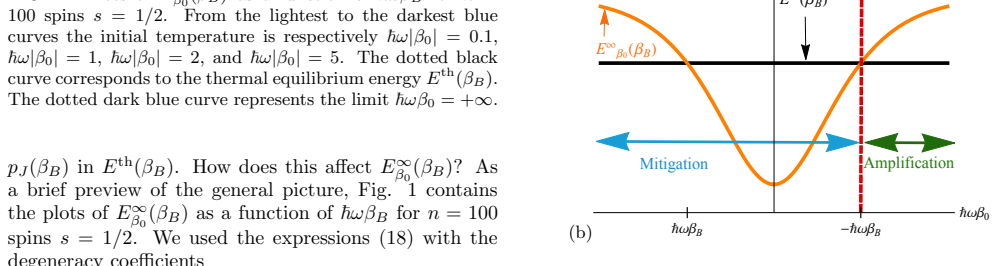
The paper's central claim is that an ensemble of $n$ spins of size $s$, initially thermal at inverse temperature $\beta_0$ and coupled collectively to a bath at $\beta_B$, does not relax to the global thermal state $\rho_{\rm th}(\beta_B)$. Instead it approaches the weighted mixture $\rho^\infty_{\beta_0}(\beta_B)=\sum_{J=J_0}^{ns} p_J(\beta_0)\sum_i \rho^{\,\rm th}_{J,i}(\beta_B)$ of thermal states of the total-spin sectors, with the weights $p_J(\beta_0)$ fixed by the initial temperature. This steady state is thermal only when $\beta_0=\pm\beta_B$. The paper shows that the resulting steady energy lies above or below the thermal energy according to whether $\beta_0/\beta_B>-1$ (mitigation) or $\beta_0/\beta_B<-1$ (amplification), that the entropy variation is always smaller than under independent dissipation, and that the free-energy variation and entropy production are reduced by up to a factor $1/n$.
Load-bearing premise
The argument assumes the collective Born-Markov master equation with the secular approximation describes the full dissipative dynamics until the ensemble reaches the steady state, and, in the cycle analysis, that stroke durations are the same for collective and independent dissipation so that work comparison is a power comparison.
Editorial extensions
If this is right
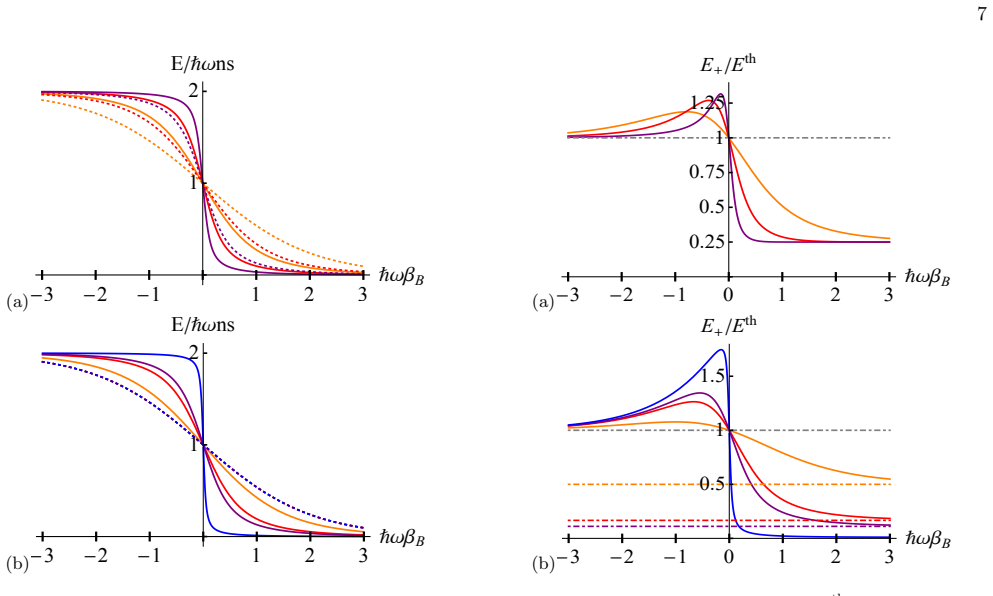
- When the ensemble starts much colder than a hot bath, collective coupling limits the final energy to roughly $1/n$ of the thermal energy it would reach under independent dissipation.
- Starting from an inverted population against a cold bath, the same collective effect amplifies the bath's cooling action, with final energy and entropy reduced by up to a factor $1/n$.
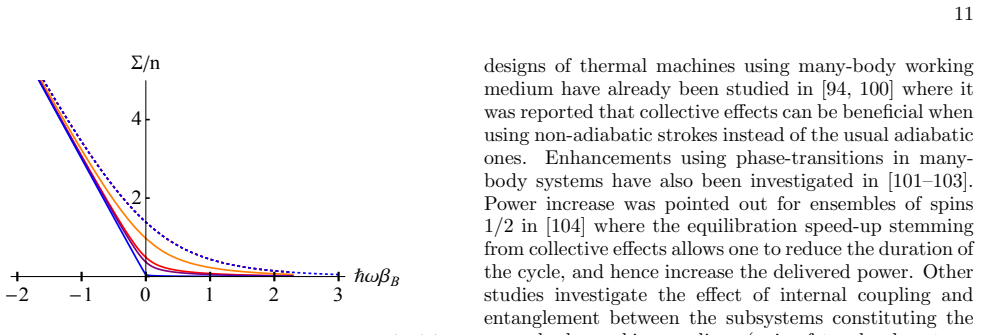
- Entropy production in the dissipative stroke is cut by up to a factor $1/n$, so large indistinguishable ensembles thermalize almost reversibly from an entropic standpoint.
- In a quantum Otto cycle whose working medium is collectively coupled to both baths, the two mitigations compound and extracted work can exceed the independent-spin value by up to $(ns+1)/(s+1)$ in the ideal limit.
- The steady-state energy saturates as $n$ grows instead of growing linearly, reproducing the saturation of excitation number seen in cavity experiments with Rydberg atoms.
Reading between the lines
- If each isochoric stroke is long enough to reach the steady state but short compared with inhomogeneity timescales, the Otto-cycle power gain here should stack with the known collective equilibration speed-up; that combination is not analyzed in the paper.
- The local spin temperature $\beta_{\rm Loc}\simeq \beta_B/n$ in the large-$|\beta_B|$ limit means a single spin inside the ensemble reads as much colder than the bath; measuring that local temperature would give a direct, spin-resolved test of the mitigation effect.
- Because the sector weights $p_J(\beta_0)$ are conserved, the initial temperature acts as a resource that the bath cannot erase; this hints at a catalytic interpretation of bath-induced coherences, but the paper does not develop that resource-theoretic framing.
Editorial analysis
A structured set of objections, weighed in public.
Referee Report
Summary. The paper considers n non-interacting spins of size s, initially in a thermal state at inverse temperature β0, interacting collectively with a bath at inverse temperature βB through a Dicke-type coupling. Using a secular Born-Markov master equation, the authors show that the steady state is a convex combination of thermal states in each total-spin sector, Eq. (16), which is generally non-thermal. They compare this steady state with the thermal state reached under independent dissipation and prove, for arbitrary n and s, inequalities governing the energy difference (mitigation for β0/βB > -1 and amplification for β0/βB < -1), a strict reduction in absolute entropy change, and a reduction in the free-energy variation and entropy production. The final part designs a quantum Otto cycle with collectively coupled baths and claims that the work extracted per cycle, and hence the power, can be enhanced by a factor up to (ns+1)/(s+1). Detailed analytical arguments are relegated to Appendices C-K.
Significance. The main steady-state results are a nontrivial generalization of the two-qubit results of [6] and are derived with unusual care: the appendices contain explicit proofs of the derivative signs, the free-energy inequality, and the stability analysis under weak perturbations. If accepted, the mitigation/amplification effects and the entropy-production reduction would have broad consequences for collective thermal machines, quantum batteries, and state protection, and the paper connects the saturation effect to a concrete cavity-QED experiment. The central weakness is the translation of the work-per-cycle calculation into a power-enhancement claim: Section VIII A models no stroke duration, while the collective dissipator relaxes different total-J sectors at very different rates, so the claimed power factor is not established.
major comments (2)
- [VIII A, Eqs. (49)-(52)] The paper's central application claim of 'large power enhancements' rests on Eqs. (49) and (50), which compare work extracted per cycle, not power. The text immediately after Eq. (49) equates 'work extracted per cycle, determining the power of the engine' with -W_coh, and Eq. (52) is quoted in the conclusion as a power-enhancement factor. Since the duration of an Otto cycle is not modeled, this is a work ratio. A work advantage per cycle can shrink or reverse when divided by the actual cycle time if the collective engine's strokes are not equally fast. To substantiate the power claim, the authors need either to state that identical stroke durations are assumed and justify that assumption, or to provide a finite-time model.
- [VIII A and Eq. (16)] The cycle analysis assumes the working medium reaches the steady state ρ∞β0(βB) of Eq. (16) at the end of each isochoric stroke. However, the collective dissipator (1) relaxes different total-J sectors at rates proportional to Γ(ω)(J∓m)(J±m+1) (see Eq. (A.1)), so low-J sectors can be orders of magnitude slower than the bright J=ns sector. For moderate |β0|, the initial thermal state has substantial weight in low-J sectors (the multiplicities lJ can be large, as in Eq. (21)), so a fixed stroke duration may not be sufficient to reach (16). A work advantage computed from the full steady states (49) is therefore not guaranteed to survive in a finite-time cycle; the authors' remark that equilibration speed-up is not included does not resolve this, because a fair power comparison requires modeling the time to reach the steady state under both collective and independent dissipation.
minor comments (3)
- [Appendix A, Eq. (A.2)] The expression e^{−ℏ(J+m)ℏωβB} contains an extra ℏ in the exponent and should read e^{−(J+m)ℏωβB}; the surrounding equalities show the intended relation.
- [V C] The comparison with the experiment in Ref. [70] is qualitative; please state explicitly that the model assumes a thermal initial state at β0 and that the agreement is a tendency, not a quantitative verification.
- [Abstract and Concluding Remarks] In light of the power-versus-work issue in Section VIII A, please rephrase the abstract and the final paragraph so that 'power enhancement' is not claimed without a finite-time model; the derived quantity is a work-per-cycle ratio.
Circularity Check
No significant circularity: the steady-state thermodynamics is derived from the collective master equation, and the authors' self-citations are interpretive rather than load-bearing.
full rationale
The central derivation is self-contained. The paper starts from the collective master equation (1) and uses the invariance of total-J eigenspaces (Sec. III) plus the per-sector steady solution of Appendix A to obtain Eq. (9). Combining this with the decomposition of an initial thermal state, Eq. (15), yields the central steady state Eq. (16). Energy, entropy, free-energy variation, and entropy production are then computed by direct algebra in Secs. V-VII and appendices C-F, with no fitted parameters and no external uniqueness theorem. The self-citations to the authors' earlier work ([6], [64]) are used for motivation, for the apparent-temperature interpretation in Appendix H, and for intuition about the local-state non-thermality; none of these citations enters the derivation of Eqs. (16)-(46). The work-per-cycle enhancement in Sec. VIII A is a genuine work comparison obtained from the derived energies, and the paper explicitly acknowledges that it did not model equilibration speed-up; the subsequent 'power enhancement' wording is a modeling extrapolation rather than a circular step. No prediction is equivalent by construction to its input, and no fitted parameter is renamed as a prediction. Therefore the appropriate circularity score is 0.
Assumptions & free parameters
assumptions (4)
- domain assumption Born, Markov, and secular approximations apply to the collective dissipative dynamics.
- domain assumption The bath cannot distinguish the n spins, so the interaction is collective (V = g J_x O_B).
- domain assumption The initial state of the ensemble is a thermal state at inverse temperature β0 with no coherences between different total-spin sectors.
- domain assumption Baths can have negative (or apparent negative) temperatures.
Cite this review
Pith. "Pith review of Thermodynamics from indistinguishability: mitigating and amplifying the effects of the bath." pith.science (2026). https://pith.science/paper/3JEQSNJ7
@misc{pith2026190810384,
  author       = {Pith},
  title        = {Pith review of: Thermodynamics from indistinguishability: mitigating and amplifying the effects of the bath},
  year         = {2026},
  howpublished = {\url{https://pith.science/paper/3JEQSNJ7}},
  note         = {Machine review of arXiv:1908.10384}
}
read the original abstract
Rich quantum effects emerge when several quantum systems are indistinguishable from the point of view of the bath they interact with. In particular, delocalised excitations corresponding to coherent superposition of excited states appear and change drastically the dynamics and steady state of the systems. Such phenomena, which are central mechanisms of superradiance, present interesting properties for thermodynamics and potentially other quantum technologies. Indeed, a recent paper [Phys. Rev. A 99, 052105 (2019)] studies these properties in a pair of indistinguishable two-level systems and points out surprising effects of mitigation and amplification of the bath's action on the energy and entropy of the pair. Here, we generalise the study to ensembles of arbitrary number of spins of arbitrary size (i.e. dimension). We confirm that the previously uncovered mitigation and amplification effects remain, but also that they become more and more pronounced with growing number of spins and growing spin size. Moreover, we find that the free energy variation and the entropy production associated with the bath-driven dissipation are systematically reduced, formalising the idea of mitigation of the bath's action. Most remarkably, the combination of mitigation effects from two baths at different temperatures can result in amplifying their action. This is illustrated with cyclic thermal machines, and leads to large power enhancements. The reduction of irreversibility is also an interesting aspect since irreversibility is known to limit the performance of thermodynamic tasks. The above findings might also lead to interesting applications in collective work extraction, quantum battery charging, state protection, light harvesting devices, quantum biology, but also for the study of entropy production. Moreover, some experimental realisations and observations suggest that such effects are within reach.
Figures

Figures from the paper (5 more)




Reference graph
Works this paper leans on
-
[6]
Thus, it is not obvious whether such phenomena have a classical analogue (see also discussion in the next Sec- tion VIII B)
for a pair of two-level systems and extended in Ap- pendixes H, I, and J for ensemble of n spins of size s. Thus, it is not obvious whether such phenomena have a classical analogue (see also discussion in the next Sec- tion VIII B). By contrast, the result from [13] stems from superradiance, which is a dynamical effect. Moreover, classical analogues of sup...
-
[1]
effective amplifica- tion
In other words the steady state ρ∞ β0(βB) is mostly made of the eigenstates {|J = ns,m⟩}−ns≤m≤ns, which are Dicke states [1, 2] (totally symmetric states). Such states contains only positive global coherences, or correlations. As shown in [64], positive correlations increase the apparent temperature of ensembles when the underlying diagonal state (in the ...
-
[2]
Gross and S
M. Gross and S. Haroche, Superradiance: An essay on the theory of collective spontaneous emission , Physics Reports (Review Section of Physics Letters) 93, 301- 396 (1982)
1982
-
[3]
In the present situation however such direct relation is much more complex to exhibit
it was possible to explicitly relates the steady state energy to the amount of bath-induced coherences in the local basis. In the present situation however such direct relation is much more complex to exhibit. Nevertheless, one can still pinpoint bath-induced coherences (between states of the local basis) as responsible for the dramatic alteration of the ...
-
[4]
Benatti, R
F. Benatti, R. Floreanini, and U. Marzolino, Entangling two unequal atoms through a common bath , Phys. Rev. A 81, 012105 (2010)
2010
-
[5]
Dicke, Coherence in Spontaneous Radiation Pro- cesses, Phys
RH. Dicke, Coherence in Spontaneous Radiation Pro- cesses, Phys. Rev. 93, 99 (1954)
1954
-
[7]
Benatti, R
F. Benatti, R. Floreanini, and M. Piani, Environment Induced Entanglement in Markovian Dissipative Dy- namics, Phys. Rev. Lett. 91, 070402 (2003)
2003
-
[8]
M. O. Scully, K. R. Chapin, K. E. Dorfman, M. B. Kim, and A. Svidzinsky, Quantum heat engine power can be increased by noise-induced coherence, Proc. Natl. Acad. Sci. 108, 15097 (2011)
2011
Show all 117 references
-
[9]
M. H. M. Passos, W. F. Balthazar, A. Z. Khoury, M. Hor-Meyll, L. Davidovich, and J. A. O. Huguenin, Ex- perimental investigation of environment-induced entan- glement using an all-optical setup , Phys. Rev. A 97, 022321 (2018)
2018
-
[10]
C. L. Latune, I. Sinayskiy, F. Petruccione,Energetic and entropic effects of bath-induced coherences , Phys. Rev. A 99, 052105 (2019)
2019
-
[11]
H. Wang, S. Liu, and J. He, Thermal entanglement in two-atom cavity QED and the entangled quantum Otto engine, Phys. Rev. E 79, 041113 (2009)
2009
-
[12]
C ¸ akmak, A
B. C ¸ akmak, A. Manatuly, and ¨O. E. M¨ ustecaplıoˇ glu, Thermal production, protection, and heat exchange of quantum coherences, Phys. Rev. A 96, 032117 (2017)
2017
-
[13]
working fluid
D. Gelbwaser-Klimovsky, W. Niedenzu, P. Brumer, and G. Kurizki, Power enhancement of heat engines via cor- related thermalization in a three-level “working fluid” , Sci. Rep. 5:14413 (2015)
2015
-
[14]
Uzdin, Coherence-Induced Reversibility and Collec- tive Operation of Quantum Heat Machines via Coher- ence Recycling, Phys
R. Uzdin, Coherence-Induced Reversibility and Collec- tive Operation of Quantum Heat Machines via Coher- ence Recycling, Phys. Rev. Applied 6, 024004 (2016)
2016
-
[15]
Mehta and R
V. Mehta and R. S. Johal, Quantum Otto engine with exchange coupling in the presence of level degeneracy , Phys. Rev. E 96, 032110 (2017)
2017
-
[16]
Watanabe, B.P
G. Watanabe, B.P. Venkatesh, P. Talkner, M.-J. Hwang, and A. del Campo, Quantum Statistical Enhancement of the Collective Performance of Multiple Bosonic En- gines, arXiv:1904.07811
1904 arXiv
-
[17]
Niedenzu and G
W. Niedenzu and G. Kurizki, Cooperative many-body enhancement of quantum thermal machine power , New J. Phys. 20, 113038 (2018)
2018
-
[18]
Holubec and T
V. Holubec and T. Novotn´ y,Effects of noise-induced co- herence on the performance of quantum absorption re- frigerators, J. Low Temp. Phys. 192, 147-198 (2018)
2018
-
[19]
Hewgill, A
A. Hewgill, A. Ferraro, and G. De Chiara, Quantum correlations and thermodynamic performances of two- qubit engines with local and common baths , Phys. Rev. A 98, 042102 (2018)
2018
-
[20]
K. E. Dorfman, D. V. Voronine, S. Mukamel, and M. O. Scully, Photosynthetic reaction center as a quantum heat engine, Proc. Natl. Acad. Sci. 110, 27462751 (2013)
2013
-
[21]
M. O. Scully, Quantum Photocell: Using Quantum Co- herence to Reduce Radiative Recombination and In- crease Efficiency, Phys. Rev. Lett. 104, 207701 (2010)
2010
-
[22]
A. A. Svidzinsky, K. E. Dorfman, M. O. Scully, En- hancing photovoltaic power by Fano-induced coherence , Phys. Rev. A 84, 053818 (2011)
2011
-
[23]
A. A. Svidzinsky, K. E. Dorfman, M. O. Scully, Enhanc- ing photocell power by noise-induced coherence , Coher- ent Optical Phenomena 1, 7-14 (2012)
2012
-
[24]
D. Xu, C. Wang, Y. Zhao and J. Cao, Polaron effects on the performance of light-harvesting systems: a quantum heat engine perspective, New J. Phys.18, 023003 (2016)
2016
-
[25]
Creatore, M
C. Creatore, M. A. Parker, S. Emmott, and A.W. Chin, Efficient Biologically Inspired Photocell Enhanced 25 by Delocalized Quantum States , Phys. Rev. Lett. 111, 253601 (2013)
2013
-
[26]
Romero, R
E. Romero, R. Augulis, V. I. Novoderezhkin, M. Fer- retti, J. Thieme, D. Zigmantas and R. van Grondelle, Quantum coherence in photosynthesis for efficient solar- energy conversion, Nature Phys. 10, 676-682 (2014)
2014
-
[27]
Killoran, S
N. Killoran, S. F. Huelga, and M. Plenio, Enhancing light-harvesting power with coherent vibrational interac- tions: A quantum heat engine picture , Journal of Chem- ical Physics 143, 155102 (2015)
2015
-
[28]
W. M. Brown and E. M. Gauger, Light-harvesting with guide-slide superabsorbing condensed-matter nanostruc- tures, arXiv:1803.08036
-
[29]
Su, C.-P
S.-H. Su, C.-P. Sun, S.-W. Li, J.-C. Chen, Photoelectric converters with quantum coherence , Phys. Rev. E 93, 052103 (2016)
2016
-
[30]
Chen, P.-Y
H.-B. Chen, P.-Y. Chiu, and Y.-N. Chen, , Vibration- induced coherence enhancement of the performance of a biological quantum heat engine, Phys. Rev. E94, 052101 (2016)
2016
-
[31]
Romero, V
E. Romero, V. I. Novoderezhkin and R. van Grondelle, Quantum design of photosynthesis for bio-inspired solar- energy conversion, Nature 543, 355-365 (2017)
2017
-
[32]
M. H. Lee, and A. Troisi, Vibronic enhancement of ex- citation energy transport: Interplay between local and non-local exciton-phonon interactions , J. Chem. Phys. 146, 075101 (2017)
2017
-
[33]
Rebentrost, M
P. Rebentrost, M. Mohseni, I. Kassal, S. Lloyd and A. Aspuru-Guzik, Environment-assisted quantum trans- port, New J. Phys. 11, 033003 (2009)
2009
-
[34]
Ishizaki, and G
A. Ishizaki, and G. R. Fleming, Unified treatment of quantum coherent and incoherent hopping dynamics in electronic energy transfer: Reduced hierarchy equation approach , J. Chem. Phys. 130, 234111 (2009)
2009
-
[35]
Lloyd, Journal of Physics: Conference Series Quan- tum coherence in biological systems, Journal of Physics: Conference Series 302, 012037 (2011)
S. Lloyd, Journal of Physics: Conference Series Quan- tum coherence in biological systems, Journal of Physics: Conference Series 302, 012037 (2011)
2011
-
[36]
S. F. Huelga and M. B. Plenio, Vibrations, quanta and biology, Contemporary Physics, 54, 181207 (2013)
2013
-
[37]
C. L. Latune, I. Sinayskiy, F. Petruccione, Heat flow reversals without reversing the arrow of time: The role of internal quantum coherences and correlations , Phys. Rev. Research 1, 033097 (2019)
2019
-
[38]
Collini, C
E. Collini, C. Y. Wong, K. E. Wilk, P. M. G. Curmi, P. Brumer, and G. D. Scholes, Coherently wired light- harvesting in photosynthetic marine algae at ambient temperature, Nature 463, 644-648 (2010)
2010
-
[39]
Lambert, Y.-N
N. Lambert, Y.-N. Chen, Y.-C. Cheng, C.-M. Li, G.- Y. Chen and F. Nori, Quantum Biology, Nat. Phys. 9, 10-18 (2013)
2013
-
[40]
Brandner, M
K. Brandner, M. Bauer, and U. Seifert, Universal Coherence-Induced Power Losses of Quantum Heat En- gines in Linear Response, Phys. Rev. Lett. 119, 170602 (2017)
2017
-
[41]
A.W. Chin J. Prior, R. Rosenbach, F. Caycedo-Soler, S. F. Huelga and M. B. Plenio, The role of non-equilibrium vibrational structures in electronic coherence and reco- herence in pigmentprotein complexes , Nature Phys. 9, 113-118 (2013)
2013
-
[42]
Krisnanda, C
T. Krisnanda, C. Marletto, V. Vedral, M. Paternostro, and T. Paterek, Probing quantum features of photosyn- thetic organisms, npj Quantum Inf. 4, 60 (2018)
2018
-
[43]
Juli` a-Farr´ e, T
S. Juli` a-Farr´ e, T. Salamon, A. Riera, M. N. Bera, and M. Lewenstein, Bounds on Capacity and Power of Quantum Batteries, arXiv:1811.04005
-
[44]
G. M. Andolina, M. Keck, A. Mari, M. Campisi, V. Giovannetti, and M. Polini, Extractable Work, the Role of Correlations, and Asymptotic Freedom in Quantum Batteries, Phys. Rev. Lett. 122, 047702 (2019)
2019
-
[45]
Uzdin, A
R. Uzdin, A. Levy, and R. Kosloff, Equivalence of Quan- tum Heat Machines, and Quantum-Thermodynamic Signatures, Phys. Rev. X 5, 031044 (2015)
2015
-
[46]
G. M. Andolina, M. Keck, A. Mari, V. Giovannetti, and M. Polini, Quantum versus classical many-body batter- ies, Phys. Rev. B 99, 205437 (2019)
2019
-
[47]
J. O. Gonz´ alez, J. P. Palao, D. Alonso, and L. A. Cor- rea, Classical simulation of quantum-coherent thermal machines, Phys. Rev. E 99, 062102 (2019)
2019
-
[48]
Herbert Spohn, J. Math. Phys. 19, 1227 (1978)
1978
-
[49]
K. V. Hovhannisyan, M. Perarnau-Llobet, M. Huber, and A. Ac´ ın,Entanglement Generation is Not Neces- sary for Optimal Work Extraction , Phys. Rev. Lett. 111, 240401 (2013)
2013
-
[50]
Kilgour and D
M. Kilgour and D. Segal, Coherence and decoherence in quantum absorption refrigerators , Phys. Rev. E 98, 012117 (2018)
2018
-
[51]
M. P. M¨ uller, Correlating Thermal Machines and the Second Law at the Nanoscale , Phys. Rev. X 8, 041051 (2018)
2018
-
[52]
J. M. R. Parrondo, C. Van den Broeck and R. Kawai, Entropy production and the arrow of time, New J. Phys. 11, 073008 (2009)
2009
-
[53]
Spohn and J
H. Spohn and J. L. Lebowitz, Adv. Chem. Phys 38, 109 (1978)
1978
-
[54]
Alicki, J
R. Alicki, J. Phys. A: Math. Gen. 12, (1979)
1979
-
[55]
F. G. S. L. Brand˜ ao, M. Horodecki, J. Oppenheim, J. M. Renes, and R. W. Spekkens, Resource Theory of Quantum States Out of Thermal Equilibrium , Phys. Rev. Lett. 111, 250404 (2013)
2013
-
[56]
J. P. Santos, L. C. C´ eleri, G. T. Landi and M. Paternos- tro, The role of quantum coherence in non-equilibrium entropy production , npj Quantum Information 5:23 (2019)
2019
-
[57]
Deffner and E
S. Deffner and E. Lutz, Nonequilibrium Entropy Pro- duction for Open Quantum Systems , Phys. Rev. Lett. 107, 140404 (2011)
2011
-
[58]
J. P. Santos, G. T. Landi, and M. Paternostro, Wigner Entropy Production Rate, Phys. Rev. Lett. 118, 220601 (2017)
2017
-
[59]
Brunelli, L
M. Brunelli, L. Fusco, R. Landig, W. Wieczorek, J. Hoelscher-Obermaier, G. Landi, F. L. Semi˜ ao, A. Fer- raro, N. Kiesel, T. Donner, G. De Chiara, and M. Pa- ternostro, Experimental Determination of Irreversible Entropy Production in out-of-Equilibrium Mesoscopic Quantum Syst...
2018
-
[60]
Pietzonka and U
P. Pietzonka and U. Seifert, Universal Trade-Off be- 26 tween Power, Efficiency, and Constancy in Steady-State Heat Engines, Phys. Rev. Lett. 120, 190602 (2018)
2018
-
[61]
A. C. Barato and U. Seifert, Thermodynamic Uncer- tainty Relation for Biomolecular Processes , Phys. Rev. Lett. 114, 158101 (2015)
2015
-
[62]
T. R. Gingrich, J. M. Horowitz, N. Perunov, and J. L. England, Dissipation Bounds All Steady-State Current Fluctuations, Phys. Rev. Lett. 116, 120601 (2016)
2016
-
[63]
Pietzonka, A
P. Pietzonka, A. C. Barato, and U. Seifert, Universal bounds on current fluctuations, Phys. Rev. E93, 052145 (2016)
2016
-
[64]
C. L. Latune, I. Sinayskiy, F. Petruccione, Apparent temperature: demystifying the relation between quantum coherence, correlations, and heat flows , Quantum Sci. Technol. 4, 025005 (2019)
2019
-
[65]
Guarnieri, G
G. Guarnieri, G. T. Landi, S. R. Clark, and J. Goold, Thermodynamics of precision in quantum non equilib- rium steady states , arXiv:1901.10428
1901 arXiv
-
[66]
A. M. Timpanaro, G. Guarnieri, J. Goold, and G. T. Landi, Thermodynamic uncertainty relations from ex- change fluctuation theorems, arXiv:1904.07574
1904 arXiv
-
[67]
S. Su, W. Shen, J. Du, and J. Chen, Thermody- namic coupling rule for far-from-equilibrium systems , arXiv:1904.04113
1904 arXiv
-
[68]
C. J. Wood and D. G. Cory, Cavity cooling to the ground state of an ensemble quantum system , Phys. Rev. A 93, 023414 (2016)
2016
-
[69]
Aberg, Catalytic Coherence, Phys
J. Aberg, Catalytic Coherence, Phys. Rev. Lett. 113, 150402 (2014)
2014
-
[70]
Ghosh, C
A. Ghosh, C. L. Latune, L. Davidovich, and G. Kurizki, Catalysis of heat-to-work conversion in quantum ma- chines, Proc. Natl. Acad. Sci. 114, 1215612161 (2017)
2017
-
[71]
C. J. Wood, T. W. Borneman, and D. G. Cory, Cavity Cooling of an Ensemble Spin System , Phys. Rev. Lett. 112, 050501 (2014)
2014
-
[72]
Barberena, R
D. Barberena, R. J. Lewis-Swan, J. K. Thompson, and A. Maria Rey, Phys. Rev. A 99, 053411 (2019)
2019
-
[73]
Y. Hama, W. J. Munro, and K. Nemoto, Relaxation to Negative Temperatures in Double Domain Systems , Phys. Rev. Lett. 120, 060403 (2018)
2018
-
[74]
J. M. Raimond, P. Goy, M. Gross, C. Fabre, and S. Haroche, Collective Absorption of Blackbody Radiation by Rydberg Atoms in a Cavity: An Experiment on Bose Statistics and Brownian Motion , Phys. Rev. Lett. 49, 117 (1982)
1982
-
[75]
R. G. DeVoe and R. G. Brewer, Phys. Rev. Lett. 76, 2049 (1996)
1996
-
[76]
Alicki and D
R. Alicki and D. Gelbwaser-Klimovsky, Non-equilibrium quantum heat machines , New J. Phys. 17, 115012 (2015)
2015
-
[77]
Breuer and F
H. Breuer and F. Petruccione, Theory of Open Quantum Systems, (Oxford, Oxford, 2002)
2002
-
[78]
Cohen-Tannoudji, J
C. Cohen-Tannoudji, J. Dupont-Roc, and G. Grynberg, Processus d’interaction entre photons et atomes , (EDP Science/CNRS ´Editions, Paris, 2001)
2001
-
[79]
Alicki, Comment on ”Nanoscale Heat Engine Beyond the Carnot Limit” , arXiv:1401.7865
R. Alicki, Comment on ”Nanoscale Heat Engine Beyond the Carnot Limit” , arXiv:1401.7865
-
[80]
C. L. Latune, I. Sinayskiy, F. Petruccione, Quantum coherence, many-body correlations, and non-thermal ef- fects for autonomous thermal machines , Scientific Re- ports 9:3191 (2018)
2018
-
[81]
R. J. de Assis, T. M. de Mendona, C. J. Villas-Boas, A. M. de Souza, R. S. Sarthour, I. S. Oliveira, N. G. de Almeida, Efficiency of a quantum Otto heat engine operating under a reservoir at effective negative temper- atures, Phys. Rev. Lett. 122, 240602 (2019)
2019
-
[82]
Kosloff, Quantum thermodynamics and open-systems modeling, J
R. Kosloff, Quantum thermodynamics and open-systems modeling, J. Chem. Phys. 150, 204105 (2019)
2019
-
[83]
Brunner, N
N. Brunner, N. Linden, S. Popescu, and P. Skrzypczyk, Virtual qubits, virtual temperatures, and the foundations of thermodynamics, Phys. Rev. E 85, 051117 (2012)
2012
-
[84]
Lu and O
Z. Lu and O. Raz, Nonequilibrium thermodynamics of the Markovian Mpemba effect and its inverse , Proc. Natl. Acad. Sci. 114, 5083 (2017)
2017
-
[85]
J. J. Sakurai, Modern Quantum Mechanics (Addison Wesley, Reading, MA, 1993)
1993
-
[86]
E. B. Mpemba and D. G. Osborne, Cool?, Phys. Educ. 4, 172 (1969)
1969
-
[87]
Lasanta, F
A. Lasanta, F. Vega Reyes, A. Prados, and A. Santos, When the Hotter Cools More Quickly: Mpemba Effect in Granular Fluids, Phys. Rev. Lett. 119, 148001 (2017)
2017
-
[88]
Campaioli, F
F. Campaioli, F. A. Pollock, F. C. Binder, L. C´ eleri, J. Goold, S. Vinjanampathy, and K. Modi, ] Enhancing the Charging Power of Quantum Batteries , Phys. Rev. Lett. 118, 150601 (2017)
2017
-
[89]
M. A. Nielsen and I. L. Chuang, Quantum Computation and Quantum Information (10th Anniversary Edition, Cambridge University Press, 2010)
2010
-
[90]
T. B. Batalh˜ ao, S. Gherardini, J. P. Santos, G. T. Landi, and M. Paternostro, Characterizing irreversibil- ity in open quantum systems , arXiv:1806.08441
-
[91]
Strasberg and M
P. Strasberg and M. Esposito, Non-Markovianity and negative entropy production rates , Phys. Rev. E 99, 012120 (2019)
2019
-
[92]
Alvarado Barrios, F
G. Alvarado Barrios, F. Albarr´ an-Arriagada, F. A. C´ ardenas-L´ opez, G. Romero, and J. C. Retamal,Role of quantum correlations in light-matter quantum heat engines, Phys. Rev. A 96, 052119 (2017)
2017
-
[93]
Ferraro, M
D. Ferraro, M. Campisi, G. M. Andolina, V. Pelle- grini, and M. Polini, High-Power Collective Charging of a Solid-State Quantum Battery , Phys. Rev. Lett. 120, 117702 (2018)
2018
-
[94]
Campaioli, F
F. Campaioli, F. A. Pollock, and S. Vinjanam- pathy, Quantum Batteries - Review Chapter , arXiv:1805.05507
-
[95]
Altintas, A
F. Altintas, A. ¨U. C. Hardal, and ¨O. E. M¨ ustecaplıoˇ glu, Quantum correlated heat engine with spin squeezing , Phys. Rev. E 90, 032102 (2014)
2014
-
[96]
Plastina, A
F. Plastina, A. Alecce, T. J. G. Apollaro, G. Falcone, G. Francica, F. Galve, N. Lo Gullo, and R. Zambrini, Irreversible Work and Inner Friction in Quantum Ther- modynamic Processes, Phys. Rev. Lett. 113, 260601 (2014)
2014
-
[97]
A. ¨U. C. Hardal, M. Paternostro, and ¨O. E. M¨ ustecaplıoˇ glu,Phase-space interference in extensive and nonextensive quantum heat engines , Phys. Rev. E 97, 042127 (2018)
2018
-
[98]
Gelbwaser-Klimovsky, W
D. Gelbwaser-Klimovsky, W. Kopylov, and G. Schaller, Cooperative efficiency boost for quantum heat engines , Phys. Rev. A 99, 022129 (2019)
2019
-
[99]
Feldmann and R
T. Feldmann and R. Kosloff, Quantum lubrication: Sup- pression of friction in a first-principles four-stroke heat engine, Phys. Rev. E 73, 025107 (2006)
2006
-
[100]
Jaramillo, M
J. Jaramillo, M. Beau, and A. del Campo. Quantum supremacy of many-particle thermal machines , New J. Phys. 18, 075019 (2016). 27
2016
-
[101]
Holubec and A
V. Holubec and A. Ryabov, Cycling Tames Power Fluc- tuations near Optimum Efficiency , Phys. Rev. Lett. 121, 120601 (2018)
2018
-
[102]
M. O. Scully, Quantum Afterburner: Improving the Ef- ficiency of an Ideal Heat Engine , Phys. Rev. Lett. 88, 050602 (2002)
2002
-
[103]
H. T. Quan, Y.-x. Liu, C. P. Sun, and F. Nori, Quantum thermodynamic cycles and quantum heat engines , Phys. Rev. E 76, 031105 (2007)
2007
-
[104]
M. Kloc, P. Cejnar, and G. Schaller, Collective performance of a finite-time quantum Otto cycle , arXiv:1905.08692
1905 arXiv
-
[105]
Campisi, R
M. Campisi, R. Fazio, The power of a critical heat en- gine, Nature Comm. 7:11895 (2016)
2016
-
[106]
Holubec, and A
V. Holubec, and A. Ryabov, Work and power fluctua- tions in a critical heat engine , Phys. Rev. E 96, 030102 (2017)
2017
-
[107]
Ma, S.-H
Y.-H. Ma, S.-H. Su, and C.-P. Sun, Quantum thermody- namic cycle with quantum phase transition , Phys. Rev. E 96, 022143 (2017)
2017
-
[108]
C. Sun, V. Y. Chernyak, A. Piryatinski, N. A. Sinitsyn, Cooperative Light Emission in the Presence of Strong Inhomogeneous Broadening, arXiv:1906.11412
1906 arXiv
-
[109]
Altintas, A
F. Altintas, A. ¨U. C. Hardal, and ¨O. E. M¨ ustecaplıoˇ glu, Rabi model as a quantum coherent heat engine: From quantum biology to superconducting circuits, Phys. Rev. A 91, 023816 (2015)
2015
-
[110]
main system
and recent extensions [111]. Furthermore, we also showed that the mitigation of the bath effects becomes stronger when the number of spins increases. Then, an other interesting application can be to maintain a spin ensemble (much) colder than the bath, essential in many fields l...
-
[111]
N. E. Nefedkin, E. S. Andrianov, A. A. Zyablovsky, A. A. Pukhov, A. V. Dorofeenko, A. P. Vinogradov, and A. A. Lisyansky, Superradiance of a subwavelength array of classical nonlinear emitters, Opt. Express 24, 3464-3478 (2016)
2016
-
[112]
Tsyplyatyev and D
O. Tsyplyatyev and D. Loss, Dynamics of the inhomo- geneous Dicke model for a single-boson mode coupled to a bath of nonidentical spin-1/2 systems , Phys. Rev. A 80, 023803 (2009)
2009
-
[113]
Coffey, and R
B. Coffey, and R. Friedberg, Effect of short-range Coulomb interaction on cooperative spontaneous emis- sion, Phys. Rev. A 17, 1033 (1977)
1977
-
[114]
P. O. Boykin, T. Mor, V. Roychowdhury, F. Vatan, and R. Vrijen, Algorithmic cooling and scalable nmr quantum computers, Proc. Ntl Ac. Sci., 99(6):33883393 (2002)
2002
-
[115]
´A. M. Alhambra, M. Lostaglio, and C. Perry, Heat-Bath Algorithmic Cooling with optimal thermalization strate- gies, Quantum 3, 188 (2019)
2019
-
[116]
Merkli, H
M. Merkli, H. Song, and G. P. Berman, J. Phys. A: Math. Theor. 48, 275304 (2015)
2015
-
[117]
R. P. Feynman, An Operator Calculus Having Applica- tions in Quantum Electrodynamics , Phys. Rev. 84, 108 (1951)
1951
Reviewed August 14, 2026 · model on record in the stance chip above.
Discussion (0). Continue with ORCID to comment.